R E S E A R C H
Open Access
Robust
H
∞
synchronization of chaotic
systems with input saturation and
time-varying delay
Yuechao Ma and Yanhui Jing
**Correspondence:
[email protected] College of Science, Yanshan University, 438 Hebeidajie Road, Haigang, Qinhuangdao, Hebei 066004, P.R. China
Abstract
This paper investigates drive-response robust synchronization of chaotic systems with disturbance, time-varying delay and input saturation via state feedback control. Sufficient conditions for achieving the synchronization of two chaotic systems are derived on the basis of the Lyapunov theory and the linear matrix inequality (LMI) technique, which is not only to guarantee the asymptotic synchronization but also to attenuate the effects of the perturbation on the overall error system to a prescribed level. Finally, an illustrative numerical simulation is also given to demonstrate the effectiveness of the proposed scheme.
Keywords: chaotic system; robust synchronization; saturation; time-varying delay
1 Introduction
In , Lorenz found the first chaotic attractor in a three-dimensional autonomous sys-tem when he studied the atmosphere convection []. Since then, more chaotic syssys-tems have been constructed, such as Chua’s circuit, logistic map, Chen system, and generalized Lorenz system (see [–]), and their complex behaviors have also been widely studied. Nowadays, there has been considerable interest in the control of chaos in nonlinear dy-namical systems, and many different techniques, such as OGY method [], PC technique [], backstepping approach [], adaptive control [], fuzzy control [], digital control [], state feedback control [], time-delay feedback control [], sampled driving signals [], and observer-based approach [], have been proposed to control chaos. Since the pioneering work by Pecora and Carroll [] who originally proposed the drive-response concept for achieving the synchronization of coupled chaotic systems, chaotic synchro-nization has received considerable attention due to its potential applications in physics, biology, and engineering and has become an important topic in control theory [, ].
However, all of these works and many others in the literature have focused on the study of chaotic synchronization between two chaotic systems without model uncertainties and external disturbance. In real physical systems, some noise or disturbance always exists, which may cause instability and poor performance. Therefore, how to reduce the effect of the noise or disturbance in synchronization process for chaotic systems has become an important issue, see [–]. On the other hand, there has been increasing interest in time-delay chaotic systems since the chaos phenomenon in time-delay systems was
first found by Mackey and Glass []. For chaotic systems with time-delay and distur-bance, several works have proposed the problem for various chaotic systems in the lit-erature [–]. In [], an adaptive control law was derived and applied to achieve the state lag-synchronization of two nonidentical time-delayed chaotic systems with unknown parameters. In [], an output coupling and feedback scheme were proposed to achieve the robust synchronization of noise-perturbed chaotic systems with multiple time-delays. An impulse control was proposed by Qian and Cao [] to synchronize two nonidentical chaotic systems with varying delay. Most of them are based on the fact that the time-delay is a constant, while, in real world applications, the time-time-delay is also varying over time. Hence the study of chaotic synchronization with time-varying delay is an important topic.
Besides, in a practical chaos system, there exist not only disturbance and varying-time delay but also the input saturation. Many literature works are based on the assumption that the actuator will not be saturated during the control process, but actuator will saturate due to its physical limitations in practice. Due to its high sensitivity to system parameters, the presence of saturation of control input may cause serious influence on system stability and performance. Hence, the derivation of controller with input saturation is an important problem. In [], an adaptive sliding mode control scheme for Lorenz chaos subject satu-rating input was presented. Rehan studied the synchronization and anti-synchronization of chaotic oscillators under input saturation via simple state feedback control in [], and the design of dynamic controller and static anti-windup compensator for Lipschitz nonlin-ear systems under input saturation was described in [] and []. However, most of them studied the normal chaotic system without time-delay and the inner uncertainty and the external disturbance. Motivated by the above discussion, in this paper we investigate the synchronization of chaotic systems with disturbance and varying time-delay under input saturation. Based on the Lyapunov stability theory, a robust controller is designed and its robustness and stability are analytically proved. Finally, we present a numerical simulation to demonstrate the feasibility and usefulness.
This paper is organized as follows. Section provides the system description. In Sec-tion , LMI-based condiSec-tions for chaotic synchronizaSec-tion are developed. In SecSec-tion , a numerical example is given to illustrate the main result. Finally, conclusion is made in Section .
Standard notation is used in this paper. For a matrixM, theith row is denoted byM(i). For a vectoru∈Rm,sat(u) =sign(u
(i))min(u¯(i),|u(i)|) represents the classical nonlinear
sat-uration function, whereu¯(i)> denotes theith bound on the saturation.
2 System description and preliminaries
Consider a class of uncertain chaotic systems with time-varying delay which is described by
dx
dt = (A+A)x(t) + (B+B)x
t–τ(t)+f(x), ()
where x∈Rn is the state vector. The vectorf(·)∈Rn is a continuous nonlinear vector
matrices with suitable dimensions.AandBare perturbation matrices representing parametric uncertainties and are assumed to be of the following form:
A=HF(t)E, B=HF(t)E, ()
whereH,H,E, andEare known real constant matrices with appropriate dimensions, F(t)∈Rn×nis an unknown real and possibly time-varying matrix satisfying
FT(t)F(t)≤I. ()
The uncertaintiesAandBare said to be admissible if both () and () hold. Eq. () is considered as the drive system and the controlled response system is given by the following differential Eq. ():
dy
dt= (A+A)y(t) + (B+B)y
t–τ(t)+f(y) +Csat(u) +w(t), ()
wherey(t)∈Rn,u∈Rmandw(t)∈Rnare the state, the input, and the external disturbance
vectors for the response system, respectively, and sat(u)∈Rm represents the saturated input.C∈Rn×mrepresents a constant matrix.
Define the synchronization error ase(t) = (x(t) –y(t))∈Rn. Subtracting the drive system
() from the response system () yields the dynamical system
de
dt = (A+A)e(t) + (B+B)e
t–τ(t)+f(x) –f(y) –Csat(u) –w(t). ()
This paper aims at designing the controller to not only asymptotically synchronize be-tween the drive and the response systems but also to guarantee a prescribed performance of the external perturbation attenuationγ.
Before presenting the main result, we introduce the following definition.
Definition[] For the synchronization error system (), it is said to have theH∞
syn-chronization with the external perturbation attenuationγ if the following conditions are satisfied:
(i) Withw(t) = , the dynamics error system () is asymptotically stable.
(ii) Given a desired positive scalarγ and under the zero-initial condition, the following performance index is satisfied:
J= ∞
eT(t)e(t) –γwT(t)w(t)dt≤. ()
For a positive definite diagonal matrixW∈Rm×m, the saturation nonlinearity satisfies
the classical global sector condition [] given by
φT(u)Wu–φ(u)≥, ()
saturation. However, if global results cannot be achieved, a more general sector condition can be utilized to design a local synchronization controller. Define the following associated set:
S(u¯) =v∈Rm; –u¯≤u–v≤ ¯u, ()
whereu¯∈Rmrepresents the bound on saturation. If () holds, the local sector condition
φT(u)Wv–φ(u)≥ ()
is satisfied.
In dealing with this study, the following assumptions and lemmas are necessary for the sake of convenience.
Assumption The time-delayτ(t) is a bounded and continuously differentiable function such that ≤τ(t)≤μand <τ˙(t)≤μ< .
Lemma [] Given any vector x,y of appropriate dimensions and a positive numberε, the following inequality holds:
xTy≤
εx
Tx+εyTy. ()
Lemma [] Let Sbe a regular n×n matrix,Scan be an n×q matrix,and Sis a regular matrix.Let a Hermitian matrix S be represented as S=SST S
S
.
Then the matrixSis positive definite if and only if the matricesSandS–STS–S are positive definite.
3 Chaotic synchronization
To synchronize the drive-response systems () and (), the following state feedback control law is considered:
u=Fe, ()
whereF∈Rm×n. By usingφ(u) =u–sat(u), () and (), the overall closed-loop system
becomes
de
dt = (A–CF+A)e(t) + (B+B)e
t–τ(t)+f(x) –f(y) +Cφ(u) –w(t). ()
Theorem Consider the drive-response systems()and()satisfying Assumptionand condition(a).Given a scalarγ > and a matrix Q=QT> ,if there exist a matrix X= XT> ∈Rn×n,a matrix R=RT> ∈Rn×n,a diagonal matrix U∈Rm×m,a matrix X
∈ Rm×n, a matrix X
∈Rm×n,and scalarsεi> (i= , , )satisfying the following linear
matrix inequalities(LMIS):
is H∞synchronized with the disturbance attenuation levelγ.
Proof Choose the following Lyapunov functional candidate:
V(t) =V(t) +V(t),
whereV(t) =eT(t)Pe(t),V(t) = –μ t
t–τ(t)eT(s)Re(s)ds,P=PT,R=RT.
First, evaluating the time derivative ofV(t) along the trajectory given in Eq. () gives
V(t) =˙eT(t)Pe(t) +eT(t)Pe˙(t)
By using Lemma and the Lipschitz condition, we have
eT(t)ATP+PAe(t)≤
Substituting Eqs. (), (), and () into Eq. () results in
+εeT further implies that the sector condition () is satisfied. By using (), we have
˙
By using Assumption , we have
˙ V(t)≤
–μe
T(t)Re(t) –eTt–τ(t)Ret–τ(t). ()
In order to obtain LMI (), we give a matrixQ=QTsuch that the following inequality
–wT(t)Pe(t) –eT(t)Pw(t)
Substituting () into () yields
Je(t),w(t)≤
From the above, if the following inequality holds:
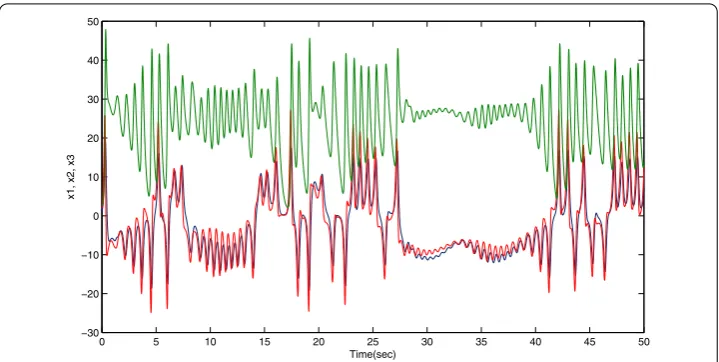
Figure 1 Chaotic behavior of the Lorenz system with time-delays.
obtained. Then integrating the function in () yields
V(∞) –V() + ∞
eT(t)e(t) –γwT(t)w(t)dt≤.
With the zero-initial condition, we have ∞
eT(t)e(t) –γwT(t)w(t)dt≤,
which completes the proof of Theorem .
4 Examples and simulation results
To demonstrate the validity of the proposed synchronization approach with input satura-tion and time-delays, we consider the Lorenz chaotic system with:
A=
Figure 2 Chaotic behavior of the Lorenz system with time-delays and disturbance.
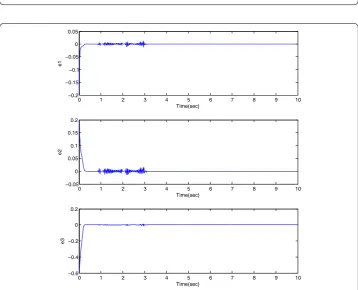
Figure 3 Synchronization error of the Lorenz system without the disturbancew(t).
By applying the conditions in Theorem withε=,ε=,ε=, and the disturbance attenuationγ = ., we can obtain the following matrices:
F= ⎡ ⎢ ⎣
. . . . . . . . .
⎤ ⎥
⎦, G= ⎡ ⎢ ⎣
. . . . . . . . .
⎤ ⎥ ⎦,
P= ⎡ ⎢ ⎣
. . . . . . . . . ⎤ ⎥
⎦, R= ⎡ ⎢ ⎣
. –. . –. . –.
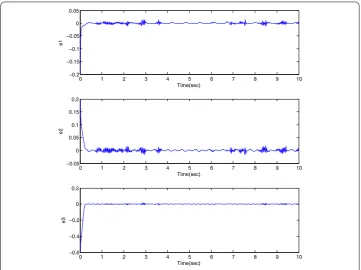
Figure 4 Synchronization error of the Lorenz system with the disturbancew(t).
Applying the controlleru=Fewithout the disturbance signal, the synchronization er-ror between the drive system and the response system with the initial conditions x= ( )T andy
= (. . .)T, respectively, is shown in Figure , which implies that the synchronization error converges to zero. Figure shows that the effect of the dis-turbancew(t) on the dynamic error system has been reduced within a prescribed level to
γ = . by the control gainF.
5 Conclusions
The problem of robustH∞synchronization for an uncertain chaotic system with
time-varying delay and input saturation has been presented. Based on the Lyapunov theory and the LMI technique, the sufficient condition has been derived not only to guarantee the asymptotic synchronization but also to ensure a prescribed perturbation attenuation per-formance. Finally, a simulation example is presented to verify the validity of the proposed method.
Competing interests
The authors declare that they have no competing interests.
Authors’ contributions
The authors have made the same contribution. All authors read and approved the final manuscript.
Acknowledgements
This paper is supported by the National Natural Science Foundation of China (No. 61273004). The authors also gratefully acknowledge the helpful comments and suggestions of the reviewers, which have improved the presentation.
Received: 9 December 2013 Accepted: 21 April 2014 Published:06 May 2014
References
2. Chen, GR, Ueta, T: Yet another chaotic attractor. Int. J. Bifurc. Chaos9, 1465 (1999)
3. Matsumoto, T, Chua, LO, Kobayashi, K: Hyperchaos: laboratory experiment and numerical confirmation. IEEE Trans. Circuits Syst.33, 1143 (1986)
4. Li, Y, Tang, SK, Chen, G: Generating hyperchaos via state feedback control. Int. J. Bifurc. Chaos15, 3367 (2005) 5. Yan, Z: Controlling hyperchaos in the new hyperchaotic Chen system. Appl. Math. Comput.168, 1239 (2005) 6. Rafikov, M, Balthazar, JM: On an optimal control design for system. Phys. Lett. A333, 241 (2004)
7. Ott, E, Grebogi, C, Yorke, JA: Controlling chaos. Phys. Rev. Lett.64, 1196 (1990) 8. Pecora, L, Carrol, T: Synchronization in chaotic systems. Phys. Rev. Lett.64, 821 (1990)
9. Wu, X, Lu, J: Parameter identification and backstepping control of uncertainLsystem. Chaos Solitons Fractals18, 721 (2003)
10. Liao, TL, Tsai, SH: Adaptive synchronization of chaotic systems and its application to secure communication. Chaos Solitons Fractals11, 1387 (2000)
11. Yau, HT, Chen, C: Chattering-free fuzzy sliding-mode control strategy for uncertain chaotic systems. Chaos Solitons Fractals30, 709 (2006)
12. Chen, GR, Lu, JH: Dynamical Analysis, Control and Synchronization of Lorenz Families. Science Press, Beijing (2003) (in Chinese)
13. Wu, X, Zhao, Y: Frequency domain criterion for chaos synchronization of Lur’s systems via linear state error feedback control. Int. J. Bifurc. Chaos15, 1445 (2006)
14. Cao, JD, Li, HX, Ho, DWC: Synchronization criteria of Lur’s systems with time-delay feedback control. Chaos Solitons Fractals23, 1285 (2005)
15. Juan Gonzalo, BR, Chen, G, Leang, SS: Fuzzy chaos synchronization via sampled driving signals. Int. J. Bifurc. Chaos14, 2721 (2004)
16. Liao, TL: Observer-based approach for controlling chaotic systems. Phys. Rev. E57, 1604 (1998)
17. Chen, G, Dong, X: From Chaos to Order: Methodologies, Perspectives and Applications. World Scientific, Singapore (1998)
18. Hendrik, R: Controlling chaotic systems with multiple strange attractors. Phys. Lett. A300, 182 (2002) 19. Sun, JT: Some global synchronization criteria for coupled delay-systems via unidirectional linear error feedback
approach. Chaos Solitons Fractals19, 789 (2004)
20. Aghababa, MP, Heydari, A: Chaos synchronization between two different chaotic systems with uncertainties, external disturbances,unknown parameters and input nonlinearities. Appl. Math. Model.36, 1639 (2012)
21. Jawaada, W, Noorani, MSM: Robust active sliding mode anti-synchronization of hyperchaotic systems with uncertainties and external disturbances. Nonlinear Anal., Real World Appl.13, 2403 (2012)
22. Wang, B, Shi, P, Karimi, HR, Song, Y, Wang, J: RobustH∞synchronization of a hyper-chaotic system with disturbance input. Nonlinear Anal., Real World Appl.14, 1487 (2013)
23. Mackey, M, Glass, L: Oscillation and chaos in physiological control systems. Science197, 287 (1977)
24. Pourdehi, S, Karimaghaee, P, Karimipour, D: Adaptive controller design for lag-synchronization of two non-identical time-delayed chaotic systems with unknown parameters. Phys. Lett. A375, 1769 (2011)
25. Cheng, CK, Kuo, HH, Hou, YY, Hwang, CC, Liao, TL: Robust chaos synchronization of noise-perturbed chaotic systems with multiple-time-delays. Phys. Lett. A387, 3093 (2008)
26. He, WL, Qian, F, Cao, JD, Han, QL: Impulsive synchronization of two nonidentical chaotic systems with time-varying delay. Phys. Lett. A375, 498 (2011)
27. Yau, HT, Chen, CL: Chaos control of Lorenz system using adaptive controller with input saturation. Chaos Solitons Fractals34, 1567 (2007)
28. Rehan, M: Synchronization and anti-synchronization of chaotic oscillators under input saturation. Appl. Math. Model.
37, 6829 (2013)
29. Rehan, M, Khan, AQ, Abid, M, Iqbal, N, Hussain, B: Anti-wind-based dynamic controller synthesis for nonlinear systems under input saturation. Appl. Math. Comput.220, 382 (2013)
30. Rehan, M, Hong, KS: Decoupled-architecture-based nonlinear anti-windup design for a class of nonlinear systems. Nonlinear Dyn.73, 1955 (2013)
31. Tarbouriech, S, Prieur, C: Stability analysis and stabilization of systems presenting nested saturations. IEEE Trans. Autom. Control51, 1364 (2006)
32. Boyd, S: Linear Matrix Inequalities in Systems and Control Theory. SIAM, Philadelphia (1994) 33. Horn, R, Johnson, C: Matrix Analysis. Cambridge University Press, Cambridge (1985)
10.1186/1687-1847-2014-124