R E S E A R C H
Open Access
On the stability of the Cartesian product of a
neural ring and an arbitrary neural network
Sergey Ivanov
1, Mikhail Kipnis
1*and Rigoberto Medina
2*Correspondence:
[email protected] 1Department of Mathematics,
Chelyabinsk State Pedagogical University, 69 Lenin Ave., Chelyabinsk, 454080, Russia Full list of author information is available at the end of the article
Abstract
The stability of a system of neural networks connected to a ring has been studied extensively throughout recent years. Our main contribution within this work states that the stability region in the parameter space of a discrete-time model can be extended by breaking such a ring provided that there is a sufficiently large number of networks. Also, it has been shown that for a small ring, paradoxical values may appear within its parameter space for which such a ring is stable; meanwhile, corresponding linear configuration is unstable.
MSC: 37B25
Keywords: stability; discrete-time model; ring of neural networks; Cartesian product of networks; the stability cone
1 Introduction
Many neural networks of artificial or natural origin, including the brain net, have a ring structure []. The stability of a ring neural network with delayed interactions has been studied in recent works such as [–]. In particular, [] examined the breaking of a ring neural network into a linear neural network which gives an extended stability region in the parameter space provided that there is a sufficiently large number of neurons at the ring neural network. In this paper, we take such an approach to address the related ques-tion dealing with a discrete-model of ring consisting of identical (maybe complicated) net-works. We characterize closely what happens with the stability of such rings after they are broken.
This paper is structured as follows. In Section , formal definitions of the Cartesian product of neural networks, ring and linear configuration of a network are stated. In Sec-tion , it is proven that by breaking a sufficiently large ring of neural networks, it does not lose its stability. Also an example of a small torus neural network,i.e.a ring consisting of small neural rings, is given. Hence, after two consecutive cut transformations, it yields a grid configuration. We show that there is a small region within the parameter space result-ing in loss of stability in the breakresult-ing of the rresult-ing neural network. Such parameter values will be called paradoxical.
2 The Cartesian product of neural networks
Neural networks have been described either by nonlinear equations [, ] or by linear nonhomogeneous equations as it is done in []. Nonetheless, local stability analysis of
steady states offers an interesting approach as we have chosen within this work. When linearized discrete-time neural networks models are considered, the state vectorxs:Z+→ Rnof a network at timesis governed by the following linear homogeneous equation (see [, , ]):
xs=γxs–m+Axs–k, s= , , . . . , ()
wherenis the number of neurons in the network,γ∈Ris a damping factor of neuron self-oscillations,m∈Z+is a delay in the damping process of neuron self-oscillations,k∈Z+
is a delay in the neuron interactions (k≥m). Entries of the matrixA∈Rn×nrepresent in-teraction forces amongndifferent neurons, thus that every entry at the principal diagonal ofAwill be zero. For everyj(≤j≤n), thejth component ofxsis the state of thejth neuron at the moments. The entryajvof the matrixAis the force of action from thevth neuron to thejth neuron. We proceed to give formal definitions to neural networks and the Cartesian product of networks as follows.
Definition A neural network is an ordered -tupleA= (γ,k,m,n,A), whereγ ∈R,
k,m∈Z+ (k≥m),A∈Rn×n. We call () the defining equation of the networkA. We say that two neural networks are compatible if and only if they have the sameγ,k,m. Given two compatibles networksA= (γ,k,m,r,A) andA= (γ,k,m,n,A), we define their Cartesian product as the neural networkAA= (γ,k,m,rn,A⊕A), where the Kronecker sum operation⊕is defined as follows:A⊕A=In⊗A+A⊗Ir, having⊗ as the Kronecker product operation, andIn,Ir stand for the unit matrices of ordersn,r, respectively.
These definitions do not contradict those given in [, ]. We also notice that the square block matrixA⊕Aof orderrnhas the form
A⊕A= ⎛ ⎜ ⎜ ⎜ ⎜ ⎝
A aIr · · · anIr
aIr A · · · anIr ..
. ... . .. ...
anIr anIr · · · A ⎞ ⎟ ⎟ ⎟ ⎟ ⎠,
whereajv(≤j,v≤n) are entries ofA.
It is not hard to see that for any given neural networkA= (γ,k,m,n,A), its matrixAcan be seen as a weighted directed graph (V;E) with a set of verticesV={, , . . . ,n}and a set of directed edgesEdefined as follows: if an entryajvofAis nonzero, then (j,v)∈Eand weighted byajv. Such a graph does not depend onγ,k,m.
For any given pairA,Bof compatible networks, their Cartesian productsABand
BAare isomorphic in the sense that one defining equation can be obtained from an-other by a straightforward permutation ofxscomponents.
Figure 1 Links in the networksC3(a,b),L2(c,d) andC3(a,b)L2(c,d).
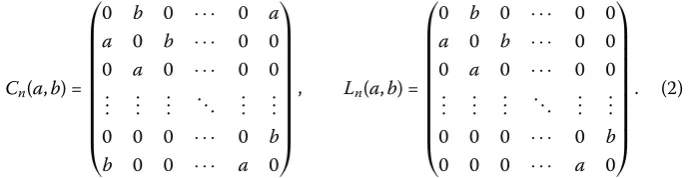
Example LetCn(a,b) be ann×ncirculant matrix forn> , and letLn(a,b) be a tridi-agonal matrix forn> :
Cn(a,b) = linear neural networks, respectively, wherebis the strength of the connection between a neuron to its counterclockwise neighbor neuron,ais the strength of their opposite direc-tion connecdirec-tion (Figure ). We point out thatCn(a,b) has a connection between its first and last neuron, meanwhileLn(a,b) has no connection between them.
It follows thatC(a,b)L(c,d) has the defining equation () with
We state the following key property of the Kronecker sum.
Theorem (see [–]) Ifλj(≤j≤r)is a full list of eigenvalues of an r×r matrix A
andμv(≤v≤n)is the corresponding list for an n×n matrix A,then the eigenvalues of
A⊕Aare given byλj+μv(≤j≤r, ≤v≤n).
3 The stability of a ring of neural networks
Figure 2 The ring of neural networks and a result of its break: the networksAC3(a,b) and
AL3(a,b).
definitions along these lines. Givenρis a positive real number, we say that equation () isρ -stable (ρ-asymptotically stable) if and only if the sequence|xs|/ρsis bounded (the sequence |xs|/ρstends to zero ass→ ∞). Equations that are notρ-stable (asymptoticallyρ-stable) will be calledρ-unstable (asymptoticallyρ-unstable). We should notice that whenρ= , (asymptotic)ρ-stability is equivalent to the usual Lyapunov notion of (asymptotic) stabil-ity. Furthermore, stability cones [, ] for stability analysis of () will be extensively used in our analysis. Stability cones for stability analysis of differential delayed matrix equations were introduced in [].
It is a plausible step to take the compatible networkLn(a,b) as the breaking of the net-workCn(a,b). Now, let us considerAto be an arbitrary neural network, then it follows that the networkALn(a,b) is the compatible breaking of the ringACn(a,b) (Figure ) in the sense that it is the resulting neural network after the breaking of all links between the first and the last copy ofAat the latter network. The stability of those neural networks involved along this process will be addressed in the following theorem.
Theorem LetA= (γ,k,m,r,A),Cn(a,b)andLn(a,b)be compatible neural networks,
obeying the condition a+b= , then for everyρ> ,there exists nsuch that for all
n>n,ifACn(a,b)isρ-stable,thenALn(a,b)is asymptoticallyρ-stable.
Proof LetA= (γ,k,m,r,A) be a neural network andλ, . . . ,λrbe the list of eigenvalues ofA. We assume the conditiona+b= and thatk,m,γ,ρ> are fixed. It was shown in [–] that the set of values (a+b)cosπnv+i(a–b)sinπnvare the eigenvalues ofCn(a,b); in a similar fashion, the set of values √abcosn+πv, ≤v≤n, are the eigenvalues ofLn. By applying Theorem and related stability analysis results from [] over the neural net-worksACn(a,b) andALn(a,b), we construct two sets of points as follows. Firstly, the setMjv= (ujv,ujv,ujv) (≤j≤r, ≤v≤n) obeying
ujv+iujv=λj+
(a+b)cosπv
n +i(a–b)sin
πv
n exp
–ik
margγ ,
ujv=|γ|.
()
Secondly, the set of pointsPjv= (ujv,ujv,ujv) (≤j≤r, ≤v≤n) obeying
ujv+iujv=λj+ √
abcos πv n+ exp
–ik
margγ , u
jv=|γ|. ()
We proceed with such a construction by an exhaustive case analysis overaandb. CASE :a≥,b≥. Let us construct for everyj(≤j≤r) pointsM
j = (uj,uj,uj) andM
j = (uj,uj,uj) so that
uj+iuj=λj+ (a+b)exp
–ik
margγ , u
uj+iuj=λj– (a+b)exp
–ik
margγ , u
j=|γ|. ()
CASE .: There existsj(≤j≤r) such thatM
j lies outside theρ-stability cone for the given values ofk,m. Then the point Mjn (see ()) lies outside theρ-stability cone, therefore the networkACn(a,b) isρ-unstable for everyn≥. So we can putn= in the conclusion of the theorem.
CASE .: There existsj(≤j≤r) such thatM
j lies outside theρ-stability cone. Let us use the fact that [n/]/napproaches / whenn→ ∞, [z] being the integral part ofz. We conclude from () that there exists annsuch that for everyn>n, the pointMj[n/] lies outside theρ-stability cone. Therefore the networkACn(a,b) isρ-unstable for every
n>n.
CASE .: For allj(≤j≤r), bothMj andMj lie inside theρ-stability cone or on its boundary. Since √ab<a+b(recall thata+b= ), all the pointsP
jv(see ()) lie inside the line segment with the endpointsM
j,Mj (see (), ()). But the section of theρ-stability cone at the levelu=|γ|has the property of being convex, hence all the pointsPjv(≤j≤
r, ≤v≤n) lie inside theρ-stability cone. Therefore the neural networkALn(a,b) is asymptoticallyρ-stable. This enables one to putn= in the conclusion of the theorem.
CASE :a≤,b≤. This case is similar to CASE .
CASE :a> ,b< . For everyj(≤j≤r), let us construct pointsMj= (uj,uj,uj) and
M
j = (uj,uj,uj) such that
uj+iuj=λj+i(a–b)exp
–ik
margγ , u
jv=|γ|, ()
uj+iuj=λj–i(a–b)exp
–ik
margγ , u
jv=|γ|. ()
CASE .: There existsj(≤j≤r) such thatM
j lies outside theρ-stability cone. Ifn→ ∞, then [n/]/n→/. Hence by () there existsnsuch that for everyn>n, the point
Mj[n/]lies outside theρ-stability cone. Therefore the networkACn(a,b) isρ-unstable for everyn>n.
CASE .: There existsj(≤j≤r) such thatM
j lies outside theρ-stability cone. This case is similar to CASE ., the only difference being in using [n/]/n→/ instead of [n/]/n→/.
CASE .: For allj(≤j≤r), bothM
j andMj lie inside theρ-stability cone or on its boundary. This case is similar to CASE ., the only difference being in using √|ab|<a–b
instead of √ab<a+b.
CASE :a< ,b> . This case is similar to CASE . Hence, our proof is completed.
Considering the semigroup structure of all neural networks forγ,k,mfixed, it is not hard to see that the neural networkE= (γ,k,m, , ) its identity element, the fact which entails that such a structure is really a commutative monoid. By replacingAbyEin The-orem , we obtain an interesting consequence.
Theorem LetCn(a,b)andLn(a,b)be compatible neural networks,obeying that a+b= ,then for everyρ> ,there exists nsuch that for all n>nifCn(a,b)isρ-stable,then
Figure 3 The boundaries of stability domains inab-plane of the networksC3(a,b)C5(a,b) (black),
L3(a,b)C5(a,b) (blue),C3(a,b)L5(a,b) (green),L3(a,b)L5(a,b) (violet).The parameters
(γ,k,m,ρ) = (0.4, 2, 1, 1). The origin is inside all the stability domains. The areas of paradoxical points for transformations 1, 2, 3, 4 (see()) are painted red.
A similar result to this corollary for a continuous-time neural network model was shown in []. We do remark that our main Theorem states that in the casea+b= , the break-ing of large rbreak-ing neural networks extends the asymptotic stability domain in the parameter space providing a sufficiently large size. The latter is crucial to it, in fact it is no longer true when the number of networks in such a ring is not large enough. We will state adequate definitions and an example to support this issue.
Definition LetA,Cn(a,b) andLn(a,b) be pairwise compatible neural networks. Con-sider (a,b) to be a point in theab-plane; we call it paradoxical for both transformations
ACn(a,b)→ALn(a,b) andCn(a,b)A→Ln(a,b)A, if the networkACn(a,b) is asymptotically stable, andALn(a,b) is unstable.
Example By consideringC(a,b)C(a,b) be a toroidal neural network, significant changes in the stability domains can be shown afterC(a,b) andC(a,b) are broken ac-cording to the following diagram
C(a,b)C(a,b)
––––––→ L(a,b)C(a,b)
⏐⏐ ⏐⏐
C(a,b)L(a,b)
––––––→ L(a,b)L(a,b).
()
Now, by using the stability cones methods from [, , ], stability domains can be found for those networks involved in the previous diagram. It is not hard to see how in all four operations denoted by arrows in (), the stability domains are significantly increased. Nevertheless, Figure shows in detail how these operations create paradoxical points, for which the system loses stability after the ring has been broken.
4 Conclusion
continuous-time model of neural ring networks was performed. Consequently, natural directions for future research are the analysis of these phenomena in our discrete-time model of neural networks. Moreover, in the future, we intend to examine relevant issues in neural networks with distributed delays.
Competing interests
The authors declare that they have no competing interests.
Authors’ contributions
All authors contributed equally to the manuscript and typed, read, and approved the final manuscript.
Author details
1Department of Mathematics, Chelyabinsk State Pedagogical University, 69 Lenin Ave., Chelyabinsk, 454080, Russia. 2Departamento de Ciencias Exactas, Universidad de Los Lagos, Casilla 933, Osorno, Chile.
Acknowledgements
This work was supported by grants from the Ministry of Education of Russia, Chelyabinsk State Pedagogical University, Russia, and by the grant from Fondecyt No. 1130112, Chile.
Received: 23 March 2014 Accepted: 6 June 2014 Published:18 Jul 2014
References
1. Vishwanathan, A, Bi, GQ, Zeringue, HC: Ring-shaped neuronal networks: a platform to study persistent activity. Lab Chip11(6), 1081-1088 (2011). doi:10.1039/c0lc00450b
2. Kaslik, E: Dynamics of a discrete-time bidirectional ring of neurons with delay. In: Proceedings of Int. Joint Conf. on Neural Networks, Atlanta, Georgia, USA, 14-19 June 2009, pp. 1539-1546. IEEE Comput. Soc., Los Alamitos (2009) 3. Kaslik, E, Balint, S: Complex and chaotic dynamics in a discrete-time delayed Hopfield neural network with ring
architecture. Neural Netw.22(10), 1411-1418 (2009)
4. Yuan, Y, Campbell, SA: Stability and synchronization of a ring of identical cells with delayed coupling. J. Dyn. Differ. Equ.16, 709-744 (2004)
5. Khokhlova, TN, Kipnis, MM: The breaking of a delayed ring neural network contributes to stability: the rule and exceptions. Neural Netw.48, 148-152 (2013)
6. Kaslik, E, Balint, S: Bifurcation analysis for a two-dimensional delayed discrete-time Hopfield neural network. Chaos Solitons Fractals34, 1245-1253 (2007)
7. Idels, L, Kipnis, M: Stability criteria for a nonlinear nonautonomous system with delays. Appl. Math. Model.33(5), 2293-2297 (2009)
8. Arbib, M (ed.): The Handbook of Brain Theory and Neural Networks, 2nd edn. MIT Press, Cambridge (2002) 9. Ivanov, SA, Kipnis, MM: Stability analysis of discrete-time neural networks with delayed interactions: torus, ring, grid,
line. Int. J. Pure Appl. Math.78(5), 691-709 (2012)
10. Imrich, W, Klavžar, S, Rall, DF: Graphs and Their Cartesian Products. AK Peters, Wellesley (2008)
11. Brualdi, RA, Cvetkovi´c, DM: A Combinatorial Approach to Matrix Theory and Its Applications. CRC Press, Boca Raton (2008)
12. Horn, RA, Johnson, CR: Topics in Matrix Analysis. Cambridge University Press, Cambridge (1994) 13. Brouwer, AE, Haemers, WH: Spectra of Graphs. Springer, Berlin (2011)
14. Cvetkovi´c, DM, Doob, M, Sachs, H: Spectra of Graphs - Theory and Applications, 3rd edn. Wiley, New York (1998) 15. Chestnov, VN: SynthesisH∞-controllers for multidimensional systems with given accuracy and degree of stability.
Autom. Remote Control72(10), 2161-2175 (2011)
16. Gryazina, EN, Polyak, BT: Stability regions in the parameter space:D-decomposition revisited. Automatica42(1), 13-26 (2006)
17. Kipnis, MM, Malygina, VV: The stability cone for a matrix delay difference equation. Int. J. Math. Math. Sci.2011, Article ID 860326 (2011)
18. Ivanov, SA, Kipnis, MM, Malygina, VV: The stability cone for a difference matrix equation with two delays. ISRN Appl. Math.2011, Article ID 910936 (2011)
19. Khokhlova, TN, Kipnis, MM, Malygina, VV: Stability cone for linear delay differential matrix equation. Appl. Math. Lett.
24, 742-745 (2011)
10.1186/1687-1847-2014-176