ETHICAL GUIDELINES AND STUDY DESIGN FOR BIOAVAILABILITY AND BIOEQUIVALENCE
STUDY
RANJIT PRASAD SWAIN*, SHILPA P, SATYAJIT PANDA
Department of Pharmaceutical Technology, Maharajah’s College of Pharmacy, Vizianagaram - 535 002, Andhra Pradesh, India. Email: [email protected]
Received: 06 August 2015, Revised and Accepted: 09 September 2015 ABSTRACT
Unusual growth in pharma industry has provoked regulatory agencies to establish regulations regarding bioavailability (BA) and bioequivalence (BE) studies. The BA and BE testing are essential in drug development process, provides the information regarding the kinetics (area under the curve [AUC], Cmax, Tmax, λz, t½, AUC0→Tss, Cmaxss, Cminss, Cavgss, Tmaxss) of single and multiple dose studies and the comparison of medicinal products. Indian Council of Medical Research (ICMR), Committee for the Purpose of Control and Supervision of Experiments on Animals (CPCSEA), Indian National Science Academy (INSA), Institutional Animal Care and Use Committee Guidebook (IACUC), National Institutes of Health, Food and Drug Administration, World Health Organization (WHO) provides the informations for strengthening the ethical guidelines for using humans and animals in clinical trials globally. Experimental design will help for better selection of models, number of subjects/animals, study conditions, randomizations, selection of control groups. Statistical evaluation parameters like Analysis of Variance help for the better interpretation of the data. The present study was aimed to study the need for BA and BE studies, ethical guidelines, experimental designs, pharmacokinetic endpoints, and their statistical evaluations. Keywords: Ethical guidelines, Study design, Bioavailability, Bioequivalence.
INTRODUCTION
Bioavailability (BA) and bioequivalence (BE) testing are essential in the drug development process because they create the foundation for regulatory decision making when evaluating formulation changes and lot-to-lot consistency in innovator products. They also serve as the primary components to demonstrate therapeutic equivalence between generic products and the reference innovator product [1]. The increasing number of drugs that can be obtained from different manufacturers and the phenomenal growth of the generic pharmaceutical industry have prompted regulatory agencies such as Food and Drug Administration (FDA) to establish BA and BE regulations put into effect in January 1977 [2]. BA studies are performed for both approved active drug ingredients [3,4] and therapeutic moieties not yet approved for marketing by the FDA. New formulations of active drug ingredients must be approved by the FDA before marketing [5]. In approving a drug product for marketing, the FDA ensures that the drug product is safe and effective for its labeled indications for use. Moreover, the drug product must meet all applicable standards of identity, strength, quality, and purity [6]. To ensure that these standards are met, the FDA requires BA/pharmacokinetic studies and, where necessary, BE studies for all drug products. For new drugs not fully approved for marketing, regulatory agencies require that in vivo BA studies should be performed on the dosage form proposed for marketing [7,8]. In vivo BA studies are also performed for new formulations of active drug ingredients or therapeutic moieties that have full NDA approval and are approved for marketing.
NEED FOR BA AND BE STUDIES
BA studies provides information regarding the pharmacokinetics of the new formulation, new dosage form such as fraction of drug absorbed, linearity, and non-linearity in the pharmacokinetics of the drug and the dose proportionality, performance of the formulation [9]. It helps to establish dosage regimen.
BE studies are performed for the comparison of two medicinal products containing the same active substance, two products marketed by different licenses containing the same active ingredients or for alternate therapy [10]. The post approval changes that include a change
in the supplier of the active ingredient, a change in the formulation or a change in the manufacturing site, the manufacturer must assure that drug product performance did not change and is same for the change by conducting BE studies. The drug product performance may be determined in vivo by BE studies or in vitro by comparative drug release or dissolution profiles, the schematic flow is illustrated in Fig. 1. Comparative drug product performance is important in the development of generic drug product is shown in the Fig. 2.
ETHICAL GUIDELINES IN CLINICAL TRAILS
Ethics in clinical research focuses largely on identifying and implementing the acceptable conditions for exposure of some individuals to risks and burdens for the benefit of the society at large [11,12]. In 1964, the World Medical Association Declaration of Helsinki underscored 12 basic principles for the conduct of human biomedical research shown in Fig. 3 [13]. In India the ICMR, in February 1980, released a “Policy Statement on Ethical Considerations involved in Research on Human Subjects.” In 1970s and 1980s, researchers at the Institute for Cytology and Preventive Oncology in New Delhi carried out a study on different stages of cervical dysplasia or precancerous lesions of the cervix [14]. These patients were left untreated and by the end of the study 71 women had developed malignancies and lesions in nine
of them had progressed to invasive cancer. After the controversy about the study became public in 1997, the ICMR started developing “Ethical Guidelines for Biomedical Research on Human Subjects” and finalized them in the year 2000. Although not a law, these guidelines have been put into force through Schedule Y.
In the technical committee of CDSCO second meeting headed by drug controller general deciding that Institutional Ethics Committee would review and approve protocol of any clinical trial. Further, apex committee recommending that the present practice of review and approval of BA/BE study protocols by Independent Ethics Committees should be discontinued. Later the committee decided that Independent Ethics Committee should be allowed to review and approve only protocols for BA/BE studies of approved drug molecules [15]. Institutional Ethics Committee Registration is approved by CDSCO as per newly introduced rule 122D. Requirements for registration of Institutional Ethics Committee is as per the provisions mentioned under appendix VII of schedule Y.
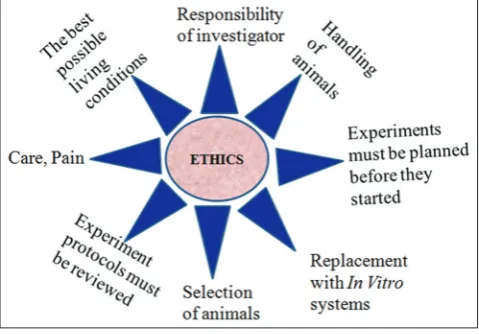
CPCSEA [16], INSA [17], Institutional Animal Care and Use Committee Guidebook (IACUC) [18] provides information for laboratory animal facility and general principles in animal research illustrated in Fig. 4.
FDA provides information regarding protection of human subjects (21CFR50) [19], standards for institutional review boards for clinical trials (21CFR16 and 56) [20], guidance for industry product development under the animal rule [21], approval for new drugs when human efficacy studies are not ethical or feasible (21CFR314) [22]. World Health Organization provides information for international ethical guidelines for biomedical research involving human subjects [23].
IMPORTANT STEPS IN CONDUCTING EXPERIMENTAL DESIGNS (IN CASE OF ANIMALS)
Selection of animal models [24-27] Spontaneous models
Spontaneous animal models are those that exist in the nature with similarity to humancondition or disease. For example occurrence of natural killer cells in rats is good example.
Experimental models
Experimental models are those that need to be created to attend the conditions we desired to be tested. Surgical models are examples of experimental or induced models.
Genetically modified models
Molecular biology has permitted modifying the animal genome to attain the aims of some studies. Genetically, modified models are therefore created for that reason. Introduction of an alien DNA and the knock-out models are good examples of these animal models.
Negative models
Negative models thus include animals that exhibit a lack of reactivity to a particular stimulus. Their main application is in studies on the mechanism of resistance that seek to gain close into its physiological basis. Why dogs do not develop arteriosclerosis is one of this questions that may be answered by a negative model.
Orphan models
Contrarily, an orphan model is used to investigate either a condition or disease that occurs in some species but not in humans. It may be important to identify diseases that may affect humans in the next future. The mad-cow disease is an example.
Number of animals to be selected [28,29]
Power analysis is most common used. The formulae are complex however statistical packages offer power analysis of which mostly used are SAS, SPSS, Epi-6, statistical. Calculations can be easily done
by several online internet sites like http//:www.biomath.info; http// www.stat.iowa.edu/~rlenth/Power//index. The number of animals that can be grouped in standard cages is a practical consideration for determining experimental group size.
Randomization [30,31]
Allocation of animals to different groups should be at random. Randomization avoids bias and guarantee that groups have same probability to receive treatment. Some of the methods are dices, envelopes containing pieces of papers with codes.
Control groups [32] Positive controls
In positive control groups, changes are expected. The positive control acts as a standard against which to measure difference in severity between experimental groups. An example of a positive control is a toxin administered to an animal, which results in reproducible physiological changes or lesions.
Fig. 2: Drug product performance and generic drug product development
Fig. 3: Ethical guidelines for using humans in clinical trials
Negative controls
Negative controls are expected to produce no change from the normal state. In the example above, the negative control would consist of animals not treated with the toxin. The purpose of the negative control is to ensure that an unknown variable is not adversely affecting the animals in the experiment, which might result in a false-positive conclusion.
Sham controls
A sham control is used to mimic a procedure or treatment without the actual use of the procedure or test substance. A placebo is an example of a sham control used in pharmaceutical studies.
Vehicle controls
A vehicle control is used in studies in which a substance for example saline or mineral oil is used as a vehicle for a solution of the experimental compound. In a vehicle control innocuous substance is used alone, administered in the same manner, in which it will be used with the experimental compound. When compared with the untreated control, the vehicle control will determine whether the vehicle alone causes any effects.
Comparative control
A comparative control is often a positive control with a known treatment that is used for a direct comparison to a different treatment. For example, when evaluating a new chemo preventive drug regime in an animal model of cancer, one would want to compare this regime to the chemo preventive drug regime currently considered “accepted practice” to determine whether the new regime improves cancer prevention in that model.
IMPORTANT STEPS IN CONDUCTING EXPERIMENTAL DESIGNS (IN CASE OF HUMAN BEINGS)
Healthy subject versus patients
Healthy subjects are preferred over patients. Practical advantages associated with enrolling healthy subjects include simpler inclusion and exclusion criteria, easier recruitment, homogenous population characteristics and less use of concomitant medications. In addition, healthy volunteers are also generally more amenable to intensive pharmacokinetic sampling schedules. A major statistical argument in favor of using healthy subjects in BE testing is that the effects of formulation factors can be readily evaluated rather than the effects of inter-or-intra subject factors that are known to affect the drug absorption, disposition or both [33].
Selection of subjects
Healthy volunteers should be used in BA studies. Healthiness is ascertained by vital signs such as temperature, pulse, respiration, blood pressure, and laboratory tests on blood, urine and also by liver function tests such as serum alkaline phosphate.
Eligibility criteria
Age, sex and body weight also influence the blood level profile of a drug product. In general 18-year-old, male subjects act as volunteers in the study [34]. It is difficult to obtain a sufficient number of subjects with this specification and hence acceptable normal ranges are 18-60 years of age and 120-200 lb of body weight. Males are preferred over females because menstrual cycle, pregnancy, lactation, and menopause stages that occur in females may affect the blood level profiles of the drug. Medical history of the subjects has to be reviewed critically by a panel of experts.
Number of subjects
For a sensible BE study the sponsor should enroll a number of subjects sufficient to ensure adequate statistical results, which is based on the power function of the parametric statistical test procedure applied. The
number of subjects should not be <12 (sometimes more than 24 are needed as in case of highly variable drug). In most of the cases 18-24 normal healthy subjects preferably non-smoking are selected [35,36].
Randomization [30,31]
The selected subjects should be distributed randomly to different groups to achieve a uniform distribution of the available volunteers with respect to age, sex, and body weight and to avoid bias.
Study conditions
The selected subjects should be maintained on a uniform diet and none of them should have taken any drug at least 1 week prior to the study.
Fasting and fed state considerations
In general, a single dose study should be conducted after an overnight fast at least 10 hrs, with subsequent fast of 4 hrs following dosing. For multiple dose fasting state studies, when an evening dose must be given, 2 hrs of fasting before and after the dose is considered acceptable [37]. However, when it is recommended that the study drug be given with food (as would be in routine clinical practice), or where the dosage form is a modified release product, fed state studies need to be carried out in addition to the fasting state studies. Studies in the fed state require the consumption of a high fat breakfast before dosing. Such a breakfast must be designed to provide 950-1000 kilo calories. At least 50% of these calories must come from fat, 15-20% from proteins and the rest from carbohydrates.
STUDY DESIGN
The study should be designed in such a way that the treatment effect (formulation effect) can be distinguished from other effects. To reduce variability a cross-over design usually is the first choice. Other designs or methods may be chosen in specific situations, but should be fully justified in the protocol and study report provided. The allocation of the subjects to the treatment sequences should be randomized [38].
Single dose study design and multiple dose study design
Single dose study are recommended for both immediate and modified release drug products as they are more sensitive in assessing the active ingredient released from drug into circulation. In the rare situation where there is a problem of sensitivity of the analytical method to measure plasma concentration after single dose administration, follow multiple dose studies [39-41]. This study design is difficult to conduct, required longer monitoring and less sensitive in detecting differences in Cmax. Drug candidates for multiple dose studies are drugs withlong elimination half-life, toxic drugs that requires multiple dose therapy, some modified release drugs.
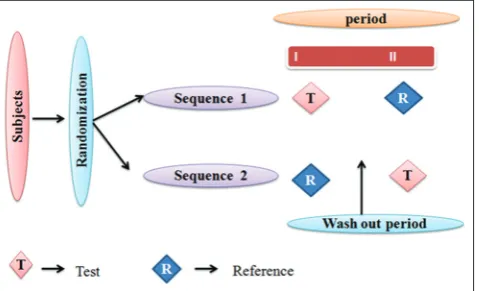
2 × 2 randomized single dose cross-over design
Each subject is randomly assigned to either sequence RT or TR (T-Test, R-Reference) at two dosing periods shown in Fig. 5. Dosing periods are
separated by a washout period of sufficient length for the drug received in the first period to be completely metabolized or excreted from the circulation [42-45]. This design is not suitable for drugs with longer half-life.
Parallel study design [44,46-48]
Normally wash out period should not exceed 3-4 weeks. If larger washout period is necessary a parallel design described in Fig. 6 is appropriate. Therefore parallel design is employed for drugs with longer half-life, but main drawback of this design is inter subject variability cannot be minimized.
Latin square study design
Latin square study design is conducted when there are more than two formulations. An experiment involvingntreatments, n2experimental units are assigned into n × n square (Fig. 7) in which the rows are called row blocks and columns are called column blocks [8]. The design minimizes inter-subject variability, carry-over effects, requires less number of subjects to get meaning full results. Requires longer time to complete the study (washout period exists between study periods) is the major drawback in this study design.
Balance incomplete block design (BIBD)
Latin square design will not be ethically advisable when there are more than three formulations as each volunteer may require drawing of too many blood samples. We can follow BIBD, which is shown in Table 1.
Salient features of this design are [44]:
• Each subject receives not more than two formulations • Each formulation is administered the same number of times • Each pair of formulation occurs together in the same number of
subjects.
Non-replicate study designs and replicate study design
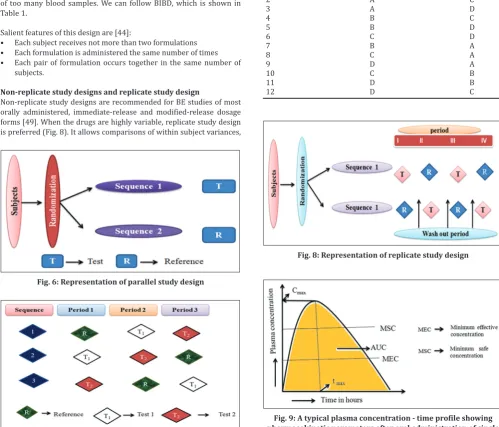
Non-replicate study designs are recommended for BE studies of most orally administered, immediate-release and modified-release dosage forms [49]. When the drugs are highly variable, replicate study design is preferred (Fig. 8). It allows comparisons of within subject variances,
reduce the number of subjects needed. Four period, two sequence, two formulation design is recommended for replicate study design, where there are three period, three sequence, single dose, the study is partially replicated [49,50].
PHARMCOKINETIC PARAMETERS [35,51-53]
For single dose studies
In a single dose BE study the following pharmacokinetic parameters (Fig. 9) are examined:
• AUC0→t = Area under the curve (from time 0 to time of last quantifiable
concentration)
• Cmax = Maximum concentration
• Tmax = Time to maximum concentration
• λz = Terminal elimination rate constant
• t½ = Terminal elimination half-life.
A sufficient number of blood samples should be taken to cover at least 80% of the AUC.
Table 1: Representation of balance incomplete block design
Sequence Period 1 Period 2
1 A B
2 A C
3 A D
4 B C
5 B D
6 C D
7 B A
8 C A
9 D A
10 C B
11 D B
12 D C
Fig. 6: Representation of parallel study design
Fig. 7: Representation of Latin square design
Fig. 8: Representation of replicate study design
Fig. 9: A typical plasma concentration - time profile showing pharmacokinetic parameters after oral administration of single
For multiple dose studies
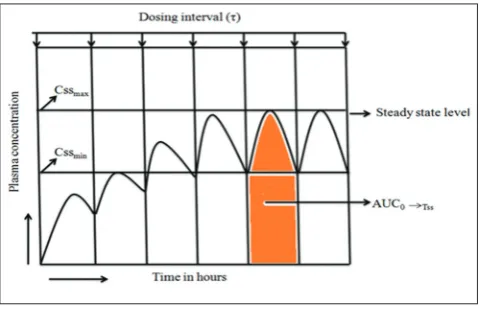
In multiple dose studies the following pharmacokinetic parameters are involved (Fig. 10).
• AUC0→Tss = Area under the curve (from time 0 to dosing interval) at
steady-state
• C maxss = Maximum concentration at steady state
• C minss = Minimum concentration at steady state
• C avgss = Average concentration at steady state
• T maxss = Time to maximum concentration at steady state
• Percentage fluctuation = 100 (Cmaxss-Cminss)/C avgss.
Cmax, Cmaxss, Cminss, Tmax, Tmaxss are determined directly from the observed data. AUCs are estimated by the conventional trapezoidal rule. In multiple dose study, at least three consecutive Cminss should be measured to assure attainment of steady state.
STATISTICAL EVALUATION [8,54-57]
Analysis of Variance has been used to analyze C max and AUC. Natural log transformation of C max and AUC is performed. Geometric mean of C max of test (Cmax ’t) and reference (Cmax ’r) is calculated. Geometric mean ratio of test and reference is calculated respectively. Similarly, geometric mean ratio of AUC is calculated. This ratio of geometric means is called point estimate. 90% confidence interval has to be calculated around the ratio of geometric means obtained for AUC and C max. For Cmax and AUC0-t the 90% confidence interval for the ratio of test and reference products should be contained within the acceptance interval of 80.00-125%. Products with a narrow therapeutic index the acceptance interval for AUC and Cmax should be tightened to 90.00-111.11%.
CONCLUSION
BA studies helps to produce safe and effective drug product by minimizing errors. BE studies reduce the time and cost of the experiment by reducing repetitive trails. Appropriate study design must be selected that suit the experiment to get meaningful results without violating the ethical guidelines.
ACKNOWLEDGMENTS
The authors are thankful to the management of MANSAS for supporting the work.
REFERENCES
1. Johnson SB. Bioavailability and bioequivalence testing. In: Remington’s G, editors. The Science and Practice of Pharmacy. USA: Pharmaceutical Press; 2013. p. 349-59.
2. Hedaya MA. Basic Pharmacokinetics. Special Indian edition. New York: CRC Press; 2010. p. 69.
3. Available from: http://www.accessdata.fda.gov/scripts/cder/ob. [Last accessed on 2015 Jul 28].
4. Available from: http://www.accessdata.fda.gov/scripts/cdrh/cfdocs/ cfcfr/CFRSearch.cfm?fr=320.25. [Last accessed on 2015 Jul 15]. 5. Available from: http://www.fda.gov/Drugs/
DevelopmentApprovalProcess/ucm079068.htm. [Last accessed on 2015 Jul 03].
6. Malik V. Law Relating to Drugs and Cosmetics. 23rd ed. Lucknow: EBC
Publishers; 2013. p. 1235.
7. Gibaldi M. Biopharmaceutics and Clinical Pharmacokinetics. 4th ed.
Hyderabad: Pharma Med Press; 1991. p. 159.
8. Shargel L, Wu - Pong S, Yu A. Applied Biopharmaceutics and Pharmacokinetics. 6th ed. Singapore: McGrew-Hill Companies; 2012.
p. 405.
9. Tandon V. Bioavailability and bioequivalence. In: Schoenwald R, editors. Pharmacokinetics in Drug Discovery and Development. New York: CRC Press; 2002. p. 97-100.
10. Available from: http://www.cdsco.nic.in/html/be%20guidelines%20 draft%20ver10%20march%2016,%2005. [Last accessed on 2015 May 24].
11. Sanmukhani J, Tripathi CB. Ethics in clinical research: The Indian perspective. Indian J Pharm Sci 2011;73(2):125-30.
12. Ethical Guidelines for Biomedical Research on Human Subjects. New Delhi: Indian Council of Medical Research; 2006.
13. Available from: http://www.wma.net/en/30publications/10policies/b3/ index.html. [Last accessed on 2015 Jul 23].
14. Available from: http://www.infochangeindia.org/20051112276/Health/ Features/Some-questionable-drug-trials.html. [Last accessed on 2015 May 25].
15. Available from: http://www.cdsco.nic.in/writereaddata/3rd%20
Technical%20%20Committee%20Minutes%2029.04.2013.pdf. [Last accessed on 2015 Jul 25].
16. Available from: http://www.icmr.nic.in/bioethics/final_cpcsea.pdf. [Last accessed on 2015 Jul 25].
17. Available from: http://www.icmr.nic.in/bioethics/INSA_Guidelines. pdf. [Last accessed on 2015 Aug 02].
18. Available from: http://www.grants.nih.gov/grants/olaw/guidebook.pdf. [Last accessed on 2015 Jul 25].
19. Available from: http://www.accessdata.fda.gov/scripts/cdrh/cfdocs/ cfcfr/CFRSearch.cfm?CFRPart=50. [Last accessed on 2015 Aug 01]. 20. Available from: http://www.fda.gov/ScienceResearch/SpecialTopics/
RunningClinicalTrials/ucm118296.htm. [Last accessed on 2015 Aug 01].
21. Available from: http://www.fda.gov/downloads/drugs/ guidancecomplianceregulatoryinformation/guidances/ucm399217.pdf. [Last accessed on 2015 Aug 01].
22. Available from: http://www.accessdata.fda.gov/scripts/cdrh/cfdocs/ c f c f r / C F R S e a r c h . c f m ? C F R P a r t = 3 1 4 & s h o w F R = 1 & subpartNode=21:5.0.1.1.4.9. [Last accessed on 2015 Aug 01].
23. Available from: http://www.cioms.ch/publications/layout_guide2002. pdf. [Last accessed on 2015 Aug 01].
24. Johnson PD, Besselsen DG. Practical aspects of experimental design in animal research. ILAR J 2002;43(4):202-6.
25. Festing MF, Altman DG. Guidelines for the design and statistical analysis of experiments using laboratory animals. ILAR J 2002;43(4):244-58. 26. Fagundes DJ, Taha MO. Modelo animal de doença: Critérios de escolha
e espécies de animais de uso corrente. Acta Cir Bras 2004;19:59-65. 27. Davidson MK, Lindsey JR, Davis JK. Requirements and selection of an
animal model. Isr J Med Sci 1987;23(6):551-5.
28. Dell RB, Holleran S, Ramakrishnan R. Sample size determination. ILAR J 2002;43:207-13.
29. de Aguilar-Nascimento JE. Fundamental steps in experimental design for animal studies. Acta Cir Bras 2005;20(1):2-8.
30. Altman DG, Doré CJ. Randomisation and baseline comparisons in clinical trials. Lancet 1990;335(8682):149-53.
31. Gupta SC. Fundamentals of Statistics. 7th ed. Mumbai: Himalaya
Publishing House; 2012. p. 12.2, 13.1, 15.5, 15.18.
32. Harrington M, editor. The Design of Experiments in Neuroscience. 2nd ed. New Delhi: SAGE Publications; 2011. p.88.
33. Qui Y, Chen Y, Zhang GG, Liu L, Porter W, editors. Developing Solid Oral Dosage Forms: Pharmaceutical Theory and Practice. 1st ed. USA:
Academic Press; 2009. p. 352.
34. Malik V. Law Relating to Drugs and Cosmetics. 23rd ed. Lucknow: EBC
Publishers; 2013. p. 1241-58.
35. Available from: http://www.ich.org/fileadmin/Public_Web_Site/ ABOUT_ICH/Organisation/GCC/Topics_under_Harmonisation/ Bioequivalence.pdf. [Last accessed on 2015 Jul 26].
36. Hedaya MA. Basic Pharmacokinetics. Special Indian edition. New York: CRC Press; 2010. p. 80.
37. Tamboli AM, Todkar P, Zope P, Sayyad FJ. An overview on bioequivalence: Regulatory consideration for generic drug products. J Bioequiv Availab 2010;2(4):86-92.
38. Available from: http://www.clindesc.com/Guidelines_online/3%20 Clinical/3.1%20General/3_1_2.pdf. [Last accessed on 2015 Jul 24]. 39. Available from: http://www.bebac.at/lectures/2-1-3-BABE.pdf. [Last
accessed on 2015 Jul 01].
40. Available from: https://www.law.cornell.edu/cfr/text/21/320.27. [Last accessed on 2015 Jul 06].
41. Available from: http://www.accessdata.fda.gov/scripts/cdrh/cfdocs/ cfcfr/CFRSearch.cfm?fr=320.27. [Last accessed on 2015 Jul 08]. 42. Grizzle JE. The two-period change-over design and its use in clinical
trials. Biometrics 1965;21():467-80.
43. Hills M, Armitage P. The two-period cross-over clinical trial. Br J Clin Pharmacol 1979;8(1):7-20.
44. De Muth JE. Basic Statistics and Pharmaceutical Statistical Applications. 3rd ed. New York: CRC Press; 2014. p. 615, 617, 619.
45. Hedaya MA. Basic Pharmacokinetics. Special Indian edition. New York: CRC Press; 2010. p. 74.
46. Available from: http://www.fda.gov/downloads/drugs/guidance compliance regulatory information/guidances/ucm073115.pdf. [Last accessedon 2015 Jul 25].
47. Bolton S, Bon C. Pharmaceutical Statistics: Practical and Clinical Applications. 5th ed. New York: Informa Health Care; 2010. p. 623.
48. Hoffman W, Lee C, Chiang A, Guo K, Ness D. Some statistical
considerations in non- clinical safety assessment. In: Dmitrienko A, Chuang-Stein C, D’Agostino R, editors. Pharmaceutical Statistics Using SAS: A Practical Guide. USA: SAS Institute; 2007. p. 98-102. 49. Available from: http://www.fda.gov/downloads/Drugs/./Guidances/
ucm070244.pdf. [Last accessed on 2015 Jul 28].
50. Niazi SK. Handbook of Bioequivalence Testing. 2nd ed. New York:
CRC Press; 2015. p. 410-2.
51. Available from: http://www.fda.gov/downloads/drugs/ guidancecomplianceregulatoryinformation/guidances/ucm389370.pdf. [Last accessed on 2015 Jul 28].
52. Notari RE. Biopharmaceutics and Clinical Pharmacokinetics: An Introduction. 4th ed. New York: Marcel Dekker; 2010. p. 46-55, 90-99.
53. Gibaldi M, Perrier D. Pharmacokinetics. 2nd ed. New York: Informa
Health Care; 2009. p. 145-88.
54. Available from: http://www.ich.org/fileadmin/Public_Web_Site/ ABOUT_ICH/Organisation/SADC/Guideline_on_Bioavailability_ and_Bioequivalance.pdf. [Last accessed on 2015 Jul 28].
55. Shaik M, Thirunagari BL, Sathe A. The basic regulatory considerations and prospects for conducting bioavailability/bioequivalence (BA/BE) studies – An overview. Comp Eff Res 2011;2011:1-25.
56. Rani S, Pargal A. Bioequivalence: An overview of statistical concepts. Indian J Pharmacol 2004;36(4):209-16.