8 h 00–8 h 09
Construct validity of the biometric smoothness in the PROMIS system: impact evaluation in a urology training program
Andrew Feifer; Josee Delisle; Maurice Anidjar
McGill University, Division of Urology, Montréal, Quebec
Objective:The use of simulation for the advancement of laparoscopic skill among urology residency programs continues to advance. One pur-ported benefit of simulation is that allows for objectification of techni-cal skill, enabling the documentation of performance improvements as experience increases. The aim of this study was to demonstrate the con-struct validity of the instrument smoothness parameter in the ProMIS (Haptica Ltd., Dublin, Ireland) augmented reality simulator using the validated and standardized MISTELS laparoscopic tasks.
Methods:Fifteen urology residents ranging from R5 to R1 were assessed using the ProMIS system on 3 occasions.The laparoscopic tasks includ-ed a peg transfer, intra and extra corporeal suturing, vessel looping and laparoscopic cutting. Smoothness of movement was measured by detect-ing the changes of instrument velocity over time (unitless) for each task. The values were recorded and subjected to statistical analysis using the students t test. Senior residents with standardized laparoscopic experi-ence greater than 50 hours were compared to junior residents with less than 50 hours of cumulative experience.
Results:The senior resident cohort demonstrated superior laparoscopic smoothness of movement in all 5 standardized laparoscopic tasks, demon-strating strong statistical significance (p < 0.05). This was further reflect-ed in an improvement in overall task completion among the senior res-ident cohort as compared to the junior resres-ident cohort. The senior resres-ident group also demonstrated greater consistency of movement, as evidence by the standard deviations across tasks. This resulted in a 38% reduc-tion in unnecessary laparoscopic instrument manipulareduc-tion.
Conclusions:These preliminary results of construct validity for the smooth-ness biometric parameter of the ProMIS simulator demonstrate its abili-ty to distinguish between more experienced and novice urologic laparo-scopists in a urology teaching program. This is a compelling feature of ProMIS that should facilitate its further incorporation into urology train-ing programs worldwide. It further demonstrates that ProMIS can be used to assess, train and follow a variety of laparoscopic technical skills, and will enhance efficiency of laparoscopic movement, and possibly decreased operative time for patients.
8 h 09–8 h 18
Early recurrences after radical prostatectomy for prostate cancer: Can we identify those patients?
Elie Antebi; Jochen Walz; Andrea Gallina; Felix K-H Chun; Alwyn M. Reuther; James A. Eastham; Eric A. Klein; Peter T. Scardino; Francesco Montorsi; Markus Graefen; Hartwig Huland; Pierre I. Karakiewicz
Objective:Timely treatment of early biochemical recurrence (BCR) of prostate cancer (PCa) may have a beneficial effect on cancer control rate. We identified the characteristics of patients at highest risk for early recur-rence and developed a nomogram predicting the risk of recurrecur-rence with-in 2 years after radical prostatectomy (RP).
Methods:From January 1987 to December 2005 8620 patients under-went RP for localized PCa in 3 different centres from Europe and North America. BCR was defined as serum prostate specific antigen (PSA) ≥
0.1 ng/mL and rising. Logistic regression models relied on patient age, clinical stage, PSA, pathological Gleason sum, extra capsular extension
(ECE), surgical margins (SM), seminal vesicle invasion (SVI) and lymph node invasion (LNI). The nomogram predicting BCR within 2 years after RP was developed based on those variables. Data from 2 centres (n = 2911; n = 1614) were used for model development and at the third cen-tre (n = 4095) was used for external validation.
Results:Median follow up was 2.5 years (range 0.1–18.2 yr), mean age of the whole cohort was 61 years (median 61 yr), mean PSA was 8.4 ng/mL (median 6.4 ng/mL), pathological Gleason sum was 6.8 (median 7), 30.6% had ECE (n = 2635), 4.1% had LNI (n = 353) and SM were positive in 23.7% (n = 2046). Within 2 years after RP, 10.0% (n = 865) relapsed, which represented 58% of all recurrences. Pathological Gleason sum > 6, LNI and SVI were the most informative predictors of early BCR. The nomogram (Fig. 1) was 86.6% accurate in the external validation cohort.
Conclusions:Early BCR after RP may be caused by the most aggressive PCa variants. They can be highly accurately identified using our external-ly validated nomogram.
8 h 18–8 h 27
The adjustable continence therapy (ACT) system: preliminary results of the North America ACT Clinical Study Group
M. Carmel; L.M. Tu; S. Aboseif; S. Nash; N. Baum; N. Galloway; P. Pommerville; J. Bressette; S.E. Sutherland; K. Whitmore; J. Slutsky Centre Hospitalier Universitaire de Sherbrooke, Sherbrooke, Quebec
Objective:The management of stress urinary incontinence (SUI) associ-ated with intrinsic sphincteric deficiency can be challenging, particu-larly after failed therapies. The Uromedica adjustable continence thera-py (ACT) system is a new device that provides bulk at the bladder neck with balloons to improve urethral coaptation and bladder neck support. The objective of this study is to determine the clinical efficacy, safety, adjustability and technical feasibility of the ACT system for treatment of female SUI.
Methods:The study population involves female patients with recurrent SUI with or without urethral hypermobility. Patient work-up was per-formed at 6 weeks, 3 months, 6 months, 9 months, 12 months and annu-ally thereafter and it includes urinalysis, a 3-day voiding diary, provoca-tive pad weight test, direct visual stress test, Stamey score and questionnaires to assess the degree of stress incontinence, voiding dys-function and quality of life.
PROGRAMME SCIENTIFIQUE
•
SCIENTIFIC PROGRAM
Results:A total of 81 subjects have been implanted and followed through 12 months. The mean age is 68.0 years old (range 31–94 yr). The medi-an number of adjustments needed up to one year to achieve maximum continence is 2.0 (0–8). Improvement in Stamey score of at least 1 grade was achieved in 62 patients (76.5%). Regarding the provocative pad weight tests, the average pad weight at 12 months was 12.2 g compared to 41.0 at baseline. Patient’s quality of life was assessed by the IQol, UDI and IIQ questionnaires and the results suggest improvement in quality of life at 12 months (p < 0.001); baseline score was 38.2 (SD 24.7) compared to 74.2 (SD 25.5) at 12 months for IQoL, 51.4 (SD 26.6) compared to 21.3 (SD 27.2) for UDI and 61.6 (SD 16.0) compared to 31.0 (SD 22.7) for IIQ. Regarding technical feasibility of implanting the ACT device, 71% of procedures were rated as mild difficulty, 23% as moderate difficulty and 6% as severe difficulty. 28% (n = 23) of patient suffered from at least one complication, but 71% considered as mild severity. The main device or procedure complications include port erosion (n = 12), balloon migra-tion (n = 10), balloon erosion (n = 8), pain/discomfort (n = 7), bladder perforation at the time of implant (n = 5) and urinary retention (n = 3).
Conclusion:The preliminary data suggest the Uromedica ACT system is an effective and simple procedure for recurrent stress urinary inconti-nence. Complications are usually of mild severity and easily managed. Longer follow-up is needed to evaluate the durability of the ACT sys-tem in managing SUI.
8 h 27–8 h 36
Ability of carbon monoxide releasing molecules to protect against transplant-related injury
Yves Caumartin; Christopher Nguan; Jian Deng; B. Sun; J. Jiang; R. Potter; H. Wang; Anthony Jevnikar; G. Cepinskas; Patrick Luke
London Health Sciences Centre, Multi-Organ Transplant Program, University of Western Ontario, London, Ontario
Objective:Significant organ damage may occur as a result of injury dur-ing the transplantation process. Carbon monoxide (CO) has previously been shown to reduce damage associated with ischemia reperfusion injury, but is difficult to store and deliver carbon monoxide in a safe, controlled manner. Therefore, we assessed the ability of novel carbon monoxide releasing molecules (CORM) to prevent apoptosis and inflammation in models relevant to the transplant process.
Methods:To assess the ability of CORM-2 (tricarbonyldichlorourthenium II dimmer) to protect C57BL/6-derived Tubular Epithelial Cells (TEC) from cytokine-mediated injury, TEC were incubated in 10 ng/mL TNFαand IFNαfor 24 hour. Using Annexin V/ 7-AAD staining, cell death was shown to be reduced in TEC after pre-incubation in CORM-2 in a concentration-dependent manner. Similarly, TEC were incubated at 4°C for 12 hour and re-warmed to assess the ability of CORM-2 to protect against temperature-mediated injury.
Results:At a concentration of 100 μM, CORM-2 appeared to optimally protect TEC from cytokine and temperature-mediated injury relevant to transplantation. As well, the ability of CORM-2 to modulate endothelial cell pro-inflammatory phenotype was evaluated. CORM-2 prevented acti-vation of NFκB with subsequent downregulation of NFκB-dependent adhe-sion molecules such as ICAM-1 after induction of inflammation. This trans-lated into reduction of neutrophils adhesion to endothelial cells (MPO assay). As well, CORM-2 reduced generation of intracellular oxidative stress as indicated by decreased oxidation of DHR123 and nitration of DAF-FM, H2O2and nitric oxide fluorochromes. Finally, iNOS was
down-regulated at the protein level.
Conclusions:We have shown that CORM can protect both endothelial and epithelial cells against temperature and inflammation-related injury. This provides rationale to use CORM in transplant perfusate to protect the organ during cold storage and reperfusion. These studies are ongoing.
8 h 36–8 h 45
Microsurgical varicocelectomy for isolated asthenospermia
Jason M. Boman; Jamie Libman; Armand Zini
Division of Urology, Department of Surgery, McGill University, Montréal, Quebec
Objective:Varicocele represents the most common cause of male infer-tility and most reports indicate that varicocelectomy has a beneficial effect on male fertility and pregnancy outcome. We sought to evaluate the clin-ical outcomes of infertile couples with varicocele and isolated asthenosper-mia who chose or not to undergo varicocelectomy.
Methods:Retrospective review of 118 consecutive infertile couples in whom the man presented with a clinical varicocele and isolated asthenospermia (< 50% motile sperm). All couples were presented with possible treatment options (observation, varicocelectomy, assisted repro-ductive technologies). The clinical characteristics and outcomes of 2 sub-groups of men (those who elected to undergo surgery — varicocelecto-my [SUR group; n = 69] and those who did not [CTL group; n = 49]) were examined and compared.
Results:Mean male and female ages, duration of infertility and, base-line TMC (total motile sperm count) were not significantly different in the CTL and SUR group. The mean TMC increased significantly after varic-ocelectomy (29,6 [preoperatively] to 39,0 million motile sperm [post-operatively], p < 0.05). The spontaneous pregnancy rate was signifi-cantly higher in the SUR group compared to the CTL group (65% v. 32%, respectively, p < 0.01). The combined spontaneous and IUI pregnancy rate was also significantly higher in the SUR group compared to the CTL group (74% v. 36%, respectively, p < 0.01). Utilization of IVF/ICSI was significantly higher in the CTL group compared to the SUR group (32% v. 11%, respectively, p < 0.05).
Conclusions:Our data support the practice of varicocelectomy for the treatment of clinical varicocele and isolated asthenospermia.
8 h 45–8 h 54
Validation of the Epstein criteria for insignificant prostate cancer in European men
Naeem Bhojani; Claudio Jeldres; Jochen Walz; Andrea Gallina; Georg C. Hutterer; François Péloquin; Marco Roscigno; Christian Eichelberg; Paul Perrotte; Patrizio Rigatti; Francesco Montorsi; Markus Graefen; Hartwig Huland; Pierre I. Karakiewicz
Objective:The Epstein criteria represent the benchmark for the predic-tion of insignificant prostate cancer (IPCa). However, these criteria were not validated in European patients. We tested the validity of the Epstein criteria in a large European patient cohort.
Methods:Between 1996 and 2006, 2580 radical prostatectomies were per-formed at a single European institution. Of these, 366 (14.2%) fulfilled the Epstein criteria for IPCa (Clinical stage T1c, PSA density < 0.15, biop-sy Gleason sum 2–6, presence of prostate cancer [PCa] in fewer than 3 cores and no more than 50% PCa in any core). We tabulated the Epstein crite-ria according to 4 separate endpoints, namely ECE, SVI, LNI and the rate of high grade prostate cancer (Gleason 7–10) at radical prostatectomy.
Results:ECE was present in 30 (8.2%) v. SVI in 1 (0.3%) v. LNI in 0 (0%) v. high grade PCa in 87 (23.7%). Concomitant absence of ECE and SVI and LNI and high grade PCa was recorded in 336 (91.8%). Any of the adverse characteristics were present in 98 (26.8%) patients.
Conclusions:The error rate of the Epstein criteria is relatively high (26.8%). Nonetheless it is similar to alternative tools predicting the probability of IPCa.
8 h 54–9 h 03
Observational study on the implantation of the TVT-SECUR under local anesthesia
Louis-Olivier Gagnon; Le Mai Tu
Centre Hospitalier Universitaire de Sherbrooke (CHUS), Sherbrooke University, Sherbrooke, Quebec
local anesthesia, because of a less-invasive technique using minimal vagi-nal dissection and no exit incisions. Available data is limited to studies done by Gynecare on human cadavers and animals. Currently, no clin-ical study on the TVT-SECUR is available.
Objective:This is a prospective, clinical, non-comparative study with pri-mary objective to observe the satisfaction and efficacy of the implantation of the TVT-SECUR under local anesthesia, with the use of questionnaires.
Methods:Data is collected through 5 questionnaires filled by the patients in a 6-month period; immediate pre-op, immediate PO, 1 week PO, 2 months PO and 6 months PO. Questionnaires focus on the satisfaction of the patient as well as the improvement in SUI symptoms.
Results:Preliminary results on 16 patients with a follow-up of 1 week show a satisfaction rate of 92% (12/13 - 3 patients witholding) and an improvement in SUI symptoms rate of 81% (13/16). Data up to 6 months PO will be available by November 2007.
Conclusion:The new TVT-SECUR shows a potential for implantation under local anesthesia, because of a less-invasive technique using minimal vagi-nal dissection and no exit incisions. This new midurethral sling could rep-resent a giant leap forward in the treatment of SUI.
9 h 03–9 h 12
Comparaison de l’issue clinique de l’hormonothérapie immédiate et de l’hormonothérapie retardée chez les patients avec métastases gan-glionnaires après la prostatectomie radicale
M.H. Lebel ; R. Tiguert ; D. Chautard ; F. Harel ; L. Lacombe ; Y. Fradet Centre Hospitalier Universitaire de Québec (CHUQ), Québec, Quebec
Introduction et objectif:Il a été suggéré que l’utilisation précoce de l’hor-monothérapie adjuvante à la prostatectomie radicale pourrait améliorer la survie chez les patients avec métastases ganglionnaires. Nous avons évalué l’impact de l’hormonothérapie adjuvante immédiate et retardée sur l’issue clinique des patients selon l’étendue de l’envahissement gan-glionnaire.
Méthode:Un total de 157 patients traités par prostatectomie radicale démontraient une atteinte ganglionnaire au rapport final de pathologie: 92 avaient une métastase unique (N1) et 65 avaient plus d’une métas-tase (N2). 51 patients ont été traités avec de l’hormonothérapie adjuvante continue commençant 1 mois après la chirurgie, 51 patients ont reçu de l’hormonothérapie adjuvante pour un an seulement tandis que 55 patients ont reçu de l’hormonothérapie au moment de la récidive biochim-ique. Le suivi médian des patients est de plus de 8 ans alors que plusieurs patients ont un suivi supérieur à 16 ans.
Résultats:À 10 ans de suivi, le taux de métastases osseuses était de 20% chez les N1 et de plus de 40% chez les N2. Le taux de mortalité spéci-fique par cancer à 10 ans est de 10% chez les N1 et de plus de 20% chez les N2. Le temps médian de récidive biochimique est de 5 ans chez le groupe N1, avec 25% des patients sans récidive à 10 ans, alors que le temps médian de récidive biochimique est de 2 ans chez le groupe N2. L’utilisation précoce de l’hormonothérapie adjuvante n’a pas démontré de différence significative quant au risque de progression des cancers dans chacun des groupes. Au contraire, les patients traités avec de l’hor-monothérapie adjuvante continue démontrent un risque accru de 300% de mourir d’une cause autre que de leur cancer durant le suivi, RR 3.093 (CI 1.37 – 6.69) p = 0.0066.
Conclusion:Cette étude démontre l’importance de l’étendue de l’en-vahissement ganglionnaire comme marqueur pronostique. Nos résultats suggèrent qu’il n’y a pas de bénéfice apparent à l’utilisation précoce de l’hormonothérapie adjuvante à la prostatectomie radicale lors de la présence de métastases ganglionnaires comparativement à l’hor-monothérapie retardée jusqu’à la récidive biochimique. Nos résultats démontrent finalement que l’hormonothérapie continue peut être dom-mageable pour les patients qui présentent un faible risque de décès spé-cifique à leur cancer.
9 h 12–9 h 21
Renal cell carcinoma with thrombus of the inferior vena cava: the Montreal General Hospital Experience
T. Abou Youssif; M. Al Otaibi; A. Al-Khaldi; K. Sircar; A.G. Aprikian;
W. Kassouf; J. Steinberg; D. Mulder; S. Tanguay McGill University Health Center, Montréal, Quebec
Objective:Renal cell carcinoma (RCC) with caval thrombus is a techni-cal and oncologitechni-cal challenge. Our objective was to evaluate our surgi-cal experience with resection of IVC thrombus.
Methods:Retrospective analysis of 74 patients with RCC and tumour thrombus treated in our institution was performed. Of these, 45 under-went radical nephrectomy and IVC thrombectomy.
Results:Mean age was 59 years. The tumour originated from the right kid-ney in 35 patients (78%). Mean tumour size was 8.6 cm. Supra diaphrag-matic thrombus was present in 8 patients with 6 (13%) extending into the right atrium. One patient underwent limited caval resection and recon-struction with PTFE graft due to extensive IVC wall invasion by the tumour. The infra-renal IVC was ligated in 2 patients due to extensive thrombo-sis. Perioperative morbidity included massive bleeding in 2 patients. One patient developed postoperative deep venous thrombosis and one patient had a cerebro-vascular accident. We had one postoperative death due to myocardial infarction. Median time to recurrence was 10 months. Five patients developed local recurrence post resection. Of these patients, 3 (60%) had supra-diaphragmatic thrombus and 2 had infra-hepatic throm-bus. Postoperative metastases occurred in 29 patients (64%). Our data showed an association between the thrombus level and rate of local recur-rence and no significant differecur-rence in the rate of postoperative metastases between the different levels of IVC thrombus. Postoperative 5 years sur-vival rate for patient with caval thrombus was 45% compared to 55% for those with renal vein thrombus. The level of caval thrombus was not predictive of survival.
Conclusion:Surgical excision of renal cell carcinoma with caval throm-bus is a safe procedure in experienced centres with relatively low peri-operative morbidity and mortality. Although the thrombus level might affect the local recurrence rate, the development of metastases and over-all survival were not affected. Given the high failure rate, this patient pop-ulation remain an ideal group to evaluate the role of adjuvant therapy.
9 h 21–9 h 30
Development of a highly accurate nomogram for prediction of the need for exploration in patients with renal trauma
Quoc-Dien Trinh2; Shahrokh F. Shariat1; Key H. Stage1; Allen F. Morey3;
Claus G. Roehrborn1; Luc Valiquette2; Pierre I. Karakiewicz2
1Department of Urology, University of Texas Southwestern Medical Center,
Dallas, Texas; 2Cancer Prognostics and Health Outcomes Unit, University
of Montreal, Montréal, Quebec; 3Brooke Army Medical Center, Fort Sam,
Houston, Texas
Objectives:The decision to explore a patient with renal trauma is high-ly complex. In order to lessen the complexity of this decision process, we developed and validated a nomogram for predicting the need for renal exploration after renal trauma.
Methods:From 1995 through 2004, 419 consecutive patients presented to our institution with traumatic renal injury. All were randomly divided into a development (50%, n = 210) and a split sample validation cohort (50%, n = 209). Logistic regression models were used to develop a nomogram for prediction of the need for renal exploration after renal trauma. Internal (200 bootstrap re-samples) and 50% split sample validations were performed.
Results:Overall, 89 patients (21.2%) underwent renal exploration, from which 60.7% (54/89) underwent nephrectomy and 39.3% (35/89) under-went renorraphy. 9% of patients with grade II injury underunder-went renal explo-ration, 16% with grade III injuries, 41% with grade IV injuries, and 100% of grade V injuries. The kidney injury scale, the mechanism of injury, the need for transfusion, blood urea nitrogen level and serum creatinine represented the most informative predictors and were included in the nomo-gram. The split sample accuracy of the nomogram for prediction of the need for renal exploration was 96.9%. It significantly (p < 0.001) exceeded the accuracy of each of its components including the AAST kidney injury scale (87.7%).
9 h 30–9 h 39
Comparaison des criteres cliniques et scintigraphiques pour determin-er le succes chirurgical post-pyeloplasties laparoscopiques
Frédéric Pouliot1; Michel-Hugues Lebel1; Jean-François Audet1; Robert
Sabbagh1; Thierry Dujardin1
1Centre hospitalier universitaire de Québec (CHUQ); Université Laval,
Québec, Quebec
Introduction:La pyéloplastie laparoscopique (PL) est une technique min-imalement invasive avec des succès comparables à la technique ouverte. Plusieurs séries de PL ont été publiées mais la définition du succès est principalement basée sur des paramètres cliniques ou radiologiques. La scintigraphie rénale au MAG3-lasix étant reconnue comme l’examen étalon or pour évaluer l’obstruction des voies urinaires supérieures, nous comparons la définition de succès entre des critères cliniques et scinti-graphiques.
Méthode:111 cas de PL ont été effectuées entre janvier 2003 et février 2007 dont 72 par voie transpéritonéale et 39 par voie rétropéritonéale. La technique d’Anderson-Hynes a été utilisée dans 98% des cas. Une scintigraphie rénale a été faite en pré- et post-opératoire dans respec-tivement 86 et 80% des cas. Le succès scintigraphique rénal en post-opéra-toire est défini comme: strict si le T1/2 < 10 minutes, non-obstructif si le T1/2 < 20minutes et technique si le T1/2 est amélioré par rapport au T1/2 pré-opératoire.
Résultats:Les indications pour la chirurgie sont la douleur (87%), la pyélonéphrite (7%) et/ou la formation de calculs (9%). Le temps opéra-toire était de 128 ± 45 minutes, les pertes sanguines étaient de 52 ± 168 minutes et le séjour hospitalier médian était de 3 jours (1 à 10 jours). Le taux de complications urologiques est de 19% et les infec-tions urinaires sont la principale complication. Les T1/2 pré- et post-opéra-toires étaient de 51 ± 48 et 17 ± 34 minutes. Au plus long suivi, 97% des patients ne présentaient plus de douleurs et donc remplissaient la déf-inition de succès clinique. Toutefois, seulement 61% et 85% des patients remplissaient les critères scintigraphiques stricts et non-obstructifs, respec-tivement. De plus, nous notons un succès technique chez 93% des patients.
Conclusions:Le taux de succès post-PL diffère grandement selon les définitions cliniques ou scintigraphiques de l’obstruction. L’utilisation de critères scintigraphiques pourrait permettre de mieux caractériser et iden-tifier les patients à risque d’échec à long-terme post-PL.
9 h 39–9 h 48
Spongioplasty facilitates postoperative catheterization, if required after non-stented tubularized incised urethral plate (TIP) repair of primary hypospadias
F. Almodhen; A.Alzahrani; R. Jednak; J-P Capolicchio; M. El-Sherbiny Divisions of Urology, Montreal Children’s Hospital, Montréal, Quebec
Introduction:We hypothesize that spongioplasty provides sufficient urethral support to facilitate early urethral catheterization without com-promising the hypospadias repair.
Materials and Methods:All non-toilet-trained children who, over a 30-month period, underwent tubularized incised-plate urethroplasty (TIP) repair for primary hypospadias were included in the study. A single sur-geon performed all procedures. In all cases the technique involved lization of the divergent spongiosa off the corpora cavernosa. The mobi-lized spongiosa was rotated toward the midline and wrapped around both the neourethra and the hypoplastic distal urethra. A dorsal preputial dartos flap was utilized to cover the neourethra. The neourethra was calibrated with an 8-F catheter following the procedure. If the catheter passed easily, the bladder was drained and the repair was left without a stent. A urethral stent was left in place when difficult catheterization was encountered. Early and late complications were documented.
Results:32 consecutive patients with a mean age of 18 ± 6 months were included in the study. The defects were distal and mid-shaft in 26 patients (80%) proximal-shaft in 6 (20%). No intraoperative catheterization dif-ficulties were encountered and all repairs were non-stented. Mean fol-low-up was 9 ± 6 months. Urinary extravasation developed in one patient (3%) on the second postoperative day. A urethral catheter was easily insert-ed and left indwelling for 5 days. One patient presentinsert-ed 6 days
postop-eratively with suspected voiding difficulty. Urethral calibration was eas-ily performed excluding any mechanical obstruction. There were no urinary fistulae and re-operation was not required. An excellent cos-metic appearance was achieved in all patients.
Conclusion:Spongioplasty provides good support to the neourethra and the hypoplastic distal urethra. It facilitates catheterization if required in the early postoperative period and should be considered with non-stent-ed TIP repairs. In addition, separating the spongiosa from the tunica albug-inia decreases tension on the midline urethroplasty suture line, which is especially important during erection. Combining spongioplasty and dar-tos flap coverage maximizes neourethral protection
9 h 48–9 h 57
Impact of statins on the rate of superficial bladder cancer recurrence
Vincent Fradet; Odile Sheehy; Fred Saad; Jacques LeLorier
Pharmacoépidémiologie et pharmacoéconomie, Centre de recherche Hôtel-Dieu, and Service d’urologie, Centre hospitalier de l’Université de Montréal (CHUM), Montréal, Quebec
Introduction:The anticancer effect of statins is being intensively stud-ied. Statins are mostly associated with diminished incidence of many solid cancers. Our objective is to determine if statins reduce the risk of super-ficial bladder cancer (SBC) recurrence and progression after TUR-BT.
Methods:This study is based on RAMQ databases. Study patients were newly diagnosed with SBC (ICD-9 = 188.x, 223.3, 233.7, and 239.4) and had a first trans-urethral resection of bladder tumour (TUR-BT) procedure between July 1, 1995 and January 1, 2002. We excluded patients with any prior cancer diagnosis and those with immediate planned cystecto-my, chemotherapy or radiotherapy. Patients were grouped into cohorts of postoperative statin users and non-users. Time to recurrence and pro-gression to cystectomy were compared among study cohorts using sur-vival analysis. Cox regression models included the following co-variables: sex, age, chronic disease score, medical and emergency visits, and hos-pitalization days. Analyses also addressed immortal time bias.
Results:Of 4834 included patients, 23% were statin users. Recurrence and progression to cystectomy was observed in 2340 and 225 of 4834 patients, respectively. There was no significant difference among study cohorts in age, gender, tumour diagnosis, surgical procedures, adjuvant therapy use, chronic disease scores, and year of surgical procedure (p > 0.05). The crude rate ratio (RR) is 0.56, and the immortal time adjusted RR is 0.81 (95% CI 0.71–0.94) for statin exposure versus SBC recurrence. For bladder cancer progression, the crude RR is 0.34, and the immortal time adjusted RR is 0.51 (95% CI 0.30–0.88). In multivariable cox regres-sion, statin use was associated with a lower risk of SBC recurrence (adjust-ed HR 0.88, 95% CI 0.80–0.97, p < 0.01) and with a lower risk of SBC progression to cystectomy (adjusted HR 0.55, 95% CI 0.38–0.80).
Conclusion:Our results suggest that postoperative statin use have a pro-tective effect on superficial bladder cancer recurrence and progression.
9 h 57–10 h 06
Percutaneous nephrolithotomy for Staghorn calculus: a single centre’s experience
F. Soucy; M. Duvdevani; L. Nott; R. Ko; J.D. Denstedt; H. Razvi Division of Urology, Department of Surgery, Schulich School of Medicine and Dentistry, University of Western Ontario, London, Ontario
Introduciton:The percutaneous management of staghorn calculi maybe one of the more challenging endourological procedures. Various tech-niques have been described and complications rates vary widely in the literature. Reported blood transfusion rates vary between 14% and 45%. The purpose of this study is to evaluate the outcomes and complica-tions with PNL for staghorn calculus in a large group of patients in a tertiary stone centre.
pneumatic, electrohydraulic and Holmium:YAG laser. Data collection included procedure time, hospital length of stay, number of access tracts, transfusion rates, major complications and stone free status.
Results:Mean age was 53.8 (range 4–84) years. The average procedure time was 104 minutes. Sixteen percent of the cases were done with mul-tiple access tracts (range 2–5). The lower calyx was most commonly used (64.1%), followed by the upper in 18.5% and the middle in 17.4%. The blood transfusion rate was 0.8%. There was no statistically significant dif-ference in terms of transfusion rates (0.7%–1.2% p = 0.24) or other major
complications between single and multiple tracts, respectively. Major complications included one case of bleeding requiring selective renal artery embolization and 8 patients were found to have a pneumo/ hydrothorax. Stone free rates at discharge and at 3 months follow-up were 78% and 91%, respectively.
14 h 30–14 h 39
Utility of urine cytology in the workup of asymptomatic microscopic hematuria
Andrew Feifer; Wassim Kassouf; Simon Tanguay; Armen G. Aprikian; Jordan Steinberg
Division of Urology, McGill University, Montréal, Quebec
Background:Patients with asymptomatic microscopic hematuria repre-sent a large number of new referrals. Current recommendations include upper tract imaging, cystoscopy, and cytological evaluation of voided urine. While cytology has been validated for use in patients with a his-tory of urothelial malignancy, its use in patients with asymptomatic micro-scopic hematuria is controversial; this stems from its low sensitivity and high relative cost. We evaluated the utility of urine cytology in a cohort of patients, specifically assessing the performance characteristics while analyzing the cost to benefit ratio.
Methods:118 consecutive patients with asymptomatic microscopic hema-turia were referred to a urology clinic (university based) from August 2005 to December 2006. All patients underwent investigation with cystoscopy, upper tract imaging (either by abdominal ultrasound, intravenous pyel-ogram, or enhanced CT with delayed images), and urine cytology eval-uated by an experienced staff cytopathologist. Cytology resultsy were clas-sified as positive (malignant cells), atypical (degenerated, non-diagnostic), or negative.
Results:All 118 patients completed the hematuria evaluation. Of the 118 patients, none had a positive cytology, 21(18%) had an atypical (or non-diagnostic) cytology, and 97 (82%) had a negative urinary cytology. Of the 118 patients, 8 (7%) were found to have a transitional cell carcinoma (TCC) of the bladder, while no patient was found to have a lesion of the upper urinary tract. 4/7 lesions were pTa, while 4/7 tumours were pT1. Of the 21 patients with an atypical urinary cytology, 4 (19%) were found to have bladder tumours, while the other 4 patients with tumours had negative cytol-ogy. If we define an atypical cytology as positive, the sensitivity, speci-ficity, positive and negative predictive values of cytology were 50%, 85%, 19%, and 96%, respectively. If we define an atypical cytology as nega-tive, the sensitivity, specificity, positive and negative predictive values of cytology were 0%, 100%, 0%, and 93%, respectively. The cost of perform-ing an individual urinary cytology was estimated at $175.
Conclusions:No patients evaluated for asymptomatic microscopic hema-turia in this study had an overtly positive cytology. While the study clear-ly demonstrated an important role in evaluating these patients (7 blad-der tumours were detected and treated), urinary cytology added no benefit while being associated with a significant cost. The high specificity is in keeping with other studies and supports the use of cytology as an adjunct to surveillance protocols in patients with a history of urothelial cancer (where the positive predictive value is high). Urinary cytology may be omitted from the work-up of patients with asymptomatic microscopic hematuria.
14 h 39–14 h 48
Clinical T3 prostate cancer treated with radical prostatectomy: patho-logical and long-term outcomes
Claudio Jeldres; Andrea Gallina; Jochen Walz; Vincenzo Scattoni; James A Eastham; Peter T Scardino; Eric A Klein; Alwyn M Reuther; Fred Saad; Francesco Montorsi; Patrizio Rigatti; Markus Graefen; Hartwig Huland; Pierre I Karakiewicz
Introduction and Objective:Locally advanced prostate cancer (cT3) is found in up to 5 percent of newly diagnosed men. However, the role of radical prostatectomy (RP) in these patients is controversial. We assessed the rate of favourable pathology at RP and of BCR-free survival in men with cT3.
Methods:Of 15 767 patients, 208 (1.3%) were cT3, and were treated with RP at 6 different institutions in North America and Europe. Statistical analy-ses addressed pathological stage at RP and Kaplan–Meier analyanaly-ses addressed the rate of BCR after RP.
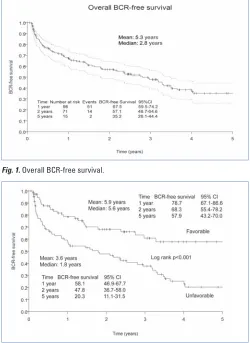
Results:Mean age was 61 years (range 39–79) and mean PSA was 13.8 ng/ml (range 0.12–47.3). Of all cT3 patients, 87 (41.8%) had favourable patho-logical findings at RP manifested by 9.1% OC stage or specimen confined (32.7%) disease (ECE positive, negative SVI, negative LNI and negative surgical margins), or pathological Gleason sum 2–6 regardless of
patho-PROGRAMME SCIENTIFIQUE
•
SCIENTIFIC PROGRAM
Vendredi, le 9 novembre 2007
Session scientifique V
Fig. 1.Overall BCR-free survival.
logical stage (7.2%). The overall actuarial median time to BCR was 2.8 years and at 5 years 73 (35.2%) patients were BCR-free (Fig. 1). As shown in Fig. 2, the actuarial median time to BCR was 5.6 vs. 1.8 years, respective-ly for those with favourable outcomes vs. the others (p < 0.001). At 5 years, 120 (57.9%) patients were BCR-free vs. 42 (20.3%) for those with unfavourable pathology (p < 0.001).
Conclusions:Despite clinically adverse presentation (cT3), almost half of these patients show favourable pathological characteristics at final pathol-ogy and 57.9% of those with favourable patholpathol-ogy are BCR-free at 5 years. These findings suggest that RP is a valid treatment option for patients with cT3 PCa.
14 h 48–14 h 57
Initial assessment of a screening tool for renal tumour therapy sensi-tivity using ex vivo invasion assay
Yves Caumartin; Penny Costello; Warren McDonald; Patrick Luke London Health Sciences Center, University of Western Ontario, London, Ontario
Background:Metastasis secondary to RCC have variable and limited responses to systemic therapy. However, the heterogeneity of tumours has not been assessed against these therapies. Using an ex vivo model of invasion, we assessed the impact of different therapeutic agents on patient’s live tumour cells procured during surgical resection.
Methods:Twelve consecutive patients undergoing surgical resection of renal masses were enrolled. A sample of each tumour was removed from the periphery of the tumour as well as a normal piece of kidney. These specimens were placed into a nutrient-rich collagen matrix. Growth and invasiveness were monitored microscopically by measuring the dis-seminated distance of tumour cells from the origin over 5 days. In the presence of different chemotherapeutic and anti-angiogenic agents, the invasive capacity of tumours was assessed. All tumours were preserved in paraffin for immunohistochemistry staining to assess cell viability and angiogenesis.
Results:Among the initial 12 patients, 10 had clear cell RCC, 1 had pap-illary RCC and 1 had a metanephric adenoma. 7 patients were pT1 and 5 were pT3 among which 3 had metastasis. Samples from the normal kidney samples did not migrate as expected. The cells from the metanephric adenoma migrated up to 110 +/−84 μm compared with 844 +/−265 μm in the malignant specimens (p < 0.001). When comparing tumours with Fuhrman grade 1/
2with 3/4, growth was 730 +/−148 v. 870 +/−281 μm,
respectively (p < 0.05). Among the therapeutic drugs, taxol, taxotere and doxorubicin were capable of reducing tumour invasiveness by 72%, 75% and 83%, respectively. Cisplatin and mTOR inhibitors had inter-mediate and variable response with a mean reduction of 46% and 36%, respectively.
Conclusion:Initial experience with this ex vivo invasion assay appears to have promise, as there is correlation between tumour grade/malignant potential and invasiveness. Potentially, it may be able to predict tumour response to therapeutic agents. In the future, we hope to create an index that assesses invasiveness/angiogenesis/viability in the hopes of individ-ualizing mono or combination therapy for patients with kidney cancer.
14 h 57–15 h 06
Effects of an antiepileptic — levetiracetam (Keppra) — on neurogenic overactive bladder in chronic paraplegic rats
Lysanne Campeau1; Ehab Elzayat1; Gilles Karsenty1; Bertil Blok1; L. Ante
Padjen2; Jacques Corcos1
1Department of Urology and 2Pharmacology and Therapeutics, Jewish
General Hospital, McGill University, Montréal, Quebec
Aims:We investigated the effects of different Levetiracetam (LEV) doses on urodynamic parameters in an animal model of overactive bladder (OAB).
Methods:Fifty-four female Sprague-Dawley rats were studied. Six of them served as normal controls, and the remaining 48 underwent T10 spinal cord transaction (SCT). Of the later, 12 were paraplegic controls, with the remaining 36 rats being divided into 3 equal sub-groups and receiving LEV at doses of 17 mg/kg, 54 mg/kg, and 108 mg/kg daily, respectively.
The ‘‘paraplegic control’’ and treatment groups were further sub-divid-ed (n = 6), and filling cystometrography (CMG) was performsub-divid-ed at 3 and 4 weeks after SCT, respectively.
Results:All ‘‘paraplegic controls’’ developed neurogenic detrusor over-activity (NDO). At 3 and 4 weeks after SCT respectively, the mean fre-quency of contractions was 1.6 ± 0.3 and 1.7 ± 0.2/min, contraction amplitude was 29.7 ± 1.4 and 31.6 ± 2.4 cmH2O, and bladder
capaci-ty was 1.1 ± 0.2 and 0.5 ± 0.1 mL. After 1 week of LEV treatment, these urodynamic parameters improved significantly in a dose-dependent man-ner, and the changes were more striking at 2 weeks. At LEV dosages of 17, 54, and 108 mg/kg, respectively, the NDO frequency went from 1.7 ± 0.3 to 0.7 ± 0.2, 0.48 ± 0.16, and 0.5 ± 0.17 contractions /min, blad-der capacity increased from 0.51 ± 0.1 mL to 1.5 ± 0.2, 2.5 ± 1.7, and 2.6 ± 0.3 ml, and micturition pressure improved from 105.8 ± 6.9 to 73.8 ± 6.8, 58.6 ± 8.9, and 49.7 ± 8.9 cmH2O.
Conclusions:LEV is an effective treatment of NDO after SCT in rats. Knowing its excellent safety profile in humans, it may provide a novel, alternative therapeutic approach to OAB. Follow-up of these experi-mental results with a clinical trials warranted.
15 h 06–15 h 15
Overexpression of IKKe induces inflammatory cytokine expression in hormone-dependent prostate cancer cells
B. Péant; J-S Diallo; L. Lessard; I.H. Koumakpayi; C. Le Page; A-M Mes-Masson ; F. Saad
Institut du Cancer de Montréal/CHUM, Montréal, Quebec, Canada. Université de Montréal, Department of Medicine, Montréal, Quebec ; Université de Montréal, Department of Surgery/Urology, Montréal, Quebec
Background:Elevated cytokine levels in serum have been associated with advanced stage metastasis-related morbidity in prostate cancer. Several studies have shown that inflammatory cytokines can accelerate the growth of human prostate carcinoma cell lines. We recently observed the induc-tion of Ikappa-B kinase-epsilon (IKKe) expression by the tumour necro-sis factor (TNF)-α; in LNCaP cells as well as elevated expression of IKKe in the androgen-independent DU145 and PC-3 cells, which exhibit con-stitutive Nuclear Factor-kappaB (NF-kB) activity. Because previous stud-ies, in murine embryonic fibroblasts, have shown that IKKe-deficiency results in the reduction of lipopolysaccharide-induced expression of cytokines, we hypothesized that deregulation of IKKe expression may be linked to inflammatory cytokine secretion and progression of prostate cancer to a hormone-refractory (HR) status.
Methods:Hormone-sensitive (HS) LNCaP and 22Rv1 cells were used to study cytokine secretion in parallel with IKKe expression upon stimula-tion with TNF-α. The pUNO-hIKKe plasmid was also used to overexpress IKKe in these HS cells to levels observed in the PC-3 and DU145 cell lines. Cytokine secretions were characterized using ELISA assays. Expression of IKKe was measured by immunoblot assays which were also used to study the intracellular status of NF-kB.
Results:We observed increased inflammatory cytokine secretion in LNCaP and 22Rv1 cells transfected by the pUNO-hIKKe plasmid. In these cells, overexpression of IKKe was detected without the activation of the NF-kB pathway which is thought to control the expression of several cytokines. On the other hand, stimulation of IKKe expression and NF-kB nuclear translocation using TNF-αfailed to induce a similar NF-kB dependent cytokine secretion in HS prostate cancer cells.
Conclusions:Our results show, for the first time, evidence that overex-pression of IKKe is closely linked to cytokine secretion. Moreover, the increase in inflammatory cytokine expression is not dependent on NF-kB in prostate cancer cells that overexpress IKKe. Further studies will be needed in order to determine the mechanism involved in the dereg-ulation of inflammatory cytokine secretion with regard to IKKe overex-pression and prostate cancer progression toward a HR status.
15 h 15–15 h 24
Initial experience with kidney transplantation from donors after cardiocirculatory death
Corinne Weernink; Anthony M. Jevnikar; Patrick P.W. Luke; William Wall Multi-Organ Transplant Program, London Health Sciences Centre, London, Ontario
Introduction:The growing discrepancy between supply and demand of donor kidneys has increased the interest in donation after cardiocircu-latory death (DCD). The CCDT recently published guidelines support-ing controlled DCD programs in Canada. We report our experience with 12 kidney transplants from 6 DCD donors.
Methodology:Between July 1, 2006 and March 1, 2007, 12 kidneys and 4 livers were procured from 6 DCD donors. These donors had sus-tained devastating intra-cerebral injuries. Without hope of recovery, with-drawal of life-sustaining therapy (WLST) was recommended by ICU physi-cians. WLST began in the ICU and 5 minutes after cessation of circulatory activity, death was declared. Through a midline abdominal incision, can-nulation and cold perfusion of the aorta with HTK solution was performed and IVC was vented. From WLST to perfusion, mean warm ischemia time (WIT) was 70.6 minutes (range 26–128). Livers and kidneys were retrieved.
Results:Twelve kidneys were transplanted into 2 female and 10 male recipients that were made aware of the DCD kidneys. Purposefully, the cold ischemia time was kept short at a mean of 5.8 (3.5–9.5) hours. Surgeries were uneventful with a mean anastomotic time of 39 (34–49) minutes. Immunosuppression included induction with thymoglobulin plus tacrolimus, mycophenolate mofetil and prednisone. 10 recipients (83%) experienced delayed graft function (DGF). Median hospital stay was 17 (13–29) days. After 9 months follow-up (n = 4), mean serum creatinine was 73 μmol/l (51–94) with a corresponding estimated creatinine clear-ance of 80 ml/min (55–85). No rejection episode or primary non-function were reported.
Conclusion:Over the 7 months since the inception of our DCD program, 12 DCD kidney transplants were performed. These kidneys sustained sig-nificant injury as a result of prolonged WIT leading to high DGF rate. Using carefully selected donors under optimal conditions, DCD can provide an additional source of organs. We await long-term results regard-ing graft function and survival.
15 h 24–15 h 33
Application of electrochemical principles for the treatment of local-ized prostate cancer
B. Bhindi; F. Cury; J. Rocha; E. Scarlata; M. Ladouceur; A. Vijh; E. El-Zayat; M. Anidjar; Y. Taguchi; S. Chevalier
McGill University Health Center Research Institute (MGH campus), Montréal, Quebec
Introduction and objective:Electrochemical therapy (ECT) is a modali-ty that employs low-level direct continuous current to produce local electroche-mical reactions in order to destroy solid tumours. Over 15 000 cancer patients have already been treated with ECT worldwide. However, limited standardization studies have been reported. The present study was aimed at characterizing ECT parameters in human prostate tumour xenografts and dog prostates.
Methods:Mice (n = 50) bearing human PC-3 or LNCaP tumours of 0.6–1.2mL were used. Electrodes were implanted in tumours and current densities of 10–15 or 25–30mA/cm2were applied for either 30 minute.
without intermission or 60 minute. with a 5-minute intermission halfway through: 17 mice were euthanized for tumour histopathology; 6 showed deteriorating health status and were included in histopathology studies; 22 were followed for recurrence/cure; 5 were found dead and exclud-ed. In the canine model (n = 3), a laparotomy was performed to submit the prostate to ECT, similarly to xenografts. Prostates were harvested imme-diately for histopathological analysis.
Results:In all conditions and the systems tested, human xenografts and dog prostate, ECT produced edema and high pH at the cathode and tis-sue dryness along with low pH at the anode. Histopathological analy-ses immediately after ECT revealed extensive necrosis, particularly at the cathode, and severe architectural changes at the anode. In mice, lesions were most prominent at higher current density and/or treatment time and progressively increased with time intervals post-ECT reaching up to 99% cell damage in the strongest treatment arm at 4 days. In the LNCaP series, this was accompanied by a decline in circulating PSA levels, which were negligible by 7 days. The most common location of remaining healthy cells was at the base of tumours. ECT did not alter the tumour growth rate in mice with clinical recurrence. The time to recurrence was longer in the group receiving the strongest ECT regimen. Five mice were considered cured.
Conclusion:Electrochemical therapy appears highly efficient in rapidly inducing extensive necrosis in the prostate and killing prostate cancer cells. Current delivery remains suboptimal and allowed the opportunity for tumour recurrence. Innovative electrode configurations will be explored, including in a large model for in situ treatment of localized prostate cancer.
8 h 00–8 h 09
Nephron-sparing surgery does not undermine renal cell carcinoma-specific survival in patients with pT3 renal cell carcinoma
Quoc-Dien Trinh; Jean-Jacques Patard; Georg C. Hutterer; Laurent Salomon; Alexandre De La Taille; Allan J. Pantuck; Pierre I. Karakiewicz
Introduction and Objective:Nephron-sparing surgery (NSS) has an estab-lished role in the treatment of patients with renal cell carcinoma (RCC). However, in patients with more advanced disease, NSS may have a detri-mental effect on cancer control. We assessed the RCC-specific survival (RCC-SS) of 91 patients treated with NSS for pT3 lesions and compared them to a matched cohort of 215 controls, who were treated with radi-cal nephrectomy for pT3 tumours.
Methods:The records of 91 patients with NSS for pT3 RCC were matched with 1158 records of pT3 patients treated with radical nephrectomy. One to 4 matches were found for 64 patients and resulted in 215 controls with the same TNM stage, tumour size, Fuhrman grade and histology. The log-rank statistic tested the difference in RCC-SS rate between the NSS patients and the matched control patients.
Results:Within the NSS cohort, most tumours were clear cell carcinomas (82.8%) and most were Fuhrman grade II (56.3%) and III (32.8%). Nodal metastases were found in 2 patients (3.1%) and 6 had distant metastases (9.4%). The same characteristics were identified in 215 patients treated with radical nephrectomy. The rate ratio quantifying the RCC-SS difference between NSS and radical nephrectomy patients was 1.0 (log-rank p = 0.7).
Conclusions:NSS results in the same survival as radical nephrectomy in patients with pT3 tumours.
8 h 09–8 h 18
Natural history of varicocele management in the era of ART: lessons from a controlled trial of microsurgical varicocelectomy for male factor infertility
Jason M. Boman; Jamie Libman; Keith Jarvi; Armand Zini
Division of Urology, Department of Surgery, McGill University, Montréal, Quebec
Introduction:Varicocele represents the most common cause of male infer-tility and most reports indicate that varicocelectomy has a beneficial effect on male fertility and pregnancy outcome. However, assisted reproduc-tive technologies are a viable alternareproduc-tive to varicocelectomy in couples with infertility. We sought to evaluate and compare the clinical charac-teristics of infertile couples with varicocele who chose or not to under-go varicocelectomy.
Methods:Retrospective review of 610 consecutive infertile couples in whom the man presented with a clinical varicocele. At the time of pres-entation, all couples were presented with their clinical information and possible treatment options (observation, varicocelectomy, assisted repro-ductive technologies). The clinical characteristics of 2 subgroups of men (those who elected to undergo varicocelctomy [n = 363] and those who did no [n = 247]) were examined and compared.
Results:Sixty percent men opted for varicocele repair. The surgical and non-surgical groups had comparable ages, partner ages and duration of infertility. However, both sperm concentration (19.8 ± 24.6 ×10⁶/mL
v. 27.6 ± 33.9 ×10⁶/mL; p = 0.001) and motility (25.5 ± 17.1% v. 32.8 ±
21.2%; p < 0.001) were significantly lower in the surgical group com-pared to the observation group. As well, the surgical group had a sig-nificantly higher prevalence of primary infertility (80% v. 71%), and significantly smaller testicles bilaterally. ART utilization rates were
signif-icantly higher in the observation group compared to the surgical group (56% v. 29%). Overall pregnancy rates (spontaneous + assisted) were not statistically significant between the 2 groups, despite differences in base-line characteristics.
Conclusions:This study on the natural history of infertile men with varic-ocele suggests that men with poorer baseline characteristics are more like-ly to opt for varicocele repair. Furthermore, couples electing to observe the varicocele are more likely to undergo ART procedures in order to con-ceive.
8 h 18–8 h 27
Large-scale validation of NF-kB p65 as a prostate cancer prognostic marker
Laurent Lessard1; Louis R. Bégin2; Pierre I. Karakiewicz1; Thorsten
Schlomm3; Anne-Marie Mes-Masson1; Fred Saad1
1Centre de recherche du CHUM et Institut du cancer de Montréal; 2Service
d’anatomopathologie, Hôpital du Sacré-Coeur de Montréal, Montréal, Quebec ; 3University Medical Center Hamburg-Eppendorf, Hamburg,
Germany
Purpose:In recent years, NF-κB p65 has become a candidate molecu-lar marker of prostate cancer progression. We and others have shown that the nuclear expression of p65 can predict biochemical recurrence and lymph node invasion in small cohorts (i.e., < 100 patients). Although it did not affect the ability of p65 to predict outcomes, sample size limita-tion may have undermined the strength of the associalimita-tion between p65 and patient outcome. Hence, the goal of the present study is to assess the prognostic value of p65 in a larger cohort.
Experimental Design:Immunohistochemical analysis of p65 was per-formed on a tissue micro-array (TMA) of radical prostatectomy specimens from 1044 patients treated at the Department of Urology, University Medical Center Hamburg-Eppendorf between 1992 and 2005. Unequivocal prostate cancer was present in 706 of analyzed samples. Non-informative cases were caused by missing spots on the TMA or absence of invasive cancer tissue. The frequency of nuclear staining (%) and the intensity of nuclear expression (0–1-2–3) were evaluated for each unequivocal sample.
Results:Kaplan–Meier analysis of the 706 patients revealed that the pres-ence of nuclear p65 (> 1%) predicts biochemical recurrpres-ence (Log Rank 5.75, p = 0.016). Interestingly, the intensity of p65 nuclear expression (2–3) appears to be an even stronger predictor (log rank 7.37, p = 0.006).
Conclusion:The ability of NF-κB p65 to predict biochemical recurrence is maintained in a large European cohort of patients. This indicates that this molecular marker may eventually be useful in clinical practice. Our centre is in the process of developing nomograms based on clinical param-eters combined to molecular markers. It is anticipated that these mark-ers will add predictive value to presently used nomograms.
8 h 27–8 h 36
Nephron sparing management of upper urinary tract transitional cell carcinoma
S. Moussa; M. Anidjar; M. Laplante; M. Elhilali; A. El-Hakim
McGill University Health Centre (MUHC), McGill University, Montréal, Quebec
Introduction and Objective:Nephron sparing approach of upper urinary tract transitional cell carcinoma (UUT-TCC) offer treatment alternative for patients with high surgical risk comorbidity and decreased overall renal
PROGRAMME SCIENTIFIQUE
•
SCIENTIFIC PROGRAM
function. Nephron sparing approaches include segmental ureterecto-my, percutaneous nephroscopy and retrograde ureteroscopy with tumour resection or fulguration. Our aim is to evaluate the oncologic outcome of nephron sparing approaches for UUT-TCC.
Methods:We performed a retrospective review of data for patients, who underwent segmental ureterectomy and endoscopic treatment (percuta-neous nephroscopy and ureteroscopy) for UUT-TCC from 1991 to 2006 at one institution. The recorded data included sex, age, history of blad-der cancer, type of surgery, complications, tumour site, tumour stage and tumour grade. We evaluated the recurrence and survival rates follow-ing nephron sparfollow-ing approachs.
Results:Overall 22 patient charts were reviewed (16 men and 6 women). Mean patient age (± SD) was 70.56 ± 11.92 years. 11 patients had a history of bladder cancer. Most of the tumours were located in the ureter (82%). 10 patients underwent segmental ureterectomy and 12 patients underwent endoscopic treatment. Grade distribution in segmental ureterec-tomy group was 0 G1 (0%) 4 G2 (40%), and 6 G3 (60%). Grade distri-bution in endoscopic group was 4 G1 (33%), 1 G2 (8%) 2 G3 (17%) and 5 Gx (42%). Multifocal TCC was found in 2 (20%) patients in seg-mental ureterectomy group and in 4 (33%) patients in endoscopic group. The mean follow up time in segmental ureterectomy group was 38.51 ± 9.39 months and in the endoscopic group was 34.79 ± 10.71 months (p = 0.8). Recurrence of the disease occurred in 4 (40%) patients of seg-mental ureterectomy group and in 5 (42%) patients of endoscopic group. The mean survival for segmental ureterectomy group was 62.76 months and for endoscopic group was 68.31 months (p = 0.29).
Conclusion:Nephron sparing approach for UUT-TCC accepted oncolog-ic outcome in a subset of patients who cannot tolerate the gold slandered treatment.
8 h 36–8 h 45
Clinical relevance of incidental prostate cancer at radical cystoprosta-tectomy for urothelial carcinoma
Nader Fahmy; Moamen Amin; Mohammed Al-Otaibi; Armen Aprikian; Andrew Feifer; Jordan Steinberg; Simon Tanguay; Wassim Kassouf Montreal General Hospital, Montréal, Quebec
Introduction:Incidental prostate cancer in radical cystoprostatectomy spec-imens performed for urothelial carcinoma has been reported in the liter-ature. We sought to evaluate the incidence of clinically relevant prostate cancer that may have implications for prostate-sparing radical cystectomy.
Methods:We retrospectively reviewed the charts of all men treated from 1993–2006 with radical cystoprostatectomy for invasive urothelial car-cinoma at the Montreal General Hospital. Patients who had suspicion of prostate cancer prior to surgery were excluded from the study.
Results:A total of 151 men were reviewed; of these, 39 (25.8%) men with a median age of 69.5 (range 41 to 83) years, were found to have inci-dental prostate cancer in the surgical specimen and form the basis of this report. Four (2.6%) men had a history of treated prostate cancer and were thought to be free of disease at surgery. Two (1.3%) men had negative TRUS prostatic biopsies for an elevated PSA. Ten patients (25.6%)
had higher grade prostate cancer (Gleason score ≥7). Thirty-seven patients (94.9%) had pT2 prostate cancer and 2 (5.1%) had pT3 disease. The surgical margin of the surgical specimens was positive in only one patient (2.5%); the tumour was in the apex of the prostate in 5 patients (12.8%). Of survivors, one patient developed biochemical recurrence and anoth-er patient developed bone metastasis due to prostate cancanoth-er.
Conclusion:Clinically relevant prostate cancer is not uncommon in cysto-prostatectomy specimens of patients with urothelial carcinoma. These findings should be taken into consideration when counseling patients for prostate-sparing cystectomy.
8 h 45–8 h 54
Étude de l’immunosuppression androgene-dependante dans le cancer de la prostate
Philippe O. Gannon; Réjean Lapointe; Anne-Marie Mes-Masson; Fred Saad
Hôpital Notre-Dame, Montréal, Quebec
Introduction:Le traitement palliatif du cancer de la prostate par la thérapie de déplétion des androgènes (TDA) procure une efficacité clinique d’en-viron 15 mois. Il a été observé que la TDA augmenterait l’infiltration de cellules immunitaires dans la tumeur. Également, que suivant la TDA, il y aurait une atténuation temporaire des mécanismes de tolérance immunologique. L’hypothèse du projet est que des mécanismes immuno-suppressifs androgènes dépendants seraient diminués suivant la TDA. Nos buts sont d’identifier et de caractériser ces mécanismes.
Méthodes:Deux lignées cellulaires sensibles aux androgènes (22rv1 et LNCaP) sont stimulées avec du R1881 (androgène synthétique). La quan-tification de l’expression génique et protéique est effectuée par PCR en temps réel (qPCR) et immuno-buvardage. L’évaluation de l’activation lym-phocytaire est effectuée par la quantification de l’expression d’IL-2 et d’IFNγpar ELISA
Résultats:À partir d’analyse par qPCR, nous avons remarqué que la stim-ulation androgénique des LNCaPs est associée à une augmentation de l’arginase-II (> 5x), de PGES (> 8x), de TGFβ(> 3x). De plus, la stim-ulation des 22rv1 est associée à une augmentation de l’arginase-II (> 3x) et de COX-2 (> 7x). Nous avons également évalué si le milieu conditionné de la stimulation au R1881 inhiberait l’activation de lympho-cytes. L’ajout de milieu conditionné aux PBMCs diminue la sécrétion d’IFNγentre 35% et 77%, ainsi que la sécrétion d’IL-2 entre 16% et 28%.
Conclusion et pertinence:Nos résultats préliminaires démontrent que la stimulation aux androgènes soutiendrait le développement d’un envi-ronnement immunosuppressif. La régulation androgénique de l’expres-sion génique de plusieurs candidats à potentiel immunosuppressif pour-rait être en cause. À long-terme, ces candidats pourraient être inhibés dans un contexte d’immunothérapie du cancer de la prostate.
8 h 54–9 h 03
Distribution of prostate specific antigen (PSA) and percentage free PSA in a contemporary screening cohort with no evidence of prostate cancer
Claudio Jeldres; Paul Perrotte; Georg C. Hutterer; Shahrokh Shariat; Constantin Ionescu; Philippe Arjanne; Fred Saad; Pierre I Karakiewicz
Objective:To explore the distribution of total PSA and percentage free/total PSA (%f/tPSA) in healthy volunteers with no clinical evidence of prostate cancer, who participated in prostate cancer screening.
Materials and methods:Analyses targeted PSA and %f/tPSA values from 3222 men, who participated in one of 4 annual prostate cancer screen-ing events between 2004 and 2007. PSA and %f/tPSA values from 3222 men were tabulated according to age strata of 40–49, 50–59, 60–69 and 70–79 years. Upper and lower 95% confidence intervals and local regression smoothing plots provided a graphical display of the relation between age and PSA or %f/tPSA. All PSA and %/tPSA analyses were repeated for each age category after excluding, respectively, the top and the bottom 10% of PSA and %f/tPSA values.
confidence intervals for the same age categories indicated that up to the age of 69 years men should not have a PSA level of > 2.5 ng/mL or a %f/tPSA of ≤25%.
Conclusion:Our results can guide clinicians about community-based dis-tribution of serum PSA and %f/tPSA values, either overall or according to age-strata.
9 h 03–9 h 12
Structural and biochemical consequences of diabetic risk factors on cor-pora cavernosa
T.M. Hale; J-E Huot-Marchand; R. Wu; R. Couture; J. deChamplain; S. Carrier; D. deBlois
Department of Pharmacology, Université de Montréal; Department of Urology, McGill University; Montréal, Quebec
Introduction:Diabetes increases the risk of developing erectile dys-function (ED). Hyperglycemia has been identified in Canadian men as an independent risk factor for ED, and vascular disease alone or associat-ed with diabetes is the most common cause of ED. In Sprague-Dawley (SD) rats, a high glucose diet increases glucose and insulin levels, insulin resistance and systolic blood pressure (BP). The present study investi-gated the impact on these parameters when dietary glucose is combined with an additional risk factor (angiotensin II, L-NAME) and examined struc-tural and biochemical changes to penile tissue. Aorta was used as a control for global changes due to treatment.
Methods:Adult SD rats were treated (4 wk) with either placebo, high glu-cose diet (G: 10%), gluglu-cose plus angiotensin II (G+A: 200ng/kg min-1)
or glucose plus L-NAME (G+L: 50mg/kg/day). BP was monitored by tail cuff. At sacrifice, fasting blood glucose and insulin were measured, a sec-tion of penis was formalin fixed, and corpora cavernosa and aorta were snap frozen. Collagen was measured by trichrome stain and phospho-specific Akt, NOS isoforms and P38 by western blot.
Results:Relative to placebo, BP was elevated in all groups (G: ↑23%, G+A ↑30%, G+L: ↑42%). Addition of angiotensin II or L-NAME to the glucose diet did not further increase fasting glucose levels, relative to glu-cose alone. Plasma insulin and insulin resistance index were decreased in G+A (↓32%, ↓39%) and increased in G+L (↑64%, ↑41%) relative to glucose alone. G, G+A and G+L markedly increased collagen staining within the wall of the dorsal arteries (Con < G < G+A ≤G+L), whereas a significant increase in cavernosal collagen content was only observed with G+A. Expression of phospho-AKT/total AKT was significantly dimin-ished with G+A and G+L treatment (G ↓34%, NS; G+A ↓47%, p < 0.05; G+L ↓53%, p < 0.05) with parallel reductions in phospho-eNOS(Ser1177) (G ↓41%, NS; G+A ↓72%, p < 0.05; G+L ↓54%, p < 0.05). Opposite changes, however, were observed in aorta with non-significant increas-es in phospho-Akt/total Akt (G: ↑120%, p < 0.05; G+A: ↑58%, NS; G+L:
↑84%, NS) and significant increases in phospho-eNOS/total eNOS (G:
↑255%, NS; G+A: 356%, p < 0.05; G+L: ↑292%, p < 0.05). Only G+A
significantly changed phospho-p38/p38 (G ↑111%, NS; G+A ↑111%, p < 0.05; G+L ↑63%, NS) expression. No changes were observed in expres-sion levels of nNOS in cavernosal tissue.
Conclusions:The present study examined the cumulative impact of risk factors on key elements relating to erectile function. Increased collagen deposition in the arterial walls would limit the vasodilatory capacity, and hence inflow, and increased collagen content can lead to impairments in venous occlusion. The reduced expression of phospho- Akt may be respon-sible for the parallel reductions in phospho-eNOS, and thus NO pro-duction. Given that similar changes were not seen in aorta this is not sim-ply a global response to treatment. It may indicate that the penis is more sensitive or affected prior to systemic tissues. While the observed changes in cavernosal protein expression and collagen deposition are suggestive of ED, further studies are needed to confirm the functional consequences.
9 h 12–9 h 21
Varicocelectomy for infertile couples with advanced paternal age
Ami Grunbaum; Jason Boman; Armand Zini
McGill University Health Centre (MUHC), Montréal, Quebec
Introduction & Objectives:Varicocele represents one of the most
com-mon causes of correctable male factor infertility. Most studies indicate that varicocelectomy has a positive effect on male fertility potential and pregnancy outcome. However, there is limited data on the impact of pater-nal age on semen parameters and pregnancy outcomes after varicocelec-tomy. We sought to evaluate the clinical outcomes of infertile couples with a clinical varicocele and advanced paternal age.
Methods:We performed a retrospective review of 581 consecutive infer-tile couples in whom the male partner presented with a clinical varicocele and an abnormal (non-azoospermic) semen analysis. We compared the clin-ical characteristics and treatment outcomes of older (40 yr of age and older, n = 115) to younger men (under 40, n = 466). Sixty older men and 295 younger men underwent subinguinal microsurgical varicocelectomy.
Results:The proportion of men with secondary infertility was signifi-cantly higher in the men ≥40 compared to the men < 40 (44% [51/115] vs. 19% [87/466], respectively, p < 0.001). On the other hand, the pro-portion of men who elected to undergo surgery was significantly lower in the men ≥40 compared to the men < 40 (52% [60/115] v. 63% [295/466], respectively, p < 0.05). There were no significant differences in base-line semen and clinical parameters and, in pregnancy rates after varico-celectomy in men ≥40 compared to men < 40. However, the sponta-neous pregnancy rate in men ≥40 who underwent varicocelectomy was significantly greater than that of an age-matched control group who did not undergo surgery (50% v. 21%, respectively, p < 0.05).
Conclusions:This study on the natural history of infertile men with ocele suggests that paternal age does not adversely the response to varic-ocelectomy. The data support the practice of varicocelectomy for treat-ment of clinical varicocele in men over the age of 40 with the intent of improving pregnancy rates.
9 h 21–9 h 30
Laparoscopic partial nephrectomy for hilar tumours: technique and results
Jean-Baptiste Lattouf1, Avi Beri2, Stephan Jeschke2, Karl Leeb2, Günter
Janetschek2
1Centre hospitalier de l’université de Montréal (CHUM); 2Krankenhaus
der Elisabethinen, Linz, Austria
Objectives:To describe our technique and postoperative results of laparo-scopic partial nephrectomy in renal hilar tumours.
Methods:Between April 2000 and September 2006, 94 partial nephrec-tomies using a laparoscopic approach were performed at our institu-tion. A total of 18 patients (19.1%) had hilar tumours. A hilar tumour was defined as a lesion suspicious for renal cell carcinoma adjacent to the major renal vessels on preoperative cross-sectional imaging. All surger-ies were performed by a single urologist (GJ). In 3 of the patients (16.7%), the indication for nephron-sparing surgery was imperative. Mean tumour size was 3cm (range 2–4.5 cm). Eight surgeries (44.4%) were performed with renal artery perfusion for cold ischemia, and the rest under warm ischemia. After occluding the renal artery and controlling the renal vein using separate rubber band tourniquets, excision of the tumour mass including delicate mobilization away from the blood vessels was per-formed. Running sutures to the base the tumour bed and for parenchymal reconstruction were applied.
confirmed renal cell carcinoma in 14 of the patients (77.8%). One patient (7.1%) had a positive surgical margin on the surface that was adjacent to the renal artery. In a median follow-up of 26 months (range 1–59 mo) no local recurrence or systemic progression occurred.
Conclusions:Laparoscopic partial nephrectomy for hilar tumours is a fea-sible and safe procedure in the hands of experienced laparoscopic sur-geons. Oncologic results seem excellent but further follow-up is need-ed for accurate long-term assessment of this surgical approach.
9 h 30–9 h 39
Nuclear ErbB4 and gamma-secretase expression correlate with prostate cancer patient clinical outcome
Ismaël Hervé Koumakpayi1; Cécile Le Page1; Pierre I. Karakiewicz2;
Anne-Marie Mes-Masson1,3; Fred Saad1,2
1Centre de recherche du Centre hospitalier de l’université de Montréal
(CRCHUM) – Hôpital Notre-Dame and Institut du cancer de Montréal;
2Department of Surgery/Urology and 3Department of Medecine Université
de Montréal, Québec, Canada
Background:Membrane protein ErbB4 is a member of ErbB growth fac-tor recepfac-tor family, which can be activated by neuregulins (NRG). Upon neuregulin activation, ErbB4 is cleaved within its transmembrane domain by presenilin γ-secratase (PSN) to release an intracellular domain that translocates into the nucleus. Although, ErbB4 ligand-dependant translo-cation of ErbB4 to the nucleus and its nuclear activity has been report-ed in breast cancer cell lines, there are few reports concerning ErbB4 nuclear localization and its clinical relevance. Here, we report for the first time the clinical relevance of ErbB4 nuclear localization, NRG, and PSN expression in prostate cancer tissues.
Methods:Immunostaining using anti-ErbB4, anti-PSN2 and anti-neureg-ulin antibodies was done on a set of tissue microarrays (TMA) from 140 patients. The TMAs contained, 92 cores of normal prostate tissue obtained from 46 autopsy specimens from young males, 373 tumour and normal adjacent cores from 63 hormone sensitive PCa (HSPCa) patients, and 146 cores from 31 hormone refractory PCa (HRPCa) patients.
Results:We found a statistically significant increase (p < 0.01) in the percentage of ErbB4 nuclear localization (68.7% v. 53.2%), NRG expres-sion (2.12 v. 1.56) and PSN2 expresexpres-sion (2.14 v. 1.51) when compar-ing cancerous tissues to normal tissue adjacent to cancer. Interestcompar-ingly, a similar statistically significant increase in nuclear ErbB4 and NRG expres-sion was observed when comparing HRPCa to HSPCa (p < 0.001). In can-cerous tissues, a strong correlation was found between nuclear ErbB4 nuclear and NRG expression (r = 0.451), between nuclear ErbB4 and PSN2 expression (r = 0.47), and between PSN2 and NRG expression (r = 0.71). Nuclear ErbB4 and PSN2 inversely correlated with tumour stage and lymph node invasion. Kaplan–Meier analysis of nuclear ErbB4 (p = 0.041) and PSN2 expression (p = 0.018) showed an inverse association with biochemical recur-rence (BCR) of PCa. In multivariate analyses including these 3 markers and clinical parameters, only nuclear ErbB4 was retained in the model.
Conclusion:Our results suggest that high nuclear ErbB4 along with increased PSN2 expression are associated with a protective effect against prostate cancer progression and BCR.
9 h 39–9 h 48
Refinement of the dog prostate cancer (DPC)-1 model: growth in immuno-competent dogs
M. Anidjar; F. Cury; E. Scarlata; J. Rocha; F. Zouanat; L. Hamel; S. Chevalier McGill University Health Center & Research Institute (MGH campus), Montréal, Quebec
Rationale and objective:Beside man, prostate cancer (PC) spontaneous-ly occurs onspontaneous-ly in a few mammals, primates and dogs. Although the canine resembles the human disease, very little research is done in dog PC in virtue of a relatively low incidence. This limitation no longer exists: an orthotopic dog prostate cancer (DPC)-1 model was established and shown to be highly aggressive when implanted in the prostate of immune sup-pressed dogs (Anidjar et al; Prostate 2001). The aim of this study was to refine the DPC-1 model and slow down its growth rate by modulating the immune system with cyclosporine.
M