Original Article
SYNTHESIS, CHARACTERIZATION AND ANTIBACTERIAL PROPERTIES OF SOME
HETEROLEPTIC METAL(II) COMPLEXES OF PARACETAMOL AND VANILLIN
ADEROJU A. OSOWOLE *
1, OLUWATOOSIN B. A. AGBAJE
2AND BABATOPE O. OJO
11Inorganic Chemistry Unit, Department of Chemistry, University of Ibadan, Ibadan, Nigeria, 2 Organic Chemistry Unit, Department of
Chemistry, University of Ibadan, Ibadan, Nigeria
Email: [email protected]
Received: 5 May 2014, Revised and Accepted: 29 May 2014
ABSTRACT
Objective: This study was aimed at investigating the suitability of Paracetamol and Vanillin in forming low spin, novel heteroleptic, octahedral metal(II) complexes and the potentials of the metal(II) complexes as broad-spectrum antibacterial agents in-vitro.
Methods: Heteroleptic metal(II) complexes of Paracetamol (HL) and Vanillin(HL1) were synthesized and characterized by percentage metal
analysis, infrared and electronic spectroscopies, room temperature magnetic moments, melting points, conductance measurements. The antibacterial activity of the synthesized complexes as well as their metal-free ligands was studied using the agar diffusion technique.
Results: Infrared spectra data confirmed that coordination was via the Paracetamol and Vanillin phenol and carbonyl oxygen atoms. The room temperature magnetic moment and electronic spectra data indicated that all the metal(II) complexes assumed octahedral geometry. Furthermore, the Ni(II) complex showed high spin low spin octahedral equilibrium, and the Cu(II) complex was dimeric and antiferromagnetic. The molar conductances of the metal(II) complexes in DMSO showed that the complexes were covalent. Interestingly, the in-vitro antibacterial studies on these metal(II) complexes, Paracetamol and Vanillin against Bacillus cereus, Escherichia coli, Proteusmirabilis, Pseudomonas aeruginosa, Klebsiella oxytoca and Staphylococcus aureus showed that the Cobalt(II) complex had the best antibacterial activity, being active against all the bacteria used with inhibitory zones range of 19.0-26.0 mm proving it’s potentials as a broad spectrum antibacterial agent.
Conclusion: Infrared and electronic spectroscopies, with room temperature magnetic moments indicated a monomeric, 6-coordinate octahedral geometry for all the complexes with the exception of the Cu(II) complex, which was dimeric.
Keywords: antibacterial, covalent, equilibrium, paracetamol, vanillin
INTRODUCTION
The advancement in the field of medicinal / bioinorganic chemistry has led to the use of metal complexes and metal nano-particles due to their imperative applications for the development of advanced novel technologies which includes chemotherapeutic and diagnostic devices [1] e. g. Platinum compounds, cisplatin (cis-[Pt(NH3)2Cl2]),
carboplatin and oxaliplatin are among the most widely used for cancer treatment; myocrisin and auranofin which contain gold complexes are used as drugs in treating rheumatoid arthritis. Furthermore, many metal complexes have been found to have potentials as antibacterial, anticancer and anti-diabetic agents [2-9].
Paracetamol (Acetaminophen) is a mild analgesic with weak anti-inflammatory activity, commonly used for the relief of aches and pains [10]. However, overdose of Paracetamol may cause liver damage [11]. Vanillin (4-hydroxy-3-methoxyphenol) is the largest use flavouring agent in foods and medicines. In addition, vanillin has very good antibacterial activity, which is exploited in perfumes and cleaning products [12-13].Detailed literature search shows that mixed drug metal complexes of o-vanillin and 4-methylthiosemicarbazone; Aspirin and Paracetamol; Paracetamol and Ibrufen; Aspirin, Paracetamol and Naproxen have been reported [3, 5, 14]. However, no information is available on the heteroleptic metal(II) complexes of Paracetamol and Vanillin. Thus, we present the synthesis, characterization and antibacterial activities of some novel heteroleptic metal(II) complexes of Paracetamol and Vanillin, with the aims of investigating the suitability of these natural ligands in forming low spin octahedral complexes, and the potentials of their metal(II) complexes as broad-spectrum antibacterial agents in-vitro. This is a continuation of the research activities of our group on the
search for biologically active metal(II) complexes that could serve as lead compounds in drug research for pain management and antiseptics; and as flavorants in the food and perfume industries [6-8].
MATERIALS AND METHODS
Reagent grade Vanillin, Copper(II)chloride tetrahydrate, Nickel(II) chloride hexahydrate, Cobalt(II)chloride hexahydrate, Manganese(II) chloride tetrahydrate, Zinc(II) nitrate hexahydrate, and Zinc(II) acetate dihydrate were obtained from Aldrich chemicals, and Paracetamol was a gift from Bentos Pharmaceutical products limited, New Garage Ibadan, Nigeria and were used as received. Solvents were purified by distillation.
Preparation of [Mn(L)(HL1)(H2O)Cl]
0.5g (3.29 mmole) of Vanillin and 0.5g (3.29 mmole) Paracetamol were dissolved in 30 mL of methanol. To the resulting homogenous solution, 0.3g (3.29 mmole) of the Mn(II) Chloride tetrahydrate was added while stirring and heating at 60oC. The resulting homogenous
solution was then refluxed for 3 h, during which the product formed. This was filtered, washed with methanol and dried over silica gel. The same procedure was used for the preparation of Co(II), Ni(II), Cu(II), and Zn(II) complexes from their chloride, acetate and nitrate salts respectively.
[Mn(L)(HL1)(H2O)Cl]: 60% yield (0.81g); Color (Lt yellow); IR (KBr,
cm−1): νOH (3525s, 3116s), νC=O + νC=C (1652s 1590s 1560s
1432s),νM–N (586m), νM–O (427 m ); vM-Cl (388s) VIS/UV λmax,(kK): 16.67, 23.81, 31.25, 37.04; D.T (◦C), 233; Formula mass
(410.75);%Mn. calcd(found)13.38 (13.19); Λm: 37.90; µeff :2.45
[Co(L)(HL1)(H2O)Cl]: 60% yield (0.82g); Color (Ash); IR (KBr, cm−1): (◦C), 235; Formula mass (447.69); %Zn. calcd(found)14.61 (14.71); Λm: 5.60; µeff :0.86
[Zn(L)(HL1)CH3CO2]: 40% yield (0.60g); Color (Lt yellow); IR (KBr,
cm−1): νOH (3159s), νC=O + νC=C (1648s 1570s 1448s),νM–N
(528m), νM–O (425 m); VIS/UV λmax,(kK): 23.53, 30.30, 37.74; D.T (◦C), 196; Formula mass (444.74); %Zn. calcd(found)15.32 (15.20); Λm: 4.98; µeff :0.27
NB: D.T: Decomposition Temperature
Physical measurement
The solid reflectance spectra of the complexes were recorded on a Perkin-Elmer λ25 spectrophotometer and infrared spectra were recorded as KBr disc on a Perkin-Elmer FT-IR spectrum BX spectrometer in the range 4000-400 cm-1. The room temperature
magnetic susceptibilities at 303K were measured on Sherwood Susceptibility Balance MSB Mark 1, melting points were determined with Mel-Temp electrothermal machine, and molar conductivity measurements of 1 x 10⁻³ M solutions in DMSO were obtained using
electrochemical analyzer Consort C933.
Antibacterial assay
The antibacterial activity of the synthesized complexes as well as their metal-free ligands was studied using the agar diffusion technique. The bacterial used were identified laboratory strains of Bacillus cereus, Escherichia coli, Proteus mirabilis, Pseudomonas aeruginosa, Klebsiella oxytoca and Staphylococcus aureus. The surface of the agar in a Petri dish was uniformly inoculated with 0.2 mL of 18 hour old test bacterial culture. Using a sterile cork borer, 9 mm wells were bored into the agar. Then 0.06 mL of 10 mg/mL concentration of each metal complex in DMSO was introduced into the wells and the plates were allowed to stand on the bench for 30 minutes before incubation at 370C for 24 hours, after which
inhibitory zones (in mm) were taken as a measure of antibacterial activity. The experiments were conducted in duplicates and Streptomycin was used as the reference drug.
RESULTS AND DISCUSSION
The formation of the metal complexes was confirmed by percentage metal, distinct decomposition temperature, infrared and electronic spectroscopies. The ligands, Paracetamol (HL) and Vanillin (HL1)
melt at 168-1700C and 840C respectively, whereas their metal
complexes decomposed in the range 190-235 0C, confirming
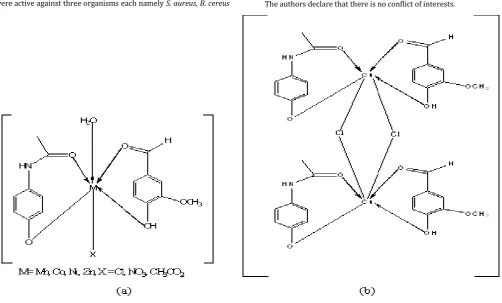
coordination. In the absence of suitable crystal for single x-ray diffraction measurement, percentage metal, magnetic and spectroscopic data were used to propose possible structures (Figure 1a).
Solubility and Conductance measurements
The complexes were slightly soluble in water, methanol, ethanol, nitromethane, and chloroform but were soluble in DMSO. Consequently, their molar conductances were measured in DMSO with values obtained in the range 4.14– 37.9 Ω-1cm2mol-1 indicating
their covalent nature [15].
Electronic Spectra and Magnetic moments
The ultraviolet spectra of the HL (Paracetamol) and HL1 (Vanillin)
were characterized by strong absorption maxima in the range 33.3-35.0 kK and 40.0-42.5 kK respectively, assigned to ππ* and charge transfer transitions. In the metal complexes, these bands shifted to the range 30.0-37.74 kK and 40.0-43.48 kK respectively due to coordination.
The Mn(II) complex showed two absorption bands at 16.67 kK and 23.81 kK, consistent with a low spin octahedral geometry and were assigned to 2T2g2T1g and 2T2g2A1g transitions. This complex had
an effective magnetic moment of 2.45 B.M. which was complementary of low spin octahedral Mn(II) [16].
Similarly, the Co(II) complex exhibited two absorption bands at 15.39 and 20.0 kK, typical of a low spin octahedral geometry and were assigned to 2Eg2T1g and 2Eg2T2g transition. An observed
moment of 2.0 B. M was indicative of low spin octahedral geometry since moments in the range 1.7-2.2 B.M were reported for low spin octahedral Co(II) complexes [17-18].
The Ni(II) complex showed two absorption bands at 11.77 and 23.26 kK typical of six coordinate high spin and low spin octahedral geometry, and were assigned to 3A2g 3T1g and 1A1g 1B2g
transitions. Room temperature magnetic moments in the range 2.8-3.3 B.M was expected for high spin octahedral complexes Ni(II) while low spin octahedral Ni(II) complexes were expected to be diamagnetic. Thus, an observed moment of 1.59 B.M for this complex corroborated equilibrium between high spin low spin octahedral geometry [19].
The Zn(II) complexes, [Zn(CH3CO2)(L)(HL1)] and [Zn(NO3)(L) (HL1)
(H2O)] expectedly showed M→L CT transitions around 23.67 kK, as
no d-d transition was expected. The former complex was diamagnetic expectedly while the latter complex had a moment of 0.86 B. M. due to polarisation paramagnetism and they assumed a 6-coordinate octahedral geometry [20].
The Cu(II) complex exhibited two bands at 11.11 kK and 21.98 kK typical of a 6-coordinate, tetragonal (octahedral) geometry and were assigned to 2B1g → 2B2g and 2B1g → 2Eg transitions [21]. A moment in
the chlorine atoms bridged two copper centers, and each copper centre reinforcing the overall magnetic susceptibility of the complex [22]. However, we are unable to confirm this due to the absence of viable crystals for single crystal X-ray structural investigation (Figure 1b).
Infrared spectra
The strong and medium bands at 3328 cm-1 and 3184 cm-1 in
Paracetamol and Vanillin were assigned as υOH band [3, 14]. This band in Paracetamol was absent in the metal complexes, due to the coordination of the phenol oxygen atom. On the contrary, the vOH band in Vanillin still remained but shifted to 3247-3116 cm-1, due to
the coordination of the phenol oxygen atom without deprotonation [4]. The broad band at 3500 cm-1 in the metal complexes were
assigned to v(OH) of coordinated water. The sharp bands in the range 1666-1503 cm-1 in Paracetamol and Vanillin were assigned to
υC=O stretching vibrations. These bands shifted to 1759-1553 cm-1
in the metal complexes, confirming coordination through their carbonyl oxygen atoms [23]. Furthermore, the new bands in the range 586 - 503 cm-1, 440-425 cm-1 and 388-356 cm-1 in the spectra
of the metal complexes were assigned to υ(M-N), v(M-O) and v(M-Cl) respectively. These bands were absent in the spectra of Paracetamol and Vanillin, a further evidence of coordination [2, 23].
Antibacterial activities
Paracetamol (HL), Vanillin (HL1) and the Mn(II) complex had no
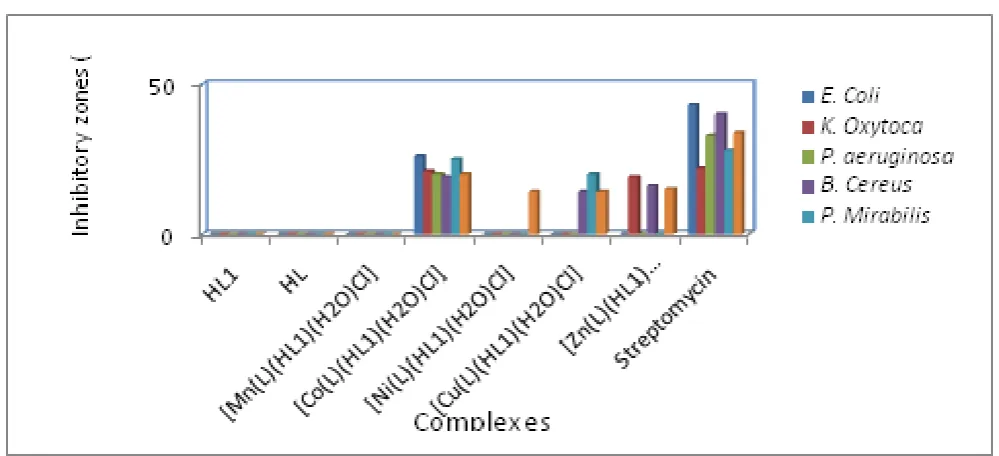
activity against the bacteria used. Several metal and metal complexes reportedly shown promise as strong antimicrobial agents against a broad spectrum of microorganisms [24]. Similarly in this study, the Ni(II) complex was active against only S. aureus with inhibitory zone of 14.0 mm. The Cu(II) and the Zn(II) complexes were active against three organisms each namely S. aureus, B. cereus
and P. mirabilis; and K. oxytoca, S. aureus and B. cereus with inhibitory zones range of 14.0-20.0 mm and 15.0-19.0 mm respectively. Hence, the Co(II) complex had the best antibacterial activity, being active against all the bacteria used with inhibitory zones range of 19.0-26.0 mm proving it’s potentials as a broad spectrum antibacterial agent (Figure 2). Generally, metal(II) complexes are expected to be more effective than the metal-free ligands due to chelation, which reduces the polarity of the metal atom mainly because of partial sharing of its positive charge with donor groups of the ligand and possible π-electron delocalization over the aromatic rings. This increases lipophilic character, favouring its permeation through lipid layers of the bacterial membrane [25]. Conversely, the inactivity of the Mn(II) and Ni(II) complexes may be attributed to their propable lipophobic character [26]. Expectedly, Streptomycin was more active than the metal complexes with inhibitory zones range of 22.0-43.0 mm.
CONCLUSION
Heteroleptic metal(II) complexes of Paracetamol (HL) and Vanillin (HL1) mostly analyzed as [M(L)(HL1)(H2O)X], where X = Cl/NO3; M =
Mn, Co, Ni, Cu and Zn based on percentage metal and conductance measurements. Infrared and electronic spectroscopies, with room temperature magnetic moments indicated a monomeric, 6-coordinate octahedral geometry for all the complexes with the exception of the Cu(II) complex, which was dimeric. The in-vitro antibacterial studies on these metal(II) complexes against B. cereus, E. coli, P.mirabilis, P. aeruginosa, K oxytoca and S. aureus showed that the Cobalt(II) complex exhibited a broad spectrum antibacterial activity against these bacteria.
CONFLICT OF INTERESTS
The authors declare that there is no conflict of interests.
Fig 1: Propose structures for some of the Metal(II) complexes
Fig 2: The activities of the metal complexes against bacteria and Streptomycin
REFERENCES
1. 1.Saritha K, Saraswathi U, Singaravelu G, Revathi S, Jayanthi V. Biological synthesis and characterization of gold nanoparticles using Lemna Minor. Asian J of Pharm and Clinical Res. 2014;7(2):165-167.
2. 2.Harminder K, Kanav D, Jaspreet K, Bharti M, Ashish C. Synthesis and evaluation of diorganotin(IV) and triorganotin(IV) derivatives of Aspirin, Paracetamol and Metronidazole as antimicrobial agents. American J of drugs and dev.2013;3(1):13-22.
3. 3.Lawal A, Obaleye JA. Synthesis, characterization and antibacterial activity of aspirin and paracetamol-metal complexes. Biokemistri 2007;19(1):9-15.
4. 4.Nejo AA, Kolawole GA, Nejo AO, Muller CJ. Synthesis, Characterization and insulin mimetic studies of complexes of Oxovanadium(IV) with Schiff bases. International J of drug formulation and research 2011;2(5):220-241
5. 5.Obaleye JA, Orjiekwe CL, Famurewa O. Effects of Some Novel Ascorbic Acid Metal Complexes on Selected Bacterial and Fungal Species. J. Sci. I.R. of Iran 1994;5(4):154-7.
6. 6.Osowole AA, Oni AA, Onyegbula K, Hassan AT. Synthesis, spectral, magnetic and in-vitro anticancer properties of some Metal(II) complexes of 3-[2,4-dihydro-1H inden-4-ylimino)methyl]napthalen-2-ol. Int. Res. J. of Pure and Applied Chemistry2012;2(3):211-220.
7. 7.Osowole AA, Ekenia AC, Achugbu BO. Synthesis, spectroscopic characterization and antibacterial Properties of some Metal (II) Complexes of 2-(6methoxybenzothiazol-2-ylimino)methyl)-4-nitrophenol. Research & Reviews: J. Pharm Analysis 2013a;2(2):1-5.
8. 8.Osowole AA, Ekennia AC, Achugbu BO, Etuk GH. Synthesis, spectroscopic characterization and structure related antibacterial activities of some metal(II) complexes of substituted triflurobutenol. Elixir Appl Chem. 2013b;59:15848-15852.
9. 9.Sangita PK, Farhad MA, Sania S, MdZakir S, Mohammad AH, Mohammad SA. Studyof Differential Scanning Calorimetry of complex of Magnesium Sulfate with Aspirin, Paracetamol and
treatment of gout. In Gilman, Alfred; Goodman,Louis Sanford; Hardman, Joel G.; Limbird, Lee E. Goodman & Gilman's thepharmacological basis of therapeutics. New York: McGraw-Hill; 2001. pp. 687–732.
11. 11.Larson AM, Polson J, Fontana RJ, et al. Acetaminophen-induced acute liver failure:
12. results of a United States multicenter, prospective study. Hepatology 2005;42(6):1364–72.
13. 12.Walton NJ, Mayer MJ, Narbad A. Vanillin. Phytochemistry 2003;63(5):505-15.
14. 13.Fitzgerald DJ, Stratford M, Gasson MJ, Ueckert J, Bos A, Narbad A. Mode of antimicrobialaction of vanillin against Escherichia coli, Lactobacillus plantarum andListeria innocua. J Appl Microbiol. 2004;97(1):104-13.
15. 14.Nahas R, Moher M. Complementary and alternative medicine for the treatment of type 2diabetes (Review). Can. Fam. Physician 2009;55(6):591-596.
16. 15.Geary WJ. The use of conductivity measurements in organic solvents for thecharacterization of coordination compounds. Coord. Chem. Revised 1971;7:81 - 122.
17. 16.Saha A, Majumdar P, Goswami S. Low-spin Mn(II) and Co(III) complexes of Naryl-2-
18. pyridylazophenylamines: new tridentate N,N,N-donors derived from cobaltmediated aromatic ring amination of 2-(phenylazo)pyridine. Crystal structure of amanganese(II) complex. J. Chem. Soc, Dalton Trans. 2000;1703-8.
19. 17.Barefield EK, Busch DH, Nelson SM. Cobalt and nickel complexes having anomalous magnetic moments. Quarterly Reviews, 1968;22:457.
20. 18.Goodwin HA. Spin Crossover in Cobalt(II) Systems. Top. Curr. Chem. 2004;234:23-27.
21. 19.Ohtsu H, Tanaka K. Equilibrium of low- and high-spin states of Ni(II) complexes
22. controlled by the donor ability of the bidentate ligands. Inorganic Chemistry 2004;43(9): 3024-30.
25. 22.Osanai K, Okazawa A, Nogami T, Ishida T. Strong ferromagnetic exchange couplings
26. in Cu(II) and Ni(II) complexes with a paramagnetic tridentate chelate ligand, 2,2-bipyridin-6-yl tert-butyl nitroxide. America J. Chem Soc 2006;128:14008-9.
27. 23.Al-Saif FA, Refat MS. Ten metal complexes of vitamin B3/niacin: Spectroscopic,thermal, antibacterial, antifungal, cytotoxicity and antitumor studies of Mn(II),Fe(III),Co(II), Ni(II), Cu(II), Zn(II), Pd(II), Cd(II), Pt(IV) and Au(III) complexes. J. of Molecular
28. Structure 2012;1021:40-52.
29. 24.Prema P, Selvarani M. Evaluation of antibacterial efficacy of chemically synthesized copper and zerovalent iron nanoparticles. Asian J of pharm and Clinical Res. 2013;6(3):223-227.
30. 25.Obaleye JA, Adediji JF, Adebayo MA. Synthesis and biological activities on metalcomplexes of 2, 5-Diamino-1, 3, 4-thiadiazole derived from semicarbazide hydrochloride. Molecules 2011;16:5861-74.