CSEIT1722186 | Received : 25 March 2017 | Accepted : 04 April 2017 | March-April-2017 [(2)2: 573-578]
International Journal of Scientific Research in Computer Science, Engineering and Information Technology © 2017 IJSRCSEIT | Volume 2 | Issue 2 | ISSN : 2456-3307
573
An Android Based Automatic Irrigation System Using Bayesian
Network with SMS and Voice Alert
Dr. P. Banumathi, D. Saravanan, M. Sathiyapriya, V. Saranya
Department of Computer Science and Engineering, Kathir College of Engineering, Coimbatore, Tamil Nadu, India
ABSTRACT
This paper presents an automatic irrigation system to provide water to the farms based on water level conditions using an android application, WSN and GPRS modules. Methods/statistical Analysis: An algorithm is developed such that sensor values are continuously fed to ARDUINO microcontroller. The sensor information is compared with the threshold values and based on that, decision will be taken to water the crops. The system is equipped with the photovoltaic panels and dual communication is established based on cellular-internet interface for continuous inquiry of data by the user. We have also developed an android mobile application for intercepting the data generated and voice alert generated. Findings: Because of system’s energy sovereignty, low cost and relatively more amounts of underground water saving, this system is preferable at water scarcity locations like desert areas. Conclusion: This irrigation system has been working with high efficiency and top speed. This system sends message to the user whenever sensors exceed there threshold value, by this system every user can understand the soil conditions and controls the system too manually, if needed.
Keywords: Automatic Irrigation, Arduino UNO, GSM Module, Soil Moisture Sensor, Temperature Sensor, Humidity Sensor
I.
INTRODUCTION
Internet of Things (IoT) is the emerging paradigm, which contains huge amount of smart object and smart devices connected to the internet for communicating with each other. IoT devices are used in many fields which make the users’ day to day life more comfortable. In recent years, the growth of internet is tremendous and has been further extended to connecting things through internet. All devices are connected to one another with various smart technologies to create worldwide ubiquitous network called IoT. The development of technologies such as IoT generates huge amount of data, leads to new age of information. At the present we are facing many challenges in the real world, which have to deal realistically. By the use of IoT challenges are rehabilitate, which consumes more time, resources and manpower. Efficient water management plays an important role in irrigated agricultural cropping systems. Irrigation is an essential component of crop production in many areas of the world. The measurement of the soil water content (u)
through in situdielectric methods are being used more frequently because they are non-destructive, provide almost instantaneous measurements, require little or no maintenance, can remain in the soil during the winter time, can provide continuous readings, they are nonradioactive, accurate measurements may be made near the soil surface, and their cost has decreased substantially in recent years. Self-propelled center pivot and linear-move irrigation systems generally apply water quite uniformly; however, substantial variations in soil properties and water availability exist across most fields.
irrigation control, data interface, software design, and communication can be challenging.
The coordination of control and instrumentation data is most effectively managed using data networks and low-cost microcontrollers [3]. Adopting a standard interface for sensors and actuators allows reuse of common hardware and communication protocol such as communication interface and control algorithm software. Instrumentation and control standards for RS-232 serial (voltage based) and RS-485 (current based) communication protocols have been widely applied and well documented for integrating sensors and actuators, particularly in industrial applications. A hard-wired system from in-field sensing stations to a base station takes extensive time and costs to install and maintain.
II.
METHODS AND MATERIAL
Proposed System:
The idea of the project is to implement an automatic irrigation system by sensing the moisture of the soil. The working of the circuit is as follows. The soil moisture sensor is inserted in the soil. Depending on the quality of the sensor, it must be inserted near the roots of the plant. The soil moisture sensor measures the conductivity of the soil. Wet soil will be more conductive than dry soil. The soil moisture sensor module has a comparator in it. The voltage from the prongs and the predefined voltage are compared and the output of the comparator is high only when the soil condition is dry. This output from the soil moisture sensor is given to the analogue input pin (Pin 2 – RA0) of the microcontroller. The microcontroller continuously monitors the analogue input pin.
When the moisture in the soil is above the threshold, the microcontroller displays a message mentioning the same and the motor is off. When the output from the soil moisture sensor is high i.e. the moisture of the soil is less. This will trigger the microcontroller and displays an appropriate message on the LCD and the output of the microcontroller, which is connected to the base of the transistor is high. When the transistor is turned on, the relay coil gets energized and turns on the motor. The LED is also turned on and acts as an indicator. When the moisture of the soil reaches the threshold value, the output of the soil moisture sensor is low and the motor is turned off. The system is also
designed to warn when the moisture is very high than the threshold and the soil is too wet, which is dangerous for the plant.
The circuit can be used to measure the loss of moisture in the soil over time due to evaporation and intake. Minimizes water waste and improves plant growth. The circuit is designed to work automatically and hence, there is no need for any human intervention. The project is intended for small gardens and residential environment. By using an advanced soil moisture sensor, the same circuit can be expanded to large agricultural fields.
The project is designed to develop an automatic irrigation system which switches the pump motor ON/OFF on sensing the moisture content of the soil. In the field of agriculture, use of proper method of irrigation is important. The advantage of using this method is to reduce human intervention and still ensure proper irrigation. The project uses an 8051 series microcontroller which is programmed to receive the input signal of varying moisture condition of the soil through the sensing arrangement. This is achieved by using an op-amp as comparator which acts as interface between the sensing arrangement and the microcontroller. Once the controller receives this signal, it generates an output that drives a relay for operating the water pump. An LCD display is also interfaced to the microcontroller to display status of the soil and water pump. The sensing arrangement is made by using two stiff metallic rods inserted into the field at a distance. Connections from the metallic rods are interfaced to the control unit. The concept in future can be enhanced by integrating GSM technology, such that whenever the water pump switches ON/OFF, an SMS is delivered to the concerned person regarding the status of the pump. We can also control the pump through WIFI.
Merits of the proposed system:
The main advantages of proposed IoT-Cloud networks with respect to traditional centralized cloud approaches are:
Low latency: service functions can be placed at the edge of the network in close proximity to the end users to support real-time services.
High reliability: service functions can be replicated across a highly distributed platform for increased fault tolerance and disaster recovery.
Reduced operational cost: service functions that require large inputs or produce large outputs can be placed close to their respective sources and/or destinations for reduced network load and associated operational cost.
High flexibility: A virtualization technology allows sharing the heterogeneous physical infrastructure among multiple services that can elastically tap into a rich pool of resources without the need of dedicated deployments.
Arduino:
Arduino is an open-source electronics platform based on easy-to-use hardware and software. Arduino boards are able to read inputs - light on a sensor, a finger on a button, or a Twitter message - and turn it into an output - activating a motor, turning on an LED, publishing something online. You can tell your board what to do by sending a set of instructions to the microcontroller on the board. To do so you use the Arduino programming language (based on Wiring), and the Arduino Software (IDE), based on Processing. Over the years Arduino has been the brain of thousands of projects, from everyday objects to complex scientific instruments. A worldwide community of makers - students, hobbyists, artists, programmers, and professionals - has gathered around this open-source platform, their contributions have added up to an incredible amount of accessible knowledge that can be of great help to novices and experts alike.
Arduino was born at the Ivrea Interaction Design Institute as an easy tool for fast prototyping, aimed at students without a background in electronics and programming. As soon as it reached a wider community, the Arduino board started changing to adapt to new needs and challenges, differentiating its offer from simple 8-bit boards to products for IoT applications, wearable, 3D printing, and embedded
environments. All Arduino boards are completely open-source, empowering users to build them independently and eventually adapt them to their particular needs. The software, too, is open-source, and it is growing through the contributions of users worldwide.
The Arduino software is easy-to-use for beginners, yet flexible enough for advanced users. It runs on Mac, Windows, and Linux. Teachers and students use it to build low cost scientific instruments, to prove chemistry and physics principles, or to get started with programming and robotics. Designers and architects build interactive prototypes, musicians and artists use it for installations and to experiment with new musical instruments. Makers, of course, use it to build many of the projects exhibited at the Maker Faire, for example. Arduino is a key tool to learn new things. Anyone - children, hobbyists, artists, programmers - can start tinkering just following the step by step instructions of a kit, or sharing ideas online with other members of the Arduino community.
There are many other microcontrollers and microcontroller platforms available for physical computing. Parallax Basic Stamp, Netmedia's BX-24, Phidgets, MIT's Handyboard, and many others offer similar functionality. All of these tools take the messy details of microcontroller programming and wrap it up in an easy-to-use package. Arduino also simplifies the process of working with microcontrollers, but it offers some advantage for teachers, students, and interested amateurs over other systems:
Inexpensive - Arduino boards are relatively inexpensive compared to other microcontroller platforms. The least expensive version of the Arduino module can be assembled by hand, and even the pre-assembled Arduino modules cost less than $50
Cross-platform - The Arduino Software (IDE) runs on Windows, Macintosh OSX, and Linux operating systems. Most microcontroller systems are limited to Windows.
learning to program in that environment will be familiar with how the Arduino IDE works.
Open source and extensible software - The Arduino software is published as open source tools, available for extension by experienced programmers. The language can be expanded through C++ libraries, and people wanting to understand the technical details can make the leap from Arduino to the AVR C programming language on which it's based. Similarly, you can add AVR-C code directly into your Arduino programs if you want to.
Open source and extensible hardware - The plans of the Arduino boards are published under a Creative Commons license, so experienced circuit designers can make their own version of the module, extending it and improving it. Even relatively inexperienced users can build the breadboard version of the module in order to understand how it works and save money.
LM-35
The LM35 series are precision integrated-circuit temperature devices with an output voltage linearly- proportional to the Centigrade temperature. The LM35 device has an advantage over linear temperature sensors calibrated in Kelvin, as the user is not required to subtract a large constant voltage from the output to obtain convenient Centigrade scaling. The LM35 device does not require any external calibration or trimming to provide typical accuracies of ±¼°C at room temperature and ±¾°C over a full −55°C to 150°C temperature range. Lower cost is assured by trimming and calibration at the wafer level. The low-output impedance, linear low-output, and precise inherent calibration of the LM35 device makes interfacing to readout or control circuitry especially easy. The device is used with single power supplies, or with plus and minus supplies. As the LM35 device draws only 60 µA from the supply, it has very low self-heating of less than 0.1°C in still air. The LM35 device is rated to operate over a −55°C to 150°C temperature range, while the LM35C device is rated for a −40°C to 110°C range (−10° with improved accuracy). The LM35-series devices are available packaged in hermetic TO transistor packages, while the LM35C, LM35CA, and LM35D devices are available in the plastic TO-92 transistor package. The LM35D device is available in
an 8-lead surface-mount small-outline package and a plastic TO-220 package.
DHT-11
The DHT11 is a basic, ultra low-cost digital temperature and humidity sensor. It uses a capacitive humidity sensor and a thermistor to measure the surrounding air, and spits out a digital signal on the data pin (no analog input pins needed). Its fairly simple to use, but requires careful timing to grab data. The only real downside of this sensor is you can only get new data from it once every 2 seconds, so when using our library, sensor readings can be up to 2 seconds old. Creating the web server and Configuring the cloud server.Deploying the sensor devices and establishing the connection with controller.Maintain the login database in cloud server.Establishing connection between WSN and Cloud model.Creating the authentication model for user in cloud server.
III.
RESULTS AND DISCUSSION
System Implementation
This automatic irrigation system senses the moisture content of the soil and automatically switches the pump when the power is on. A proper use of the irrigation system is very important because the main reason is the shortage of land reserved water due to lack of rain, unplanned use of water as a result large amounts of water goes waste. The power supply consists of a step-down transformer, which steps step-down the voltage to 12VAC. By using a bridge rectifier this AC is converted to DC, then it is regulated to 5v using a voltage regulator which is used for the operation of the microcontroller.
When the soil condition is greater than the reference voltage, the soil becomes dry. Then the timer sends the logic signal 0 to the microcontroller, this turns off the motor driver circuit and prompts motor to pump water to the fields. Finally, the condition of the motor and soil display in the serial monitor. Micro irrigation is nothing but a slow and regular application of water and nutrients moving down drop-by-drop directly to the root zone of the plants through low-discharge emitters and plastic pipes. This irrigation system is today’s need of the hour as the natural water resources which are gift to the mankind have become scarce, and that are now not unlimited and free forever. But, the world’s water resources are now fast moving back on track. After one completes the study of inter relationship between crops, soil, water and climatic conditions, one will find this micro irrigation system as a suitable system capable of delivering exact quantity of water at the root zone of the plants.
This system ensures that the plants do not endure from the strain or stress of less and over watering. The advantages of using this micro irrigation system are that for every drop of water used, we get more crop, better quality, early maturity, higher yield. Moreover, this system saves labor cost and water up to 70%. The working of this irrigation system covers over 40 crops spanning across 500 acres.
In order to perform the environmental monitoring process, the actual requirements of the current plants must be identified. These information are collected from the precision database of the plant agriculture. The development configuration is applied with he arduino circuit and list of sensor attached in either analog of in digital input model.the power supply is provided to activate the embedded circuit. The components are connected with the system using USB interface.
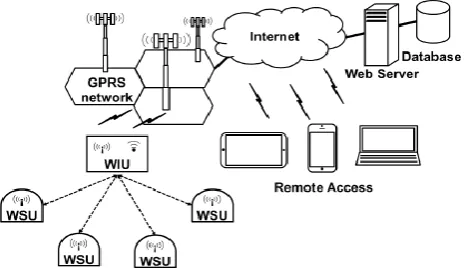
Using sensor temperature and humidity (dht11) current environment status is identified using the analog input modelling. The identifies inputs ate forwarded to embedded device and the input is displayed in the system attached with the arduino. The smartphone is connected with the arduino serial input as either on Bluetooth interface Or in WiFi interface. The information collected by the sensor are forwarded to the smart phone using the wireless interface of the system
In the periodical activities of the arduino system, the water is irrigated using the DC motor attached in the system. The rpm of the motor and the number of revolutions are controlled by the embedded system. The continues events are regulated from the embedded controlled as the part of timer activity. Whenever the timer is expired the motor is execute to provide the water with the specific water level.
From the provision of the water irrigation, the output of the system is identified and stored in the database as output with respect to the input. The temperature level increment and decrement with the changes in the humidity are applied to the neural network. To identify the accurate requirement of the water supply which is used to classify the input level. The system is validated from the learning process.
MACHINE-TO-MACHINE (M2M) communications constitute the basic communication paradigm in the emerging Internet-of-Things (IoT) and involve the enabling of seamless exchange of information between autonomous devices without any human intervention. The increasing popularity of services and systems based on the use of M2M communications has been fueled in part by the utility of the applications they facilitate, as well as by the continued fall in the prices of autonomous devices capable of sensing and actuating.
The increasing M2M traffic and the associated revenue have created an interest among telecom operators as well as regulatory and standardization bodies to facilitate M2M communications. In the application systems based on IoT, physical entities are connected to the information systems through sensors or tags, which become the representations of physical entities in information systems. The information systems cannot transfer physical entities directly; instead, the representations of the physical entities are transferred to realize the interactions of the physical entities.
MAC address of the sensor module. ESP tag information can be read using an embedded ESP reader on the Android smartphone and tapping the phone on the tag is the only requirement to read the target device information and to start the application. Different ESP tags can be used to store multiple target connection information on the Android application.
IV.CONCLUSION
It also has a rapid development of many fields including farming. The impact of the IoT on the evolution towards next generation smart environments will largely depend on the efficient integration of IoT and cloud computing technologies. A direct estimate of crop water use by subsurface measurements of soil water content has been limited by the high cost of reliable soil moisture sensors. In-field sensor-based site-specific irrigation management is of benefit to producers for efficient water management. Communication signals from the sensor network and irrigation controller to the base station were successfully interfaced using low-cost wifi radio communication. An irrigation machine was converted to be electronically controlled by a programming logic controller that updates sensed information. In this work, An automated irrigation system is developed to optimize water use for agricultural crops. The system has a distributed wireless network of soil-moisture and temperature sensors placed in the root zone of the plants. An algorithm was developed with threshold values of temperature and soil moisture that was programmed into a microcontroller-based gateway to control water quantity.
V.
REFERENCES
[1]. Wang X, Yang W, Wheaton A, Cooley N, Moran B. Efficient registration of optical and IR images for automatic plant water stress assessment. Comput Electron Agr. 2010 Nov; 74(2):230–7. [2]. Nallani S, Berlin Hency V. Low Power Cost
Effective Automatic Irrigation System. Indian Journal of Science and Technology. 2015 Sep; 8(23):1–6.
[3]. Yuan G, Luo Y, Sun X, Tang D. Evaluation of a crop water stress index for detecting water stress in winter wheat in the North China Plain. Agr Water Manag. 2004 Jan; 64:29–40.
[4]. Erdem Y, Arin L, Erdem T, Polat S, Deveci M, Okursoy H, Gultas HT. Crop water stress index
for assessing irrigation scheduling of drip irrigated broccoli (Brassica oleracea L. var. Italic). Agr Water Manag. 2010 Dec; 98(1):148– 56.
[5]. Kim Y, Evans RG, Iversen WM. Remote sensing and control of an irrigation system using a distributed wireless sensor network. IEEE Trans Instrum Meaurement. 2008 Jul; 57(7):1379–87. [6]. Dalip, VK. Effect of Environmental Parameters
on GSM and GPS. Indian Journal of Science and Technology. 2014 Aug; 7(8):1183–8.
[7]. Zhou Y, Yang X, Wang L, Ying Y. Low cast design of wireless irrigation system based on ZigBee technology Networks Security. 2009 NSWCTC ‘09 International Conference on Wireless Communications and Trusted Computing. 2009 Apr. p. 572–5.
[8]. Vijaya kumar S, VishnuVardhan D. Wireless Network Sensors for Precise Agriculture Monitoring. (IJIRSE) International Journal of Innovative Research in Science and Engineering. 2011 Mar; 307–10.