CSEIT1722172 | Received : 22 March 2017 | Accepted: 31 March 2017 | March-April-2017 [(2)2: 488-494]
International Journal of Scientific Research in Computer Science, Engineering and Information Technology © 2017 IJSRCSEIT | Volume 2 | Issue 2 | ISSN : 2456-3307
488
An Efficient Image Retrieval System Using Surf Feature Extraction and
Visual Word Grouping Technique
S. Bhuvana,
F. Ragini Felicia Suruti,
R. Shariene Fathima,
P. Vincy Roshalin, M. Radhey
Computer Science and Engineering, Sri Krishna College of Technology, Coimbatore, Tamil Nadu , IndiaABSTRACT
Content Based Image Retrieval is widely used to find the location of images for many application scenarios. It is used to tag the images using large geo-tagged image set. In recent years, images are tagged based on their locations and geo-tagged images consumes more memory space. Therefore, the performance of the image location estimation can be improved by using visual word groups. The mean shift clustering algorithm and a position descriptor have been used to generate visual word groups. A fast indexing structure is build using document builder interface. Thus the drawbacks in the existing system have been over-come in the proposed system. The proposed system involves Speeded-Up Robust Transform (SURF) which is a feature detection and descriptor method which is used for object recognition. The modules include Feature extraction which is used to identify the interest points within the image, Indexing which builds an inverted file structure to reduce the image size, Image retrieval which compares the input image with the query image to give the resultant output and Re-Ranking which categorizes the top ranked images.
Keywords : Image Retrieval, Bag-Of-Visual Words, Spatial Constraint, Salient Area Detection, And Mean-Shift Clustering.
I.
INTRODUCTION
1.1 Background
Image processing is the technique to analysis and manipulate digitized images in order to boost image quality. It is a methodology to convert a picture into digital type and perform some operations thereon, so as to urge increased image quality or to extract some helpful data from it. It’s a kind of signal dispensation within which input is image, like video form or picture and output is also image or characteristics related to that image. Image processing mainly involves digital image processing, optical and analogue image processing.
1.2 Content Based Image Retrieval:
Content Based Image Retrieval (CBIR) is the method of retrieving images from a large dataset. The content may refer colors, shapes, textures that can be derived from the image itself. It is used to find a particular image from a collection of images which is shared by many professional groups. With massive image
databases turning into a reality in both scientific and medical domains and in the advertising/marketing domain ways for organizing information of pictures for effective image retrieval have become important. CBIR plays a vital role for this purpose. CBIR mainly determines the locations of an input image using clustering techniques. It improves the image location estimation process.
1.3 SURF Feature Extraction:
method should preferably be applicable when the image shows the object with various transformations, mainly scale and rotation, or when certain parts of the object are occluded. The main steps involved in SURF feature extraction involves:
Detection: Automatically identify interesting features such as colour, texture, interest points this must be done robustly. The same feature should always be detected regardless of viewpoint.
Description: Every interest point must have a specific description that does not rely on the features such as scale and rotation.
Matching: Given an input image, determine which objects it contains and matches, and possibly a transformation of the object, based on predetermined interest points. This paper involves various sections: Section I described the introduction of the paper, section II depicts the literature review, section III gives a brief detail about the proposed system, section IV explains the experimental results, section V gives the conclusion and section VI Describes the future work.
II.
METHODS AND MATERIAL
Related works:
In this section, the existing solutions for the image retrieval technique and several state of image retrieval methods are reviewed. The related work includes several methods which are briefly explained below:
2.1 Bag of visual words method: In a recent paper, S. Zhang, Q.Tian ,G. Hua, Q. Huang, and S. Li [1] proposed a descriptive visual words and visual phrases for various image applications. The Bag-of-visual Words (BoW) image representation has been implemented for various scenarios and problems in the fields of multimedia and computer vision. The basic idea is to represent images as visual documents composed of repeatable and distinguishing visual elements, which are comparable to the words in texts. In this paper, Descriptive Visual Words (DVWs) and Descriptive Visual Phrases (DVPs) are suggested as the visual correspondences to text words and phrases, where visual phrases allude to the frequently co-occurring visual word pairs. Based on this idea, a general framework is proposed for creating DVWs and
DVPs from classic visual words for several applications.
2.2 Location estimation method: J.Li, X. Qian, Y. Y. Tang, L. Yang, and T. Mei [4] proposed a GPS estimation method for places of interest to determine the location of images. In recent years people tend to share their photos, taken while they are traveling, to the social media sharing websites, such as Facebook. With the help of these images taken in places of interest in conjunction with the broad multimedia information realm, the task of automatic image GPS location estimation became possible. Typically, images taken from similar locations share some unique features, even when the images are taken from several viewpoints. These salient features play an important role in the image location estimation problem. Experiments on different datasets provide the effectiveness of the proposed method. Saliency of each BoW in determining the image will be measured. In this paper a method has been proposed to avoid duplication of images. Spatial constraint method is both efficient and effective. It also discovers false matches of certain features among images and improves image retrieval performance.
2.3 Object detection method: In this paper G. Cheng et al.,[3] proposed an effective representation and classification of scenes using very high resolution (VHR) for remote sensing images which cover a wide range of applications. Although low-level image features have been proven to be efficient for scene classification, they are not semantically useful and thus have difficulty to deal with challenging visual recognition tasks. In this study, the authors proposed a new and effective auto-encoder-based method to make use of a shared mid-level visual dictionary. This dictionary serves as a shared and universal basis to find level visual elements. On the one hand, the mid-level visual dictionary learnt using machine learning technique is more discriminative and contains rich semantic information, compared with the traditional low-level visual words.
ignored or exploited for full geometric verification, which is computationally expensive. Estimation of the geometric constraints is a complicated task.
2.5 Landmark Retrieval Method: In this paper, E. Gavves, C. G. M. Snoek, and A. W. M. Smeulders[7] have addressed the incoherence problem of the visual words in bag-of-words vocabularies. Different from existing work, which assigns words based on closeness in descriptor space, focus is made to find pairs of independent, distant visual words – the visual synonyms – that are likely to host image patches of same visual reality. Image geometry is used to find those image features that lie in the nearly distinct physical location, yet are assigned to various other words of the visual vocabulary. Defined in this way, evaluation is done based on the validity of visual synonyms. Examining the closeness of synonyms in the L2 - normalized feature space is also done. Visual synonyms is widely used for vocabulary reduction.
2.6 Motivation: From the literature review it was observed that most of the image retrieval technique utilizes SIFT method where the computational cost is extremely high for model parameters training. Global Positioning System (GPS) estimation approach is also very computationally intensive when the scale of dataset is very large. To overcome these issues, the proposed system utilizes SURF method. The computational cost of SURF extraction is very low when compared to other extraction methods.
III.
RESULTS AND DISCUSSIONProposed Scheme:
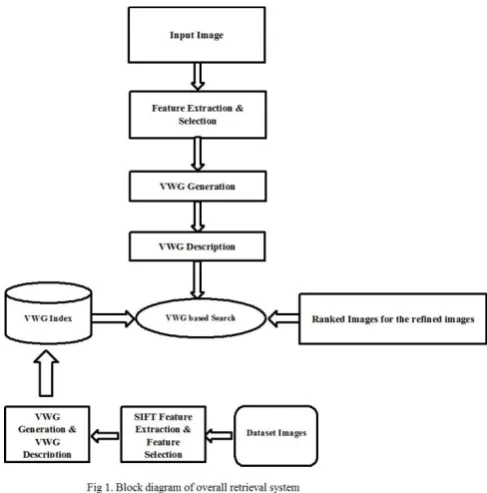
The following block diagram depicts the overall image retrieval system. The various modules of the image retrieval system is mentioned in the below diagram.
3.1 Feature extraction and selection:
Feature extraction involves a set of data within which the interest points are selected from the image for object comparison. Latent semantic analysis is the main process done in feature extraction and selection. Latent semantic analysis is the process which groups words that are similar in meaning various regions in each image is matched according to the similarity.
3.2 VWG description and generation:
Visual word group description and generation involves several steps:
Set up image category sets: Organize and separate the images into training and test subsets. Use the
image
data store function to store the images to use for
training an image classifier. Grouping images into categories makes handling large sets of images much easier. Split Each Label function is used to split the images into training and test data.Figure 2. VWG Generator
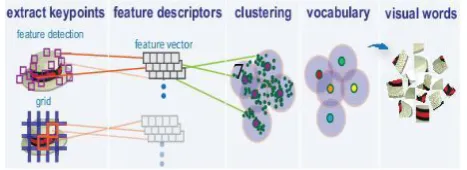
represents the features, by using the k-means clustering algorithm on the feature descriptors acquired from training sets. The algorithm iteratively groups the descriptors into k mutually exclusive clusters. Extricate features based on a feature detector, or define a grid to extract feature descriptors. Therefore, use the grid for images that do not have similar features, such as an image containing scenery. Using speeded up robust features (or SURF) detector higher scale invariance can be obtained.
7
Figure 3. Train an Image Classifier with BoVW
The
trainImageCategoryClassifier function gives an
image classifier. The function trains a multiclass classifier by using the error correcting output codes (ECOC) framework. Along with binary support vectormachine (SVM) classifiers. The
trainImageCategoryClassifier function utilizes the bag of visual words returned by the bagofFeatures object to convert images in the image set into the histogram of visual words. The histogram of visual words are used as the positive and negative samples which is used to train the classifier. Use the bagofFeatures conversion method to convert each image from the training set. This function identifies and extracts features from the image and then makes use of the approximate nearest neighbor algorithm to build a feature histogram for each image. The function then increases histogram bins based on the proximity of the descriptor.
Figure 4. Encoding method
Repeat this for each image in the training set to develop the training data.
Figure 5. Classification of training data
Assess the quality of the classifier. The output confusion matrix depicts the analysis of the prediction. A perfect classification results in a normalized matrix which contains 1s on the diagonal. An incorrect classification will result fractional values.
Figure 6. Construction of confusion matrix
3.3 Grouping images into clusters:
Images are clustered based on certain features. Through this feature clustering the whole dataset can be divided into several groups. K-means clustering is utilized to divide the dataset into M small clusters, denoted as Cn (n = 1, . . . , M).
Mean Shift Clustering:
Mean shift is a technique for detecting the maxima of a density function given discrete data sampled from that given function. It is useful for finding the modes of this density.
Consider a given set of points in a two-dimensional space.
Consider a circular window centered at C, having radius r as the kernel.
Mean shift is a hill climbing algorithm which mainly involves shifting this kernel iteratively to a higher density region till it achieves the convergence.
6. At every iteration the kernel is shifted to the centroid. The method of calculating this mean mainly depends on the choice of the kernel. 7. At the point of convergence, no more direction
will be found at which a shift can occupy more points inside the kernel.
3.4 Image Indexing
Image indexing builds inverted file structure for all the images to reduce the image size. The relative position descriptor of visual word is recorded. Each image contains different visual word groups. Sift points and visual word groups are detected and calculated. The position descriptor vectors are generated. Finally, the similarity between the input image and query image has been calculated.
3.5 Re-ranking of images
The images which are compared with the query image is then grouped based on its similarity. The images which are more similar to the query image is presented at the top while the other images are ranked according to the similarity. Thus the image retrieval becomes easier with the help of re-ranking technique.
4. Experimental results:
4.1 Image dataset: Image dataset involves several images contained in a data matrix. Variety of data sets are available for retrieval of images such as CALTECH dataset, CORAL dataset etc. A collection of 100 images of several category from WANG dataset has been made.
4.2 Performance analysis:
Images from the WANG dataset have been used. This dataset comprises of a large number of images ranging from animals to outdoor sports to natural images. Some researchers are of the opinion that the Corel database meets all the requirements to evaluate an image retrieval system, due to its large size. For our experiment, a collection 100 of several categories of images from WANG database has been made. These images are collected from several domains such as buses, dinosaurs, elephants, flowers etc. Each category has images with a resolution of either 256 384 or 384 256. For each query, the system collects database images with the shortest image matching distance
computed for easy retrieval. If the retrieved image belongs to same category as that of the query image, then we can say that the system has appropriately identified the expected image, or else, the system has failed to find the expected image after comparison. The test image is matched with matched database to identify high frequency regions and matching. Precision is the fraction of retrieved documents that are relevant to the search. Precision takes all retrieved documents, but it can also be evaluated at a cut-off rank, considering only the top-ranked results returned by the system.
Eq.1
Recall in information retrieval is the fraction of the documents that are similar to the query image which are successfully retrieved.
Eq. 2
The performance measure of the algorithms proposed is done with the calculation of the precision-recall.
4.3 Comparison Graph:
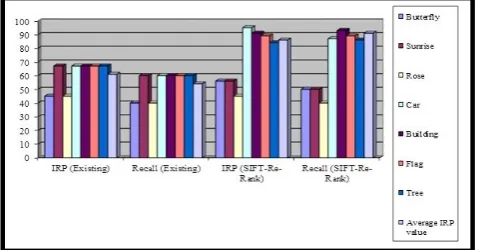
The below image represents the query image comparison between different image sets after calculating Image Retrieval Precision (IRP) and re-call category.
Figure 7. Compare different image with IRP and
Recall
IV.CONCLUSION
The process of dealing with the manipulations of
any image database has become extremely tedious
due to its intense growth. Thus our approach dealt
in this paper involves an efficient CBIR technique
that focuses on low-level image features such as
the color, texture and shape. The proposed system
aims on an automatic image search and retrieval.
This system incorporates a new indexing technique
along with few other feature extraction techniques
that extracts various multi-resolution SIFT features
with re-ranking from the images in the database.
The system also contains a very simple but very
effective retrieval method and all these put
together have reduced the number iterations that
were there in the existing systems. Experiments
were stimulated using WANG database and were
proved that this system has minimized the effects
of user's inaccurate relevance feedback and
appropriate images were retrieved very efficiently
with less iteration
.
V.
FUTURE WORK
The future works appear from the limitations and
the difficulties when we develop our system. The
following developments can be made in the future:
It hope to build more generalized CBIR system
which increase the system searching ability and
provide more accurate results. To improve the
retrieval results, the system has to take the
feedback from the user. The user checks the results
and comments on them by some way. Then, the
system recalculates the results with the advantage
of the feedback. To further improve the
performance of the retrieval system, we hope to
optimize some settings of the system architecture
and techniques that used in this research. There
exist some details setting that can be discussed and
optimized with the images retrieval issues. This is
like, the number of clusters k as an inputs for the
K-means algorithm and input parameters of the
genetic algorithm etc.
VI.REFERENCES
[1] S. Zhang, Q. Tian, G. Hua, Q. Huang, and S. Li, “Descriptive visual words and visual phrases for image applications,” in Proc. 17th ACM MM, 2009, pp. 75–84.
[2] Y. Li, D. J. Crandall, and D. P. Huttenlocher, “Landmark classification in large-scale image collections,” in Proc. IEEE 12th ICCV, Sep. /Oct. 2009, pp. 1957–1964.
[3] G. Cheng et al., “Object detection in remote sensing imagery using a discriminatively trained mixture model,” ISPRS J. Photogram. Remote Sens., vol. 85, pp. 32–43, Nov. 2013.
[4] J. Li, X. Qian, Y. Y. Tang, L. Yang, and T. Mei, “GPS estimation for places of interest from social users’ uploaded photos,” IEEE Trans. Multimedia, vol. 15, no. 8, pp. 2058– 2071, Dec. 2013.
[5] C. Hauff and G.-J. Houben, “Placing images on the world map: A microblog-based enrichment approach,” in Proc. 35th ACM SIGIR, 2012, pp. 691–700.
[6] H. Liu, T. Mei, J. Luo, H. Li, and S. Li, “Finding perfect rendezvous on the go Accurate mobile visual localization and its applications to routing,” in Proc. 20th ACM Int. Conf. Multimedia, 2012, pp. 9–18.
[7] E. Gavves, C. G. M. Snoek, and A. W. M. Smeulders, “Visual synonyms for landmark image retrieval,” Comput. Vis. Image Understand., vol. 116, no. 2, pp. 238– 249, 2012.
VII.
Author Profile
Dr. S. Bhuvana Shanmugam is
currently working as Assistant
Professor in the department of
Computer
Science
and
Engineering, Sri Krishna College
of Technology, Her research work
in Image Retrieval. Her research
interests includes Image Processing and Machine
Learning.
Ms. F. Ragini Felicia Suruti
is
currently working as Assistant
Professor in the department of
Computer Science and Engineering,
Sri Krishna College of Technology.
Her area of interests includes Image
Processing
and
Database
management system.
Ms. P. Vincy Roshalin is currently
pursuing Bachelor’s degree in
Computer Science and Engineering
at
Sri
Krishna
College
of
Technology, Coimbatore. Her area
of
interest
includes
Database
Management System and Java
programming.
Ms. M. Radhey is currently
pursuing Bachelor’s degree in
Computer Science and Engineering
at
Sri
Krishna
College
of
Technology, Coimbatore. Her area
of
interest
includes
Database
Management System and Java programming.
Ms.
R.
Shariene
Fathima
is
currently
pursuing
Bachelor’s