DrillCutTM vs VersaCutTM prostate tissue morcellation devices after holmium laser enucleation: A prospective, randomized controlled trial
Ahmed Ibrahim, MD, MSc1; Mostafa M. Elhilali, MD, PhD, FRCSC1; Mohammed A. Elkoushy, MD, PhD1,2; Sero Andonian, MD, MSc, FRCSC, FACS1*; Serge Carrier, MD, FRCSC1*
1Department of Urology, McGill University Health Centre, Montreal, QC, Canada; 2Department of Urology, Suez
Canal University, Egypt *Co-senior authors
Acknowledgement: CUA-SIU International Scholarship to Dr Ahmed Ibrahim.
Cite as: Can Urol Assoc J 2018 December 3; Epub ahead of print. http://dx.doi.org/10.5489/cuaj.5626
Published online December 3, 2018
***
Abstract
Introduction: We aimed to compare efficacy, safety, and cost of disposables of the DrillCutTM morcellator with the VersaCutTM morcellator after holmium laser enucleation of the prostate (HoLEP).
Methods: After obtaining ethical approval, consecutive patients undergoing HoLEP for symptomatic benign prostatic hyperplasia were randomized to have their enucleated prostates morcellated by either Karl Storz® DrillCutTM or Lumenis® VersaCutTM morcellators. All procedures were performed by two experienced urologists. Patients’ demographics and perioperative data were recorded. Both morcellators were compared for their safety, efficacy, and cost-effectiveness.
Results: Eighty-two patients were included in the study (41 per each arm). Both groups were comparable in terms of age, preoperative prostate size (114 vs. 112 mL; p>0.05), enucleation time (95.3 vs. 91.7 minutes; p>0.05), and morcellation time (22.6 vs. 17.3 minutes; p>0.05). The DrillCutTM was associated with significantly lower morcellation rate when compared withthe VersaCutTM (3.6 vs. 4.9 g/min; p= 0.03). In terms of safety, there was no significant difference between both morcellators in complication rates (2.4% vs. 7.3 %; p=0.1). However, there was one case of bladder perforation requiring exploration with the VersaCutTM. The DrillCutTM was associated with significantly higher cost of disposables when compared with the
Conclusions: Despite the small sample size, the DrillCut™ was associated with lower morcellation rate when compared with the VersaCutTM. However, this difference may not be clinically significant. Although both morcellators were comparable in their safety, the DrillCutTM was associated with higher cost of disposables when compared with the VersaCutTM.
Introduction
Bothersome lower urinary tract symptoms (LUTS) secondary to benign prostatic hyperplasia (BPH) is a common problem, which impacts patients’ quality of life. Transurethral resection of the prostate (TURP) was considered the surgical gold standard for treatment of bladder outlet obstruction (BOO) secondary to BPH for more than 2 decades. Currently, different types of laser procedures have been used as altrnatives to TURP due to lower morbidity and higher
efficiency.1,2
Introduction of the Holmium laser represented a turning point in minimally-invasive laser therapy for BPH as it achieves size-independent prostatic cavity similar to simple open
prostatectomy with significantly lower perioperative morbidity.3 It has successfully passed the steps of validation through a growing number of well-designed randomized controlled studies.4,5 Consequently, recent guidelines now incorporate holmium laser enucleation of the prostate (HoLEP) as an alternative option for treatment of symptomatic BPH with high level of evidence for safety and efficacy.6
HoLEP has been criticized for its long procedural time, which consists of two critical steps of transitional zone enucleation followed by tissue morcellation. All endoscopic enucleation
techniques end by completely detaching the adenoma and depositing it in the bladder. Although several technical modifications have been made during the last several years to improve the efficacy of enucleation, the optimal morcellation device is still unknown.7,8
Morcellation time depends mainly on the amount of enucleated prostatic tissue,
Methods
This is a prospective randomized clinical study in which consecutive patients undergoing HoLEP for BPH were randomly assigned to have their enucleated prostate morcellated by either Karl Storz® DrillCutTM or Lumenis® VersaCutTM by two experienced urologists. Although one surgeon had more experience than the other, both surgeons had performed at least 500 HoLEP procedures each using the VersaCutTM morcellator prior to the trial. The study was approved by the local ethics committee. Inclusion criteria for the study were male subjects over 40 years of age presenting with BOO due to BPH and scheduled for HoLEP. Written informed consents were obtained prior to enrollment into the study. Patients with previous surgical treatment for BPH, uncorrected coagulopathy, in addition to patients with history of prostate cancer were excluded from the study.
Sample size calculation
At the time of sample size calculation, there was only one published randomized clinical study comparing the gold standard VersaCutTM to the newer PiranhaTM morcellator.9 In that study, they had powered to detect a difference of 2.5 grams per minute in morcellation rate and their sample size was calculated to consist of 35 patients in each arm.9 At the end of their study, they found no statistically significant difference in the morcellation rates of PiranhaTM and VersaCutTM (5.6 vs 4.8 grams per minute; p=0.14).9 There were no other published studies regarding the
morcellation rate of the latest DrillCutTM morcellator. Therefore, this study was powered to detect a difference in morcellation rate of 2 grams per minute between DrillCutTM and
VersaCutTM morcellators. We hypothesized that 2 grams per minute difference in morcellation rate would be clinically significant between the two morcellators (morcellation efficiency). Type I error (alpha) was set at 0.05 (two-tailed) and type II error (beta) was set at 0.2 (power of 80%). This yielded a projected overall sample size of 82 patients (41 per arm).
Randomization
Surgical technique
HoLEP procedure basically involves anatomical dissection of the prostatic adenoma off the surgical capsule via a retrograde approach, starting at the apex. A 120 W holmium laser generator (Lumenis PulseTM P120H, Yokneam, Israel) was connected to a reusable 550-nm quartz end-firing fiber (SlimLineTM 550, Lumenis Inc.) and used through a modified
continuous-flow 26 Fr resectoscope with a distal bridge and video system. An enucleation loop has been recently used as a laser guide with a retracting beak and a working element. Under general or regional anesthesia, using warm normal saline as an irrigant, urethral meatal
calibration was performed using Van Buren sounds up to 30 French (Fr). Based on the prostate anatomy and the presence of a prominent median lobe, either a one, two or three-lobe technique was performed. Rigid indirect nephroscope, with a 5-mm working channel, was used to
introduce the tissue morcellator at the end of the procedure using dual irrigation system. Both morcellators were present at our institution before starting randomization. Prior to starting our randomized study, we tested the new DrillCutTM morcellator at different morcellation speeds and we found that when using higher rpms than the recommended 1500rpm, there was a problem with the suction mechanism of the morcellator which affected the morcellation rate. Therefore, the DrillCutTM morcellator was set at the manufacturer’s recommended setting of 1,500 rpm to achieve maximum efficiency. For the Lumenis VersaCutTM, the foot switch was used to control the speed of morcellation based on the subjective feel of the quality of morcellated tissues and the need for suction. It was not possible to track the morcellation speed of the VersaCutTM morcellator since there are no log files that could analyzed. For the purposes of standardization, every blade was used for a maximum of 4 times for both morcellators. Following morcellation of the prostate tissue, a standard 22Fr two-way or three-way catheter was inserted with intermittent or continuous bladder irrigation, respectively. The urethral catheter was removed on
post-operative day 1 and the patient was discharged home.
The following morcellator parameters were collected: morcellation time defined as the time from introduction of the morcellator blade into the bladder until extraction of the last piece of the prostatic adenoma; morcellation rate (efficiency) as calculated by dividing the weight of the prostate specimen by the time needed for retrieval (g/min); incidence of difficult morcellation due to tissue consistency (beach balls or snow balls); device-related complications; device
malfunction; and cost of disposable instruments. All subjects were followed-up to assess perioperative and postoperative adverse events related to the procedure.
Statistical analyses
distributed continuous variables, respectively. Two-tailed p-values of less than 0.05 were set for statistical significance.
Results
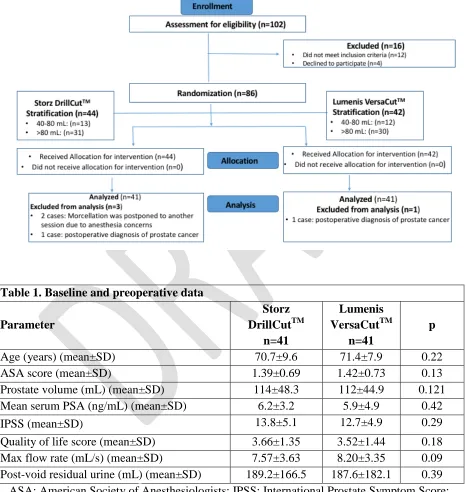
A total of 82 patients were included in the final analysis in this open-label randomized controlled trial (41 patients in each arm) between June 2016 and October 2017 (Figure 1). There were no significant differences between both groups in terms of age, pre-HoLEP PSA and prostate size as assessed by trans-rectal ultrasound. Baseline and pre-operative characteristics are presented in (Table 1). Each surgeon performed comparable number of morcellations using DrillCutTM and VersaCutTM morcellators.
Intra-operatively, there was a significant difference between the two morcellators in terms of morcellation rate. The mean morcellation rate of the DrillCutTM was significantly lower than the mean morcellation rate of the VersaCutTM morcellator (3.6 vs. 4.9 g/min, p=0.03). However, there were no significant differences in terms of enucleation time, morcellation time, beach-ball identification and pathological specimen after morcellation (p>0.05) (Table 2). Similarly, there was no significant difference in the incidence of difficult morcellation (difficult engagement of the tissue to the morcellator blade) (Table 2). The difference in morcellation rate, however, did not reach our clinically significant difference in morcellation efficiency of 2 grams per minute between both devices as we defined it.
In terms of complications, there was no significant difference in the rate of device-related complications between the DrillCutTM and VersaCutTM morcellators, respectively (2.4 vs. 7.3%, p>0.05) (Table 2). There was only one patient (2.4%) who had small mucosal injury with the DrillCutTM morcellator which did not require prolonged catheterization (Table 2). There were 3 intra-operative complications (7.3%) with the VersaCutTM morcellator with 2 (4.8%) cases of small mucosal injury, which did not require prolonged catheterization and one (2.4%) case of bladder perforation requiring open exploration. This was a 68-year-old patient with 127g prostate undergoing HoLEP for urinary retention. During prostate enucleation, the bladder neck was slightly undermined, and the surgical capsule was thin. When morcellation with the VersaCutTM morcellator started, visibility was suboptimal. After 15 minutes of morcellation, the bladder could not be adequately distended. In addition, the patient`s abdomen was distended. Bladder perforation was suspected, and the morcellation was aborted. A retrograde cystogram was performed and showed extra-peritoneal extravasation of contrast. As a precaution, an open cystostomy was performed with retrieval of prostatic lobes and the wound was closed in layers. The patient’s urine was clear the next day without continuous bladder irrigation. He was
Discussion
HoLEP has proved itself as the only endoscopic procedure with superior efficacy compared with the traditional transurethral resection of the prostate (TURP).11 Meta-analyses have confirmed how well established HoLEP has now become the new gold standard for management of
symptomatic BPH, with a low long-term re-treatment rate in addition to greater improvement in prostate symptom scores and flow rates when compared with TURP.12-15 However, the HoLEP technique is hindered by longer learning curve and operative time, consisting of enucleation time and morcellation time. The DrillCutTM morcellator has been recently introduced by Karl Storz. However, there are no randomized trials comparing DrillCutTM and VersaCutTM morcellators. Therefore, in the present study, we compared the DrillCutTM morcellator to the VersaCutTM morcellator in terms of efficacy, safety, and cost-effectiveness in a prospective randomized fashion.
Both groups were comparable in terms of pre-operative TRUS volume, enucleation time, and morcellation time (Table 2). However, there was a significant diffrence between both morcellators in terms of morcellation rate (efficiency). The mean morcellation rate of the DrillCutTM morcellator was significantly lower than that of the VersaCutTM morcellator (3.6 vs. 4.9 g/min, p= 0.03). However, the difference in morcellation efficiency of 1.3g/min did not reach our target difference in morcellation rate of 2 grams per minute and may not be clinically
significant.
There was no statistically significant diffrence between both morcellators in terms of device malfunction (9.7% vs. 4.8%; p>0.05). During two cases randomized to the DrillCutTM
morcellator, the blades of the morcellator were changed due to inappropriate suction or difficulty in engaging tissues. In addition, during two cases randomized to the VersaCutTM morcellator, there were temporary device malfunctions, which did not require changing the blades of the VersaCutTM morcellator. One case of DrillCutTM morcellator malfunction required switching to the VersaCutTM morcellator due to suction pump failure of the DrillCutTM morcellator. These troubleshooting problems may have increased the overall operative and morcellation times.
prefered to use the DrillCutTM morcellator due to its subjective feeling of safety in avoiding bladder perforations.
With regards to the cost of disposable instruments per case, it was found that the new DrillCutTM morcellator was more expensive than the VersaCutTM morcellator (247.50 vs. 160.90$; p<0.01). The price diffrence could be explained by the expensive disposable double tubing (suction and irrigation) and blades of the DrillCutTM morcellator when compared with the VersaCutTM morcellator.
The study is not without limitations including non-blinding of surgeons due to difference in the shape and setup of both morcellators. In addition, the small sample size may have led to type II error in determining statistically significant difference in safety of both morcellators. Other confounders might have affected the morcellation time such as the quality of the prostatic tissue and presence of bleeding from the enucleation bed that may have led to poor vision during morcellation leading to increased time needed for morcellation. However, these confounders were present in both arms and randomization would have decreased the bias. Since the Lumenis VersaCutTM was the original morcellator and the Storz DrillCutTM morcellator recently came on the market, both surgeons had more experience with the Lumenis VersaCutTM morcellator. While both surgeons and operating room personnel were trained on the new DrillCutTM morcellator prior to its use in the trial, it is possible that the differences seen in the morcellation rates are related to both surgeons being more familiar with the VersaCutTM morcellator. Yet, at the end of the trial, both surgeons preferred the use of the newer DrillCutTM morcellator due to its safety profile subjectively. Despite these limitations, this is the first randomized clinical study comparing the new DrillCut™ to the original VersaCutTM prostate tissue morcellators during HoLEP.
Conclusion
References
1. Neill MG, Gilling PJ, Kennett KM, et al. Randomized trial comparing holmium laser enucleation of prostate with plasmakinetic enucleation of prostate for treatment of benign prostatic hyperplasia. Urology 2006; 68(5):1020-1024.
2. Kuntz RM. Current role of lasers in the treatment of benign prostatic hyperplasia (BPH). Eur Urol 2006; 49(6):961–969.
3. Elzayat EA, Elhilali MM: Holmium laser enucleation of the prostate (HoLEP): the endourologic alternative to open prostatectomy. Eur Urol 2006; 49(1):87-91. 4. Tooher R, Sutherland P, Costello A, et al: A systematic review of holmium laser
prostatectomy for benign prostatic hyperplasia. J Urol 2004; 171(5):1773-1781.
5. Kuntz RM, Lehrich K, Ahyai SA: Holmium laser enucleation of the prostate versus open prostatectomy for prostates greater than 100 grams: 5-year follow-up results of a
randomized clinical trial. Eur Urol 2008; 53(1):160-166.
6. Van Rij S, Gilling PJ. In 2013, Holmium Laser Enucleation of the Prostate (HoLEP) May Be the New ‘Gold Standard’. Curr Urol Rep 2012; 13(6):427–432.
7. Ahyai SA, Gilling P, Kaplan SA et al: Meta-analysis of functional outcomes and complications following transurethral procedures for lower urinary tract symptoms resulting from benign prostatic enlargement. Eur Urol 2010; 58: 384-397.
8. Dusing MW, Krambeck AE, Terry C et al: Holmium laser enucleation of the prostate: efficiency gained by experience and operative technique. J Urol 2010; 184: 635-640. 9. El Tayeb MM, Borofsky MS, Paonessa JE et al: Wolf Piranha Versus Lumenis VersaCut
Prostate Morcellation Devices: A Prospective Randomized Trial. J Urol. 2016; 195(2):413-417.
10.Nickel JC, Aaron L, Barkin J, et al: Canadian urological association guidelineon male lower urinary tract symptoms/benign prostatic hyperplasia (MLUTS/BPH): 2018 update. Can Urol Assoc J. 2018;12(10):303-12.
11. McAdams S, Nunez-Nateras R, Martin CJ et al: Morcellation Efficiency in Holmium Laser Enucleation of the Prostate: Oscillating Morcellator Outperforms Reciprocating Morcellator with No Apparent Learning Curve. Urology 2017; 106:173-177.
12.Tan A, Liao C, Mo Z et al: Meta-analysis of holmium laser enucleation versus
transurethral resection of the prostate for symptomatic prostatic obstruction. Br J Surg 2007; 94: 1201-1208.
13.Elmansy HM, Kotb A and Elhilali MM: Holmium laser enucleation of the prostate: long-term durability of clinical outcomes and complication rates during 10 years of follow-up. J Urol 2011; 186: 1972-1976.
14.Tooher R, Sutherland P, Costello A, et al: A systematic review of holmium laser prostatectomy for benign prostatic hyperplasia. J Urol 2004; 171(5):1773-1781.
15. Elkoushy MA, Elshal AM, Elhilali MM. Reoperation after Holmium Laser Enucleation of the Prostate for Management of Benign Prostatic Hyperplasia: Assessment of Risk Factors with Time to Event Analysis. J Endourol. 2015; 29(7):797-804.
Figures and Tables
Fig. 1. CONSORT (Consolidated Standards of Reporting Trials) flowchart for study participants.
Table 1. Baseline and preoperative data Parameter
Storz DrillCutTM
n=41
Lumenis VersaCutTM
n=41
p
Age (years) (mean±SD) 70.7±9.6 71.4±7.9 0.22
ASA score (mean±SD) 1.39±0.69 1.42±0.73 0.13
Prostate volume (mL) (mean±SD) 114±48.3 112±44.9 0.121 Mean serum PSA (ng/mL) (mean±SD) 6.2±3.2 5.9±4.9 0.42
IPSS (mean±SD) 13.8±5.1 12.7±4.9 0.29
Quality of life score (mean±SD) 3.66±1.35 3.52±1.44 0.18 Max flow rate (mL/s) (mean±SD) 7.57±3.63 8.20±3.35 0.09 Post-void residual urine (mL) (mean±SD) 189.2±166.5 187.6±182.1 0.39
Table 2. Intraoperative and post-operative data
Parameter Storz
DrillCutTM
Lumenis
VersaCutTM p
Enucleation time (mean±SD) 95.3±30.4 91.7±25.7 0.639
Morcellation time (mean±SD) 22.6±11.7 17.3±12.1 0.236 Morcellated tissue weight (g) (mean±SD) 79.9±38.2 76.6±45.1 0.709 Morcellation efficiency (g/min) (mean±SD) 3.6±0.9 4.9±1.1 0.03 Total operation time (min) (mean±SD) 129±40.5 122.1±38.7 0.792 Total lasing energy (kJ) (mean±SD) 192.8±139.6 189.1±131.2 0.24
No. complications, n (%) 1 (2.4%) 3 (7.3%) 1.0
Bladder mucosal injury, n (%) 1 (2.4%) 2 (4.8 %) 1.0
Bladder perforation, n (%) 0 (0%) 1 (2.4%) 1.0
Difficult visualization, n (%) 3 (7.3%) 4 (9.7%) 1.0 Difficult morcellation, n (%) 5 (12.2%) 3 (7.3%) 1.0
Device malfunction, n (%) 4 (9.7%) 2 (4.8 %) 1.0
Failure of morcellation, n (%) 1 (2.4%) 0 (0%) 1.0
Presence of beach balls, n (%) 4 (9.7%) 2 (4.8%) 1.0
Mean hospital stay (hours) 28±2.7 30±6.1 0.670
Cost of disposables (CAD$/pt) 247.5 160.9 < 0.001