273 | P a g e
A CRITICAL REVIEW ON OPTIMIZATION OF
PROCESS PARAMETERS OF FRICTION STIR
WELDING
Sushil Kumar
1, Pankaj Chandna
2, Gian Bhushan
31,2,3
Department of Mechanical Engineering, National Institute of Technology, Kurukshetra (India)
ABSTRACT
Friction Stir Welding (FSW), being a novel process and facilitates welding various joints required for several industries mainly aerospace, marine, spacecraft, automotive, etc. It is an attractive solid state material joining technology, different to conventional welding methods, having ability to produce welds with higher integrity and minimum induced distortion, reduced porosity defect, reduced heat affected zone, no requirement of shielding gas, ecofriendly and minimum residual stresses etc. In this paper, a critical estimation of important features of friction stir welding namely process principle, selection of tool and workpiece material, metallurgical and mechanical aspects; effect of process parameters; methodology for optimizing the process parameters have been discussed. Further different applications of the process are presented along with critical review of literature; finally recognized areas of research work on materials such as AA6061 and Taguchi (L9) orthogonal array used as a methodology to optimize the process parameters for conditions to achieve better quality welds.
Keywords: Aluminum alloy 6061, Friction Stir Welding, L9 Orthogonal array, Review and
Taguchi.
I. INTRODUCTION
Friction stir welding was invented at the welding institute of UK in 1991 as a solid-state joining technique, and
it was initially applied to aluminum alloys. [1] Alloys of this class are extensively employed in marine frames,
pipelines, and storage tanks and aircraft applications. Compared to many of the fusion welding processes that
are normally used for joining structural alloys, FSW is an emerging solid state joining process in which the
material that is being welded is not melted and recast. It is also an effective joining technique for a variety of
different materials. The metals with low melting temperatures such as copper and aluminum were among the
first to be joined by this technique with the help of steel tool. Mahoney et al. [2] found that joints formed by
FSW hold much of the base material strength and have many other advantages over joints produced by
conventional welding techniques. Chao et al. [3] found that the maximum temperature in the material being
274 | P a g e distortion, solidification, cracking, porosity, oxidation, and other defects that result from conventional fusion
welding are not observed [4-5].
II. WORKING PRINCIPLE
Friction stir welding (FSW) is a solid-state joining technique in which coalescence occurs due to thermo
mechanical deformation of workpieces as the resulting temperature exceeds the solidus temperature of
workpieces. The fundamental concept of FSW technique is depicted in Fig.1. It consists of a non-consumable
rotating tool having a specially designed tool pin and shoulder. Tool pin is plunged into the faying faces of
sheets or plates to be joined thus tool moves in the transverse direction along the length. The tool rotates in the
clockwise direction and translates from front to back as shown in Figure 1. The left side where the direction of
tool rotation is same of tool travel direction is termed as advancing side. It is opposite to the direction of metal
flow. The side opposite to advancing side where rotation of tool is reverse of direction of tool travel is termed as
retreating side. Due to frictional heat between tool and workpiece, material around the pin is softened and a
solid state joint is produced without melting. [6-7]
Figure 1: Schematic representations of friction stir welding.[11]
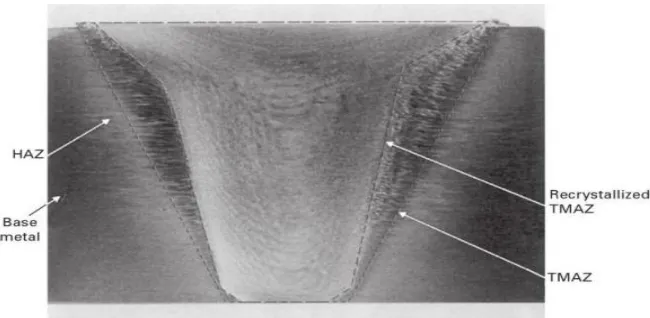
In FSW joints various micro structural regions can be observed as shown in Fig. 2. The Base metal region is
unaffected by heat as it is far away from the recrystallized zone and hence micro structural and mechanical
properties of this region remains unaltered. The second region is heat-affected zone (HAZ) that is next to Base
metal and is affected by heat but no plastic deformation takes place in this region; however, mechanical and
micro structural properties changes. The next region is thermo mechanically affected zone (TMAZ) affected
zone that is very near to weld nugget and it is plastically deformed by means of tool. In this region material
deforms without recrystallization. Next region is nugget zone or stir zone or fully recrystallized zone in which
275 | P a g e Figure 2: FSW transverse section (Misra & Ma, 2005)
III. THE CRITICAL WELDING PARAMETERS
3.1 Tool Rotation and Traverse Speeds, to be considered in FSW; how fast the tool rotates and how quickly it
traverses the interface. These two parameters have considerable importance and must be chosen with care to
ensure a successful and efficient welding cycle. Further, the relation with heat input is complex, increasing the
rotation speed or decreasing the traverse speed will result in a hotter weld also for good weld quality, and
material surrounding the tool should be hot enough to enable the extensive plastic flow required and minimize
the forces acting on the tool leading to tool breakage. On the other hand excessively high heat input may be
detrimental to the final properties of the weld.
3.2 Tool tilt and plunge depth, plunge depth is defined as depth of the lowest point of the shoulder below the
surface of the welded plate and plunging the shoulder below the plate surface increases the pressure below the
tool and helps ensure adequate forging of the material at the rear of the tool. Tilting the tool by 1 to 4 degrees,
such that the rear of the tool is lower than the front, will assist this forging process. This will ensure the
necessary downward pressure such that the tool fully penetrates the weld addressing defects such as pin rubbing
on the backing plate surface or a significant under match of the weld thickness compared to the base material
etc.
3.3 Tool Design, good tool can improve both quality of the weld and the maximum possible welding speed. So
it is desirable that the tool material is sufficiently strong, tough, and hard wearing at the welding temperature
along with good oxidation resistance and low thermal conductivity. For example tool steel AISI H13 and HSS
M2 to weld aluminum alloys within thickness ranges of 0.5 – 50 mm but more advanced tool materials are
necessary for more demanding applications such as highly abrasive metal matrix composites or higher melting
point materials such as steel or titanium. Majority of tools have a concave shoulder profile.
3.4 Welding forces, a number of forces will act on the tool during welding, a downward force to maintain the
position of the tool, the traverse force acts parallel to the tool motion, and torque is required to rotate the tool. In
order to prevent tool fracture and to minimize excessive wear and tear on the tool and associated machinery, the
276 | P a g e 3.5 Flow of material, mode of material flow through extrusion chamber and frozen pin technique will lead to
better forging of material.
IV. LITERATURE REVIEW
Ericsson and Sandstrom (2002) studied the influence by welding speed on the fatigue strength of friction stir
welds and also compare the fatigue results with results for conventional arc-welding methods: MIG-pulse and
TIG. Aluminum alloy 6082 used as a working materials.
Liu et al. (2003) studied the optimum welding parameters of friction stir welding on AA2017-T35 to establish
the relations between welding parameters and tensile strength of the joints.
Kovacevic (2003) investigate a three-dimensional model based on finite element analysis was used to study the thermal history and thermo mechanical process in the butt-welding of aluminum alloy 6061-T6.
Huseyin Uzun et al.(2004) studied microstructure, hardness and fatigue properties of friction stir welded joint
of dissimilar Al 6013-T4 alloy and X5CrNi18-10 stainless steel. Optical microscopy was used to characterize
the microstructures of the weld nugget, the heat affected zone (HAZ), and thermo-mechanical affected zone
(TMAZ) and the base materials.
Cavaliere et al. (2005) studied the mechanical and micro structural properties of weld joint of dissimilar 2024
and 7075 aluminum sheets joined by friction stir welding (FSW) and analyze the mechanical response with
respect to the parent materials.
Kovacevic (2005) studied thermo-mechanical simulation of friction stir welding to predict the transient
temperature field, active stresses developed forces in all the three dimensions and may be extended to determine
the residual stress.
Marzol et al. (2006) established that friction stir welding (FSW) process parameters envelope for an AA 6061 alloy reinforced with 20% of Al2O3 particles, and also determine the properties of the obtained joints.
Microstructure has been observed with optical microscope, and images have been analyzed with image analysis
software.
Watanabe et al. (2006) investigated the effects of a pin rotation speed, the position for the pin axis, on the tensile strength and the microstructure of the joint. The behaviour of the oxide film on the faying surface of the
steel during welding also examined.
Scialpi et al. (2006) studied the effect of different shoulder geometries on the mechanical and micro structural
properties of a friction stir welded joints of aluminum alloy 6082 T6. The effect of the three shoulder geometries
has been analyzed by visual inspection, macrograph, HV micro hardness, bending test and transverse and
longitudinal room temperature tensile test. The investigation results showed that, for thin sheets, the best joint
has been welded by a shoulder with fillet and cavity.
Zhang et al. (2007) represent the 3D material flows and mechanical features under different process parameters
by using the finite element method based on solid mechanics. Experimental results were also given to study the
effect of process parameters on joining properties of the friction stir welds. Numerical results indicate that the
tangent flow constitutes the major part in the material flow. The shoulder can accelerate the material flow on the
277 | P a g e Cavalierea et al. (2007) analyzed the effects of processing parameters on mechanical and micro structural properties of AA6082 joints produced by friction stir welding. Different welded specimens were produced by
employing fixed rotating speeds of 1600rpm and by varying welding speeds from 40 to 460 mm/min. The SEM
observations of the fatigue specimens, welded at 115 mm/min, showed that at higher stress amplitude levels the
cracks initiate at the surface of the welds. By decreasing the stress amplitude the cracks initiate by the internal
defects.
Elangovan et al. (2007) studied the influences of tool pin profile and welding speed on the formation of friction
stir processing zone in AA2219. In this investigation an attempt has been made to study the effect of tool pin
profiles and welding speed on the formation of friction stir processing zone in AA2219.
Moreira et al. (2008) Studied that mechanical and metallurgical characterization of friction stir welded butt joints of aluminum alloy 6061-T6 with 6082-T6 was carried out. For comparison, similar material joints made
from each one of the two alloys were used. The work included microstructure examination, micro hardness,
tensile and bending tests of all joints. The results show that the friction stir welded dissimilar joint present
intermediate mechanical properties when compared with each base material. In tensile tests the dissimilar joint
displayed intermediate properties. For instance in the hardness profile the lowest values were obtained in the
AA6082-T6 alloy plate side where rupture occurred, and in the nugget all type of joints present similar values.
Kanwer S. Arora et al. (2010) studied that friction stir welding of aluminum alloy 2219 using an adapted
milling machine was reported. The downward or forging force was found to be dependent upon shoulder
diameter and rotational speed whereas longitudinal or welding force on welding speed and pin diameter. Tensile
strength of welds was significantly affected by welding speed and shoulder diameter whereas welding speed
strongly affected percentage elongation.
Hwang et al. (2010) experimentally explore the thermal history of a work piece undergoing Friction Stir
Welding involving butt joining with pure copper C11000. In the experiments, K-type thermocouples were used
to record the temperature history at different locations on work piece. This data, combined with the preheating
temperature, tool rotation speeds and tool moving speeds allowed parameters for a successful weld to be
determined.
S. Rajakumar et al. (2011) observed that in FSW process tool parameters plays a major role in deciding the
joint strength. Joint strength is influenced by grain size and hardness of the weld nugget region. Hence, in this
investigation an attempt was made to develop empirical relationships to predict grain size and hardness of weld
nugget of friction-stir-welded AA6061 aluminum alloy joints. The empirical relationships are developed by
response surface methodology incorporating FSW tool and process parameters. A linear regression relationship
was also established between grain size and hardness of the weld nugget of FSW joints.
Aval (2011) investigate that the thermo-mechanical responses during the dissimilar friction stir welding of
aluminum alloys have been evaluated employing a three-dimensional model and the finite element software
ABAQUS. Also, both experimental and simulated results indicate that welding fixtures significantly affect the
residual stress profiles as well as their magnitudes.
Elangovan et al. (2012) focuses on the development of an effective methodology to determine the optimum
278 | P a g e Mariano et al. (2012) presents a literature review on friction stir welding (FSW) modeling with a special focus
on the heat generation due to the contact conditions between the FSW tool and the work piece. A reliable FSW
process modeling depends on the fine tuning of some process and material parameters. Usually, these
parameters are achieved with base on experimental data. The numerical modeling of the FSW process can help
to achieve such parameters with less effort and with economic advantages.
Zhang (2012) studied that, the thermal modeling of underwater friction stir welding (FSW) was conducted with
a three-dimensional heat transfer model. The vaporizing characteristics of water were analyzed to illuminate the
boundary conditions of underwater FSW. Temperature dependent properties of the material were considered for
the modeling. For underwater joint, the high-temperature distributing area is dramatically narrowed and the
welding thermal cycles in different zones are effectively controlled in contrast to the normal joint.
Bhatt (2013) observed that Friction stir welding of AA6061-T6 aluminum alloy to overcome limitations of
fusion welding. The FSW tool, not being consumed, produces a joint with predominant advantages of high joint
strength, lower distortion and absence of metallurgical defects. Process parameters such as tool rotational speed,
tool traverse speed and axial force and tool dimensions play an important role in obtaining a specific
temperature distribution and subsequent viscosity distribution within the material being welded.
Guo (2013) Studied that the Dissimilar AA6061 and AA7075 alloy have been friction stir welded with a variety
of different process parameters. In particular, the effects of materials position and welding speed on the material
flow, microstructure, micro hardness distribution and tensile property of the joints were investigated. It was
revealed that the material mixing is much more effective when AA6061 alloy was located on the advancing side
and multiple vortexes centers formed vertically in the nugget.
Keivani (2013) have studied in their work, friction stir welding (FSW) is applied extensively in industry for
joining of nonferrous metals especially aluminum. A three-dimensional model based on finite element analysis
was used to study the thermal characteristic of copper C11000 during the FSW process.
Liu a (2013) In their research, the 4 mm thick 6061-T6 aluminum alloy was self-reacting friction stir welded at
a constant tool rotation speed of 600 rpm.The specially designed self-reacting tool was characterized by the two
different shoulder diameters. The results of transverse tensile test indicated that the elongation and tensile
strength of joints increased with increasing welding speed. The defect-free joints were obtained at lower
welding speeds and the tensile fracture was located at the heat affected zone adjacent to the thermal
mechanically affected zone on the advancing side.
Simoes a, (2013) studied the FSW of polymers, From the study it was possible to conclude that, due to the
polymers rheological and physical properties, the thermo-mechanical conditions during FSW are very different
from that registered during welding of metals, leading to completely different material flow mechanisms and
weld defect morphologies.
Pan (2013) studied that friction Stir Welding is a complex thermal-mechanical process. Numerical models have
been used to calculate the thermal field, distortion and residual stress in welded components but some modeling
parameters such as film coefficient and thermal radiation of the work pieces may be technically difficult or
279 | P a g e FSW process thermal parameters have been successfully identified. This automatic parameters characterization
procedure could be used for the FSW process optimization.
He (2014) discussed and illustrated numerical analysis of friction stir welding with brief case studies. In
addition, several important key problems and issues remain to be addressed about the numerical analysis of
friction stir welding and opportunities for further research are identified.
V. RESULTS AND DISCUSSION
From the above literature study it is evident that there is a potential for Friction Stir Welding of aluminum
alloys in various fields. FSW continues to be the subject of investigations and further development and
improvements in the joining of aluminum alloys. Even many studies have been performed; there is still a
considerable need to further examine existing and new combinations of process parameters such as tool
rotational speed, traverse speed and tool tilt angle. Existing researches are constrained to the microstructure
of weld joint. Hence an attempt has been made to explore the optimization of parameters of FSW.
Experimental techniques that include statistical design of experiment, such as Taguchi method is
considered to achieve an optimal solution. Study on various process parameter of FSW on 6061-T6
aluminum alloy was carried out on vertical milling machine.
5.1 Material Selection
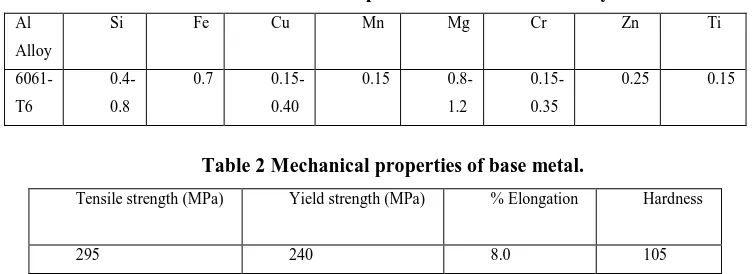
The base material used in this study is aluminum alloy AA6061-T6. The composition and mechanical properties
of is given in Tables 1 and 2, respectively.
Table 1 Chemical Compositions of Aluminum Alloy.
Al
Alloy
Si Fe Cu Mn Mg Cr Zn Ti
6061-T6
0.4-0.8
0.7
0.15-0.40
0.15
0.8-1.2
0.15-0.35
0.25 0.15
Table 2 Mechanical properties of base metal.
Tensile strength (MPa) Yield strength (MPa) % Elongation Hardness
295 240 8.0 105
Specially designed tool as shown in Fig.1 is used in the Friction stir welding. The material of the tool is
HSS M2 Steel Rod of Dia. 22 mm. A non-consumable high-speed steel tool is used for welding 6061 Al
alloy having the shoulder diameter of 22 mm and the tool has cylindrical shaped probe (tool pin) with
threads. Probe diameter and length is 6 mm and 5.7mm respectively. The diameter of the head is 18mm.
The hardness of tool is around 54HRC.
280 | P a g e
5.2 Selection Of Process Parameters And Levels
The main parameters that affect the mechanical properties of FS welded joints and the practical limits are
summarized in Table 3.
Table 3—Process parameters values and their three levels
Level Rotational speed(rpm) Transverse speed (mm/min.) Tool tilt angle(deg)
1 500 16 0
2 710 20 1
3 1000 25 2
5.3 Methodology Selection
From the above literature study there was various methodology used to optimize the process parameters by
different authors like Taguchi, Response Surface methodology etc. so the Taguchi (L9) orthogonal array is used
to optimize the process parameters, such as tool rotational speed, welding speed and tool tilt angle. Analysis of
variance was also used to find out the significant parameter that affects the mechanical properties. The
following are the steps to be followed for process parameter optimization by this methodology given by Ross
and Phillip J. [6-7]:
Step 1: Determine the quality characteristic to be optimized.
Step 2: Identify the noise factors and test conditions.
Step 3: Identify the control factors and their alternative levels.
Step 4: Design the matrix experiment and define the data analysis procedure.
Step 5: Conduct the matrix experiment.
Step 6: Analyze the data and determine optimum levels for control factors.
Step 7: Predict the performance at these levels
A. Selection of Orthogonal Array
As three levels and three factors are taken into consideration, L9 OA is used in this investigation as shown in
Table 1. Only the main factor effects are taken into consideration and not the interactions. The degrees of
freedom (d.f.) for each factor is 2 (number of levels- 1, i.e. 3 - 1 = 2) and therefore, the total d.f. will be 3× 2 =
6. Generally, the d.f. of the OA should be greater than the total d.f. of the factors. As the d.f. of L9 is 8 it is
suitable for the study.
Table-1:-Experimentation control log using OA L9.
Exp.No RPM Feed Tilt Angle
1 1 1 0
2 1 2 1
3 1 3 2
4 2 1 1
5 2 2 2
6 2 3 0
7 3 1 2
8 3 2 0
281 | P a g e
VI. CONCLUSIONS AND FUTURE SCOPE
In this paper, a critical review of different aspects of FSW technique has been illustrated. It has been decided to
present the major findings related to FSW at one place so as to provide a clear picture to the reader. Following
points can be concluded:
Friction stir welding owing to its distinctive characteristics: low distortion and shrinkage even in long welds,
free of arc, filler metal, and shielding gas, low HAZ, free of spatter and porosity defect is emerging as an
alternative to fusion welding. FSW is found suitable for joining similar or dissimilar metals or alloys including
aluminum, magnesium, copper, steel, zinc, nickel and its alloys, plastics, etc.
Like traditional fusion welding butt and lap joint can be carried out in friction stir welding. Although, no special
preparation is needed. In addition, it is observed that FSW shows significant enhancement in tensile strength,
ductility, fatigue, and facture toughness as compared to fusion welding.
It is clear that, FSW process parameters: tool rotation rate, traverse speed, tool tilt angle influence the
mechanical and metallurgical behaviour of joints and hence, are vital to produce sound and defect-free weld.
According to available literature, most of the research work is focused on friction stir welding of aluminum,
copper and magnesium. Friction stir welding of alloys, plastics, composite materials, etc. is having huge scope
for future research.
The influences of the input process parameters on process performance characteristics and interaction effects are
not significantly explored. In-detail study of contribution of the individual input process parameters on process
performance characteristics is lacking in literature.
Mechanism of materials flow, tool geometry design, wearing out of welding tool, and force distribution during
welding needs proper attention.
REFERENCES
[1] Thomas, W. M., et al. International patent application no. No. 9125978.8. PCT/GB92/02203 and GB patent
application, 1991. C. Dawes, W. Thomas, TWI Bulletin 6, November/December 1995, p. 124.
[2] Mahoney, M. W., et al. "Properties of friction-stir-welded 7075 T651 aluminum." Metallurgical and
materials transactions A 29.7 (1998): 1955-1964.
[3] Chao, Yuh J., and Xinhai Qi. "Thermal and thermo-mechanical modeling of friction stir welding of
aluminum alloy 6061-T6." Journal of Materials Processing and Manufacturing Science 7 (1998): 215-233.
[4] Thomas, W. M., and E. D. Nicholas. "Friction stir welding for the transportation industries." Materials &
Design 18.4 (1997): 269-273.
[5] Heidarzadeh, A., et al. "Tensile behavior of friction stir welded AA 6061-T4 aluminum alloy joints."
Materials & Design 37 (2012): 166-173.
[6] Ross, Phillip J. "Taguchi techniques for quality engineering: loss function, orthogonal experiments,
parameter and tolerance design." (1988).
[7] De Backer, Jeroen, Gunnar Bolmsjö, and Anna-Karin Christiansson. "Temperature control of robotic friction
stir welding using the thermoelectric effect." The International Journal of Advanced Manufacturing
282 | P a g e
[8] Liu, G., et al. "Microstructural aspects of the friction-stir welding of 6061-T6 aluminum." Scripta materialia
37.3 (1997): 355-361.
[9] Mahoney, M. W., et al. "Properties of friction-stir-welded 7075 T651 aluminum." Metallurgical and
materials transactions A 29.7 (1998): 1955-1964.
[10] McNelley, T. R., S. Swaminathan, and J. Q. Su. "Recrystallization mechanisms during friction stir
welding/processing of aluminum alloys." Scripta Materialia 58.5 (2008): 349-354.
[11] Mishra, Rajiv S., and Z. Y. Ma. "Friction stir welding and processing." Materials Science and Engineering:
R: Reports 50.1 (2005): 1-78.
[12] Ericsson, Mats, and Rolf Sandström. "Influence of welding speed on the fatigue of friction stir welds, and
comparison with MIG and TIG." International Journal of Fatigue 25.12 (2003): 1379-1387.
[13] Chen, C. M., and R. Kovacevic. "Finite element modeling of friction stir welding—thermal and
thermomechanical analysis." International Journal of Machine Tools and Manufacture 43.13 (2003):
1319-1326.
[14] Liu, H. J., et al. "Tensile properties and fracture locations of friction-stir-welded joints of 2017-T351
aluminum alloy." Journal of Materials Processing Technology 142.3 (2003): 692-696.
[15] Zhang, Hui-jie, Hui-jie Liu, and Y. U. Lei. "Thermal modeling of underwater friction stir welding of high
strength aluminum alloy." Transactions of Nonferrous Metals Society of China 23.4 (2013): 1114-1122.
[16] Jamshidi Aval, H., S. Serajzadeh, and A. H. Kokabi. "Experimental and theoretical evaluations of thermal
histories and residual stresses in dissimilar friction stir welding of AA5086-AA6061." The International Journal of Advanced Manufacturing Technology 61.1 (2012): 149-160.
[17] Hattel, Jesper Henri, Kim Lau Nielsen, and Cem Celal Tutum. "The effect of post-welding conditions in
friction stir welds: from weld simulation to ductile failure." European Journal of Mechanics-A/Solids 33 (2012): 67-74.
[18] Chen, C. M., and R. Kovacevic. "Finite element modeling of friction stir welding—thermal and
thermomechanical analysis." International Journal of Machine Tools and Manufacture 43.13 (2003): 1319-1326.
[19] Li, Bo, et al. "Dissimilar friction stir welding of Ti–6Al–4V alloy and aluminum alloy employing a modified
butt joint configuration: Influences of process variables on the weld interfaces and tensile properties."
Materials & Design 53 (2014): 838-848.
[20] Rajakumar, S., C. Muralidharan, and V. Balasubramanian. "Statistical analysis to predict grain size and
hardness of the weld nugget of friction-stir-welded AA6061-T6 aluminium alloy joints." The International Journal of Advanced Manufacturing Technology 57.1-4 (2011): 151-165.
[21] Elangovan, K., and V. Balasubramanian. "Influences of tool pin profile and welding speed on the formation
of friction stir processing zone in AA2219 aluminium alloy." Journal of materials processing technology
200.1 (2008): 163-175.
[22] Arora, Kanwer S., et al. "Effect of process parameters on friction stir welding of aluminum alloy 2219-T87."
283 | P a g e
[23] Ericsson, Mats, and Rolf Sandström. "Influence of welding speed on the fatigue of friction stir welds, and
comparison with MIG and TIG." International Journal of Fatigue 25.12 (2003): 1379-1387.
[24] Riahi, Mohammad, and Hamidreza Nazari. "Analysis of transient temperature and residual thermal stresses
in friction stir welding of aluminum alloy 6061-T6 via numerical simulation." The International Journal of Advanced Manufacturing Technology 55.1 (2011): 143-152.
[25] Vijayan, S., et al. "Friction stir welding of Al–Mg alloy optimization of process parameters using Taguchi
method." Experimental Techniques 34.5 (2010): 37-44.
[26] Mustafa, Faiz F., Ali H. Kadhym, and Hiba H. Yahya. "Tool geometries optimization for friction stir
welding of AA6061-T6 aluminum alloy T-joint using Taguchi method to improve the mechanical behavior."
Journal of Manufacturing Science and Engineering 137.3 (2015): 031018.
[27] Lakshminarayanan, A. K., and V. Balasubramanian. "Process parameters optimization for friction stir
welding of RDE-40 aluminum alloy using Taguchi technique." Transactions of Nonferrous Metals Society of
China 18.3 (2008): 548-554.
[28] Kumar, Sanjay, Sudhir Kumar, and Ajay Kumar. "Optimization of process parameters for friction stir
welding of joining A6061 and A6082 alloys by Taguchi method." Proceedings of the Institution of
Mechanical Engineers, Part C: Journal of Mechanical Engineering Science 227.6 (2013): 1150-1163.
[29] Elangovan, S., K. Anand, and K. Prakasan. "Parametric optimization of ultrasonic metal welding using
response surface methodology and genetic algorithm." The International Journal of Advanced Manufacturing Technology 63.5 (2012): 561-572.
[30] Rajakumar, S., C. Muralidharan, and V. Balasubramanian. "Establishing empirical relationships to predict
grain size and tensile strength of friction stir welded AA 6061-T6 aluminum alloy joints." Transactions of
Nonferrous Metals Society of China 20.10 (2010): 1863-1872.
[31] Rajakumar, S., and V. Balasubramanian. "Predicting grain size and tensile strength of friction stir welded
joints of AA7075-T6 aluminum alloy." Materials and Manufacturing Processes 27.1 (2012): 78-83.
[32] Soundararajan, Vijay, Srdja Zekovic, and Radovan Kovacevic. "Thermo-mechanical model with adaptive
boundary conditions for friction stir welding of Al 6061." International Journal of Machine Tools and Manufacture 45.14 (2005): 1577-1587.
![Figure 1: Schematic representations of friction stir welding.[11]](https://thumb-us.123doks.com/thumbv2/123dok_us/7772609.1280433/2.595.74.478.372.547/figure-schematic-representations-friction-stir-welding.webp)