Scholarship@Western
Scholarship@Western
Electronic Thesis and Dissertation Repository
2-2-2011 12:00 AM
Architecture Supporting Computational Trust Formation
Architecture Supporting Computational Trust Formation
Chern Har YewUniversity of Western Ontario
Supervisor Hanan Lutfiyya
The University of Western Ontario Graduate Program in Computer Science
A thesis submitted in partial fulfillment of the requirements for the degree in Doctor of Philosophy
© Chern Har Yew 2011
Follow this and additional works at: https://ir.lib.uwo.ca/etd
Part of the Systems Architecture Commons
Recommended Citation Recommended Citation
Yew, Chern Har, "Architecture Supporting Computational Trust Formation" (2011). Electronic Thesis and Dissertation Repository. 86.
https://ir.lib.uwo.ca/etd/86
This Dissertation/Thesis is brought to you for free and open access by Scholarship@Western. It has been accepted for inclusion in Electronic Thesis and Dissertation Repository by an authorized administrator of
(Spine title: Architecture Supporting Computational Trust Formation) (Thesis format: Monograph)
by
Chern Har Yew
Graduate Program in Computer Science
A thesis submitted in partial fulfillment of the requirements for the degree of
Doctor of Philosophy
The School of Graduate and Postdoctoral Studies The University of Western Ontario
London, Ontario, Canada
ii
CERTIFICATE OF EXAMINATION
Supervisor
______________________________ Dr. Hanan Lutfiyya
Supervisory Committee
______________________________ Dr.
______________________________ Dr.
Examiners
______________________________ Dr. Michael Bauer
______________________________ Dr. Robert Mercer
______________________________ Dr. Victoria Rubin
______________________________ Dr. Ferhat Khendek
The thesis by
Chern Har Yew
entitled:
ARCHITECTURE SUPPORTING COMPUTATIONAL TRUST
FORMATION
is accepted in partial fulfillment of the requirements for the degree of
Doctor of Philosophy
iii
Abstract
Trust is a concept that has been used in computing to support better decision making. For
example, trust can be used in access control. Trust can also be used to support service
selection. Although certain elements of trust such as reputation has gained widespread
acceptance, a general model of trust has so far not seen widespread usage. This is due to
the challenges of implementing a general trust model. In this thesis, a middleware based
approach is proposed to address the implementation challenges.
The thesis proposes a general trust model known as computational trust.
Computational trust is based on research in social psychology. An individual’s
computational trust is formed with the support of the proposed computational trust
architecture. The architecture consists of a middleware and middleware clients. The
middleware can be viewed as a representation of the individual that shares its knowledge
with all the middleware clients. Each application uses its own middleware client to form
computational trust for its decision making needs. Computational trust formation can be
adapted to changing circumstances. The thesis also proposed algorithms for
computational trust formation. Experiments, evaluations and scenarios are also presented
to demonstrate the feasibility of the middleware based approach to computational trust
formation.
Keywords
iv
I wish to express my sincere gratitude towards my supervisor, Dr. Hanan Lutfiyya. Her
guidance, encouragement and friendship are instrumental in my completion of this work.
Other professors that have helped me along the way include Dr. Michael Bauer and Dr.
Mark Perry. As for fellow distributed systems research group colleagues, special thanks
needs to be directed towards Brad Simmons (graduated), Raphael Mafita Bahati
v
CERTIFICATE OF EXAMINATION ... ii
Abstract ... iii
Acknowledgments... iv
Table of Contents ... v
List of Tables ... xi
List of Figures ... xiii
List of Appendices ... xviii
Chapter 1 ... 1
1 Introduction ... 1
1.1 Current Use of Trust in Computing ... 1
1.2 Computational Trust ... 3
1.2.1 Foundational Research ... 3
1.2.2 Definition ... 4
1.2.3 Properties ... 6
1.2.4 Conceptual Model ... 9
1.2.5 Trust Formation ... 12
1.3 Application of Computational Trust ... 13
1.3.1 Movie Selection Scenario ... 13
1.3.2 Web Service Selection Scenario ... 14
1.4 Challenges to Computational Trust ... 17
1.5 Contributions of Thesis ... 18
1.6 Thesis Organization ... 19
1.7 Summary ... 20
vi
2.1 Preconditions for Trust ... 21
2.2 Concepts Related to Trust ... 21
2.2.1 Untrust, Distrust and Mistrust ... 22
2.2.2 Trustworthiness ... 22
2.2.3 Contract ... 23
2.2.4 Confidence ... 23
2.3 Privacy ... 24
2.4 Risk ... 25
2.5 Decision Making ... 26
2.6 Summary ... 26
Chapter 3 ... 27
3 Literature Review ... 27
3.1 Survey of Trust and Reputation ... 27
3.1.1 The World Wide Web (WWW) ... 27
3.1.2 Peer-to-Peer (P2P) Networks ... 30
3.1.3 Virtual Communities ... 34
3.1.4 Pervasive Computing Environments... 38
3.2 Middleware Support for Computational Trust Formation ... 39
3.3 Survey of Trust Middleware ... 40
3.4 Summary ... 41
Chapter 4 ... 42
4 Computational Trust Architecture... 42
4.1 Assumptions ... 42
vii
4.1.3 Evidence ... 44
4.1.4 Belief ... 45
4.1.5 Emotional Trust Formation ... 47
4.1.6 Factors Influencing Computational Trust Formation ... 48
4.1.7 Privacy ... 50
4.1.8 Architecture Deployment ... 50
4.1.9 Summary ... 50
4.2 Overview of Architecture ... 51
4.3 Information Flow of Architecture ... 52
4.4 Summary ... 53
Chapter 5 ... 54
5 SCOUT ... 54
5.1 SCOUT Design ... 54
5.2 Evidence Gathering Service ... 55
5.2.1 Evidence Gatherer ... 57
5.2.2 Evidence Handler ... 57
5.2.3 Evidence Source Assessor ... 58
5.2.4 Evidence Gathering Manager ... 59
5.3 Belief Formation Service ... 63
5.3.1 Belief Engine ... 64
5.3.2 Belief Formation Manager ... 65
5.4 Emotional Trust Service ... 68
5.5 Summary ... 69
viii
6.1 Trust Calculator Design ... 71
6.2 Trust Calculation Plan... 72
6.3 Trust Calculator ... 77
6.4 Summary ... 79
Chapter 7 ... 81
7 Algorithms ... 81
7.1 Belief Formation ... 81
7.1.1 Experience... 82
7.1.2 Recommendation ... 84
7.1.3 Reputation ... 85
7.1.4 Signal ... 86
7.1.5 Summary ... 86
7.2 Evidence Source Assessment ... 87
7.2.1 Evidence Assessment ... 87
7.2.2 Evidence Source Trust Assessment ... 89
7.2.3 Summary ... 90
7.3 Summary ... 91
Chapter 8 ... 92
8 Implementation ... 92
8.1 SCOUT ... 92
8.2 Trust Calculator ... 93
8.2.1 Trust Calculation Planner ... 94
8.2.2 Trust Calculation Engine ... 95
ix
9 Experiments... 97
9.1 Goals ... 97
9.2 Assumptions ... 98
9.3 Metrics ... 99
9.4 Experimental Testbed ... 99
9.4.1 Overview ... 100
9.4.2 Web Services ... 100
9.4.3 Evidence Sources ... 102
9.4.4 Web Service Selection Strategies ... 103
9.5 Experiments Based on Experience... 107
9.5.1 Static Web Services ... 108
9.5.2 Fluctuating Web Services ... 110
9.5.3 Dynamic Web Services ... 112
9.5.4 Fluctuating-Dynamic Web Services ... 114
9.6 Experiments Based on Recommendation ... 116
9.6.1 Similar Recommenders ... 118
9.6.2 Dissimilar Recommenders ... 122
9.7 Experiments Based on Experience, Recommendation ... 127
9.8 Conclusions and Discussions ... 131
9.9 Summary ... 132
Chapter 10 ... 134
10 Scenarios ... 134
10.1 Movie Scenario ... 134
x
10.2 Web Service Scenario ... 138
10.2.1 Overview ... 138
10.2.2 Implementation ... 159
10.3 Summary ... 160
Chapter 11 ... 161
11 Evaluation ... 161
11.1 Evaluation of SCOUT ... 161
11.1.1 Evolution ... 161
11.1.2 Computational Trust Properties ... 162
11.1.3 Computational Trust Challenges... 163
11.2 Evaluation of Trust Calculator ... 164
11.2.1 Evolution ... 164
11.2.2 Computational Trust Properties ... 165
11.2.3 Computational Trust Challenges... 165
11.3 Summary ... 166
Chapter 12 ... 167
12 Conclusions and Future Directions ... 167
12.1 Conclusions ... 167
12.2 Future Work ... 169
References ... 172
Appendices ... 186
xi
Table 1: Trust Types and Computational Trust Formation ... 49
Table 2: Assumptions of Computational Trust Architecture ... 50
Table 3: Algorithms for Belief, Aggregate Belief and Trust Calculation... 53
Table 4: Example Aggregate Belief Filters ... 67
Table 5: Web Services (Experiments) ... 99
Table 6: Legend of Figure 39 ... 107
Table 7: Result Summary (Static Web Services, Average: ) ... 108
Table 8: Result Summary (Static Web Services, Average: ) ... 109
Table 9: Result Summary (Fluctuating Web Services, Average: ) ... 110
Table 10: Result Summary (Fluctuating Web Services: , Average: ) ... 111
Table 11: Result Summary (Fluctuating Web Services: , Average: ) ... 111
Table 12: Result Summary (Fluctuating Web Services, Average: ) ... 112
Table 13: Result Summary (Fluctuating Web Services, Weighted Average: ) ... 112
Table 14: Result Summary (Dynamic Web Services, Average: ) ... 113
Table 15: Result Summary (Dynamic Web Services: , Average: ) ... 113
xii
Table 18: Result Summary (FD Web Services, Average: ) ... 115
Table 19: Result Summary (FD Web Services, Average: ) ... 116
Table 20: Result Summary (FD Web Services, Weighted Average: ) ... 116
Table 21: Similar Recommenders (Experiments) ... 118
Table 22: Dissimilar Recommenders (Experiments) ... 123
xiii
Figure 1: Relationships among Trust Dimensions ... 11
Figure 2: Computational Trust Formation ... 13
Figure 3: Cognitive Trust Formation (Movie) ... 14
Figure 4: Cognitive Trust Formation (Web Service) ... 15
Figure 5: From Distrust to Trust [86] ... 22
Figure 6: eBay’s Feedback Forum ... 28
Figure 7: Computational Trust Formation (Architecture) ... 43
Figure 8: Cognitive Trust Formation from Aggregate Beliefs (Web Service) ... 47
Figure 9: Hierarchy of Trustee Type and Identity ... 48
Figure 10: Computational Trust Architecture ... 52
Figure 11: Information Flow of Architecture ... 53
Figure 12: Evidence Gathering Service ... 56
Figure 13: EG-Policies (Identity)... 60
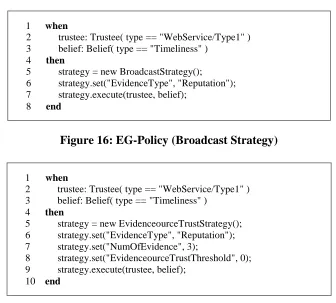
Figure 14: EG-Policy (Properties) ... 61
Figure 15: EG-Policy (Evidence Source Trust) ... 61
Figure 16: EG-Policy (Broadcast Strategy) ... 62
Figure 17: EG-Policy (Evidence Source Trust Strategy) ... 62
xiv
Figure 20: BF-Policy... 66
Figure 21: AF-Policy ... 67
Figure 22: Emotional Trust Service ... 68
Figure 23: ET-Policies ... 69
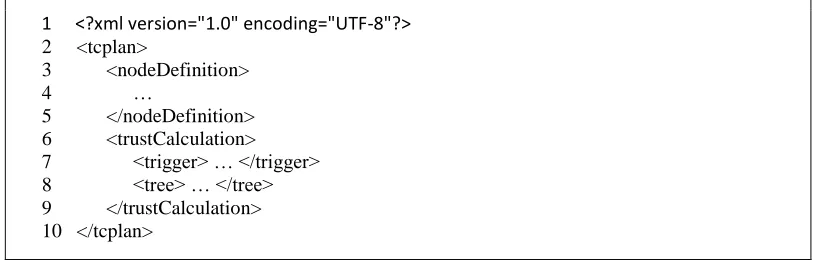
Figure 24: Structure of TcPlan ... 72
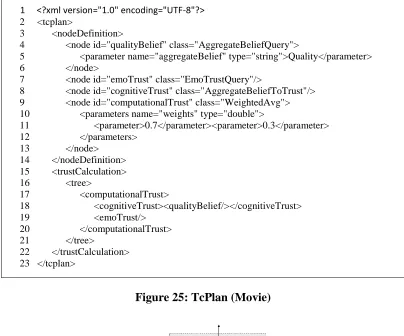
Figure 25: TcPlan (Movie)... 73
Figure 26: Tree of TcPlan (Movie) ... 73
Figure 27: TcTemplate (Movie) ... 74
Figure 28: TcPlan (Web Service) ... 76
Figure 29: Tree of TcPlan (Web Service) ... 77
Figure 30: Trust Calculator ... 77
Figure 31: Trust Calculator’s Execution ... 79
Figure 32: Experience Weights ... 83
Figure 33: Evidence Assessments ... 88
Figure 34: SCOUT Implementation... 92
Figure 35: Factors-TcPlan Mapping (Movie) ... 94
Figure 36: Factors-TcPlan Policy (Movie) ... 95
Figure 37: Experimental Testbed’s Algorithm ... 100
xv
Figure 40: Mean Experience (Similar Recommenders, Average: ) .... 119
Figure 41: Percentage of Positive Experiences (Similar Recommenders, Average:
) ... 120
Figure 42: Mean Experience (Similar Recommenders, ,
) ... 121
Figure 43: Percentage of Positive Experiences (Similar Recommenders,
, ) ... 121
Figure 44: Mean Experience (Similar Recommenders, , )
... 122
Figure 45: Percentage of Positive Experiences (Similar Recommenders,
, ) ... 122
Figure 46: Mean Experience (Dissimilar Recommenders, Average: ) 124
Figure 47: Percentage of Positive Experiences (Dissimilar Recommenders, Average:
) ... 124
Figure 48: Mean Experience (Dissimilar Recommenders, ,
) ... 125
Figure 49: Percentage of Positive Experiences (Dissimilar Recommenders,
, ) ... 126
Figure 50: Mean Experience (Dissimilar Recommenders, , )
... 126
Figure 51: Percentage of Positive Experiences (Dissimilar Recommenders,
xvi
Figure 53: Percentage of Positive Experiences (Trustor and Similar Recommenders,
Average: , ) ... 129
Figure 54: Mean Experience (Trustor and Dissimilar Recommenders, Average: , ) ... 130
Figure 55: Percentage of Positive Experiences (Trustor and Dissimilar Recommenders, Average: , ) ... 131
Figure 56: BF-Policy (Movie) ... 136
Figure 57: EG-Policy (Movie) ... 137
Figure 58: Computational Trust Formation (Movie) ... 138
Figure 59: Factors-TcPlan Mappings (Web Service Selection) ... 140
Figure 60: TcPlan (Web Service Selection) ... 142
Figure 61: Tree of TcPlan (Web Service Selection) ... 143
Figure 62: BF-Policy (Competence Belief) ... 144
Figure 63: EG-Policy (Qualification Belief)... 145
Figure 64: BF-Policies (Accessibility Belief) ... 147
Figure 65: EG-Policies (Availability Belief) ... 148
Figure 66: Computational Trust Formation (Web Service Selection) ... 149
Figure 67: Factors-TcPlan Mappings (Web Service Negotiation) ... 151
xvii
Figure 70: BF-Policies (Dependability Belief) ... 154
Figure 71: Computational Trust Formation (Web Service Negotiation) ... 155
Figure 72: Web Service Management Policies ... 156
Figure 73: AF-Policies (Web Service) ... 158
Figure 74: EA-Policy (Web Service) ... 159
Figure 75: Web Service Discovery, Selection and Negotiation Web Service ... 160
Figure 76: Web Service Management Web Service ... 160
Figure 77: Trust Coordination Plan ... 165
Figure 78: Syntax of Aggregate Belief Filter ... 188
xviii
Appendix A: Syntax of SCOUT Policies... 186
Chapter 1
1
Introduction
Decision making is about trying to make the best possible selection from a set of
available choices. Decisions in real life are often made through satisficing (i.e., trying to
make a good enough selection) as opposed to aiming for the optimal solution [119]. This
is due to the fact that human beings are cognitive misers [42] that take advantage of
mental shortcuts (cognitive heuristics) when faced with complex decisions. Note that the
taking of these mental shortcuts is usually not out of laziness but due to the limited
capacity of human beings to process uncertainty and incomplete information [42]. As a
result, when faced with complex decisions, trust is often used as a mental shortcut for
complexity reduction. This is by eliminating choices that are not trusted from
consideration. Trust can be thought of as an alternative to rational prediction [75].
This chapter is organized as follow. The chapter starts with a discussion of the
current use of trust in computing. This is followed by an introduction to computational
trust. Two scenarios are provided as illustration of the use of computational trust in
computing. The chapter ends with a discussion of the challenges to calculating
computational trust and how this thesis contributes towards addressing these challenges.
1.1 Current Use of Trust in Computing
In computing, trust has its roots in computer security. Authentication and authorization
are concepts commonly associated with trust [50]. In this thesis, this type of trust is
known as access trust. The goal of access trust is to restrict access so as to protect
computing resources from harm. One could think of an authorized user as a user that is
trusted by the computing resource owner. The more a user is trusted, the more likely it
would be afforded more rights.
A common form of access trust is identity-based trust. Trust is determined from
the identity of the user (e.g. username and password). A weakness of identity-based trust
closed environments such as a corporate LAN where all the LAN participants have been
vetted (i.e., being hired by human resources) beforehand. This is not a valid assumption
in open environments such as the Internet. On the Internet, most of the users are strangers
to each other. Knowing the identity of the stranger (if it is even available) is not sufficient
in determining how much the stranger can be trusted.
In [16], the authors proposed that trust should be resolved without the use of
identity. The paper introduced the term trust management as “a unified approach to
specifying and interpreting security policies, credentials and relationships that allow
direct authorization of security-critical actions” [16]. This view of trust is sometimes
known as rule-based trust or policy-based trust. Several well-known trust management
systems include PolicyMaker [16], KeyNote [15] and REFEREE [28]. In a trust
management system, rules or policies are used to define the conditions in which rights are
to be granted. This is usually based on the presence of digital certificates (credentials).
An example is to only grant access to university computing resources if the user has a
certificate proving that the user is a student of the university. More recently, this view of
trust has been used to provide security for web services through WS-Security [97] and
WS-Trust [96].
In [50] and [40], the authors identified a number of weaknesses to trust
management. The weaknesses include:
A trust management system is a binary yes/no system where a user is either trusted or not trusted. Trust in everyday social life however is much more
complex. For example, John may trust both Alice and Bob but between the two,
John may trust Alice more than Bob. Such trust dynamics are not represented in
trust management systems.
In trust management, certificate issuers are unconditionally trusted. If a university
issues a certificate stating that a user is a student, it is automatically assumed that
this is indeed the case. This is an unrealistic assumption. There may be a conflict
of interest or factors such as money or even carelessness that could result in the
Trust is not static and may change over time. For example, good experiences from
using a service may increase trust in the service while bad experiences do the
opposite. Instead of updating trust immediately based on a trustee’s change in
behavior, a trust management system needs to wait for certificates to make any
trust changes. As a result, the trust management system is completely dependent
on the pace at which certificate issues updates and distributes certificates.
To address the weaknesses of trust management, a more general model of trust is needed.
In this thesis, this general model of trust is known as computational trust.
1.2 Computational Trust
The first part of this section covers the research that forms the foundation of
computational trust. Next, a definition for computational trust is proposed. This is
followed by discussion on the properties of computational trust and the different
dimensions of computational trust. Finally, computational trust formation is explained.
1.2.1
Foundational Research
Many different disciplines have studied the concept of trust. In biology, research has
shown that the hormone Oxytocin [70] when administered can increase trust among
humans. In [17], the author examined trust as seen in social psychology, philosophy,
economics, contract law and market research. The author discovered that different
disciplines tend to view trust differently. For example, social psychology tends to focus
on trust as the fulfillment of expectations. In philosophy, trust is viewed as non-rational.
In economics, trust is viewed as rational. In contract law, the focus is on trust as a
complement to legal contracts. Finally in market research, the focus is on the role that
trust plays in relationship based marketing.
Of the different disciplines, this thesis has adopted the view of trust in social
psychology. Basically, trust can be divided into four areas of research [27]. Individual
relates to a trustor and a trustee. A trustor refers to a subject1 that trusts others. Atrustee
is an entity2 that is being trusted. Relational trust believes that trust is an emergent
property of a relationship as opposed to a directed behavior. Societal trust is concerned
with the role that trust plays in the proper functioning of society. Trust is often credited as
the social capital that makes cooperation in a society possible [92].
Of the four research areas, the focus of this thesis is on interpersonal trust. As a
real life example, consider the case of a buyer (trustor) trying to buy a car from a used car
salesperson (trustee). There is no way for the buyer to know whether or not the
salesperson has the buyer’s best interest in mind. The salesperson could be trying to sell
the buyer a lemon. The uncertainty and lack of complete information makes the car
buying decision challenging. Trust can be used to aid in the buyer’s decision making. A
buyer can choose to only buy cars from a trusted used car salesperson. In a computing
context, the example could be the buying of a car from a used car website.
Many real life decisions have computing equivalents. Thus interpersonal trust can
be used in computing to aid the trustor in its decision making. In this thesis,
computational trust is built on the research in interpersonal trust. This should allow
computational trust to be used in not just computer security but also in general decision
making such as web service selection.
1.2.2
Definition
Trust is a concept that is easily recognizable but surprisingly difficult to define. Many
different definitions of trust have been proposed to address the different facets of trust.
For example, the American Heritage Dictionary defines trust as “firm reliance on the
integrity, ability, or character of a person or thing” [132]. Grandison and Sloman define
trust as “the quantified belief by a trustor with respect to the competence, honesty,
1
A subject could be a person, a group of people (e.g. organization) or a representative of a person (e.g. software agent).
2
security and dependability of a trustee within a specified context” [51]. Note that in both
definitions, trust is defined through the listing of the characteristics of a trustee.
A different approach to defining trust is provided by Deutsch in [35]:
An individual is confronted with an ambiguous path, a path that can lead to an
event perceived to be beneficial (Va+) or to an event perceived to be harmful
(Va−);
He perceives that the occurrence of Va+ or Va− is contingent on the behavior of
another person;
He perceives the strength of Va− to be greater than the strength of Va+
If he chooses to take an ambiguous path with such properties, the individual is
said to have made a trusting choice; if he chooses not to take the path, he has
made a distrustful choice;
In this definition, there is no listing of characteristics. This is also the case in [44] where
Gambetta defines trust as “a particular level of the subjective probability with which an
agent assesses that another agent or group of agents will perform a particular action, both
before he can monitor such action (or independently of his capacity ever to be able to
monitor it) and in a context in which it affects his own action”.
The definition of computational trust in this thesis is based on the definition
proposed by Gambetta in [44]. The concept of roles as discussed in [24] is also
incorporated into the trust definition. We define computational trust as follows:
Computational trust is a particular level of subjective assessment of
whether a trustee will exhibit characteristics consistent with the role
of the trustee, both before the trustor can monitor such characteristics
(or independent of the trustor’s capacity ever to be able to monitor it)
When compared to the definition presented in [44], the term “probability” has been
replaced with the term “assessment” to highlight the fact that trust can be calculated in ways other than probability theory. As the term “agent” has a different meaning in social science than in computer science, the more general terms “trustor” and “trustee” are used
instead to avoid confusion. Also, a trustee can be an inanimate object. So “taking action”
may not always be possible for certain trustees. The term “action” therefore has been replaced with the term “exhibit characteristics”. As for decision making, there are roles in
which both the trustor and the trustee must play. For example the decision of buying
services from a trustee. In this example, the trustor plays the role of a buyer while the
trustee plays the role of a seller. Whether the trustor trusts the trustee or not is dependent
on what the trustor believes to be the role of a “good seller”. If a trustee conforms to the
role as defined by the trustor, then the trustor can be said to trust the trustee.
1.2.3
Properties
Trust can be characterized by a number of basic properties [1], [52]. These properties are
also applicable to computational trust and are briefly described in this section.
1.2.3.1
Quantifiable and Comparable
There are many different ways in which trust can be represented. For example in [2], trust
is represented as a binary value of trust or mistrust. Although a binary representation is
easy to understand, it also has the weakness of lack of expressiveness. A simple way to
provide more expressiveness is to represent trust as multi-valued. In [1] for example, four
different trust degrees are defined. These are “Very Trustworthy”, “Trustworthy”,
“Untrustworthy” and “Very Untrustworthy”. It is also possible to represent trust as a
continuous variable as opposed to a discrete variable. Common representations include
representing trust as a value between zero and one (often seen in cases when trust is
treated as a probability) or between negative one and one. Although representing trust as
a real number allows for fine-grained distinction, such a representation can make it
difficult to discern the meaning behind the calculated trust value. For example, given two
error or is there something fundamentally different about trust in the two trustees? A
continuous representation makes discerning trust differences more challenging.
A trustor may feel uncertain about the result of its trust calculation. Some
researchers choose to represent this uncertainty as separate from trust. Often times, this is
known as reliability ( [110], [59]) or confidence ( [54], [128], [135]) in the calculated
trust. Other researchers choose to integrate uncertainty into trust such as in [23] where
trust is represented not as one value but as a range of possible trust values. Here, the
larger the range, the less certain the trustor is with regards to the calculated trust value.
1.2.3.2
Subjective
Different trustors may have different views on whether a trustee can be trusted. The
differences in trust are caused by the following two factors:
Incomplete information. A trustor may not have access to the complete history of
a trustee. Trust is often calculated based on available information. Different
trustors may not have access to the same information.
Subjectiveness of trustor. Different trustors may interpret the same information
differently. For example, a more forgiving trustor may be willing to accept some
failures from a trustee while a less forgiving trustor may not. Different trustors
may also have different views on how much uncertainty is acceptable. Emotions
like love and friendship could influence trust calculation as well. Finally, different
trustors may view the role of a trustee differently. For example, a trustor may
value security more than ease of use while this may not be the case for a different
trustor. These differences in expectations may influence the level of trust that a
trustor has for a trustee.
1.2.3.3
Multidimensional
A trustor may trust a trustee in one dimension but not in a different dimension. For
example, a trustor may trust a dentist with his dental health but not trust the dentist’s
Mechanical Turk service [9]. A trustor may trust a trustee with transactions that are less
than a hundred dollars but not in cases when the transaction is worth a million dollars.
Even the environment can play a role in a trustor’s trust in a trustee. For example, an
environment in which malicious sellers are actively being identified and banned can
increase trust in all the sellers in the environment. The associations of a trustee for
example, the fact that a trustee is acting on behalf of the government may have an impact
on trust as well.
It is possible for trust in one dimension to influence trust in a different dimension.
As an example, consider the case of general trust and specific trust [107]. An example of
general trust is trust in Amazon [7]. An example of specific trust is trust in one of the
services provided by Amazon. If Amazon decided to launch a new service, knowing
nothing about the new service, the trustor’s trust in Amazon may influence the trustor’s
initial trust in the new service.
1.2.3.4
Dynamic
A trustor’s level of trust in a trustee may change over time. This change may be caused
by the presence of new information or the retirement of old information that are no longer
relevant. It could also be caused by the lack of new information on a trustee. With no new
information, a trustee’s behavior could have changed without the trustor knowing anything about it. This increases the trustor’s uncertainty with regards to the calculated
trust value. It is important for computational trust to be regularly reevaluated so that it
can keep up with the dynamic nature of trust.
1.2.3.5
Reflexive, Non-Symmetrical and Non-Transitive
Trust is reflexive as a trustor always trusts itself. Though the level of trust a trustor has
for itself may change over time (as trust is dynamic). Since trust is also multidimensional,
there is more than one type of self-trust. For example, a trustor that does not trust itself to
fix the water leak would hire a plumber to do the job. A trustor that does not trust itself to
In general, trust is non-symmetrical. This means that knowing the level of trust a
trustor A has for a trustee B does not help in determining B’s level of trust in A. This
non-symmetrical property follows from the property of trust being subjective. Therefore,
a trust relationship between A and B can be represented as two one-way trusts.
In general, trust is non-transitive. However, under certain semantic constraints, it
is possible for trust to be transitive. According to [64], transitivity requires that “the last
edge in the path represents functional trust and that all other edges in the path represent
referral trust, where the functional and the referral trust edges all have the same trust
purpose”. The term “trust purpose” is used to refer to why the calculated trust is needed.
Suppose the trustor has a trust purpose for finding a good car mechanic. Referral trust
would be the trust in a trustee to be able to recommend a good car mechanic. Functional
trust would be the trust in a trustee as being a good car mechanic. If A trusts B to
recommend a good car mechanic and B recommends C, then through transitivity, A can
trust C to be a good car mechanic. A different example of trust transitivity can be found
in a public-key infrastructure (PKI). In PKI, trust transitivity is established through the
existence of a chain of certificates (known as a certification path).
In general, trust is weakened or diluted by transitivity [64]. As such, in a chain of
A, B and C, A’s trust in C cannot be greater than B’s functional trust in C.
1.2.4
Conceptual Model
A conceptual model is used to show the “relationships between factors that are believed
to impact or lead to a target condition” [93]. A conceptual model should be
implementation independent. The conceptual model of computational trust is based on
the work of Lewis and Weigert [75]. The model views trust as consisting of three
dimensions: cognitive trust, emotional trust and behavioral trust. For the rest of this
section, each of the dimensions is described followed by a discussion of the relationships
1.2.4.1
Cognitive Trust
Cognitive trust is trust based on reasoning. It is knowledge-driven [61] though the
information that cognitive trust is based on can be unreliable and incomplete. Given the
available information, a cognitive leap is needed to arrive at a trustor’s cognitive trust in a
trustee [75]. As predicting the future is often impossible, the cognitive leap though based
on knowledge is still a leap of faith. Different trustors may have different comfort levels
about how much information it needs before it is willing to make a cognitive trust
prediction. This is one of the reasons for why trust is subjective.
1.2.4.2
Emotional Trust
Emotional trust or affective3 trust is trust based on feelings and affective bonds. It is
non-cognitive and often cannot be justified by the available information. Examples of
emotional trust includes trust based on faith, love, friendship, family, common values etc.
It is also present in public trust such as trust in doctors, judges, politicians, etc. Due to the
presence of emotion, a trustor would feel hurt or betrayed when the trustor realizes that
the trustee should not have been trusted. This is seen when relationship ends or when
someone who is highly respected such as a judge is caught in a scandal.
1.2.4.3
Behavioral Trust
Behavioral trust is trust as expressed through a trustor’s behavior. Experiments such as
Prisoner’s Dilemma (PD) games [10] can be used to investigate this type of trust. In a PD
game, a player can choose to either cooperate or defect. A player who chooses to
cooperate can be viewed as having behavior trust in the opposing player while a player
who chooses to defect is signaling the opposite. A strict behavioral interpretation of trust
can be misleading as trust is not the only factor that could influence a trustor’s behavior
[75]. For example, a trustor may decide to take action not due to trust but due to pressure
3
from its superior. An interpretation of this action as trust would lead to the drawing of the
wrong conclusion.
1.2.4.4
Trust Relationships
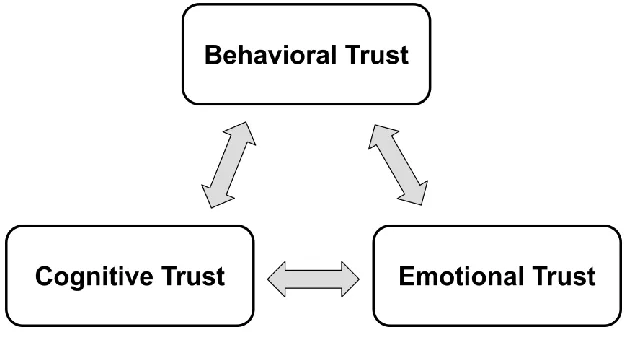
Cognitive trust, emotional trust and behavioral trust are related to each other [75]. The
web of relationships is graphically illustrated in Figure 1. To develop emotional trust, a
cognitive base needs to be present as it is hard to develop emotions towards complete
strangers. When reasoning about whether to trust, a trustor’s emotions may influence how
the available information are interpreted [72]. A trustor’s behavior can be influenced by
its cognitive trust and emotional trust. Behavioral trust exhibited by others may influence
a trustor’s cognitive trust and emotional trust.
Figure 1: Relationships among Trust Dimensions
In [75], it was pointed out that trust in real life can be decomposed into cognitive
trust and emotional trust. For example, ideological trust can be viewed as trust with high
cognition and emotion. Faith is trust with high emotion but with a lack of cognition. For
mundane everyday decisions such as the route to drive to work or what to have for lunch,
trust typically consists of low cognition and low emotion. A more detailed list of
1.2.5
Trust Formation
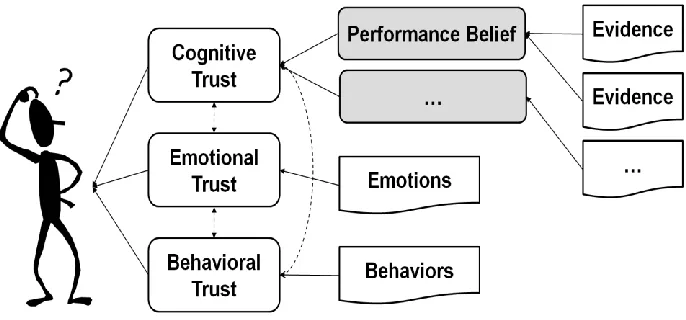
The conceptual model introduced in Section 1.2.4 forms the basis for computational trust
formation. Cognitive trust can be viewed as a function of a trustor’s beliefs in a trustee
[25]. Belief can be defined as the “degree of conviction of the truth of something
especially based on a consideration or examination of the evidence” [12]. Evidence is any
information that can be used in the formation of belief value. An evidence creator is also
known as the evidence source. There are many different types of evidence. The most
common are the trustor’s experience with a trustee, recommendation, reputation and
signal. Experience with a trustee is the knowledge that the trustor gained after interacting
with the trustee. Recommendation is experience that a trustor shares with others. For
example, when a movie critic writes a review for a movie, the review is the critic’s movie
recommendation. Reputation is the consensus assessment of a trustee by members of a
social network [94]. An example reputation is the Tomatometer of Rotten Tomatoes
[106] that is used to keep track of the reputation of movies among movie reviewers. In
the example, Rotten Tomatoes is the reputation system. The movie reviewers are
members of Rotten Tomatoes’ social network. Signal is information that a trustee
volunteered to the trustor. For example, by volunteering information showing that the
trustee has just passed an inspection (information that a trustor may not be aware), this
increases the trustor’s beliefs in a trustee.
The formation of emotional trust is based on the trustor’s emotions towards the
trustee. Behavior trust formation is based on the behaviors exhibited towards the trustee.
A graphical illustration of computational trust formation is shown in Figure 2. As
computational trust is subjective, it is the responsibility of the trustor to determine how
the trust dimensions are to be combined to form computational trust. It is also the
responsibility of the trustor to determine how the different trust dimensions influence
Figure 2: Computational Trust Formation
1.3 Application of Computational Trust
To demonstrate how computational trust can be used in computing, two scenarios are
introduced in this section. The scenarios are movie selection and web service selection.
The scenarios are used throughout this thesis to highlight different aspects of
computational trust.
1.3.1
Movie Selection Scenario
In the movie scenario, the movie selector (trustor) is interested in selecting a movie
(trustee) to watch based on the movie’s quality. Reading a movie’s description does not
help in making quality determination. A movie description is typically advertisement
from the movie studios. Advertisements can be assumed to be biased towards the movie.
To obtain evidence on a movie’s quality, a movie selector could obtain reputation values
from movie review sites such as Rotten Tomatoes, IMDb (The Internet Movie Database)
[60], Metacritic [91], etc. Due to differences in the underlying social network and
differences in the reputation calculation algorithm used, different reputation systems may
produce different reputation values. For example, the movie “Zombieland” as of October
6, 2010 has a score of 89% on Rotten Tomatoes, a 7.8 on IMDb and a 73 on Metacritic.
The differences in reputation values could also be due to the reputation system being
malicious or biased. As a result, this thesis has adopted the view that a trustor should
have access to as many evidence sources as possible. This is to provide the trustor with
An example cognitive trust calculation is shown in Figure 3. In the figure, the
movie selector chooses to only contact Rotten Tomatoes and IMDb for the reputation of
“Zombieland”. Basically, quality belief is calculated by averaging the normalized
reputations. As for cognitive trust, it is calculated by being assigned the same value as the
quality belief.
Figure 3: Cognitive Trust Formation (Movie)
In terms of emotional trust, the movie selector may enjoy horror films. Such
emotion could influence whether the movie is emotionally trusted. With respect to
behavior trust, the movie selector’s observations that a lot of his friends have seen “Zombieland” and liked it can cause the movie to be behaviorally trusted. These different trust dimensions are combined based on the movie selector’s subjective views to form the selector’s computational trust in a movie.
1.3.2
Web Service Selection Scenario
Typically web service selection starts with web service discovery. The return value of
discovery is a set of web service instances * + that satisfies the
consumer’s functional requirements. As for the consumer’s non-functional requirements,
let * + denote the set of metrics representing the non-functional
aspects. Associated with each web service instance is an offer
*( ) ( ) ( ( ))+ where is the value that service
promises for metric . Many web service selection strategies focus on selecting a web
service instance based on offers. Such approaches are often risky. A web service may not
exaggerated or lied about its capabilities (intentional) or the service being overloaded
(unintentional). Trust can be used to assess the validity of an offer. Figure 4 graphically
depicts an example of how cognitive trust in a web service is calculated based on beliefs:
qualification, timeliness, accuracy and coverage.
Figure 4: Cognitive Trust Formation (Web Service)
In terms of the qualification of the web service, this could be deduced from the
qualification signals (certificates) issued by neutral third parties (certificate providers)
that has validated the web service’s qualification. As for the timeliness of the web
service, i.e., whether computation required can complete on time or not, this belief is
formed through the weighted average of the consumer’s past experiences with the service and the service’s reputation. The results produced by a web service could be evaluated by
the consumer in terms of accuracy and coverage. The results are accurate if they are
correct. The results have good coverage if the breadth of the solutions provided meets the
trustor’s expectations. As both accuracy and coverage cannot be obtained through
monitoring, they are obtained by querying the consumer after service invocation.
Accuracy belief and coverage belief are based on applying weighted average on the
consumer’s past experiences with the service and the service’s reputation. Finally,
cognitive trust is calculated from the four calculated beliefs. In this case, if a web service
is believed to be qualified and the values calculated for timeliness belief, accuracy belief
and coverage belief are all greater than zero, then cognitive trust is assigned a positive
In the case of timeliness belief, accuracy belief and coverage belief, the beliefs are
formed from evidence of multiple types. This is to account for the fact that evidence of
different types has different properties. Between experience, recommendation and
reputation, experience is considered the most important as it is created by the trustor [63].
It is assumed that the trustor is always non-malicious towards itself4. A trustor also
always has its own best interest in mind. This may not be the case with recommendation
created by recommender and reputation created by reputation system. Recommendation
and reputation however can be used to guide the trustor in terms of which trustee to
invoke to gain experience. Moreover, the number of past experiences that a trustor has
with a trustee could be very low if the trustor had very few interactions with the trustee.
The number may be too few to be representative of the trustee’s behavior. In this case,
recommendations and reputation may be valued more. Between recommendation and
reputation, recommendation is usually valued more than reputation. With
recommendation, the trustor determines the recommenders to be contacted. This is based
on the assumption that the trustor is familiar with the behavior of the recommenders.
Without familiarity, a trustor has to depend on reputation. With reputation, its calculation
is often opaque to the trustor. This means that the trustor may not be able to determine the
effectiveness of the gathered reputation. As for signals, third-party signals are valued
more than signals generated by the trustee. This is due to the fact that a signal created by
the trustee about itself can be self-serving.
As different evidence types have strengths and weaknesses, this thesis has
adopted the view that having access to multiple evidence types is desirable in belief
calculation. This is similar to views found in existing work such as [59] and [110]. For
each evidence type, multiple evidence sources should be accessible. In the case of web
services, reputation systems may include [78], [87] and [140].
In terms of emotional trust, this could be influenced by the branding of a web
service. In fact, the use of branding to create an affective bond between a consumer and a
4
brand (e.g. through shared values such as caring about the environment) is known as
emotional branding [47]. With respect to behavior trust, a consumer is more likely to
behaviorally trust a web service that is popular and used by many. The different trust
dimensions are combined based on the consumer’s subjective views to form the consumer’s computational trust in a web service.
1.4 Challenges to Computational Trust
The idea of applying a general model of trust to computing was first proposed by Marsh
[84] in 1994. Since then, certain elements of trust such as reputation has gained
widespread acceptance (e.g. eBay [38] and Amazon). However, the concept of a general
trust model has so far failed to gain traction. We believe that this is due to the inherently
difficulty in implementing a general trust model. For computational trust, the challenges
are as follows:
Lack of standards for discovering and accessing evidence. This means that it is up
to the application developer to implement all needed evidence discovery and
evidence gathering protocols. This is inefficient as applications may implement
the same protocols leading to code duplication. Also, if the trustor has preferences
towards a certain set of evidence sources, this would need to be configured for
each application individually. Moreover, if the trustor would like to use the
evidence provided by an evidence source, it is not always possible as the
protocols needed may not be supported by an application.
Lack of standards for representing evidence. Evidence can be represented as a
rating. A rating is the result of evidence evaluation where the result is represented
as a position on a scale [101]. Ratings can come in different forms. For example,
ratings used by Rotten Tomatoes are in the form of 0 to 100 percent. Ratings used
by IMDb are in the form of 1 to 10. There are other forms of evidence
representations as well. For example as a X.509 certificate or in the form of a text
review. Some evidence may even be encrypted to ensure security and privacy.
The lack of a standard evidence representation makes it challenging for an
Evidence Filtering. Not all the gathered evidence should be used in belief
calculation. Evidence may be fabricated by malicious evidence sources to
intentionally mislead the trustor. Evidence may be biased by the views of
evidence sources. For example, a movie reviewer (evidence source) that is biased
against horror films may give a horror film a worse rating than what a regular
moviegoer would considered to be fair.
According to [63], there are currently two main approaches to evidence
filtering. One approach is to simply exclude or give low weight to evidence that
are outliers. This is based on the assumption that in any environment, the majority
of the evidence are non-biased and non-malicious. In [137] for example, a beta
distribution is computed of the evidence. Any evidence that is less than the 1%
quantile or greater than the 99% quantile are filtered out. A different approach is
for the trustor to identity those evidence sources that can be trusted to provide the
trustor with quality evidence. When evidence is needed, only those trusted
evidence sources would be contacted for evidence gathering. An example can be
found in [30] where evidence source trust depends on whether the evidence
source agrees with the trustor.
Computational Trust is subjective and multidimensional. There are many different
ways in which computational trust in a trustee can be calculated. Factors such as
the trustor’s emotion (e.g. feeling pessimistic), the trustor’s preferences (e.g.
valuing accuracy over coverage), the decision the trustor is trying to make (e.g.
movie selection or web service selection), the importance of the decision, etc.
could all have an influence on computational trust calculation.
1.5 Contributions of Thesis
Listed below are the contributions of this thesis:
A general trust model known as computational trust. The model is based on work
by Lewis and Weigert [75]. As a result, unlike most work on trust in computing,
computational trust has a social psychological underpinning. The model is also
based trust (cognitive trust and behavioral trust) and non-evidence-based trust
(emotional trust) differently. When implementing the computational trust model,
a number of adaptations have been made to Lewis and Weigert’s model including
the merging of cognitive and behavioral trust, deriving emotions from the
trustor’s knowledge of the trustee and the simplification of the relationships
among the trust dimensions
An architecture for supporting computational trust formation. The architecture
consists of a middleware known as SCOUT (Services supporting COmpUtation of
Trust). SCOUT consists of a set of web services that can be used by Trust
Calculators for computational trust calculation. The calculated computational trust
can be used to support decision making. The computational trust architecture is
designed to address the challenges outlined in Section 1.4.
Algorithms for computational trust formation.
Experiments, evaluations and scenarios demonstrating the feasibility of the
proposed architecture in supporting computational trust formation.
1.6 Thesis Organization
The remaining chapters of this thesis are organized as follows. Chapter 2 provides more
background on trust. Chapter 3 reviews the trust literature. Chapter 4 provides a high
level overview of the computational trust architecture. The components of the
architecture are introduced in Chapter 5 and Chapter 6. The algorithms implemented in
the architecture are described in Chapter 7. Our prototype implementation is described in
Chapter 8. Experiments using the prototype are described in Chapter 9. The prototype is
applied to two different scenarios in Chapter 10. We evaluated the architecture with
respect to our stated goals in Chapter 11. Finally, the thesis ends with conclusions and
1.7 Summary
Trust is a concept has been investigated by many different disciplines including
computing. There are a number of weaknesses to the current computing approach to trust.
This could be addressed through the adoption of a more general trust model. In this
thesis, the trust model is known as computational trust. It is based on research on
interpersonal trust in the field of social psychology. A definition for computational trust
is provided along with discussion of its properties, conceptual model, formation and
application. The rest of this thesis focuses on addressing the challenges to calculating
Chapter 2
2
Trust Primer
The focus of this chapter is on providing more background on trust. As computational
trust is a type of trust, the discussions in this chapter also apply to computational trust.
This chapter is divided into five sections. The first section describes the preconditions for
trust. Next, several concepts that are related to trust are introduced and explained. This is
followed by a discussion of the role that privacy plays in trust calculation. The fourth
section of this chapter covers the relationship between trust and risk. The last section
discusses how trust can be used in decision making.
2.1 Preconditions for Trust
Trust is not always needed for decision making. In [69], the authors identified three
preconditions for trust. The preconditions are dependence, uncertainty and vulnerability.
Dependence is about having to rely on others to fulfill a specific need. Uncertainty occurs
when one is not one hundred percent certain about the outcome of a decision. As for
vulnerability, it is the cost for making of a wrong decision. Uncertainty and vulnerability
together are commonly known as risk [69]. There would be no need for trust if a decision
poses no risk to the trustor [82].
In the movie selection scenario, the selector depends on the movie being of high
quality. Without actually seeing the movie, there is always uncertainty about the actual
movie quality. Finally, making the wrong movie selection could result in wasted money
and time. As the scenario satisfied all three preconditions, trust can be used in the
scenario to facilitate movie selection. Similar arguments can also be made for the web
service selection scenario.
2.2 Concepts Related to Trust
In this section, several concepts are introduced with the goal of clarifying how these
2.2.1
Untrust, Distrust and Mistrust
In [86], the authors introduced the concepts: untrust, distrust and mistrust. Mistrust is
used to describe trust that turns out to be misplaced. Distrust is the negative form of trust
where the trustee is believed to be actively working against the trustor. Finally, untrust is
when there is trust in a trustee but not enough to overcome the perceived risk. A
graphical illustration of the different concepts is shown in Figure 5. In the figure, the
cooperation threshold is used to represent the perceived risk associated with a decision.
Figure 5: From Distrust to Trust [86]
In movie selection and web service selection, a selection is only made if trust in a
movie or a web service is above the cooperation threshold. Distrust occurs if a movie is
believed to be of low quality or if a web service is believed to be incompetent or
malicious. Untrust occurs if trust exists but just not enough for a selection to be made. As
for mistrust, this occurs after a selection when the trustor discovers that it should not have
selected the movie or web service.
2.2.2
Trustworthiness
Trust and trustworthiness should not be used interchangeably [31], [45]. Trust is
associated with the trustor and could influence the behavior of a trustor. Trustworthiness
is a characteristic of the trustee. A trustee is perceived to be trustworthy. A trustor is more
In movie selection, a movie directed by a competent director is perceived to be
trustworthy. Whether a selector would trust such a movie is a completely separate
question. A web service could behave in a trustworthy manner by trying its best to satisfy
all consumer requests. Whether the displayed trustworthiness is enough for a consumer to
trust the web service is subjective and consumer dependent.
2.2.3
Contract
A trustor and a trustee may decide to enter into a contract. By doing so, the trustor and
trustee are delegating the responsibility for contract enforcement to some agreed upon
authority. An authority could be the legal system or an impartial mediator. It is the
authority’s responsibility to assess whether there is any contract violation and if so to
impose punishment. The introduction of a contract does not mean that there is no need for
trust [25]. Trust in the authority to be able to enforce signed contracts underlies the entire
rationale for contracts. A trustor also needs to trust that that the trustee would be deterred
by the punishment. Otherwise, the trustee could choose to accept the punishment and
violate the contract at will.
Contracts are not always available for all decision making. For example, there is
usually no contract for movie watching. Contracts are more commonly associated with
web services. A web service could offer a standardized contract to all its consumers. A
web service could also choose to negotiate with each of its consumers to offer customized
contracts to suit each of the consumer’s needs.
2.2.4
Confidence
A trustor trusts a trustee to complete the assigned job. A trustor is confident that the
trustee can complete the assigned job. In the previous examples, trust and confidence are
used interchangeably. Different researchers have offered different views on how to
distinguish between the two concepts. According to Luhmann in [82], confidence is the
expectation of not being disappointed. For example, a trustor is confident that the light
would turn on with the flip of a switch. Luhmann argues that trust also involves
expectation except it presupposes a situation of risk. With trust, a trustor is given a choice
car from is a trusting decision. This is not the view in [31] where trust is defined as “an
attitude of confident expectation…”. In this definition, confidence is considered a part of
trust which seems to contradict the view of Luhmann [86].
In [118], the authors argued that trust is only relevant in risky situations where
familiarity with the trustee is low. Moreover, trust can only applied to a trustee that is a
person or a person-like entity. Confidence on the other hand is based on a high level of
familiarity and can be applied to just about anything. Carole Smith in [121] proposed an
alternate view where trust is seen as a moral exercise of free will. With trust, there is
uncertainty about the possible outcomes and a lack of objective information. With
confidence, there is an explicitly established outcome where information is collected in
an objective and scientific manner. For example, holding public servants accountable
through performance reviews can increase public confidence in a public institution. The
focus on performance measurements however can have a negative effect instilling
distrust between employees and managers.
There is a distinct lack of agreement among different researchers on how to
distinguish between trust and confidence. As the disagreement is mainly a naming issue
(i.e., when should trust be used and when should confidence be used to describe a
situation), we do not see how introducing the concept of confidence could benefit
decision making. As a result, we ignore confidence and focus on trust exclusively in this
thesis. Note that in some computer science literature, the term confidence is sometimes
used to refer to confidence in the calculated trust. This specific usage of the term is
unrelated to the discussion in this subsection and therefore the usage is acceptable.
2.3 Privacy
It is up to an evidence source to determine whether evidence should be disclosed to a
trustor. Without evidence, cognitive trust cannot be calculated. Yet when evidence is
disclosed, privacy may be lost. It is difficult to recover from privacy loss. As an example,
consider a trustee’s identity. Identity is needed for trust calculation. For maximum
privacy, a trustee could choose anonymity. However, it is almost impossible to calculate
with lesser privacy through pseudonymity. Even with pseudonymity, it can be difficult to
hold a trustee accountable for its bad behavior if the trustee can change its pseudonym at
will. So for pseudonymity to work, it needs to be difficult for a trustee to acquire more
than one pseudonym.
In the field of trust negotiation [13], disclosure policies are used to implement
conditional evidence disclosure. The goal is to provide privacy protection by only
revealing evidence on an as needed basis. However as pointed out by Danah Boyd in
[18], privacy is more than just control over evidence disclosure. It is also about providing
the user with control over how its evidence is being distributed. There is a difference
between making private evidence publicly accessible and having that evidence being
widely publicized without the user’s consent [18].
2.4 Risk
Trust is a concept that is inherently linked to risk [22], [65]. Risk involves uncertainty
and vulnerability. In [73], risk is defined as the likelihood and severity of an accident. In
[88], the authors argued that risk should consider more than just the accidents or negative
outcomes. If a decision involves the possibility of both positive and negative outcomes,
the aggregate level of risk (i.e., risks from all possible outcomes of a decision) should be
different than if there is only the possibility of negative outcomes. This view of risk is the
one that is adopted in this thesis. Risk is also considered to have the following properties:
quantifiable, subjective, multidimensional and dynamic.
In [25], the authors argued that there are two types of risk. The first is the risk of
failure. This is the gain the trustor could have had had it not make the wrong decision.
The second is the risk of wasted effort. This is the investment of the trustor that had gone
to waste. Example investments could be time or money. As for how trust and risk are
related to each other, [45] proposed three possibilities:
Mediating relationship. In this relationship, trust does not have a direct impact on
decision making. Instead, trust is used to reduce the riskiness of a decision. It is