Lydia A.L. Bazzano MD, PhD2, Kaitlin S. Potts MPH1
1Affiliation 1; [email protected]
1.
Department of Global Community Health and Behavioral Sciences, 2Department of Epidemiology,
Tulane University School of Public Health and Tropical Medicine, New Orleans, Louisiana, USA
* Correspondence: [email protected]
Department of Global Community Health and Behavioral Sciences, Tulane University School of Public
Health and Tropical Medicine, 1440 Canal St., New Orleans, USA 70125, +15049882338
Abstract: Continued high rates of both under- and over-nutrition in low- and low-middle-income
countries highlight the importance of understanding dietary practices such as early and exclusive
breastfeeding, and dietary patterns such as timely, appropriate complementary feeding—these
behaviors that are rooted in complex cultural ecologies. A systematic review and synthesis of
available qualitative research related to infant and young child dietary patterns and practices from
the perspective of parents and families in low income settings is presented, with a focus on barriers
and facilitators to achieving international recommendations. Data from both published and grey
literature from 2006-2016 was included in the review. Quality assessment consisted of two phases
(CASP guidelines and assessment using GRADE-CERQual), followed by synthesis of the studies
identified, and subsequent thematic analysis and interpretation. The findings indicated several
categories of both barriers and facilitators, spanning individual and system level factors. The review
informs efforts aimed at improving child health and nutrition, and represents the first such
comprehensive review of the qualitative literature, uniquely suited to understanding complex
behaviors leading to infant and young child dietary patterns.
Keywords: qualitative research; infant feeding; complementary feeding; breast feeding; low income
country
Introduction
Early nutrition is crucially important for children to survive, grow and develop into healthy
adults who can lead rewarding lives and productively contribute to their communities, and this has
widely been recognized as an international priority.1 Despite important progress over the last
decades, almost half of all childhood deaths (those under age 5) continue to be linked to nutritional
causes. 2 In addition to morbidity and mortality, the impacts of poor nutrition, both under- and
overnutrition, include strong, negative intergenerational consequences for descendants. 3 Alongside
maternal nutrition and intrauterine exposures, 4 nutritionally-based caring behaviors of families,
including breastfeeding and complementary feeding, form the basis of child nutrition; as a result,
impacting child nutrition through improving feeding practices has been extensively studied and
subsequently promoted. 5-8
The United Nations Children’s Fund (UNICEF) and the World Health Organization (WHO)
concur that optimal nutrition practices for childhood include early initiation of breastfeeding,
exclusive breastfeeding for the first 6 months of life, followed by the addition of nutritionally
adequate, safe, and appropriate complementary foods with continuation of breastfeeding for 1 year
and longer. 9, 10 Markers of appropriate infant and young child feeding include these practices, as
well as the timely introduction of solid and semi-solid foods, adequately frequent provision of daily
meals, dietary diversity, and consumption of iron rich foods. In response to the need for simple,
patterns also change rapidly within short intervals of age. 12, 13 Nonetheless information on infant
and young child feeding (IYCF) practices is required to improve nutrition and health during the first
2 years of life. Over the last decade, numerous studies on improvement of nutrition-related behaviors
for infants and young children have relied on qualitative research methods, well-suited to exploring
complex behaviors and their underlying psychosocial and cultural drivers, to investigate IYCF
practices. 14-18 This body of research is likely to contain useful information to further understanding
of behavioral approaches to improve child nutrition. A comprehensive summary of qualitative data
on IYCF from lower-income settings, including a synthesis of barriers and facilitators to
recommended practices, is currently lacking in the biomedical literature.
The primary objective of the proposed study was to systematically review qualitative literature
related to family experiences (particularly parental ones) of infant and young child feeding in
low-income countries, synthesizing information on the barriers and facilitators that may relate to
interventions to impact nutrition, survival, growth and development. The results provide an
overview of qualitative studies relating parental perspectives on infant and child feeding, in the
interest of providing insights for developing, improving, and scaling nutrition interventions.
Methods
This systematic review was registered with the International Prospective Register of Systematic
Reviews (PROSPERO): registration number CRD42016035677. The review followed guidelines from
the Enhancing Transparency in Reporting the Synthesis of Qualitative Research (ENTREQ)
statement. Due to the exclusive focus on qualitative research, the review employed the ENTREQ
guidelines 19 in lieu of the PRISMA guidelines, which are more specific to the requirements of
quantitative literature reviews. 20
Studies were only reviewed if their results were directly obtained from participants who were
parents or close family members of an infant or young child (0–2 years of age) at the time of the study.
Family members, for the purposes of this review, were defined to include mothers, fathers or other
caregivers living in the child’s household who routinely engage in infant or young child feeding.
Infant and child feeding practices were defined as all actions taken to meet the physiological
nutritional needs of children in this age group, including but not limited to: breastfeeding;
introduction of solid, semi-solid, and/or family foods (known as complementary feeding); and
continued breastfeeding of children alongside provision of solid/semi-solid food.
Inclusion and exclusion criteria
Included studies used widely accepted qualitative data collection methods, with well-described
methodology, including for example: interviews, focus groups, direct observation, and participatory
action research. Included studies also needed to have provided a clear description of recognized
qualitative data analysis methods (e.g., grounded theory, narrative analysis, content analysis,
thematic analysis).
The initial search strategy was developed for MEDLINE and then adapted for the other
databases. Medical Subject Headings (MeSH) were initially used followed by free-text terms using
controlled vocabulary (see Appendix 1 for a detailed description of the search strategy). Results were
restricted to English language publications from the last 10 years, due to potential difficulties in
translating and interpreting foreign language qualitative data by native English-speaking reviewers,
and to ensure that the review identifies literature relating to the most current infant and young child
feeding practices. In addition reference lists of included studies were manually searched to identify
any additional studies that fit the inclusion criteria.
The included gray literature was initially identified through listing of relevant websites to search
for organizations working in nutrition in lower-income countries (in consultation with experts
working in the field who use and disseminate data through websites for related nutrition research).
A custom search engine (CSE) was created using Google Custom Search. Within the CSE, the relevant
websites were searched using search strategies adapted from those used in the databases to reflect
relevant keywords related to qualitative studies of IYCF.
The review also included documents identified through a manual review of organizational
reports and reports from relevant meetings related to nutrition of young children in low income
countries. Results were similarly limited to publications in English from the last 10 years.
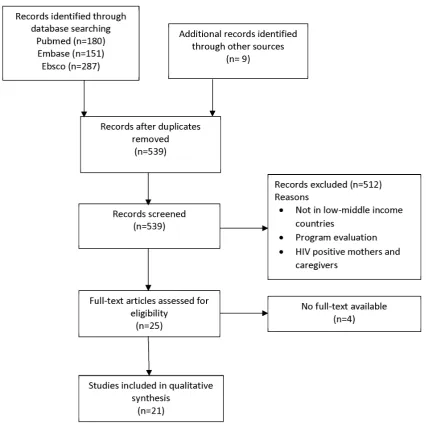
A flow diagram using PRISMA guidelines for reporting of systematic reviews is presented in
Figure 1 in reporting of the selection process and results. 20 For organization of initial search results,
Endnote reference management software (Thomson Reuters (Scientific) LLC) was used, and results
of searches imported to the software. At the first stage, duplicates and irrelevant studies were
removed. Two independent reviewers then screened study titles and abstracts for suitability against
inclusion and exclusion criteria. The decision to include or exclude a study was required to be agreed
on by both reviewers (ANB and AK). If after consultation a decision wasn’t reached by the two
reviewers, a third reviewer (EFK) made the final decision.
Data extraction
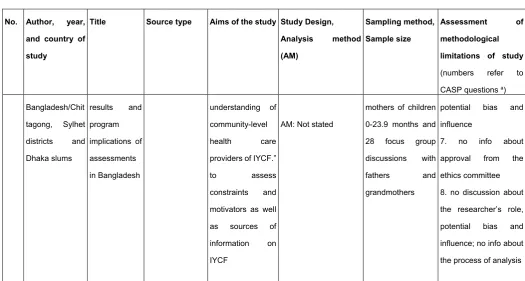
For organization of extracted data, a unified matrix was utilized to record specific characteristics
of included studies. Extracted data included: reference details (author, year, title, journal/publisher);
country/region of study; objectives or aims of the study; study design including methodological
approaches (e.g., interviews/focus groups) and conceptual basis underlying the study (e.g.,
Grounded Theory); analysis method(s); sampling methodology and sample size; and initial
assessment of the methodological limitations of the study. The initial results of the selection process
and data abstraction are presented in Table 1.
Additional steps were taken in the data extraction phase that involved expanding the matrix
(Table 1) to include participant characteristics, summaries of key outcomes/results reported, and the
emergent review findings for which the study contributes evidence. These details are given in
Appendix 2.
Quality appraisal
in Table 2. During this process, methodological limitations of emergent findings were considered and
categorized as minor, moderate or major, based on the absence of description of key elements of
methodology (guided by the CASP assessment in Table 1) in the document(s) which support the
finding, including the following: approach used to recruit or sample participants, how potential for
researcher bias was addressed, how analysis was done or, in the case of mixed methods research,
how statistical sampling and analysis was done. Minor methodological limitations were those with
one element missing, moderate limitations were those with two elements missing, and major
limitations were those with three or more missing. Full details of which elements were missing from
each document are available in Appendix 3. Additional assessments of emergent findings were
conducted based on the quality of the studies or documents supporting the finding. These included
assessments of relevance, coherence and adequacy guided by the GRADE CERQual methodology.
Assessments of relevance and coherence were not conducted for emergent findings with minimal
(usually one) studies or grey literature contributing to the finding. These assessments for each
emergent finding are given in Table 2 with full details of the how assessments were made found in
Appendix 3. The overall assessment of confidence in emergent findings was based upon the
assessments of methodological limitations, relevance, coherence and adequacy and was guided by
the GRADE CERQual method. These are given for each emergent finding in Table 2 along with an
explanation of judgment describing how the level of confidence was reached.
Following abstraction and grading of evidence, the final step involved data from the results,
discussion, and conclusion sections of the included studies, being extracted and entered into NVivo
11 qualitative software (NVivo qualitative data analysis software; QSR International Pty Ltd. Version
11, 2015), wherein thematic analysis was employed to identify domains descriptive of the data for
investigation and presentation.
This thematic analysis led to a more interpretive phase in order to understand how the themes
identified may represent barriers and facilitators to change infant and young child feeding; for this
we used an approach similar to that of Thomas et al. 24
Results
After a narrative summary of themes identified through the initial analysis was available, three
reviewers (ANB, AK, EFK) met jointly to consider these and produce a consensus-based listing of
barriers and facilitators. This step evaluated all emergent findings in light of the summary of themes
wherein several emergent findings were often merged into one synthesized finding, or individual
emergent findings were discarded due to weak assessments of confidence or minimal support from
the included studies. Table 3 presents the synthesized review findings of barriers and facilitators
generated through the data synthesis exercise and subsequently agreed on by reviewers.
Four categories of barriers to recommended breastfeeding practices were identified, and three
categories of barriers to recommended complementary feeding practices were identified. Barriers to
breastfeeding included factors specific to infant or mother, and cross-cutting beliefs and perceptions,
as well as a pervasive lack of support for breastfeeding, from families, health workers and due to
time poverty. Several categories of facilitators were also identified from the literature reviewed,
including food security, social support, and individual infant and maternal factors.5. Conclusions
This section is not mandatory, but can be added to the manuscript if the discussion is unusually
long or complex.
for breastfeeding mothers 27 and one carried out in 2013 considered the psychosocial correlates of
exclusive breastfeeding 28, neither of those included a comprehensive approach to assessing the
quality of included studies.
Strengths of the current review included the use of multiple reviewers experienced in qualitative
research and data collection and analysis, a comprehensive search strategy, assessment and scoring
of quality and confidence placed in the findings based on guidelines, and inclusion of grey literature.
Limitations of the study were the exclusion of documents not available in the English language and
date limitations.
The review focused on identifying studies that related the experiences and first-hand accounts
of family members responsible for providing for the care and nutritional needs of young children
under 2 years of age. Through this systematic qualitative review and synthesis, hypothesized barriers
and facilitators to improving infant and young child feeding were identified. The findings presented
in this review are directly applicable to social and behavioral change initiatives in low resource
settings aimed at improving practices for better health and nutrition of young children.
Acknowledgments: All authors have read and approved the final manuscript.
Funding: The study received no financial support.
Appendix B
Table 1. Data extraction of studies included in review including bibliographic information, study
details and assessment of methodological limitations.
No. Author, year,
and country of
study
Title Source type Aims of the study Study Design,
Analysis method
(AM)
Sampling method,
Sample size
Assessment of
methodological
limitations of study
(numbers refer to
CASP questions a)
1 Lynn M.
Babington
2006
Dominican
Republic/ Las
Matas de Farfan
Understanding
Beliefs,
Knowledge,
and Practices
of Mothers in
the Dominican
Republic
Related to
Feeding
Infants and
Young
Children
Journal:
Hispanic Health
Care
International
“To expand
knowledge
regarding feeding
practices and
nutritional beliefs
of mothers living in
the Dominican
Republic.”
Qualitative methods (a
focus group
discussion)
AM: modified constant
comparative method
Convenience
sampling
10 mothers aged
16-45 years with at
least one child.
5. no discussion
regarding saturation of
data; only 10
participants; limited
explanation of results;
few illustrative quotes.
6. no discussion about
the researcher’s role,
potential bias and
influence
8. limited data to
support the findings; no
discussion about the
researcher’s role,
potential bias and
influence
2 Amal
Omer-Salim, Lars-Ake
Persson,
PiaOlsson
2007
Tanzania/
suburban Dar es
Salaam
(Temeke district)
Whom can I
rely on?
Mothers’
approaches to
support for
feeding: An
interview study
in suburban
Dar es
Salaam,
Tanzania
Journal:
Midwifery
“To explore and
describe mothers’
perception of baby
feeding and
approaches to
support for baby
feeding”
“to describe and
explore mothers’
experiences of
support for baby
feeding, with a
focus on the
transition from
exclusive to
non-exclusive breast
feeding, in
suburban Dar es
Qualitative methods
(semi-structured
interviews)
AM: Qualitative
content analysis
Purposive selection
from clinic
8 mothers with
babies under 6
months of age
5. no discussion
regarding saturation of
data; only 8
participants;
6. no discussion about
the researcher’s role,
potential bias and
influence
8. no discussion about
the researcher’s role,
potential bias and
Salaam,
Tanzania.”
3 C
Tawiah-Agyemang, BR
Kirkwood, K
Edmond, A
Bazzano and Z
Hill 2008 Ghana/ Kintampo district Early initiation of breast-feeding in Ghana: barriers and facilitators Journal: Journal of Perinatology
“To explore why
women in Ghana
initiate
breast-feeding early or
late, who gives
advice about
initiation and what
foods or fluids are
given to babies
when
breast-feeding initiation is
late”
Qualitative methods
AM:
“The focus groups and
semi-structured
interviews were
independently
analyzed by the two
lead researchers
through the systematic
identification and
coding of themes. The
findings were then
discussed and consensus reached.” Purposive sampling 52 semi-structured interviews with recent mothers,
8 focus group
discussions with
women of
child-bearing age,
13 semi-structured
interviews with
health workers,
policy makers and
implementers
6. no discussion about
the researcher’s role,
potential bias and
influence
7. no info about
approval from the
ethics committee
8. no discussion about
the researcher’s role,
potential bias and
influence
4 Gloria E. Otoo,
Anna A. Lartey,
Rafael
Pérez-Escamilla
2009
Ghana/ Manya
and Yilo Krobo
districts Perceived Incentives and Barriers to Exclusive Breastfeeding Among Peri-urban Ghanaian Women Journal: Journal of Human Lactation To explore Ghanaian women’s knowledge and attitudes toward exclusive breastfeeding Qualitative methods
(four focus group
discussions)
AM: Thematic analysis
Convenience
sampling
4 focus group
discussions with a 7
to 10 mothers who
had at least one
child less than 4
months old per
group
6. no discussion about
the researcher’s role,
potential bias and
influence
8. no discussion about
the researcher’s role,
potential bias and
influence
5 Luzmil A
Hernandez,
Marth A Lucia
Vasqu 2010 Colombia/ Cali Practices and beliefs about exclusive breastfeeding by women living in
Commune 5 in
Cali, Colombia Journal:
Colombia
Médica
To describe the
practices and
beliefs about
breastfeeding
during the first 6
months after
delivery,
Qualitative methods
(ethnonursing)
AM: Ethnonursing
Spradley’s method
(identification of
domains, taxonomies,
componential analysis,
and finally themes)
Key informants
were “intentionally
selected”
15 key informant
participants (three
interviews for each
participant: 45 [60
to 90 minutes in
6. no discussion about
the researcher’s role,
potential bias and
influence
7. no info about
approval from the
ethics committee
8. no discussion about
length] interviews
total); there were
also general
participants
(relatives of the key
informants)
potential bias and
influence
6 Sabrina
Rasheed,
Rukhsana
Haider, Nazmul
Hassan, Helena
Pachon,
Sanjeeda Islam,
Chowdhury S.B.
Jalal, Tina G.
Sanghvi
2011
Bangladesh/
one rural area
(South Harina
Village of
Lohagara
Sub-district) in
Chittagong and
three slum areas
(Badda Saat
Tola and Mirupr)
in Dhaka
Why does
nutrition
deteriorate
rapidly among
children under
2 years of
age? Using
qualitative
methods to
understand
community
perspectives
on
complementar
y feeding
practices in
Bangladesh
Journal: Food
and Nutrition
Bulletin
To understand
community
perspectives on
complementary
feeding practices
in order to inform
the design of
future
interventions for
improved
complementary
feeding.
Qualitative (mixed)
methods
(Semi-structured
interviews, food
attributes exercises,
opportunistic
observations, trials of
improved practices,
key informant
interviews, focus group
discussions, and
24-hour dietary recall
survey)
AM:
Thematic analysis
-data triangulation of
different data sources
identified themes to
understand
phenomena
Convenience
sampling
Respondents were
selected
“opportunistically”
42 semi-structured
interviews with
mothers;
6 interviews with
key informants (2
village doctors and
4 traditional birth
attendants); 4 focus
group discussions
with 2
grandmothers and
fathers; food
attributes exercises
with 24 mothers;
24-dietary recall
survey with 195
mothers; and 21
opportunistic
observations of
feeding times
involving meals or
snacks.
6. no discussion about
the researcher’s role,
potential bias and
influence
8. no discussion about
the researcher’s role,
potential bias and
7 Pranee C.
Lundberg, Trieu
Thi Ngoc Thu
2011
Vietnam/ Ho Chi
Minh City Breast-feeding attitudes and practices among Vietnamese
mothers in Ho
Chi Minh City
Journal: Midwifery “To describe breast-feeding attitudes and practices among Vietnamese
women in Ho Chi
Minh City.”
Qualitative methods
(semi-structured
in-depth interviews and
observations) AM: Qualitative content analysis Purposive convenience sampling 23 voluntary Vietnamese
mothers who have
given birth to a child
within the last two
years
6. no discussion about
the researcher’s role,
potential bias and
influence
8. no discussion about
the researcher’s role,
potential bias and
influence
8 Yati Afiyanti,
Dyah Juliastuti 2012 Indonesia/ Jakarta Exclusive breastfeeding practice in Indonesia Journal: Birth Journal of Midwifery
To explore cultural
practices and behaviors of breastfeeding among Indonesian mothers Qualitative methods (semi-structured interviews) – Grounded Theory AM: Constant comparative analysis Purposive and theoretical sampling
8 key participants
(breastfeeding mothers) 10 general participants (family members and healthcare cadre)
5. no explanation
regarding the data
collection setting
6. no discussion about
the researcher’s role,
potential bias and
influence
8. no discussion about
the researcher’s role,
potential bias and
influence
9 Hope Mei Hong
Lee, Jo Durham,
Jenny Booth, Vanphanom Sychareun 2013 Lao PDR/ Vientiane (Sisattanak
district and eight
in
Hatxayfong
distric)
A qualitative
study on the
breastfeeding experiences of first-time mothers in Vientiane, Lao PDR Journal: BMC Pregnancy & Childbirth
To identify the
reasons and
influences behind
the BF decisions of
first-time mothers
in Lao PDR.
Focusing on
decisions around
when to initiate BF,
timing of the
introduction of
complementary
foods and BF
duration.
Qualitative methods
(interviews and focus
group discussions)
AM: Thematic analysis
Purposive sampling
In-depth interviews
with16 first-time
mothers and 7 key
informants; focus
group discussions
with 24 first-time
mothers
6. no discussion about
the researcher’s role,
potential bias and
influence
8. no discussion about
the researcher’s role,
potential bias and
10 Christy
Bomer-Norton
2013
Haiti/ Artibonite
Timing of
breastfeeding
initiation in
rural Haiti: A
focused
ethnography
Dissertation:
The University of
Texas at
Arlington
To describe
factors affecting
the timing of
breastfeeding
initiation among
Haitian mothers,
particularly the
specific cultural
beliefs
and practices
Qualitative methods
(ethnography)
AM: Ethnography
Purposive
convenience
sampling
25 mothers with
children less than
12 months old
8. no discussion about
the researcher’s role,
potential bias and
influence
11 Anne Laterra,
Mohamed A.
Ayoya,
Jean-Max Beauliere,
M’mbakwa
Bienfait, Helena
Pachon
2014
Haiti/ Artibonite,
Nippes, Quest,
and Sub-Est
Infant and
young child
feeding in four
departments in
Haiti;
mixed-method study
on prevalence
of
recommended
practices and
related
attitudes,
beliefs, and
other
determinants
Journal: Pan
American
Journal of Public
Health
To determine and
describe the
prevalence and
patterns of three
recommended
practices for infant
and young child
feeding—
exclusive
breastfeeding,
continued
breastfeeding, and
achievement of
minimum dietary
diversity
To identify the
attitudes and
beliefs that inform
these practices
and any other
factors that
may facilitate or
impede their
implementation
Mixed methods (a
cross-sectional survey
and 12 focus group
discussions)
AM: Qualitative data
was analyzed by using
thematic content
analysis
Survey respondents
were recruited by
using multi-stage
cluster sampling.
After survey
completion,
respondents were
invited to participate
in a FGD held that
same day.
12 focus group
discussions
(with4-14 participants)
among women >=
18 years old with
children <= 2 years
old)
5. no info regarding the
form of data is not (e.g.
tape recordings, notes
etc); no discussion
about saturation of data
6. no discussion about
the researcher’s role,
potential bias and
influence
8. no discussion about
the researcher’s role,
potential bias and
12 Gretel H. Pelto, Margaret Armar-Klemesu 2015 Kenya/ Vihiga and Kitui Identifying interventions
to help rural
Kenyan
mothers cope
with food
insecurity:
results of a
focused
ethnographic
study
Journal:
Maternal & Child
Nutrition To identify potential interventions to improve the quality, availability,
and affordability of
foods consumed
by infants and
young children
Qualitative methods
(Phase 1: 8-10 key
informants’ interviews,
community
observations. Phase 2:
Interviews with at least
32 caregivers of
infants and young
children (6-23 months
of age))
AM: Focused
ethnographic study
Unknown how key
informants were
selected.
Caregivers were
randomly selected
in a small
representative
sample
8-10 Key informants
and at least 32
caregivers
5. no explanation
regarding the form of
data; no discussion
about saturation of data
6. no discussion about
the researcher’s role,
potential bias and
influence
8. no discussion about
the researcher’s role,
potential bias and
influence
13 Alessandra N
Bazzano,
Richard A
Oberhelman,
Kaitlin Storck
Potts, Leah D
Taub, Chivorn Var 2015 Cambodia/ Takeo province What health service support do families need for optimal breastfeeding
? An in-depth
exploration of young infant feeding practices in Cambodia Journal: International Journal of Women’s Health
To provide an
in-depth
understanding of
breastfeeding
practices in order
to appropriately
design a scalable
newborn health intervention incorporating expanded breastfeeding counseling and support Qualitative methods (27 semi-structured interviews with caregivers; 14 observation sessions
and two focus group
discussions with
healthcare providers)
AM: an ethnographic
approach
Purposive sampling
27 interviewees
5. no justification
regarding the data
collection setting; no
discussion about
saturation of data
6. no discussion about
the researcher’s role,
potential bias and
influence
8. no discussion about
the researcher’s role,
potential bias and
influence
14 Jennifer Burns,
Jillian A. Emerson, Kimberly Amundson, Shannon Doocy, Laura E.
Caulfield, Rolf D.
W. Klemm A Qualitative Analysis of Barriers and Facilitators to Optimal Breastfeeding and Complementa ry Feeding Journal: Food and Nutrition Bulletin To characterize IYCF practices
and barriers and
enablers to optimal
child feeding in
South Kivu
Qualitative approach
(focus group
discussions,
structured and
in-depth interviews)
AM: Thematic analysis
Convenience
sample of Jenga
Jamaa 2 program
beneficiaries
(women of
reproductive age),
Prevention of
Malnutrition in
Children under Two
6. no discussion about
the researcher’s role,
potential bias and
influence
8. no discussion about
the researcher’s role,
potential bias and
2016
Democratic
Republic of
Congo/ South
Kivu
Practices in
South Kivu,
Democratic
Republic of
Congo
Approach (PM2A)
care group lead
mothers and
government health
workers.
188 participants in
20 FGDs with
mothers of children
<24 months of age
and women of
reproductive age.
119 structured
interviews among
mothers with
children <24
months of age. 43
in-depth individual
interviews with
health workers and
lead mothers.
Grey literature
15 Alive &
Thrive-Ethiopia
2010
Ethiopia/ Tigray
region
IYCF
Practices,
Beliefs, and
Influences in
Tigray Region,
Ethiopia
Alive & Thrive To understand
infant and young
child feeding
practices and the
role of service
providers in the
study
communities.
Specific objectives
are:
• To describe
current IYCF
practices
Qualitative approach
(focus group
discussion, maternal
interviews,
observations,
interviews with service
providers
AM: “Data analysis
was done mainly
based on the
interpretative
approach that involves
eliciting meanings from
Respondents were
randomly selected
in each area from a
list provided by the
health post, and the
study interviewers
also went door to
door to identify
households with
children in the
required age group
45 mothers with
interviews; 3 fathers
6. no discussion about
the researcher’s role,
potential bias and
influence
8. no discussion about
the researcher’s role,
potential bias and
influence; lack of an
in-depth description of the
• To identify
barriers and
facilitators for
recommended
IYCF practices
• To identify people
and approaches
that can
influence optimal
IYCF change
• To explore
strategies for
improving
complementary
feeding practices
for young
children
• To explore the
potential role of
health and
community
workers to support
IYCF behavior
changes and thus
reduce stunting in
young children
the collected
information.”
and 2 grandmothers
with FGDs; 27
interviews with
service providers
16 Alive & Thrive
2010
Ethiopia/ SNNP
Region
IYCF
Practices,
Beliefs, and
Influences in
SNNP Region,
Ethiopia
Alive & Thrive To understand
infant and young
child feeding
practices and the
role of service
providers in the
study
communities.
Specific objectives
are:
Qualitative approach
(focus group
discussion, maternal
interviews,
observations,
interviews with service
providers
AM: “Data analysis
was done mainly
Respondents were
randomly selected
in each area from a
list provided by the
health post, and the
study interviewers
also went door to
door to identify
households with
6. no discussion about
the researcher’s role,
potential bias and
influence
8. no discussion about
the researcher’s role,
potential bias and
influence; lack of an
in-depth description of the
• To describe
current IYCF
practices
• To identify
barriers and
facilitators for
recommended
IYCF practices
• To identify people
and approaches
that can
influence optimal
IYCF change
• To explore
strategies for
improving
complementary
feeding practices
for young
children
• To explore the
potential role of
health and
community
workers to support
IYCF behavior
changes and thus
reduce stunting in
young children
based on the
interpretative
approach that involves
eliciting meanings from
the collected
information.”
children in the
required age group
47 mothers with
interviews; 3 fathers
and 3 grandmothers
with FGDs; 27
interviews with
service providers
17 United States
Agency for
International
Development
2010
Formative
assessment of
infant and
young child
feeding
practices at
the community
United States
Agency for
International
Development
“The objectives of
this study were to:
describe the key
influencers of
infant and young
child feeding
practices in
Qualitative approach
(focus group
discussion with
mothers, fathers and
grandmothers and
in-depth interviews with
stakeholders)
Recruitment of FGD
participants was
facilitated by local
health facility staff.
Clinics and
community
organizations
5. 5. no explanation
regarding the data
collection setting
6. no discussion about
the researcher’s role,
potential bias and
Zambia level in
Zambia
targeted areas in
Zambia; examine
the barriers and
constraints to the
uptake of
recommended
feeding and caring
practices; learn
more about the
types of foods
used for
complementary
feeding and the
age of children
when these foods
are introduced;
identify feasible
and effective
channels for
promoting
recommended
infant and young
child feeding
practices.”
AM: Thematic analysis
identified interview
participants.
6 FGDs with 6 to 12
participants each, in
4 different groups:
mothers with
children < 6mos;
mothers with
children 6 to 23 mos
of age; fathers with
children ≤ 23mos;
grandmothers with
children ≤ 23mos
(24 total FGDs)
36 in-depth
interviews with
stakeholders
8. no discussion about
the researcher’s role,
potential bias and
influence
18 United States
Agency for
International
Development
2011
Nigreria/ Federal
Capital Territory
(Abuja Municipal
Area Council,
Bwari Area
Formative
assessment of
infant and
young child
feeding
practices-federal capital
territory,
Nigeria
United States
Agency for
International
Development
“(1) To conduct a
cross-sectional
investigation of
breastfeeding
habits of
caregivers among
target groups.
(2) To investigate
complementary
feeding practices
among target
groups.
Qualitative approach
(In-depth interviews
with stakeholders and
focus group discussion
with care givers)
AM: Thematic content
analysis
Purposive
convenience
sampling (from
health facility)
In FGDs, 91
mothers of children
< 6 months old, 81
mothers of children
6 to 24 months old,
75 grandmothers of
children
under-24-6. no discussion about
the researcher’s role,
potential bias and
influence
7. no info about
approval from the
ethics committee
8. no discussion about
the researcher’s role,
potential bias and
Council, Kuje
Area
Council and
Kwali Area
Council)
(3) To document
responsive
feeding practices,
food hygiene, and
feeding the sick
child practices in
the study areas.
(4) To identify
prospects of health
communication
interventions
through the use of
relevant media for
reaching the
respective target
groups.
(5) To identify
existing alternative
platforms for
communication
interventions and
information
sharing and
dialogue among
target groups.”
month-olds and 82
fathers of children
under-24-
month-olds
19 United States
Agency for
International
Development
2011
Malawi
Consulting
with
caregivers –
formative
research to
determine the
barriers and
facilitators to
optimal infant
and young
child feeding in
United States
Agency for
International
Development
Identify specific
dietary problems
among children
less than 2 years
of age, including
determining the
energy density and
nutrient density
(particularly iron,
zinc, and vitamin
Phase 1 Qualitative
approach (In-depth
interviews with care
givers and
observations) and
Phase 2 TIPs (trials of
improved practices)
AM: Thematic content
analysis
Purposive sampling
Interviews with 60
mothers/caregivers
of children 6-23
months and 18 key
informants
6. no discussion about
the researcher’s role,
potential bias and
influence
8. no discussion about
the researcher’s role,
potential bias and
three regions
of Malawi
A) of common
foods given to
children in different
age groups.
Gain a further
understanding of
current feeding
practices and
feeding problems
that
Impede adequate
dietary intake in
children less than
2 years of age.
Describe
maternal/child
behaviors related
to responsive
feeding.
Identify the
positive and
negative social,
cultural, and
economic factors
that influence
current practices,
including the
influence of other
family and
community
members.
20 Academy for
Educational
Development
(AED)/
Alive & Thrive
Initial Insight
Mining and
Pretest
Research for
Academy for
Educational
Development
(AED)/
Alive & Thrive
To assess IYCF
practices as well
as an analysis of
the specific
information gaps
Qualitative approach
(focus group
discussion with
mothers/caregivers
and in-depth Multi-stage
sampling:
Stage 1: Purposive
selection of two
4. no info about
recruitment strategies
5. no explanation
Ethiopia Country
Office
2011
Ethiopia:
Oromia,
Amhara,
SNNPR and
Tigray; rural
areas only
Alive & Thrive
Ethiopia
Ethiopia Country
Office
that needed to be
explored through
the insight mining
and pretest
research.
interviews with
community health
workers and
community leaders
AM: Not stated
rural areas within
each region.
Stage 2: Purposive
sampling of
participants by field
recruiters (audience
profiles were
identified and filed
recruiters selected
participants using a
recruitment
questionnaire which
included key criteria
for selection and
criteria for
disqualification)
32 focus group
discussions among
mothers, fathers
and mothers in law;
26 in-depth
interviews with
stakeholders
(HEWs, VCHWs,
Religious leaders,
Kebele leaders,
women’s
associations
leaders)
collection setting and
the form of data
6. no discussion about
the researcher’s role,
potential bias and
influence
7. no info about
approval from the
ethics committee
8. no discussion about
the researcher’s role,
potential bias and
influence; no info about
the analysis process
21 United States
Agency for
International
Development
2011
Engaging
grandmothers
and men in
infant and
young child
feeing and
United States
Agency for
International
Development
Assess
complementary
feeding practices
of children
younger than 2
years and
A qualitative and
participatory in-depth
approach (focus group
discussion with
mothers/caregivers
and in-depth
Purposive sampling
in line with the
objectives of the
assessment: FGD
participants were
recruited by
6. no discussion about
the researcher’s role,
potential bias and
influence
8. no discussion about
Kenya/ Eastern
and Western
Provinces
maternal
nutrition –
Report of a
formative
assessment in
Eastern and
Western
Kenya
community beliefs
that influence
these.
Determine
maternal dietary
practices during
pregnancy and
lactation and
household factors
that influence
these.
Establish the roles
and
responsibilities of
men and
grandmothers in
the family and in
maternal dietary
and infant and
young child
feeding practices.
Determine cultural
influencers of
maternal, infant,
and young child
feeding.
Document
available services
and support for
nutrition in the
intervention areas.
interviews with key
informants)
AM: Thematic content
analysis
community health
workers based on
guideline criteria.
16 focus group
discussions (each
discussion
comprised between
10 and 12
members); in each
of the 2 provinces 8
FGDs occurred
among these
groups:
• 2 FGDs with
fathers of
children <2 yrs
• 2 FGDs with
mothers of
children <2 yrs
• 2 FGDs with
grandmothers
of children <2
yrs
• 2 FGDs with
mothers of
children <2 yrs
• 2 FGDs on
maternal
nutrition for
mothers of
children <2 yrs
And 28 in-depth
interviews with
stakeholders
potential bias and
22 United States
Agency for
International
Development
2011
Ghana/ Sunyani
West, Jaman
South, Nkoranza
North, Tain, and
Atebutu-Amanten
Ghana
promotion of
complementar
y feeding
practices
project –
baseline
survey report
United States
Agency for
International
Development
To provide an
in-depth analysis of
infant and young
child feeding
knowledge,
practices, and
behaviors as a
baseline to guide
the
implementation of
the Ghana
Promotion of
Complementary
Feeding Practices
Project, and to
provide a basis for
monitoring and
evaluating the
effectiveness of
the behavior
change
communication
campaign
Qualitative and
quantitative methods
(structured survey,
in-depth interviews, and
focus group
discussion)
AM: Thematic
analysis; triangulation
of different data
sources
Communities were
purposively
selected based on
the presence of
mother support
groups and church
based groups.
Female caregiver
participants were
purposively
selected.
Convenience
sampling was used
for the selection of
the fathers, health
workers, and
community group
leaders.
20 focus group
discussions with
fathers of children
6-24 months and 30
focus group
discussions with
mothers/caregivers
of children 6-24
months. Each group
has about 10
participants
5. no explanation
regarding the form of
data)
6. no discussion about
the researcher’s role,
potential bias and
influence
7. no info about
approval from the
ethics committee
8. no discussion about
the researcher’s role,
potential bias and
influence
23 Alive & Thrive
Bangladesh
2012
Perceptions,
practices, and
promotion of
infant and
young child
feeding –
Alive & Thrive
Bangladesh
“To determine the
perceptions of
mothers, influential
family and
community
members and
Qualitative and
quantitative methods
(structured survey,
in-depth interviews, and
focus group
discussion)
Purposive
convenience
sampling
Semi-structured
interviews with 42
5. no explanation
regarding the form of
data
6. no discussion about
Bangladesh/Chit
tagong, Sylhet
districts and
Dhaka slums
results and
program
implications of
assessments
in Bangladesh
understanding of
community-level
health care
providers of IYCF.”
to assess
constraints and
motivators as well
as sources of
information on
IYCF
AM: Not stated
mothers of children
0-23.9 months and
28 focus group
discussions with
fathers and
grandmothers
potential bias and
influence
7. no info about
approval from the
ethics committee
8. no discussion about
the researcher’s role,
potential bias and
influence; no info about
the process of analysis
a