4-Connected Evaluation Approach for Communication
Optimization UWSN
Ritika Chugh
1, Meenu Dhingra
21
Research Scholar, M.Tech,
2Assistant Professor, Deptt. of Computer Sc. & Engineering,
Vaish College of Engineering, Rohtak, Haryana (India)
ABSTRACT
The main challenge of underwater sensor network is to track the floating node without the existence of individual node tracker. In this paper, a four-connected method is provided for tracking the four effective neighbor nodes so that the communication optimization will be achieved. The work is divided in two main stages. In first stage, the neighbor node identification and the tracking are done based on the coverage range and mobility variation. Once the neighbors are identified, four stable connected nodes are identified which are considered as feasible communicating nodes. In second stage, the communication analysis on these nodes is done in terms of communication loss, communication delay and communication rate parameters. The proposed approach is simulated in NS2 environment. The comparative observations show that the proposed method has reduced the communication loss and improved the network reliability.
Keywords: UWSN, Node Tracking, Communication Analysis
I.INTRODUCTION
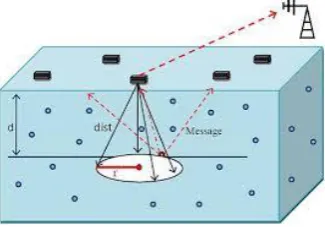
Underwater sensor network is the real time network in which the nodes are either floating on the surface of the water or present in depth. The controllers or the base stations exist on the surface but no such controller exists in the water itself. The nodes have to maintain the tracking information by performing the control message sharing. The reliability of this network depends on the network scenario, topology, protocol and the communication technology. The configuration management is defined with specification of different standards. The network interface is defined to achieve the communication reliability. The nodes are restricted in terms of energy and the sensing range. This kind of real time network suffers from various challenges. These challenges are at network level, communication level and node level. The functional UWSN is shown in figure 1.
The figure is showing the water area as the depth considered environment. In which the nodes can either exist in the work or can be floating. The blue smaller circles are showing the smart sensing devices. These sensor nodes are more capable then normal nodes. These nodes are defined with energy, memory and the processing unit. The white circle is showing the coverage of the sensor nodes. The tracking of the nodes within the network is done through the coverage range of sensor nodes present in the UWSN. The black rectangular boxes are the controller nodes or the base station present at the surface to accept the data from the sensor nodes. The tower showing outside the main base station used to connect the environment to the outer world. The sensor nodes are responsible to capture the information from the environment and pass it to the rectangular controller. The controllers aggregate this information and submit it to the main server via satellite connection or the internet connection.
In this paper, an effective communication method is provided for by tracking the selective neighbor nodes. The communication parameter based analysis on the neighboring nodes is to generate the communication path. The work is defined to optimize the communication in underwater sensor network. In this section, the basic structure of underwater sensor network, its architecture and the limitation of the network is defined. In section II, the work defined by the earlier researchers is discussed. In section III, the research methodology associated to the work is presented. The process model is described in this section. In section IV, the results obtained from the work are provided. In section V, the conclusion obtained from work is presented.
II. EXISTING
WORK
observation was provided in this work to analyze the network traffic and the physical locations of nodes. Based on the initial observation, the route formation and the communication optimization were simplified. The network performance improvement was provided in this work.
Author work[6] on the performance optimization was provided to generate the communication correlation between the nodes and to optimize the network communication. The computation cost based investigation was provided to analyze the network traffic and to generate optimize path. Author[7] has generated the traffic based analysis in the critical sensor network and provided a mobility analysis model to achieve the real time tracking. The mobility preserved communication was provided by the author to improve the network communication and to improve the network life. The mobility modeling is suggested by the author to reduce the computational cost and to optimize the network communication. Author[8] has defined an effective method for route discovery in the sensor network. The robust environment based next neighbor selection was defined. The communication was defined in case of congested network and to optimize the communication by generating the multihop communication. The optimized link based analysis was provided to reduce the communication loss and to improve the resource utilization. The performance driven optimization was provided by the author. Author[9] has defined a work on routing optimization based on the network traffic observation and the resource monitoring. The utilization of available resources was done to reduce the communication loss and communication delay. In this work, bandwidth utilization was provided along with consideration of network challenges. Author[10] has provided a real time analysis method for mobile network to achieve the reliable network communication. The multihop route formation was provided by the author to utilize the network configuration and mobility model. The connectivity specific and the node analysis based evaluation were provided to optimize the network communication. The quantification of network communication and performance vectors was provided by the author.
Author[11] has defined a work on the evaluation method based on the mobility and the network quantization. The performance driven analysis was provided based on different communication vectors. The dynamic connectivity based mobility observation was provided to analyze the communication throughput and to improve the network performance. A work on the gateway selection and evaluation was provided to optimize the dynamic connectivity of nodes. Author[12] has defined a hybrid network method to identify the data leak and to reduce the communication leakage. The data integrity analysis in the hybrid mobile network was provided by the author increase the communication trust and security. A communication vector driven route formation method was provided in this work. The route optimization protocol is defined to improve the network communication. Author[13] has used the communication method based on the mobility to generate the effective mobile communication. The route election based on the traffic observation was provided in this work. The inter-connectivity observation was considered to gain the effective network path.
III. RESEARCH METHODOLOGY
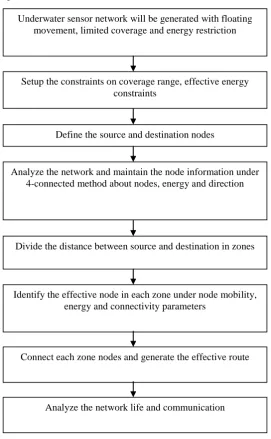
route formation based on the effective node selection from the neighbor list is provided in this work. The model of process work is shown in figure 2.
Figure 2 : Proposed Framework
The figure 2 showing the network flow based on the expected work stages. The work is divided into three main layers. In the first layer, the network level analysis is performed to identify the network integrity. The four connected method is defined to track the nodes in network. In the second layer, the zones are formed between source and destination. In final layer, the effective node selection is done based on energy and connectivity strength parameters. The method will be implemented in NS2 environment. The work is defined to improve the network communication and life. The simulation results are shown in next section.
IV. RESULTS
The proposed work is defined to optimize the communication for underwater sensor network. The proposed work is simulated in NS2 environment by generating a random network. The network is defined with 25 mobile
Underwater sensor network will be generated with floating movement, limited coverage and energy restriction
Setup the constraints on coverage range, effective energy constraints
Define the source and destination nodes
Analyze the network and maintain the node information under 4-connected method about nodes, energy and direction
Divide the distance between source and destination in zones
Identify the effective node in each zone under node mobility, energy and connectivity parameters
Connect each zone nodes and generate the effective route
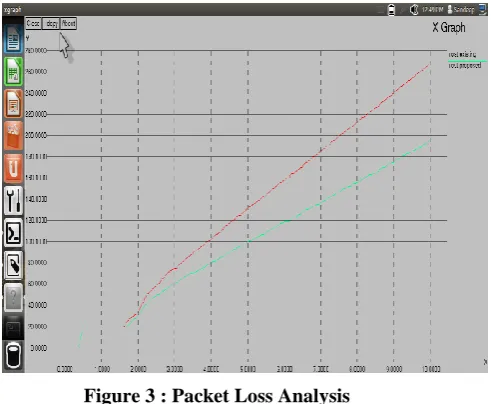
sensor nodes. The comparative analysis is done in terms of communication loss and loss rate parameters. The packet loss analysis is shown in figure 3.
Figure 3 : Packet Loss Analysis
Figure 3 is showing the comparative analysis of this work in terms of packet loss evaluation. The x axis is showing the simulation time and y axis showing the packet loss. The comparative observation shows that the proposed method has reduced the communication loss and improved the communication reliability. The rate of the data loss is also reduced and it is provided in figure 4.
Figure 4 : Loss Rate Analysis
Figure 4 is showing the communication loss rate obtained from the work. The comparative analysis is showing the method has reduced the rate on which the communication loss occurs over the network. The overall communication strength is improved from the work.
V
.
CONCLUSIONREFERENCES
[1] Axel Krings," Neighborhood Monitoring in Ad Hoc Networks", CSIIRW ’10, April 21-23, 2010, Oak Ridge, Tennessee, USA ACM 978-1-4503-0017-9
[2] Ying Li," Component-Based Track Inspection Using Machine-Vision Technology", ICMR’11, April 17-20, 2011, Trento, Italy ACM 978-1-4503-0336-1/11/04
[3] Bogdan Carbunar," JANUS: Towards Robust and Malicious Resilient Routing in Hybrid Wireless Networks", WiSe’04, October 1, 2004, Philadelphia, Pennsylvania, USA. ACM 1-58113-925-X/04/0010 [4] Johann Schlamp," How to Prevent AS Hijacking Attacks", CoNEXT Student’12, December 10, 2012,
Nice, France. ACM 978-1-4503-1779-5/12/12
[5] Joshua Goodman," Stopping Outgoing Spam", EC’04, May 17–20, 2004, New York, New York, USA. ACM 1-58113-711-0/04/0005
[6] Danny Dhillon," Implementation & Evaluation of an IDS to Safeguard OLSR Integrity in UWSNs", IWCMC’06, July 3–6, 2006, Vancouver, British Columbia, Canada. ACM 1-59593-306-9/06/0007
[7] Ahmed Khurshid," VeriFlow: Verifying Network-Wide Invariants in Real Time", HotSDN’12, August 13, 2012, Helsinki, Finland. ACM 978-1-4503-1477-0/12/08
[8] Evan Cooke," Toward Understanding Distributed Blackhole Placement", WORM’04, October 29, 2004, Washington, DC, USA. ACM 1-58113-970-5/04/0010
[9] Umair Sadiq," CRISP: Collusion–Resistant Incentive–Compatible Routing and Forwarding in Opportunistic Networks", MSWiM’12, October 21–25, 2012, Paphos, Cyprus. ACM 978-1-4503-1628-6/12/10
[10] Mauro Conti," A Randomized, Efficient, and Distributed Protocol for the Detection of Node Replication Attacks in Wireless Speed networks", MobiHoc’07, September 9-14, 2007, Montréal, Québec, Canada. ACM 978-1-59593-684-4/07/0009
[11] Garima Gupta," Reference based approach to Mitigate Blackhole Attacks in Delay Tolerant Networks", Q2SWinet’12, October 24–25, 2012, Paphos, Cyprus. ACM 978-1-4503-1619-4/12/10
[12] Abhijit Das," Energy Aware Topology Security Scheme for Vehicular Adhoc Ad Hoc Network", ICCCS’11, February 12–14, 2011, Rourkela, Odisha, India. ACM 978-1-4503-0464-1/11/02