Physics of double parton interactions
Recent results from DØ experiment
GeorgyGolovanov1,
1Joint institute for nuclear research, Dubna, Russia
Abstract.A study of processes with double parton interactions (DPI) in pp¯ collisions collected by DØ detector at the Tevatron collider at √s =1.96 TeV is presented. The study includes measurements of DPI event fraction and the effective cross section, a process-independent parameter related to the effective interaction region inside a hadron. The measurements are done using processes with photon and hadronic jets in different parton-parton scatterings: photon+jet+dijet, photon+b/c+dijet and diphoton+dijet. The measured effective cross section is applied in order to estimate background from DPI processes toWHproduction at the Tevatron energy.
1 Introduction
High energy inelastic hadron-hadron collisions are generally described as a hard 2→2 partonic scat-tering with soft gluon radiation in initial and final states with account of fragmentation and hadroniza-tion effects. However, there is a possibility to find more than one hard parton-parton scattering within the same hadron-hadron collision. The cross section of a process with double parton interaction is proportional to cross sections of two partonic scatterings A and B:σDPI ≡σAσB/σeff. The scaling
parameter,σeff, historically called theeffective cross section, having a unit of cross section,
character-izes the size of the effective interaction region within a hadron. The effective cross section is directly related to the spatial distribution of partons within a hadron and being a phenomenological parameter strongly needs experimental input. Moreover, some final states being produced by DPI mechanism can mimic rare processes produced by single parton-parton interaction (SPI). A study of DPI at
high-pTregime provides the important information about hadron structure and crucial for precise estimates
of background for many rare processes.
2 Study of DPI kinematics in final states containing photons and jets
The DØ detector is a general purpose detector described in [1]. The events should pass triggers based on the identification of high-pT cluster in the electromagnetic calorimeter with loose shower shape
requirements for photons. Photon candidates are selected using calorimeter cells by creating clusters inside a cone with radiiR ≡ [Δη2+ Δφ2]1/2 =0.2 around a cell-initiator. A photon candidate in an
event should be isolated in a ringR =0.2, the electromagnetic fraction of the total photon energy
disposition should be>96% and the probability to have a track associated to the calorimeter cluster to be<0.1%.
Jets are reconstructed using the DØ Run II iterative midpoint cone algorithm with a cone size
R=0.5. Measured jet energy does not necessarily match the energy of the parent parton caused by the parton-to-hadron fragmentation and interaction of hadrons with calorimeter material. Jet energy scale procedure is applied in order to correct measured jet energy to the true energy sum of all particles in a jet [2].
The technique used forσeffmeasurement is based on the difference of double parton-parton
inter-action and doublepp¯collision event rates [3]. Assuming that scatterings in the two parton-parton hard processes are uncorrelated, DPI and doublepp¯collision events should be kinematically identical. The effective cross section is extracted from the ratio of observed DPI and doublepp¯collision event rates.
2.1 DPI inpp¯→γ+jet+dijetprocess
The associate production of photons and hadronic jets in leading order is based on Compton-like
qg → qγand annihilationqq¯ → gγ processes. Additional hadronic jets in an event are caused by gluon radiation in initial and final states that also leads to pT-imbalance between the photon and
the leading jet. The main source of background toγ+jets production comes from processes with photons produced by hadron decays (π0,η, etc.) and fragmentation photons, that mostly suppressed
by the photon isolation requirement. Theqg→qγprocess dominates in broad kinematic region with the photon transverse momentumpγT<150 GeV and its contribution to the totalγ+ jets cross section
becomes comparable to the annihilation process atpγT150 GeV. The fraction ofqg→qγrelative to
the totalγ+ jets event cross section is shown in figure 1(a).
The DPγ+jet+dijet event sample is selected from DØ data with a singlepp¯collision vertex [3]. The collected statistics of the sample corresponds to the integrated luminosity of 8.7 fb−1. Each event must contain at least one photon in the pseudorapidity region|η| < 1.0 or 1.5 < |η| < 2.5 and at least three jets with |η| < 2.5. Events are selected with the photon transverse momentum
pγT >26 GeV, leading (in pT) jet pTjet1>15 GeV, while the next-to-leading (second) and third jets must have 15< pTjet2,3 <30 GeV. To avoid photon/jets overlapping the topology cuts requiring all object pairs (photon-jet or jet-jet) to be separated in (η−φ) space by distanceΔR(γ,jet) >0.7 and ΔR(jet,jet) > 1.0 are applied.
Any event in γ+jet+dijet sample can be produced by two independent 2 → 2 parton-parton scatterings or by a single parton-parton 2 → 4 scattering with gluon radiation in an initial or final state as well. To identify the events with two independent parton-parton scatterings that produce
γ+jet+dijet final state, an angular distribution sensitive to the kinematics of the DPI events is used. Among others, one can define a variable:
ΔS ≡Δφ(qT1, qT2), (1)
whereΔφis an azimuthal angle between the imbalance vectors of photon-leading jet (q1
T) and dijet
(q2
T) pairs inγ+jet+dijet events. This angle is schematically shown in figure 2(a). The distribution of
ΔS variable reflects angular properties of a mixture ofγ+jet+dijet events containing both single and double parton-parton scatterings. The contribution from SPI events to theΔS tends to shift distribution towardsπbecause of the well-balanced in pT photon and jets in a 2→ 4 process. The contribution from the DPI events should be flat since theΔS angle betweenqTvectors of two independent 2→2
scatterings is arbitrary.
(GeV) γ T p process γ q →
Fraction of qg
0 0.5 1
| < 1 γ 0 < |y
> 15 GeV
T jet p > 0 jet y ⋅ γ | < 0.8, y
jet |y < 0 jet y ⋅ γ | < 0.8, y
jet |y > 0 jet y ⋅ γ | < 2.5, y
jet
1.5 < |y
< 0
jet
y
⋅
γ | < 2.5, y
jet
1.5 < |y
30 100 200
PYTHIA 6.3, CTEQ6.5M
(a) S Δ dN/d 4 10 5 10 6 10 Data, inclusive DP model SP model Total -1 DØ, L = 8.7 fb
(a)
S [rad]
Δ 0 0.5 1 1.5 2 2.5 3
D a ta /T ot al 0.9 1 1.1 (b)
Figure 1.(a) The fraction of events produced via theqg→qγsubprocess relative to the total associated photon and jet production for various photon and jet rapidity regions. (b) TheΔS distribution in the data, DPI, SPI models, and the sum of the DPI and SPI contributions weighted with their fractions (“Total") inγ+jet+dijet final state. γ T p jet3 T p S Δ jet1 T p jet2 T p 1 T
q q2T
(a) 1 γ T p 2 γ T p S Δ jet1 T p jet2 T p 1 T
q q2T
(b)
Figure 2.A possible orientation of photon and jets transverse momenta vectors. Vectorsq1 T andq
2
T are thepT
-imbalance vectors of (a)γ+jet and dijet pairs inγ+jet+dijet events and (b) diphoton and dijet pairs inγγ+dijet events.
DPI model is composed by overlaying in a single event one event of an inclusive sample ofγ+1 jet events and one event of a sample of inelastic non-diffractive events selected with the minimum bias trigger and a requirement of at least one jet. Both samples contain only singlepp¯ collision events. The resulting mixed events, with jets re-ordered in pT, are required to pass theγ+jet+dijet event selections described above. This model of DP events, calledmixdp, assumes independent parton
scatterings withγ+jets and dijet final states by construction.
The DPI event fraction, fDPI, is found using a maximum likelihood fit of theΔS distribution
of the data to signal DPI and background SPI templates that are taken to be shapes of theΔS dis-tribution in themixdp model and SPI model simulated by sherpa, respectively. Signal and
back-ground samples used as templates satisfy all the selection criteria applied to the data sample. The result of the fit is shown in figure 1(b). The found fraction of DPI events with total uncertainty is
2.2 DPI inpp¯→γ+b/c+dijetprocess
The evolution of the study described in section 2.1 is a first measurement of the DPI rates andσeff
involving heavy flavor leading jet using theγ+b/c+dijet final state and direct comparison to the results obtained withγ+jet+dijet events. Theγ+b/c+dijet production is mainly caused byb(c)g→
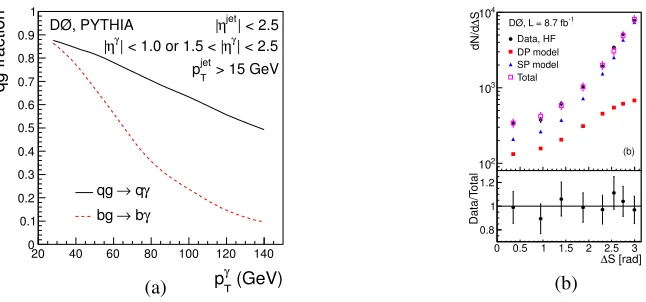
b(c)γandqq¯ → gγwithg → QQ¯, whereQ =b(c) [3]. Figure 3(a) shows the fractions ofqgand
bg subprocesses in events withγ+jet andγ+b-jet final states, calculated using defaultpythia6.4
settings and thecteq6.1L parton distribution function. At pγT30 GeV the Compton-like scattering
dominates over the annihilation process, contributing about (85−88)% of events. Since the initial quarks in the Compton-like scattering for inclusiveγ+jet andγ+b-jet production are typically light andb/cquarks, respectively, the difference between effective cross sections measured in the two processes should be sensitive to the difference between light quark and heavy quark transverse spatial distributions in a hadron.
(GeV)
γ T
p
20 40 60 80 100 120 140
qg fraction
0 0.1 0.2 0.3 0.4 0.5 0.6 0.7 0.8 0.9 1
| < 2.5
γ
η
| < 1.0 or 1.5 < |
γ
η
|
| < 2.5
jet η
| DØ, PYTHIA
> 15 GeV
jet T
p
γ
q
→
qg
γ
b
→
bg
(a)
S
Δ
dN/d
2 10 3 10 4 10
Data, HF DP model SP model Total
-1 DØ, L = 8.7 fb
(b)
S [rad]
Δ 0 0.5 1 1.5 2 2.5 3
D
a
ta/T
ot
al
0.8 1 1.2
(b)
Figure 3. (a) The fractions of events produced via theqg → qγand bg → bγsubprocesses. (b) TheΔS
distribution in the data, DPI, SPI models, and the sum of the DPI and SPI contributions weighted with their fractions (“Total") inγ+b/c+dijet final state.
Events undergo the same selection criteria as described in Section 2.1 with additional leading jet requirements which ensure that there is sufficient information to identify the leading jet as a heavy flavor candidate and have typical efficiency of about 90%. The technique of thefDPIandσeffextraction
is similar to the previous measurements and the found fraction is fDPIγb j j = 0.173±0.020(stat)± 0.002(syst), that gives the effective cross sectionσγDPIb j j=14.6±0.6(stat)±3.2(syst) mb. Figure 3(b) illustrates the results of the fitting procedure. Within uncertainties, the effective cross section in the
γ+jet+dijet event sample is consistent with that in the event sample with identified heavy flavor jets, allowing to conclude that there is no evidence ofσeffdependence on the initial parton flavor.
2.3 DPI inpp¯→γγ+dijetprocess
The goal of this study is to obtain the DPI rate and the effective cross section in theγγ+dijet final state [4]. The main contributions to diphoton production at the Tevatron are from theqq¯ → γγand
contribution to the total diphoton cross section. In this analysis which restricts the transverse momenta of each of the two leading jets to the range of (15−40) GeV and the transverse momenta of each of the two leading photons to be above 15 GeV, theqq¯scattering significantly dominates theggprocess, withqq¯fraction of about (70−80)%.
(GeV)
γ γ
M
50 100 150 200 250 300 350
γγ
→
Fraction of gg
0 0.05 0.1 0.15 0.2 0.25
0.3 PYTHIA 6.4, CTEQ6.1L
(a)
S (rad) Δ
0 1 2 3
Events
1 10
2 10
3 10
Data
DP model
SP model
Total
-1
D0, L = 8.7 fb
(b)
Figure 4. (a) The fraction of events produced via thegg→ γγsubprocess relative to the total diphoton cross section. (b) TheΔS distribution in the data, DPI, SPI models, and the sum of the DPI and SPI contributions weighted with their fractions (“Total") inγγ+dijet final state.
The DPI event fraction is found by fitting signal (mixdp model constructed similarly to those
described in sections 2.1 and 2.2) and background (sherpaSPI sample) event models to the data using
ΔS variable which is shown in figure 2(b). The result of the fit is presented in figure 4(b) and the found fraction of DPI events is fDPIγγj j =0.213±0.061(stat)±0.028(syst). Along with the measured selection efficiencies and geometric acceptances it gives the effective cross section σγγDPIj j = 19.3± 1.4(stat)±7.8(syst) mb, which is in agreement with the previous measurements within uncertainties.
3 DPI as a background to
WH
production at the Tevatron
As it was mentioned above a distinctive feature of DPI events is an interaction of two parton-parton pairs within the samepp¯collision. The measured effective cross section, which is directly related to the spatial distribution of partons within a hadron, is used to estimate the rate of DPI events at the Tevatron energy as a background to associateWHproduction withH→bb¯decay mode.
The HW production channel is simulated with Higgs boson masses of mH = 115 GeV and
mH = 150 GeV. The DPI scattering is simulated bypythia8 as inclusiveqq¯ → W +X
produc-tion in the first parton process and inclusive QCD dijet producproduc-tion in the second process. The cross sections of the simulated events are normalized to either experimentally measured cross sections or to theoretical NNLO predictions. The differential cross sectionsdσ/dMjjare calculated for theHW
and DPI (W+dijet) events. To match the detector resolution, the jet transverse momenta are smeared in order to approximately reproduce the jetpTresolution of the DØ detector. It is shown that the DPI cross section dominates theHWsignal by more than two orders of magnitude, and the DPI cross sec-tion is caused mainly by theW+2 light jets (stemming fromu/d/s-quarks or gluons) production [5].
In the signalHWevents there are twob-jets in the final state. Since the leading DPI background is caused by theW+2 light jet events, one should expect a significant reduction after requiring the jet
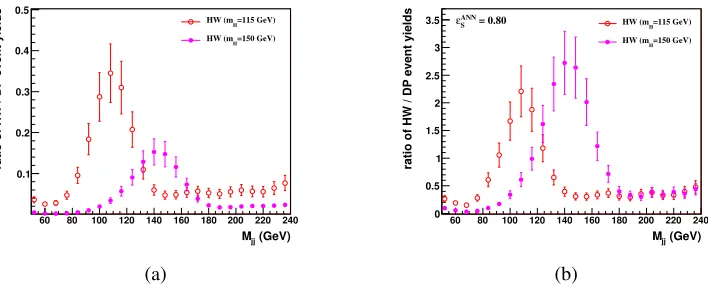
dijet massMjjbins for the events selected byb-tagging. The uncertainty in each bin is caused by the
normalization factors and the effective cross section. One can see that the Higgs boson events withMH
=115 GeV are expected to be suppressed by about a factor 3 (S/B0.35) in the peak position, while the signal events withMH=150 GeV are suppressed by about a factor 7. A set of variables sensitive
to DPI kinematics is used as an input to a dedicated artificial neural network (ANN) to separate the
HWfrom the DPI events. The new signal-to-background ratios are shown in figure 5(b). This ratio reaches about 2.2 atMjj115 GeV and about 2.7 atMjj150 GeV.
(GeV) jj M
60 80 100 120 140 160 180 200 220 240
ratio of HW / DP event yields 0.1
0.2 0.3 0.4 0.5
=115 GeV) H HW (m
=150 GeV) H HW (m
(a)
(GeV) jj M
60 80 100 120 140 160 180 200 220 240
ratio of HW / DP event yields
0 0.5 1 1.5 2 2.5 3
3.5 =115 GeV)
H HW (m
=150 GeV) H HW (m = 0.80
ANN S
ε
(b)
Figure 5.The ratio ofHWsignal to DPI background event yields (a) with theb-tagging and (b) with account of the ANN selection efficiency taken for theHWevents to be 80%.
4 Conclusion
Kinematic features of processes with double parton-parton scatterings have been studied by DØ ex-periment at the Tevatron. The effective cross section, a process independent parameter directly related to the size of the interaction region within a hadron, has been measured in processes with various final states containing isolated photons and hadronic jets and found to beσγDPIj j j=12.7±0.2(stat)± 1.3(syst) mb,σγDPIb j j =14.6±0.6(stat)±3.2(syst) mb andσγγDPIj j =19.3±1.4(stat)±7.8(syst) mb. All measured values are in agreement within uncertainties with each other as well as with most of the
σeff measurements performed at the Tevatron and LHC. It is also shown that DPI production can be a
significant background to many rare processes, especially with multi-jet final state. A set of variables allowing to reduce the DPI background is suggested.