J. Phys. C : Solid State Phys., Vol. 8, 1975. Printed in Great Britain. @ 1975
Self-consistent calculations for shallow defects in
semiconductors
:
11. Donor-acceptor pairs
A M Stoneham and A H Harker
Theoretical Physics Division, Atomic Energy Research Establishment, Harwell, Oxfordshire, OX11 ORA.
Received 11 November 1974
Abstract. A general method has been developed for performing self-consistent calculations for shallow defects or defect complexes in semiconductors. Results are given here for donor- acceptor pairs in GaP and a comaprison is made of the various treatments of central-cell corrections and the effects arising from the overlap of the donor and acceptor wavefunctions. Whilst no detailed refitting of host parameters is attempted, it seems likely that the current estimate of the bandgap (2.339 eV) is too large, and the latest estimates of the dielectric constant may also be inaccurate.
1. Introduction
One of the classes of defect central to the development of commercial electro-optic devices consists of donor-acceptor pair systems (eg Dean 1973). In these systems, an electron trapped at a donor may recombine with a hole trapped at an acceptor, giving luminescence with an energy E,,, approaching that of the bandgap, EGAP’
The donor-acceptor pairs are of great scientific interest, in addition to their techno- logical virtues. Extremely accurate spectroscopy is possible, giving recombination ener- gies and other details of the transitions as a function of the donor-acceptor separation. The theory of the trends with separation of the transition energy, E,,,, is the subject of the present paper. We shall demonstrate the use of the general computer program
SEMELE (Stoneham and Harker 1975, to be referred to as I), comparing earlier treat-
ments of the theory with a more accurate approach and commenting on the implications for the parameters of the host lattice.
2. General
In this section we outline previous work on donor-acceptor systems, the choice of suitable systems to test different aspects of the theory and the values of parameters for the various systems studied.
2.1. Earlier theories
The results which have been the mainstay of the interpretation of donor-acceptor recombination data are given by Hopfield (1964), whose ‘quantum chemistry’ approach to shallow defects is followed in the present paper. The essence of his conclusions is that
at large separations R , where the donor and acceptor wavefunctions do not overlap
AE
=
EGAP - E,,, N E , -k E ,-
e2/ER (2.1)where
ED
is the donor ionization energy, E, the acceptor ionization energy and E the dielectric constant (usually taken as the static constant). At very small separations, where the Coulomb fields of the ionized donor and acceptor would cancel to a great extent, Hopfield argues:AE N E,,, (2.2)
where E,,, is the exciton binding energy.
We shall be concerned primarily with AE(R), together with the effects of central-cell corrections on the various energies. We shall not be discussing the many small correc- tions to (2.1) proposed by other workers. These include multipole corrections, elastic interactions, polaron effects, van der Waals terms and corrections from the wavevector dependence of the dielectric constant. However, it is worth stressing that the van der Waals terms are not important. The original discussion of this contribution (Trumbore and Thomas 1965) was based on empirical arguments. Revised estimates of the dielectric constant reduced the need for these terms. Further, quantitative estimates are possible (Stoneham 1975) based on the observed polarizabilities of donors and acceptors (Dean and Patrick 1970), which show that the van der Waals terms must be only a few per cent of the original estimates. The problem has been complicated by the incorrect screening used by many workers (including some otherwise-scrupulous analyses, for example, Vink et a1 1973): the van der Waals term should contain an E-, factor, not the E - ’ commonly found (McLachlan 1965, Israelachvili 1972). In essence, the instantaneous dipole on one centre induces a dipole proportional to E - ’ on the other and the interaction of these two dipoles is screened by a further E-’ factor.
There have been four earlier calculations of the separation dependence of AE which go beyond (2.1). The earliest, due to Williams (1960) took into account the overlap of the donor and acceptor wavefunctions. This work was extended later by Mehrkam and Williams (1972), whose work we discuss in more detail in $3. Hopfield (1964) quotes otherwise-unpublished calculations in his review. His work appears to cover many of the aspects treated later by Mehrkam and Williams and his results have the added virtue of going over to (2.2) at small spacings. Bindemann and Unger (1973) adopted a strategy different in detail, using ‘floating’ wavefunctions centred on sites other than the donor and acceptor. Their method also behaves reasonably at short distances. Calculations for molecular H, (Hurley 1954, Rosen 1931) suggest the Bindemann-Unger treatment should give rather better energies than the Mehrkam-Williams method.
2.2. Choice of system
Central-cell effects in donor-acceptor pairs 1111
tions suffices. The sulphur donor is fairly deep and is suitable for comparing the merits of different treatments of the central-cell terms.
2.3. Choice of parameters
We shall need to choose values of the dielectric constant E, the effective masses
m,*
andm,!, and the band gap E,,,. In addition to these host lattice properties, the effective radii for the core electrons must be established for a description of the central-cell corrections (cf
6 3 of the preceding paper).
We shall normally use the following parameters for G a p :
E = 11.02
m: = 0.33 m, m,! = 0.38 m,
EGAP = 2.339 eV (Dean 1973). (Vink et a1 1973)
(I. to fit effective-mass donor energy),
(I, to fit effective-mass acceptor energy),
(2.3)
I
Different parameters are used occasionally. In special cases, notably G a p : (Zn, S), we compare results with earlier work using E = 10.75, and so we alter the dielectric constant. In other cases, central-cell corrections are included by modifying mf. We shall also see that our calculations cast doubt on the assumed values of E and
EGAP.
As described in I, the donor core can be represented by a nuclear charge Z = 5 and four electrons in orbitals with wavefunctions proportional to exp( - ar) and r exp(
-
iar).
The parameters a can be varied to give the correct central-cell correction. In I we needed to know only that the a controlled the central-cell correction. Here we need to know the precise relation between a and the donor binding. The results of such calculations are given in figure 1. All choices of basis function and all scalings are as described in I.However, there is one slight difference. For systems with more than one centre, as for a donor-acceptor pair, there are advantages in using a Gaussian basis in calculating the molecular integrals. These advantages are very considerable when more than two centres are involved. The program used has an option for expanding the Slater orbitals chosen as a sum of Gaussians. The approximations introduced are slight if enough Gaussians (typically 3 or
4)
are used and arise mainly from the poor description of the cusp in the 1s core functions. The results in figure 1 have used an expansion in terms of three Gaussians. The same expansion was used in all subsequent calculations.I
\t l ~ l l l l
0 2 06 IQ
43
Pigure 1. Donor ionization energies in G a P for various choices of core wavefunctions. These results
use Z = 5, and Is and 2s functions expi- rr) and
2.4. Different levels of calculation
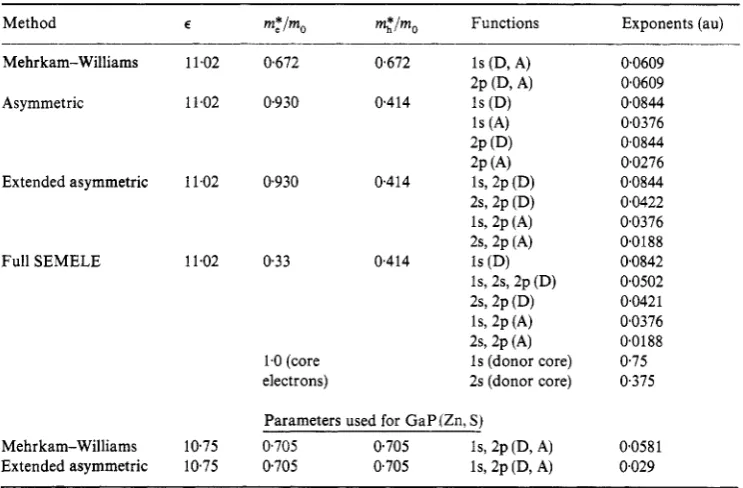
We have calculated the variation of the donor-acceptor pair energy with separation using five different levels of approximation, which we now summarize in 2.4.1-2.4.5. The wavefunction parameters used are listed in table 1.
Table 1. Parameters used in various calculations for G a p : (S, C)
Method E m:im, m , * h Functions Exponents (au)
Mehrkam-Williams Asymmetric
Extended asymmetric
Full SEMELE
Parameters used for GaPIZn. S i Mehrkam-Williams
Extended asymmetric
1075 0705 0.705 Is, 2~ (D, A)
10.75 0.705 0,705 Is, 2p (D, A)
0.0609 00609 0.0844 0.0376 0.0844 0.0276 0.0844 0.0422 0.0376 00188 0.0842 0.0502 0,0421 0.0376 00188 0.75 0,375
0.0581 0,029
2.4.1. Coulombic form (case I). This form uses equation (2.1) and is asymptotically correct at large distances. But, since donor-acceptor spectra are often used to determine the dielectric constant E , the results may show unduly good agreement with experiment. In
particular, one should note that the largest separations for which there are accurate data are only two or three times the effective Bohr radii: the true asymptotic regime and the range of spacings seen in practice do not overlap.
2.4.2. Mehrkam- Williams form (case 11). In its most basic version, Mehrkam and Williams (1972) assume a total wavefunction of the form +&re
-
R,) ~ ) ~ ( r +-
RA), where R , andRA give the donor and acceptor positions. The one-particle functlons have the form:
+(I) = N(1
+
oPZ) exp ( - j r )Central-cell effects in donor-acceptor pairs 1113
where E, and E!, are measured in Rydbergs. This scheme was used in Hopfield‘s earlier calculations. Thirdly, the exponent p was not treated as a full variation parameter. It was fixed by the relation:
where a, is the Bohr radius. This value of
p
was held constant for a range of spacings. Note too that the p parameter for the 2p component of $ is the same as for the Is compo- nent; for the hydrogen atom,pz,
is halfPI,.
The parameter Q is varied freely, altering theweights of 1s and 2p in the one-electron functions to minimize energy. Mehrkam and Williams call this process ‘configuration admixture’, a misleading phrase, totally different in meaning to the standard useage of molecular physics (eg Condon and Shortley 1935, Slater 1963, Coulson 1963, McWeeney and Sutcliffe 1969).
2.4.3. Simple asymmetric form (case 111). This corresponds t o the Mehrkam-Williams model in all respects but one: the asymmetry of donor and acceptor is included. Instead of (2.5), the electron and hole masses are defined by:
m* - = €’E,
m,
and
where again E, and ED are measured in Rydbergs. The orbital exponents for electron and hole are then fixed by the relations:
m e
p
= Aa,
= a&E, (2.9)e m,*
and
(2.10)
The asymmetry may be quite considerable. For the G a p : (S, C) system, for example, p, is only 45% of
p,.
2.4.4. Extended basis form (case IV). This is
a
generalization of case 111, but with a more general form of the one-particle functions $. Instead of only Is and 2p functions, with exponents /3 defined by (2.9) or (2.10), the following set of functions is used:gxponent
b :
1s and 2p functions Exponent p/2: 2s and 2p functions;that is, four basis functions for the donor and four different ones for the acceptor.
2.4.5. Full central-cell approach (case V). In this form, the central-cell corrections for the donor are included by using a realistic core, as described in
9 2.3 of this paper and 0 3 of the
preceding paper. Additional 2p basis functions are included, with exponents as for the 2s functions. In the cases we shall be treating, the acceptor is treated as in case IV, namely by a specially-chosen effective mass. This approximation should be reasonable for the shallow carbon acceptor, which we discuss primarily, where the ionization energy is onlyTable 2. Predictions of various models for AE, the difference between the bandgap and the donor-acceptor recombination energy. The difference is in meV and is positive when the energy of luminescence predicted is less E,,,. Spacings are in atomic units. The singlet- triplet splitting uses the full SEMELE method.
Spacing Coulombic Mehrkam- Asymmetric Extended Full Singlet-
( a 4 Williams asymmetric SEMELE triplet
splitting
10 -96'26 - 13.95 - 11.47 17.23 12.92 9.22
20 27.17 34.80 37.05 40.4 1 36.79 9.30
30 68.31 65.99 67.38 67.82 65.73 9.03
40 88.88 85.93 86.45 86.53 85.71 6.95
60 109.46 107.48 107.45 107.46 107.96 3.30
3. Results for Gap:
(S,
C)
The ionization energies for the two component defects are 104.2 meV (S) and 46.4 meV
(C). Results for all five methods and spacings R = 10, 20, 30, 40 and 60 au are given in table 2 and shown in figure 2. With the parameters adopted, the exciton energy is
8.6 meV (preceding paper) in the open-shell Hartree-Fock procedure used here. This is compatible with the observed values (albeit fortuitously so) and we shall use this value to obtain results for zero spacing. We shall compare the various methods in
0
5.3.1. Coulomb form
As mentioned, this is asymptotically exact at large R. However, it gives a divergence at small R. In the present case (2.1) predicts a transition energy higher than that for the free exciton when R
<
R , 9.2A,
and results for smaller spacings will surely be unreliable./?(A)
Central-cell effects in donor-acceptor pairs 1115
3.2. Mehrkam-Williams form
This method also becomes unreliable at small R, overestimating the transition energy considerably when R
6
R,. The reason for the overestimate is the relative inflexibility of the choice of basis. Like all the methods described, this method should converge satisfactorily on the asymptote (2.1) at large spacings. But one important point emerges, relevant for all the methods11-V.
The effectiveBohr radius
is of the order of 8.7A and the largest spacings studied are rather less than 30.k The overlaps are still significant at these distances and it is not trivial to deduce values parameters like E from the experimen- tal data.The p-like admixture decreases at large separations and is listed in table 3.
Table 3. s-p admixture on the donor in the Mehrkam-Williams and the Asymmetric cases for G a p : (S, C). The values quoted are the weights of the normalized s and p functions. The charge density between the donor and acceptor is reduced by the admixture. Results for other methods show similar trends, but are more complicated because of the more extended basis used.
Separation (au)
Method 10 20 30 40 60
Mehrkam-Williams 0.232 0.189 0.120 0.067 0,0155
Asymmetric 0421 0246 0,140 0076 0,019
3.3. Simple asymmetry
As with cases I and 11, problems occur for small separations. The general features of I1 and I11 agree qualitatively, both as regards energies (table 2) and admixtures of p-like terms (table 3). The admixtures reduce the charge densities in the overlap region. Quantitatively, asymmetry makes a difference of more than 1 meV out to distances of order 20
A
and differences in the donor p-admixture of more than 1%
to similar distances.3.4. Extended basis
This is the simplest method which avoids problems at small spacings. The electron-hole recombination energy appears to converge properly onto the exciton energy at small R and to the asymptote at large R .
3.5. Full central-cell approach
Like the extended basis method, this form gives the correct asymptotic behaviour at both large and small R. However, there is quite a large differencein the values of the transition energy given by this method and the extended basis method at 10 au and 20 au separa- tions. Available experimental data are compatible with both ; it is not easy to decide which is the most successful, partly because other complications (eg multipole correc- tions) are significant.
4. Results for Gap: (Zn, S)
We have treated this system in much less detail and quote results here primarily to verify the Mehrkam-Williams results and to see the effects of extending the basis used without other sophistications. Consequently, we have used different crystal parameters, namely:
E = 10.75 m: = mz = 0.705. (4.1)
The effective masses and exponents p
=
0.0581 au have been chosen using (2.5), (2.6) and the ionization energies of 104.2 meV (S) and 64 meV (Zn).I \ \
4 8 I2 16
R (A,
Figure 3. Recombination cnergies for the Gap: (Zn, S ) donor-acceptor pair in various approximations : Curve A, Coulombic; curve B, Mehrkam-Williams; and curve C, extended asymmetric. The experimental data (0) are taken from Dean (1973).
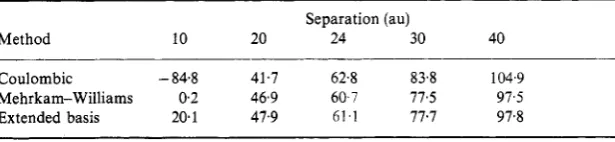
The results given in table 4 were obtained with the present program. Mehrkam and Williams give their results in diagrammatic form only; suffice it to say that our data and theirs appear to agree provided one includes a constant shift of their results of the sort described in their paper.
The main difference between the calculations of the Mehrkam-Williams form (case 11) and those with a more extended basis (as for case 11, but with additional 2s and 2p functions with exponents p/2) is at small separations. The more extended basis avoids the divergence mentioned in $3.
5. Discussion
We now compare various aspects of the different approximations, with the aim of deciding which approaches can be used reliably and conveniently in calculations of
Table 4. Predictions of A E in meV for Gap: ( S , Zn)
Separation (au)
Method 10 20 24 30 40
Coulombic - 84.8 41.7 62.8 83.8 104.9
Mehrkam-Williams 0.2 46.9 60.7 77.5 97.5
Central-cell effects in donor-acceptor pairs 1117
donor-acceptor pair spectra. Convenience is important, whilst not an overriding factor. Suffice it to say that we believe.the SEMELEprogram to be particularly straightforward to use; the calculations have been automated, and the program combines simplicity of use with great flexibility.
The first point to discuss is the choice of basis functions. Can one successfully use just a single s and a single p function on each site? The answer seems to be no. Both the Mehrkam-Williams and asymmetric approaches behave very badly at small spacings R.
Indeed, both predict the wrong sign for AE at shall R. But the other approaches (in- cluding that of Bindemann and Unger 1973, whose floating functions are equivalent to
an expansion in many spherical harmonics with related radial factors) behave properly at small spacings. These successful approaches include the extended basis and full SEMELE methods. We shall return to the results at large spacings later.
The second point concerns the way in which the central-cell corrections are included. Again, the small-separation cases are the strongest tests. There are effects at large spacings but these are masked by the purely Coulombic part of AE. Deviations from (2.1) should show a strong model-dependence because of the different asymptotic wavefunctions, but their value is a small fraction of AE at most. The results of table 2 or figure 2 show large differences between the two methods whose behaviour is satisfactory; that is, between the extended basis form and the full SEMELE form. We have not been able to use experiment to decide between these two, partly because the experimental data in the critical 10-20 au range are very incomplete. The problem is complicated further by the need for extra theoretical corrections at small R, like multipole corrections. But the full SEMELE form makes more realistic assumptions about the form of the central-cell corrections, so one would expect its predictions to be the most reliable.
The third point concerns the intermediate and larger spacings. At the largest spacings, the Coulombic part of AE (see (2.1)) dominates, and all theories do reasonably well. Indeed, at these spacings it is the parameterizations of the host dielectric constant and bandgap which are the most important factors. The present calculations suggests that the standard parameters adopted (EGAP = 2.339 eV and E = 11.02) may be in error. The important point is that the estimates of these parameters are based on the Coulombic form (2.1) at the larger spacings. But the ‘large’ spacings usually used (to 70
A
for G a p :(0, C) by Vink et al, but more commonly only 20-30
A)
are only a few times larger than the effective Bohr radii and overlap terms are still significant. Thus the usual parametersEGAP and E are empirical parameters, useful only for interpolation and limited extrapola-
tion, and not correct crystal parameters. It would be a major undertaking to repara- meterize the spectra and we have not done this. But the results do suggest that the band gap is 2 to 3 meV smaller than assumed (giving 2.336 to 2.337 eV). This new value is consistent with all the data with which we are familiar. It also implies a slightly lower exciton binding than usual, about 8 meV instead of 10 meV. This too is consistent with other data (see eg Czaja 1971).
parameters for the other methods. Further, if the band gap is reduced to 2.337 eV, only the full SEMELE approach is satisfactory at smaller R.
Differences between the models become apparent at intermediate spacings, where all show trends of the right qualitative form. But, whilst the more advanced methods (ex- tended basis and full SEMELE) give results which lead naturally to the correct small-R behaviour, the two other methods (Mehrkam-Williams and asymmetric) give satisfactory corrections over such a small range of spacings that there is rather little advantage in using them.
Acknowledgments
We are indebted to Dr V Saunders (Atlas Laboratory) for the copy of ATMOL on which
SEMELE is based, and to Drs P J Dean, D C Herbert and A M White (RRE Malvern) for
stimulating discussions.
References
Bindemann R and Unger K 1973 Phys. Stat. Solidi 56(b) 563-71
Condon E U and Shortley G H 1935 Theory of Atomic Spectra (London: Cambridge UP) ch 15 Coulson C A 1961 Valence (London: Oxford UP)
Czaja W 1971 Phys. Kondens. Mater. 12 22636 Dean P J 1973 Prog. Solid St. Chem. 8 1-126 Dean P J and Patrick L 1970 Phys. Rev. B2 1888-99
Hopfield J J 1964 Proc. Znt. Con$ on Semiconductors, Paris pp 125-35 Hurley A C 1954 Proc. R . Soc. 226 179-90
Israelachvili J N 1972 Proc. R . Soc. A331 39-51 McLachlan A D 1965 Discuss, Faraday Soc. 40 23846
McWeeny R M and SutcliffeB T 1969 Methods of Molecular Quantum Mechanics (New York: Academic Press) Mehrkam L and Williams F E 1972 Phys. Rev. B6 37534
Rosen N 1931 Phys. Rev. 38 2099-104
Slater J C 1963 Quantum Theory of Molecules and Solids: Z (New York: McGraw-Hill) p 45 Stoneham A M 1975 Theory of Defects in Solids (London: Oxford UP)
Stoneham A M and Harker A H 1975 J. Phys. C : Solid St. Phys. 8 1102-8 Trumbore F A and Thomas D G 1965 Phys. Rev. 137 A1030-7