Scholarship@Western
Scholarship@Western
Electronic Thesis and Dissertation Repository
8-20-2015 12:00 AM
Generating Invalid Input Strings for Software Testing
Generating Invalid Input Strings for Software Testing
Benjamin D. Revington
The University of Western Ontario
Supervisor
James H. Andrews
The University of Western Ontario Graduate Program in Computer Science
A thesis submitted in partial fulfillment of the requirements for the degree in Master of Science © Benjamin D. Revington 2015
Follow this and additional works at: https://ir.lib.uwo.ca/etd
Part of the Software Engineering Commons
Recommended Citation Recommended Citation
Revington, Benjamin D., "Generating Invalid Input Strings for Software Testing" (2015). Electronic Thesis and Dissertation Repository. 3087.
https://ir.lib.uwo.ca/etd/3087
This Dissertation/Thesis is brought to you for free and open access by Scholarship@Western. It has been accepted for inclusion in Electronic Thesis and Dissertation Repository by an authorized administrator of
SOFTWARE TESTING
(Thesis Format: Monograph)
by
Benjamin Daniel Revington
Graduate Program in Computer Science
Submitted in partial fulfillment of the requirements for the degree of
Master of Science
School of Graduate and Postdoctoral Studies The University of Western Ontario
London, Ontario August, 2015
c
Grammar-based testing has interested the academic community for decades, but
lit-tle work has been done with regards to testing with invalid input strings. For our research, we generated LR parse tables from grammars. We then generated valid and invalid strings based on coverage of these tables. We evaluated the effectiveness of these strings in terms of code coverage and fault detection by inputting them to subject programs which accept input based on the grammars. For a baseline, we
then compared the effectiveness of these strings to a more general approach where the tokens making up each string are chosen randomly. Analysis revealed that the LR strategy achieved higher code coverage than the randomly generated strings in most cases. Even when the LR strategy garnered less code coverage, it still covered
sub-stantial code not touched by the benchmark. The LR strategy also showed effective fault finding ability for some programs.
Keywords: Software Testing, LR Parse Table, Grammar-Based Testing, Invalid Input Testing, Code Coverage
First and foremost, I owe my gratitude to Dr. Jamie Andrews. He provided guidance,
technical expertise, the choice of topics, help with the algorithms, and so much more. This thesis would not have been possible without him. I am truly blessed to have had such an excellent supervisor. I could not have asked for a more intelligent, kind, or patient man to serve under.
I thank Drs. Mike Bauer, David Bellhouse, and Sylvia Osborn for examining my thesis and coming to my defense. Additionally, I wish to acknowledge Dr. Duncan Murdoch. His instruction on the statistical programming language R years ago was what interested me in computer science initially.
I wish to thank Janice Wiersma and the rest of the department for making my Masters at Western possible.
I will always be indebted to my family for their love and support. I would not be
where I am today without their help.
I am thankful for the support from all my friends. I wish to specifically mention Santo Carino for providing some technical expertise, and Megan Stuckey, for her kindness, inspiration, and offering me usage of her family’s resources when needed.
I wish to acknowledge the creators of CUP for creating a publicly available LR parsing program that provided exactly what we needed to perform this research.
Finally, I thank my Lord and Saviour, Jesus Christ. Without Him, I am nothing.
Abstract ii
Acknowledgement iii
Table of Contents iv
List of Tables viii
List of Figures ix
1 Introduction 1
1.1 Introduction . . . 1
1.2 Motivations . . . 2
1.3 Thesis Focus . . . 3
1.4 Thesis Organization . . . 5
2 Background and Related Work 6
2.1.1 Test Coverage . . . 7
2.1.2 Randomized Testing . . . 9
2.2 Grammars . . . 11
2.2.1 Context-Free Grammars . . . 11
2.2.2 LR Parsers . . . 12
2.3 Generation of Grammar-Based Input . . . 16
3 Process and Algorithms 21 3.1 Example From User Manual . . . 21
3.1.1 CUP Specification . . . 22
3.1.2 LR Parse Table and Grammar Identifiers . . . 25
3.2 Definitions . . . 27
3.3 Algorithms . . . 31
3.3.1 Description of Algorithms . . . 32
3.3.2 Stopping Condition . . . 35
4 Grammars 39 4.1 Subject Grammars . . . 39
4.2 Subject Grammar Preparation . . . 42
4.2.1 Grammar Preparation . . . 42
4.3 Parameter Tuning . . . 46
4.4 Test Input Generation . . . 50
5 Application and Results 62 5.1 Subject Programs . . . 62
5.2 Subject Program Preparation . . . 64
5.3 Procedure . . . 66
5.4 Code Coverage . . . 69
5.4.1 Overview . . . 70
5.4.2 Unique Lines Covered for All Input Types . . . 73
5.4.3 Unique Lines Covered for LR Parse Table Inputs . . . 77
5.4.4 Unique Lines Covered for LR Parse Table Inputs Compared to Benchmark Inputs . . . 81
5.5 Test Results . . . 83
5.5.1 Non-Final Output Classification . . . 83
5.5.2 Invalid Token Output Classification . . . 86
5.5.3 Valid Output Classification . . . 88
6 Conclusions and Future Work 91 6.1 Conclusions . . . 91
A Example Grammar LR Parse Table 97
B Grammar Dump for Example Grammar 106
C CUP Copyright Notice, License and Disclaimer 109
References 111
Vita 114
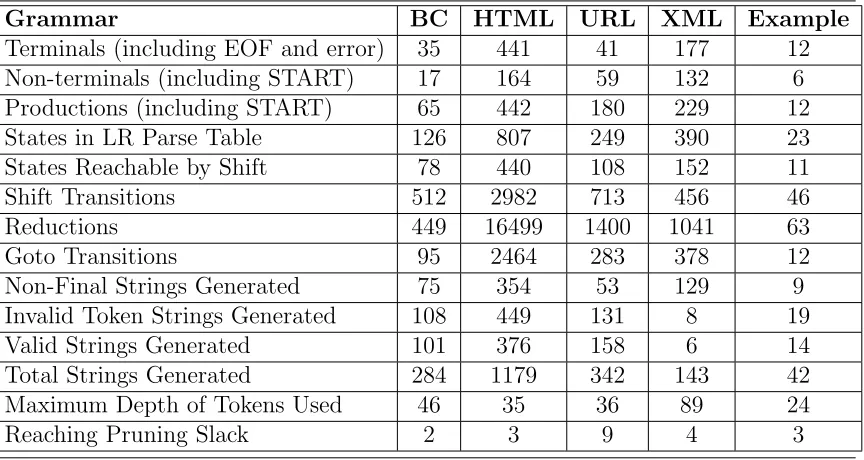
4.1 Basic data for each grammar, the number of strings generated for each coverage type, and the maximum depth of tokens and reaching pruning slacks used to garner those strings. . . 40
5.1 Line and branch coverage results for all combinations of non-final, valid, invalid token, and benchmark program inputs for each of the four sub-ject programs. . . 72
2.1 LR Parser Schematic [1]. . . 13
2.2 Example grammar for Figure 2.3 from [1]. . . 15
2.3 Sample Canonical LR Parse Table for Example Grammar [1]. . . 15
3.1 CUP specification imports, preliminaries, terminals, non-terminals, and precedences for an example grammar. . . 23
3.2 CUP specification grammar for an example grammar. . . 23
3.3 Algorithm used to find reaching strings. . . 32
3.4 Algorithm used to visit states. . . 33
3.5 Algorithm used to visit states after a reduction. . . 34
4.1 Script procedure for obtaining RPS and maximum depth. . . 47
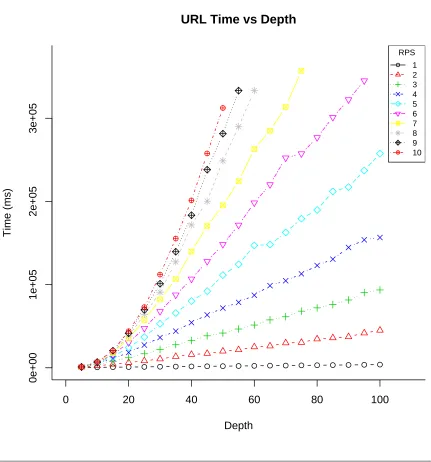
4.2 Time required for search versus depth searched for BC. . . 54
4.3 Number of states found versus depth searched for BC. . . 55
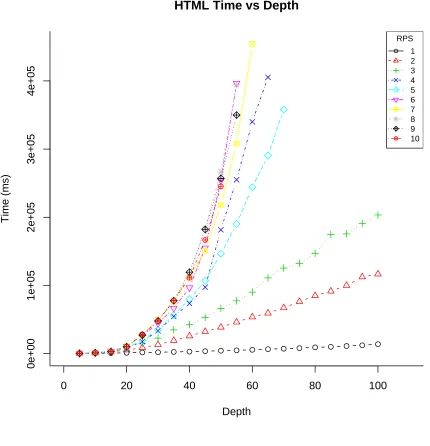
4.4 Time required for search versus depth searched for HTML. . . 56
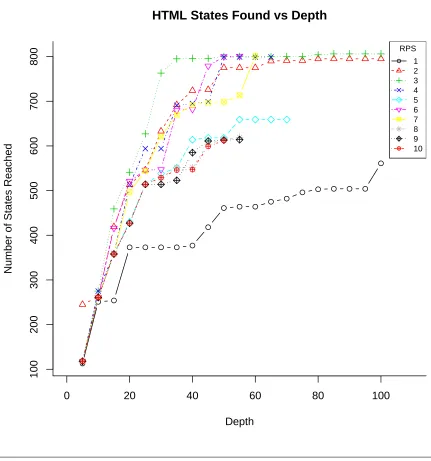
4.5 Number of states found versus depth searched for HTML. . . 57
4.7 Number of states found versus depth searched for URL. . . 59
4.8 Time required for search versus depth searched for XML. . . 60
4.9 Number of states found versus depth searched for XML. . . 61
5.1 General procedure for running inputs on subject programs. . . 68
5.2 Total line coverage percentage for all programs. . . 71
5.3 bc line coverage. . . 74
5.4 Jtidy line coverage. . . 74
5.5 NanoXML line coverage. . . 75
5.6 URI.java line coverage. . . 75
5.7 bc line coverage without benchmark. . . 78
5.8 Jtidy line coverage without benchmark. . . 78
5.9 NanoXML line coverage without benchmark. . . 79
5.10 URI.java line coverage without benchmark. . . 79
5.11 Lines covered by the benchmark but not the LR strategies versus lines covered by the combined LR strategies but not the benchmark. . . 82
5.12 Classification of non-final outputs. . . 84
5.13 NanoXML NullPointerExceptionInputs . . . 86
5.14 Classification of invalid token outputs. . . 87
5.15 Classification of valid outputs. . . 89
Chapter 1
Introduction
1.1
Introduction
Software testing is an important part of the software development life cycle, the
process of creating or modifying software systems. Software testing is the stage in
the software development cycle where the software’s quality is evaluated with the
aim of detecting problems so that they can be fixed before the program is put into
production. Grammar-based testing is the branch of software testing aimed at fixing
problems in software which require their inputs to conform to a particular grammar.
Significant research has been done on grammar-based testing in evaluatingvalidinputs
that conform to a grammar, but limited work has been done in evaluating invalid
inputs. An invalid input will likely test different code than a valid input. In this
thesis, we explore generating both valid and invalid inputs for grammar-based testing
purposes. We use a structure called an LR parse table to generate valid and invalid
inputs from grammars, and then feed the inputs to software programs expecting
by observing the code coverage and analyzing the outputs of the programs.
1.2
Motivations
Software testing is an increasingly important area of research as it is one of the most
costly stages of the software development life cycle [9]. Improperly tested software
could potentially result in millions of dollars in losses, or in some cases, even injury
or death. Extensive research has been done on testing programs dealing with simple
integer inputs, but programs accepting grammar-based string inputs have typically
been more difficult to test [5]. Since many grammar-based software programs exist,
it is necessary to ensure that grammar-based testing procedures are adequate.
Work in the field of grammar-based testing has traditionally focussed on generating
valid inputs whilst neglecting invalid inputs. It is not sufficient for a software program
to simply accept and handle valid inputs correctly; it needs to gracefully reject invalid
inputs as well. Programmers will add code to prevent software from crashing if it
receives invalid input, preferably providing the user with helpful error messages.
One example of invalid input would be if the user did not finish entering all the
necessary elements of their input. For example, a person writing a C program might
accidentally leave off a “}” at the end of their code. The compiler would need to
catch and inform the programmer of the error without crashing. Another possibility
would be if the user makes a typo, such as accidentally writing a “:” when a “;” is
required. In this situation, the input might be complete, but one element of the input
Evaluating these situations by measuring the code coverage achieved by detecting
invalid inputs, and analyzing the outputs to ensure that the programs tested were
rejecting erroneous output correctly, would have great value in the field of
grammar-based testing. We evaluate both of these situations in this thesis.
1.3
Thesis Focus
The focus of this thesis is to analyze the effects of invalid inputs in grammar-based
testing. Our approach was to generate strings from LR parse tables, convert them
to bytes acceptable as inputs, and submit these inputs to grammar-based software.
The results were evaluated by observing the code coverage achieved and checking if
the software under test classified the inputs correctly.
An LR parse table is an unchanging data table generated by an LR parser. LR
parsers are a type of bottom-up parser that efficiently handles deterministic
free languages in linear time [1]. We generated these LR parse tables from
context-free grammars. LR parse tables have a collection of states which are reachable with
different strings. We searched through the LR parse tables by generating strings that
take us to different states. We used a heuristic search algorithm to find routes through
the LR parse table. In this manner, we generated three types of strings: strings that
were complete and valid, strings that were complete but invalid because one valid
token in the string had been exchanged with an invalid one, and strings that were
invalid because they were incomplete. We attempted to generate as many strings in
each category as we could, but due to the presence of infinite routes through the LR
We also generated strings not based on the LR parse table to use as a comparison.
These strings had their tokens chosen randomly, with no thought given to the
struc-ture of the LR parse table. Randomized testing has been shown to be surprisingly
effective in practice, finding problems even in well-tested software programs [5]. As
such, we felt that this randomized testing approach would make for a fair evaluation
of our LR parse table inspired strategies for generating strings.
After generating these strings, they were converted into bytes suitable for input to a
software program. We obtained software programs that take input corresponding to
the grammars from which we generated strings. We then provided our inputs to the
software programs for the testing procedure.
We calculated the amount of code covered in the software programs tested, in order to
evaluate how thorough our approach was at stimulating the grammar-based software.
Our results indicate that the LR parse table approach usually covered more code
than the randomly generated inputs, and when it did not, it still held complementary
value. We also evaluated the outputs of each program to determine whether the inputs
had been correctly discerned as valid or invalid. We discovered that the number of
correctly classified inputs varied greatly between subject programs. Additionally, we
observed if any inputs caused the subject programs to crash, to determine if our
strategy could detect any lurking bugs in these well-tested programs. We discovered
1.4
Thesis Organization
The introduction, motivation for our work, and focus of this thesis, have been provided
in Chapter 1. Chapter 2 discusses related work to provide context for this thesis. We
also provide an in-depth explanation of some important concepts for our research. We
discuss an example grammar to illustrate some key concepts in Chapter 3. In Chapter
3, we also define key terms, and describe the algorithms used in this thesis. Chapter 4
is where we introduce our subject grammars, describe how we prepared them, explain
how we generated parse tables, detail how we tuned the parameters of our heuristic
search algorithm, and discuss how we generated our inputs. In Chapter 5, we identify
our subject programs, describe how the programs were prepared for testing, give the
procedure used in applying the inputs to the programs, and provide an analysis of the
experimental results. In Chapter 6, we conclude and discuss possible areas of future
Chapter 2
Background and Related Work
This chapter details some related work and provides some background knowledge for
the reader. We discuss the nature of automated software testing, explain grammars
and how to derive LR parse tables from them, and then provide a brief history of the
study of generation of grammar-based input.
2.1
Automated Software Testing
Software programs can be tested by black box or white box testing. Black box testing
determines test cases based on the requirements for the program on a high level, while
white box testing determines test cases based on investigating the code itself [5]. This
thesis combines the two approaches, since the test cases are generated based on a high
level view of the grammar that the program under test looks at, but the results are
The purpose of testing software programs is to locate faults in code. A software
developer programming a software application may accidentally make an error that
causes an unintended result in the code. A fault is a manifestation of an error in
software that may cause a failure when running the code. A fault causes the program
to behave in an unintended manner, such as crashing or providing a user with incorrect
output. Finding and localizing faults in programs, and the effects that they have
on the software under test, is an ongoing area of research in software engineering.
Francis et al. [15] use a tree based method for analyzing the faults of programs and
determining why they cause tests to fail. Masri et al. [24] performed a study of the
causes of reduced effectiveness in localizing faults of programs. In our research, we
examine finding faults themselves, but we also observe what coverage may result in
programs when input that has the opportunity of finding a fault is provided.
2.1.1
Test Coverage
Test coverage, also known as code coverage, refers to the extent to which the source
code of a software program has been tested by a given collection of tests. If a
pro-gram’s test suite achieves more code coverage, then it means that it has been tested
more thoroughly, and so it is likely that more bugs in the program may have been
caught. In this thesis, we use line coverage, and, to a lesser extent, branch coverage,
to assess the amount of code coverage for our four subject programs. Line coverage
checks to see how many lines of a program have been covered. Branch coverage tests
if each decision direction in the program has been executed.
if (x > 5 && y > 5) { x = x+1;
y = x*2;
x = x - 9; }
If we run only one test case, and in it x andy are less than 5, then we will have 33%
line coverage because the top line was executed but not the other two. We would
also have 50% branch coverage, because one of the two possible truth values for the
if statement have been tested (namely, the false value). If we add another test case
where bothxandy are greater than 5, then we will have achieved 100% line coverage
since all lines are now covered (between both test cases). This would also give us
100% branch coverage because we have evaluated both options (true and false) for
the if statement. It is worth differentiating line coverage from the slightly stronger
metric of statement coverage, which checks if each statement of the program has been
tested. Sincex = x +1 is on the same line as theif statement above, the statement
coverage value will be different from line coverage if the if statement is false for all
test cases.
Branch coverage differs from condition coverage in that condition coverage checks
if each Boolean sub-expression evaluates to both true and false but does not worry
about the overall decision made. In the example above, condition coverage would
check if bothx >5evaluates to true and false, and ify >5 evaluates to both as well,
but condition coverage is not concerned about whether the whole decision (what is
between the brackets) evaluates to true or false. We look at both branch and line
coverage in this thesis, but place the focus on line coverage, because our code coverage
measuring utilities differ slightly in how they define branch coverage.
Cober-tura is a free Java tool that calculates the amount of code covered by tests. We used
Cobertura version 2.1.1 to test Java subject programs. gcov is a coverage tool that
comes with the free C compiler gcc. We usedgcovversion 1.01 on a subject program
written in C to obtain line coverage and gcov’s version of branch coverage.
2.1.2
Randomized Testing
In running our code, we wished to see if inputs following the structure of a
gram-matical structure known as an LR parse table (which will be explained in the next
subsection) would prove more helpful, less helpful, redundant to, or complementary
to, randomized inputs. Testing with random inputs, or randomized testing as it is
commonly called, is unbiased and has shown to be surprisingly effective [26] [16] [5],
so it makes for a worthy comparison. Randomized testing hammers the program with
random input, which often catches unexpected software bugs that more structured
approaches miss. Miller et al. [26] used randomized testing on Unix utilities in this
manner and were able to find many bugs in well-tested programs. However, they
admit that their approach is not exhaustive, as that would require formal
verifica-tion. Groce et al. [16] later used random testing on aircraft software as a means for
preparing the way for using formal verification. They achieve this through their
ap-proach to randomized test input generation, hardware simulation with fault injection,
automated test case minimization, and designing the initial system with an eye for
testability later.
Randomized testing has a long history, but has questions as to its level of thoroughness
due to its undirected nature. Pacheco et al. [28] attempted to deal with this difficulty
is analyzed and used for improving further tests. This approach maintains the benefits
of random testing with regards to scalability and simplicity while avoiding some of its
downsides, such as meaningless or redundant inputs. Korel [22] describes a technique
for choosing the inputs while the program is still in execution. This dynamic strategy
of automatically generating test data makes use of how information flows through a
program to hasten the search process for inputs that cause undesired behaviour in
the program [25] [22].
Andrews et al. [3] used a genetic algorithm to optimize test coverage by finding
pa-rameters for randomized unit testing. Unit testing programs allows for testing of
individual sections of code, rather than taking a high level approach based on
sys-tem requirements [13]. Andrews et al. [3] generated unit test data on two levels: a
randomized unit testing engine lower level, and a genetic algorithm that uses
selec-tion, mutations, fitness evaluaselec-tion, and recombination to find good values for the
randomized unit testing parameters.
In contrast to randomized testing, symbolic testing executes the path of a program
and generates a set of constraints on the input variables [21] [10] [8]. This approach,
however, suffers from the state space explosion problem, as many different paths are
possible through a program. Our approach was based on a context-free grammar and
then applied concretely to a program rather than being built directly on the program
under test. Symbolic testing is not practical for normal usage due to the state space
2.2
Grammars
2.2.1
Context-Free Grammars
A grammar gives a clearly defined syntactic specification of a language. From some
types of grammars, we can establish a syntactic structure for a source program by
creating a parser. A parser receives a string of tokens from a lexical analyzer and
verifies that the string can be produced for the source language by the grammar.
A properly designed grammar’s parser can be valuable for such tasks as generating
correct object code from source programs, and for detecting errors in input. The four
main types of errors that can be detected are lexical errors (misspellings of keywords,
identifiers, or operators), syntactic errors (syntax errors such as a misplaced semicolon
or a missing “{” ), semantic errors (such as type mismatches between operands and operators), and logical errors (incorrect reasoning by the programmer that may still
be a well-formed construction of the language) [1]. Evaluating grammars is important
for software testing since many programs expect some inputs to conform to a
gram-mar. According to Hennessy and Power [17], “Grammar-based software includes not
only programming language compilers, but also tools for program analysis, reverse
engineering, software metrics and documentation generation.”
A context-free grammar is made up of a start symbol, terminals, non-terminals, and
productions. Terminals are the basic symbols from which strings are formed.
Non-terminals denote patterns of tokens, and enforce a hierarchical structure on the
lan-guage. One non-terminal is declared as the start symbol, and it denotes the set of
strings making up the language produced by the grammar. The mode in which
context-free grammar. Each production is denoted by a non-terminal on the left side, a “—>”
or “::=” (based on preference, as the meaning is the same for both symbols), and then
a body on the right side made up of zero or more non-terminals or terminals that
describe the way the strings of the non-terminal at the left side may be constructed.
An example production looks like this:
S ::= a S T b
where “S” is the non-terminal on the left side, “a” and “b” are terminals, and “S”
and “T” are non-terminals [1].
2.2.2
LR Parsers
A bottom-up parser is one that constructs a parse tree (a graphical representation
that filters out the production order to replace the non-terminals for a derivation of
the grammar) for an input string by starting at the bottom (the leaves of the tree),
and works its way up to the top or root of the tree. The most common kind of
bottom-up parser used is the LR(k) parser. The “L” refers to scanning the input
from left to right. The “R” refers to constructing a rightmost derivation in reverse.
The “k” is the number of symbols of look ahead used in making parsing decisions.
In practical applications, k is 0 or 1. LR parsers use constructs known as LR parse
tables, which can be created to recognize almost all programming language constructs
that can be generated from context-free grammars [1].
A schematic for an LR parser is given in Figure 2.1. The LR parser consists of a stack
Figure 2.1 LR Parser Schematic [1].
consisting of two parts (“action” and “goto”) and the output [1].
The behaviour of an LR parser follows a set pattern, with the current input token,ai,
and state on the top of the stack, sm, determining the resulting configuration. The
consequences of parsing one token with a particular stack of states are determined
by the action-goto table. There are four basic options for the parse of a given input
token:
1. The parser shifts the next state, s, as described by the action-goto table, onto
the state stack. The token ai is read and the parser moves on to token ai+1.
2. The parser performs a reduction based on a particular production in the
gram-mar, where r state symbols are popped off the stack leaving state sm−r at the
side of the production. After popping rstates off the stack, the parser pushes a
new state on the stack based on the non-terminal on the left side of the
produc-tion and the state currently exposed at the top of the stack after the r states
have been popped. The goto part of the action-goto table determines what
the new top state will be. A reduction does not use up an input token, so the
configuration of the parser after will still be looking at token ai, just with a
different state on the top of the stack.
3. If the parser reaches a final state and receives the proper token, the LR parser
accepts the input and the parsing is completed.
4. The parser may find an error, such as if a particular input token is not accepted
at a particular state [1].
A parser’s next action is determined by the LR parse table. We will now look at an
example from [1] for illustration. An augmented grammar (augmented means that
the start production ending with EOF has been added) is shown in Figure 2.2. The
LR parse table derived from the grammar is shown in Figure 2.3. Figure 2.3 shows a
$ in place of EOF, either of which indicates a termination of the input. Blanks in the
LR parse table indicate that there are no transitions at those states for those tokens
(i.e. an error will result). In Figure 2.3, transitions starting with s are shifts and
transitions beginning withr are reductions. The numbers given by the shifts indicate
the state to shift to. The numbers given by the reductions indicate the number of the
productions to reduce with (where S ::= CC is production 1). For the given example,
reaching the end of input at state 1 indicates that the input is accepted (which is
equivalent to reducing with the start production).
Figure 2.2 Example grammar for Figure 2.3 from [1].
$START ::= S EOF
S ::= C C
C ::= c C
C ::= d
Figure 2.3 Sample Canonical LR Parse Table for Example Grammar [1].
and the LALR parser. The simple LR parser (or LR(0) parser) is the easiest to create
and is space efficient but has no look ahead. The most general form of LR parser
is the canonical LR parser, also known as an LR(1) parser (LR(1) as parsers rarely
require a k >1). The canonical LR parser is far less space efficient, but can accept
more options due to the look ahead. In this thesis, we utilized an LALR or
Look-Ahead LR parser. LALR parsers are nearly as powerful as canonical LR parsers but
We decided to use a pre-existing, publicly available LALR parser generator, the
Con-structor of Useful Parsers (CUP) version 0.10 created by Scott E. Hudson [19]. CUP
is similar to the well known compiler-compiler YACC in terms of role, features,
spec-ifications, etc. Unlike YACC however, “CUP is written in Java, uses specspec-ifications,
including embedded Java code, and produces parsers which are implemented in Java”
[19]. CUP also requires some additional information for an input specification beyond
just the basic grammar, but this will be explored more later in this thesis.
There were some other automatic LR parser generators that we looked at, the best
one being the GOLD Parsing System [11]. GOLD was simpler in setup than CUP,
provided better documentation, and claimed to support more programming languages
than any other parser. Unfortunately, GOLD did not provide us with as direct access
to the LR parse table itself, which is what we needed.
2.3
Generation of Grammar-Based Input
There has been a significant amount of work done on generating grammar-based
in-put over the years. In 1972, Purdom [29] described an algorithm that could be used
to generate sentences for testing parsers. The goal of the algorithm is to produce
short sentences from a context free grammar such that every production is used at
least once. The sentences aid in debugging context free grammars and testing parsing
programs. The algorithm aims for creating many short sentences rather than fewer,
longer sentences. The parses are sent to a referee routine and the sentences to a
pars-ing routine, with the parspars-ing routine sendpars-ing any parses it finds to the referee routine
enough to be valuable for detecting errors in a parsing building program, with the
sentences generated having largely been useful in detecting errors in grammars.
Our research focussed more on the coverage of the individual states of the LR parse
tables, while Purdom focussed on coverage of the grammar rules used to create the
table. Our work also included generating invalid input in addition to valid input.
While Purdom’s valid input could aid in ensuring that the grammar did not reject
good input, our work allows us to check that the grammar does not accept bad input
too.
Zhao and Lyu [32] do further work on generating grammar-based input. They
demon-strate the first approach to generating string test data automatically from character
string predicates. Character string predicates are made up of one string comparison
function, like strcmp, and one character string variable [32]. Our approach in this
thesis is not to give programs input based on paths through the program directly,
but rather to automatically generate our string test data by finding paths through
the LR parse tables.
Hennessy and Power [17] explore the idea of generating minimal test suites for
grammar-based software by a reduction strategy grammar-based on “rule coverage”, which analyses the
rules (productions) that the grammar is based on. Minimizing a test suite ensures
that the test suite is more efficient and will use fewer resources to execute. Not
run-ning unnecessary tests or parts of tests helps save software businesses money [31] [9].
The approach Hennessy and Power use was tested on three grammar-based tools for
C++. Hennessy and Power report that their test suite is comparable to that
gen-erated by Purdom’s algorithm in terms of size. Additionally, Hennessy and Power’s
there was no strong correspondence between rule coverage and code coverage for a
grammar-based software application, their reduced test suites kept the code coverage
reasonably stable. Unfortunately, their minimized test suites failed to preserve the
fault-finding ability of the originals.
When we generated string test data through various techniques, we found that the
state space for these strings could be massive. This is a common issue with
grammar-based testing. For a particular grammar “one can trivially derive combinatorially
exhaustive test-data sets up to a specified depth” [23]. L¨ammel and Schulte [23]
attempt to control for this issue of state space explosion in grammar-based testing.
They use a bottom-up algorithm for test data generation based on a collection of
control mechanisms that are simpler approximations of full combinatorial coverage.
An example of something that they did to control for state space explosion is to
control recursive calls, both in terms of total depth and by keeping the depth of
recursions with multiple arguments balanced. They implement their approach in a
C# based test data generator called Geno. Their approach is effective, but would not
work for our research since we derive the strings from parse table paths rather than
program paths.
Another approach to generating test data is to use genetic algorithms [18] [2].
Al-shraideh and Bottaci [2] present an approach to test data generation where program
branches are covered which depend on string predicates. They use genetic algorithms
to search through the programs, and string matching techniques like regex, string
ordering, and string equality, to generate string test data.
In industry, a lot of testing needs to be done on programs accepting strings as input.
fault-finding ability. Beyene and Andrews [5] address this problem by deriving Java classes
called “Grammatical Category Objects” (GCOs) from a given context-free grammar.
They use meta-heuristic and deterministic techniques to obtain strings. Every symbol
(terminal or non-terminal) receives its own GCO. They test valid strings, but did not
test invalid strings as we do in this thesis. They test their approach on two example
grammars and their corresponding subject programs just as we do in this thesis.
Kiezun et al. [20] created the HAMPI program to provide a solver over bounded
string variables for string constraints. HAMPI is “a solver for word equations over
strings, regular expressions, and context-free grammars” [20]. A user specifies
con-straints and HAMPI finds a string that satisfies all the concon-straints or reports that the
constraints are unsatisfiable. String terms in the HAMPI language are created out of
bounded string variables, string constants, string concatenations, and extraction
op-erations. The smallest level of formula (i.e. atomic formulas) in the HAMPI language
are “equality over string terms, the membership predicate for regular expressions and
context-free grammars, and the substring predicate that takes two string terms and
asserts that one is a substring of the other” [20]. Bounding of context-free grammars
and regular expressions is an important feature of HAMPI that differentiates it from
the string-constraint solvers used in analysis and testing tools. Bounding is
benefi-cial because it permits a more expressive input language that allows operations on
context-free languages that would otherwise be undecidable. Bounding also makes
the satisfiability problem that HAMPI solves easier to deal with. Due to a multitude
of dependencies on specific versions of specific libraries, we decided not to use HAMPI
for this thesis.
Mass´e et al. [6] build off the work done by Kiezun et al. They mention that Kiezun
approach cannot express morphisms (substitutions) and antimorphisms (reverse
sub-stitutions) well. The authors propose a new representation of fixed length word
equations through the use of a graph data structure. They then implement a generic
word equation solver in Python to assess the feasibility of their representation. Like
Mass´e et al., B¨uttner and Cabot [7] emphasize the importance of modelling for
prob-lems involving strings [30]. They create a lightweight solver using constraint logic
programming for tractable string constraints in model finding that creates large
solu-tions. Their implementation solves some large instances of common string constraints
efficiently.
Feldt and Poulding [14] attempt to generate string test data with meta-heuristic
tech-niques, but in a different manner than what was attempted by Beyene and Andrews.
Feldt and Poulding [14] use random generators and formal grammars to generate
highly structured grammar-based inputs. They give the operator the option of biasing
them towards scalability (a bias towards large structures), detecting faults efficiently,
Chapter 3
Process and Algorithms
This chapter describes the process and algorithms used to obtain strings. We
demon-strate the process with an example grammar provided by CUP. The chapter explains
the example grammar, defines some terminology, demonstrates these definitions with
examples, and discusses the algorithms used in searching through the LR parse tables.
3.1
Example From User Manual
In this portion of the thesis, we will discuss the workings of an LR parse table for a
grammar using a simple example grammar provided with CUP. This grammar had no
subject program for testing on, but it will help the reader to understand some basic
concepts. While programming the algorithms to manipulate the larger grammars,
3.1.1
CUP Specification
The CUP specification syntax is given as five major components: package and
im-port specifications, used code components, symbol (terminal and non-terminal) lists,
precedence declarations, and the context-free grammar itself. All of the components
must appear in the order given, though some are optional. In Figures 3.1 and 3.2,
we give the specification for the example grammar that CUP provides. The example
specification is for a simple calculator. This calculator permits using parentheses to
clarify order of operations, provides access to the modulus operation, and requires
lines to be terminated with a semicolon (;).
The first component of the CUP specification is package and import specifications for
the generated Java code. This portion of the CUP specification is optional. In the
example above and our own input grammars, we imported the java_cup.runtime
classes since these provided helpful data for our program.
The next part of the grammar specification is an optional part for user code
com-ponents (which in our example appears under the “Preliminaries” comment). These
basic declarations aid in telling CUP how to set up and use the scanner (used for
reading tokens). Like the import and package declarations, there was no need to
add anything here for our purposes, so we left in the same declarations found in the
example grammar.
Next is the first required portion of the CUP specification: the symbol lists. The
sym-bol lists are declarations of all the terminals and non-terminals used in the grammar.
CUP’s output includes a Java class where each terminal (and optionally non-terminal)
Figure 3.1 CUP specification imports, preliminaries, terminals, non-terminals, and precedences for an example grammar.
// CUP specification for a simple expression evaluator (no actions)
import java_cup.runtime.*;
/* Preliminaries to set up and use the scanner. */ init with {: scanner.init(); :};
scan with {: return scanner.next_token(); :};
/* Terminals (tokens returned by the scanner). */
terminal SEMI, PLUS, MINUS, TIMES, DIVIDE, MOD; terminal UMINUS, LPAREN, RPAREN;
terminal Integer NUMBER;
/* Non terminals */
non terminal expr_list, expr_part; non terminal Integer expr, term, factor;
/* Precedences */
precedence left PLUS, MINUS;
precedence left TIMES, DIVIDE, MOD; precedence left UMINUS;
Figure 3.2 CUP specification grammar for an example grammar.
/* The grammar */
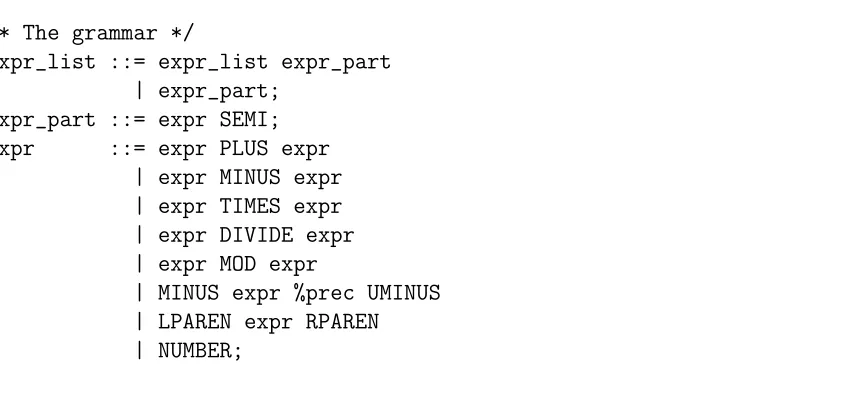
expr_list ::= expr_list expr_part | expr_part;
expr_part ::= expr SEMI; expr ::= expr PLUS expr
| expr MINUS expr | expr TIMES expr | expr DIVIDE expr | expr MOD expr
as “Integer” as in the example, but we did not use this feature in our work.
The next section of the CUP specification is for precedences. This optional section
helps with parsing grammars that have some ambiguity. Each precedence line gives
the identifier precedence, the associativity, and a set of terminals. Precedences listed
on a later line are stronger. The possible associativities are left, right, and nonassoc
(for nonassociative). The associativities are used to deal with conflicts between equal
precedences. The example precedences are all “left”, indicating that if we have, say,
a subtraction followed by an addition in the input, then we should do the subtraction
(on the left) first. Any terminals not explicitly mentioned in this part of the CUP
specification will be given the lowest precedence. The point of these precedences is
to help CUP deal with shift-reduce problems. A shift-reduce problem occurs in LR
parse tables that are not LR(1). Shift-reduce problems are conflicts between a possible
shift action and a reduce action. An example given for the example specification of
a shift-reduce problem in the CUP user manual is parsing 3 + 4 * 8. After parsing
3 + 4, CUP would not know whether to reduce the 3 + 4 or shift the * onto the
stack. Since * (or multiplication) has a higher precedence than + (or addition), the
* will be shifted and the multiplication will be performed before the addition. These
declarations also help CUP specify a precedence for each production in the grammar.
The precedence of a production is equivalent to the last terminal in that production
(with the lowest precedence assigned to a production with no terminals).
The last component of a CUP specification is the grammar itself. In the grammars
that we used, we made use of an optional declaration not found in the example
grammar that tells CUP which non-terminal to start with. If this start declaration
is not provided, then CUP starts with the non-terminal on the left side of the first
has a left hand side non-terminal, followed by “::=”, followed by a series of actions,
terminals, and non-terminals (with an optional contextual precedence assignment),
followed by a semicolon. We did not use actions or contextual precedence assignments
(“%prec”) in our input grammars. The semicolons are used to terminate a production
or set of productions with a given left side non-terminal.
3.1.2
LR Parse Table and Grammar Identifiers
Once CUP has an input specification in the format that it approves, it can be run
to generate its output classes. CUP outputs two classes: one which identifies each
terminal (and optionally non-terminal) with an integer, and another which contains
the parser itself. The parser contains a set of condensed tables detailing the
produc-tions, possible acproduc-tions, and the reductions/ gotos. The parser also contains another
class that encapsulates user supplied action code. The user supplied action code tells
the parser what to do when the user provides a particular input. CUP provides the
command-line option of dumping a representation of the non-condensed LR parse
table to the standard output, which we modified to write to a file instead. A copy
of the LR parse table generated for our example grammar, as dumped by CUP, is
provided in Appendix A. A grammar dump, provided in Appendix B, shows the
nu-merical identifiers of the terminals, non-terminals, and productions. These identifiers
are needed to understand the representation of the parse table in Appendix A.
The grammar dump file shows the terminals, non-terminals, and expanded set of
productions for our example grammar. Terminals 2 to 11 are the normal terminals
that we saw identified in the CUP specification. Terminal 0 is “EOF” or end of file.
terminating parsing input. Terminal 1 is for identifying errors. The non-terminals
are listed from 0 to 5. Non-terminals 1 to 5 are the non-terminals given in the CUP
specification. Non-terminal 0 ($START) is generated by CUP to help expand the
grammar to have a starting production. The productions 0, and 2 to 11, are those
declared in the CUP specification. Production 1 is the extra production CUP created
to use as a start production. The input specification for this example grammar did not
tell CUP explicitly where to begin (i.e. telling CUP what non-terminal to start with),
whereas the specifications we generated for our research did. The start production is
given as production 0 in these other instances.
With the productions, terminals, and non-terminals numerically identified, now we
can turn our attention to the representation of the LR parse table itself. We always
start in state 0. Each state in the action table (the top table) has one or more
transitions. These transitions can be shift transitions or reductions. A state can
have all shifts, all reductions, or a mix. Each transition identifies the terminal to
transition on, the type of transition (i.e. shift or reduce), and then either the state
we should transition to next if it is a shift, or the production to reduce on if it is a
reduction. Any given state can only have one possible action for any given terminal.
We observe that each of the 23 states has some combination of shifts and reductions.
We direct the reader to state 21, where the only option is a reduction on terminal 0
with production 1. The way CUP organizes itself, reducing on terminal 0, i.e. EOF,
with the starting production, in this case production 1, is the equivalent of accepting
a full sequence of input with the LR parser.
After the action table, the reader will observe what CUP has called the “reduce”
table, which is just the goto table by another name. The goto table lists transitions
The goto table is sparser than the action table. Goto transitions only occur after a
reduction has occurred. The non-terminals to transition on are determined by the
non-terminal on the left side of the production we reduced with. Looking at state 0
in the goto table, we see three transitions: a transition to state 4 on non-terminal 1,
a transition to state 1 on non-terminal 2, and a transition to state 6 on non-terminal
3. The action and goto/reduce tables combine to form the action-goto table.
3.2
Definitions
To be consistent with the usual practice in formal language theory, we use the word
“string” to refer to a sequence of terminal symbols that can be parsed by the abstract
grammar. A string may or may not be terminated by a special symbol that indicates
the end of the input. This special symbol cannot appear anywhere else in the string.
To be consistent with the tool we use, we refer to this symbol as EOF.
We use the phrase “program input” to refer to a sequence of actual bytes that can be
used as an input to a program. Thus, a sequence of bytes would have to be tokenized
into a sequence of terminal symbols in order to be parsed by the grammar. Conversely,
given a sequence of terminal symbols, each symbol would have to be replaced by a
sequence of bytes in order to be translated into a program input.
The following definitions assume that we have a grammar G, the LR parse table
constructed for that grammar by a parser generator like CUP, and a parser based on
that table.
it is an invalid string.
An example of a valid string, with literals in place for terminals for readability for
our example calculator grammar could be “5 + 6;” whereas an invalid string might
be “5 +” since addition requires two quantities to add.
Definition 3.2.2 A string u covers state s of the parse table if processing u+EOF
causes the parser to pass through state s.
If for our example grammar we have a string of two terminal symbols that takes us
from the start state (state 0) to state 3 and then to state 2, then we would say that
string covers states 0, 3, and 2.
Definition 3.2.3 A string u is a reaching string for a state s if it covers s, but no
proper prefix of ucovers s.
Using the example immediately above, we would say that our string is a reaching
string for state 2, but not for states 0 or 3.
Definition 3.2.4 A set R of strings is a reaching set if every string u ∈ R is a
reaching string for some state s. It is completeif, for every state s in the parse table,
there is a reaching string u∈R for s.
The following definitions assume a reaching set R.
Definition 3.2.6 A setS of stringscovers all nonfinal states wrtR if it contains all
strings u∈R that are reaching strings for nonfinal states.
There are three types of states in an LR parse table which do not correspond to
non-final states coverage. The first type is the final state. The second type of state
is states that cannot be reached by a shift transition from one state to another. The
reason for this is that non-final states coverage requires us to follow a sequence of
tokens through the LR parse table until we reach a particular state, but strings taking
us to non-final states not reachable by at least one shift transition will be the same
as some string in the set S that reaches a shift-reachable state. A shift transition will
use up a token and then stop, but a reduction followed by a goto will not use up a
token. As such, if we take a particular token to activate a reduction and then utilize
the corresponding goto transition, we will not “stop” in a state until we eventually
shift again, which could be immediately after the goto, or could be some number of
reductions and gotos later. Another way of describing this type of state is any state
that can only be reached by a goto transition.
The last type of state which we did not include in non-final states coverage was states
which could not be reached in any reasonable amount of time. This will be explained
more later, but for now, we will simply mention that because the number of possible
routes through a table can be infinite, reaching some states is extremely difficult.
Definition 3.2.7 A set S of stringscovers all valid strings wrt R if, for every string
u∈R, there is a valid string v ∈S such thatu is a prefix of v.
Definition 3.2.8 A setSof stringscovers all invalid tokenswrtR if, for every string
1. v is invalid;
2. v =uxw for some terminal symbol x and string w; and
3. There is a terminal symbol y such thatuyw is valid.
In the special case that the reaching set R is complete, these definitions could be
expressed in terms of the states directly, rather than relative to R. We are expressing
them relative to a reaching set R because, as we discuss later, we were not able to
construct a complete reaching set for our two most complex subject grammars.
Strings can cover states not reachable by a shift because the strings used to reach
them cause the parser to parse through these states. For example, suppose we have
a string that takes us to, and then stops in, some non-final state. From there, some
token may cause us to reduce, and then use a goto to enter a state which has some
shift transitions. We then shift on this terminal to some other state, using up the
input token. However, if we performed the initial reduction with a different terminal,
then we will take a different shift transition when we reach the state with the shifts.
This will instead take us to a different state than the one reached by the other shift
when the input token is used up.
Since parse tables may offer multiple routes to states reachable by shifts, one of these
strings, both, or neither may be unique when continued to the final state. In this
way, we should expect significantly more valid strings than non-final state strings.
Invalid token strings change the first token after going through the state to which
the reaching string corresponds, so we should expect these strings to also be more
numerous than the non-final state covering strings. Since the sets covering all valid
these strings may be redundant means that there will likely be different numbers of
strings in each set even though invalid token strings are all based on valid strings.
There is one additional input that we used when testing our programs. We felt that
we needed some sort of a benchmark to see how effective basing our input on an LR
parse table was, so we created a random input generator too. This random input
generator would accept the list of possible terminals, excluding 0 and 1 (EOF and
error), and then make inputs of a specified length where the order was fully random
(completely ignoring the structure of the LR parse table). The length of the strings
was determined by the maximum length of any string (non-final, valid, or invalid)
used for that grammar. These strings have the advantage of running error recovery
code because they do not conform to the structure of the grammar, but do not get
as far into the LR parse table and so may test less of the grammar (and less of the
program).
3.3
Algorithms
This section will explain attempts made to use different algorithms to achieve
cover-age of the LR parse tables. We attempted two different strategies: a basic, depth-first
search, and a depth-first iterative deepening search. We discovered that there was a
state space explosion problem which prevented us from reaching some of the
possi-ble states in any reasonapossi-ble amount of time. Figures 3.3, 3.4, and 3.5 provide the
Figure 3.3 Algorithm used to find reaching strings.
Algorithm FindReachingStrings(t) ---Input:
- State table t
Output: map of states to reaching strings Algorithm:
- stateStack = empty stack of states - str = empty string of symbols
- map = empty map of states to strings - Visit(t, 0, stack, str, map)
- Return map
3.3.1
Description of Algorithms
The algorithm provided in Figure 3.3 maps states to reaching strings. This algorithm
calls the Visit algorithm given in Figure 3.4. The Visit algorithm first checks if the
stopping condition has been met (to be explained more in a bit). If no string is in
the map for the state that Visit is currently at, then the map for that state is set to
be the string used to reach the state. Then, after pushing the state onto the stack,
for every shift or reduction available in that state, the token used to activate the next
transition is added to the current string and the transition is taken. If the transition
is a shift, then Visit is called recursively on the state that the shift takes us to. If the
transition is a reduction, then the state stack is cloned, a reduction is attempted, and
if the reduction was performed successfully, the VisitAfterReduce algorithm given in
Figure 3.5 is called.
Once we pop back after trying any given transition, the terminal used to activate the
transition is removed from the input string. If all the transitions have been used for
Figure 3.4 Algorithm used to visit states.
Algorithm Visit(t, state, stateStack, str, map) ---Input:
- State table t - State state
- Stack stateStack of states
- String str (string reaching this state) - Map map of states to reaching strings Modifies: map
Algorithm:
- If StoppingCondition, then return - If no string in map for state, then:
- Set map[state] = str - Push state on stateStack
- For each symbol x that can be accepted in this state: - Append x to str
- If x induces a shift to nextState:
- Visit(t, nextState, stateStack, str, map) - Else (x induces a reduce on production p):
- clonedStack = stateStack.clone() - success = doReduce(t, clonedStack, x) - If success:
- VisitAfterReduce(t, clonedStack, x, str, map) - Delete x from the end of str
- Pop state off stateStack
At the end of each call to the Visit algorithm, the state stack is the same as it was at
the start of the call. This permitted us to continue the depth-first search after each
recursive Visit call had returned.
DoReduce does one reduction step, which may modify the state stack. This is why we
needed to clone the state stack before performing a reduction, so that we could restore
the state stack by the end of the call to Visit. An attempted reduction might fail
Figure 3.5 Algorithm used to visit states after a reduction.
Algorithm VisitAfterReduce(t, stateStack, x, str, map) ---Input:
- State table t
- Stack stateStack of states - Symbol x
- String str (string reaching this state) - Map map of states to reaching strings Modifies: map
Algorithm:
- If no string in map for state, then: - Set map[state] = str
- If x induces a shift to nextState:
- Visit(t, nextState, stateStack, str, map) - Else (x induces a reduce on production p):
- success = doReduce(t, stateStack, x) - If success:
- VisitAfterReduce(t, stateStack, x, str, map)
ago) might not be acceptable in the state we are currently in. This would imply that
the symbol was not actually valid when we chose it initially.
As was previously mentioned, the VisitAfterReduce algorithm from Figure 3.5 is
performed after a reduction is attempted by Visit. This algorithm starts by checking
if there is a string in the map to that state, if there is not, the current string is added.
Then, if the current input token induces a shift to another state, the Visit algorithm is
called on that new state. Otherwise, if the current input token causes a reduction to
occur in the current state, doReduce is called again, and if doReduce was successful,
VisitAfterReduce is recursively called on the new state that the goto takes us to.
It is possible to execute many reductions in succession with the VisitAfterReduce
that VisitAfterReduce must work with the input token it is given, whereas Visit tries
all of the options available to it.
3.3.2
Stopping Condition
Now we shall discuss our exploration of different stopping conditions, as indicated in
Figure 3.4. The first attempted stopping condition was obtained by recording every
state visited and then stopping the recursion when we got to a state seen previously.
Hence, this initial stopping condition was just that we had seen the state before, as
would be expected with a normal depth-first search. Eventually we discovered that
this stopping condition was inadequate because it made some states unreachable.
These states were unreachable because sometimes it is necessary to pass through a
state multiple times in order to reach another state.
A simple example of this is with a production S ::= E + E. This production is for
an ambiguous context-free grammar. An ambiguous context-free grammar requires
precedence rules to resolve these ambiguities. Most productions are associated with
unique states that are reached after the production was successfully used to parse a
string. However, because there are two E non-terminals on the right-hand side of the
production, we need to pass through the states associated with parsing an E twice
before reaching the state associated with the production. In essence, what we realized
is that the state space to be explored was not the finite space of parse table states,
but rather, the infinite space of stacks of parse table states.
We then tried recording the top N elements of the stack on each call to Visit, and
same as we had seen before. This is a heuristic; it may prune too much and still
prevent us from reaching states, but it is adjustable. A smaller number for N prunes
the search space more, and a larger number prunes it less. We therefore referred to
this number as the “reaching pruning slack”, or RPS for short. However, we found
that when we set RPS to a large number, the algorithm took an infeasibly long time,
possibly computing for hours without finishing its depth-first search. We then added
a depth bound on the number of recursive calls to Visit, passing this number as an
extra parameter to Visit and VisitAfterReduce.
The StoppingCondition thus became either that the depth bound had been exceeded,
or that the top RPS elements of the stack had been seen before. Note that when RPS
is greater than the depth bound, we are essentially exploring the entire search space
up to the depth bound. The end result was a heuristic search algorithm, a depth-first
iterative deepening search with multiple stopping conditions. Depth-first iterative
deepening works as a depth-first search with an increasing depth bound. The depth
bound starts at 0, then increases to 1, then 2, and so on until the goal has been found
or an overall depth bound has been reached.
This algorithm was not guaranteed to find reaching strings for all states, but we could
adjust the two parameters (RPS and depth bound) in order to maximize the number
of states found in a given time. The depth-first iterative deepening also returned
more efficient strings (i.e. fewer terminals) than the basic depth-first search since it
tried every possible route at each depth. The process used to determine the optimal
values for the reaching pruning slack and maximum depth to search to parameters is
provided in the next chapter.
because not every shift, reduction, and goto transition was taken. Simply taking
every available shift and reduction at the states reached was insufficient for locating
every state. It was required in many cases to go through a state multiple times in
order to reach some other states. The need for our stopping conditions arose because
we needed to permit this repeating of state visits, yet had to be able to control the
amount of time spent searching. This repetition of visits was required to activate not
shifts or reductions, but goto transitions.
Before implementing the depth-first iterative deepening strategy with stopping
con-ditions, we dedicated some time to trying to “force” our algorithm to take these goto
transitions. If we could direct our algorithm to take these goto transitions, then, at
least theoretically if there were no disjoint parts of the table, we should be able to
reach any state we wish. The difficulty encountered was that taking these goto
tran-sitions requires reducing after taking a specific path from the state with the goto (by
shifts, reductions, and possibly gotos from other states along the way). We attempted
to direct our route through the parse table when our depth-first search popped back
to a state where all of its shifts and reductions had been used up, but some unused
goto transitions remained. We considered trying to use the productions themselves
to guide this process, but the fact that multiple productions may correspond to one
non-terminal (which is what the goto transition would need to be taken on), and the
fact that working through a production may involve calling other productions (when
reductions along the way are performed) made this infeasible.
We also considered a version of depth-first iterative deepening branching out from the
state with the gotos that need to be taken where no pruning of the state space would
occur. This would perform an intense, but hopefully short, “local” search until the
Chapter 4
Grammars
This chapter is organized as follows: the subject grammars used for research are
introduced, the process used to prepare the grammars and generate their LR parse
tables is described, the strategy we used to tune the parameters is explained, and
finally, we discuss how we generated test inputs.
4.1
Subject Grammars
The grammars used for research were BC, HTML, XML, and URL.
The first grammar, BC, stands for basic calculator, and is a grammar for a Unix
utility used to perform calculations. We obtained the BC grammar from [27]. In this
Table 4.1 Basic data for each grammar, the number of strings generated for each coverage type, and the maximum depth of tokens and reaching pruning slacks used to garner those strings.
Grammar BC HTML URL XML Example
Terminals (including EOF and error) 35 441 41 177 12
Non-terminals (including START) 17 164 59 132 6
Productions (including START) 65 442 180 229 12
States in LR Parse Table 126 807 249 390 23
States Reachable by Shift 78 440 108 152 11
Shift Transitions 512 2982 713 456 46
Reductions 449 16499 1400 1041 63
Goto Transitions 95 2464 283 378 12
Non-Final Strings Generated 75 354 53 129 9
Invalid Token Strings Generated 108 449 131 8 19
Valid Strings Generated 101 376 158 6 14
Total Strings Generated 284 1179 342 143 42
Maximum Depth of Tokens Used 46 35 36 89 24
Reaching Pruning Slack 2 3 9 4 3
corresponding literals, the structure of the grammar in a format similar to but not
quite the same as what CUP expects, and the rules of precedence and associativity for
the operators. The syntax of BC is similar to that of C. BC is a considerably larger
grammar than the example one from the previous chapter, but is still significantly
smaller than the other three used for research. As a whole, BC was also one of the
simpler grammars to work with.
The next grammar, HTML, stands for HyperText Markup Language, and is the
standard mark-up language used in creating web pages. We had a copy of a
gram-mar for HTML from previous work that we were able to use with some
adjust-ing. This grammar was a BNF grammar created by Marek Gryber (obtained from
http://www.angelfire.com/ar/CompiladoresUCSE/COMPILERS.html) based on the
official HTML grammar (from http://www.w3.org/TR/1999/REC-html401-19991224/)
diffi-culties unique to HTML arose due to the sheer size of the grammar. Table 4.1 shows
that the number of productions used in HTML is 442. The next largest grammar
is XML with 229. For comparison, the example grammar discussed in the previous
chapter has only 12 productions. Additionally, the HTML and XML grammars in
their basic form had literals rather than terminals. These literal strings needed to be
exchanged for terminals to have either grammar accepted by CUP.
The grammar we used for URL was technically a grammar for URIs, as defined in
Appendix A of [4]. A URI is a uniform resource identifier, whereas a URL is a uniform
resource locator [4]. All URLs are URIs, but not all URIs are URLs, as there is also a
category of URIs known as URNs (uniform resource names) separate from URLs [4].
URI is a more general term than URL, but our plan for this thesis was to test URLs
as best we could, so we continued to refer to the grammar as URL, even if technically
everything is done with the URI grammar. We did not find a proper grammar for
URLs alone.
XML stands for Extensible Markup Language, and is a grammar used to define a set
of rules to encode documents in a way readable to both computers and people. As
previously mentioned, XML was the second largest grammar in terms of productions,
but more significantly, was the most difficult to generate strings for that could reach
a final state than any of the other grammars. Like with HTML, we had a copy of the
grammar available from previous work. This XML grammar was a BNF grammar
![Figure 2.1 LR Parser Schematic [1].](https://thumb-us.123doks.com/thumbv2/123dok_us/7767076.1277378/24.612.126.541.149.369/figure-lr-parser-schematic.webp)
![Figure 2.2 Example grammar for Figure 2.3 from [1].](https://thumb-us.123doks.com/thumbv2/123dok_us/7767076.1277378/26.612.115.548.227.518/figure-example-grammar-figure-from.webp)