540 | P a g e
WASTE MATERIALS TO BIOFUEL USING
MICROORGANISMS
Dr. Krishna
Assistant Professor in Biotechnology, Tumkur University, Tumakuru, Karnataka, (India)
ABSTRACT
Biofuels are the bio product, produced by microorganisms by fermentation. It can be produced by using varies types of wastes available in earth environment. Biofuels must be the alternate for fuels in future. Fuel scarcity now a day is the biggest war issue product. To overcome from such social problems researchers must dedicate their work to produce biofuel from waste materials. So that both problems – demand for fuels and management of wastes will be solved. So in the concern of good earth life present chapter will discuss about use of waste materials to produce biofuels by using microorganisms. Biofuels are produced by fermentation techniques. In scientific field there are many types of fermentation techniques to produce biofuels. But in this chapter we discus about simple conventional and low cost technique to produce biofuel, that can be used even by common person. To achieve this, in the present work Solanumnigrum L. fruits were taken, which is the weed found all over the country. According to literature Solanumnigrum is the best medicinal plant and used very commonly in Asian counties. But use of Solanumnigrum L. fruits for biofuel is not yet recorded. Both spoiled and fresh fruits were used as substrate and achieved production of bioethanol using Saccharomyces cerevisiae. According to literatures about fermentation many wastes like agro wastes, fruit wastes and many more can be used to produce biofuel.
Keywords: Biofuels, Microorganisms, Wastes
I.INTRODUCTION
In earth fuels are of two categories, one is geographical fuel, that is fuel from fossil fuels from prehistoric biological matter and second is biofuels, derived directly from plants and indirectly from agricultural, industrial, commercial and domestic waste substrates. All these substrates are generally known as biomass. Conversion of biomass results in fuel in solid, liquid, and gas form. Such biofuels are renewable fuels which generally involve contemporary carbon fixation, same that occur during photosynthetic bacteria. There are different types of wastes or biomass. Some of the biofuels are like bioethanol, biomethanol, biodiesel, butanol, green diesel, biogasoline, vegetable oils, bioethers, biogas, syngas, solid biomass fuels and these are categories in different biofuels generations like, First, second, third and fourth generation biofuels.
541 | P a g e
than can be sustained. When burnt, fossil fuels release carbon dioxide into the atmosphere. This stored form of carbon is released, increasing atmospheric carbon dioxide, adding to greenhouse gases and contributing to climate change.Biofuels are an integral part of the emerging „bio-economy‟, where plant material is used to produce specific chemicals and bulk industrial chemicals. In the future these may increasingly replace chemicals derived from fossil oil. The full picture, however, is much more complex as different biofuels have widely differing environmental, social and economic impacts. Biofuels are already entering the market, driven amongst other things by their potential to improve energy security and to contribute to climate change mitigation. There are real opportunities to develop efficient biofuel supply chains that can deliver substantial greenhouse gas savings [20].
Transport now accounts for about 20% of global anthropogenic carbon dioxide emissions and 25% of emissions in the United Kingdom (UK), and these figures are growing faster than for any other sector. If the UK is to reach its target of reducing emissions by 60% by 2050 then cuts will need to be made in the transport sector. Transport has become the main driver for increasing global primary oil demand, which is predicted to grow by 1.3% per year up to 2030, reaching 116 million barrels per day (up from 84 million barrels per day in 2005) [20].
Deterioration of the environment due to rapid industrialization of human production and dependence of countries on imported fossil fuels has meant that satisfaction of their energy needs is not assured. These considerations made the discovery of renewable fuels, which will be based on national resources - one of the most important priorities for most countries worldwide [5-7]. The use of wastes as raw materials for the production of biofuels not only prevents the “food versus fuel” dilemma; it also counteracts accumulation of these wastes in the environment.
Food waste is an interesting potential substrate, as the amount of it in the EU is growing. According to a report released by the European Commission in 2010, it has been estimated to increase from 89.3 Mt in 2006 (which resulted in the emission of 170 million tons of CO2) to 126.2 Mt by 2020 [12]. Food waste can be derived from homes, manufacturing, food services, and the retail sector; domestic food waste production is the largest part of them and accounts for 42% of the total. The problem of food waste production is higher in Asia, where an increase in the total amount of annual urban food waste is expected from 278 Mt in 2005 to 416 Mt in 2025 [13].
542 | P a g e
Moreover, in recent years‟ regulations about feeding animals with food waste have become stricter. For example, in the EU, the EC law no. 1774/2002 prohibits the use of catering waste for animal feed [9]. Finally, incineration is also a waste treatment method used for food waste. Despite the fact that energy can be produced during incineration, the capital and operating costs are considered to be too high and air pollution can also result (For example, see [13]). It is obvious that these “traditional” ways of food waste manipulation have proven to be problematic from an environmental point of view and do not help in reducing their total amount. These food wastes or any other waste if accumulate in large amount, then management is in future is very difficult. In order to overcome with the types of problem, we consider production of biofuel is alternate management for wastes. Bioethanol one of the best and more extensively used biofuel from past to present day. In future demand for bioethanol definitely increases as the geographical fuels decreases. The decrease of geographical fuels is mainly due to development and population blast day by day, indirectly result in increase in wastes in earth. The better solution for both is the production of biofuels by using microorganisms. Exploit of microorganisms in the field of biofuel production is very less, say about 1 to 2% from total number of microorganisms known till now. Current research in biofuel production using microorganisms are slowly gaining attention, but require more research on production of biofuels. Finding suitable biomass and microorganisms is a task to overcome from increased demand on geographical fuels. Finding new methodology to use wastes as a substrate and finding more suitable crops and microorganisms are the major steps to achieve the target product. Knowledge on biofuels is essential to fulfill the energy demand.Some of the microorganisms such as yeast – includes Saccharomyces cerevisiae, species of Saccharomyces, fungi – includes Cunninghamella japonica and Gliocladiumroseum are the recent research promise to produce lipids and myco-deisel, bacteria – includes animal gut bacteria like Clostridium found in Zebra feces, convert cellulose into butanol fuel. Microbes in panda waste are used for production of biofuel from bamboo and other materials. Algae – includes Diatoms and other algal species are used as biomass to produce biofuels. In the present chapter, discussing about plant biomass – plant weed Solanumnigrum. L. fruit, a weed found all over the world. In the view of farmer benefit present Solanumnigrum plant fruit was used as a substrate for the production of bioethanol using screened microorganisms.
543 | P a g e
or starch [8, 9]. The use of sugars and starch as raw materials for ethanol production had a negative effect on their availability as human food, which raised their prices globally and increased concern about the ethics of biofuel production [9-11]. In the present work the weed plant SolanumnigrumL. fruits are used, which is commonly available in agricultural fields. Many researchers recorded that the plant have many medicinal properties, which is commonly used as traditional medicine in India. The use of its fruits for the production of alcohol is not yet explored. So in the view of agriculture as well as human being the present work was undertaken.II.SOLANUM NIGRUM L. FRUIT TO BIOETHANOL
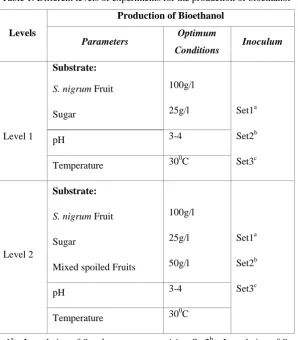
Bioethanol is one of the best alternate fuel for present and future use. Bioethanol is a type of biofuel, and is defined as any fuel whose energy obtained through biological process. The production of bioethanol is mainly involved in use of microorganisms in the absence of oxygen, calledanaerobic fermentation [1, 3]. It can be produced from materials which have carbohydrate sources. The carbohydrate sources can be used directly as starch, sucrose, glucose etc. or it may be in natural sources like in plant material such as fruits, grains (rice, barley, wheat etc.) or in other waste materials which contains rich amount of carbohydrates such as waste from agriculture, industries and domestic [2, 4]. In management of wastes, use of waste material is very much helpful [1]. Because it is very cheap, contains rich amount of carbohydrates (in case of agricultural wastes), easy to obtained and remediation of waste material will get alternate solution with by-product such as biofuel [2]. Production of Bioethanol from SolanumNigrum L. Fruit was achieved in different steps, firstly by selection of Microorganisms for Bioethanol Production. The selection of microorganisms is very important in fermentation process. Because when it is subject to different levels of experiments, it should not under go any changes like mutation. In this work the microorganisms are selected from spoiled fruits of S. nigrum by using suitable media. When the microorganisms are isolated in suitable media are then purified and subjected to selected substrate. In the present work there are mainly two microorganisms were isolated and are belongs to Saccharomyces sp. In second step, selection of substrate for the production of bioethanol. The main substrate used in this process is fruits of S. nigrum L. plants with sugar. Along with this the spoiled fruits such as grapes, banana and apple are used for the production of biofuel. The selected substrate where first subject to surface sterilization with sodium hypochlorite. The with distilled water and processed for fermentation. Experimental Setup for the production of Bioethanol was set in two levels for the first time, this novel method is to get high percentage of alcohol. Level 1: In this level both the microorganisms which was isolated from suitable media is subjected to substrate with defined concentration, pH and temperature. The substrate is S. nigrum L. fruit alone with sugar in three sets, one set is for Saccharomyces cerevisiae, one for Saccharomycessp and one more is for unidentified microorganism. Level 2: Here again both microorganisms are used along with S. cerevisiae, but instead of single substrate mixture of spoiled fruits are used and kept for fermentation process. In third step, selected different fermentation condition for Level 1 and Level 2 [Table 1].
544 | P a g e
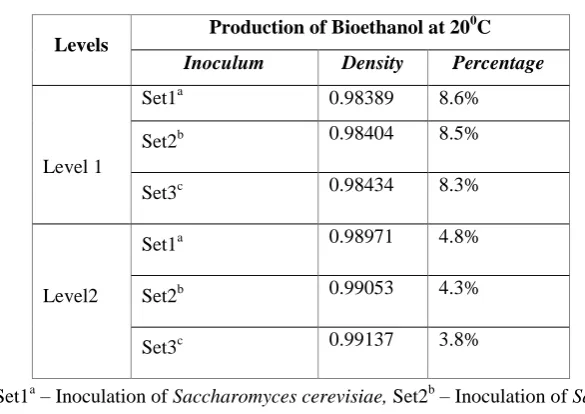
volatile compounds. In order to get pure form, the product is subjected to alcohol distillation process (novel distillation setup was designed). The percentage of alcohol recovered is estimated by using specific gravity method [1, 2] and obtained specific gravity is compared with AOAC chart [2].The percentage of bioethanol from Solanumnigrum. L. fruits were tabulated in [Table 2].This work was for the first time used Solanumnigrum L. fruits as substrate for the production bioethanol and it will have good future for agriculturist as well as for industrialist. The percentage of distilled bioethanol is determined by using pycnometer. The percentage was obtained by using standard chart AOAC against density of alcohol at 200C. In Figure 1 it was clear that the level 1 with set1 produced high amount of bioethanol when compared to other set and level. In the present study it was observed that Level 1 recorded high percentage of bioethanol compared to Level 2. So it suggests that use of single substrate with sugar yield high percentage of bioethanol, compared to mixed fruits, and Solanumnigrum L. fruits.
III.FIGURES AND TABLES
Table 1. Different levels of experiments for the production of bioethanol
Levels
Production of Bioethanol
Parameters Optimum
Conditions Inoculum
Level 1
Substrate:
S. nigrum Fruit 100g/l
Sugar 25g/l Set1a
pH 3-4 Set2
b
Temperature 30
0
C Set3c
Level 2
Substrate:
S. nigrum Fruit 100g/l
Sugar 25g/l Set1
a
Mixed spoiled Fruits 50g/l Set2
b
pH 3-4 Set3c
Temperature 300C
Set1a – Inoculation of Saccharomyces cerevisiae, Set2b – Inoculation of Saccharomycessp Set3c – Inoculation of Unidentified Microorganism
545 | P a g e
Table 2. Percentage of bioethanol produced by different sets of microorganismsLevels
Production of Bioethanol at 200C
Inoculum Density Percentage
Level 1
Set1a 0.98389 8.6%
Set2b 0.98404 8.5%
Set3c 0.98434 8.3%
Level2
Set1a 0.98971 4.8%
Set2b 0.99053 4.3%
Set3c 0.99137 3.8%
Set1a – Inoculation of Saccharomyces cerevisiae, Set2b – Inoculation of Saccharomycessp Set3c – Inoculation of Unidentified Microorganism
Note: Density in kg/L (Kilogram per Liter), % = percentage, 0C = degree Celsius
Figure 1. Histogram of production of bioethanol in percentage.
IV.CONCLUSION
546 | P a g e
biofuels is must and guidelines should be implicated to use biomass and production of biofuels to help to achieve energy securities and good environment on earth.V.ACKNOWLEDGEMENT
Author is thankful to UGC-MRP for providing financial support and Tumkur University for continuous support to research work.
REFERENCES
[1] K. A.Gray, L.Zhao, andM.Emptage, Bioethanol. Current opinion in chemical biology. Elsevier. 10,2006, 141-146. Doi – 10.1016/j.cbpa.2006.02.035
[2] L. E. JR.Casida, Industrial Microbiology, 1st ed. New Age International (P) Ltd, 2010, 117-175.
[3] A.Webb, and D. Coates, Biofuel and Biodiversity. Secretariat of the convention on biological diversity, Montreab; 2012. Technical Series No. 65, 69. ISBN – 92-9225-427-6
[4] IEA – Energy Technology Essentials. (2007). OECD/IEA. [Internet]. Available from: https://www.iea.org/publication/freepublications/publication/essentials2.pdf [Accessed: 2017-01-16]
[5] F. Shen, J.N.Saddler, L.Liu Lin, S.Deng, Y.Zhang, G.Yang,H.Xiao, and Y.Li. Evaluation of steam pre-treatment on sweet sorghum bagasse for enzymatic hydrolysis and bioethanol production. Carbohyd. Polym, 2011, 86, 1542–1548.
[6] V.Kachrimanidou, N.Kopsahelis, A.Chatzifragkou, S.Papanikolaou, S.Yanniotis, I.Kookos, and A A.Koutinas. Utilization of by-products from sunflower-based biodiesel production processes for production of fermentation feedstocks. Waste Biomass Valor. 2013, 4, 529–537.
[7] L.Matsakas, U.Rova, and P.Christakopoulos. Evaluation of dried sweet sorghum stalks as raw material for methane production. Biomed. Res. Int. 2014, doi:10.1155/2014/731731.
[8] L.Matsakas, and P.Christakopoulos, Optimization of ethanol production from high dry matter liquefied dry sweet sorghum stalks. Biomass Bioenerg. 2013, 51, 91–98.
[9] M.Wang, J.Wang, J. X.Tan, J. F.Sun, and J. L.Mou. Optimization of ethanol fermentation from sweet sorghum juice using response surface methodology. Energy Source 2011, 33, 1139–1146.
[10] L.Matsakas, and P.Christakopoulos. Fermentation of liquefacted hydrothermally pretreated sweet sorghum bagasse to ethanol at high-solids content. Bioresour. Technol. 2013, 127, 202–208.
[11] D.Pimentel, A.Marklein, M. A.Toth, M.N.Karpoff, G. S.Paul, R.McCormack, J.Kyriazis, and T.Krueger. Food versus biofuels: Environmental and economic costs. Hum. Ecol. 2009, 37, 1–12.
[12] European Communities: EC preparatory study on food waste in the EU27. Available online:http://ec.europa.eu/environment/eussd/pdf/bio_foodwaste_report.pdf [Accessed: 2015-01-16]. [13] Melikoglu M, Lin C S K, Webb C. Analyzing global food waste problem: pinpointing the facts and
estimating the energy content. Cent. Eur. J. Eng. 2013, 3, 157–164.
547 | P a g e
[15] C.S.K.Lin, L.A.Pfaltzgraff, L.Herrero-Davila, E.B.Mubofu, S.Abderrahim, J.H.Clark, A.A.Koutinas,N.Kopsahelis, K. Stamatelatou, F.Dickson, et al. Food waste as a valuable resource for the production of chemicals, materials and fuels. Current situation and global perspective. Energy Environ. Sci. 2013, 6, 426– 464.
[16] B.K.Adhikari, S.Barrington, and J.Martinez. Predicted growth of world urban food waste and methane production. Waste Manag. Res. 2006, 24, 421–433.
[17] E. U.Kiran, A. P Trzcinski, W. J Ng, andY.Liu. Enzyme Production from Food Wastes Using a Biorefinery Concept. Waste Biomass. Valor. 2014, 5, 903–917.
[18] S.Yan, J.Li, X.Chen, J.Wu, P.Wang, J.Ye, and J.Yao. Enzymatical hydrolysis of food waste and ethanol production from the hydrolysate. Renew. Energy 2011, 36, 1259–1265.
[19] O.N Uncu, andD. Cekmecelioglu. Cost-effective approach to ethanol production and optimization by response surface methodology. Waste Manag. 2011, 31, 636–643.