419 | P a g e
DISASTER MANAGEMENT AND DAMAGE
EVALUATION IN STRUCTURAL COLLAPSE
Akash R. Avhad
1, Dadasaheb O. Bhavar
2, Manish D. Mata
31,2
Department of Civil Engineering,
Guru Gobind Sing Collage of Engineering & Research Centre, Nashik (India)
3
Department of Civil Engineering, S.S.G.B. COET Bhusawal, Maharashtra (India)
ABSTRACT
Disaster can be defined as a horrific event which causes the loss, decline, deterioration of production and
ability to use an asset to its full economic potential and which often results in the loss of human life. Also it
hinder economic growth, cause poverty, waste time, cause diversion of funds, delay development and cause
huge financial loss and human suffering and death. Disaster management (or emergency management) is the
discipline of dealing with and avoiding both natural and manmade disasters. It involves preparedness, response
and recovery in order to lessen the impact of disasters. Emergency management is “the discipline and
profession of applying science, technology, planning and management to deal with extreme events that can
injure or kill large numbers of people, do extensive damage to property, and disrupt community life.
Study deals with the emergency management in collapse of structure which also can be considered under
manmade disaster. Determination of cost of the structural collapse, rather taking the case study of particular
project a random project is considered and detail study on the construction of project is analysed. Reverse
approach is applied as the cost of construction incurred is approximately loss in collapse of structure .Detailed
cost estimate of entire structure is determined to avoid calculation in next project software is developed in
visual basic. Software with appropriate input gives the entire cost of the project which itself means loss in its
collapse. Measures are suggested in pre as well as post disaster phase to minimize the loss in of wealth as well
life. The paper in all gives loss analysis and management in the collapse of structure
Keywords: Disaster; Hazard; Collapse; Rescue; Management
I. INTRODUCTION
Disaster can be defined as a horrific event which causes the loss, decline, deterioration of production and ability
to use an asset to its full economic potential and which often results in the loss of human life. Also it hinder
economic growth, cause poverty, waste time, cause diversion of funds, delay development and cause huge
financial loss and human suffering and death. Disaster management (or emergency management) is the
discipline of dealing with and avoiding both natural and manmade disasters. It involves preparedness, response
and recovery in order to lessen the impact of disasters. Disaster management does not necessarily avert or
420 | P a g e
Emergency management is “the discipline and profession of applying science, technology, planning andmanagement to deal with extreme events that can injure or kill large numbers of people, do extensive damage to
property, and disrupt community life.
In order to avoid, or reduce significant losses, it is essential that emergency managers identify, anticipate and
implement processes to respond to critical risks, in order to reduce the probability of their occurrence, or the
magnitude and duration of impact. It is essential for them to not only have controls in place to handle the
emergency, but they should also have plans to ensure Business Continuity of critical operations post-incident. It
is essential for an organization to include procedures for determining whether an emergency situation has
occurred and at what point an emergency management plan should be activated. The implementation of an
emergency plan involves much more than just its preparation. It must be regularly maintained, in a structured
and methodical manner, to ensure it remains up to date and fit for purpose in the event of an emergency.
Emergency managers will generally follow a common process to anticipate, assess, prevent, prepare, respond
and recover from an incident.
1.1 Disaster Classification
Natural disasters are events arising from natural causes such as volcanic eruptions, cyclones, earthquakes, etc.
having little control over it; also often known as “Act of God”.
Manmade disasters are non-natural events occurring due to the involvement of human activities. These could be
sudden or long term, sudden disasters could be collapse of any building, bridge or structures; while long term
are as clearing of jungles, sand mining etcThis report basically deals with the manmade disaster involving the
Loss analysis and management of the disaster which could also be referred as emergency management in
collapse of structure.
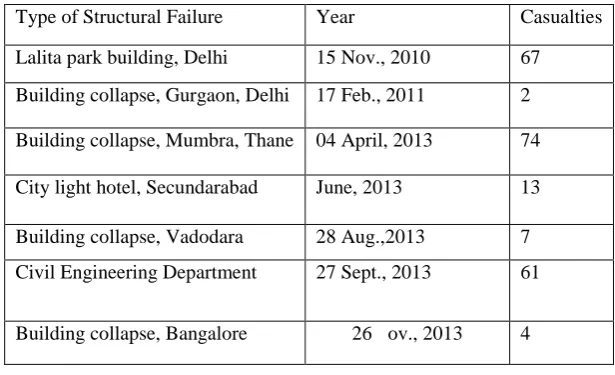
Table 1.1 Structure Collapse in particular year and respective causalities.
Type of Structural Failure Year Casualties
Lalita park building, Delhi 15 Nov., 2010 67
Building collapse, Gurgaon, Delhi 17 Feb., 2011 2
Building collapse, Mumbra, Thane 04 April, 2013 74
City light hotel, Secundarabad June, 2013 13
Building collapse, Vadodara 28 Aug.,2013 7
Civil Engineering Department 27 Sept., 2013 61
Building collapse, Bangalore 26 ov., 2013 4
II. EMERGENCY MANAGEMENT
“Disaster prevention, mitigation and preparedness are better than disaster response in achieving the goals and
421 | P a g e
very high cost. Prevention contributes to lasting improvement in safety and is essential to integrated disastermanagement”.
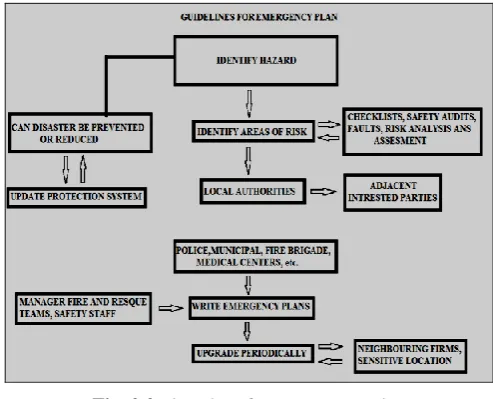
Fig. 2.1 Flowchart for Emergency Management.
2.1 Emergency Preparedness Plans
Every disaster incident has a various phases which may vary according to the type of disaster and incident. The
principle of the sequence of action is to alert, rescue and contend disaster. The chart below suggests the
preparation of emergency planning.
3.1.1 Elements of Emergency Plans
1) Communication and control system.
2) Assigning key person with specified responsibilities.
3) The work emergency procedures.
4) Liaisons with outside authorities and service in co-operation with outside services.
5) Public relations including media
2.1.2 Objective of Emergency Plan
422 | P a g e
2) To hasten the process of controlling and containing the incident.3) To facilitate co-ordination of external authorities and service.
4) To establish the system for flow of information during the emergency and preservation of relevant data for
subsequent investigation
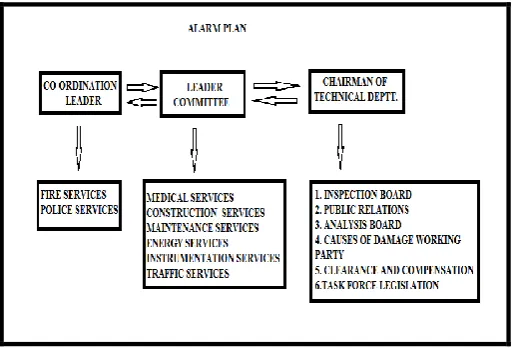
2.2 Disaster Medical Alarm Plan
The medical alarm plan provides speed and efficient medical care for insured people. There need to be trained
first aid at the scene of disaster, adequate doctors, first aid men, casualty wards.
The disaster site must have medical service equipped with required ambulance, disasters trailers that can quickly
reach the hospital in the surrounding. There should be large rescue section necessary medical aid and prepared
dressing material should be available. Proper and speedy internal and external communication is crucial
prerequisite to successful hazard prevention.
Fig 2.3 Flowchart for Alarming System Plan
2.3 Disaster Actions and Teams
Warning Notification
A warning notification implies that a crisis/ disaster is imminent and advance action may be initiated for
minimizing the damage / rescue operations. The warning notification indicating the magnitude of crisis/ disaster
should be communicated authorities concerned with the important structures.
Rescue Operation
It will be the responsibility of the emergency management group to identify the essential staff and form a Task
force, which reports at defined locations so that they can be readily contacted. It will also holds the
responsibility to remove all non-essential staff to assembly points. The rescue team consist responsibilities as
mentioned below.
Task Force
Identify source of hazard and try to neutralize / contain it
1) Isolate remaining plant and keep it in safe condition
2) Organize safe shut down of the plant, if necessary
423 | P a g e
Systems,etc.4) Any other responsibility as decided by Team Leader.
Maintenance Team
1) Attend to all emergency maintenance jobs on priority basis.
2) Take steps to contain or reduce the level of hazard that can create a crisis /disaster.
3) Organize additional facilities as required.
4) Any other responsibility as decided by Team leader, looking into the circumstances at the time of the crisis /
disaster.
Security Team
1) Man all the gates
2) Bar entry of unauthorized persons and non-essential staff
3) Permit with minimum delay the entry all of authorized personnel and outside agencies, vehicles, etc. who
have to provide assistance
4) Allow ambulances / evacuation vehicles through without normal checks
5) Any other responsibility as decided by Team leader, looking into the circumstances at the time of the crisis /
disaster
Safety team
1) Arrange required safety requirement
2) Arrange to measure polluted gas concentration in case of gas leaks at various location.
3) Record location.
4) Collect and preserve evidence in connection with accident, guide authorities on all safety related issues.
5) Any other responsibility as decided by Team Leader, looking into the circumstances at the time related of the
disaster.
Medical team
1) Arrange first aid material stretcher and reach accident site quickly
2) Arrange for immediate medical attention
3) Arrange for sending the casualties to various hospitals and nursing homes etc.
4) Ask specific medical assistance from outside including through medical specialists in consultation with the
EMM.
5) Any other responsibility as decided by Team Leader looking into the circumstances at the time of the crises /
disaster.
Fire Fighting Team
In case fire erupts and emergency is due to fire, the fire Team shall be responsible to:
1) Rush to the fire spot to extinguish the fire.
2) Seek help from external firefighting agencies.
3) Evacuate persons affected due to whatsoever reasons.
424 | P a g e
III. ESTIMATION OF LOSS AND SOFTWARE DEVELOPMENT
Determination of cost of the structural collapse, rather taking the case study of particular project a random
project is considered and detail study on the construction of project is analysed. Reverse approach is applied as
the cost construction incurred is the loss in collapse of structure. The details of the structure considered are
stated as:
Name of Project: Bliss Central
Owner: Mr. Mahajan S. D.
Location:ShivajiChowkCidco Nasik.
Number of Floor: Ground + Eight.
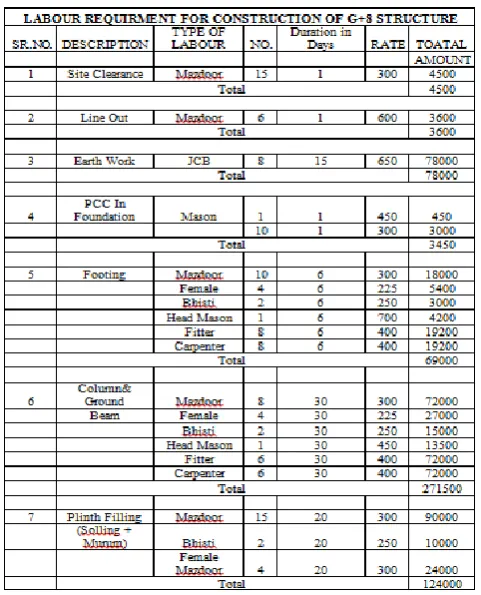
Initially for the determination of the loss detailed estimate is formed of the labour and material requirement of
the entire structure. Plan of the entire structure is determined by in the excel sheet which need to be formulated
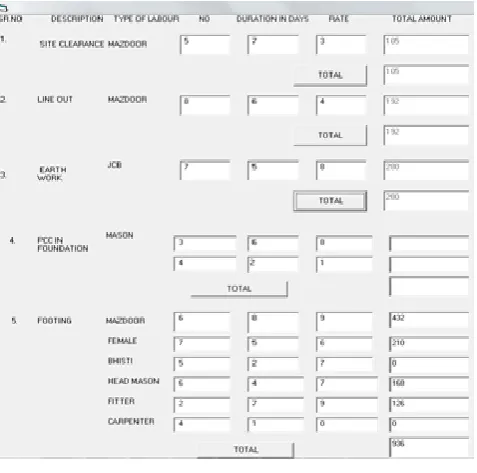
each time for new project. It becomes tedious and laborious to calculate hence software was developed in visual
basic which makes very convenient to calculate and determine the loss incurred in collapse of structure.
Software with executable format need not to install and directly worked as a compatible file.
Advantages of Software:
1) It is useful to find out the approximate cost of the collapsed structure.
2) The .exe file enables to work and utilize without any installation.
3) Approximate approach avoids the data of the collapsed structure.
4) The loss in disaster can be found out quickly.
5) Easy and user friendly avoiding tedious calculations.
6) Generalized approach makes its use countable in any circumstantial collapse of structure.
Fig -1: Snap Shot of Software
425 | P a g e
Loss due to the collapse of structure in Mumbra Building (collapsed on 4th April 2013), collapse is determinedby our generalized approach as:
Detailed cost analysis of Bliss Cental Project:
Total Labour cost Rs. 3146400
Total Material cost Rs. 20195231
Total Cost is found to be Rs 23341631.
Loss in ithe project: Assuming reducing factor by 20% as the probable loss in the project so,
Loss found to be: Rs 18673304.8
Total Casualities are 67 and Rs 500000 to each announced as compensation which becomes: Rs 52173304.8.
427 | P a g e
V. CONCLUSIONS
1. Responsibilities of the different group of people involved in the rescue operations. This resulted in lack of
coordination of work among different organizations.
2. Lack of rescue equipment and trained personnel was evident in the events that involved collapse of such kind.
3. Equipment had to be obtained from different government and private organization the government has taken
steps to procure some equipment, but that is still very inadequate for such a situation.
4. The Armed Forces lacked relevant training and equipment but was, nevertheless, the only institution in the
country with the capacity to respond to managing such collapse event. The civilian authorities lack the
capability to take control of disaster management in such a situation. The involvement of the civilian authorities
needs to be improved.
5. The Armed Forces have developed a plan for post-disaster management but whether these proposed
operational centers are safe need to be assessed first.
6. The collapse events have shown that there was lack of clarity in distribution of work.
7. Government has to take quick and precise steps in the law binding process for the justification of the incident
occurred
8. Roles and duties to each person and organization should be predefined and necessary training to tackle such
incidents.
9. Many models have been made, but most of them are based on empirical models and are therefore very
tedious.
10. Need of software for easy evaluation of loss avoiding repeated process.
REFERENCES
[1]. Wenling XUAN, Xiuwan CHEN, Gang ZHAO, Early Warning Monitoring and Management of
Disasters, The Workshop on Applications of Spatial Information Technology on Disaster Prevention and
Reduction, October 08, 2005.
[2]. Gonzalo Lizarralde, Université de Montréal,The challenge of low-cost housing for disaster prevention in
small municipalities, Building resilience achieving effective post-disaster reconstruction (2008).
[3]. XU Tao, MAO Guozhu, LI Xin, ZHAO Lin (2008), Building Fire Rescue With Evacuation Management
Information System And Its Application, ISBN- 978-1-4244-3672, IEEE 2009.
[4]. JI Yuan, Ping Tan, Investigation and Analysis on the Damage of Buildings in Wenchuan County
Townduring Earthquake, ISBN- 978-0-7695-3876, IEEE 2009.
[5]. Alton Y.K Chua, RadhikaShenoyBalkunje, Dion Hoe-LianGoh, Evaluation of Disaster Management
Portal , ISBN- 978-1-4577-1539 , IEEE 2011.
[6]. Zhuyang Han, WenguoWeng, Quanlai Zhao, Xin Ma, Quanyi Liu, and Quanyi Huang, Investigation on
an Integrated Evacuation Route Planning Method Based on Real-Time Data Acquisition for High-Rise