Computing nucleon EDM on a lattice
MichaelAbramczyk1, Sinya Aoki2,3, TomBlum1,4, TakuIzubuchi4,5, Hiroshi Ohki4, and Sergey Syritsyn4,6,
1Physics Department, University of Connecticut, Storrs, Connecticut 06269, USA
2Center for Gravitational Physics, Yukawa Institute for Theoretical Physics, Kyoto University, Kyoto 606-8502, Japan
3Center for Computational Sciences, University of Tsukuba, Tsukuba 305-8577, Japan 4RIKEN/BNL Research Center, Brookhaven National Laboratory, Upton, New York 11973, USA 5Physics Department, Brookhaven National Laboratory, Upton, New York 11973, USA
6Department of Physics and Astronomy, Stony Brook University, Stony Brook, New York 11794, USA
Abstract. I will discuss briefly recent changes in the methodology of computing the baryon EDM on a lattice. The associated correction substantially reduces presently exist-ing lattice values for the proton and neutron theta-induced EDMs, so that even the most precise previous lattice results become consistent with zero. On one hand, this change removes previous disagreements between these lattice results and the phenomenologi-cal estimates of the nucleon EDM. On the other hand, the nucleon EDM becomes much harder to compute on a lattice. In addition, I will review the progress in computing quark chromo-EDM-induced nucleon EDM using chiral quark action.
1 Introduction
Observing a non-zero nucleon electric dipole moment (EDM) will be evidence of violations of fun-damental P,T-symmetries beyond the level of the Standard Model. Such violations are necessary to explain the excess of matter over antimatter in the Universe, and theCPin the CKM matrix of the Standard model is insufficient for the observable amount of matter. Knowledge of nucleon structure and interactions is necessary to interpret constraints from precise experiments attempting to measure the EDM of nucleons and nuclei, the precision of which is projected to improve by two orders of magnitude in the next decade.
An EDM may be induced within the Standard Model by the QCD ¯θ-term, the smallness of which is known as the strongCPproblem. In order to constrain ¯θQCDfrom nucleon EDM measurements, lattice calculations of the ¯θQCD-induced neutron EDMs have been performed earlier in Refs. [1–3] using the background electric field and in Refs. [4–10] from nucleon matrix elements inCPvacuum. In our recent paper [11], we have found that the analysis of the nucleon EDM in Refs. [4–10] was flawed, and all previous results are largely consistent with zero.
In this report, we calculate the nucleon EDM induced by theCP-odd quark-gluon electric dipole interaction (so-called chromo-EDM)
LcEDM =i
ψ=u,d ˜ δψ
2 ψ¯Ta(gSGµνa )σµνγ5ψ=i
ψ=u,d ˜
δψOψG˜, OψG˜ = 12ψ¯Ta(gSGaµν)σµνγ5ψ , (1)
using 243×64 lattices generated with Iwasaki gauge action and Nf = 2+1 dynamical flavors of Domain Wall fermions by the RBC collaboration. These lattices have pion massmπ ≈330 MeV and lattice spacinga−1 ≈1.73 GeV. We perform these calculations using two independent methods: (1) nucleon matrix elements of the vector current and (2) nucleon energy shifts in the background electric field.
2 Nucleon EDM on a lattice
In order to compute the nucleon EDM on a lattice, one has to calculate nucleon matrix elements of the quark vector current in aCPvacuumN|Jµ|N
CP. CP violation leads to “parity mixing” of the nucleon spinoru → u˜ = eiα5γ5u, which is equivalent to a chiral rotation of the nucleon mass
mN → e−2iα5γ5mN in the Dirac equation. In order to extract the nucleon matrix elements, one has to analyze the nucleon-current correlators as
N(p)JµN¯(p) ∝eiα5γ5−i/p
Euc+mN
2E
N
eiα5γ5?Γµ
Euc
eiα5γ5?−i/pEuc+mN
2EN e
iα5γ5, (2)
where the phase factors in curly braces were deemed necessary as parts of the nucleon propagator in theCPvacuum in Refs. [4–10]. However, as we discuss in our recent paper [11], these factors lead to incorrect results and should be omitted because the correct decomposition of the vector current into CP-even and -odd form factors is
p+q, σ|Jµ|p, σ=u¯
p+q,σ
F1γµ+(F2+iF3γ5)iσ µνq
ν 2mN
up,σ (3)
with spinors satisfying the Dirac equation (i∂/−mN)uand having definite parityγ4up = +u(−p). The improper chiral phase factorseiα5γ5in Eq.2lead to mixing of form factorsF3andF2, resulting in a
spurious contribution to the electric dipole form factor
F3→F3˜ =F3−2α5F2. (4) (conventions are consistent with our definitions in Ref. [11]).
3 EDM from form factors
In this section we summarize briefly our methodology, with full details provided in Ref. [11]. The CP-odd (CP) form factorF3is extracted from nucleon matrix elements in presence ofCPinteractions with the actionSCP−even+iδCPS =SCP−even+iδ˜ψx[OψG˜]x. To compute them, we evaluate corrections to the nucleon correlation functionsCCP=CCP−even−iδ˜
ψδCPClinear in theCP-odd operatorOψG˜:
δCPCNJN¯(p, q;tsep,top)=
x,y,z
e−ipy+iqz
N(y,tsep) [¯qγµq](z,top)N¯(0) [OψG˜]x, (5)
δCPCNN¯(p;tsep)=
x,y
e−ipy
In this report, we calculate the nucleon EDM induced by theCP-odd quark-gluon electric dipole interaction (so-called chromo-EDM)
LcEDM=i
ψ=u,d ˜ δψ
2 ψ¯Ta(gSGµνa )σµνγ5ψ=i
ψ=u,d ˜
δψOψG˜, OψG˜ = 12ψ¯Ta(gSGaµν)σµνγ5ψ , (1)
using 243 ×64 lattices generated with Iwasaki gauge action and Nf = 2+1 dynamical flavors of Domain Wall fermions by the RBC collaboration. These lattices have pion massmπ ≈330 MeV and lattice spacinga−1 ≈1.73 GeV. We perform these calculations using two independent methods: (1) nucleon matrix elements of the vector current and (2) nucleon energy shifts in the background electric field.
2 Nucleon EDM on a lattice
In order to compute the nucleon EDM on a lattice, one has to calculate nucleon matrix elements of the quark vector current in aCPvacuumN|Jµ|N
CP. CPviolation leads to “parity mixing” of the nucleon spinoru → u˜ = eiα5γ5u, which is equivalent to a chiral rotation of the nucleon mass
mN → e−2iα5γ5mN in the Dirac equation. In order to extract the nucleon matrix elements, one has to analyze the nucleon-current correlators as
N(p)JµN¯(p) ∝eiα5γ5−i/p
Euc+mN
2E
N
eiα5γ5?Γµ
Euc
eiα5γ5?−i/pEuc+mN
2EN e
iα5γ5, (2)
where the phase factors in curly braces were deemed necessary as parts of the nucleon propagator in theCPvacuum in Refs. [4–10]. However, as we discuss in our recent paper [11], these factors lead to incorrect results and should be omitted because the correct decomposition of the vector current into CP-even and -odd form factors is
p+q, σ|Jµ|p, σ=u¯
p+q,σ
F1γµ+(F2+iF3γ5)iσ µνq
ν 2mN
up,σ (3)
with spinors satisfying the Dirac equation (i∂/−mN)uand having definite parityγ4up = +u(−p). The improper chiral phase factorseiα5γ5in Eq.2lead to mixing of form factorsF3andF2, resulting in a
spurious contribution to the electric dipole form factor
F3→F3˜ =F3−2α5F2. (4) (conventions are consistent with our definitions in Ref. [11]).
3 EDM from form factors
In this section we summarize briefly our methodology, with full details provided in Ref. [11]. The CP-odd (CP) form factorF3is extracted from nucleon matrix elements in presence ofCPinteractions with the actionSCP−even+iδCPS =SCP−even+iδ˜ψx[OψG˜]x. To compute them, we evaluate corrections to the nucleon correlation functionsCCP=CCP−even−iδ˜
ψδCPClinear in theCP-odd operatorOψG˜:
δCPCNJN¯(p, q;tsep,top)=
x,y,z
e−ipy+iqz
N(y,tsep) [¯qγµq](z,top)N¯(0) [OψG˜]x, (5)
δCPCNN¯(p;tsep)=
x,y
e−ipy
N(y,tsep) ¯N(0) [OψG˜]x, (6)
d u u d u u d u u d u u d u u d u u d u u d u u d u u d u u d u u d u u d u u d u u (a) z z x y z y z x y z x (b)
Figure 1. (a) Quark-connected contractions of the nucleon, quark current (dots), and cEDM operators (crosses). (b) Propagators required for computing quark-connected contractions of the nucleon, quark current, and cEDM operators.
in addition to the regularCP-even correlatorsCNN¯ = NN¯andCNJN¯ = N[¯qγµq] ¯N. Connected insertions ofOψG˜ generate contractions (shown in Fig.1(a) for nucleon-current correlators) that are computed using a set of sequential propagators (Fig.1(b)). The gluon field strengthTa[gSGa
µν]contx in the lattice chromo-EDM operator is approximated using a “clover” plaquettes centered at sitex,
(Ta[gSGa
µν]contx ) → Gµνclov= 1 8i
(UP
x,+ˆµ,+ˆν+UxP,+ˆν,−ˆµ+UxP,−ˆµ,−ˆν+UxP,−ˆν,+ˆµ)−h.c.
(7)
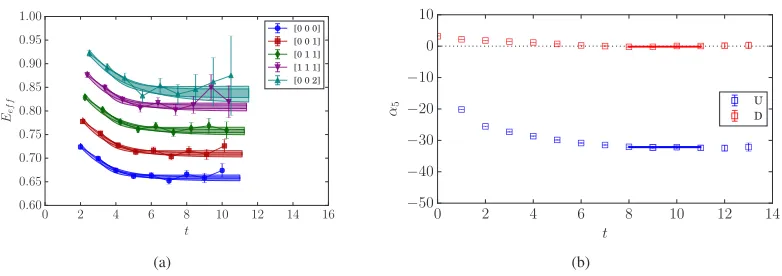
Nucleon energies inCP-even vacuum are extracted from theNN¯ correlator with 2-state fits (Fig. 2(a)). As widely discussed in the literature, in aCP vacuum the lattice nucleon operator (uTCγ
5d)ucreates a parity-mixed state so that the nucleon propagator is
CCP
NN¯(p,t)
g.s.=−i/pEuc+mNe
2iα5γ5
2EN e
−ENt=eiα5γ5 −i/pEuc+mN
2EN e
iα5γ5e−ENt. (8)
where (−i/pEuc)=ENγ4Euc−ip·γEuc. In order to subtract theF1,2terms mixing withF3, we calculate the parity-mixing angleα5from the ratio of the nucleon correlators,
α5e f f(t)=−Tr
T+γ
5δCPCNN¯(t) TrT+C
NN¯(t)
t→∞
= α5 (9)
whereT+= 1+γ4
2 , and extract the value from its plateaus (see Fig.2(b)).
To evaluate the ground state matrix elements, we use the three central plateau points of the ratios,
[δCP]RNJN¯(tsep,top)= [δ
CP]C
NJN¯(tsep,top)
c 2(tsep)
c 2(tsep) c2(tsep)
c 2(top) c2(top)
c2(tsep−top)
c
2(tsep−top)
, (10)
wherec()2 (t)=Tr[T+CNN¯(p(),t)] with a fixed sink momentump=0 and varying source momentap. Form factorsF1,2are extracted with overdetermined analysis of matrix elements of the quark vector current averaged over directions of the current and the momentum transferq = (p−p) that give equivalent combinations ofF1,2as described, e.g., in Ref. [12]. The results for the Sachs form factors GE =F1−τF2andGM=F1+F2(whereτ= Q
2
4m2
N =
EN−mN
0 2 4 6 8 10 12 14 16
t
0.60 0.65 0.70 0.75 0.80 0.85 0.90 0.95 1.00
Eef
f
[0 0 0] [0 0 1] [0 1 1] [1 1 1] [0 0 2]
(a)
0 2 4 6 8 10 12 14
t
−50
−40
−30
−20
−10 0 10
α5 UD
(b)
Figure 2. (a) Effective energy plots forp2≤4p2
min, together with two-state fits. (b) Chiral rotation angleα5of the
proton field induced byu- andd-quark cEDM interactions (no disconnected contractions, no renormalization);
Combining these components did not result in improved precision of theF3 form factor. With only theNJ4N¯component, the form factor is given by the expression
(1+τ)F3(Q2)=qmN 3KRTr[T
+
Sz+δCPRNJ4N¯]−α5GE(Q2), (11)
whereT+ Sz+ = T
+(1+ Σ
z) = 12(1+γ4)(1−iγ1γ2),τ = Q 2 4m2
N =
EN−mN
2mN andKR = √2ENmN(mN+EN). The second term in the rhs is the mixing subtraction. Following our recent paper [11], we stress that the correct subtraction of F1,2 mixing contributions from F3 is different from the expressions used in earlier Refs. [4–10] by a term (−2α5F3) due to spurious mixing ofF2andF3 in the vector current vertex in these papers. TheF3results for the four combinations of flavors in the cEDM and current operators are shown in Fig.3(b), again demonstrating no visibletsepdependence.
4 EDM from energy shift
Calculation of the dipole moment using a uniform background field is advantageous because it does not require momentum extrapolation. The calculation is straightforward for the neutron, but for the proton one has to analyze correlation functions that are complicated due to its constant accelera-tion [13]. However, since the uniform background field is quantized on a lattice, it cannot be made arbitrarily small. For small lattices, the minimal field strength is very large with the magnitude com-parable to the QCD scale:E0=a23Lx·2πLt, where the extra factor of 3 is due to the fractional quark charge. On the 243×64 lattice, the minimal electric field isE
0 ≈0.04 GeV2 ≈200 MV/fm. Such an electric field pulls theuquark in the neutron with tension≈(160 MeV)2, or approximately 14% of the QCD string tension. Although it may deform the neutron away from the ground state, we believe that the correction is insignificant at our level of precision.
We introduce the uniform electric field along thezaxis of the lattice as described in Ref. [11]. Using the modified QCD+U(1) gauge links, we calculate the regular nucleon correlatorCNN¯,Eand its
linear perturbation in theCP-odd interactionx[OψG˜]x, similarly to the form factorF3:
δCPCNN¯,E(p,t)=
y
e−ip(y−x)N(y,t) ¯N(x,0)OCP
0 2 4 6 8 10 12 14 16
t
0.60 0.65 0.70 0.75 0.80 0.85 0.90 0.95 1.00
Eef
f
[0 0 0] [0 0 1] [0 1 1] [1 1 1] [0 0 2]
(a)
0 2 4 6 8 10 12 14
t −50 −40 −30 −20 −10 0 10
α5 UD
(b)
Figure 2. (a) Effective energy plots forp2≤4p2
min, together with two-state fits. (b) Chiral rotation angleα5of the
proton field induced byu- andd-quark cEDM interactions (no disconnected contractions, no renormalization);
Combining these components did not result in improved precision of theF3form factor. With only theNJ4N¯component, the form factor is given by the expression
(1+τ)F3(Q2)= qmN 3KRTr[T
+
Sz+δCPRNJ4N¯]−α5GE(Q2), (11)
whereT+ Sz+ = T
+(1+ Σ
z) = 12(1+γ4)(1−iγ1γ2),τ = Q 2 4m2
N =
EN−mN
2mN andKR = √2ENmN(mN+EN). The second term in the rhs is the mixing subtraction. Following our recent paper [11], we stress that the correct subtraction of F1,2 mixing contributions from F3 is different from the expressions used in earlier Refs. [4–10] by a term (−2α5F3) due to spurious mixing ofF2 andF3 in the vector current vertex in these papers. TheF3results for the four combinations of flavors in the cEDM and current operators are shown in Fig.3(b), again demonstrating no visibletsepdependence.
4 EDM from energy shift
Calculation of the dipole moment using a uniform background field is advantageous because it does not require momentum extrapolation. The calculation is straightforward for the neutron, but for the proton one has to analyze correlation functions that are complicated due to its constant accelera-tion [13]. However, since the uniform background field is quantized on a lattice, it cannot be made arbitrarily small. For small lattices, the minimal field strength is very large with the magnitude com-parable to the QCD scale:E0=a32LxLt·2π , where the extra factor of 3 is due to the fractional quark charge. On the 243×64 lattice, the minimal electric field isE
0 ≈0.04 GeV2≈200 MV/fm. Such an electric field pulls theuquark in the neutron with tension≈(160 MeV)2, or approximately 14% of the QCD string tension. Although it may deform the neutron away from the ground state, we believe that the correction is insignificant at our level of precision.
We introduce the uniform electric field along thezaxis of the lattice as described in Ref. [11]. Using the modified QCD+U(1) gauge links, we calculate the regular nucleon correlatorCNN¯,Eand its
linear perturbation in theCP-odd interactionx[OψG˜]x, similarly to the form factorF3:
δCPCNN¯,E(p,t)=
y
e−ip(y−x)N(y,t) ¯N(x,0)OCP
ψGE. (12)
−0.2
0.0 0.2 0.4 0.6 0.8 1.0 1.2
GEp
(T= 8)
(T= 10)
(T= 12)
−0.10
−0.05
0.00 0.05 0.10
GEn
−0.5
0.0 0.5 1.0 1.5 2.0 2.5
GMp
0.0 0.5 1.0 1.5
Q2[GeV2]
−1.4
−1.2
−1.0
−0.8
−0.6
−0.4
−0.2
0.0 0.2
GMn
(a) P,T-even nucleon vector current (Sachs) form factors.
−15 −10 −5 0 5 10 15 F3 p , (cEDM) U
(T= 8)
(T= 10)
(T= 12)
−15 −10 −5 0 5 10 15 F3 n , (cEDM) U −15 −10 −5 0 5 10 15 F3 p , (cEDM) D
0.0 0.1 0.2 0.3 0.4 0.5 0.6 0.7 0.8
Q2[GeV2]
−15 −10 −5 0 5 10 15 F3 n , (cEDM) D
(b) Electric dipole form factorsF3induced byu- andd-quark
chromo-EDM interactions.
Figure 3.Nucleon CP-even and CP-odd electric dipole form factors. Disconnected contractions are not included for either currents or cEDM insertions.
It is important to use the modified gauge links both in the computing of the propagators and in the construction of the smeared sources and sinks. Otherwise, since the individual quarks are charged, the results would depend on the gauge of the electromagnetic potential. For the purpose of source construction, the QCD gauge links are first APE-smeared, with the electromagnetic potential applied afterwards.
Following Ref.[11], the energy of a polarized (S||E) particle on a Euclidean lattice is shifted by
the imaginary valueδE=−(ζ/2m)iE. The nucleon correlator at rest (p=0) is therefore
CCP
NN¯,E(p=0,t)=|ZN|2e
iα5γ51+γ4 2
1+ Σz 2 e−(
mN+δE)t+1−Σz 2 e−(
mN−δE)teiα5γ5. (13)
Analogously to the treatment of theCP-odd form factorF3, the linear perturbation inx[OψG˜]xyields
CNN¯,E−iδ˜ψδCPCNN¯,Et→∞= |ZN|2e−mNt1+γ4
2 +iα5γ5−ΣzδE t
−10 0 10 20 30 40 50
ζ
ef
f
n
(
t
)
,
(cEDM)
U E/E0=±1
E/E0=±2
0 2 4 6 8 10 12 14
t
−10
0 10 20 30 40 50
ζ
ef
f
n
(
t
)
,
(cEDM)
D E/E0=±1
E/E0=±2
(a) The neutron EDM computed from energy shifts with two values of the electric field. The units are dimensionless and the scale is the same as forF3.
−100
−80
−60
−40
−20
0 20
F3
n
,
(cEDM)
U
E/E0=±1
E/E0=±2
NEWF3(T= 8)
NEWF3(T= 10)
OLDF3(T= 8)
OLDF3(T= 10)
0.0 0.1 0.2 0.3 0.4 0.5 0.6
Q2[GeV2]
−100
−80
−60
−40
−20
0 20
F3
n
,
(cEDM)
D
(b) Comparison of the neutron EDFFF3n(Q2) computed
with the conventional [4–10] and the new (11) formulas to the energy shift results.
from which we obtain the following estimator for the electric dipole moment:
ζeff(t)=2m
NdeNff(t)=− 2mN
Ez
R
z(t+1)−Rz(t), Rz(t)=
TrT+Σ
zδCPCNN¯,Ez(t)
TrT+C NN¯,Ez(t)
. (15)
To estimate the effects of the ground state distortion by the background field, we have computed the neutron correlation functions with two valuesE = E0 and 2E0, with the results forζeff(t) shown in Fig.4(a). We chooset = 6. . .9 as the common plateau to estimate the value ofζ for both flavors
ψ =u,d. In the case ofd-quark cEDM, we observe nonzero values of the energy shift. The EDM values computed withE=E0and 2E0agree well with each other, indicating that the energy shift is linear inEand our current EDM results are not sensitive to the nucleon ground state distortion by the electric field.
Our calculation of the neutron EDM from the energy shift does not depend on the parity mixing (chiral phase rotation) of the nucleon states in theCPvacuum. This mixing, if not taken into account correctly, may lead to the spurious mixing betweenF3 andF2. By comparing the energy shift and the form factor results, we demonstrate numerically that indeed our analysis of the parity mixing in Ref. [11] is correct. This comparison is shown in Fig.4(b), together with form factor values ˜F3 computed using expressions from Refs. [4–10] given in Eq.4. The ˜F3values are different fromF3 only if the mixing angleα5is relatively large. Thus, in the case ofu-quark cEDM, the valueα5for the neutron is small, and there is no observable difference betweenF3and ˜F3. However, in the case of
d-quark cEDM, the difference is remarkable. It is clear that even with the current uncertainties due to excited states and theQ2→0 extrapolation, the comparison favors agreement withF
−10 0 10 20 30 40 50 ζ ef f n ( t ) , (cEDM)
U E/E0=±1
E/E0=±2
0 2 4 6 8 10 12 14
t −10 0 10 20 30 40 50 ζ ef f n ( t ) , (cEDM)
D E/E0=±1
E/E0=±2
(a) The neutron EDM computed from energy shifts with two values of the electric field. The units are dimensionless and the scale is the same as forF3.
−100 −80 −60 −40 −20 0 20 F3 n , (cEDM) U
E/E0=±1
E/E0=±2
NEWF3(T= 8)
NEWF3(T= 10)
OLDF3(T= 8)
OLDF3(T= 10)
0.0 0.1 0.2 0.3 0.4 0.5 0.6
Q2[GeV2]
−100 −80 −60 −40 −20 0 20 F3 n , (cEDM) D
(b) Comparison of the neutron EDFF F3n(Q2) computed
with the conventional [4–10] and the new (11) formulas to the energy shift results.
from which we obtain the following estimator for the electric dipole moment:
ζeff(t)=2m
NdeNff(t)=− 2mN
Ez
R
z(t+1)−Rz(t), Rz(t)=
TrT+Σ
zδCPCNN¯,Ez(t)
TrT+C NN¯,Ez(t)
. (15)
To estimate the effects of the ground state distortion by the background field, we have computed the neutron correlation functions with two valuesE = E0 and 2E0, with the results forζeff(t) shown in Fig.4(a). We chooset = 6. . .9 as the common plateau to estimate the value ofζ for both flavors
ψ =u,d. In the case ofd-quark cEDM, we observe nonzero values of the energy shift. The EDM values computed withE=E0and 2E0agree well with each other, indicating that the energy shift is linear inEand our current EDM results are not sensitive to the nucleon ground state distortion by the electric field.
Our calculation of the neutron EDM from the energy shift does not depend on the parity mixing (chiral phase rotation) of the nucleon states in theCPvacuum. This mixing, if not taken into account correctly, may lead to the spurious mixing betweenF3 andF2. By comparing the energy shift and the form factor results, we demonstrate numerically that indeed our analysis of the parity mixing in Ref. [11] is correct. This comparison is shown in Fig.4(b), together with form factor values ˜F3 computed using expressions from Refs. [4–10] given in Eq.4. The ˜F3 values are different fromF3 only if the mixing angleα5is relatively large. Thus, in the case ofu-quark cEDM, the valueα5for the neutron is small, and there is no observable difference betweenF3and ˜F3. However, in the case of
d-quark cEDM, the difference is remarkable. It is clear that even with the current uncertainties due to excited states and theQ2→0 extrapolation, the comparison favors agreement withF
3but not ˜F3. This agreement between the energy shift and the form factor calculation of nEDM serves as a numerical cross-check of our analysis of the latter. We believe that this discrepancy has not been detected in earlier lattice studies of the ¯θQCD-induced nucleon EDM because of the small corresponding values of the mixing angle as well as the relatively large statistical errors, which made the comparison between Refs. [2] and [4] inconclusive.
5 Summary
We have performed calculations of the nucleon electric dipole moments induced byCP-odd quark-gluon electric dipole interactions using two different methods. In the first method we calculate nu-cleon matrix elements in theCPvacuum by evaluating up to four-point connected nucleon correlation functions. TheCP-odd interaction is treated as perturbation of theCP-even vacuum and is straight-forward to analyze using sequential propagators. We have performed calculations with three different source-sink separations and we do not observe any significant excited states in either theCP-even form factorsF1,2or theCP-odd electric dipole form factorF3.
In the second method, we also treat theCP-odd interaction as a perturbation but compute the neutron EDM from the energy shift in a uniform background electric field. The energy-shift method for computing the nucleon EDM has been used before [1–3], but our calculation is the first one that uses the uniform background electric field respecting periodic boundary conditions [13]. The statistics is identical in both methods, and the energy shift results agree with the form factorsF3 if they are computed with the new formula [11]. Also, both methods yield comparable uncertainty. The energy-shift method may be preferable in the future because it does not require forward-limit extrapolation, and excited states may be easier to control [14].
In both methods, we observe statistically significant signal for the cEDM-induced nucleon EDM, although we do not include disconnected diagrams in our calculation, and our results are not yet renormalized. Comparison of the results from the two methods serve as a numerical cross-check of our recent finding that the extraction of theCP-odd form factorF3and the nucleon EDM in previous works was incorrect. Specifically, the reported values contain spurious contributions (−2α5κ) due to mixing with the anomalous magnetic momentκof the nucleon.
We plan to calculate disconnected contributions to theF3form factors as an extension to the pre-sented work, combining the existing nucleon correlators and quark-disconnected loops with insertions of the quark current, chromo-EDM, and both. Although the disconnected contractions are simpler to construct (they do not require four-point correlators and associated sequential propagators), we expect that the stochastic noise will be a much bigger problem compared to the connected contractions.
ACKNOWLEDGEMENTS
References
[1] S. Aoki, A. Gocksch, Phys. Rev. Lett. 63, 1125 (1989), [Erratum: Phys. Rev. Lett.65,1172(1990)]
[2] E. Shintani, S. Aoki, N. Ishizuka, K. Kanaya, Y. Kikukawa et al., Phys.Rev.D75, 034507 (2007), hep-lat/0611032
[3] E. Shintani, S. Aoki, Y. Kuramashi, Phys.Rev.D78, 014503 (2008),0803.0797
[4] E. Shintani, S. Aoki, N. Ishizuka, K. Kanaya, Y. Kikukawa et al., Phys.Rev.D72, 014504 (2005), hep-lat/0505022
[5] F. Berruto, T. Blum, K. Orginos, A. Soni, Phys.Rev.D73, 054509 (2006),hep-lat/0512004 [6] R. Horsley, Y. Nakamura, D. Pleiter et al., The Electric dipole moment of the nucleon from
simulations at imaginary vacuum angle theta(2008),0808.1428
[7] F.K. Guo, R. Horsley, U.G. Meissner, Y. Nakamura, H. Perlt, P.E.L. Rakow, G. Schierholz, A. Schiller, J.M. Zanotti, Phys. Rev. Lett.115, 062001 (2015),1502.02295
[8] A. Shindler, T. Luu, J. de Vries, Phys. Rev.D92, 094518 (2015),1507.02343
[9] C. Alexandrou, A. Athenodorou, M. Constantinou, K. Hadjiyiannakou, K. Jansen, G. Koutsou, K. Ottnad, M. Petschlies, Phys. Rev.D93, 074503 (2016),1510.05823
[10] E. Shintani, T. Blum, T. Izubuchi, A. Soni, Phys. Rev.D93, 094503 (2016),1512.00566 [11] M. Abramczyk, S. Aoki, T. Blum, T. Izubuchi, H. Ohki, S. Syritsyn, Phys. Rev.D96, 014501
(2017),1701.07792
[12] S. Syritsyn, J. Bratt, M. Lin, H. Meyer, J. Negele et al., Phys.Rev. D81, 034507 (2010), 0907.4194