$
SVHXGRVFDODU
JOXHEDOO
DQG
FKDUPHG
PHVRQV
LQ
WKH
H[WHQGHG
OLQHDU
VLJPD
PRGHO
Walaa I. Eshraim1,a
1Institute for Theoretical Physics, Goethe University, Max-von-Laue-Str. 1, D–60438 Frankfurt am Main, Germany
Abstract.In the framework of the so-called extended linear sigma model (eLSM), we
include a pseudoscalar glueball with a mass of 2.6 GeV (as predicted by Lattice-QCD simulations) and we compute the two- and three-body decays into scalar and pseudoscalar mesons. This study is relevant for the future PANDA experiment at the FAIR facility. As a second step, we extend the eLSM by including the charm quark according to the global
U(4)R×U(4)Lchiral symmetry. We compute the masses, weak decay constants and
strong decay widths of open charmed mesons. The precise description of the decays of open charmed states is important for the CBM experiment at FAIR.
1 Introduction
The fundamental interactions of quarks and gluons are described by quantum chromodynamics (QCD). The development of an effective hadronic Lagrangian plays an important role in the descrip-tion of the masses and the interacdescrip-tions of low-lying hadron resonances [1]. To this end, we developed the so-called extended Linear Sigma Model (eLSM) [2] in which (pseudo)scalar and (axial-)vectorqq mesons and additional scalar and pseudoscalar glueball fields are the basic degrees of freedom. The eLSM emulates the global symmetries of the QCD Lagrangian: the global chiral symmetry (which is exact in the chiral limit), the discrete C, P, and T symmetries, and the classical dilatation (scale) symmetry. When working with colorless hadronic degrees of freedom, the local color symmetry of QCD is automatically preserved. In QCD (and thus also in the eLSM) the global chiral symmetry is explicitly broken by non-vanishing quark masses and quantum effects [4], and spontaneously by a non-vanishing expectation value of the quark condensate in vacuum [5]. The dilatation symmetry is broken explicitly by the logarithmic term of the dilaton potential, by the mass terms, and by theU(1)A
anomaly.
The investigation of the properties of bound states of gluons, so-called glueballs, is an important field of research in hadronic physics. The glueball spectrum has been predicted by Lattice QCD [6], where the third lightest glueball is a pseudoscalar state (JPC =0−+), denoted asG≡gg, with a mass
of about 2.6 GeV, which is studied in the present work.
Studying the properties of the third most massive of all quarks, the charm quark, is an active field of hadronic physics [7]. Thus we extend the eLSM (which has shown success in describing the phe-nomenology of the nonstrange-strange mesons [2, 8]) from the three quark-flavor case [8] to the four
ae-mail: [email protected]
C
quark-flavor case [9–11] with only three new unknown parameters related to the charm sector. Chiral symmetry is strongly explicitly broken by the current charm quark mass.
In the present work, we compute the two- and three-body decays of the lightest pseudoscalar glueball within the eLSM in the case of three flavors. Moreover, we calculate all meson masses in the eLSM including light and charmed mesons, the (OZI-dominant) strong decays of open charmed mesons, and the weak decay constants of charmed mesons.
These proceedings are organized as follows: in Sec. 2 we present theU(Nf)R×U(Nf)Lextended
Linear Sigma Model with (axial-)vector mesons. In Sec. 3 we present the vacuum properties of a pseudoscalar glueball within the eLSM. In Sec. 4 we outline the extension of the eLSM toNf =4 and
present the results for the masses, weak decay constants, and decay widths, and in Sec. 5 we provide our conclusions and an outlook.
2 The extended Linear Sigma Model
In this section we present the eLSM Lagrangian which is constructed from two requirements stem-ming from the underlying QCD theory: (i) global chiral symmetryU(Nf)R×U(Nf)L; (ii) dilatation
invariance, with the exceptions of the scale anomaly and theU(1)Aanomaly. It is also invariant under the discrete symmetriesCandP. The Lagrangian of the eLSM for a generic number of flavorsNf
[2, 8–12] takes the following form
L=1 2(∂μG)
2−
Vdil(G)+Tr[(DμΦ)†(DμΦ)]−m20
G G0
2
Tr(Φ†Φ)−λ1[Tr(Φ†Φ)]2
−λ2Tr(Φ†Φ)2+Tr[H(Φ + Φ†)]+Tr⎧⎪⎪⎨⎪⎪⎩ ⎡ ⎢⎢⎢⎢⎢ ⎣
G G0
2
m2 1
2 + Δ ⎤ ⎥⎥⎥⎥⎥
⎦(Lμ)2+(Rμ)2⎫⎪⎪⎬⎪⎪⎭
−1 4Tr[(L
μν
)2+(Rμν)2]−2 Tr[EΦ†Φ]+c(detΦ−detΦ†)2+icG˜ΦG(det˜ Φ−detΦ†)
+ig2
2{Tr(Lμν[L μ,
Lν])+Tr(Rμν[Rμ,Rν])}+h1 2Tr(Φ
†Φ)Tr[(Lμ)2+(
Rμ)2]
+h2Tr[(ΦRμ)2+(LμΦ)2]+2h3Tr(ΦRμΦ†Lμ)+. . . , (1)
where the fieldGdenotes the dilaton field and its potential [13] reads
Vdil(G)=
1 4
m2 G Λ2 G
G4ln G
ΛG
−G4 4
, (2)
in which the parameter ΛG ∼ NCΛQCD sets the energy scale of the gauge theory. Moreover,
DμΦ ≡ ∂μΦ−ig1(LμΦ−ΦRμ) is the covariant derivative and contains the (pseudo)scalar
quark-antiquark mesons,Lμν ≡∂μLν−∂νLμ, andRμν ≡∂μRν−∂νRμare the left-handed and right-handed field strength tensors which describe the (axial-)vector mesons. In eLSM Lagrangian (1) the dots refer to further chirally invariant terms listed in Ref. [8]: These terms do not affect the masses and decay widths studied in the present work and we therefore omitted them. The terms involving the matrices H,E,andΔare the mass terms and break the dilatation and chiral symmetry due to nonzero current quark masses. Note that theEterm is a new term added to the model to account for the charm quark mass, whereas the termc(detΦ−detΦ†)2 describes theU(1)A anomaly. The constantchas
dimen-sion [Energy]4−2Nf. Furthermore, the pseudoscalar field is the last field included in the model by the
icG˜ΦG˜(detΦ−detΦ†) term (details are provided in the next section).
Spontaneous symmetry breaking takes place whenm2
well as the glueball fieldG =G0, [2, 8–11]. To implement this breaking one has to shift the scalar
fieldsG → G0+GandΦ → diag{ √
2σN, √
2σN, ...}+ Φ. Using the eLSM we study the vacuum
properties of the lightest pseudoscalar glueball ˜Gin the case ofNf =3, and by extending it toNf =4,
we study the phenomenology of charmed mesons. Details will be given in the following two sections.
3 Phenomenology of a pseudoscalar glueball
In this section we compute the decay widths of the pseudoscalar glueballGinto a scalar and a pseu-doscalar meson,G→PS and into three pseudoscalar mesonsG→PPP.
In Ref.[14] we considered anNf =3 chiral Lagrangian which describes the interaction between the
pseudoscalar glueballG≡ |gg >and (pseudo-)scalar mesons as follows:
Lint ˜
G =icG˜ΦG˜
detΦ−detΦ†, (3)
wherecG˜Φis a dimensionless coupling constant andΦreads for three flavours,Nf =3 [8]:
Φ =(Sa+iPa)ta= √1 2
⎛ ⎜⎜⎜⎜⎜ ⎜⎜⎜⎜⎜ ⎜⎜⎝
(σN+a00)√+i(ηN+π0)
2 a
+
0 +iπ+ KS++iK+
a−0 +iπ−
(σN−a00)√+i(ηN−π0)
2 K
0 S +iK0
KS−+iK− K¯0
S +iK¯0 σS +iηS ⎞ ⎟⎟⎟⎟⎟ ⎟⎟⎟⎟⎟
⎟⎟⎠, (4)
whereS andPrefer to scalar and pseudoscalar mesons, respectively, whileta are generators of the
groupU(Nf). As discussed in Ref.[14] the multipletΦtransforms underU(3)L×U(3)Rchiral
trans-formations asΦ→ULΦUR†, whereasUL(R) =e−iθ
a
L(R)tais an element ofU(3)
L(R)and the pseudoscalar
glueballGis chirally invariant. We then conclude that the interaction Lagrangian (3) is invariant under S U(3)R×S U(3)Land also invariant under parity (Φ→Φ†andG→ −G), but not invariant under the
axialUA(1) transformation.
The states in the interaction Lagrangian are assigned as physical resonances to light quark-antiquark states with mass2 GeV [14]. For the pseudoscalar sectorP, the fields→−π andKrepresent the pion isotriplet and the kaon isodoublet [8]. The bare fieldsηN ≡ |uu¯ +dd¯ /
√
2 andηS ≡ ss¯ are the
nonstrange and strange contributions of the physical statesηandηwhich can be obtained by [8]:
η=ηNcosϕ+ηSsinϕ, η=−ηNsinϕ+ηScosϕ, (5)
where the mixing angle isϕ44.6◦[8]. For the scalar sectorS, the field→−a0is assigned to the physical
isotriplet statea0(1450) and the scalar kaon fieldsKsto the resonanceK0∗(1430). In the scalar-isoscalar
sector the bare nonstrange fieldσN ≡ uu¯ +dd¯ !
/√2 corresponds to the resonance f0(1370) [8] but
the bare strange fieldσS ≡ |ss¯ can be assigned to the resonance f0(1710) [8] or f0(1500) [15].
To compute the decays of the pseudoscalar glueball we have to implement the spontaneous symmetry breaking by shifting the scalar-isoscalar fields by their vacuum expectation values as follows [8, 14]:
σN→σN+φNandσS →σS +φS , (6)
whereφNandφS represent the chiral-nonstrange and strange condensates [8], as the following
φN=Zπfπ, φS =
2ZKf√K−φN
2 . (7)
Table 1.Branching ratios for the two- and three-body decay of the pseudoscalar glueball ˜Ginto a scalar and a pseudoscalar meson, whereσS is assigned either to f0(1710) or tof0(1500) (values in parentheses).
Quantity result in GeV Quantity result in GeV ΓG˜→KKS/ΓtotG˜ 0.060 ΓG˜→KKη/ΓtotG˜ 0.049 ΓG˜→a0π/ΓGtot˜ 0.083 ΓG˜→KKη/Γtot˜
G 0.019 ΓG˜→ησN/Γ
tot ˜
G 0.0000026 ΓG˜→ηηη/Γ tot
˜
G 0.016 ΓG˜→ησ
N/Γ
tot ˜
G 0.039 ΓG˜→ηηη/Γ tot
˜
G 0.0017 ΓG˜→ησS/Γ
tot ˜
G 0.012 (0.015) ΓG˜→ηηη/Γ tot
˜
G 0.00013 ΓG˜→ησS/Γ
tot ˜
G 0 (0.0082) ΓG˜→KKπ/Γ tot
˜
G 0.47 ΓG˜→ηππ/ΓGtot˜ 0.16 ΓG˜→ηππ/ΓGtot˜ 0.095
All parameters have been determined in Ref.[8]. Here, we present the theoretical results of the two-body decayG→PS and the three-body decayG→PPP[14] as branching ratios, where the mass of the pseudoscalar glueballGis 2.6 GeV predicted by Lattice QCD simulation [6] which are indepen-dent of the unknown couplingcGΦin Table 1. Here,ΓtotG˜ = ΓG˜→PPP+ ΓG˜→PS is the total decay width.
Note that in the eLSM (3) the decay of the pseudoscalar glueball into three pions vanishes [14]:
ΓG˜→πππ =0 . (8)
4 Phenomenology of charmed mesons
In this section we enlarge the eLSM (1) by including the charm quark [9–11]. We then compute the masses of light and (open and hidden) charmed mesons, the weak decay constants, and the decay widths of open charmed mesons.
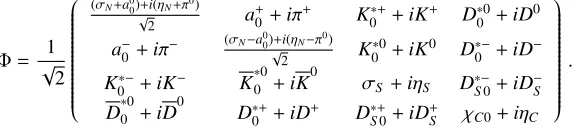
In the extension to the four-flavor case, the multipletΦas seen in Eq.(4) is extended as follows:
Φ = √1 2 ⎛ ⎜⎜⎜⎜⎜ ⎜⎜⎜⎜⎜ ⎜⎜⎜⎜⎜ ⎜⎜⎜⎜⎜ ⎝
(σN+a00)√+i(ηN+π0)
2 a
+
0 +iπ+ K0∗++iK+ D∗00+iD0
a−0 +iπ−
(σN−a00)√+i(ηN−π0)
2 K
∗0
0 +iK0 D∗−0 +iD−
K0∗−+iK− K∗00+iK 0
σS +iηS D∗−S0+iD−S
D∗00+iD 0
D∗0++iD+ D∗S+0+iD+S χC0+iηC ⎞ ⎟⎟⎟⎟⎟ ⎟⎟⎟⎟⎟ ⎟⎟⎟⎟⎟ ⎟⎟⎟⎟⎟ ⎠ . (9)
The new (pseudo)scalar charmed mesons appear in the fourth line and fourth column. In the pseu-doscalar sector there are: an open charmed stateD0,±, open strange-charmed statesD±
S, and a hidden
charmed ground stateηC(1S) [9]. In the scalar sector there are open charmedD∗00,± and strange
charmed mesonD∗ ±S0 which are assigned toD∗0(2400)0
,±andD∗
S0(2317)±[9], respectively. Similarly,
the new (axial-)vector charmed mesons appear also in the fourth line and fourth column of the left-and right-hleft-anded matrices which are described as [11]:
Lμ=Vμ+Aμ= √1 2 ⎛ ⎜⎜⎜⎜⎜ ⎜⎜⎜⎜⎜ ⎜⎜⎜⎜⎜ ⎜⎜⎜⎜⎝
ωN√+ρ0
2 + f1N√+a01
2 ρ
++a+
1 K∗++K1+ D∗ 0+D0
1
ρ−+a− 1
ωN√−ρ0
2 + f1N√−a01
2 K
∗0+K0
1 D∗−+D−1
K∗−+K1− K ∗0
+K01 ωS +f1S D∗−S +D−S1
Rμ=Vμ−Aμ= √1 2
⎛ ⎜⎜⎜⎜⎜ ⎜⎜⎜⎜⎜ ⎜⎜⎜⎜⎜ ⎜⎜⎜⎜⎝
ωN√+ρ0
2 − f1N√+a01
2 ρ
+−a+
1 K∗+−K1+ D∗0−D01
ρ−−a− 1
ωN√−ρ0
2 − f1N√−a01
2 K
∗0−K0
1 D∗−−D−1
K∗−−K1− K ∗0
−K01 ωS −f1S D∗−S −D−S1
D∗0−D01 D∗+−D+1 D∗S+−D+S1 J/ψ−χC1 ⎞ ⎟⎟⎟⎟⎟ ⎟⎟⎟⎟⎟ ⎟⎟⎟⎟⎟ ⎟⎟⎟⎟⎠ μ
. (11)
In the vector sector, the nonstrange-charmed fieldsD∗0,D∗±correspond toqqresonancesD∗(2007)0
andD∗(2010)±, respectively, while the strange-charmedD∗±0 is assigned to the resonanceD∗±0 (with
massmD∗±0 ), and there is the lowest vector charmonium stateJ/ψ(1S). In the axial-vector sector, the
open charmed mesonsD1andDS1are assigned toD1(2420) andDS1(2536), respectively, whereas the
charm-anticharm stateχc1corresponds to theccresonanceχc1(1P) [9].
In order to implement the spontaneous symmetry breaking we shift the charm-anticharm scalar field
χC0by its vacuum expectation valueφC[9–11] as
χC0→χC0+φC, (12)
besides shifting the light scalar-isoscalar fields as seen in Eq. (6). Almost all parameters are determined in the low-energy study of Ref.[8]. We fix the three new parameters related to the charm sector by a fit including twelve masses of hidden and open charmed mesons withχ2/d.o.f 1 (for details see Ref.[9]).
4.1 Masses
In the case of theU(4)R×U(4)Llinear sigma model, there are interesting mass differences between
vector and axial-vector charmed mesons which depend on the charm condensateφC, and are
indepen-dent of the parametersεCandδC[9]:
m2D1−m
2 D∗=
√
2 (g21−h3)φNφC, m2χC1−m
2
J/ψ=2 (g 2
1−h3)φ2C, m2DS1−m
2
D∗S =2 (g21−h3)φSφC. (13)
The theoretical results are
m2D1−m
2
D∗=(1.2±0.6)×106MeV2, m2χC1−m
2
J/ψ=(1.8±1.3)×106MeV2,
m2DS1−m
2
D∗S =(1.2±0.6)×10
6MeV2,
while the experimental values are
m2D1−m
2
D∗=1.82×10⁶MeV2, m2χC1−m
2
J/ψ=2.73×106MeV2, m2DS1−m
2
D∗S =1.97×10⁶MeV2.
The agreement is fairly good, which shows that our determination of the charm condensateφC is
compatible with experiment, although it still has a large uncertainty.
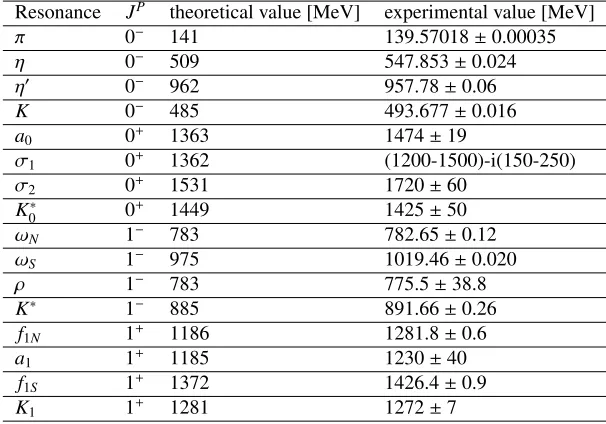
We obtained the light and charmed meson masses, which are reported in Table 2 [10] and Table 3 [9], respectively. Note that the values of the light meson masses are the same in the case ofNf =3 as
Table 2.Light meson masses.
Resonance JP theoretical value [MeV] experimental value [MeV]
π 0− 141 139.57018±0.00035
η 0− 509 547.853±0.024
η 0− 962 957.78±0.06
K 0− 485 493.677±0.016
a0 0+ 1363 1474±19
σ1 0+ 1362 (1200-1500)-i(150-250)
σ2 0+ 1531 1720±60
K0∗ 0+ 1449 1425±50
ωN 1− 783 782.65±0.12
ωS 1− 975 1019.46±0.020
ρ 1− 783 775.5±38.8
K∗ 1− 885 891.66±0.26
f1N 1+ 1186 1281.8±0.6
a1 1+ 1185 1230±40
f1S 1+ 1372 1426.4±0.9
K1 1+ 1281 1272±7
Table 3.Masses of charmed meson
Resonance JP Our Value [MeV] Experimental Value [MeV]
D0 0− 1981±73 1864.86±0.13
D±S 0− 2004±74 1968.50±0.32
ηc(1S) 0− 2673±118 2983.7±0.7
D∗0(2400)0 0+ 2414±77 2318±29 D∗S0(2317)± 0+ 2467±76 2317.8±0.6
χc0(1P) 0+ 3144±128 3414.75±0.31
D∗(2007)0 1− 2168±70 2006.99±0.15 D∗s 1− 2203±69 2112.3±0.5
J/ψ(1S) 1− 2947±109 3096.916±0.011 D1(2420)0 1+ 2429±63 2421.4±0.6
DS1(2536)± 1+ 2480±63 2535.12±0.13
χc1(1P) 1+ 3239±101 3510.66±0.07
4.2 Decays
The weak-decay constants of the pseudoscalar open charmed mesonsDandDS [9, 10] are
fD=
φN√+√2φC
2ZD
=(254±17) MeV, fDS =
φS +φC
ZDS
=(261±17) MeV ,
where the experimental values [16] are
fD=(206.7±8.9) MeV, fDs =(260.5±5.4)MeV.
Table 4.Decay widths of open charmed mesons
Decay Channel Theoretical result [MeV] Experimental result [MeV] D∗0(2400)0→Dπ 139+−243114 Γ =267±40
D∗0(2400)+→Dπ 51+182
−51 Γ =283±24±34
D∗(2007)0→D0π0 0.025±0.003 seen;<1.3
D∗(2007)0→D+π− 0 not seen
D∗(2010)+→D+π0 0.018+0.002
−0.003 0.029±0.008
D∗(2010)+→D0π+ 0.038+0.005
−0.004 0.065±0.017
D1(2420)0→D∗π 65−+5137 27.4±2.5
D1(2420)0→D0ππ 0.59±0.02 seen
D1(2420)0→D+π−π0 0.21+−00..01015 seen
D1(2420)0→D+π− 0 not seen
D1(2420)+→D∗π 65+−5136 Γ =25±6
D1(2420)+→D+ππ 0.56±0.02 seen
D1(2420)+→D0π0π+ 0.22±0.01 seen
D1(2420)+→D0π+ 0 not seen
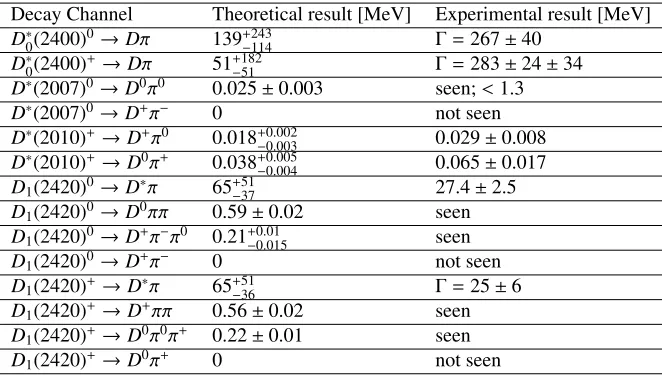
The results of (OZI-dominant) strong decay widths of the open charmed mesons described by the resonancesD∗0,D∗,andD1are summarized in Table 4 [9, 11].
5 Conclusion
In this work we have studied the phenomenology of the pseudoscalar glueball and charmed mesons in an effective model called the extended linear sigma model (eLSM) with vector and axial vector mesons. Firstly we have presented a chirally invariant effective Lagrangian describing the interaction of the pseudoscalar glueball with (pseudo)scalar mesons. We have computed within the eLSM the decay widths of the lightest pseudoscalar glueball into three pseudoscalar and a scalar and pseudoscalar meson. The results are presented as branching ratios which can be measured in the upcoming PANDA experiment at the FAIR facility [17].
Furthermore, the outline of the extension of the eLSM from the three-flavor case to the four-flavor case including the charm quark has been presented. Most parameters are determined in the low-energy study for the nonstrange-strange sector [8]. Three new unknown parameters have been fixed in a fit to the experimental values (details are presented in Ref.[9]). The weak decay constants of nonstrange charmDand strange charmDS have been calculated. All meson masses in the eLSM
(1) have been computed, with the same results for light mesons as in the strange and non-strange sector [8], and with (open and hidden) charmed meson masses being in reasonably good agreement with experimental data [16]. As a last step, we have evaluated the OZI-dominant decays of open charmed mesons (Table 3). The results are compatible with the results and the upper bounds listed by the PDG [16].
Acknowledgments
The author thanks F. Giacosa and D. H. Rischke for cooperation, and S. Janowski for cooperation in the phenomenology of the pseudoscalar glueball. Financial support from the Deutscher Akademischer Austausch Dienst (DAAD) is acknowledged.
References
[1] C. Amsler and N.A. Tornqvist, Phys. Rept.389, 61 (2004); E. Klemt and A. Zaitsev, Phys. Rept. 454, 1 (2007) [arXiv: 0708.4016[hep-ph]].
[2] D. Parganlija, F. Giacosa and D. H. Rischke, Phys. Rev. D82, 054024 (2010) [arXiv:1003.4934 [hep-ph]].
[3] J. S. Schwinger, Annals Phys.2, 407 (1957); M. Gell-Mann and M. Levy, Nuovo Cim.16, 705 (1960); S. Weinberg, Phys. Rev. Lett.18, 188 (1967).
[4] G.’t Hooft, Phys. Rev. D 14, 3432 (1976); G. ’t Hooft, Phys. Rev. Lett.37, 8 (1976); G. ’t Hooft, Phys. Rept. 142, 357 (1986).
[5] C. Vafa and E. Witten, Nucl. Phys. B234, 173 (1984); L. Giusti and S. Necco, JHEP0704(2007) 090 [hep-lat/0702013 [HEP-LAT]].
[6] C. Morningstar and M. J. Peardon, AIP Conf. Proc.688, 220 (2004) [arXiv:nucl-th/0309068]; M. Loan, X. Q. Luo and Z. H. Luo, Int. J. Mod. Phys. A21, 2905 (2006) [arXiv:hep-lat/0503038]; E. B. Gregory, A. C. Irving, C. C. McNeile, S. Miller and Z. Sroczynski, PoSLAT2005, 027 (2006) [arXiv:hep-lat/0510066]; Y. Chenet al., Phys. Rev. D73, 014516 (2006) [arXiv:hep-lat/0510074]. [7] N. Brambilla, A. Pineda, J. Soto and A. Vairo, Rev. Mod. Phys.77(2005) 1423.
[8] D. Parganlija, P. Kovacs, G. Wolf, F. Giacosa and D. H. Rischke, Phys. Rev. D87, 014011 (2013) [arXiv:1208.0585 [hep-ph]].
[9] W. I. Eshraim, F. Giacosa and D. H. Rischke, arXiv:1405.5861 [hep-ph]. [10] W. I. Eshraim, PoS QCD-TNT-III, 049 (2013) [arXiv:1401.3260 [hep-ph]]. [11] W. I. Eshraim and F. Giacosa, arXiv:1409.5082 [hep-ph].
[12] F. Giacosa, D. Parganlija, P. Kovacs and G. Wolf, EPJ Web Conf. 37, 08006 (2012) [arXiv:1208.6202 [hep-ph]].
[13] A. Salomone, J. Schechter and T. Tudron, Phys. Rev. D23, 1143 (1981); H. Gomm and J. Schechter, Phys. Lett. B158, 449 (1985); A. A. Migdal and M. A. Shifman, Phys. Lett. B114, 445 (1982).
[14] W. I. Eshraim, S. Janowski, F. Giacosa and D. H. Rischke, Phys. Rev. D87, 054036 (2013) [arXiv:1208.6474 [hep-ph]]; W. I. Eshraim, S. Janowski, A. Peters, K. Neuschwander and F. Gi-acosa, Acta Phys. Polon. Supp.5, 1101 (2012) [arXiv:1209.3976 [hep-ph]]; W. I. Eshraim and S. Janowski, PoS ConfinementX118, (2012) [arXiv:1301.3345 [hep-ph]]; W. I. Eshraim and S. Janowski, J. Phys. Conf. Ser.426, 012018 (2013) [arXiv:1211.7323 [hep-ph]].
[15] H. Y. Cheng, C. K. Chua and K. F. Liu, Phys. Rev. D74, 094005 (2006) [hep-ph/0607206] [16] J. Beringeret al. (Particle Data Group), Phys. Rev. D86, 010001 (2012).