International Journal of COPD
Dove
press
O r I g I n a l r e s e a r C h open access to scientific and medical research
Open access Full Text article
COPD in patients with stable heart failure
in the primary care setting
Mark J Valk1
Berna D Broekhuizen1
arend Mosterd1,2
nicolaas P Zuithoff1
arno W hoes1
Frans h rutten1
1Julius Center for health sciences
and Primary Care, University Medical Center Utrecht, 2Department of
Cardiology, Meander Medical Center, amersfoort, the netherlands
Background: Presence of chronic obstructive pulmonary disease (COPD) in heart failure (HF) has prognostic and therapeutic implications. Exact prevalence estimates are lacking because most previous studies estimated the prevalence of COPD among HF patients while unstable and in the presence of pulmonary congestion.
Methods: Community-dwelling patients with an established diagnosis of HF and in a stable phase of their disease were invited for spirometry. COPD was defined according to the Global initiative for chronic Obstructive Lung Disease (GOLD) classification and considered present if the ratio of the post-bronchodilator forced expiratory volume in 1 second and forced vital capacity was below 0.7.
Results: Thirty of the 106 patients with HF (mean age 76 [standard deviation] 11.9 years, 57% male) had COPD (prevalence 28.3% [95% confidence interval (CI) 19.7%–36.9%]), with similar rates among those with HF and a reduced ejection fraction (18 individuals; prevalence 28.6% [95% CI 20.0%–37.2%]) and HF with preserved ejection fraction (12 individuals; prevalence 27.9% [95% CI 19.4–36.4]). Twenty-one (70%) of the 30 participants were newly detected cases of COPD.
Conclusion: More than a quarter of the patients with HF concomitantly have COPD, with the large majority being previously unrecognized. Coexistence of COPD should be considered more often in these patients.
Keywords: heart failure, COPD, prevalence, comorbidity, spirometry, diagnosis, primary care
Introduction
Heart failure (HF) and chronic obstructive pulmonary disease (COPD) are both common in the elderly, and often coexist.1 Diagnosing COPD in HF is
chal-lenging because clinical features overlap, and dyspnea and fatigue are common symptoms.1,2 Both share smoking as an important risk factor, and they have a
chronic progressive disease trajectory with systemic effects, and require complex treatment regimens.3–5 The prognosis of patients with both disorders is worse than
those with only one of the diseases.6,7 Importantly, bronchodilators may improve
symptoms of COPD, but possibly cause cardiac side effects.8,9 Under-diagnosis of
one disease in the presence of another is an important issue,10,11 but also there is a
risk of over-diagnosing COPD in patients with HF if these patients are not stable and have some pulmonary congestion.12 Pulmonary congestion is common in those
hospitalized for an exacerbation of HF, and this may mimic COPD clinically, but also spirometrically. Spirometry at discharge in that situation would show – caused by pulmonary congestion – a larger reduction in forced expiratory volume in 1 second (FEV1) than in forced vital capacity (FVC), resulting in a risk of over-diagnosing COPD.13,14 When patients with HF are stable and euvolemic, the FEV/
Correspondence: Mark J Valk University Medical Center Utrecht, Julius Center for health sciences and Primary Care, stratenum 6.138, PO Box 85500, 3508 aB Utrecht, the netherlands
Tel +31 65 131 1485 Fax +31 33 465 3491
email [email protected]
Journal name: International Journal of COPD Article Designation: Original Research Year: 2015
Volume: 10
Running head verso: Valk et al
Running head recto: COPD in patients with heart failure in primary care setting DOI: http://dx.doi.org/10.2147/COPD.S77085
International Journal of Chronic Obstructive Pulmonary Disease downloaded from https://www.dovepress.com/ by 118.70.13.36 on 22-Aug-2020
For personal use only.
Number of times this article has been viewed
This article was published in the following Dove Press journal: International Journal of COPD
Dovepress
Valk et al
FVC allows to adequately detect COPD, although, both the FEV1 and the FVC are reduced to a similar extent.15
Diagnosing COPD at the right moment is therefore key in patients with HF.
Earlier reports on the prevalence of co-morbid COPD in HF often relied on previous documentation of COPD, or on spirometry results performed in HF patients when unstable.10,16,17 Prevalence estimates ranged from 9% to 52%.2
Data in a representative sample of patients with HF in a stable phase of their disease, also including patients with preserved ejection fraction (PEF), are still lacking.1
The aim of our study was to provide a valid prevalence estimate of COPD in a representative sample of patients with HF while in a stable condition (ClinicalTrials.gov identifier NCT01662323).
Methods
Design and study population
In a cross-sectional study we enrolled patients from 30 gen-eral practices from the vicinity of Amersfoort, the Nether-lands. The study and recruitment period was from November 2010 until October 2011. In total 70,000 persons were enlisted in these practices. In the Netherlands all citizens are registered with a general practitioner (GP), irrespec-tive of cooperairrespec-tive care by a hospital specialist, including those living in a home for the elderly, but excluding those living in a nursing home or hospice. Patients were eligible if they had a diagnosis of HF confirmed by an expert panel consisting of two cardiologists and a GP specializing in HF using all diagnostic information, including echocardiogra-phy. The panel based the diagnosis of HF on the criteria of the European Society of Cardiology, that is, suggestive symptoms and objective evidence of cardiac structural or functional cardiac abnormality related to ventricular dys-function at rest detectable with echocardiography. For HF with reduced ejection fraction (HF-REF) the left ventricular ejection fraction should be ,45%. For HF with preserved ejection fraction (HF-PEF) the left ventricular ejection frac-tion should be $45%, in addition to diastolic dysfunction identified by echocardiography.18 Disagreement between
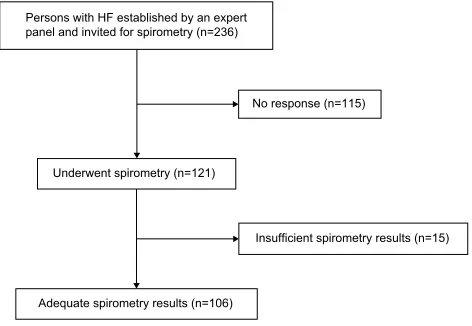
panel members was resolved by majority. We invited 236 patients with a confirmed diagnosis of HF for spirometry, and 121 (51.2%) consented to participate (Figure 1).
The study was approved by the Regional Medical Ethics Committee of the Meander Medical Center, Amersfoort, the Netherlands. All participants gave written informed consent.
Measurements
Between November 2010 and June 2011 baseline charac-teristics of the participants were extracted from the medi-cal files of the participating GPs. Participants underwent spirometry in the primary care setting performed by trained personnel. Spirometry was performed with SPIDA software (Spida 5) and microloop. Before and after 400 micrograms
of salbutamol, the FVC and FEV1 were measured. COPD
was considered present if the post-bronchodilator FEV1/ FVC ratio was below 0.7, as defined by the Global initia-tive for chronic Obstrucinitia-tive Lung Disease (GOLD) crite-ria.5 Severity of pulmonary obstruction was expressed as
the proportion of the predicted FEV1 (the latter based on “normal” values as derived from the population at large with the same age, sex, and height) and derived from the forced spirometry.19 The FEV
1 as percentage predicted was
subdivided into four categories: $80, 50–79, 30–49, #30. The quality of the flow-volume curves was assessed by an experienced physician.
Data analysis
We compared HF patients who decided to participate with nonparticipants. In the participants we compared those with and without COPD. In those with COPD, we com-pared “already known” with “newly detected”. Finally, we compared patients with HF-REF and HF-PEF. Differences between groups were assessed with the chi-square or Fisher’s exact tests for categorical variables, and indepen-dent stuindepen-dent’s t-test for continuous variables. The prevalence of COPD was calculated with the binominal 95% confidence intervals (95% CIs). All data were analyzed with SPSS version 20.0.
3HUVRQVZLWK+)HVWDEOLVKHGE\DQH[SHUW SDQHODQGLQYLWHGIRUVSLURPHWU\Q
$GHTXDWHVSLURPHWU\UHVXOWVQ 8QGHUZHQWVSLURPHWU\Q
1RUHVSRQVHQ
,QVXIILFLHQWVSLURPHWU\UHVXOWVQ
Figure 1 Flow diagram. Abbreviation: hF, heart failure.
International Journal of Chronic Obstructive Pulmonary Disease downloaded from https://www.dovepress.com/ by 118.70.13.36 on 22-Aug-2020
Dovepress COPD in patients with heart failure in primary care setting
Results
Two-hundred and thirty-six patients with established HF were invited for spirometry. Baseline characteristics of the participants (n=121) were not significantly different from the nonparticipants (n=115) (Table S1). In 15 patients spirometry results were of insufficient quality, leaving 106 for this analysis (Figure 1). The mean age of the 106 participants was 76.0 (standard deviation [SD] 11.9) years, and 57% were male. The prevalence of COPD was 28.3% (95% CI 19.7%–36.9%), with similar rates for those with a REF (28.6% [95% CI 20.0%–37.2%]) and PEF (27.9% [95% CI 19.4%–36.4%]).
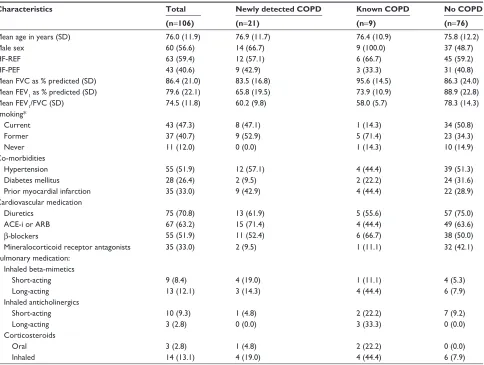
Table 1 shows patient characteristics of all 106 patients. On average, patients with COPD were older than those without COPD. Mean FEV1 % predicted was 65.8 (SD 19.5) and 73.9 (SD 10.9) for those with newly detected COPD and
without COPD, respectively. Seventy percent of the subjects with COPD was previously undiagnosed by their GP. None of the patients with COPD had a history of asthma. Table 2 shows the patient characteristics of newly detected cases vs HF patients without COPD. In Table 3 we compared patients
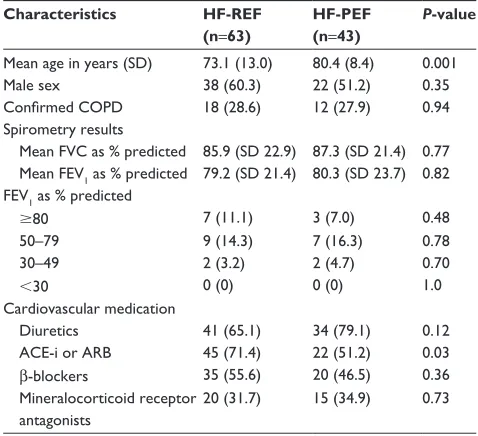
with HF-REF and HF-PEF. The mean post-dilator FEV1 %
predicted was approximately 80% for both HF-REF and HF-PEF patients. Patients with HF-REF were more often male than those with HF-PEF.
Discussion
In our study among stable community-dwelling HF patients the prevalence of COPD was 28.3%, and in 70% this was a new diagnosis of COPD. Prevalence rates were comparable for the subgroups of HF-REF and HF-PEF.
Table 1 Characteristics of the 106 patients with established heart failure divided into those with and without newly detected,
or already known COPD
Characteristics Total Newly detected COPD Known COPD No COPD (n=106) (n=21) (n=9) (n=76)
Mean age in years (sD) 76.0 (11.9) 76.9 (11.7) 76.4 (10.9) 75.8 (12.2)
Male sex 60 (56.6) 14 (66.7) 9 (100.0) 37 (48.7)
hF-reF 63 (59.4) 12 (57.1) 6 (66.7) 45 (59.2)
hF-PeF 43 (40.6) 9 (42.9) 3 (33.3) 31 (40.8)
Mean FVC as % predicted (sD) 86.4 (21.0) 83.5 (16.8) 95.6 (14.5) 86.3 (24.0)
Mean FeV1 as % predicted (sD) 79.6 (22.1) 65.8 (19.5) 73.9 (10.9) 88.9 (22.8)
Mean FeV1/FVC (sD) 74.5 (11.8) 60.2 (9.8) 58.0 (5.7) 78.3 (14.3)
smoking*
Current 43 (47.3) 8 (47.1) 1 (14.3) 34 (50.8)
Former 37 (40.7) 9 (52.9) 5 (71.4) 23 (34.3)
never 11 (12.0) 0 (0.0) 1 (14.3) 10 (14.9)
Co-morbidities
hypertension 55 (51.9) 12 (57.1) 4 (44.4) 39 (51.3)
Diabetes mellitus 28 (26.4) 2 (9.5) 2 (22.2) 24 (31.6)
Prior myocardial infarction 35 (33.0) 9 (42.9) 4 (44.4) 22 (28.9)
Cardiovascular medication
Diuretics 75 (70.8) 13 (61.9) 5 (55.6) 57 (75.0)
aCe-i or arB 67 (63.2) 15 (71.4) 4 (44.4) 49 (63.6)
β-blockers 55 (51.9) 11 (52.4) 6 (66.7) 38 (50.0)
Mineralocorticoid receptor antagonists 35 (33.0) 2 (9.5) 1 (11.1) 32 (42.1)
Pulmonary medication: Inhaled beta-mimetics
short-acting 9 (8.4) 4 (19.0) 1 (11.1) 4 (5.3)
long-acting 13 (12.1) 3 (14.3) 4 (44.4) 6 (7.9)
Inhaled anticholinergics
short-acting 10 (9.3) 1 (4.8) 2 (22.2) 7 (9.2)
long-acting 3 (2.8) 0 (0.0) 3 (33.3) 0 (0.0)
Corticosteroids
Oral 3 (2.8) 1 (4.8) 2 (22.2) 0 (0.0)
Inhaled 14 (13.1) 4 (19.0) 4 (44.4) 6 (7.9)
Notes: numbers are cases (%) unless mentioned otherwise. *Data on smoking were missing in 15 patients.
Abbreviations: COPD, chronic obstructive pulmonary disease; sD, standard deviation; hF-reF, heart failure with reduced ejection fraction; hF-PeF, heart failure with preserved ejection fraction; FVC, forced vital capacity; FeV1, forced expiratory volume in 1 second; aCe-i, angiotensin converting enzyme inhibitor; arB, angiotensin receptor
blocker.
International Journal of Chronic Obstructive Pulmonary Disease downloaded from https://www.dovepress.com/ by 118.70.13.36 on 22-Aug-2020
Dovepress
Valk et al
Our results are in line with previous studies reporting prevalence rates of 9%–52% in patients with HF.2 These
previous studies were performed in hospitalized patients with an over-representation of HF-REF, and spirometry was performed while these patients were recently pulmonary fluid overloaded. We could therefore provide a more valid point estimate of the COPD prevalence of the HF population at large than previous studies. A recent study among 118 elderly patients with stable HF and a smoking history of $10 pack years also showed a prevalence rate of 30% of COPD, similar to our study, and also a similarly high number of newly detected cases of COPD (64%).20 In this study COPD
was also defined according to the GOLD criteria. Moreover, patients were investigated while stable, approximately 3 months after being hospitalized for HF. Separate prevalence rates for HF-REF and HF-PEF, however, were lacking.20
The prevalence of COPD in patients with HF in our study is approximately 1.5 times higher than the expected estimate of 20% in elderly from the population at large.21
We found that the post-bronchodilator FEV1 in patients with HF was on average 80% of predicted in patients with the same age and length. This is in line with a previous study show-ing that HF in the absence of COPD may cause a reduction in FEV1 of approximately 20%, caused by HF itself.15 Thus,
classifying severity of COPD based on FEV1 % predicted may overestimate the severity of obstruction in patients with HF. Because both FVC and FVC as % predicted are reduced approximately 20%, the ratio FEV1/FVC is not affected.15
A strength of our study is the inclusion of a representative sample of patients with HF in a stable phase of their disease, and we could present prevalence rates for patients with HF-REF and HF-PEF separately.
A limitation is the relatively small sample size and the lack of body box measurements. Measurements of the total lung capacity and the residual volume would have been helpful to refine the diagnosis of COPD, especially in cases with spirometry results around the critical cut-off point of FEV1/FVC 0.7.22 Importantly, however, previous studies
reporting on the prevalence of COPD in HF did not apply pulmonary function tests other than spirometry. Recently, some authors advocated age- and sex-related thresholds for the FEV1/FVC lower limit of normal to define COPD.19
We did not use one of the suggested lower limit of normal methods, because application in our study would reduce the possibility to compare our results with previous studies. Finally, some COPD cases may in fact represent persistent asthma, or “mixed cases”, however, none of the COPD cases in earlier years had been labeled with asthma by the GP. We therefore preferred to use the GOLD-definition for COPD (a FEV1/FVC ,0.7). Knowledge of co-morbid COPD in patients with HF has clinical implications because for the management of breathlessness there is room for pulmonary inhalation drugs. We have, however, realized that some
Table 2 Characteristics of the patients with heart failure and a
new diagnosis of COPD vs those without COPD
Characteristics Newly diagnosed COPD (n=21)
No COPD (n=76)
P-value
Mean age 76.9 (11.7) 75.8 (12.2) 0.71
Male sex 14 (66.7) 37 (48.7) 0.14
hF-reF 12 (57.1) 45 (59.2) 0.87
hF-PeF 9 (42.9) 31 (40.8) 0.87
smoking
Current 8 (47.1) 34 (50.8) 0.59
Former 9 (52.9) 23 (34.3) 0.28
never 0 (0) 10 (14.9) 0.79
Cardiovascular medication
Diuretics 13 (61.9) 57 (75.0) 0.24
aCe-i or arB 15 (71.4) 48 (63.2) 0.48
β-blocker 11 (52.4) 38 (50.0) 0.85
Mineralocorticoid receptor antagonist
2 (9.5) 32 (42.1) 0.006
Notes: Numbers are cases (%) unless specified otherwise. Data on smoking were missing in 13 patients.
Abbreviations: COPD, chronic obstructive pulmonary disease; hF-reF, heart failure with reduced ejection fraction; hF-PeF, heart failure with preserved ejection fraction;
Table 3 Characteristics and spirometry results of the 106 patients
with established hF, divided in those with hF-reF and hF-PeF
Characteristics HF-REF (n=63)
HF-PEF (n=43)
P-value
Mean age in years (sD) 73.1 (13.0) 80.4 (8.4) 0.001
Male sex 38 (60.3) 22 (51.2) 0.35
Confirmed COPD 18 (28.6) 12 (27.9) 0.94
spirometry results
Mean FVC as % predicted 85.9 (sD 22.9) 87.3 (sD 21.4) 0.77 Mean FeV1 as % predicted 79.2 (sD 21.4) 80.3 (sD 23.7) 0.82
FeV1 as % predicted
$80 7 (11.1) 3 (7.0) 0.48
50–79 9 (14.3) 7 (16.3) 0.78
30–49 2 (3.2) 2 (4.7) 0.70
,30 0 (0) 0 (0) 1.0
Cardiovascular medication
Diuretics 41 (65.1) 34 (79.1) 0.12
aCe-i or arB 45 (71.4) 22 (51.2) 0.03
β-blockers 35 (55.6) 20 (46.5) 0.36
Mineralocorticoid receptor antagonists
20 (31.7) 15 (34.9) 0.73
Note: Numbers are cases (%) unless specified otherwise.
Abbreviations: hF, heart failure; COPD, chronic obstructive pulmonary disease; sD, standard deviation; hF-reF, heart failure with reduced ejection fraction; hF-PeF, heart failure with preserved ejection fraction; FVC, forced vital capacity; FeV1, forced expiratory volume in 1 second; aCe-i, angiotensin converting enzyme
inhibitor; arB, angiotensin receptor blocker.
International Journal of Chronic Obstructive Pulmonary Disease downloaded from https://www.dovepress.com/ by 118.70.13.36 on 22-Aug-2020
Dovepress COPD in patients with heart failure in primary care setting
authors suggest that both beta-mimetics and anti-muscarinic agents may harm the heart. HF drugs may be prescribed in patients with COPD, including cardio selective β-blockers. It is, however, important to uptitrate slowly.23
Conclusion
COPD is common in patients with HF, both HF-REF and HF-PEF, and remains undetected in the majority of patients. Selective screening of patients with HF when in a stable phase of their disease should be considered.
Acknowledgments
We wish to thank the participating patients and GPs, and Sjaane Hilligehekken, Sanne Rooymans, and Sanne Hillebrand for performing the pulmonary function tests. The study was conducted with an unrestricted research grant from the health insurance company Agis Achmea.
Author contributions
FHR conceived the study idea. AWH, FHR, AM, and MJV designed the study. MJV did the data acquisition, and MJV, BDB, and NPZ did the statistical analysis. MJV, and BDB drafted the manuscript and all authors contributed to the revision of the manuscript. FHR supervised the study and is guarantor of the study.
Disclosure
The authors report no conflicts of interest in this work.
References
1. Rutten FH, Cramer MJ, Lammers JW, Grobbee DE, Hoes AW. Heart failure and chronic obstructive pulmonary disease: An ignored combina-tion? Eur J Heart Fail. 2006;8(7):706–711.
2. Hawkins NM, Petrie MC, Jhund PS, Chalmers GW, Dunn FG, McMurray JJ. Heart failure and chronic obstructive pulmonary disease: diagnostic pitfalls and epidemiology. Eur J Heart Fail. 2009;11(2): 130–139.
3. McMurray JJ, Adamopoulos S, Anker SD, Auricchio A, Bohm M, Dickstein K, et al. ESC Guidelines for the diagnosis and treatment of acute and chronic heart failure 2012: The Task Force for the Diagnosis and Treatment of Acute and Chronic Heart Failure 2012 of the European Society of Cardiology. Developed in collaboration with the Heart Failure Association (HFA) of the ESC. Eur Heart J. 2012;33(14):1787–1847. 4. Le Jemtel TH, Padeletti M, Jelic S. Diagnostic and therapeutic
chal-lenges in patients with coexistent chronic obstructive pulmonary disease and chronic heart failure. J Am Coll Cardiol. 2007;49(2): 171–180.
5. Vestbo J, Hurd SS, Agusti AG, et al. Global strategy for the diagnosis, management, and prevention of chronic obstructive pulmonary dis-ease: GOLD executive summary. Am J Respir Crit Care Med. 2013; 187(4):347–365.
6. Iversen KK, Kjaergaard J, Akkan D, et al. The prognostic importance of lung function in patients admitted with heart failure. Eur J Heart Fail. 2010;12(7):685–691.
7. Boudestein LC, Rutten FH, Cramer MJ, Lammers JW, Hoes AW. The impact of concurrent heart failure on prognosis in patients with chronic obstructive pulmonary disease. Eur J Heart Fail. 2009;11(12): 1182–1188.
8. Au DH, Udris EM, Fan VS, Curtis JR, McDonell MB, Fihn SD. Risk of mortality and heart failure exacerbations associated with inhaled beta-adrenoceptor agonists among patients with known left ventricular systolic dysfunction. Chest. 2003;123(6):1964–1969.
9. Salpeter SR. Cardiovascular safety of beta(2)-adrenoceptor agonist use in patients with obstructive airway disease: a systematic review. Drugs Aging. 2004;21(6):405–414.
10. Iversen KK, Kjaergaard J, Akkan D, et al. Chronic obstructive pul-monary disease in patients admitted with heart failure. J Intern Med. 2008;264(4):361–369.
11. Rutten FH, Cramer MJ, Grobbee DE, et al. Unrecognized heart failure in elderly patients with stable chronic obstructive pulmonary disease. Eur Heart J. 2005;26(18):1887–1894.
12. Brenner S, Guder G, Berliner D, et al. Airway obstruction in systolic heart failure – COPD or congestion? Int J Cardiol. 2013;168(3): 1910–1916.
13. Dimopoulou I, Daganou M, Tsintzas OK, Tzelepis GE. Effects of sever-ity of long-standing congestive heart failure on pulmonary function. Respir Med. 1998;92(12):1321–1325.
14. Petermann W, Barth J, Entzian P. Heart failure and airway obstruction. Int J Cardiol. 1987;17(2):207–209.
15. Guder G, Rutten FH, Brenner S, et al. The impact of heart failure on the classification of COPD severity. J Card Fail. 2012;18(8):637–644. 16. Kjoller E, Kober L, Iversen K, Torp-Pedersen C; Trace Study Group.
Importance of chronic obstructive pulmonary disease for prognosis and diagnosis of congestive heart failure in patients with acute myocardial infarction. Eur J Heart Fail. 2004;6(1):71–77.
17. Macchia A, Monte S, Romero M, D’Ettorre A, Tognoni G. The prognostic influence of chronic obstructive pulmonary disease in patients hospitalised for chronic heart failure. Eur J Heart Fail. 2007;9(9):942–948.
18. Boonman-de Winter LJ, Rutten FH, Cramer MJ, et al. High preva-lence of previously unknown heart failure and left ventricular dys-function in patients with type 2 diabetes. Diabetologia. 2012;55(8): 2154–2162.
19. Quanjer PH, Tammeling GJ, Cotes JE, Pedersen OF, Peslin R, Yernault JC. Lung volumes and forced ventilatory flows. Report Work-ing Party Standardization of Lung Function Tests, European Community for Steel and Coal. Official Statement of the European Respiratory Society. Eur Respir J Suppl. 1993;16:5–40.
20. Boschetto P, Fucili A, Stendardo M, et al. Occurrence and impact of chronic obstructive pulmonary disease in elderly patients with stable heart failure. Respirology. 2013;18(1):125–130.
21. Halbert RJ, Natoli JL, Gano A, Badamgarav E, Buist AS, Mannino DM. Global burden of COPD: systematic review and meta-analysis. Eur Respir J. 2006;28(3):523–532.
22. Guder G, Brenner S, Angermann CE, et al. “GOLD or lower limit of normal definition? A comparison with expert-based diagnosis of chronic obstructive pulmonary disease in a prospective cohort-study”. Respir Res. 2012;13(1):13.
23. Guder G, Brenner S, Stork S, Hoes A, Rutten FH. Chronic obstructive pulmonary disease in heart failure: accurate diagnosis and treatment. Eur J Heart Fail. 2014;16(12):1273–1282.
International Journal of Chronic Obstructive Pulmonary Disease downloaded from https://www.dovepress.com/ by 118.70.13.36 on 22-Aug-2020
International Journal of COPD
Publish your work in this journal
The International Journal of COPD is an international, peer-reviewed journal of therapeutics and pharmacology focusing on concise rapid reporting of clinical studies and reviews in COPD. Special focus is given to the pathophysiological processes underlying the disease, intervention programs, patient focused education, and self management protocols.
This journal is indexed on PubMed Central, MedLine and CAS. The manuscript management system is completely online and includes a very quick and fair peer-review system, which is all easy to use. Visit http://www.dovepress.com/testimonials.php to read real quotes from published authors.
Dovepress
Dove
press
Valk et al
Supplementary material
Table S1 Characteristics of the 236 patients with established heart failure who were invited for spirometry, divided into participants
and nonparticipants
Participants (n=121) Nonparticipants (n=115) P-value
Male sex 46.3 55.7 0.15
Mean age in years (sD) 77.0 (11.4) 76.6 (11.9) 0.91
hypertension 56.7 53.0 0.63
Diabetes mellitus 30.6 26.1 0.44
Prior myocardial infarction 33.1 32.2 0.89
angina pectoris 22.3 13.0 0.06
Atrial fibrillation 54.5 50.4 0.53
egFr ,60 ml/m2 38.8 37.4 0.82
Medication
Diuretics 84.3 73.0 0.03
aCe-i 54.5 52.2 0.72
β-blocker 59.9 52.2 0.29
Digoxin 24.0 21.7 0.68
Note: Numbers are cases (%) unless specified otherwise.
Abbreviations: SD, standard deviation; eGFR, estimated glomerular filtration rate according to the modification of diet in renal diseases formula; ACE-i, angiotensin converting enzyme inhibitor.
International Journal of Chronic Obstructive Pulmonary Disease downloaded from https://www.dovepress.com/ by 118.70.13.36 on 22-Aug-2020