Analysis for Iris and Periocular Recognition in
Unconstraint Biometrics
Mr. Shiv Kumar
1, Dr. Arvind Kumar Sharma
2Research Scholar
1, Associate Professor
21,2
Dept. of Computer Science, OPJS University, Rajasthan (India)
ABSTRACT
The security and safety concern, being more important worldwide, has been encouraging utilization of biometrics systems. Seeing the numerous advantages over the unconstrained (non-cooperative) biometrics over the traditional way of biometrics, former has attracted the researcher attentions recently. There are various biometrics traits like face, iris and their extended form of unconstrained way of capturing data from subject has put so many challenges in biometrics application. Recently, periocular recognition has been proved to be a useful trait for authentication and verification purpose. In this paper, we have presented parameter analysis of periocular dataset using various pattern recognition techniques to test their effectiveness in unconstrained environment. The main goal of this research work to investigate the techniques of periocular biometrics in unconstrained situation to achieve non-cooperative biometrics.
Keywords—Biometrics, Iris Recognition, Periocular Recognition , HOG, LBP, PCA.
I. INTRODUCTION
investigation of efficient methods of periocular biometrics using appropriate dataset has become the objective of researchers. Evaluation of recognition algorithms in unconstrained environment needs wide diversity embedded across the sample images from dataset in terms of pose, scale and illumination. After identifying the need of database which can emulate the unconstrained environment for periocular identification, we have considered set of periocular images captured from various subjects at different scales (captured from different camera distances) with varying pose and illumination. Few of subject face images showing the variation in scale and pose that may occur in unconstrained biometrics are shown in figure 1.
Figure 1: Sample Face Images showing variation in pose and scale from UBIPr Dataset [7]
In this paper, we have presented parameter analysis and optimization of periocular dataset using various pattern recognition techniques to test their effectiveness in unconstrained environment. The main goal of this research work to investigate the use of periocular biometrics in unconstrained situation to achieve non-cooperative biometrics.
The remainder of this paper is organized as follows: Section 2 briefly overviews existing literature for periocular biometrics and discusses the challenges that arise from less constrained environments. Section 3 elaborates pattern recognition methods that can be used for periocular recognition. An experimental results and discussion will appear in section 4. Finally, paper will be concluded with summary of work presented here and future work that can be carried out further
II.RELATED WORK
analyzing the effect of pose variation and occlusion. The experiments carried in this paper uses FRGC 2.0 database
Another important paper [6] in this area has demonstrated the fusion techniques on periocular and iris images for non-ideal images of the eye characterized by occluded irises, motion and spatial blur, poor contrast and illumination artifacts. The experimental results using MBGC database with score level fusion can improve the recognition performance.
In another paper [5], author compare two GEC-based Type II feature extraction (GEFE) methods for periocular biometric recognition: a steady-state GA and an elitist Estimation of Distribution Algorithm (EDA). These GECs (referred to as GEFEssga and GEFEeda) evolve a population of feature masks (FMs) with the objective of minimizing the number of features needed as well as optimizing the recognition accuracy.
In one of the recent papers [1] , gender and ethnicity were identified using periocular images. Authors use the LBP as feature extractor and SVM classifier. Experiments were performed with FGRC face dataset. A very important conclusion is derived in this paper that classification accuracy obtained by using the periocular images is comparable to that obtained by using entire face images for gender and ethnicity recognition.
III.PATTERN DESCRIPTORS AND PERIOCULAR REGION
Weighted gradient orientation histogram (WGOH) is very popular in both outdoor localization and indoor localization [9]. Several improving and simplifies has carried out on it. Gradient orientation can well deal with illumination changes. Several systems have proved that this method is an efficient approach and can make good recognition results. Unlike color histogram, WGOH first converts an image into gray image. All the processes are based on the gray-image. Then gradient magnitude m(x, y) and gradient orientation angle (x,y) of each pixel are computed to construct the histogram.
The LBP operator was first introduced as a complementary measure for local image contrast [10]. The first incarnation of the operator worked with the eight-neighbors of a pixel, using the value of the center pixel as a threshold. An LBP code for a neighborhood was produced by multiplying the thresholded values with weights given to the corresponding pixels, and summing up the result.
Since the LBP was, by definition, invariant to monotonic changes in gray scale, it was supplemented by an orthogonal measure of local contrast. The average of the gray levels below the center pixel is subtracted from that of the gray levels above (or equal to) the center pixel. Two-dimensional distributions of the LBP and local contrast measures were used as features.
PCA [11] being global descriptor, will be inefficient intuitively as opposed to it’s popularity in using face recognition. This fact may be because of the lack of low frequency components present in the eyes in its immediate vicinity.
Dataset Description: To evaluate the algorithms to be used in unconstrained biometrics, dataset with wide
dataset has not just captured the variation in pose of the subjects but also subjects were at different distances from the camera leading to variations in scale of face images and hence in periocular samples. Thus, we selected this UBIPr for evaluation of various objectives.
Periocular Region for Feature Extraction: For better performance of recognition, it is necessary to have
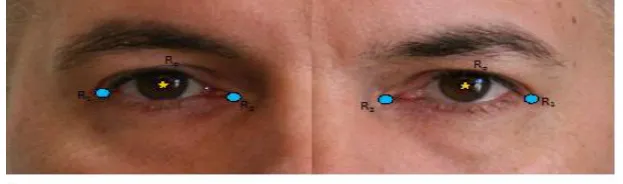
proper overlapping in periocular images across all periocular images. This fact requires importance in selecting the reference points about which periocular region of interest (ROI) would be cropped. In [1], authors has selected the iris center as a reference point and being this point a center , rectangular region of 3Rx4R pixels was cropped from the face images, R being a radius of iris. In [7], it has been shown that the eye center will give proper overlapping in terms of eye structure across eyes of subjects, even with different gazes. This method is based on two facts, one is iris center changes the position in eye structure without much change in other landmarks position, if gaze changes. Another fact is that iris radius changes or becomes difficult to measure actual radius with different amount of closing always associated with even opened eye. Moreover, closed eye or more than half closed ye leads to impossibility of measuring the iris radius. Though this method can be ideal in obtaining proper overlapping across all the periocular region samples, it’s almost rare to directly locate the center of eye due to movement in iris for different gazes. However, the location of eye corners is completely independent of gaze or movement of iris and also of closeness of eyes. Thus column coordinate (y) of eye center can be an average of that of two eye corners (R1y and R2y), while its row coordinate (x) can be same as that of iris center (R0x) as shown in figure 2. The effect of two types of reference points on the grid alignment is shown in figure 3.
Figure 2. Reference Points selected for cropping Periocular ROI
IV. EXPERMENTAL DISCUSSION AND RESULT
are shown in figure 6. PCA was created using two low resolutions, frontal samples. Number of principle components for PCA descriptor was chosen as 300.
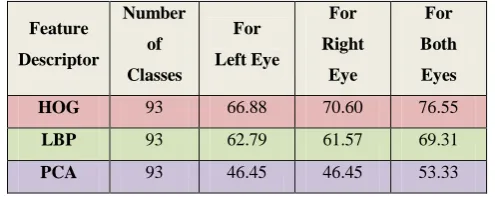
After determining optimized parameters for all descriptors, next goal was to examine the recognition capability of different features such as HOG, LBP and PCA with selected parameters of each feature descriptor. For each experiment, two low resolutions, frontal images of each class were used as gallery images and rest 13 images from each class were used as probe images. These experiments were executed for left eye, right eye and for both eyes separately and with all the classes exist in dataset. The recognition ratios are shown in table 1 with periocular region i.e. horizontal difference in pixels between two eye corners. The performance obtained by HOG and LBP are nearly same but computational complexity of LBP is higher than that of HOG. It can also be seen that recognition with both eyes gives slightly better result as compared to that with individual eyes. As compared to local descriptors, PCA has very poor performance in periocular recognition as opposed to its popular use in face recognition algorithms.
To test the performance using eye corners as reference points over the iris center for selecting periocular region, we repeated above recognition experiment with reference points as iris center proposed in [1] and eye corners proposed in [7]. These experiments were performed with periocular image sample with 0.9EWx1.2EW pixels, EW being as eye width. Recognition accuracy with iris center is shown in table 2. It supports the use of eye corners as reference points to select the periocular region especially in case of unconstrained biometrics, where pose, gaze variations are bound to happen.
Further, we tested the performance with this optimized parameters and techniques and presented the recognition accuracy with different combination of techniques as shown in table 3 and 4 and combining in table 5. This examines the effectiveness of periocular recognition algorithm with different pose of subjects.
Feature Descriptor
Number of Classes
For Left Eye
For Right Eye
For Both Eyes
HOG 93 70.46 74.05 82.15
LBP 93 68.24 67.16 76.12
PCA 93 58.63 59.64 68.75
Table 1: Recognition Accuracy in percentage for LBP, HOG and PCA with periocular
region i.e. horizontal difference in pixels between two eye corners
Feature Descriptor
Number of Classes
For Left Eye
For Right
Eye
For Both Eyes
HOG 93 66.88 70.60 76.55
LBP 93 62.79 61.57 69.31
PCA 93 46.45 46.45 53.33
V. CONCLUSION AND FUTURE WORK
In this paper, we have presented parameter analysis of periocular dataset using various pattern recognition techniques to test their effectiveness in unconstrained environment. The main goal of this research work to investigate the use of periocular biometrics in unconstrained situation to achieve non-cooperative biometrics. We have optimized the parameters for different feature techniques like HOG, LBP and PCA representations. It has been also observe that new technique of determining the reference point for cropping the periocular sample has given superior performance that that with iris center. Thus this technique can be used to select the periocular region especially in case of unconstrained biometrics, where pose, gaze variations are bound to happen. Further, we examined the performance of periocular recognition for various poses of periocular samples.
REFERENCES
[1] J. Lyle, P. Miller, S. Pundlik, and D. Woodard. Soft biometric classification using periocular region features. In Biometrics: Theory Applications and Systems (BTAS), 2010 Fourth IEEE International Conference on, pages 1 –7, sept. 2010.
[2] E. Murphy-Chutorian and M. Trivedi. Head pose estimation in computer vision: A survey. Pattern Analysis and Machine Intelligence, IEEE Transactions on, 31(4):607 –626, april 2009.
[3] U. Park, R. Jillela, A. Ross, and A. Jain. Periocular biometrics in the visible spectrum. Information Forensics and Security, IEEE Transactions on, 6(1):96 –106, march 2011.
[4] U. Park, A. Ross, and A. Jain. Periocular biometrics in the visible spectrum: A feasibility study. In Biometrics: Theory, Applications, and Systems, 2009. BTAS ’09. IEEE 3rd International Conference on, pages 1 –6, sept. 2009.
[5] L. Simpson, G. Dozier, J. Adams, D. Woodard, P. Miller, K. Bryant, and G. Glenn. Genetic amp; evolutionary type ii feature extraction for periocular-based biometric recognition. In Evolutionary Computation (CEC), 2010 IEEE Congress on, pages 1 –4, july 2010.
[6] D. Woodard, S. Pundlik, P. Miller, R. Jillela, and A. Ross. On the fusion of periocular and iris biometrics in non-ideal imagery. In Pattern Recognition (ICPR), 2010 20th International Conference on, pages 201 –204, aug. 2010.
[7] Chandrashekhar Padole, Hugo Proença; Periocular Recognition: Analysis of Performance Degradation Factors,
in Proceedings of the Fifth IAPR/IEEE International Conference on Biometrics – ICB 2012, New Delhi, India,
March 30-April 1, 2012.
[8] M. Savvides, K. R. Jr., D. L. Woodard, and G. Dozier. Unconstrained biometric identification: Emerging technologies. Computer, 43:56–62, 2010.
[10] T. Ojala, M. Pietikinen, and D. Harwood. A comparative study of texture measures with classification based on featured
distributions. Pattern Recognition, 29(1):51 – 59, 1996.
[11] M. Turk and A. Pentland, “Face Recognition Using Eigenfaces,” Proc. IEEE Conf. on Computer Vision and Pattern Recognition, 1991, pp. 586-591.
Techniques Eye Front Pose Left Pose
@ 30 Degree Aprox.
Right Pose @ 30 Degree Aprox.
HOG
Right 93.1183 64.5161 54.1935
Left 91.1828 61.5054 47.9570
Both 94.1935 73.9785 61.5054
LBP
Right 84.7312 53.9785 46.0215
Left 87.5269 56.1290 44.7312
Both 89.0323 64.0860 54.8387
PCA
Right 86.4516 32.4731 20.4301
Left 81.0753 31.8280 26.4516
Both 91.6129 38.0645 30.3226
Table3: Pose Wise Recognition Accuracy in percentage for Iris
Centre using LBP, HOG and PCA Techniques
Techniques Eye Front Pose
Left Pose @ 30 Degree
Aprox.
Right Pose @ 30 Degree
Aprox.
HOG
Right 93.5484 66.6667 61.9355
Left 91.1828 58.0645 62.1505
Both 95.0538 73.5484 77.8495
LBP
Right 83.8710 60.8602 56.7742
Left 87.0968 53.5484 64.0860
Both 90.1075 68.8172 69.4624
PCA
Right 84.7312 56.5591 37.6344
Left 83.0108 64.0860 28.8172
Figure 4: Pose Wise Recognition Accuracy in percentage for Eye Corners using LBP, HOG and PCA Techniques
Technique
s Eye
Front Pose Left Pose
@ 30 Degree Aprox.
Right Pose
@ 30 Degree Aprox.
Iris Cente r Eye Corner s Averag e Iris Cente r Eye Corner s Averag e Iris Cente r Eye Corner s Averag e HOG Righ t 93.11
8 93.548 93.333
64.51
6 66.666 65.591
54.19
3 61.935 58.064
Left 91.18
2 91.182 91.182
61.50
5 58.064 59.784
47.95
7 62.150 55.053
Both 94.19
3 95.053 94.623
73.97
8 73.548 73.763
61.50
5 77.849 69.677
LBP
Righ t
84.73
1 83.871 84.301
53.97
8 60.860 57.419
46.02
1 56.774 51.397
Left 87.52
6 87.096 87.311
56.12
9 53.548 54.838
44.73
1 64.086 54.408
Both 89.03
2 90.107 89.569
64.08
6 68.817 66.451
54.83
8 69.462 62.150
PCA
Righ t
86.45
1 84.731 85.591
32.47
3 56.559 44.516
20.43
0 37.634 29.032
Left 81.07
5 83.010 82.043
31.82
8 64.086 47.957
26.45
1 28.817 27.634
Both 91.61
2 89.032 90.322
38.06
4 69.247 53.655
30.32
2 47.957 39.139
Table 5: Pose Wise Recognition Accuracy in percentage for Average of Iris Center and Eye Corners using
![Figure 1: Sample Face Images showing variation in pose and scale from UBIPr Dataset [7]](https://thumb-us.123doks.com/thumbv2/123dok_us/7780510.1284922/2.595.206.389.226.351/figure-sample-face-images-showing-variation-ubipr-dataset.webp)