Semantic Features for Automated Answer Scoring
Tarandeep Singh Walia
1, Gurpreet Singh Josan
2, Amarpal Singh
31
Research Scholar, IKG PTU, Kapurthala, Punjab,(India)
2
Punjabi University, Patiala, Punjab, (India)
3
KCET, Amritsar, Punjab, (India)
ABSTRACT
This study reviews the features used in the previous Automated Answer Scoring system, and attempts to develop a new semantic features for Automated Scoring System. Automated essay scoring is a measurement technology in which computers evaluate typed text. Measuring semantic similarity of sentences is closely related to semantic similarity between words. It makes a relationship between a word and the sentence through their meanings. Determining the similarity between sentences is one of the crucial tasks in natural language processing (NLP).
Keywords: Automated Essay Scoring(AES), Natural Language Processing(NLP).
I. INTRODUCTION
Automated Scoring receives an answer text as an input and outputs a score based upon various features of the
text. The scoring is performed by extracting the grammatical relations as well as semantic relations from the
student answer and reference answer.
II. NEED OF AUTOMATED SCORING
The system will assist teachers’ classroom assessment and help to overcome time, cost, reliability, and
generalizability issues in writing(typed) assessment. Responding manually to student papers is a burden for
teachers. Particularly if they have number of students and if they assign frequent writing assessment, providing
individual feedback the student essays might be time consuming. Automated system can be very useful because
they can provide the student with a score as well as feedback within seconds. Gradually, the need of Automated
answer scoring system is felt in the educational sector.
III. AES AND NLP
NLP have major tasks such as discourse analysis, morphological segmentation, parsing, word sense
disambiguation and information extraction etc. Automated Scoring can choose some tasks from NLP for scoring
process. Automated Scoring systems are a combination of various techniques such as – NLP (Natural Language
Processing) along with, Statistics, Artificial Intelligence (Machine Learning), Linguistics and Web
Technologies, etc. Today, Automated Scoring is still a difficult, intricate and interesting issue for researchers in
artificial intelligence and natural language processing though many English Automated Scoring systems have
Current automatic essay-scoring techniques are inappropriate for scoring the content of an essay because they
either rely on grammatical measures of quality or machine learning techniques, neither of which identifies
statements of meaning (propositions) in the text.
The system to be developed is planned to follow two step process. The first step involves analysing the input
answer so as to identify possible errors wiz spelling errors and syntactic errors. The second step compares the
input answer with given answer essay to detect semantics and differences as errors. There after the output
generated by the system is compared with the result given by human rater and in this way the performance of
the system is evaluated. To estimate the accurate score generated from syntactic similarity to semantic
similarity.
II.
RELATED WORK
Latent Semantic Indexing Approach
Latent semantic analysis (LSA) is a technique in natural language processing that main focus is on the content
related features rather than surface features. Latent semantic indexing is the application of a particular
mathematical technique, called Singular Value Decomposition or SVD, to a word-by-document matrix. LSA
assumes that words that are close in meaning will occur in similar pieces of text. Especially semantic structures
can be considered problematic for machines. Latent Semantic Analysis (LSA) is an attempt to solve problem in
the domain of information retrieval and can be seen as general attempt for representing semantic structure.
Xinming Hu, Huosong Xia(2010), discussed Automated Assessment System for Subjective Questions Based
on LSI. In this paper they explore an approach to automated assessment system for subjective question based on
latent semantic indexing. Specifically, LSI is a statistical method that analyzes and represents important
associative patterns among terms. In our automated assessment system, LSI is used for reducing influence of
synonymy and polysemy on the impartiality of the assessment result. While the experiment shows that the
theoretical architecture and are generally applicable for the automated assessment for short essay questions.
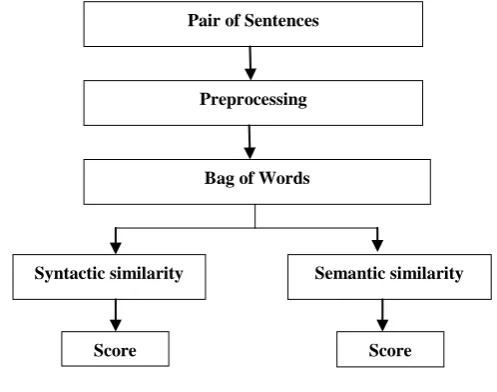
Pair of Sentences
Preprocessing
Bag of Words
Syntactic similarity Semantic similarity
Score Score
Govinnage R. Perera, Deenuka N. Perera, A. R. Weerasinghe(2015), “A Dynamic Semantic Space
Modelling Approach for Short Essay Grading”. On most of other LSA based systems, it is required to feed the
system with the pre-marked training essays. Those training data set is considered as the semantic space and each
student answer essay is considered as a similarity query in order to calculate the score. In this proposed method,
Student answers collectively themselves considered as a semantic space and similarity was calculated against
the deviation from the model answer. Thus, it is considered as a dynamic semantic space. This dynamic
semantic space was computed using Vector Space Models (i.e. LSA) and it was dynamically built upon each
essay question set utilizing student answers. The future direction of this research is to extend this research for
handling different languages other than English and to evaluate the system with a large data set.
Pantulkar Sravanthi, B Srinivasu(2017), explains “SEMANTIC SIMILARITY BETWEEN SENTENCES”.
In this, they evaluated and tested three different semantic similarity approaches like cosine similarity, path based
approach, and feature based approach. They propose an unsupervised approach to automatically calculate
sentence levels similarities based on word level similarities, without using any external knowledge.
III. SEMANTIC FEATURES
Semantic features are indispensable while scoring because they holds whole content(meaning) of student’s
answer. The system returns zero as final score if it does not find any semantic features even if syntactic features
are available. No doubt, there are many existing predefined semantic features or rules. But this makes scoring a
complex task, and at the same time proper integration and correlation among these features are not fully possible
and thereby giving inaccurate results. The following semantic rules have been incorporate with automated
scoring system:
Word POS
Word bigram and trigram
POS bigram and trigram
Word Vector similarity
Semantic Vector similarity
Text coherence
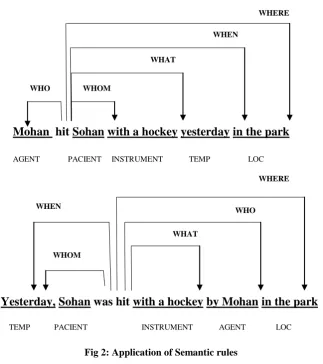
The following example sentence contains five syntactic constituents labeled with their corresponding semantic
Fig 2: Application of Semantic rules
Mohan hit Sohan with a hockey yesterday in the park
AGENT PACIENT INSTRUMENT TEMP LOC
WHO WHOM
WHAT
WHEN
WHERE
WHOM WHEN
WHAT
WHO WHERE
Yesterday, Sohan was hit with a hockey by Mohan in the park
TEMP PACIENT INSTRUMENT AGENT LOC
The semantic features points will calculate To compute the similarity we follow feature based approach which
generates the similarity score in depth of word meaning level and definition level and then comparing the
generated results with the previous existing measures for better results.
the final score of student answer. The surface or syntactic features are analyzing the input answer in order to
detect possible errors, such as spelling errors and syntactic errors. The semantic features are comparing the
student input answer with given reference answers to identify the semantics, and differences as errors. So, the
semantic features are essential while scoring because it holds whole content(meaning) of student answer.
III.
CONCLUSION
Automated system can be very useful because they can provide the student with a score as well as feedback
within seconds. The Automated Scoring system is more objective and consistent than human raters. Automated
Scoring will perform fair scoring, can be repeated again and again with consistency. The semantic features are
essential while scoring because it holds whole content(meaning) of student answer. The research in this
direction will open new dimensions for researchers as it is an interdisciplinary work. If such a system be
REFERENCES
[1] Ahmed Alzahrani, Abdulkareem Alzahrani, Fawaz K. Al Arfaj, Khalid Almohammadi(2015), “ AutoScor:
An Automated System for Essay Questions Scoring”, published by International Journal of Humanities
Social Sciences and Education (IJHSSE), Volume 2, Issue 5.
[2] Boris Galitsky(2017), “Matching parse thickets for open domain question answering”, published by Data &
Knowledge Engineering, Elsevier, 107, 24–50.
[3] hen, Yen-Yu, Chien-Liang Liu, Tao-Hsing Chang, and Chia-Hoang Lee(2010) "An Unsupervised
Automated Essay Scoring System", published by Intelligent Systems, IEEE.
[4] Chirag Parikh, Parimal Patel(2009), “Performance Evaluation of AES Algorithm on Various Development
Platforms”, published in the proceedings of International Conference on Computer Engg. & Tech., IEEE,
Volume:1.
[5] Deirde Kerr, Hamid(2013), “Automatic Short Essay scoring using NLP to extract semantic information”,
published by Journal of National Center for Research on Evaluation, Standards, and Student Testing
(CRESST).
[6] Govinnage R. Perera, Deenuka N. Perera, A. R. Weerasinghe(2015), “A Dynamic Semantic Space
Modelling Approach for Short Essay Grading” published by International Conference on Advances in ICT
for Emerging Regions (ICTer), 043-049.
[7] Hongbo Chen, Ben He(2013), “ AES by Maximizing Human-machine Agreement”, published in
proceeding of National/International Conference on Empirical Methods in Natural Language Processing,
Pages 1741–1752.
[8] Kaja Zupan, Zoran Bosni(2017), “Automated essay evaluation with semantic analysis”, published by
Knowledge-Based Systems 120, Elsevier 118–132.
[9] Kong Joo Lee, Yong-Seok Choi, Jee Eun Kim(2011), “Building an automated English sentence evaluation
system for students learning English as a second language”, published by Elsevier, Computer Speech and
Language 25, 246–260.
[10] Leila Kosseim , Jamileh Yousefi(2008), “Improving the performance of question answering with
semantically equivalent answer patterns”, published by Data & Knowledge Engineering, Elsevier, 66, 53–
67.
[11] Min-Chul Yang , Do-Gil Lee , So-Young Park , Hae-Chang Rim(2015) , “ Knowledge-based question
answering using the semantic embedding space”, published by Elsevier , Expert Systems With Applications
42, 9086–9104.
[12] Oleksandr Kolomiyets, Marie-Francine Moens(2011), “A survey on question answering technology from an
information retrieval perspective”, published by Information Sciences 181, Elsevier, 5412–5434.
[13] Paloma Moreda, Hector Lorens, Estela Saquete, Manuel Palomar(2011), “Combining semantic information
in question answering systems”, published by Information Processing and Management, Elsevier 47, 870–
885.
[14] Pantulkar Sravanthi, B. Srinivasu(2017), “Semantic similarity between sentences” published by
[15] Sofian Hazrina , Nurfadhlina Mohd Sharef , Hamidah Ibrahim , Masrah Azrifah Azmi Murad , Shahrul
Azman Mohd Noah(2016), “ Review on the advancements of disambiguation in semantic question answering system”, published by Elsevier, Information Processing and Management, 1–18.
[16] Xinming Hu, Huosong Xia(2010), “Automated Assessment System for Subjective Questions Based on LSI”
published by Third International Symposium on Intelligent Information Technology and Security
Informatics, IEEE, DOI 10.1109/IITSI.2010.76
[17] Zhang Qiang(2014), “The application of network automated essay scoring system in college English