1917 | P a g e
UNDERSTANDING INFORMATION LITERACY: A
VIEW FROM ITS MODELS AND STANDARDS
Deepak Aggarwal
1, Dr. Sarman
2 1Librarian, Malout (Punjab)
2
Bhag Singh Khalsa College for Women, Kala Tibba, Abohar (Punjab)
ABSTRACT
The purpose of this paper is to discuss in detail the several models and standards invented by various professionals and organizations, in order to achieve an information literate society. Information literacy is the set of skills to select, access, evaluate, use and communicate information effectively. It forms the basis of lifelong learning. Along with describing all the steps and guidelines of information literacy models and standards, this paper also proposes the need of application of these models in curriculum of higher education.
Keywords: Information literacy, Higher Education, I-Skills, Information Literacy Models,
Competency Standards.
Information literacy-a set of capabilities to select, evaluate and use the information in an efficient manner- is the basis of lifelong learning. A person who is capable to select, access, evaluate, use and communicate information effectively is information literate. Information literacy means being informed. The concept of information literacy has become the buzzword of the modern society. It attracts the curiosity and attention of various authors. Lenox & Walker (1993) define information literacy by characterizing the information literate: one who has the analytical and critical skills to formulate research questions and evaluate results, and the skills to search for and access a variety of information types in order to meet his or her information need. Various terms related to information literacy have been used by various authors. These are media literacy, digital literacy, computer literacy, etc. The Joint Information Services Committee (2005) uses the term i-skills to describe information literacy and IT skills. I-skills are defined as “the ability to identify, assess, retrieve, evaluate, adapt, organize and communicate information within an iterative context of review and reflection.” The Illinois Mathematics and Science Academy (2006) defines digital information fluency (DIF) as “the ability to find, evaluate and use digital information effectively, efficiently and ethically.”
I. INFORMATION LITERACY MODELS AND STANDARDS
Various professionals and organizations have invented various models and standards that act as a step-to-step guide for achieving information literacy objectives. The main aim of these standards and models are to enable individuals to acquire the necessary competencies and become information literate citizens. Several such models and standards are given below:
1918 | P a g e
Invented by Mike Eisenberg and Robert B. Berkowitz, the Big6 is the most widely-known and widely-used information literacy approach to teaching information and technology skills in the world. The Big6 is an information and technology literacy model and curriculum, implemented in thousands of schools through higher education. Some people call the Big6 an information problem-solving strategy because with the Big6, students are able to handle any problem, assignment, decision or task. Big6 is a six-stage model to help anyone solve problems or make decisions by using information. Two sub-stages are part of each main category in the Big6 model:
1. Task Definition
1.1 Define the information problem 1.2 Identify information needed
2. Information Seeking Strategies
2.1 Determine all possible sources 2.2 Select the best sources
3. Location and Access
3.1 Locate sources (intellectually and physically) 3.2 Find information within sources
4. Use of Information
4.1 Engage (e.g., read, hear, view, touch) 4.2 Extract relevant information
5. Synthesis
5.1 Organize from multiple sources 5.2 Present the information
6. Evaluation
6.1 Judge the product (effectiveness) 6.2 Judge the process (efficiency)
1919 | P a g e
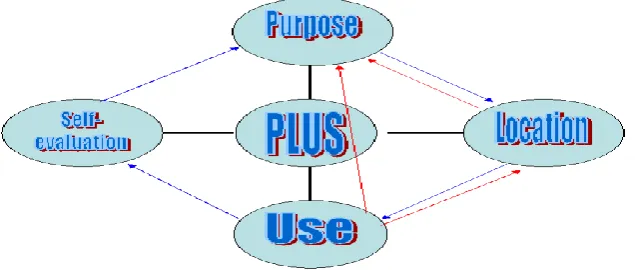
Figure 1: The PLUS Model
REACTS-Pitts/Stripling Research Process Model
(http://virtualinquiry.com/inquiry/stripling.htm)
The REACTS Taxonomy developed by Barbara Stripling and Judy Pitts focuses on critical thinking in the research process. This model focuses on strategies for ensuring high level thinking and resulting quality products. The REACTS Taxonomy includes the following elements:
Recalling
Explaining
Analyzing
Challenging
Transforming
Synthesizing
Along with the teaching strategies associated with the REACTS Taxonomy, Stripling and Pitts designed a 10-step process to help students develop their term paper from topic selection to final product. Each 10-step includes reflective questions to help the student focus their activities.
1. Choose a broad topic
2. Get an overview
3. Narrow the topic
4. Develop thesis statement
5. Formulate questions
6. Plan for research
7. Find, analyze, evaluate
8. Evaluate evidence
9. Establish conclusions
10. Create and present final product
II. INFORMATION SEARCH PROCESS-KUHLTHAU
1920 | P a g e
The Information Search Process (ISP) presents a holistic view of information seeking from the user‟s perspective in six stages: task initiation, selection, exploration, focus formulation, collection and presentation. The six stage model of the ISP incorporates three realms of experience: the affective (feelings) the cognitive (thoughts) and the physical (actions) common to each stage. The ISP describes common experiences in the process of information seeking for a complex task that has a discrete beginning and ending and that requires considerable construction and learning to be accomplished. The model reveals a search process in which a person is seeking meaning in the course of seeking information. From the user‟s perspective the primary objective of information seeking is to accomplish the task that initiated the search, not merely the collection of information as an end in itself. The ISP presents seeking information as a means to accomplish a goal. The model of the ISP is articulated in a holistic view of information seeking from the user‟s perspective in six stages:
Initiation: when a person first becomes aware of a lack of knowledge or understanding, feelings of uncertainty and apprehension are common.
Selection: when a general area, topic, or problem is identified, initial uncertainty often gives way to a brief sense of optimism and a readiness to begin the search.
Exploration: when inconsistent, incompatible information is encountered, uncertainty, confusion, and doubt frequently increase and people find themselves “in the dip” of confidence.
Formulation: when a focused perspective is formed, uncertainty diminishes as confidence begins to increase.
Collection: when information pertinent to the focused perspective is gathered, uncertainty subsides as interest and involvement deepens.
Presentation: when the search is completed with a new understanding enabling the person to explain his or her learning to others or in someway put the learning to use.
Pathways to Knowledge Information Skills Model- Pappas and Tepe (http://virtualinquiry.com/inquiry/pathways.htm)
The Pathways to Knowledge model sponsored by Follett was developed by Marjorie L. Pappas and Ann E. Tepe. Designed for children and young adults, the authors stress the importance of questioning and authentic learning. Their focus is on a nonlinear process for finding, using, and evaluating information. The mode includes the following stages:
Appreciation and Enjoyment (Examine the word)
Presearch (Develop an overview; explore relationships)
Search (Identify information providers; select information resources; seek relevant information)
Interpretation (Interpret information)
Communication (Apply information; share new knowledge)
Evaluation (Evaluate process and product)
III. INFOHIO DIALOGUE MODEL FOR INFORMATION LITERACY
1921 | P a g e
The DIALOGUE model involves the following areas that spell DIALOGUE:
Define - Explore/Identify the need for the information; Determine the basic question
Initiate - "Distressing ignorance"
Assess - Identify keywords, concepts, and possible resources; Consider information literacy skills; "Tapping prior knowledge" and "Building background"
Locate - Identify possible sources of information; Develop a search strategy; Locate and retrieve available resources
Organize - Identify the best and most useful information sources; Evaluate the information retrieved
Guide - Search log or journal; Student assistance and review; Educator assistance and review
Use - Determine presentation format; Present results; Communicate information
Evaluate - Evaluate the project/results; Evaluate the process; Assess the teaching and learning
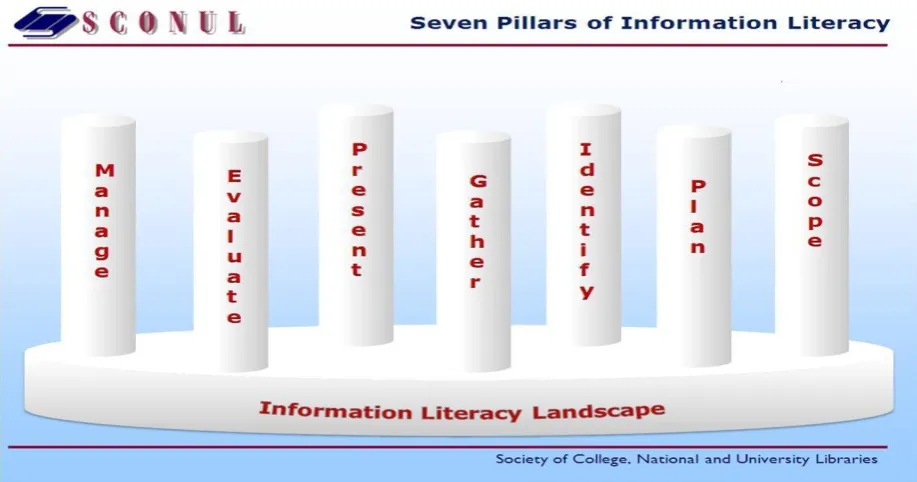
The Seven Pillars of Information Literacy: Core Model for Higher Education (www.sconul.ac.uk/sites/default/files/documents/coremodel.pdf)
In 1999, The SCONUL Working Group on Information Literacy published “Information skills in higher education: a SCONUL position paper” (SCONUL, 1999), introducing the Seven Pillars of Information Skills model. Since then, the model has been adopted by librarians and teachers around the world as a means of helping them to deliver information skills to their learners. However, in 2011 it was felt that the model needed to be updated and expanded to reflect more clearly the range of different terminologies and concepts which we now understand as “Information Literacy”.
In order for the model to be relevant to different user communities and ages, the new model is presented as a generic “core” model for Higher Education, to which a series of “lenses”, representing the different groups of learners, can be applied.
1922 | P a g e
The core model describes a set of generic skills and understandings; for different user communities a “lens” can be developed which highlights different attributes, adds in more complex or simpler statements and uses language recognized by the specific community which it represents. In this way, it is hoped that the model can be used flexibly by individuals and teachers; they can adapt it as appropriate to personal circumstances.
The 8Ws Model for Information Literacy (http://virtualinquiry.com/inquiry/8ws.htm)
This model was developed by Annette Lamb in the early 1990s. The model is similar to the work of Eisenberg, McKenzie, Kuhlthau, Pappas and Tepe. However, a fun alliteration was used to stimulate student interest and focus on the student's perspective. The students are probably familiar with the 5Ws (who, what, when, where, and why), here are 8 new ones.
Figure 3: The 8Ws Model for Information Literacy
Empowering 8-NILIS
1923 | P a g e
1924 | P a g e
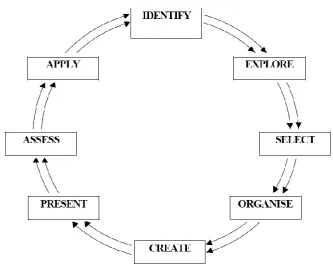
Figure 4: Eight components of Empowering 8 Model
However various library and information science professional bodies worldwide have produced standards and guidelines for information literacy. Along with competencies, various strategies have also been made by which these competencies can be achieved. Information Literacy Competency Standards for Higher Education and Australian and New Zealand Information Literacy Framework are the major standards adopted worldwide.
III.
INFORMATION
LITERACY
COMPETENCY
STANDARDS
FOR
HIGHER
EDUCATION
(http://www.ala.org/acrl/standards/informationliteracycompetency)
1925 | P a g e
IV. AUSTRALIAN AND NEW ZEALAND INFORMATION LITERACY FRAMEWORK
(http://archive.caul.edu.au/info-literacy/InfoLiteracyFramework.pdf)
The second edition of the 2001 Information literacy standards is entitled the Australian and New Zealand information literacy framework: principles, standards and practice to reflect the ways academics and librarians have used the first edition. It incorporates changes developed at a workshop in Sydney in January 2003. Prior to the workshop, input was received from university, technical and further education and other librarians from around Australia and New Zealand. The Australian and New Zealand information literacy framework is derived, with permission, from the Association of College and Research Libraries‟ (ACRL) Information literacy competency standards for higher education. The Framework provides the principles, standards and practice that can support information literacy education in all education sectors. The Framework incorporates standards and learning outcomes that consist of the characteristics, attributes, processes, knowledge, skills, attitudes, beliefs and aspirations associated with the information literate person. The standards are grounded in generic skills, information skills and values and beliefs. The Framework provides institutions with guidance for policy development within disciplines and professions, and a basis for whole of institution evaluation of the effectiveness of
strategies to implement institutional policies. The Framework also provides a structure for students to have an awareness and understanding of their interaction with information. The Australian and New Zealand information literacy framework is based on four overarching principles. These are, that information literate people:
Engage in independent learning through constructing new meaning, understanding and knowledge
Derive satisfaction and personal fulfillment from using information wisely
Individually and collectively search for and use information for decision making and problem solving in order to address personal, professional and societal issues
Demonstrate social responsibility through a commitment to lifelong learning and community participation. The principles frame six core standards which underpin information literacy acquisition, understanding and
application by an individual. These standards identify that the information literate person:
Recognizes the need for information and determines the nature and extent of the information needed
Finds needed information effectively and efficiently
Critically evaluates information and the information seeking process
Manages information collected or generated
Applies prior and new information to construct new concepts or create new understandings
1926 | P a g e
V. THE NINE INFORMATION LITERACY STANDARDS FOR STUDENT LEARNING
(http://umanitoba.ca/libraries/units/.../InformationLiteracyStandards_final.pdf)
Information Literacy Standards for Student Learning provide a conceptual framework and broad guidelines for describing the information-literate student. The standards consist of three categories, nine standards, and twenty-nine indicators. The core learning outcomes that are most directly related to the services provided by school library media programs are found in the three standards and thirteen indicators in the “information literacy” category. The other two categories—three standards and seven indicators for “independent learning” and three standards and nine indicators for “social responsibility”—are grounded in information literacy but describe more general aspects of student learning to which school library media programs also make important contributions. Taken together, the categories, standards, and indicators describe the content and processes related to information that students must master to be considered information literate. The standards and indicators are written at a general level so that library media specialists and others in individual states, districts, and sites can tailor the statements to meet local needs. These educators are the ones who know their student populations; their role is to apply these general statements in light of the developmental, cultural, and learning needs of all the students they serve. By offering broad guidelines for describing the information-literate student, Information Literacy Standards for Student Learningprovide a conceptual framework and supporting material for local efforts.
VI.CONCLUSION
The study of various information literacy models and standards will definitely guide the students and faculty particularly in higher education to step by step achieve the information literacy skills. In the „Information Literacy Competency Standards for Higher Education‟ produced by ACRL, It is declared that information literacy forms the basis of lifelong learning and is common to all disciplines, to all learning environments and to all levels of education (Rajalakshmi, 2007). So the role of information literacy in higher education cannot be neglected. The inclusion of information literacy instruction in curriculum of all higher educational institutes in India is need of the hour. It is also pertinent to note that in order to create information literate society, the cooperation of teaching faculty and libraries is utmost important.
REFERENCES
[1.] Illinois Mathematics and Science Academy (2006).21st Century Information Fluency: Assessing Students' Knowledge and Skills. Retrieved from 21cif.com/resources/materials/conferences/necc_070506.pdf
[2.] Joint Information Services Committee (2005).Improving staff i-skills: An introductory guide. Retrieved from www.jisc.ac.uk/media/documents/publications/improvingi skills_rtf.rtf
[3.] Lenox, M. F. & Walker, M. L. (1993).Information literacy in the educational process.The Educational Forum, 57(2), 312-324. Quoted in Choukhande, V. G. (2009).Information literacy curriculum in academic libraries. Information Age, 3(3), 5.
1927 | P a g e
[5.] Wijetunge, P. (2008). Improving information skills of the postgraduate students of NILIS University of Colombo: A case study. DESIDOC Journal of Library & Information Technology, 28(2), 18-27.
[6.] http://archive.caul.edu.au/info-literacy/InfoLiteracyFramework.pdf
[7.] http://comminfo.rutgers.edu/~kuhlthau/information_search_process.htm
[8.] http://farrer.csu.edu.au/PLUS/
[9.] http://umanitoba.ca/libraries/units/.../InformationLiteracyStandards_final.pdf
[10.]http://virtualinquiry.com/inquiry/dialogue.htm
[11.]http://virtualinquiry.com/inquiry/pathways.htm
[12.]http://virtualinquiry.com/inquiry/stripling.htm
[13.]http://virtualinquiry.com/inquiry/8ws.htm
[14.]http://www.ala.org/acrl/standards/informationliteracycompetency
[15.]http://www.big6.com/