IN HONG KONG
CHAN WING CHEUNG
JI~MYTHESIS SUBMITTED POR THE DEGREE OP DOCTOR OP PHILOSOPHY
IN EDUCATION (EDUCATIONAL PSYCHOLOGY),
UNIVERSITY OF LONDON INSTITUTE OF EDUCATION
West Yorkshire, LS23 7BO
www.bl.uk
BEST COpy AVAILABLE.
West Yorkshire, LS23 7BQ
www.bl.uk
TEXT BOUND CLOSE TO
THE SPINE IN THE
West Yorkshire, LS23 7BQ
www.bl,uk
PAGINATED BLANK PAGES
ARE SCANNED AS FOUND
IN ORIGINAL THESIS
NO INFORMATION IS
West Yorkshire, LS23 7BQ
www.bl.uk
ABSTRACT
The study deals with the relations of parent-child interaction
among Hong Kong adolescents with certain psychological attributes
including intellectual abilities, attitude to home, social interest,
academic motivation and popularity. In view of the emphasis on
examination results in the Hong Kong community, it was also found
useful to investigate aspects of the relations of parent-child
interaction by itself, and together with the above psychological
attributes, to school achievements.
By the use of the Ginsburg Parent Image Differential Test,
twelve parental factors were identified for parent-child
inter-action. The AH4 Test was used to assess intellectual abilities.
Original measures were constructed for the other psychological
attributes. The subjects were students aged around 17 in Form
IV classes of a stratified random sample of Hong Kong
Anglo-Chinese schools where English was the main medium of instruction.
Certain hypotheses were tested by the use of the following
statistical techniques: product moment correlation, principal
components analysis, stepwise multiple regression, and analyses
of variance and covariance. Considering the particular social
context in Hong Kong, cross-cultural evidence from U.S.A.,
Mexico, and Singapore was also examined and found to support the
argument that the Hong Kong situation was rather unique. Hence
interpretation of the results was restricted to the cultural,
social, economic, and educational pattern of Hong Kong.
The main trends clearly identified in th~ study were that mothers tended to be more responsible for significant
aspects of their adolescents' cognitive development and fathers
pressures were put on the boys than on the girls by parents,
especially by the mother: boys, too, proved generally superior
to girls in cognitive abilities, but inferior in the affective
traits. These findings were found to be in agreement with the
boy-centred society and patriarchal home practices of traditional
ACKl~OWLEDGEMENTS
First of all, I am most grateful to my joint tutors
Mrs. D.N. Penfold and Dr. V.H. King for their expert advice
and experienced supervision. Without their competent guidance,
this thesis would not have been completed.
I thank the Commonwealth Scholarships Commission for the
award of a scholarship and the Hong Kong Government for granting
me leave of absence, which has enabled me to do this research
without the interference of work.
I am indebted to all my colleagues and friends in Hong Kong
and overseas for their useful help. I .. ppreciate very much their
valuable suggestions and technical assistance, and I wish to
tender my sincere gratitude to them all.
Thanks are due particularly to the principals, senior masters,
teaching staff, and students of the sixteen schools, which
participated in this project. Without their cooperation, it
would have been practically impossible to make this study. I
am also thankful to the University of London libraries and
computer centres for their wonderful service.
Finally, I wish to acknowledge with thanks a grant from the
University of London Central Research Fund in support of this
CONTENTS Title Abstra.ct Acknowledgements Contents 1 2 4 5 7
Index to Ta.bles
Index to Models 12
Chapter One: Introduction 13
1. The General Trends 13
2. The Particular Cultural-Educational
Problems of Hong Kong 15
Chapter Two: Review of Relevant Literature 19
1. Researches Concerned with Material
Home Environment 19
2. Researches Bearing More Particularly
on Psychological Home Environment 25 3. Researches Directly Related to the
Present Study 38
4. Chronological Summary of Research
Literature Leading to the Present Study 49
(a) Cognitive Aspects 49
(b) Affective Aspects 52
5. Summary of Review in Terms of Present
Research 55
References 57
Chapter Three:Pormulation and HYpotheses
1. General Considerations 65 65
69
2. Specific Hypotheses
Chapter Pour: The Parent Image Differential Test 1. Background of Research
Chapter Fivel
Chapter Sixl
2. Preliminary Investigation 3. Cross-Cultural Comparisons
4. An Appraisal References
Test Construction 1. Likert-Type Test
2. Sentence Completion Test 3. Composition Test
4. Popularity Test References
The Investigation 1. Areas and Tests
(a) Parent-Child Interaction
!
b) Cognitive Aspects c) Affective Aspects d) Achie vements2. The Samples
(&!
Hong Kong Pre-Test Sample (b Singapore Pre-Test Sample (c The Main Sample3. The Procedures
b Specific Administration
l
al General Process
c Data from Schools and Teachers B..fe ences
Page. Chapter Seven:Validities and Reliabilities of Instruments
~~~~~~ 1. Validities 146 146
146 151 155 157 158 158 166 166 167 167 168 168 169 (a) Parent Image Differential Test
(b) AH4 Test
(c) Likert-Type Test
(d) Popularity Test 2. Reliabilities
(a) Parent Image Differential Test (b) AH4 Test
(c) Likert-Type Test
(d) Sentence Completion Test (e) Composition Test
(f) Popularity Test (g) Teachers' Ratings References
~Ch=a~p~t~e~r~E~i~g_ht_ITest of HYpotheses
1. Methods of Analysis 170 170
113 114 189 21.8 222 228 2. Summary of HYPotheses
3. Test of Hypothesis I
4. Test of Hypothesis II
5.
Test of Hypothesis III 6. Test of HYpothesis IV ReferencesChapter Ninel Results and Discussion 229
1. The Relations of Parental and Other
Chapter Tenl
Bib Ii ograph"yI Appendices:
Variables ' 229
2. Sex Differences in Various Variables 236
3. Multiple Regression Models 241
4. Parental Differences in Various Behaviour 252 5. School Differences in Various Variables 254
6. Other Results 255
(a> Sex Differences in Parental Variables255 (b) Sex Differences in Importance
ot
Parental Factors 257
(c) Cross-Cultural Comparison of
Importance of Parental Factors 258
Reterences 260
Summary and Conclusions
1. Summary of Findings
2. Hong Kong Si~uation and SUggestions for Further Research
(a) The Limitation (b) Other Variables (c) Cultural Pressures (d) Examination Pressures
(e) Summing up
INDEX TO TABLES
Chapter Four
Page
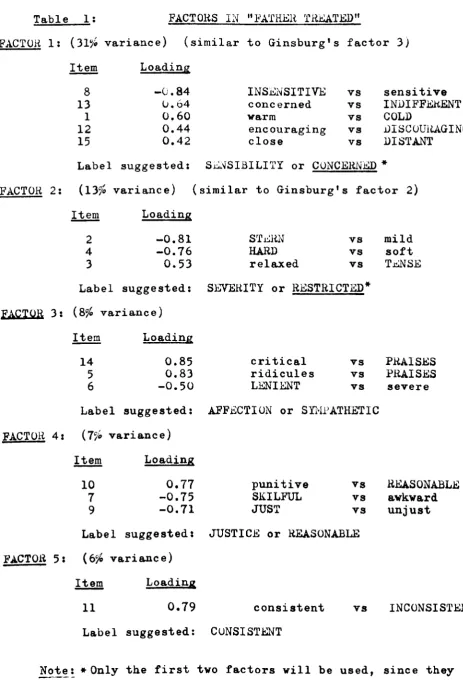
Table 1: Factors in "Father Treated"
79
Table 2: Factors in "Mother Treated" 80
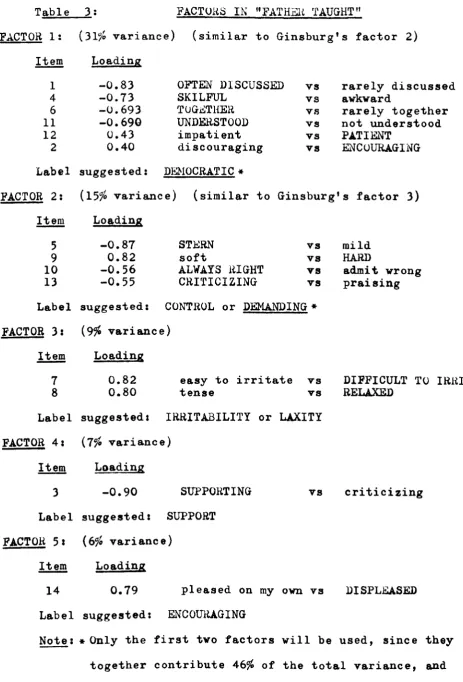
Table. 3: Factors in "Father Taught" 81
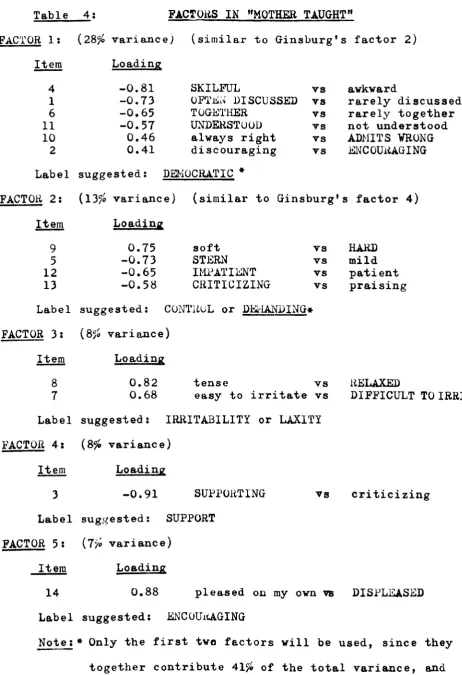
Table 4: Factors in "Mother Taught" 82
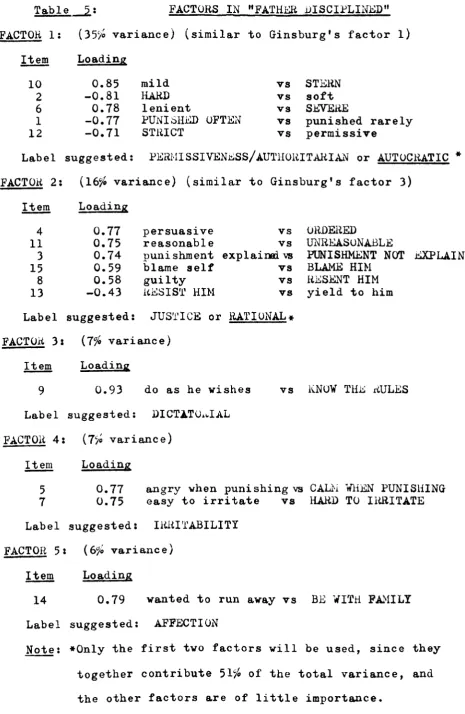
Table 5: Factors in "Father Disciplined" 83
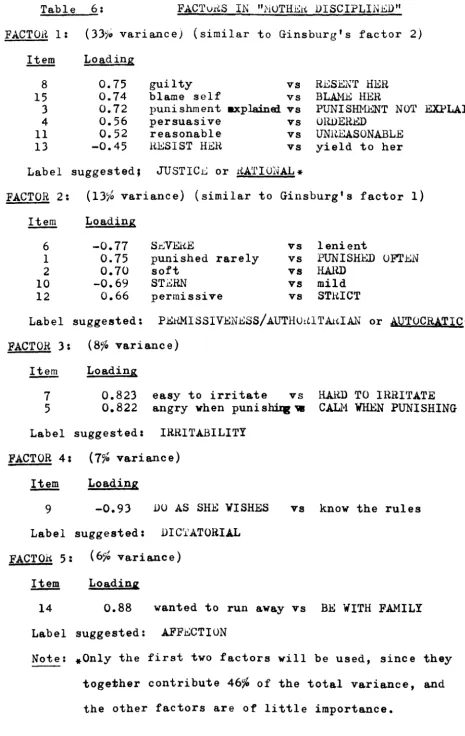
Table 6: Factors in "Mother Disciplined" 84
Table
7:
Factors and Items for Hong Kong and NorthAmerican Groups 85
Table 8: Factors and ttems for Hong Kong and Mexican
Groups 86
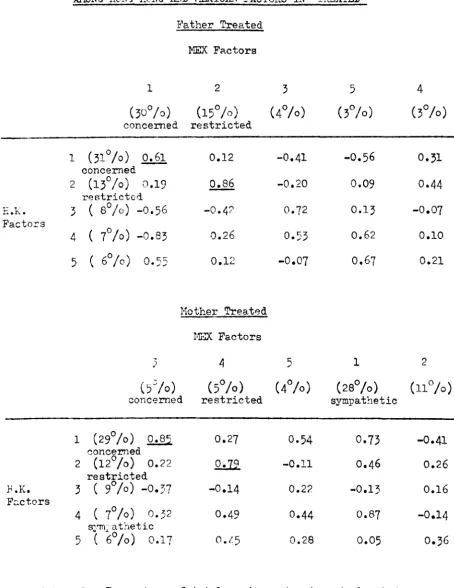
Table 9: Coefficients of Congruence among Hong Kong Boy
and Girl Factors in "Treated" 87
Table 10: Coefficients of Congruence among Hong Kong Boy
and Girl Factors in "Taught" 88
Table II: Coefficients of Congruence among Hong Kong Boy
&Ild Girl Factors in "Disciplined" 89
Table 12: Coefficients of Congruence among Hong Kong and
North American Factors in "Treated" 91
Table 13: Coefficients of Congruence among Hong Kong and
North American Factors in "Taught" 92
Table 14: Coefficients of Congruence among Hong Kong and
North American Factors in "Disciplined" 93
Table 15: Coefficients of Congruence among Hong Kong and
Mexican Factors in "Treated" 98
Table 16: Coefficients of Congruence among Hong Kong and
Mexican Factors in "Ta.ught" 99
Table 17: Coefficients of Congruence among Hong Kong and
Mexican Factors in "Disciplined" 100
Chapter Five
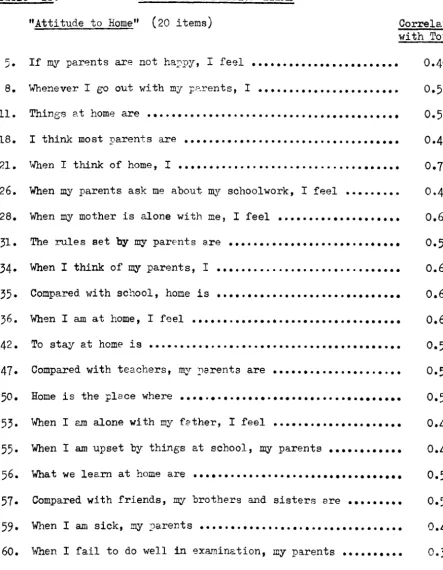
Table 18& "Attitude to Home" Factors
Table 19: "Social Interest" Factors
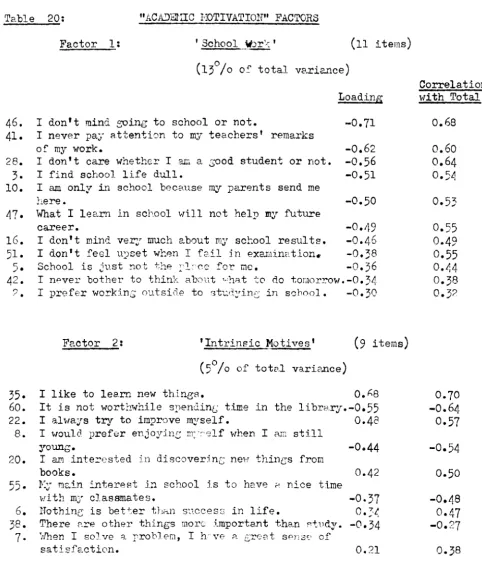
Table 20: "Academic Motivation" Factors
Table 21: "Academic Motivation" Factors (cont'd.).
I I I
112
113
Table 22: Sentence Completion Items
Table 23: Sentence Completion Items (cont'd.)
Table 241 Sentence Completion Items (oont'd.)
Chapter Six
118
119
120
Table 25: Distribution of the Sample by Type c:£ School 135 Table 26: Distribution of Hong Kong Form IV Students
(1970-71) 135
Table 27: Characteristics of the Hong Kong Final Sample 136
Table 28: Average Academic Results for the Years 1967-70 138
Chapter Seven
Table 29: Coefficients of Congruence among Hong Kong and
Singapore Factors in "Treated" 148
Table 30: Coefficients of Congruence among Hong Kong and
Singapore Factors in "Taught" 149
Table 31: Coefficients of Congruence among Hong Kong and
Singapore Factors in "Disciplined" 150
Table 32: Factors and Items for Singapore Group 151
Table 331 Correlations ~ AH4 Scores with Academic Resu1ts153 Table 34: Intercorrelations of Cognitive Abilities 153
Table 35: Correlations of AH4 Scores with Teachers'
Ratings 154
Table 361 Correlations of Composition Test with Attitude
Tests 156
Table 37: Correlations of Sentence Completion Test with
Likert Test 157
Table 38. Hoyt Reliabilities of the PID Test 160
Table 39: Hoyt Reliabili ties of the PID Factors 160
Table 40: Coefficients of Congruence among Hong Kong
Test-Retest Factors in "Treated" 161
Table 41: Coefficients of Congruence among Hong Kong
Test-Retest Factors in "Taught" 162
Table 42: Coefficients of Congruence among Hong Kong
Page
Table 43: Father Factors and Items Used in Final Analyses 164
Table 44: Hother Factors and Items Used in Fina] Analyses 165
Table 45: Reliabilities of AH4 Test
Table 46: Test-Retest Reliabilities of Likert Test
Table 47: Reliabilities of Sentence Completion Test
Table 48: Inter-rater Reliabilities
166
167
167
168
Chapter Eight
Table 49: Ha.ximum Score, Range, Hean, and Standard
Deviation of Variables (Excluding Achievements) 175
Table 50: Correlation Matrix of All Variables (Excluding
Achievements) 176
Table 51: Correlation Hatrix of All Variables (Excluding
Achievements) (cont'd.) 177
Table 52: Ha.ximum Score, Range, Hean, and Standard
Deviation of Variables (Including Achievements)
(Boys) 182
Table 53: Correlation Matrix of All Variables (Including
Achievements) (Boys) 183
Table 54: Correlation Matrix of All Variables (Including
Achievements) (Boys) (cont'd.) 184
Table 55: Maximum Score, Range, }lean, and Standard
Deviation of Variables (Including Achievements)
(Girls) 186
Table 56: Correlation Matrix of All Variables (Including
Achievements) (Girls) 187
Table 57: Correlation }latrix of All Variables (Including
Achievements) (Girls) (cont'd.) 188
Table 58:
Table 59:
Table 60:
Table 61:
Table 621
Rotated Factor Matrix of All Variables (Excluding
Achievements) 191
Rotated Factor Matrix of All Variables (Including
Achievements) (Boys) 193
Rotated Factor Matrix of All Variables (Including
Achievements) (Girls) 194
ANOVA in All Variables (Excluding Achievements) (Between Sexes)
ANOVA in Cognitive and Affective Attributes (Between Sexes)
196
Table 63: ANCOVA in Cognitive and Affective Attributes
(Between Sexes) 198
Table 64: ANCOVA in Cognitive and Affective Attributes
(Between Sexes) (cont'd.) 199
Table 65: ANCOVA in Cognitive and Affective Attributes
(Between Sexes) (cont'd.) 200
Table 66: ANCOVA in Cognitive and Affective Attributes
(Between Sexes) (cont'd.) 201
Table 67: ANOVA in Achievements (Between Sexes) 202
Table 68: !NeOVA in Achievements (Between Sexes) 202
Table 69: ANCOVA in Achievements (Between Sexes) (cont'd.) 202
Table 70: &~COVA in Achievements (Between Sexes) (cont'd.) 203
Table 71: ANCOYA in Achievements (Between Sexes) (cont'd.) 203
Table 72: ~~COVA in Achievements (Between Sexes) (cont'd.) 204
Table 73: ANOYA in "Treated" (Between Parents) 219
Table 74: ANOYA in "Taught" (Between Parents) 220
Table 75: ANOVA in "Disciplined" (Between Parents) 221
Table 76: ANOVA in Cognitive Abilities (Between ~ol.) 223
Table 77: ANOVA in "Attitude to Home" (Between Schools) 224
Table 78: ANOYA in "Social Interest" (Between Schools) 225
Table 79: ANOYA in "Academic Motivation" (Between Schools) 226
Table 80: Range of School Differences in Psychological
Variables 227
Chapter Nine
Table 81: Significance of Relationships between Parental
Variables and Other Psychological Variables 229
Table 82: Significance of Relationships between Parental
Variables and Achievement Variables (Boys) 234
Table 83: Significance of Relationships between Parental
Variables and Achievement Variables (Girls) 234
Table 84: Significance of Sex Differences in Psychological
Variables 236
Table 86: Significance of Multiple R and Order of
Importance of Parental Variables for Prediction
of Other Psychological Variables 242
Table 87& Significance of Hul tiple R and Order
at
Importance ~~ Parental Variablesfor Prediction
of Other Psychological Variables (cont'd.) 244
Table 881 Significance of Multiple R and Order of
Importance of Parental Variables for Prediction
of Other Psychological Variables (cont'd.) 246
Table 891 Significance of Multiple R and Order of
Importance of Parental Variables for Prediction
of Achievements 247
Table 90 & Significance of Hul tiple R and Order of'
Importance of All Psychological Variables for
Prediction of ~chievements 249
Table 911 Significance of Parental Differences in "Treated"252
Table 921 Significance of Parental Differences in "Taught" 252
Table 931 Signifieance of Parental Differences in
"Disciplined" 253
Table 941 Significance of Between-School Differences in
Psychological Variables 254
Table 951 Significance of Sex Differences in Ratings of
Parental Variables 256
Table 961 Percentage of Total Variance Explained by Parental Factors in Six Corresponding Factor
Analyses 257
Table 971 Percentage of Total Variance Explained by Parental Factors in Six Corresponding Factor
INDEX TO NODELS
Ml: Conjectured Model of Socialisation Processes in the
Child's Intellectual and Emotional Development 68
M2: Regression Hodels for Cognitive Abilities (Boys
and Girls) 205
M3: Regression Models for Cognitive Abilities (Boys) 206
M4: Regression Models for Cognitive Abilities (Girls) 206
1'15: Regression Models for Affective Aspects (Boys and
Girls) 208
M6: Regression Models for Affective Aspects (Boys) 209
M7: Regression Models for Affective Aspects (Girls) 210
M81 Regression Models for Affective Aspects (Boys and
Girls) (cont'd.) 211
M9: Regression Models for Affective Aspects (Boys)
(cont'd.) 211
MIO: Regression Models for Affective Aspects (Girls)
(cont'd.) 211
Mlil Regression Models for Achievements (Boys) 215
M12: Regression Models for Achievements (Girls) 216
M13: Regression Models for Achievements in Relation to
All Variables (Boys) 217
M14: Regression Models for Achievements in Relation to
CHAPTER ONE INTRODUCTION 1. The General Trends
Prior to the advent of formal educational systems in the various countries, nearly all learning and teaching took place incidentally within the home and in informal practices of
different kinds within the tribal or group environment. The
emergence of certain individuals as "teachers" and the development of schools as places vhere children were sent by their parent.
to be taught by others changed all that and ve now have a ditterent: largely outside-the-home "education system". It would seem
that the educational emphasis has shifted trom home to school but is it really so, and one vonders by how much? Research
over the last titty years and particularly during the last decade has shown that achievements and attitudes in the formal place ot learning, the school, still rest heavily on the informal learnia. and teaching that has occurred, unconsciously perhaps, at home prior to the child's entry to school. It appears that the cultural standard and psychological impact ot the child's home conditions continue to have a relevance in the child's total learning.
Psychologists, educators and sociologists now seem to alree that the tamily is normally the most signiticant single influence on the early development
ot
the child. Indeed, the hoae, with its clo.e ties and personal inter-relationships, emerges as the environment which makes the .trongest bid to remain the mostthe educational function of the family remains important in modern society, and even more so because it appears al.o to
determine future attitudes towards education. There is no doubt that most early social learning is experienced within the tamily, which provideshe child with his initial identity, and it is in
the ho.e that the child obtains his first impreasions of people, whether good or bad. The child clearly relates to his apecitic family and is influenced by that family's characteriatic. and customs. Through the parents there de~elopa what may be ter.ed the basic emotional and social education of the child, although the average parents are seldom equipped with adequate knowledge and training to optimise this particular tunction.
In addition to the abo~e consideratio •• , we have e~idence
to believe that the aocio-economic background of the child's tamily has an important b.aring on the child's upbringing.
However, recent tindings •••• to suggeat that the paychological environment has more tar-reaching .ttecta on the develop.ent
ot
the child's cognition and emotion than the merely p~.ical or material environment, and this is especially true in the Vest siace most home. in V.stern culture are above the le~.l where material condition. are likely to attect adver.ely the d.~eloping
abilities and other attribute. of the child.
To move further afield to specific are •• , we find that in the Hong Kong situation, parents who can alford to aend th.ir children to •• condary .chools are gen.rally in the .iddle- or upper-income group., and therefore material aapect. may again not b. a critical consideration. The present .tudy take. account
ot
2. The Particular Cultural-Educational Problems of Hong Kong In order to have a better understanding of the Hong Kong situation and problems, the current cultural-educational scene may be reviewed briefly. The population of Hong Kong is OTer
four millions, of which about 9~ are Chinese. Cantonese is the major dialect spoken among the Chinese community. However, English has been up till noy the only official language in governaent and also in most private enterprises. Though Hong Kong is a bilingual society, English is essential for academic and business purposes and has marked commercial value locally. Both spoken and written English is desirable for entry into the various professions and to overseas universities. Minority groups in the order of their percentage of the total population include British, American, Portuguese, Japanese, German, Dutch, French, and Italian. Hence, Hong KOBg culture is pri.arily in the Chinese tradition interwoven to varying degrees with Western ideas and practices.
Though Hong Kong is very much Westernised, especially in the urban areas, nearly all the ancient Chinese custo.s and festivals are still observed by most Chinese residents. Homes, particularly those in the rural areas, are still .anaged in a
patriarchal fashion, with poyer and authority vested in the father or in the male head of the family. The Chinese in Hong Kong still have very strong family ties, though less so now perhaps than in the past. Strong family restrictions on children still prevail, particularly within the less educated homes.
Whilst there is DO class system as such iD Hong Kong, the gap between the rich and the poor i8 very great indeed and marked inequalities and social injustices continue. However, the
education. Religious ditterences appear to parallel the economic divisions, the religion of the low-income group being alm08t
exclu8ively Buddhist, while that ot the middle- and high-income group8 is u8ually Christian and either Catholic or Prote8tant.
Since Bong Kong is a highl, comm.rcial and capitali8t society and a "laissez-faire" policy preT.ils, lite is highly competitive. M08t par.nt8, including those ot poor famili.s, de8ire a8 ext.nded an education as possible for their childr.n in order to upgrade their 8tatus in society. Bec.use
at
the p.rtic-ular situation in Bong Kong, parents attach gre.t Talue orimportance to the intellectual abiliti.8 and acad.mic achi.Te.ents ot their children. Many parents no doubt look on .ducation tor their children a8 a means by which their own high .8pirations can be realized, thus it i8 con8id.red to b. the way by which their children can surp.ss their parents' position in lite. Hence most children in Hong Kong ar. under constant par.ntal pre8sure to do w.ll in school, and th.y are well .ware ot the
consequences of failure and also .s • result academic examination r.sults ar. given undue importanc.. Parents' child-r.aring
cognitive and affective status.
Currently, education in Hong Kong is neither free nor
compulsory at the secondary level, though the government introduced free primary education in September 1971. There are three major stages of education in Hong Kong, primary, secondary and tertiary, and the normal ages for entry are 6, 12, and 19 years respectively. Nearly all primary schools are Chinese, with Cantonese as the
medium of instruction, and English as a second language, There are four types
ot
secondary education. Anglo-Chinese grammar schools, Chinese middle schools, general secondary technical schools, and secondary modern schools, in the orderot
size of their student enrolments. The Anglo-Chinese grammar schools are by far the most important, however, in terms of their nuabers and economic value, there being at this present time 229 such school. as against 114 Chinese middle schools, 11 secondary technical schools, and 5 secondary modern schools in 1970-71. It should also be noted that the .nrolment for Anglo-Chinesegrammar schools is about four times that tor Chinese middle schools. For further education, there are three Colleges of Education (i.e., teachers' colleges), one Technical College, and two Universities. The University of Hong Kong (English-speaking) was established in 1911. It now has full faculties of arts, science, social
science and law, medicine, engineering and architecture, and covers all the main professional disciplines except dentistry. The
Chinese University of Hong Kong (Chinese-speaking) was established only in 1963 and is a tederal university with three constituent colleges. It has arts, science, commerce and social science faculties, and tends to be moving towards the development
ot
proportion (about ~) of the school leavers and have not been
able to proTide enough· places to cope with the demands of students and of their parents.
The present stu~ centres its inve8tigation.· in the jnglo-Chinese grammar schools and the secoadary technical schools,
since the medium of instruction in these tvo types
ot
school is English and this in turn makes it possible to use psychological teats in English. It ia also in thes. schools that the tuture of Hong Kong appears to be inTested, and where the tvo cultures of Chinese and EngliSh mingle most tre.ly and easily. It se.ms appropriate therefore, since the emphasia in Hong Kong is on English and on the academic subjects, to tocus the present study on those inatitutions where English is the common language otCHAPTER TYO
REVIEW OF RELEVANT LITERATURE
There are av~ilable a wealth of sociological as well as psychological research studies dealing in various ways with the relation of home environaent to the cognitive and affective growth of children. However, the field of enquiry must be restricted
and only the more iaportant contributions to this area of knowledge and particularly those which lead to the formulation and develop-ment of the hypotheses of the present study, will be reviewed here.
1. Researches Concerned with Material Home Epvironment. In England, the classical study of Gordon1 (1923) on the intellectual ability of canal boat children revealed that they were interior in ability to children brought up in a more normal
educational environment. Gay2 (1925) further showed that there was a greater deficiency in the more verbal aspects of their
ability as measured by the Binet-Simon test than in their ability as revealed on performance tests. In most of these types of
researches quoted, it is quite possible that the parents and children yere also genetically inferior, and therefore it should not be argued that they prove that poor environment as such caused the obserTed child deficiencies. It m~ be agreed that the "in toto" hereditary explanation is unlikely, but its possible effect should continue to be recognized.
Wheeler) (1932, 1942) studied East Tennessee aountain
children and found that the test scores at all grades were higher than the test scores for co.parable grades ten years before, and he attributed the difference to the iaproved conditions, both
Havighurst and J&nke4 (1945) carried out an extensive study on all children between 10 and 16 years of age in an American Mid-West Community. They found that children from families of higher socio-economic status tended to do better in all tests of ability than children of lower status. Pleming5 (1943) also
obtained a positive correlation between socio-economic status and test performance. Cattel16 (1934) confirmed this relationship between parental occupation and child intelligence. Vemon7 (1947) also found significant variations of intelligence aaong adult
naval recruits with occupation, age, and locality of residence. Piaget8 (l950) considered that intellectual operations are acquired by interaction between organism and environment in a
lawful 'sequence', while Bebb9 (1949), from his neurophysiological studies, distinguished intelligence A, which he defined as the innate genetic potentiality, neither observable nor measurable, from intelligence B, which he interpreted as the present .eatal efficiency of the individual resulting from his interaction vith his environment. VernonlO (1960) accepted Bebb's view of
intelligence A and B, but pointed out that available intelligence tests are imperfect measures of intelligence B, and hence
introduced the term intelligence C to refer to that aspect of
intelligence B which is measured by intelligence tests. Catte11ll (1963) considered that the general factor which emerges from
correlations between batteries of varied tests is in effect an amalgam of two components, which he called fluid and c~stal1ized
intelli,ence. Pluid intelligence he thought represents the influence of biological factors on intellectual deTe10paent,
Campbell12(195l) studied the cultural level of the home
in relation to educational attaimnent, and found that the
following aspects seem to affect secondary school performance
appreciably, availability of music, books, newspapers, journals,
radio programmes, pictures, ballet and concert going. He pointed
out that most attention has been concentrated upon one aspect ot
the home environment, namely the socio-economic status ot the parents, and that very few investigations have been made by
objective assessments of home conditions; therefore it may be
considered that the present evidence on the effects of home
environment is far from conclusive.
Eells et al.13 (1951) reported that there exists a Ter,y
clearcut relationship between social status and measured
intelligence, especially where the measure ot intelligence is
based on tests ot verbal ability. The differences vere also found to increase with age. Arvidson14 (1956), in his investigation ot
some factors influencing the achievement of first year secondary
modern school children, found that the most important factor
appeared to be the home conditions and that the intluence of the
home environment was greater on verbal ability than on numerical
achievement. He further maintained that speech, expression,
even thought itself, are all conditioned by home background, and
these are tundamental to proficiency in English. Watts15
discussed the part played by language in intellectual development
in a usetul publication as early a8 1944(revised 1963). Burt1s16
study (1937) also suggested that poverty, popUlation density,
family size, poor health and inadequate general knowledge vere
the aspects of low social class which were associated with
backwardness in school. It should be pointed out that
better class homes certainly provide advantages to the
or business executive type of parent may be considered most often
to be more intelligent than the unskilled labourer, so that part
of the inferiority of the latter's c~ildren may be thought to be genetic in character.
Fraserl7
(1959),
in her study in Aberdeen schools, showed that the relationship between intelligence and home environmentfactors was very high. She also found that the child who is well
equipped verbally is able to score highly on intelligence tests,
even non-verbal ones. Bernstein18
(1958, 1959, 1961)
maintained that there was very little difference between a working classgroup and a public school group with respect to non-verbal
ability but that verbal ability was significantly lower for the
working class group. He explained his results as follows&
"Because of the different structuring of the working-class environment the working-class
child does not learn a language which is
structured to mediate personal qualifications but is limited to expressive symbolism and a public language."
In other words, in the higher income groups, there is early
pressure on the child to verbalise his feelings and abstract ideas.
As pointed out by Vernon19(1969), the working class child who
does not normally get training in using language to convey
abstract ideas, is handicapped in general intellectual development
and starts his schooling at a considerable disadvantage, compared
with the middle class child. Stott2
0(1967)
also asserted that t~mode of verbal communication between a mother and her preschool child is vitally important to the development of the latter'sc08Ditive structure and hence to his later educability in school.
These observations would appear to be reasonable and generally
acceptable in the present context.
While acknowledging that in general there is a difference
professionals and those of the children of unskilled labourers, Anastasi2l (1958) drew attention to the fact that the correlations between home ratings and intelligence vary with the content of the home-rating scales, the nature of the intelligence test, and the size and nature of the sample used. However, she said that in general, the correlations between home-ratings and intelligence found between the ages of 3 and 18 years cluster around 0.40,
though they range from 0.20 to slightly over 0.50, and that correlations Yith social status are higher in those abilities
(particularly verbal) that tend to be favoured by a superior
social environment. She agreed that good socio-economic background favours intellectual development. She also made the interesting point that bilingualism per Be need not handicap a child and
that it is not the interference of the two languages, so much as the restriction in the learning of one or both to limited areas, that produces a handicap. This is of particular relevance to the Bong Kong situation where the majority of secondary schools are bilingual.
Other stUdies relating socio-economic hoae environment to intellectual abilities, and in particular to verbal abilities include those of McNemar, Seashore, Jersild, HaTighurst, Vernon, Ravenette, Reid, Douglas, Viseman, Thom, and the Scottish Mental Survey. McNemar22 (1942) pointed out that the mean Igts ot
children of professional fathers were in general appreciably
socio-economic status) tend to have a higher average level of intelligence.
As regards verbal abilities, Vernon26 (1960) emphasized that children from the middle class, and particularly professional
homes (where they are likely to hear richer and more accurate speech), tend to acquire a better and more enriched vocabulary than those from working class homes. Ravenette27 (1963) found that tor working class children, scores on verbal tests are significantly lower than perceptual scores, and the difference
(for some reason) is more clearly marked for girls than for boys. Prom his Jamaican study, Reid28 (1964) concluded that mental associations which become established very early in life -- (e.,. from preschool experiences) -- remain a permanent part of the individual and exert continuing effects on mental growth and educational development. He indicated that loss of developaent during the early period m.r not be recoverable at later ages, and that the home is almost solely responsible at this stage tor providing a sufficiently enriched and stimulating environmeat for the child. In England, Douglas29 (1964) recognised that children vho are encouraged in their studies by parents do appreciably better in picture intelligence tests as veIl as in attainment tests of reading-comprehension and arithmetic. Viseman et at?°
(1967) asserted that socio-economic class and its associated
occupational class and the mean test score of children.
other aspects of environmental influence have also been
investigated from time to time with significant results. To
mention a few, Douglas)) (1964) found that eldest children with
one or two siblings do better in secondary selection examinations.
As early as thirty years ago, Bonney34 (1942) reported that
family size neither explained nor described adequately the
person-ality of any particular child. But, as pointed out by Nisbet)5
(1953), size of family in itself may be a causal factor in poor
mental development, just as poor language stimulus in the home
has been shown to be if they both correlate with low intelligence,
as appears to be the case. Berdie36 (1943) studied interests, and
Maas)7 (1955) aspirations in relation to social environment.
Berdie found that the income and occupational status of fathers
seemed to govern, to some extent, the interests of their sonSI
technical interests predominated in the lower income groups,
while business interests went with higher incomes in m~ cases. Maas maintained that middle-class fathers were more concerned
than working-class fathers about social status, and had higher
educational and vocational aspirations.
2. Researches Bearing More Particularly on PsYchological Home Environment
In 1947, Burt38 pointed out that social surveys have been
limited chiefly to economic conditions and the material standards
of life so that the social attitudes, ideals and behaviour of
different groups have been barely touched upon. The main researche.
on the psychological (as distinct from the material and physical)
aspects of home environment in relation to children's cognitiTe
and affective growth are reviewed in this section.
crOS8-cultural studies concluded that socio-economic level and linguistic
background are considerably associated with 'g' and with
educational and verbal performance, but cultural stimulus in the
home gives an eTe. higher correlation with the 'g' factor. The
most important single factor in children's performance on 'g'
and verbal tests seemed to be the cultural level of the home,
parental education and encouragement, reading facilities and
probably the speech background. The next most important factor
in the home situation is the purposefulness and rationality of
the family atmosphere. Economic level as such is subsidiary.
In 1921, 1923, 1933, 1940, Preud40 presented his
psycho-analytic point of view: The child takes the parents as his model
because they have qualities the child lacks; he wants to become
like them and this Freud called the identification process.
Freud postulated the superego (in addition to the id and ego),
as representing internally the values and ideals of the society
to which the child belongs. Originally, these are conveyed
through its parents by means of rewards and punishments meted
out in response to its behaviour, but they later become incorporated
into its ego-ideal by the process of introjection. The parents
are the first adults in contact with the child, and hence they
play an important role in being the child's first models with
which he identifies.
In 1934, Mead4l stated that there are two types of conduct
involved in the parent-child relationship' imitation by the child,
and the sympathetic response of the parent. A child has no 'self'
at birth, and his development is dependent on social experience
and activity. Selt is a structure ot attitudes built up, partly by the organisation of the perceived attitudes of others towards
and partly by the organisation of the generalised attitudes of
the social group to which he belongs. Staines42 (1954) pointed
out in his study that self and society interpenetrate through
education, while Zahran43 (1966) did a research on the
self-concept which he considered to be central in the study of
personality. The self-concept provides the key to one of the
most successful methods in counselling, namely client-centred
therapy.
Goldfarb44 (1943) investigated the later development of
two groups of orphans reared in different settings during their
first three years. The first group were adopted into foster-homes
where they had more individual attention, nurturance, warmth,
and adequate mothering; the other group remained in an institution
where they vere emotionally deprived, and experienced impersonal
care and inadequate mothering. Go~arb found that
institution-reared orphans were relatively retarded, compared with the
foster-home children, on all intelligence tests, particularly in concept
formation, reasoning, and abstract thinking. Language and speech
difficulties vere more common among the institution-reared children
and persisted long after they left the orphanage. Also, the
severe deprivation and the emotional unresponsiTeness of their
early environment resulted in social and emotional maladjustment,
persisting at least into adolescence.
Symonds45 (1939) indicated that the degree of acceptance or
rejection of the child vas one of the two most significant
considerations in the home, the other being the autonomy of the
child as opposed to his rigid control. He further pointed out
that rejection, over-attention, and conflict between parents m'f
hinder the deTelopment of the child, and that family size also
emphasised that the home is the most powerful transmitter of the
culture of the group. Parental precepts and examples produce
conditioning long before conscious teaching by other institutions
of society can reach the child. Parental acceptance and affection,
or the opposite, determine the psychological atmosphere surrounding
the child. Baldwin, Kalhorn, and Breese47 (1945, 1949) considered
that warmth is the most crucial and pervasive factor affecting
the child. The child from a democratic home is more active, more
socially outgoing, and higher in intellectual curiosity,
origin-ality, and constructiveness. Ye may sum all this up in the more
positive statement that there is evidence to show that the
democratic home atmosphere is more conducive to intellectual
growth than other types of home control.
Kent and Davis48 (1957) reported that the type of discipline
practised by the mother in the family environment is associated
in an interesting way with test performance. Children in 'demandingt
homes, where rewards are conditional on achievements, scored
highest all round on their test, especially on the verbal materials.
Children of over-anxious parents were equally high in intelligence,
but their school achievements were found to be far lower.
Child-ren of unconcerned and indifteChild-rent paChild-rents tended to score loy
on all tests. Porter49 (1957) also noted that parental interest
played a highly significant role in children's academic achievement
and in their remaining at school.
In 1948, both Bossard50 and Frank5l placed eaphasis on the
role played by the family in child development. Bossard pointed
out that the development
ot
personality involves a constant series of choices; such choices represent a person's values, and suchvalues 'are in large part the result of family conditioning'.
which is the essential agency for the socialization of the young
child and for introducing him to the culture in which he is to
grow up and live. Lacking the necessary warmth of parental
affection, the young child retains his egocentricity too long,
develops fears, and builds up his defences in the form of
distrustful and revengeful attitudes of mind. Later in 1952,
Bossard and Sanger52 added that, in a small family, considerable
emphasis is placed on individual development, but there may be
over-protectiveness. On the other hand, in a large family, there
tends to be rather less intimate contact between the parent and
any individual child. Three years .ter, Bossard and Bol1 53 (1955,
1956) suggested interesting and fruitful hypotheses about whether
family size is actually a psychological as well as a sociological
variable in child development. Yallenstein54 (1937) even
attributed inferior development in several aspects of character
directly to broken homes. Stern55 (1949) pointed out that the
lack of normal home life and parental identification prevented
many of his delinquent subjects from developing their superegos
in the normal manner, and he found difficulty in training them
to develop proper attitude. of responsibility and service.
Mus •• n56 carried out many researches on the psychological
development of the child, and in 1963 reported the following
findings: Motivation, personality structure, language ability,
and social-psychological environment all contribute significantly
to intelligence. Inadequate learning opportunities and
unstimulat-ing environments handicap the workunstimulat-ing-class child's performance
in intelligence tests. Since the child's
Ig
score is partlyrelated to the desire to improve his knowledge and problem-solving
skills, family experiences which encourage the develop.ent of this
stronger desire for intellectual mastery. Parents are (in effect)
intellectual models for identification. }lussen also pointed out
that a child's first social learning occurs at home, and his
earliest experiences with his family, particularly with his
mother, are critical in determining his attitude toward, and his
expectations of, other individuals. He agreed that early
mother-child relationships influence not only a mother-child's immediate
behaviour, but also his subsequent, long-term adjustment,
particularly at the adolescent stage, though the exact nature
and extent of the enduring consequences of early child-rearing
practices have not been clearly established. He noted that
parents who severely restrict their child's freedom of movement
may suppress his tendencies to explore and to investigate, and
thus inhibit the development of motivations for autonomy and
independence.
Continuing Mussen's findings, it also appears that strong
motivation to learn and to perform well in school is fostered by
parental encouragement of competence and exploration early in life.
Parental motivation has been found to be s~~ificantly related to the student's aspiration level -- children with high
self-esteem tend to have parents who are also high in self-self-esteem.
Mussen exphasized that the specific nature of the child's
relationships with his parents is far more influential in
deter-mining his self-image than is the socio-economic class status.
Concerning delinquency, Mussen pointed out that socio-economic
factors are not the only significant antecedents. Personal
insecurities and psych~logical problems arising from disturbed
family relationships also playa significant role in the delinquent'~
background. In 1969, Mussen, with Conger and Kagan57 together
"Although the extra-familial environment
(teachers and peers) exerts a strong influence on the motives and behaviours of school-age children, the attitudes and practices of the family are still of major significance. The models that the parents present to the children, and the pattern of rewards and punishments they exercise are determined, in large measure, by two sets of factors -- the unique personalities of the parents and the values of the social-class setting in which the family lives.'.'
In 1950, Allport58 commented that children and youth need
warm affectionate relationships and at the same time need a
respect for and a defence of their own self-esteem. Liu59 found
that close and affectionate family ties among Chinese, with
patriarchal management in the home, help to provide security and
freedom from apprehension for the child or youth. In 1952,
Jersild'O emphasized that it is in the bosom of the home that the
self begins to develop and unfold. It is here that the child has
his first opportunity to differentiate himself from others, and
here too that he is accepted or rejected. Also in 1952, Havighurs~l
pointed out that consistency of discipline received by the child
is positively related to the development of his ethical competence,
including self-control and self-direction.
In 1954, Miles62 stressed that shared family experience is
important in the development of family interests. Jones63 (1954)
agreed that the first and most important place in a list of
environmental factors influencing character development must be
assigned to the home. Sears, Maccoby, Levin64 (1957) added that
the most significant aspect of the home is the warmth of the
relationship between parents and children, and that mothers are
more effective with children particularly when they find ample
time to play with them, permit much affectionate interaction with
them, and accept their dependency needs. The American
inter-actions between mother and child lay the groundwork for the child's
development of a sense of trust or distrust in the external world.
Medinnus66 (1961) reported that lack of parental acceptance seemed
to constitute an important factor in the poor adjustment of certain
first-grade children. In 1964, Swift67 pointed out that the way
in which children are treated by parents is of over-riding
importance in determining their perceptions of themselves, while 68
in 1965 Rosenberg agreed that the child's self-esteem is clearly
related to patterns of parental behaviour.
The following studies have important implications for the
present research and in the area of students' interests. Lovell
and White69 (1958) found that students choosing to study science
(even if they were not strongly interested themse1vea) were
significantly more likely to have had fathers who had scientific
interests and who had tried to impart to their sons technical
knowledge and skills. Meyer70 (1959) identified a number of
sociological and educational factors related to science interest
and stated that the home probably exerts a dominant influence.
He also stressed that the attitudinal relations between parents
and child, and the extent of democratic, stable and co-operative
behaviour in the home, seem to have more influence than the
social status of the occupation of the father in relation to
interest. Fraser's71 work (1959) revealed that intelligent and
well-educated parents who provide the child with a favourable
environment tend to encourage the child to develop interests aimilar
to their own and to motivate him to do well at school. hV&ns72
(1965) also supported the view that environmental influences play
an important part in determining the interests which an individual
develops, though heredity may also be involved.
relevance. Newcomb73 (1955) considered that the family is the most important among the primary groups and that childhood
experiences in the family are likely to lead to differential
personality characteristics. He particularly pointed out that
the ways in which fJhildren are indulged, loved, disciplined, or
punished depend partly, though by no means entirely, upon forms
of family organization, and that attitudes acquired in the family
are reinforced by the influence of external reference groups.
Becker et al!4 (1959) reported that authoritarian and arbitrary maternal attitudes were correlated with the presence of certain
types of conduct and behaviour problems in children, and that
frustration of the child's autonomy led to excessive shyness and
timidity. Johnson and Medinnus75 (1965) also indicated that differences in maternal attitudes and behaviour could produce
differences in the personalities of children. In 1965, Dinkmeyer76
gave the following account:
"The parents are the child's first teachers. They have a greater influence on him than any o~her single agency. Hany of the attitudes, interests, etc. are somewhat established by the time he reaches school. The parents provide the child with his first social
interaction. Their attitudes toward learning and academic discipline serve as a model for him to
accept or reject. The child's learning difficulties often relate to some problem in the parent-child relationship. "
Stewart and Warnath77 (1965) are of the opinion that the only way
in which a child can make the transition from a state of dependency
to one of independence is for him to internalize parental values
so that he comes to reward himself for various types of independent
behaviour. hvans78 (1965) realized that, as members of a family, children are surrounded by people subscribing to various opinions
about what constitutes a desirable way of life, and in due course,
most children develop attitudes resembling those of other members
t ' t t ' t ' l ' I ' f' ' 1 " ,t,80( 67) of r(:rce~) J.OilS, n - - l uues, a.n<.. ,)I?: 1(' S, W;ll e I..,OO;)c'1'Sin1 n 19
aclced tlwt ilotll('rs of ilit:;ll self-esteem cl~i+dren were [:Iore likely
to enforce established rules carefully anti consistently. Lastly
in 1968, l'ioore8l asserted tilat the family is u!';iurently a
univQrsal feature of human societies: i t uniformly provides for,
amonr: otlier t;iings, initial social ~)lacelilent and early socialization
o f t j 1 P Y () Ull [~ 0
tll" t :'lidul e-c In.s S ,grnr:lLlar scll 001 cHi llLrcn llacl "i ~)ler achi eveldent
motivation tHan illidule-class secondary (llodern) school cflildren,
wllile ':':':ntwist1e83 (1968) elilphasized tLl.at academic 10tivHtion
deI)cnds both on teLlperai:lental trai ts and enVirOllltlental variables
which interact wi tll eaCll other.
l~egCl.rdi
llG popularity, the studi es of Goldfurb84 (1945) ,Spitz 85 (l94:'j ) andowlby86(1953) all showed that children W;lO
were institutionalized in infancy and who did not f'xperience
consistent 'mothering' , became apathetic and socially unresponsive.
Harshall and LcCpndless87 (1957) exal!lined tne relati on of adult
dependency to children's popularity with peers and found
consist-ently Ilegative correl~tions between their measure of popularity
and thei r measures of dependence. 'l'lli s suggest s that emoti onal
dependence Illay interfere with some of the child's adjustments to
his schoolmates. Bandura88 (1963) indicated that the parents of
aggressive pread.olescellts and adolescents use pilysical punis.lIilent
more frequently and reasoning less frequently than the parents
of non-aggressive children.
89 )
Symonds (1939 stated that when either or hoth parents
reject a child, he is likely to be aggressive, attention-getting,
further pointed out that the family is the first and most important
socializing agency and that its emotional attachments are crucial
in the development of social relationships to others. The child's
experiences within the family eventually develop in him a sense
of acceptance or rejection by the primary group. He concluded
that the more severe the punishment that is received for aggression
in infancy and in childhood, the more the child tends to have
direct or indirect expressions of aggression and a considerable
increase in anxiety about aggressive acts later on. Also the
more inconsistency the child experiences, the more marked are
likely to be his aggressive tendencies. Children who are raised
in a less authoritarian atmosphere in which there is consistency
and acceptance tend to be more open to others. They are friendlier
and able to respond more adequately in their relationships with
peers. He maintained that there is mounting evidence to support
the view that discipline in the home affects the child's social
development. It also appears that children from autocratic homes
tend to be more frequently rated as unpopular with classmates,
more quarrelsome, more sensitive to praise and blame, and less
considerate than children from democratic homes. Unduly firm
or rigid parental controls are thus shown to be detrimental to
children's social development. Interestingly enough, in view
of popular opinion about the socializing value of large families,
children from small families are more frequently acceptable than
those from large families, as pointed out by English91 (1961).
Lasko, Koch, Johnson and Medinnus have commented on the
first-born child. Lasko92 (1954) said that the mothers behave
less warmly, and are more restrictive and coercive, towards their
first child than towards their second. Moreover, they protect
be less parent-child interaction among first-borns. Koch93 (1956)
reported that the first-child was generally judged to recover
less readily from emotional upsets and anger. The middle child
was more suggestible and social, while the youngest child seemed
to be most concerned about establishing his individuality within
the family. Johnson anu
~ledinnus94
(1965) pointed out that thefirst child, upon the birth of a sibling, must adjust to a change
in the quality of his interaction and relationship with parents.
The second child, on the other hand, enjoys a greater stability
of parental treatment. It is significant that all the above
investigators seem to agree very well on the essentials of this
issue.
Regarding adolescents and their problems, Stott95 (1950)
took the view that juvenile delinquency is an escape from an
emotional situation which is too much for the child, such as
domestic disharmony, parental ill health, lack of feeling of
security, and emotional estrangement from parents. In the same
year, Cooper96 added that inadequate affection in the home and
differences between the parents concerning the social, emotional,
and moral development of their children are the conditions most
likely to lead to delinquency. Many writers, including Horrocks,
Rosen, Sherif, Bandura, and Campbell, have discussed the influence
of the family on adolescents. Horrocks97 (1954) noted that for
adolescents, the home represents the ultimate and definitive
repository of adult authority. However, Rosen98 (1955) stated
that more often than not, in cases where parent-peer groups have
conflicting attitudes, adolescents tended to agree with their
peers
rath(~r
than their parents. Sherif and Sherif99 (1956)"Conflict situations arise when practices and
values sanctioned by the family and those sanctioned by the adolescent's peer group on the same issues pull in opposite directions. The relative strengths of the reference groups will determine which alternat-ive will be followed."
Bandura and 'fal terslOO (1959) attributed the development of
~essive behaviour in adolescents to the failure to satisfy the child's needs for dependency in early years. Campbell 101 (1969)
concluded that ties between parents and children remain close
throughout adolescence; the positive orientation toward parents
does not diminish, and may indeed increase, during this period.
Glueck and Glueckl02 (1950) found that the less use of physical
punishment in childhood and the more reasoning, the less likely
is the child or adolescent to engage in delinquent behaviour.
Vernonl03 (1969), summarizing other studies, agreed that
socialization practices and the home 'climate' are most influential
during the preschool and early school years. The democratic but
demanding home climate encourages better intellectual pro,ress
than the over-protected, the autocratic or the unc~ncerned homes. Based on the results of his own study, Hillerl04 (1967) also
suggested that though the long-established relationship between
social class and academic achievement was confirmed, the
import-ance of social class as an influential variable should now receive
less emphasis from sociologists, psychologists and social workers
than in the past. He suggested that more attention instead should
be given to social-psychological variables which are common to,
and cut across social classes. Blooml05 (1964) also emphasized
that parental interest and encouragement are more important
factors in development than the material circumstances of the home.
The present study follows this line of thought.
should be investigated and careful enquiry reveals that the
following authors have given their opinions on this issue. 106 ( . .
Ausubel et ale 1954) pOlnted out that although parent
behaviour is an objective event in the real world, it affects
the child's ego development only to the extent and in the form
in which he perceives it. Hence, perceived parent behaviour is
in reality a more direct, relevant and proximate determinant of
personality development than the actual stimulus context to which
it refers. Sanfordl07 (1956) remarked that discipline which is
strict and rigid and, from the child's point of view unjust or
unreasonable, may be submitted to, but it will not be genuinely
accepted, in the sense that the child will eventually apply it
to himself in the absence of external figures of authority.
Jersild l08 (1960) stated that to understand the meaning of the
parent-child relationship, we need to ask not only what the parents
do and what they intend, but how the child perceives the situation.
The child's view may be very different from what the parents have
in mind. Lastly, in 1961, Meyer and Penfoldl09 asserted that
children's beliefs about their parents' interests mattered more
than the actual interests and this meant that children tend to
model themselves on their parents as they see them. The present
research adopts this point of view.
3. Researches Directly Related to the Present Study
There have been several specific studies in many parts of
the world which are of particular importance since their approaches
and findings are clearly relevant to the ~ms of the present study. The following review may not be complete, but it is believed that
it includes most of the essential literature.
Werner llO (1969) reported from his longitudinal study of a