SECURE WEB MINING
Jayalakshmi
1,
Dr.M.Mohammed Ismail
2, P. Rizwan Ahmed
31
Research Scholar, Computer Science, Mazharul Uloom College, Ambur, Tamil Nadu, (India)
2,3
Associate Professor & Head , Research Department of Computer Science, Mazharul Uloom
College, Ambur, Tamil Nadu, (India)
ABSTRACT
Data mining technology has emerged as a means of identifying patterns and trends from large
quantities of data. Data mining and data warehousing go hand-in-hand: most tools operate by
gathering all data into a central site, then running an algorithm against that data. However, privacy
concerns can prevent building a centralized warehouse – data may be distributed among several
custodians, none of which are allowed to transfer their data to another site. This project addresses the
problem of computing association rules within such a scenario. We assume homogeneous databases:
All sites have the same schema, but each site has information on different entities. The goal is to
produce association rules that hold globally, while limiting the information shared about each site. In
this project, a new protocol is proposed which combines the advantages of the existing approaches to
perform privacy preserving in distributed mining of association rules. Both the privacy and
performance characteristics of the proposed protocol are studied and compared with the mining and
cryptographic approaches.
Keywords: Data Mining, Web Mining
I. OBJECTIVE
Data mining can be applied to data sets of any size, and while it can be used to uncover hidden patterns, it
cannot uncover patterns which are not already present in the data set. Data mining extracts novel and useful
knowledge from data and has become an effective analysis and decision means in corporation. Data sharing can
bring a lot of advantages for research and business collaboration. However, large repositories of data contain
private data and sensitive rules that must be preserved before published. Motivated by the multiple conflicting
requirements of data sharing, privacy preserving and knowledge discovery, privacy preserving data mining
(PPDM) has become a research hotspot in data mining and database security fields. Two problems are addressed
in PPDM: one is the protection of private data; another is the protection of sensitive rules (knowledge) contained
II. DATA MINING
Data mining (the analysis step of the "Knowledge Discovery in Databases" process, or KDD), a field at the
intersection of computer science and statistics, is the process that attempts to discover patterns in large data sets.
It utilizes methods at the intersection of artificial intelligence, machine learning, statistics, and database systems
The overall goal of the data mining process is to extract information from a data set and transform it into an
understandable structure for further use Aside from the raw analysis step, it involves database and data
management aspects, data preprocessing, model and inference considerations, interestingness metrics,
complexity considerations, post-processing of discovered structures, visualization, and online updating.
Generally, data mining (sometimes called data or knowledge discovery) is the process of analyzing data from
different perspectives and summarizing it into useful information - information that can be used to increase
revenue, cuts costs, or both. Data mining software is one of a number of analytical tools for analyzing data. It
allows users to analyze data from many different dimensions or angles, categorize it, and summarize the
relationships identified. Technically, data mining is the process of finding correlations or patterns among dozens
of fields in large relational databases.
Fig 1: Process of Data Mining
2.1 Data
Data are any facts, numbers, or text that can be processed by a computer. Today, organizations are accumulating
vast and growing amounts of data in different formats and different databases. This includes: Operational or transactional data such as, sales, cost, inventory, payroll, and accounting Nonoperational data, such as industry sales, forecast data, and macro economic data
Meta data - data about the data itself, such as logical database design or data dictionary definitions
2.2 Information
The patterns, associations, or relationships among all this data can provide information. For example, analysis of
2.3 Knowledge
Information can be converted into knowledge about historical patterns and future trends. For example, summary
information on retail supermarket sales can be analyzed in light of promotional efforts to provide knowledge of
consumer buying behavior. Thus, a manufacturer or retailer could determine which items are most susceptible to
promotional efforts.
III. DATA WAREHOUSES
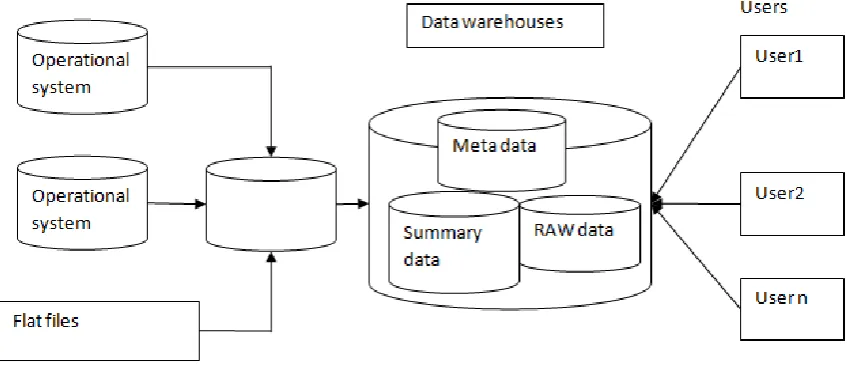
In computing, a data warehouse (DW or DWH) is a database used for reporting and data analysis. It is a central
repository of data which is created by integrating data from multiple disparate sources. Data warehouses store
current as well as historical data and are commonly used for creating trending reports for senior management
reporting such as annual and quarterly comparisons.
The data stored in the warehouse are uploaded from the operational systems (such as marketing, sales etc.,
shown in the figure to the right). The data may pass through an operational data store for additional operations
before they are used in the DW for reporting.
The typical ETL-based data warehouse uses staging, integration, and access layers to house its key functions.
The staging layer or staging database stores raw data extracted from each of the disparate source data systems.
The integration layer integrates the disparate data sets by transforming the data from the staging layer often
storing this transformed data in an operational data store (ODS) database. The integrated data are then moved to
yet another database, often called the data warehouse database, where the data is arranged into hierarchical
groups often called dimensions and into facts and aggregate facts. The combination of facts and dimensions is
sometimes called a star schema. The access layer helps users retrieve data.
Data mining elements
Extract, transform, and load transaction data onto the data warehouse system.
Store and manage the data in a multidimensional database system.
Provide data access to business analysts and information technology professionals. Analyze the data by application software.
Present the data in a useful format, such as a graph or table.
Different levels of analysis are available:
Artificial neural networks: Non-linear predictive models that learn through training and resemble biological
neural networks in structure.
Genetic algorithms: Optimization techniques that use processes such as genetic combination, mutation, and
natural selection in a design based on the concepts of natural evolution.
Decision trees: Tree-shaped structures that represent sets of decisions. These decisions generate rules for the
classification of a dataset. Specific decision tree methods include Classification and Regression Trees
(CART) and Chi Square Automatic Interaction Detection (CHAID). CART and CHAID are decision tree
(unclassified) dataset to predict which records will have a given outcome. CART segments a dataset by
creating 2-way splits while CHAID segments using chi square tests to create multi-way splits. CART
typically requires less data preparation than CHAID.
Nearest neighbor method: A technique that classifies each record in a dataset based on a combination of the
classes of the k record(s) most similar to it in a historical dataset (where k 1). Sometimes called the k-nearest
neighbor technique.
Rule induction: The extraction of useful if-then rules from data based on statistical significance.
Data visualization: The visual interpretation of complex relationships in multidimensional data. Graphics
tools are used to illustrate data relationships.
3.1 Data Mining Techniques
There are several major data mining techniqueshave been developed and used in data mining projects recently
including association, classification, clustering, prediction and sequential patterns. We will briefly examine
those data mining techniques with example to have a good overview of them.
3.2 Association
Association is one of the best known data mining technique. In association, a pattern is discovered based on a
relationship of a particular item on other items in the same transaction. For example, the association technique is
used in market basket analysis to identify what products that customers frequently purchase together. Based on
this data businesses can have corresponding marketing campaign to sell more products to make more profit.
3.3 Classification
Classification is a classic data mining technique based on machine learning. Basically classification is used to
classify each item in a set of data into one of predefined set of classes or groups. Classification method makes
use of mathematical techniques such as decision trees, linear programming, neural network and statistics. In
classification, we make the software that can learn how to classify the data items into groups. For example, we
can apply classification in application that “given all past records of employees who left the company, predict which current employees are probably to leave in the future.” In this case, we divide the employee’s records into two groups that are “leave” and “stay”. And then we can ask our data mining software to classify the employees
into each group.
IV. CLUSTERING
Clustering is a data mining technique that makes meaningful or useful cluster of objects that have similar
characteristic using automatic technique. Different from classification, clustering technique also defines the
classes and put objects in them, while in classification objects are assigned into predefined classes. To make the
concept clearer, we can take library as an example. In a library, books have a wide range of topics available. The
challenge is how to keep those books in a way that readers can take several books in a specific topic without
one shelf and label it with a meaningful name. If readers want to grab books in a topic, he or she would only go
to that shelf instead of looking the whole in the whole library.
4.1 Privacy-Preserving Data Mining on Data Grids in the Presence of Malicious Participants
Distributed data mining allows data to be shared without compromising privacy. On the one hand, data mining
techniques have been shown to be a leading tool for data analysis, and as such they are likely to satisfy researchers’ needs as an interface to the data stored in a grid. On the other hand, the models produced by data
mining tools are statistical and thus satisfy the privacy concerns of the data owners. As a result, different HMOs
can choose to reveal their databases not for direct reading but rather to a distributed data mining algorithm that
will execute at the different sites and produce a statistical model of the combined database. That the algorithm
produces statistics still does not guarantee privacy: an HMO also has to make certain that the data mining
algorithm itself does not leak information. For instance, an algorithm in which each HMO computes its
mortality rate and then sends it to a polling station which computes the global statistics would not meet this
criterion because the polling station would be informed of the mortality rate for each HMO. This calls for a
specific type of distributed data mining algorithm that is privacy-preserving. The idea there is to perturb the data
by adding random transactions to the database. These perturbations hide the original data, but average out in the
statistics.
V.CONCLUSION
Cryptographic tools can enable data mining that would otherwise be prevented due to security concerns. We
have given procedures to mine distributed association rules on vertically partitioned data. We have shown that
distributed association rule mining can be done efficiently under reasonable security assumptions. We believe
the need for mining of data where access is restricted by privacy concerns will increase. Examples include
knowledge discovery among bank services of different datasets. Another possibility is secure approximate data
mining algorithms. Allowing error in the results may enable more efficient algorithms that maintain the desired
level of security. In summary, it is possible to mine globally valid results from distributed data without revealing
information that compromises the privacy of the individual sources. Such privacy preserving data mining can be
done with a reasonable increase in cost over methods that do not maintain privacy
REFERENCES
[1]. R. Agrawal and R. Srikant. Fast algorithms for mining association rules in large databases. In VLDB,
pages 487–499, 1994.
[2]. R. Agrawal and R. Srikant. Privacy-preserving data mining. In SIGMOD Conference, pages 439–450,
2000.
[3]. D. Beaver, S. Micali, and P. Rogaway. The round complexity of secure protocols. In STOC, pages 503–
513, 1990.
[4]. M. Bellare, R. Canetti, and H. Krawczyk. Keying hash functions for message authentication. In Crypto,
[5]. A. Ben-David, N. Nisan, and B. Pinkas. FairplayMP - A system for secure multi-party computation. In
CCS, pages 257–266, 2008.
[6]. J.C. Benaloh. Secret sharing homomorphisms: Keeping shares of a secret secret. In Crypto, pages 251–
260, 1986.
[7]. J. Brickell and V. Shmatikov. Privacy-preserving graph algorithms in the semi-honest model. In
ASIACRYPT, pages 236–252, 2005.
[8]. D.W.L. Cheung, J. Han, V.T.Y. Ng, A.W.C. Fu, and Y. Fu. A fast distributed algorithm for mining
association rules. In PDIS, pages 31– 42, 1996.
[9]. D.W.L Cheung, V.T.Y. Ng, A.W.C. Fu, and Y. Fu. Efficient mining of association rules in distributed
databases. IEEE Trans. Knowl. Data Eng., 8(6):911–922, 1996.
[10].T. ElGamal. A public key cryptosystem and a signature scheme based on discrete logarithms. IEEE