Nuclear data analyses for improving the safety of
advanced lead-cooled reactors
Pablo Romojaro1,*, Francisco Álvarez-Velarde1, and Nuria García-Herranz2 1CIEMAT, Energy Department, Avenida Complutense 40, 28040, Spain
2UPM, Energy Engineering Department, Calle José Gutiérrez Abascal 2, 28006, Spain
Abstract. A target accuracy assessment of the effective neutron multiplication factor, keff, for MYRRHA (Multi-purpose hYbrid Research Reactor for High-tech Applications) lead-bismuth cooled fast reactor has been performed with JEFF-3.3 and ENDF/B-VIII.0 state-of-the-art nuclear data libraries and the SUMMON system. Uncertainties in keff due to uncertainties in nuclear data have been assessed against the target accuracies provided by SG-26 of the WPEC of OECD/NEA in 2008 for LFR. Results show that keff target accuracy is still exceeded by more than a factor of two using the latest nuclear data evaluations released in 2018. Consequently, nuclear data assimilation has been carried out using criticality experiments from the International Criticality Safety Benchmark Evaluation Project that are representative of MYRRHA. The results from this work show that the level of accuracy needed in nuclear data cannot be obtained using only differential experiments, but the combination of experimental covariance data and integral experiments together with Generalised Least Squares technique can provide adjusted nuclear data capable of predicting reactor properties with lower uncertainty and consistent with differential data.
1 Introduction
The Lead-cooled Fast Reactor (LFR) is one of the three technologies selected by the Sustainable Nuclear Energy Technology Platform (SNETP) [1] that can meet future European energy needs. Significant efforts are being made by researchers and industry to overcome the main drawbacks for the industrial deployment of LFR, which are the lack of operational experience and the impact of uncertainties in the reactor design, operation and safety assessment.
In nuclear reactor design the uncertainties mainly come from material properties, fabrication tolerances, operative conditions, simulation tools and nuclear data. However, even though the uncertainty in nuclear data is one of the most important sources of uncertainty in reactor design and reactor physics simulations [2], significant gaps between the uncertainties and the target accuracies have been systematically shown in the past [3]. Meeting the target accuracy is required not only to achieve the requested level of safety for this technology, but also to minimize the increase in the costs due to additional security measures.
In this paper, a target accuracy assessment of the effective neutron multiplication factor,
keff, for MYRRHA (Multi-purpose hYbrid Research Reactor for High-tech Applications) [4]
lead-bismuth cooled fast reactor is performed with the JEFF-3.3 [5] and ENDF/B-VIII.0 [6] state-of-the-art nuclear data libraries and the SUMMON system [7]. Uncertainty quantification (UQ) analyses have already been carried out for previous MYRRHA designs [8-10] or with older nuclear data evaluations [11]; nevertheless, since JEFF-3.3 and ENDF/B.VIII.0 were released, an updated analysis was required in order to take into account the changes in the new nuclear data libraries and their impact in the criticality safety coefficients.
Furthermore, data assimilation for the main isotopes contributing to the uncertainty has been performed using critical mass experiments from the International Criticality Safety Benchmark Evaluation Project (ICSBEP) [12] that are representative of MYRRHA, in order to obtain adjusted nuclear data with constrained uncertainties and to reduce the uncertainty in the criticality parameter.
2 SUMMON system
The Sensitivity and Uncertainty Methodology for MONtecarlo codes (SUMMON) system [7, 13] has been conceived by CIEMAT as a tool to perform complete automated sensitivity and uncertainty analyses of the most relevant criticality safety parameters of detailed complex reactor designs from the neutronic point of view, i.e., keff, eff, eff and
reactivity coefficients, using state-of-the-art nuclear data libraries and covariances.
A detailed description of SUMMON, including the methodologies used to calculate the sensitivity coefficients and perform the uncertainty quantification analyses, can be found in Ref. [7, 13].
Recently, the Data Assimilation With summoN (DAWN) module has been developed to perform data assimilation using integral experiments from public databases, with the aim of providing adjusted nuclear data, not only capable of predicting reactor properties within the target design accuracy, but also statistically consistent with the various differential measurements.
DAWN is based on the generalised least squares technique [14], in which the evaluation of the posterior expectation of the cross sections, 𝜎′ and covariances, 𝑀
𝜎′, is done by finding
the minimum of the following function:
𝜒2= (𝜎 ′− 𝜎
𝜎 )
𝑇 𝑀𝜎−1(
𝜎′− 𝜎 𝜎 ) + (
𝐸 − 𝐶 𝐶 )
𝑇 𝑀𝐸𝐶−1(
𝐸 − 𝐶
𝐶 ) (1)
where 𝜎 and 𝑀𝜎are the a priori expectation and covariance matrix of the cross sections, 𝐸 is
the experimental value of the measured integral parameter, 𝐶 is the a priori calculated value of the integral parameter and 𝑀𝐸𝐶 is the relative integral parameter covariance matrix.
The cross sections modifications that minimize the 𝜒2 thanks to the adjustment are:
(𝜎 ′− 𝜎
𝜎 ) = 𝑀𝜎𝑆
𝑇𝐺−1(𝐸 − 𝐶
𝐶 ) (2)
and the associated a posteriori covariance matrix is:
𝑀𝜎′ = 𝑀𝜎− 𝑀𝜎𝑆𝑇𝐺−1 𝑆𝑀𝜎= 𝑀𝜎(𝐼 − 𝑆𝑇𝐺−1𝑆𝑀𝜎) (3)
3 Sensitivity and uncertainty analyses
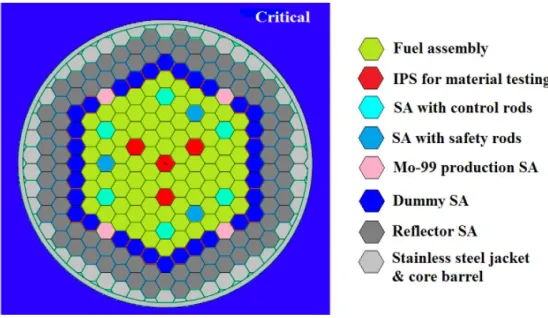
MYRRHA’s updated core design is described in detail in Ref. [4]. For this work a simplified model [15], homogenised on fuel assembly level, of the critical core configuration in nominal conditions at Beginning of Life (BoL) has been used. The layout of the core is shown in Fig. 1.
Fig. 1. Critical MYRRHA core layout.
Sensitivity calculations were performed in order to obtain the sensitivity coefficients for uncertainty propagation and to identify the most important nuclear data for neutron induced reactions in MYRRHA. A comparison between the Integrated Sensitivity Coefficients (ISC) obtained using JEFF-3.3 and ENDF/B-VIII.0 nuclear data libraries of the most relevant reactions for keff is shown in Table 1. It can be seen that the sensitivity coefficients obtained
with both libraries are practically the same, therefore for the uncertainty quantification, the uncertainties in nuclear data have been propagated using only the sensitivities derived with JEFF-3.3 library.
Table 1. ISC of the top 5 reactions for MYRRHA using JEFF-3.3 and ENDF/B-VIII.0 libraries.
MYRRHA – ISC (%/%)
Quantity JEFF-3.3 ENDF/B-VIII.0 239Pu 0.696 0.698 239Pu (n,f) 0.482 0.486 238U (n,) -0.112 -0.115
240Pu 0.081 0.080
239Pu (n,) -0.053 -0.056
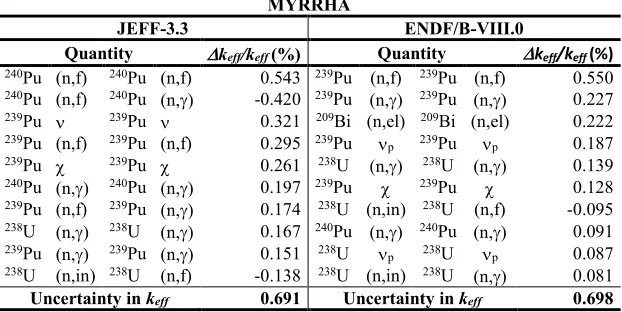
Using the “Sandwich Rule” of the “Propagation of Moments” method [7], the uncertainties were propagated with both JEFF-3.3 and ENDF/B-VIII.0 covariance data. The top 10 contributors, as well as the total uncertainty in keff due to these contributors, are
presented in Table 2. A good agreement can be observed in the total keff uncertainty derived
by JEFF-3.3 and ENDF/B-VIII.0, even though the contributors differ. This can be attributed to differences in the evaluations, such as the case of 240Pu(n,f), to missing correlations, such
Table 2. UQ for MYRRHA using different covariance evaluations.
MYRRHA
JEFF-3.3 ENDF/B-VIII.0
Quantity keff/keff (%) Quantity keff/keff (%)
240Pu (n,f) 240Pu (n,f) 0.543 239Pu (n,f) 239Pu (n,f) 0.550 240Pu (n,f) 240Pu (n,) -0.420 239Pu (n,) 239Pu (n,) 0.227 239Pu 239Pu 0.321 209Bi (n,el) 209Bi (n,el) 0.222 239Pu (n,f) 239Pu (n,f) 0.295 239Pu p 239Pu p 0.187 239Pu 239Pu 0.261 238U (n,) 238U (n,) 0.139 240Pu (n,) 240Pu (n,) 0.197 239Pu 239Pu 0.128 239Pu (n,f) 239Pu (n,) 0.174 238U (n,in) 238U (n,f) -0.095 238U (n,) 238U (n,) 0.167 240Pu (n,) 240Pu (n,) 0.091 239Pu (n,) 239Pu (n,) 0.151 238U p 238U p 0.087 238U (n,in) 238U (n,f) -0.138 238U (n,in) 238U (n,) 0.081 Uncertainty in keff 0.691 Uncertainty in keff 0.698
Design target accuracies for a wide range of innovative systems were provided in 2008 by the SG-26 of the Working Party on International Nuclear Data Evaluation Co-operation of OECD/NEA [16]. For fast reactors at BoL, a target accuracy of 300 pcm in the effective neutron multiplication factor was specified. Nearly 700 pcm of uncertainty in keff have been
obtained in the UQ using the state-of-the-art JEFF-3.3 and ENDF/B-VIII.0 libraries; therefore, the design target accuracy is still exceeded by more than a factor of two for the considered modern nuclear data evaluations.
4 Data assimilation
In order to constrain the uncertainties, an assimilation on the main contributors to the uncertainty in keff, i.e., 240Pu, 239Pu and 238U nuclear data, was performed using only JEFF-3.3
cross sections and covariances as a prior.
However, before nuclear data can be adjusted, the first step is to select a comprehensive set of complementary experiments, representative of the target application. In practice, this means calculating correlations among the reactor concept and experiments to determine how representative is the latter of the former. This was done by means of the representativity factor, 𝑓𝑅𝐸:
𝑓𝑅𝐸=
𝑆𝑅𝑇𝑀𝜎𝑆𝐸
√(𝑆𝑅𝑇𝑀𝜎𝑆𝑅)(𝑆𝐸𝑇𝑀𝜎𝑆𝐸)
(4)
where 𝑆𝑅 is the sensitivity vector for the targeted reactor and 𝑆𝐸 is the sensitivity vector for
the experiment. The closer 𝑓𝑅𝐸 is to one, the more similarity exists between the reactor and
the experiment.
- JEZEBEL (PMF001) [18]: bare sphere of 239Pu metal, sensitive to 239Pu;
- 240Pu JEZEBEL (PMF002) [19]: bare sphere of 239Pu metal with 20.1 at% 240Pu,
sensitive to 240Pu;
- PU-MET-FAST-006 (PFM006) [20]: plutonium sphere reflected by uranium, sensitive to 238U.
In Table 3, the representativity factors between MYRRHA and the three experiments and among the experiments themselves are shown. While the most representative experiment is PMF002, a close similarity between the experiments is observed, due to all of them employing plutonium as fissile material and having similar energy spectrums.
Table 3. Representativity factor of the experiments used in the assimilation.
𝒇𝑹𝑬 MYRRHA PMF001 PMF002 PMF006 MYRRHA 1.00 0.71 0.88 0.52
PMF001 0.71 1.00 0.78 0.98 PMF002 0.88 0.78 1.00 0.75 PMF006 0.52 0.98 0.75 1.00
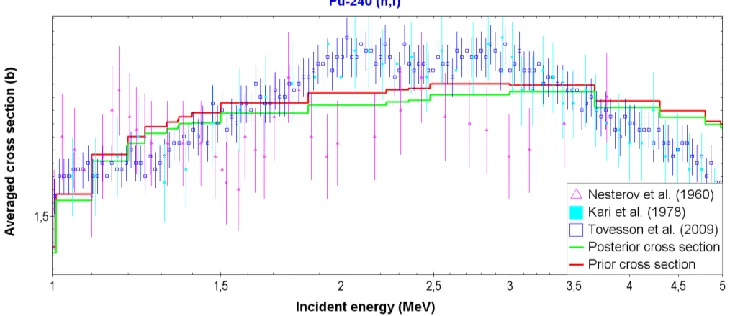
Once the assimilation was performed, the posterior covariance matrices and original sensitivity coefficients were used to propagate the uncertainties. The consistency of the assimilation was assessed against experimental data. An example of the consistency checks is given in Fig. 2, where the prior and posterior 240Pu(n,f) cross sections after the assimilation
with PMF002 integral experiment are represented. It can be seen that the central value of the cross section has been modified in the fast energy range and is compatible with the various experimental differential data.
Fig. 2. 240Pu(n,f) prior and posterior cross sections compared with experimental data.
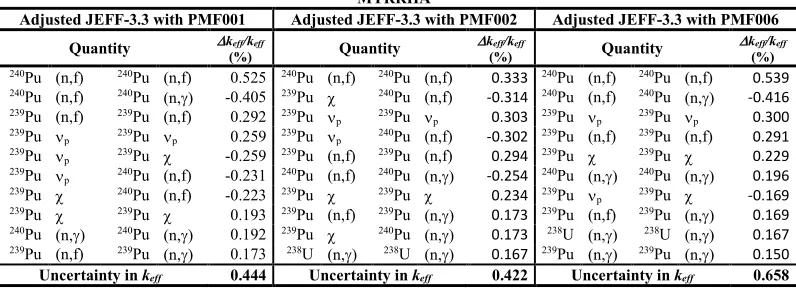
The results from the UQ using the posterior covariance matrices are presented in Table 4. The highest reduction in MYRRHA keff uncertainty is given by the assimilation of PMF002
experiment (the most sensible to 240Pu and most representative of MYRRHA) due to the
substantial reduction in the uncertainty of the two major contributors, i.e., 240Pu(n,f) and 240Pu(n,f)- 240Pu (n,). Furthermore, new strong negative cross-correlations between isotopes
and reactions appear after the adjustment, such as 239Pu
p-240Pu(n,f), which are the main
Table 4. UQ for MYRRHA using adjusted covariance matrices.
MYRRHA
Adjusted JEFF-3.3 with PMF001 Adjusted JEFF-3.3 with PMF002 Adjusted JEFF-3.3 with PMF006
Quantity keff/keff
(%) Quantity k(%)eff/keff Quantity k(%)eff/keff
240Pu (n,f) 240Pu (n,f) 0.525 240Pu (n,f) 240Pu (n,f) 0.333 240Pu (n,f) 240Pu (n,f) 0.539 240Pu (n,f) 240Pu (n,) -0.405 239Pu 240Pu (n,f) -0.314 240Pu (n,f) 240Pu (n,) -0.416 239Pu (n,f) 239Pu (n,f) 0.292 239Pu
p 239Pu p 0.303 239Pu p 239Pu p 0.300 239Pu
p 239Pu p 0.259 239Pu p 240Pu (n,f) -0.302 239Pu (n,f) 239Pu (n,f) 0.291 239Pu
p 239Pu -0.259 239Pu (n,f) 239Pu (n,f) 0.294 239Pu 239Pu 0.229 239Pu
p 240Pu (n,f) -0.231 240Pu (n,f) 240Pu (n,) -0.254 240Pu (n,) 240Pu (n,) 0.196 239Pu 240Pu (n,f) -0.223 239Pu 239Pu 0.234 239Pu
p 239Pu -0.169 239Pu 239Pu 0.193 239Pu (n,f) 239Pu (n,) 0.173 239Pu (n,f) 239Pu (n,) 0.169 240Pu (n,) 240Pu (n,) 0.192 239Pu 240Pu (n,) 0.173 238U (n,) 238U (n,) 0.167 239Pu (n,f) 239Pu (n,) 0.173 238U (n,) 238U (n,) 0.167 239Pu (n,) 239Pu (n,) 0.150
Uncertainty in keff 0.444 Uncertainty in keff 0.422 Uncertainty in keff 0.658
5 Conclusions
A target accuracy assessment of the effective neutron multiplication factor for MYRRHA innovative lead-bismuth cooled fast reactor has been carried out using the JEFF-3.3 and ENDF/B-VIII.0 state-of-the-art nuclear data libraries and the SUMMON system. Similar sensitivities and total keff uncertainty have been derived using both libraries, however, the
contributors to the uncertainty significantly differ. This have been attributed to differences in the evaluations, to missing correlations and to missing covariance evaluations. Moreover, the uncertainties in keff due to uncertainties in nuclear data have been assessed against the target
accuracies provided by SG-26 of the WPEC of OECD/NEA in 2008 for LFR. Results show that keff target accuracy is still exceeded by more than a factor of two using the latest nuclear
data evaluations released in 2018.
In order to constrain the uncertainties in keff, an assimilation on the main contributors to
the uncertainty has been performed using only JEFF-3.3 nuclear data as a prior and publicly available critical mass experiments from the International Criticality Safety Benchmark Evaluation Project. The consistency of the nuclear data adjustment has been checked against differential experimental data and good agreement has been found. A significant reduction in keff uncertainty has been obtained using the experiments most representative of MYRRHA,
due to the reduction in the uncertainty of the major contributors and to the presence a posteriori of strong cross-correlations between isotopes and reactions that did not exist a priori. Results show that a reduction of nearly 300 pcm can be achieved performing an assimilation with the most sensitive experiment to the major contributor to the uncertainty, proving that the combination of experimental covariance data and integral experiments together with Generalised Least Squares technique, can provide adjusted nuclear data capable of predicting reactor properties with lower uncertainty and consistent with differential data.
References
1. Sustainable Nuclear Energy Technology Platform. http://www.snetp.eu 2. I. Kodeli, Report OECD/NEA (2007)
6. D.A. Brown et al., Nucl. Data Sheets 148, 1-142 (2018) 7. P. Romojaro et al., M&C 2017 (2017)
8. C.J. Díez et al., Nucl. Data Sheets 118, 526-518 (2014) 9. A. Stankovskiy et al., Nucl. Data Sheets 118, 513-515 (2014) 10. T. Sugawara et al., Ann. Nucl. Energy 38, 1098-1108 (2011) 11. P. Romojaro, Ann. Nucl. Energy 101, 330-338 (2017) 12. OECD/NEA, NEA/NSC/DOC(95)03/I (2016) 13. P. Romojaro et al., PHYSOR 2018 (2018)
14. C. De Saint Jean et al., OECD/NEA NEA/NSC/WPEC/DOC(2010)429 (2011) 15. A. Stankovskiy et al., SCK•CEN/4463803 (2014)
16. M. Salvatores et al., OECD/NEA NEA/WPEC-26 (2008) 17. OECD/NEA, NEA/NSC/DOC(95)03/II (2016)