A STUDY ON CORT PROGRAM OF THINKING SKILLS (BREADTH)
TO DEVELOP EXPOSITORY WRITING SKILLS AMONG PRIMARY
PUPILS
Mahendran Maniam1+
Thanageswary K. Thanasamy2
Jeevitra Sentna Raja3
Kalaivaani Aluemalai4
1,2,3,4University Pendidikan Sultan Idris,Malaysia.
(+ Corresponding author)
ABSTRACT
Article History Received: 6 February 2020 Revised: 12 March 2020 Accepted: 14 April 2020 Published: 25 May 2020
Keyword
s
Cognitve research trust (CoRT) Writing skill
Primary students Expository writing Teaching Learning.
The purpose of this study is to determine the use of Cognitive Research Trust (CoRT) Program to teach expository writing for primary Year 6 students. The participants of this study comprised of 25 students who have acquired basic language skills, however they struggle to write good essays as they do not know the techniques to elaborate ideas. The data of this mix-mode study were collected through tests (Pre-test and Post-test) and interview. The test results showed that the mean score of the Post-Test was significantly higher than the mean score of the Pre-Test. The findings from the interview showed that the participants had positive response towards this intervention and it was a helpful tool to improve their writing skill. The findings strongly suggested that CoRT program could be a useful technique in assisting the teaching and learning process of writing skills.
Contribution/ Originality:
This study is one of very few studies which have investigated CORT programmeamong Malaysian primary school children. The findings showed that the participants had positive response towards this intervention and it was a helpful tool to improve their writing skill. The findings strongly suggested that CoRT program could be a useful technique in assisting the teaching and learning of writing skill.
1. INTRODUCTION
Writing is one of the most important skills that every student need to acquire, however it is also known for its difficulty and complexity. According to Al-Mukdad (2019) writing is regarded as a difficult skill for both native and non-native students because students should have the ability to balance multiple issues, such as content, organization, purpose, audience, vocabulary, punctuation, spelling, and mechanics in writing. Moreover, writing also encompasses thinking and learning process, motivates communication, and makes our thoughts available for reflection (Welie, Schoonen, & Kuiken, 2018). According to Lincoln and Idris (2015) writing is not a skill that we acquire naturally like speaking. It has to be taught gradually even for first language learners. Children are increasingly expected to express what they know about many different subjects through writing as they progress through school. However, many children struggle to write in English without proper guidance to organize and elaborate their ideas.
International Journal of Asian Social Science
ISSN(e): 2224-4441 ISSN(p): 2226-5139
DOI: 10.18488/journal.1.2020.105.232.247 Vol. 10, No. 5, 232-247.
According to Nobahar, Tabrizi, and Shaghaghi (2013) teachers should include instructions and practices with strategies on how to deal with writing composition, how to generate ideas on a topic, how to rehearse ideas and how to consider the options prior to devising a plan for organizing their plan. Consequently, they will gradually learn and acquire the method of how to get started when writing English composition. Most pupils avoid writing essays because they do not know how to begin and far more worse is that they are unable to organize their ideas well. Therefore, CoRT program will be used to induce ideas from students to provide a platform for the pupils to write better and their personal involvement in the subject of discussion could make the writing to be more interesting as well as challenging for the pupils.
1.1. Cognitive Research Trust (CoRT) Programme
CoRT is a program implemented in many countries for teaching thinking which was established by Edward de Bono, one of the pioneers of brain training, in Cambridge, England (DeBono, 1984). This program is widely used for direct teaching of thinking over 7 million students in more than 30 countries, including the United States, the United Kingdom, Japan, Canada, Australia, Singapore, Ireland and Venezuela. CoRT is a package of 6 sections consist of 10 lessons each respectively, used for teaching constructive thinking from the age of 8 and onwards
(Debono, 2014). The program signifies the most comprehensive method of teaching thinking which includes
constructive and operational thinking as well as creative and generative thinking (Debono., 2009). It comprises of six thinking tools which are (1) Breadth, (2) Organization, (3) Interaction, (4) Creativity, (5) Information and (6) Action. This research would focus on the effectiveness of the first part of the CoRT Program.
CoRT (1) Breadth This section helps students to widen their perception. It is crucial that it must be taught before any other section as this section provide the foundation before introducing other sections. It encompasses of 10 lesson and the researcher prepared a training program incorporating 7 lessons, which have been described below:
Lesson 1: Plus, Minus, Interesting (PMI) - Exploring all the plus, minus and interesting aspects in a situation or thought.
Lesson 2: Consider all factors (CAF) – Examining all the possible factors associated with a situation or idea.
Lesson 3: Consequence and Sequel (C&S) – Involves seeking for all possible consequences and sequels in the short term and long term.
Lesson 4: Aims, Goals, Objectives (AGO) – Identifying the aims, goals and objectives of a work or a decision made. Lesson 5: First Important Priorities (FIP) – Selecting the possibilities and arranging them on the list of priorities. Lesson 6: Alternatives, Possibilities, Choices (APC) – Finding all the alternatives, possibilities and options and taking them into account in making decisions.
Lesson 7: Other people views (OPV) – Drawing attention to the views of others related to the situation.
The widely used CoRT program is based on the belief that should be taught in schools explicitly, not incidentally. Hussin (2018) believes that there is a strong feeling growing among educators that thinking is a skill by itself that should be given direct attention. The author further highlighted that it has been a greater task in the philosophy of education to produce a generation who are able to think for themselves which coherent with the emergence of Education 4.0. Edward De Bono once said, “I think there is a danger with young people of being dependent in the sense that they don‟t acquire any identity or self-image of themselves as thinker”. Therefore, it is crucial and necessary to implement CoRT program into the education system to improve students‟ writing skills.
2. STATEMENT OF PROBLEM
factors such as lack of exposure, lack of real world knowledge, poor reading habits, the inability to organize ideas and etcetera. Therefore, this research will provide some insights on whether or not the CoRT program used to elicit ideas for writing essays is able to improve pupils‟ writing skills. Debono. (2009) in his book described this method as glasses method. “If you have poor eyesight you cannot see the world clearly, with glasses you can see the world more clearly”. With that, we can hope that pupils can improve their writing skills. Thus, it is the teachers‟ responsibility to prepare the next generation for Education 4.0 where they are capable of thinking on their own and generate ideas to be more productive.
3. RESEARCH OBJECTIVES
a) To investigate the effects of teaching CoRT program (BREADTH) on developing pupils‟ ability to write essay in English Language.
b) To find out pupils‟ perception towards the use of CoRT program for teaching thinking.
4. RESEARCH QUESTIONS
a) Are there statistically significant differences between the pre and Post-Test result on pupils‟ writing skills based on the Cort program (BREADTH) for teaching thinking?
b) What are the pupils‟ perception towards the first part of the CoRT program for teaching thinking?
5. PURPOSE OF THE STUDY
The purpose of the study is to explore the effectiveness of the first part of CoRT program (BREADTH) in helping pupils to improve their writing skills. Besides, the researcher also intended to find out pupils‟ perception towards CoRT program in enhancing their writing ability. In order to carry out this research, the participants were chosen from a rural school in southern of Perak district who are at the age of twelve. I have discovered this writing problem among the pupils during my teaching and learning process in the school. I believe my research would be helpful to find a solution for the pupils‟ writing issue.
6. LITERATURE REVIEW
6.1. Review on the Past Studies
There have been a number of researches done in this area by other researchers. Their findings based on their respective researches prove that CoRT program does not fail to have a positive impact on the students‟ performance. The findings of these researchers further consolidate this study that CoRT program is indeed vital to prepare students before they write their composition. The past studies can be divided into two sections; all the general studies conducted using CoRT and the other section focuses on studies conducted specifically on English language using CoRT.
6.2. Past Studies on CoRT
Al-Edwan (2011) investigated the effects of CoRT strategies in critical thinking for history course using 163
seventh grade students in Jordan. The result indicated that there were statistically significant differences in the participants‟ critical thinking for history course with the use of CoRT strategies. Another study in Malaysia conducted by Anida, Husna, Intan, and Zulkifli (2019) explored on the use of CoRT scale to assess students Higher-Order Thinking skills (HOTS) in Malay language using six Malay language teachers as their sample. The result indicated the appropriate use of CoRT program could help the students to improve HOTS.
develop 21st century learning skills through CoRT program. The results were strongly in favor of CoRT strategies to stimulate critical and creative thinking skills which is essential survival skill in this era.
6.3. Past Studies on CoRT for English Language
Alshurman (2017) conducted experimental research to study the effects of CoRT 1 (Breadth) for teaching
thinking by employing communication scale measurement for the Pre-Test and Post-Test data collection tool. The target students were 36 second semester university students. The result indicated that there were statistically significant differences (α=0.05) between the pre and post results of the experimental group, thus proving the effectiveness of CoRT program on the development of communication skill by expanding their understanding and perception circle. Also in Jordan, Al-Faoury and Khwaileh (2014) revealed that CoRT program developed students‟ creativity in writing short stories and further recommended that CoRT could increase students‟ fluency, originality and flexibility in writing.
Another quantitative research was done by Hmeadat (2016) using CoRT program on a sample consisted of 86 seventh grade students from a Jordanian private school by administrating pre and Post-Test. The results from the tests revealed that there was a statistical significant difference at (α = 0.05) in the scores of the control and experimental group. The result was in favor of the experimental group and the researcher recommended that CoRT program can be used as a new instructional model.
It can be concluded that CoRT program to improve expository writing are used effectively in foreign countries and scant in ESL classroom in Malaysia. Despite the studies on CoRT program is skewed towards the achievement gains, some important research gaps remain. Therefore, more researches are needed to study on the relationship between CoRT program and effectiveness on their writing skills among ESL learners in ESL countries, especially in Malaysia. This brought my attention to conduct a study using CoRT program to improve students‟ expository writing skills in Malaysian ESL classroom.
7. METHODOLOGY
7.1. Research Method
First of all, research design encompasses two types of research which are quantitative and qualitative research. Quantitative research is based on numerical analysis and objective measurement of collecting data through surveys or questionnaire whereas, qualitative research emphasizes on a systematic subjective approach to gain an insight or to explore the depth of the phenomenon through interviews, observations or analysis (Eriksson, Boistrup, &
Thornberg, 2018; Ma, 2015). This study is a mixed mode research where both qualitative and quantitative research
method are used. Interview was conducted to collect qualitative data whereas Pre-Test and Post-Test were administered to collect quantitative data.
7.2. Participants
This study was conducted with 25 Year 6 primary school pupils. They are homogenous in few aspects as they share the same cultural background. Their first language is Malay and they use Malay as the medium of instruction. The researcher adopted non-probability sampling methods, which was convenient sampling. The participants were chosen based on the accessibility of the researcher to study on the subjects.
7.3. Data Collection Tool 7.3.1. Pre-Test – Post-Test
Appendix 1). Thus, there is high reliability and validity in the test as it is directly taken from Cambridge. Participants underwent a Pre-Test without the knowledge of CoRT program and for the Post-Test, participants employed the techniques taught in the CoRT program. This was done to look for any differences between the Pre-Test and Post-Pre-Test essays. The difference between the writing scripts obtained from both the tests will determine to what extent the CoRT program was helpful to the students to write expository essays.
7.4. Interview
A semi-structured interview was employed to ensure the collection of detailed data which may not be accessed when questionnaires are used (Roulston, 2019). Interview can be considerably useful tool in allowing the participants to talk and express their perception towards the intervention. Besides, the researcher has the flexibility to ask for clarification by probing questions when the participants‟ responses are unclear, thus it enhances validity of the instrument. The semi-structured interview instrument is a researcher made instrument. The instrument has been attached in Appendix 2. Five participants were interviewed on volunteerism basis. Their interviews were audio-recorded and transcribed verbatim afterwards. This would provide a permanent record of what was and what was not said during the interview (Gill, Stewart, Treasure, & Chadwick, 2008). The interviews were conducted after all the interventions have been implemented completely. Participants were asked for their perception on essay writing before and after introducing CoRT program.
8. DATA ANALYSIS
8.1. Tests
The writing scripts obtained from the Pre-test and Post-test from the participants was evaluated. The researcher assigned an UPSR examiner to evaluate the writing scripts based on a marking scheme (Refer to
Appendix 3) The evaluation was based on the scores awarded to the most number of main ideas that can be produced
by the participants. The focus of analysis was mainly on the content of the writing scripts for both the Pre-Test and Post-Test. The main purpose was to make a comparison between the content of both the tests.
The raw scores obtained from the tests were analyzed to produce graphs for the scores of Pre-Test and Post-Test. Besides, the researcher utilized the scores from both tests in deriving the mean and standard deviation scores. Based on the scores of the Pre-Test and Post-Test, the researcher determined the status of the NULL hypothesis of this study.
8.2. Interview
The interview transcriptions were analyzed through thematic analysis. This process contains of six steps which are organizing data, coding and describing data, identifying themes, connecting and interrelating data and finally providing meaning (Roulston, 2019). In this study, the data of interview transcriptions were analyzed based these six steps. Based on the transcription, the data was organized in small chunks of information so that it allowed the researcher to pick out concepts and themes easily. Once the data was organized, the ideas and concepts were organized into themes. Next, the researcher tried finding connection between the themes and interrelated the themes. Finally, the researcher provided meaning by making a summary of the findings and the themes.
9. DATA COLLECTION PROCEDURES
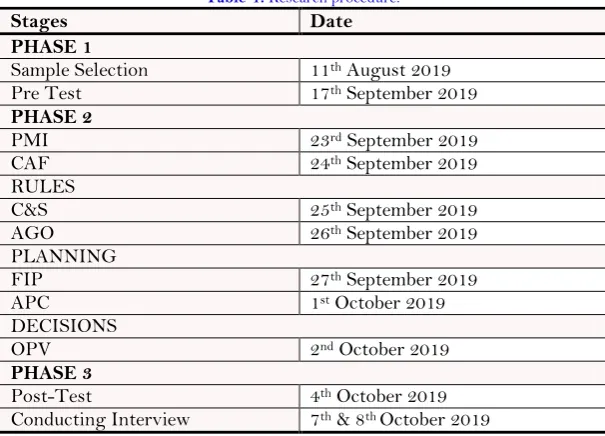
The data collection procedure is the overall illustration of the research that was carried out by the researcher. Therefore, research procedure clearly explain the steps that has been executed in a chronological order (Refer to
Table 1). This research was categorized into three phases; Phase 1, Phase 2 and Phase 3. Phase 1 is the stage before
Table-1. Research procedure.
Stages Date
PHASE 1
Sample Selection 11th August 2019
Pre Test 17th September 2019
PHASE 2
PMI 23rd September 2019
CAF 24th September 2019
RULES
C&S 25th September 2019
AGO 26th September 2019
PLANNING
FIP 27th September 2019
APC 1st October 2019
DECISIONS
OPV 2nd October 2019
PHASE 3
Post-Test 4th October 2019
Conducting Interview 7th & 8th October 2019
10. RESULTS
The results have been categorized according to the two research questions. Two types of data collection tools were used namely, Pre-Post Test and Interview. The pre-test and post-test scores were analyzed by the descriptive statistics. On the other hand, the interview responses were analyzed according to each questions.
10.1. Results Concerning the First Research Question
The scores from the Pre-Test and Post-Test were tabulated as in Appendix 4. The pupils answered a short essay about “Friend” during the pre-test and an essay about “Ambition” in the post-test. The marked essay are attached below as Appendix 5. The pupils‟ score were divided according to three groups. The scores were categorized as Above Average, Average and Below Average.
The scores of pupils according to the categories are stated below in Table 2.
Table-2. Range of scores.
Range of scores Pre-test Post-test
Above Average (18 - 25) 0 22
Average (10 - 17) 20 3
Below Average (0 - 9) 5 0
Total 25 25
The range of scores showed that pupils performed better in post-test as compared to pre- test. Pre-test result showed that there were 0 pupils in the above average group, 20 pupils in the average group and 5 pupils in the below average group. On the contrary, in post-test there were 22 pupils in the above average group, 3 pupils in the average and none in below average. This shows a vast difference in the scores and the success of the CoRT program in helping pupils to think of points and write an essay.
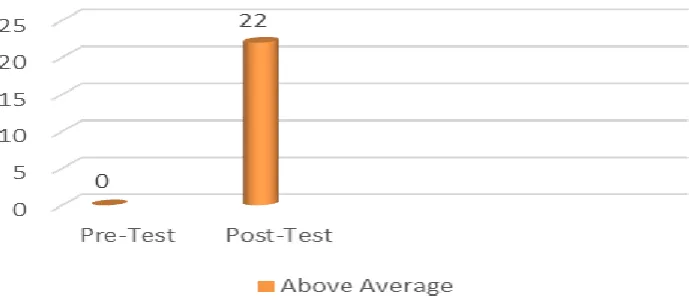
Figure-1(a). Comparison of the above average group pre-test and post-test results.
Figure 1 (a) shows the Bar Graph above indicates that the pupils scored better in post-test as compared to
pre-test. This can be seen as there were none of them whom scored 18-25 marks before the intervention of CoRT. But 22 out of 25 participants were in this category during post-test. This clearly shows that the CoRT thinking program has given a great impact on the pupils to write better. As the highest score is 25, the pupils scored full marks for points in the essay write up.
Figure-2(b). Comparison of the average group pre-test and post-test results.
Figure 2(b) shows that the number pupils in the average group decreased in post-test as compared to pre-test.
This can be seen as there 20 of them whom scored 10-17 marks before the intervention of CoRT. But the quantity dropped to 3 during post-test. This proves that the CoRT thinking program has given extensive ways for pupils to write better.
Figure-3(c). Comparison of the average group pre-test and post-test results.
Figure 3 (c) shows the number pupils in the below average group dropped to 0 in post-test as compared to 5
the greatest achievement of CoRT program. This also proves that the CoRT thinking program has impacted the weaker pupils to write at least a little and score better.
This study employed a pre-test and post-test design and was concerned with 7 approaches in the CoRT Program. It aimed at comparing the performance of learners exposed to the 7 approaches of brainstorming techniques in order to write an expository essay effectively. The results obtained from the pre-test and post-test were analyzed using descriptive statistics as in Table 3.
Table-3. Pre-test and post-test result.
Type of test Number of pupils Min Max Mean Standard deviation
Pre-Test 25 8 15 11.72 2.354
Post-Test 25 17 25 21.4 2.415
According to the results in Table 3, there was a significant difference in the scores between pre-test (M=11.72, SD=2.354) and post-test (M=21.4, SD=2.415). That is, the use of CoRT Program (BREADTH) on pupils‟ writing skills for teaching thinking has positive effect on pupils‟ performance. The minimum score for pre-test is 8 but it shoot up to 17 in the post-test and the maximum in pre-test is 15 whereby it progressed to 25 in the post-test. Thus, with the use of CoRT program, pupils‟ performed better in the post-test and made a big progress.
10.2. Results Concerning the Second Research Question
The second research question is “What are the pupils‟ perception towards the first part of the CoRT program for teaching thinking?” In answering the second research question, the responses of the pupils were categorized into 7 different questions as in the table below. 5 pupils whom volunteered were interviewed before and after intervention. The analysis of the pupils‟ responses allowed us to better understand how they experienced the use of CoRT as one of the thinking tool in their learning contexts. The pupils‟ observed presented mixed levels of familiarity with the CoRT programs. Some were keen about PMI method and some CAF and C and S while others used AGO. Pupils did not enjoy writing due to the difficulties they face to come up with the points and felt confusing. On the other hand, CoRT program helped the pupils to think about the points as the framework is given. The responses of the pupils are displayed in the table below and the transcription is attached in the appendices. (Appendix 6 - 10).
Table-4. Pupils‟ responses for the first question.
1. Did you run out of ideas in the process of writing?
S1 S2 S3 S4 S5
Yes-know little Yes-hard Yes-scared Yes-stuck Yes- little idea
When the pupils were asked “Did you run out of ideas in the process of writing?” before the intervention, their responses differ. But all of them answered “YES”. They said that they know a little, hard, scared, stuck and little idea as can been seen in Table 4. These responses gives us the idea that pupils were facing difficulties to come up with the suitable points for the topic.
Table-5. Pupils‟ responses for the second question.
1. Did you have a clear focus on what to write?
S1 S2 S3 S4 S5
Before After Before After Before After Before After Before After No-hard
Secondly, the question “Did you have a clear focus on what to write?” has gained two different responses. The pupils answered “NO” before the intervention whereas one pupil answered yes but not clear. The pupils said it is hard to have a focus, they go out of topic, confusing and English is hard as stated in Table 5. On the other end, pupils responded “YES” after the invention. One pupils responded on using PMI and others responded using CoRT helps them to write in focus.
Table-6. Pupils‟ responses for the third question.
1. Did you enjoy the writing lesson?
S1 S2 S3 S4 S5
Before After Before After Before After Before After Before After No-hard Yes No- sentence
hard Yes. No-point difficult Yes No-don‟t know. Yes -easier No-a lot Yes simple -
Table 6 shows, the pupils were asked “Did you enjoy the writing lesson?”. The pupils responded “NO” before
the intervention whereas “YES” after the intervention. They said No because it is hard, writing sentence is hard, points are difficult, a lot and one pupil mentioned „don‟t know.‟ After the intervention of CoRT program, pupils find it easier and simple.
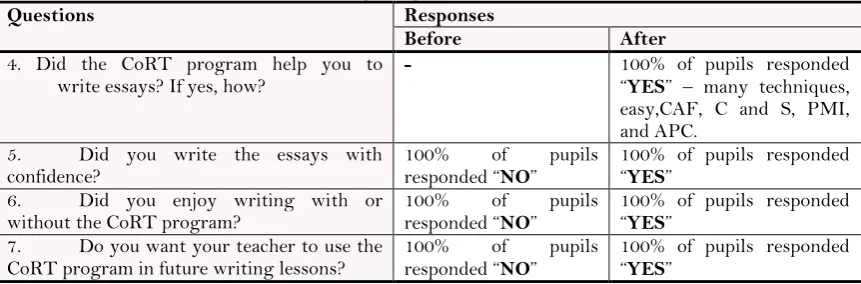
Table-7. Pupils‟ responses for the questions.
Questions Responses
Before After
4. Did the CoRT program help you to
write essays? If yes, how? - 100% of pupils responded “YES” – many techniques, easy,CAF, C and S, PMI, and APC.
5. Did you write the essays with
confidence? 100% responded “NO” of pupils 100% of pupils responded “YES” 6. Did you enjoy writing with or
without the CoRT program? 100% responded “NO” of pupils 100% of pupils responded “YES” 7. Do you want your teacher to use the
CoRT program in future writing lessons? 100% responded “NO” of pupils
100% of pupils responded “YES”
Table 7 shows the rest of the questions are as stated above. All the 5 respondents said that CoRT program
helped them to write as it taught them many techniques, easy and they can use CAF,C and S, PMI and APC. They could grasp the techniques. The questions on confidence and the pupils enjoy using CoRT yield a result of two extremes. The extremes are No before the intervention and Yes after the introduction of CoRT. Last but not least, the question on “ Do you want your teacher to use the CoRT program in future writing lessons?” got the response of Yes from all the 5 pupils whom were interviewed.
11. DISCUSSIONS, CONCLUSIONS AND RECOMMENDATIONS
Respondents showed a positive result with CoRT Program on writing essays. These findings are in line with
Al-Faoury and Khwaileh (2014) findings that CoRT program developed students‟ creativity in writing short stories.
Al-Faoury and Khwaileh (2014) recommended that CoRT could increase students‟ fluency, originality and flexibility in writing. Further researches need to be done in these areas as CoRT gives a positive impact on pupils‟ language learning process. Apart from that, this study specifically involves a minimum sample size that a study must have (Creswell, 2009) for the acceptance of its findings. Therefore, this study has narrow scope for its generalization to larger sample. In short, it can be concluded that pupils‟ writing skills based on the CoRT Program (BREADTH) for teaching thinking yields a positive result and it is useful for pupils.
Funding: This study received no specific financial support.
Competing Interests: The authors declare that they have no competing interests.
Acknowledgement: All authors contributed equally to the conception and design of the study.
REFERENCES
Al-Edwan, Z. S. M. (2011). The effectiveness of a training program based on cognitive research trust strategies to develop
seventh grade students‟critical thinking in history course. Journal of Social Sciences, 7(3), 436-442.Available at:
https://doi.org/10.3844/jssp.2011.436.442.
Al-Faoury, O. H., & Khwaileh, F. (2014). The effect of teaching CoRT program no.(4) entitled" creativity" on the gifted learners'
writings in Ein El-Basha center for gifted students. Theory and Practice in Language Studies, 4(11), 2249-2258.Available
at: https://doi.org/10.4304/tpls.4.11.2249-2257.
Al-Mukdad, S. (2019). Investigating English academic writing problems encountered by arab international university students. Theory and Practice in Language Studies, 9(3), 300-306.Available at: https://doi.org/10.17507/tpls.0903.07.
Alshurman, W. M. (2017). The effects of the first part of the CoRT program for teaching thinking (BREADTH) on the
development of communication skills among a sample of students from Al al-Bayt University in Jordan. Educational
Research and Reviews, 12(2), 73-82.Available at: https://doi.org/10.5897/err2016.3069.
Anida, S., Husna, F. M. R., Intan, S. M. A. A.-B., & Zulkifli, O. (2019). Using the cognitive research trust scale to assess the
implementation of the elements of higher-order thinking skills in Malay language teaching and learning. International
Journal of Recent Technology and Engineering, 8(2), 392-398.Available at:
https://doi.org/10.35940/ijrte.b1064.0782s219.
Creswell, J. (2009). Research design: Qualitative, quantitative, and mixed methods approaches (3rd ed.). Thousand Oaks, CA: Sage.
DeBono, E. (1984). Critical thinking is not enough. Educational Leadership, 42(1), 16-17.
Debono, E. (2014). Dr. Edward De Bono, brain training and lateral thinking pioneer. Retrieved from http://www.edwdebono.com\debono\index.html.
Debono., E. (2009). Cort thinking lessons. United Stated of America: The Opportunity Thinker.
Eriksson, E., Boistrup, L. B., & Thornberg, R. (2018). A qualitative study of primary teachers‟ classroom feedback rationales. Educational Research, 60(2), 189-205.Available at: https://doi.org/10.1080/00131881.2018.1451759.
Gill, P., Stewart, K., Treasure, E., & Chadwick, B. (2008). Methods of data collection in qualitative research: Interviews and focus
groups. British Dental Journal, 204(6), 291-295.Available at: https://doi.org/10.1038/bdj.2008.192.
Hmeadat, S. R. A. (2016). The effect of the cognitive research trust program for development of thinking skills on the
achievement of the Jordanian English language learners. The Arab Journal of Sciences and Research Publishing, 2(1),
442-450.Available at: https://doi.org/10.12816/0025342.
Hussin, A. A. (2018). Education 4.0 made simple: Ideas for teaching. International Journal of Education and Literacy Studies, 6(3),
92-98.Available at: https://doi.org/10.7575/aiac.ijels.v.6n.3p.92.
Lincoln, F., & Idris, A. B. (2015). Teaching the writing process as A first and second language revisited: Are they the same? Journal of International Education Research, 11(2), 119-124.Available at: https://doi.org/10.19030/jier.v11i2.9192.
Ma, F. (2015). A review of research methods in EFL education. Theory and Practice in Language Studies, 5(3), 566-571.Available
Momin, N. K. C., & Marak, K. T. K. (2019). Transformational application avenue of CoRT thinking strategy for higher
education. International Journal of Advance Research, 7(4), 48-54.Available at: https://doi.org/10.21474/ijar01/8789.
Nobahar, B., Tabrizi, A. R. N., & Shaghaghi, M. (2013). The effect of concept mapping on iranian intermediate EFL learners'
self-efficacy and expository writing accuracy. Theory and Practice in Language Studies, 3(11), 2117-2127.Available at:
https://doi.org/10.4304/tpls.3.11.2117-2127.
Roulston, K. (2019). Preparing researchers to conduct interdisciplinary, multi-method qualitative research. The Qualitative
Report, 24(9), 2259-2292.
Tilemma, M. (2012). Writing in first and second language. International Journal of Teaching and Education, 3(4), 21 – 34.
Welie, C., Schoonen, R., & Kuiken, F. (2018). The role text structure inference skill plays for eighth graders‟ expository text
comprehension. Reading and Writing, 31(9), 2065-2094.Available at: https://doi.org/10.1007/s11145-017-9801-x.
APPENDICES
APPENDIX 1
Cambridge English Exam – Preliminary Englist Test (Part 3)
Name : ____________________________________ Class: _____________ This section consists of two questions. Answer ONE question only.
Write an essay based on the given topic. Your essay should be between 80 to 100 words.
1. Everyone needs friends. What qualities make someone a good friend? How can you be a friend for someone who needs one? Write an essay that explains ways to be a good friend.
2. People do all kinds of jobs. Some people build. Others serve. Some teach. Others sell. Some people work on ships at sea, and others in skyscrapers in cities. What kind of job would you like to do? As a future worker, write an essay that names a job you would like, describes the work, and tells why you would like it.
______________________________________________________________________________________________ ______________________________________________________________________________________________ ______________________________________________________________________________________________ ______________________________________________________________________________________________ ______________________________________________________________________________________________ ______________________________________________________________________________________________ ______________________________________________________________________________________________ ______________________________________________________________________________________________ ______________________________________________________________________________________________ ____________
APPENDIX 2
Section A (The next four questions are students’ experience before introducing CoRT programme) 1. Did you run out of ideas in the process of writing?
2. Did you have a clear focus on that to write? 3. Did you write the essays with confidence? 4. Did you enjoy the writing lesson?
Section B (The next 5 questions are students’ experience after introducing CoRT programme) 5. Did the CoRT programme help you to write essays? If yes, how?
9. Did you enjoy writing with or without the CoRT programme?
10. Do you want your teacher to use the CoRT programme in future writing lessons?
APPENDIX 3
Analytic Rubric for Scoring Writing Ideas
16 - 20 Main idea is distinct and is developed through vivid and relevant details. Well organized with a strong beginning, middle, and end.
11-15 Main idea is clear and is developed through relevant details. Organized with a beginning, middle, and end.
6 – 10 Main idea is evident and is somewhat developed through details, some of which may be irrelevant.
Attempts to organize with a beginning, middle, and end.
0 – 5 Main idea is not present, or a main idea is not developed with details. Does not have a beginning, middle, or end.
Mechanics
5 Very few or no grammar, spelling punctuation, or capitalization errors 4 Relatively few grammar, spelling, punctuation, or capitalization errors 3 Some grammar, spelling punctuation, or capitalization errors
2 Many grammar, spelling, punctuation, or capitalization errors 1 No complete sentences.
APPENDIX 4
Students Pre-Test Post-Test Difference
1 12 20 8
2 8 23 15
3 12 22 10
4 9 19 10
5 13 22 9
6 13 23 10
7 15 25 10
8 15 25 10
9 14 22 8
10 11 22 10
11 10 20 10
12 12 20 8
13 15 23 8
14 13 22 9
15 15 24 9
16 14 23 9
17 9 17 8
18 8 19 11
19 12 25 13
20 8 22 14
21 11 20 9
22 10 17 7
23 10 17 7
24 14 23 9
25 10 20 10
APPENDIX 5 – Respondent 1
Interviewer / Interviewee Questions and Responses Keywords
Warm Up Session
Researcher Hi, how are you?
Respondent 1 Hi teacher, I am fine thank you. Researcher What did you have for breakfast?
Researcher Can I ask you a few questions regarding the research?
Respondent 1 Yes teacher.
Section A (The next four questions are students‟ experience before introducing CoRT programme) Researcher Did you run out of ideas in the process of writing?
Why?
Respondent 1 Yes, hmmmm. I feel I know very little. Yes-know little Researcher Did you have a clear focus on that to write? Why?
Respondent 1 No….because I feel the topic is hard at times. So I
just write whatever I feel like writing. No-hard Researcher Did you write the essays with confidence?
Respondent 1 No, teacher. No
Researcher Did you enjoy the writing lesson? Why?
Respondent 1 No. Writing is hard. No-hard
Section B (The next 6 questions are students‟ experience after introducing CoRT programme) Researcher Did the CoRT programme help you to write
essays? If yes, how?
Respondent 1 Yes…..in a way that it has many techniques. Yes-many techniques Researcher Did you have a clear focus on what to write?
Respondent 1 Yes with the Plus Minus Interesting point. It helps
me to think of points easily. Yes-PMI Researcher Did you write the essays with confidence?
Respondent 1 Yes. Yes
Researcher Did you enjoy the writing lesson?
Respondent 1 Yes. Yes
Researcher Did you enjoy writing with or without the CoRT programme?
Respondent 1 I enjoy with Cort because of the ways. Yes-CoRT-ways Researcher Do you want your teacher to use the CoRT
programme in future writing lessons?
Respondent 1 Yes. Yes
Researcher Thank you for your response. Respondent 2 You‟re welcome teacher.
APPENDIX 6 – Respondent 2
Interviewer / Interviewee Questions and Responses Keywords
Warm Up Session
Researcher Hi, how are you?
Respondent 2 Hi teacher, I am fine thank you. Researcher What did you have for breakfast? Respondent 2 I had bread.
Researcher Can I ask you a few questions regarding the research? Respondent 2 Yes teacher.
Section A (The next four questions are students‟ experience before introducing CoRT programme) Researcher Did you run out of ideas in the process of writing? Why?
Respondent 2 Yes. I feel very hard. Yes-hard
Researcher Did you have a clear focus on that to write? Why?
Respondent 2 No….because the topic is confusing. No- confusing Researcher Did you write the essays with confidence?
Respondent 2 No. No
Researcher Did you enjoy the writing lesson? Why?
Respondent 2 No. The sentence cannot write. No- sentence
Researcher Did the CoRT programme help you to write essays? If yes, how?
Respondent 2 Yes, I like the Consider All Factors. Yes-CAF Researcher Did you have a clear focus on what to write?
Respondent 2 Yes. Yes.
Researcher Did you write the essays with confidence?
Respondent 2 Yes. Yes
Researcher Did you enjoy the writing lesson?
Respondent 2 Yes. Yes.
Researcher Did you enjoy writing with or without the CoRT programme?
Respondent 2 Yes with CoRT. Yes-CoRT.
Researcher Do you want your teacher to use the CoRT programme in future writing lessons?
Respondent 2 Yes. Yes.
Researcher Thank you for your response. Respondent 2 You‟re welcome teacher.
APPENDIX 7 – Respondent 3
Interviewer / Interviewee Questions and Responses Keywords
Warm Up Session
Researcher Hi, how are you?
Respondent 3 Hi teacher, I am fine thank you. Researcher What did you have for breakfast?
Respondent 3 I had soup.
Researcher Can I ask you a few questions regarding the research?
Respondent 3 Yes teacher.
Section A (The next four questions are students‟ experience before introducing CoRT programme) Researcher Did you run out of ideas in the process of writing?
Why?
Respondent 3 Yes. I am scared. Yes-scared
Researcher Did you have a clear focus on that to write? Why?
Respondent 3 Yes sometimes. But mostly not clear. Yes-not clear Researcher Did you write the essays with confidence?
Respondent 3 No No
Researcher Did you enjoy the writing lesson? Why?
Respondent 3 No because the points are difficult to elaborate. No-point difficult Section B (The next 6 questions are students‟ experience after introducing CoRT programme)
Researcher Did the CoRT programme help you to write essays? If yes, how?
Respondent 3 Yes, teacher. I like to use the Consequence and
Sequel to write. Yes-C and S
Researcher Did you have a clear focus on what to write?
Respondent 3 Yes. Yes.
Researcher Did you write the essays with confidence?
Respondent 3 Yes. Yes.
Researcher Did you enjoy the writing lesson?
Respondent 3 Yes. Yes.
Researcher Did you enjoy writing with or without the CoRT programme?
Respondent 3 Yes with CoRT. Yes-CoRT.
Researcher Do you want your teacher to use the CoRT programme in future writing lessons?
Respondent 3 Yes. Yes.
APPENDIX 8 – Respondent 4
Interviewer / Interviewee Questions and Responses Keywords
Warm Up Session
Researcher Hi, how are you?
Respondent 4 Hi teacher, I am fine thank you. Researcher What did you have for breakfast? Respondent 4 I had maggi mee.
Researcher Can I ask you a few questions regarding the research? Respondent 4 Yes teacher.
Section A (The next four questions are students‟ experience before introducing CoRT programme) Researcher Did you run out of ideas in the process of writing? Why?
Respondent 4 Yes. I am stuck. Yes-stuck
Researcher Did you have a clear focus on that to write? Why?
Respondent 4 No. I write out of topic. No-out of topic
Researcher Did you write the essays with confidence?
Respondent 4 No. No
Researcher Did you enjoy the writing lesson? Why?
Respondent 4 No. I don‟t know what to write. No-don‟t know.
Section B (The next 6 questions are students‟ experience after introducing CoRT programme) Researcher Did the CoRT programme help you to write essays? If yes,
how?
Respondent 4 Yes. I use the Plus Minus Interesting point. Easy to find
points. Yes-PMI-easy
Researcher Did you have a clear focus on what to write?
Respondent 4 Yes. Yes.
Researcher Did you write the essays with confidence?
Respondent 4 Yes. Yes
Researcher Did you enjoy the writing lesson?
Respondent 4 Yes. Yes- easier
Researcher Did you enjoy writing with or without the CoRT programme?
Respondent 4 Yes with CoRT Yes-CoRT
Researcher Do you want your teacher to use the CoRT programme in future writing lessons?
Respondent 4 Yes. Yes.
Researcher Thank you for your response. Respondent 2 You‟re welcome teacher.
APPENDIX 9 – Respondent 5
Interviewer / Interviewee Questions and Responses Keywords
Warm Up Session
Researcher Hi, how are you?
Respondent 5 Hi teacher, I am fine thank you. Researcher What did you have for breakfast? Respondent 5 I had roti canai.
Researcher Can I ask you a few questions regarding the research? Respondent 5 Yes teacher.
Section A (The next four questions are students‟ experience before introducing CoRT programme) Researcher Did you run out of ideas in the process of writing?
Why?
Respondent 5 Yes sometimes. I can write a little only. Yes- little idea Researcher Did you have a clear focus on that to write? Why?
Respondent 5 No. The topics are hard to write in English. No-hard-English Researcher Did you write the essays with confidence?
Respondent 5 No. No
Researcher Did you enjoy the writing lesson? Why?
Respondent 5 No, writing in English is a lot. No-a lot
If yes, how?
Respondent 5 Yes. I use the Alternatives Possibilities and Choices
way. Yes-APC
Researcher Did you have a clear focus on what to write?
Respondent 5 Yes. Yes.
Researcher Did you write the essays with confidence?
Respondent 5 Yes. Yes.
Researcher Did you enjoy the writing lesson?
Respondent 5 Yes, its simple. Yes- simple
Researcher Did you enjoy writing with or without the CoRT programme?
Respondent 5 Yes with CoRT. Yes-CoRT
Researcher Do you want your teacher to use the CoRT programme in future writing lessons?
Respondent 5 Yes. Yes.
Researcher Thank you for your response. Respondent 2 You‟re welcome teacher.