Football Skills
Paid James Michael Callery Dip. Phys. Ed, (MelbUnL)
TSTC (MelbUni) B,Eco/PoI (MonMelb)
B.A(MonMelb)
This thesis is presented in Mfilment of the requirements of the degree of
Doctor of Philosophy
Department of Physical Education and Recreation Faculty of Human Development
Victoria University of Technology
FTS THESIS 796.336 CAL 300010047^4068
Gallery, Paul James Michael Imagery rehearsal
This thesis examined imagery, self-efficacy, and performance. A single-case,
multiple-baseline study presented an imagery rehearsal program on kick passing to ten Austrahan Football League (AFL) players over half a competitive season. Kicking performance, assessed by three expert judges, increased for eight players after imagery rehearsal was introduced, according to visual analysis of individual graphs. Significant spUt middle technique analyses (p<0.05) provided support for four players. A second single-case,, multiple-baseline study presented an imagery rehearsal program on attaining fi'ont and centre position to eight AFL players over more than half a conqjetitive season. Percentage of firont and centres in matches, and self-efficacy, assessed by Bandura's (1977) microanalytic technique, increased for all eight players after knagery rehearsal was introduced, according to visual analysis of mdividual graphs. Significant split middle technique analyses (p<0.05) for performance provided support for six players. Twenty one AFL players and 18 elite juniors participated in a study of a closed, non-conq)etitive goal-kicking task. Players conq)leted a
microanalytic self-efficacy scale, kicked at goal once from 20 positions, and reported self-efficacy again. Half the senior and junior players conq)leted 10 audio-taped imagery rehearsal sessions, reporting self-efficacy after sessions 4, 8, and 10. The others did relaxation on sessions 4, 8, and 10, con:q)letitig self-efficacy assessment after each. All players then performed kicks fi^om 20 positions, and completed a final self-efficacy rating. Analysis of Variance (ANOVA) showed significant mteraction effects (p<0.05) for performance, F(l,36)=78.81, p<0.001, and self-efficacy,
group performed significantly better than the control group at post-test, while self-efficacy was significantly higher for the imagery group for all measures once treatment started. LISREL indicated significant paths (p<0.05) fi:om imagery to post-test performance and to self-efficacy on aU occasions after treatment started, but no significant path fi-om self-efficacy to post-test performance. The results of three studies consistently supported the efficacy of imagery rehearsal for enhancing performance and efficacy of expert performers, but did not support
I sincerely thank Dr. Tony Morris, my principal supervisor, for his professional guidance, encouragement, attention to detail, and fiiendly advice over the last six years. Tony went to great pains to make himself available for consultations at short notice and was even happy to provide such assistance at his own home. Tony refused to "leave any stone unturned" in all aspects of this presentation. I will always be indebted to Tony for his diligence and fiiendship in the latter part of my professional development. I know that Tony, I, and om: families have developed a lasting
fiiendship throughout this marathon task.
The most significant people to show appreciation to, for their support and encouragement, throughout the production of this thesis, are, my wife Kate, and my children, Katie, Ben, and Matt. They have endured my back for countless hours, as I have sat and typed at the word processing keyboard without ever complaining or becoming upset. Now is then turn for the good things that have been placed on "the back burner". May the words "not now" or "a httle later" never be uttered by me to them again.
Liz Homer "Head" of the Human Movement Department, in which I teach, and Dannielle McKeman "Head" of the University, have been a tower of support as well as providing a calming influence. Liz never finds any academic's demand too
arose. I am extremely grateful to Bill Howarth for his usual "co-operation" with the printing of draft after draft, and finally this final document.
Special thanks to Dr. Peter Rendell and Dr. Neil Diamond for then assistance in the statistical analysis and the stmctural equation modelling. Thanks also To Dr. Mark Anderson, my second supervisor, for his advice and for also introducing me to the "htde book" The Elements of Style.
I will always be indebted to Professor Bemie Daffey, Associate Professor Kevin Burke, and Associate Professor John Saunders for encouraging me to pursue my career path and enabling me to conq)lete these studies.
List of Tables (i) List of Figures (ii) Chapter 1: Introduction 1
Chapter 2: Literature Review 3
2.1 Introduction to the Literature Review 3
2.2 Definitions 4 2.3i Theories of How Imagery Works 8
2.3.1 Psychoneuromuscular Theory 9 2.3.2 Symbolic Learning Theory 10 2. J. 3 Bioinformational or Information Processing Theory 11
2.3.4 Arousal or Activation Theory 12.
2.4 Measurement 14 2.5 ImgeryUsein Sport 20
2.6 Research 21 2.6./1 Research on Mental Practice and Imagery 21
2.6.2 Analogue Tasks 23 2.6.3 Closed Skills out of the Conq)etitive Environment 24
2.514 Closed Skills in Competition 25 2.6.5 Open Skills out of Competition 26
2.6.7 ~* Research on Imagery When Combined with other.., 29 Techniques
2.6.8 - Motivational Role of Imagery 33 2.7 Problems with Imagery Theory and Research 34
2.8 Single-Case Research Designs 40
2.9 Summary 45 2.10 The Present Thesis 47
Chapter 3: The Effect of Imagery on the Performance of an
Austrahan Rules Football Skill 48
3.1 Introduction 48 3.2 Methods 50
3.2.1 Participants 50 3.2.2 Design 41 3.2.3 Treatment 53 3.2.3.1 Diary of Reactions to Treatment 58
3.2.3.2 Football Imagery Questionnaire 60
3.2.4 Measures 63 3.2.4.1 Performance Ratmg 63
3.2.4.2 Social Vahdation Questionnaire 68
3.2.5 Procedure 68 3.3 Results ...71
4.1 Introduction 99 4.1.1 Imphcations of the Study of Imagery Rehearsal
and Disposal Skills in Austrahan Rules Football 99 4.1.2 Self-Efficacy and its Relationship to Imagery and
Performance 103 4.2 Methods 105 4.2.1 Participants 105 4.2.2 Design 105 4.2.3 Task 117 4.2.4 Imagery Program. 118
4.2.4.1 Imagery Sesssions 118
4.2.4.2 Diary 123 4.2.5 Measures 124 4.2.5.1 Performance Scores 124
4.2.5.2 Self-Efficacy Ratings 125 .5.3 Social Vahdation 126
4.2.6 Procedure 127 4.3 Results 130 4.3.1 Front and Centres 130
Chapter 5 : The Relationship between Imagery Rehearsal,
Self-Efficacy and Performance of a Goal Kicking Skill 167
5.1 Introduction 167 5.2 Methods 171 5.2.1 Participants 171 5.2.2 Design.. 171 5.2.3 Treatment 172
5.2.3.1 Content of Imagery Program. 172 5.2.3.2 Self-Report Imagery Rehearsal Evahiation 174
5.2.3.3 Diary 174 5.2.4 Measures 175 5.2.4.1 Goal Kicking Performance 175
5.2.3.2 Self-Report Goal Kicking Self-Efficacy 177
5.2.4.3 Social Validation 179
5.2.5 Procedure 180 5.3 Results 185 5.3.1 Goal Kicking Performance 186
5.3.2 Self-Efficacy for Goal Kicking 190 5.3.3 Social Vahdation Results 195
6.1 Introduction 203 6.2 Stmctural Equation Modelling 205
6.2.1 General Princq)les 205 6.2.2 Assessment of Fit 209 6.3 Stmcture ofthe Model 211
6.4 Methods 217 6.4.1 Participants, Treatment, Measures and
Procedure for Data Collection 217 6.4.2 Stuctural Equation Modellmg Methods 217
6.5 Results 218 6.5.1 Goodness of Fit 223
6.6 Discussion and Conclusions 229
Chapter 7: Thesis Conclusion and Final Comments 243
7.1 Introduction 243 7.2 Conclusions firom Studies 1, 2, 3, and Stmctural
Equation Modelling 243 7.3 Imphcations for Theory and Research 245
7.4 Methodological Considerations 253
7.5 Future Research 266 7.6 Imphcations For Practice 274
(i)
List of Tables
1. Verbal Descriptions and Points Scored for Disposals 65 2. Means and Standard Deviations for Disposal Skills for
Baseline and Treatment Periods 72 3. Impotant Attributes of Front and Centres in Australian
Rules Football Games 121 4. Means and Standard Deviations for Front and Centres for
Baseline and Treatment Periods 131 5. Treatment Self-Efficacy Ratings Compared to BaseUne
Self-EfTicacy Ratings 142 6. Means of Goal Kicking Performance for Participants in the
Experimental and Control Groups 187 7. Means and Standard Deviations for Self-Efficacy across Six
Repeated Measures 192 8. Newman-Keuls Post-Hoc Analysis for the Imagery
List of Figures
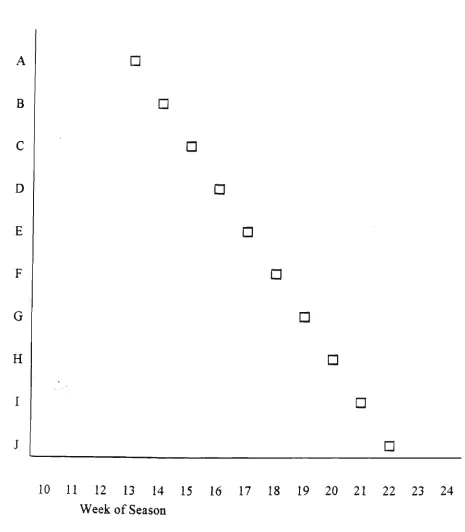
1. Staggered introduction of intervention on a weekly basis
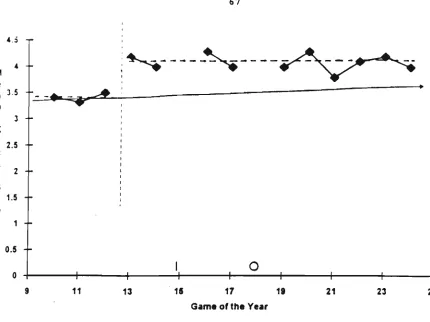
in single-case, multiple-baseline design 52 2. An example of a player's mean disposal scores per game for
Australian Rules Football Games 10 to 24,1991 67 3. Mean disposal scores per game of player 1 for Australian
Rules FootbaU games 10 to 24,1991 73 4. Mean disposal scores per game of player 2 for Australian
Rules FootbaU games 10 to 24,1991 74 5. Mean disposal scores per game of player 3 for Australian
Rules FootbaU games 10 to 24,1991 75 6. Mean disposal scores per game of player 4 for Australian
Rules FootbaU games 10 to 24,1991 76 7. Mean disposal scores per game of player 5 for AustraUan
Rules FootbaU games 10 to 24,1991 77 8. Mean disposal scores per game of player 6 for AustraUan
Rules FootbaU games 10 to 24,1991 78 9. Mean disposal scores per game of player 7 for AustraUan
Rules FootbaU games 10 to 24,1991 79 10. Mean disposal scores per game of player 8 for AustraUan
Rules FootbaU games 10 to 24,1991 81
12. Mean disposal scores per game of player 10 for AustraUan
Rules FootbaU games 10 to 24, 1991 82
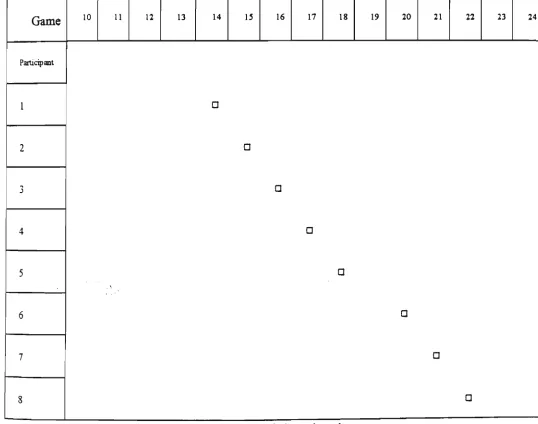
13. Introduction of participants to imagery program under
multiple-baseline conditions 116
14. Percentage of front positions attained for player 1 132
15. Percentage of front positions attained for player 2 133
16. Percentage of front positions attained for player 3 134
17. Percentage of front positions attained for player 4 135
18. Percentage of front positions attained for player 5 136
19. Percentage of front positions attained for player 6 137
20. Percentage of front positions attained for player 7 138
21. Percentage of front positions attained for player 8 139
22. Self-efficacy ratings attained for player 1 143
23. Self-efficacy ratings attained for player 2 144
24. Self-efficacy ratings attained for player 3 145
25. Self-efficacy ratings attained for player 4 146
26. Self-efficacy ratings attained for player 5 147
27. Self-efficacy ratings attained for player 6 148
28. Self-efficacy ratings attained for player 7 149
29. Self-efficacy ratings attained for player 8 150
30. Positions and dimensions of goal kicking targets and
kicking positions 176
32. Imagery and control group player means for
self-efficacy by occasion 193
33. Model 1, the basic LISREL stuctural equation model 212
34. Model 2, the LISREL stuctural equation model
mcludmg SE 4 and SE 5 213
35. Model 3, the LISREL stuctural equation model including initial
goal kicking performance and the first five self-efficacy ratings...214
36. Model 3, the LISREL stuctural equation model including
imagery intervention period self-efficacy and final performance 215
37. Model 5, the fuUy expanded LISREL stuctural equation model.. 216
38. Basic model relating imagery, self-efficacy, and performance
including path coefficients and t-tests 218
39. LISREL path coefficients and t-test values for Model 2
including three self-efficacy measures 219
40. LISREL path coefficients and t-test values for Model 3 including
initial performance and the first five self-efficacy ratings 220
41. LISREL path coefficients and t-test values for Model 4 221
Chapter 1: Introduction
Mental practice, and in particular imagery rehearsal, has been a widely employed technique in endeavouring to enhance sport performance (e.g., Corbin,
1972; Jowdy, Murphy, & Durtschi, 1989; Kendall, Hrycaiko, Martm, & Kendall, 1990; Kun & Tennant, 1993; Sumn, 1980). Researchers have conducted a large number of studies on imagery rehearsal and examined its use as a means of in:q)roving skilled performance in a variety of physical activities (e.g., Blair, Hall, & Leyshon,
1993; Kolonay, 1977; Hall & Erffineyer, 1983). Much ofthe past research, which has produced positive results when enq)loying imagery as an intervention, has been experimental, and used closed skills or analogue tasks. It has often employed novice participants (e.g.. Hall & Erffineyer, 1983; Woolfolk, Murphy, Gottesfeld & Aiken
1985). Other supportive 'evidence' for imagery as a performance enhancement intervention comes from anecdotal reports. For example, Nicklaus (1974) reported on how he used imagery to help him play successfiil golf shots. Furlong (1979) conducted athlete interviews to establish self-reported use of unagery by athletes, and HaU, Rodgers, and Barr (1990) employed evaluation questionnaires to estabhsh how players used imagery. The difficulty with this type of evidence is that it is largely descriptive in nature and provides a vahdity by association only, from which no conclusions can be drawn.
to base practice on studies carried out in the non competitive environment ofthe laboratory, often with college students. Open skills should be studied, as, at present, most apphed work is based on studies of closed skills. Research should also examine the processes by which imagery m the real world may enhance performance.
That the role of imagery remains equivocal after such a large amount of research, is largely attributable to poor research designs for which there are a multitude of reasons. There is a need for research to be conducted with the aim of providing more information on the processes involved in imagery. Research needs to be conducted on performance m ehte sport, to examine the appUcabihty of imagery m that context. Research should examine the impact of imagery on the performance of open skills m competition. Smgle-case research designs may be an effective way of estabUshing the impact of imagery mterventions on skiU performance m real world competitive settings.
Chapter 2: Literature Review
2.1 Introduction to the Literature Review
There has been considerable debate about the nature of unagery. Several terms have been used to label the phenomenon. A number of theories have proposed mechanisms by which imagery operates. A range of measurement instruments have been developed to assess the process of imagery. To place imagery in its context, the major definitions, theories and proposed measures of imagery are considered. There is a large amount of research hterature on imagery and related phenomena, such as mental practice. This review summarises research, proposing distmctions between types of studies and focussing on the conception of unagery which forms the basis for the research reported in this thesis. There have been many research methods adopted in the study of imagery. One which has not been widely used, but which could
Mental practice refers to the symbohc rehearsal of a physical activity in the absence of any gross muscular movements (Richardson, 1967a). Corbm (1972) defined mental practice as the repetition of a task without observable movement, but with the specific intent of learning. Suinn (1980) defined mental practice as any form of covert practice or symbohc rehearsal, including simply thinking through a motor action. Murphy and Jowdy (1992) provide a succinct summary definition of mental practice, concluding that it is a descriptive term for a particular non physical technique used by athletes and many other mdividuals. In summary, mental practice consists of covert practice or symbohc rehearsal other than physical practice. In this practice or rehearsal, unagery mirrors sensory or perceptual e7q)eriences, m that the person is consciously aware of these experiences and usually controls them.
A number of other terms have been used for processes similar to mental practice. These mclude mental rehearsal, visualisation, imagery rehearsal, symbohc rehearsal, modelling, imaginal practice, and visual motor behaviour rehearsal. A form of mental practice that has received research attention recently is imagery rehearsal The study of imagery is concerned primarily with how people represent and process information mentaUy or symbohcaUy. Imagery, along with other cognitive processes, has often been referred to as mental practice. Imagery rehearsal was defined by Sumn (1976) as a more narrow term than mental practice. Suinn claims that imagery
that reintegrate reahty experiences, thus enabhng the individual to gain control over the physical experience. Imagery is understood to be a multi-modal process, that is, one that involves all or many ofthe sense modahties. Sumn (1976) sees imagery as more than an isolated, one dimensional thinking process. It is a retrieval of experience that is hohstic and is multi dimensional. It is more than visual, it is tactile, auditory, emotional, and muscular. During imagery, the participant actually lives the situation. Thus, the individual experiences motor, emotional and physiological involvement during the process of unagery (Suinn, 1976). Suinn (1983) distmguishes between unagery rehearsal and mental practice in that only m unagery rehearsal can it be concluded that imagery was used to achieve the covert practice, whereas in mentally practising, any number of techniques might be enq)loyed. One of these techniques is imagery rehearsal Suinn (1976) developed visuomotor behavioural rehearsal
(VMBR), a specific technique to execute imagery rehearsal
Suinn's original work. The term mental practice is apphed to previous laboratory research, where operationalization ofthe psychological process did not reflect the multi-modal reintegration of experience emphasised by Suinn.
Some sport psychologists have distinguished two unagery perspectives in research on sport performance. These are mtemal and extemal imagery (Mahoney & Avener, 1977). Intemal unagery has been regarded as predommantly kinesthetic m nature, that is, athletes imagine themselves to be witlun then own bodies while performing the imagery and focusing on the muscular feelings associated with
performance. Athletes feel themselves participatmg, but they also see, hear, and smell the object of attention. Extemal imagery is considered to be primarily visual m
nature, that is, athletes imagme watching themselves from the outside. Mahoney and Avener (1977) described visual imagery as extemal and kmesthetic imagery as intemal with regard to hnaginal focus. In extemal imagery, a person views themself from the perspective of an extemal observer (much like m home movies). Intemal imagery, on the other hand, requires an approximation ofthe real-life phenomenology, such that the person actually imagines being inside their body and experiencing those sensations which might be expected in the actual situation. Mahoney and Avener (1977) argue that this requires a predominantly kinesthetic input and assumes a first person
that internal imagery has its greatest knpact on performers who aheady possess a high level of skill. Mahoney, Cjabriel, and Perkins (1987) concluded that, relative to theh non-ehte peers, ehte athletes rely more on intemally focused and kinesthetic imagery. Also, Mahoney and Avener (1977) found that ehte gymnasts who qualified for the Olympic team favoured an mtemal perspective more often than did nonqualifiers.
A similar study on skiing also found an intemal perspective to be more frequently used by the very best skiers, who visualised the course from an intemal perspective, whereas the less successfiil skiers visualised from an extemal perspective (Rotella, Gansneder, Ojala, & Bilhng, 1980). Doyle and Landers (1980), after
imagery that are not clear. For example, whether there are differences in effectiveness ofthe two types of knagery, whether either can be tramed, or whether an activity, or the way in which it is taught, can affect either intemal or extemal imagery.
Furthermore, the suggestion that intemal imagery equates with the kmesthetic modahty and that extemal knagery equates with the visual modahty has not been demonstrated and might be more confusing than helpfiiL Both mtemal knagery and extemal imagery can have kmesthetic and visual aspects. The form of imagery used might agam depend on the person, the activity, the nature of training, or the specific mstmctions given, hi short, there are many unanswered questions about mtemal and extemal knagery. An examination ofthe impact of knagery on performance might presently put aside the mtemal/extemal imagery issue. Sknilarly, care m the use of terminology and the precision with which techniques and procedures are described and used, is advisable in the knagery area m general
2.3 Theories of How Imagery Works
2.3.1 Psychoneuromuscular Theory
Psychoneuromuscular theory suggests that imagery rehearsal duphcates the actual motor pattern being rehearsed. It is proposed that sknilar impulses occur m the brain and are transmitted to the muscles when athletes imagine movements. The
impulses are similar to those occurring when they actually make those same movements. Jacobson (1930a, b, c, d, 1931a, b) when studying muscle activity among subjects imagmg such activities as balding the forearm, curling a weight, or clknbmg, found that muscle activity m the specific muscles normally requked to effect the movements was generally greater while imaging than when at rest. Schmidt (1982) has speculated that very small forces are generated by mental practice. Schmidt postulates that these small forces are detected by the Golgi tendon organs which provide feedback to the premotor cortex. This process strengthens the existing motor program or allows for adjustments m the motor program to take place. These changes m the motor program ki5)rove subsequent performance. With the advances in the development of psychophysiological assessment devices and techniques, this theory might well be able to be tested with much greater sophistication. The
psychoneuromuscular theory has been referred to as the theory of muscle memory, or the neuromuscular feedback theory (Harris & Robmson, 1986; Vealey & Walter,
muscle innervation. Scientific evidence supports the notion that vivid, knagined events produce sknilar irmervation in the muscles to the actual physical experience (Jacobson, 1931; Jowdy & Harris, 1990). Vealey and Waher (1993) stated that psychoneuromuscular theory has been supported m that imagery has been shown to ehcit muscle innervation, but the occurrence of this low-level muscle innervation has not been shown to relate to performance knprovement. Similarly, Perry & Morris (1995) question this research on the grounds that low-level muscle mnervation was measured on physical actions with no performance element, or it is not possible to link the intervention to performance enhancement.. Even if the innervation and
performance enhancement were to be shown contiguously (ie. together), it could be that the muscle mnervation is a byproduct of knagery for performance enhancement, which occurs through another process. Therefore, the difficult question that needs to be addressed is can this research be rephcated when studying skilled performance m such a way that demonstrates that the low level muscle innervation has caused the facihtation of performance. At this stage it is difficult to see this issue being resolved.
2.3.2 SymboUc Learning Theory
1 1
Sackett (1934, 1935) used a maze tracing task that had many symbohc components and found that knaginary practice led to greater effects on performance than verbal or overt rehearsal. Perry (1939) found that knaginal practice was most effective m
pegboard, symbol digit substitution, and card sortmg tasks; and less effective m mirror tracmg and tapping (acts requiiing actual movements). Vealey and Walter (1993) have used the term "mental blueprint" to describe the symbohc learning theory and
suggest that the use of knagery strengthens the blueprint that enables the skill to become automatic. They contend, that athletes can understand the notion of employmg knagery to strengthen thek mental blueprint or to make the skill more automatic. Indkect support for this theory comes from research which suggests that imagery is more effective in tasks with large cognitive con^onents con^ared with those having high motor content (e.g., Mrd, Landers, Thomas & Horan, 1991; Ryan & Simons, 1982). Furthermore, a meta-analysis by Feltz and Landers (1983)
concluded that the effect size was much larger m studies that used cognitive, rather than motor or strength tasks.
2.3.3 Bioinformational or Information Processuig Theory
According to biomformational theory (Lang, 1977, 1979) performance effects should be higher where imagery more closely rephcates the actual response situations ofthe task. Lang argues that learning and performance involve the hnkmg of
permits Imks to be strengthened. A study supporting the view that response processes during imagery facUitate performance on various tasks was conducted by Hecker and Kaczor (1988), usmg propositions for a famihar action scene, a famihar athletic anxiety scene, and an unfamihar fear scene. A neutral control scene had no response propositions attached to it. Heart-rate data supported the effects ofthe response propositions on the famihar scenes, as bio-informational theory predicted. The effect on performance, however, was not hnked to the physiological data in this study. Accordmg to biomformational theory, performance effects should be higher where knagery rephcates the actual response propositions ofthe real task (Sumn, 1993). Ziegler (1987) distinguished between "active imagery" and "passive knagery" across three imagery conditions, passive knagery, active imagery, and passive imagery phis practice, but found no significant difference across the three imagery groups, when
100 women from a fitness class imagined making basketball free throws. Because this theory is conq)aratively new, it requkes much fiirther research.
2.3.4 Arousal or Activation Theory
1 3
and Waher (1993) refer to this as a "mental set" perspective. After studying the moods of a task relevant group that imaged performing well at the task and another group that remembered positive mood state experiences, Lee (1990) reported, that the relevant knage group produced significantly better performance than the general positive mood group. In a second study of 142 male participants, Lee (1990)
concluded that the content ofthe imagery is important but that the imagery effect does not occur by affectmg mood state. Feltz and Riessinger (1990) compared the influence of "m vivo emotive imagery" phis feedback versus feedback alone on muscle endurance and self-efficacy. The emotive knagery involved generating "images that were assumed to ehcit feehngs of con:q)etence and bemg psyched-up... (and) holding out longer than the opponent and being successfiil" (p. 135). The authors concluded that m vivo emotive imagery is effective m increasing one's sense of perceived efficacy to endure muscular isometric performance, and to a lesser extent actual performance. The weakness ofthe arousal/activation theory is that it does not specifically explam how imagery optimises arousal and attention, nor has the theory been vahdated by research. Nevertheless, from an apphed perspective this theory has great practical appeal because it can be readily apphed by the performer. The performer can also associate with the idea that by using productive imagery prior to competing, that performance can be facihtated.
be made with caution, if anything these findings could be seen as encouraging, because skilled performers doing the skiU at which hey are experts, should be more highly motivated and ego-mvolved.
2.6.3 Closed SkiUs out of the Competitive Environment
Mixed results have been produced from research that has studied knagery rehearsal, for real skills ofthe closed type. Some of this research has been conducted away from con:q)etition. Kolonay (1977) used Visuo-Motor Behavioural Rehearsal (VMBR), a technique developed by Suinn (1976), that mcorporates relaxation exercises with knagery rehearsal mtervention, to help irapiove free shooting m basketball She assigned 72 male basketballers, from eight college basketball teams, to one of four experimental groups: relaxation and knagery rehearsal (VMBR), relaxation alone, imagery rehearsal alone, and a no imagery control group. Traming was provided through audio tape recordings m order to ensure standardised
e?q)eriences. These recordings were played prior to each of 15 basketball practices, covering a six week period. The players were pre-tested on thek abkity to throw baskets from the foul hne and then post-tested at the end ofthe six week training period. Both tests took place m a non-coirpetitive envkonment. It was found that the group incorporatmg relaxation and knagery rehearsal improved thek goal shooting significantly compared to the other three groups.
25
skills have also been based predominantly on closed skills. Hall and Erffineyer (1983) looked at free throw shots m basketball. Woolfolk et al, (1985) studied puttmg a golf bah, and Koop and Martm (1983) studied the ehmmation of swknmkig stroke errors. Blak et al,. (1993) studied the effects of an imagery training program on the performance of soccer tasks by skilled and novice players. These tasks were closed and mcluded dribbling, passing at targets, shooting, and checking off Performance on the post-test as measured by response time revealed a significant iii5)rovement from the pre-test for both the skilled and the unskilled players in the imagery group, whereas the control group failed to show any improvement for either skilled or novice performers.
Such findings are encouragmg, but many skills are open m nature, m the real competitive envkonment, and not protected by the non-conq)etitive envkonment. These two aspects, that is, open skills and the real competitive envkonment, requke much greater attention in fiirther research. Exan:q)les of the Umked studies that have been conducted m these areas will be addressed in the following two sections.
2.6.4 Closed SkiUs in Competition
participants, such as, unskilled college undergraduates, and to provide research rigour. Titley made comparisons between pre-intervention and post-intervention performance. The intervention took the form of visuomotor behaviour rehearsal (VMBR), invoKing knagery of a standardised kicking motion when kickmg for goal. It was found that goal kicking m male American footbaUers in:q)roved both m
consistency and accuracy. In the games following VMBR, the kicker in^roved his consistency and accuracy from greater distances m particular. As with anecdotal accounts, there were no controls m these studies to fulfil the rigours of tradkional research design.
Another study conducted by Noel (1980) examined the effect of VMBR on the closed skill of tennis serving in a toumament envkonment. The primary concern of this study was to mvestigate whether the VMBR training would knprove serving accuracy, con^ared to a control group. It was concluded that mentally rehearsing the tennis serve, while relaxed, facihtated performance under toumament conditions, but only for high abihty players. Studies conducted m baseball (Lane, 1980), usmg multiple knagery trakung sessions, showed mdications of positive effects of
unprovement in performance of closed skiUs in conq)etitive settings. It can be seen, however, that more studies need to be conducted m this area of examming the influence of imagery on the performance of closed skills in competition.
27
Little research has been pubhshed on open skills out of competition. Blak et al, (1993) did, however, conduct a study that closely approximates this situation. They mvestigated the effect of an imagery program on the performance of a soccer task by 22 skilled and 22 novice soccer players. Two performance measures were recorded, response time, and performance accuracy. The task was open in nature because it consisted of dribbUng, passsing, shootmg and checking ofl^ which are all open m real game situations. The knagery group particq)ants were given an imagery traming program, consistmg of two 15 minute sessions per week, for a six week period. The control group developed a con:5)etitrve strategy that was totaUy
umelated to the performance task. This consisted of two sessions a week over a six week period coinciding with the timing ofthe imagery program for the imagery group. Performance on the post-test as measured by response time revealed a
significant improvement for both the skilled and novice players in the imagery group, whereas, the control group failed to show any improvement. No effects were found for performance accuracy. Much further research is requked, hke the Blak et al (1993) study to establish the kiq)act that knagery has on the performance of the execution of open skills m the non-competitive setting.
2.6.6 Open SkiUs in Competition
environment. A major difficulty with research conducted on open skills in the real world is that it is not clear, when an effect is found, which ofthe elements ofthe intervention or, what extraneous factors, may have influenced the results. For example, difficulty of opposition can have a major effect on performance of open skills m conq)etition. Because ofthe difficulty of controlling such variables, it would appear that most researchers have steered clear of such research in the past. The real competitive sporting world, however, comprises many open skills, and players and coaches ahke want to benefit from the results of research related to such skills. Kendall et al (1990) exammed the use of knagery to enhance a defensive basketball skill in four women basketbaU players at the collegiate level The defensive skill was to be exhibked by the defender m the defensive zone when the offensive player attempted to dribble towards the basket. These players had no previous experience with mental skills traming. Usmg a smgle-case design, they monitored performance of the skiU, rated by expert judges from video, during a basehne period. Then they
introduced the intervention and continued to momtor performance for several weeks. The intervention was mtroduced to each player on a daily basis during a five day interval when they were not playing. The treatment mcluded a general mtroduction to mental preparation, relaxation exercises, imagery rehearsal techniques, self-talk, and the use of audio tape to help in imaging performance ofthe defensive skill Generally, the mtervention period was associated with improved performance. Unfortunately it
is not possible to draw any firm conclusions concerning the efficacy of imagery, '
2 9
Nevertheless, this research was conducted in a real game setting.
McKenzie and Howe, (1991) found traming involving imagery rehearsal for tackhng in Rugby, was as effective as physical practice in terms of transfer to game performance. This study was conducted on 74 male mgby players, who were placed mto three positional groups, "Tight Five", "Back Row and Halfback", and "Outside Back" Players. There were three treatment conditions (Mental Imagery, Physical Practice, and Mental Imagery and Physical Practice). Followmg each two week training period, games were videotaped and reliable measures of tackling performance were obtamed. It was foimd that tackling traming involving mental imagery was more effective than physical practice, and the combination of mental imagery and physical practice was the most effective training method. The resuks of this study are most encouraging and fiirther promote this type of research as a means of bridging the gap between research in the laboratory and the apphed world.
2.6.7 Research on Imagery When Combined with Other Techniques
Some studies have found imagery rehearsal to be an important intervention when combmed with other components of mental traming (e.g., Sumn, 1976;
unagmg a course. Kolonay (1977), used VMBR, to help knprove free shootmg in basketball. It was found that the group incorporating relaxation and imagery
rehearsal knproved thek goal shooting significantly compared to three other groups.
Wemberg et al (1987) investigated whether imagery, preceded by arousal or relaxation, was more effective m terms of quahty ofthe imagery, as weU as
performance, on a variety of motor tasks. Forty-two students, enroUed m self-defense classes met three times a week for 16 weeks. After six weeks, which served as a basehne for establishing performance capabihties m three karate measures, the
participants were assigned to one ofthe following condkions: arousal imagery, which included hstening to upbeat music; relaxation knagery, which mvolved participants performmg relaxation techniques; and a control, which requked, amongst other things, memorising and reciting Chinese writings. During the next four weeks, the experimenter met with all participants mdividuaUy and helped train them m thek specific technique. Participants were tested m weeks 12 and 16 and told to use thek mental preparation strategy just prior to each performance test. Results mdicated that the relaxation imagery group produced significantly better performance on the karate measure of sldll than did aU other conditions. There were no differences between any ofthe groups for a variety of activities involving coordmation, endurance, strength, and speed of movement. Weinberg et al concluded that, perhaps the best type of preparation for imagery is dependent on the type of activity enq)loyed, and
3 1
Kim and Tennant (1993) hypothesised that a combined visuahsation and Danjeon breathing group would ehcit greater improvement than either technique alone, and that the separate visuahsation and Danjeon breathmg groups would achieve higher scores than a control group. Danjeon breathing is a relaxation technique
concemed with voluntary control of breathing in an attenq)t to achieve a higher level of mental state and readiness. Forty-eight college students were randomly assigned to one of four groups, control, visuahsation, Danjeon breathing, and visuahsation phis Danjeon breathing. The results suggested that the combmation of visualisation phis Danjeon breathing facihtated ak pistol shooting performance, conq)ared to
visualisation or Danjeon breathing alone. Together these studies of combmed techniques suggest that knagery may work better when combined with other
components of mental training, although improvement in performance m these studies could be due to an additive effect of other mdependent techniques, such as when unagery is combined with relaxation or self talk.
modelhng. Gray and Fernandez (1990) found the same result when rephcatmg the Hall and Erffineyer smdy with varsity basketball players. In a study ofthe effect of mental rehearsal on table tennis performance (Lejeune, Decker, & Sanchez, 1994), found participants who combmed physical practice, observational leammg, and imagery were the only players to improve thek performance m two table tennis performance conditions, which were to repeat a shot and to alternate between shots. Participants assigned to the other three groups, a control group, a physical practice group, and an observational learning group, did not produce a significant
improvement m performance. Because this study did not enq)loy a physical practice and knagery group, it is not possible to conclude that the combination of all three components was superior to other conditions.
Usmg a smgle-case, multq)le-basehne design, KendaU et al, (1990) examined the effects of an imagery rehearsal, relaxation, and self-talk package on the
performance of a specific defensive basketbaU skiU during conq)etkion by four female college basketbaUers. They concluded that the mtervention was clearfy effective. It must be noted that each of the techniques in this study had a purpose and they were not just used to support imagery, as is the case in the relaxation studies mentioned previously. That is the relaxation and self-talk packages were being assessed
independently. Also it must be recognised that the research reported here, except for KendaU et al. (1990), was conducted on closed skiUs or analogue tasks, that is,
3 3
2.6.8 Motivational Role of Imagery
Another aspect ofthe inq)act of imagery on performance was proposed by Paivio (1985), who suggested that mental imagery plays a motivational role m mediatmg motor behaviour. He argued that motivated behaviour as manifested through frequency, persistence, and efficiency ofthe overt practice of performance
skiUs, may be enhanced by imaging the performance of these activities. Van Gyn, Wenger, and Gaul (1990) also pomted out the motivational mfhience, when
investigating the possibihty of using imagery as a method for enhancing the transfer of non specific training to performance, although they concluded that
"transfer-appropriate processmg" was a more hkely explanation for thek findmgs, and the motivational influence was downplayed. In this case, cycle training was used m an attenqjt to enhance 40 metre sprint performance. Forty participants were pre-tested on a Wmgate cycle ergometer for peak power output and for a 40 metre sprint time. Participants were then assigned to foiu: groups; knagery training (IT), power traming (PT), imagery and power training (IPT), and a control group. Particq)ants trained for six weeks in thek groups and were then re-tested. It was found that knagery alone did not enhance sprint performance or peak power, but that IPT enhanced peak power and the 40m sprint performance. Van Gyn et al. pomt out that this transfer could occur as a result of a motivational context created by imagery.
practismg a golf putting task (persistence and effort) and would have higher task specific self-efficacy than control participants. It was found that, during the
performance-oriented phase, participants m the performance knagery group practised more than participants m the control group. Martm and HaU (1995) concluded that despite repeated negative feedback, participants who used knagery were more motivated to practise than control participants. Martin and HaU offered a possible explanation for the motivational effect, because during the training-oriented phase, when performers had no other performance goals nor objective means of evaluating thek progress, there was no difference among the groups for time spent practising. Beginning with the fourth imagery session, however, particq)ants were cued to compare thek putting performance with a list of specific norms/goals. These corq)arisons acted as performance feedback and apparently made aU participants acutely aware of thek shortcomings as evidenced by thek adoption of lower self-set goals. The performance knagery group responded to this awareness with mcreased motivation to practise. The rationale for this hypothesis was only partiaUy confirmed, as the imagery group was no more efficacious than the control group when
self-efficacy for performance was coEC5)ared. The motivational mfhience is suggested because ofthe attention given to participants. It must be recognised that this clakn could be made about any research that pays attention to participants regardless ofthe techniques used.
35
Howe (1991) in a review ofthe hterature, summarised his assessment that imagery can perform a useflil fimction under particular ckcumstances. These ckcumstances are that imagery is more effective for experienced athletes, and if k is multi-sensory, rather than purely visual This statement could be questioned, because the devices used to determine what kmd of imagery has been en:q)loyed lack vahdity. In his review, Howe (1991) proposed that knagery can serve a usefid fimction under certam ckcumstances such as, it is more effective for more experienced athletes, unagery is more effective for those who consider themselves to be effective imagers, unagery is more effective when combined with physical practice, imagery is more effective for closed skills than open skills. This last statement could be queried, because knagery has been found to be effective with closed skills, but httle research has been conducted on open skills to make a comparison between the inapaict of unagery on open and closed skills. Nevertheless, Howe (1991) raised several issues that stiU need to be addressed by research on imagery. Among these are the need to
QxploTQ the effectiveness of imagery programs intended to enhance performance of
basic motor skills for young children and older populations, because most research has exammed young adults. In addition, the question of when knagery might be most effectively employed in the leanung or performance of skills, and the optimal duration of an knagery program for skiU in:q)rovement must be considered. Furthermore, there are stiU questions to resolve about the content of knagery programs, the length of training sessions, and the measurement of imagery, according to Howe.
example, Andre and Means (1986), and Wollman (1986), concluded that the results of previous studies are far from consistent. It was argued that the results of research suggested that imagery alone would not guarantee the successfiil completion of a particular task m any given motor performance situation. WoUman, Hill, and Lipsitz (1985) conducted two experiments to assess the effects of knagery on sport
performance m a naturalistic setting. The first study, employing 14 men's coUege cross country runners as particq)ants, found no significant difference m running times between two groups. The first group was exposed to an mtervention of relaxation, information on running technique, and imagery, the second group was exposed to only relaxation and running technique information. The results of utilizing a package inchidmg knagery and the sport performance of running is mterestmg, however, whether this findmg can be generalised to the execution of sport skills is questionable. Feltz and Landers (1983) m a meta-analysis foimd that cognkive tasks were more largely effected than tasks which were essentially motor or mvolved strength. Fkstly, there were only seven participants m each group and that would suggest a high
probability of making a Type H error. Secondly, it might have been that imagery did not facihtate running time because there was no real "skiU" to enhance. The study measured running tknes, and k is difficult to argue that a physical skiU is bemg
mfluenced in this situation. Any significant effect of knagery on running times is more likely to arise from motivational or confidence changes, rather than changes m running "skiU". Indeed k may be difficult to estabhsh any cause and effect relationship
37
relaxation, imagery, attentional focussmg, and positive mental attitude. The control group received no treatment. Analysis showed that scores in the experimental group did not improve significantly over those ofthe control group and, in fact, were almost aU significantly worse. Again, this study had a smaU number of participants which poses the possibihty of Type H error. It was also possible the experimental group had insufficient time to rehearse the imagery intervention, so a subsequent effect of
imagery treatment was highly unlikely.
Lamkand and Ramey (1994) mvestigated the effectiveness of physical practice augmented by knagery alone, for improving basketbaU foul shootmg. It was
hypothesised that only the imagery condition would inq)rove foul shootmg. A sample of 19 female coUege basketbaU players was used. They were randomly assigned to a relaxation or a mental imagery training condkion. There were four training sessions over three weeks. The imagery training consisted of focussing on kinesthetic, visual, and auditory stknuli, whereas, the relaxation group participated in various breathing exercises. Sessions for each group lasted approximately 20 mkiutes and were
effective intervention.
A study conducted by WoolfoUc et al, (1985) foimd a degradation m
performance in conditions enq)loying negative outcome knagery, but another group showed enhancement of performance after using positive outcome imagery. Fifty male coUege students were assigned to one of six experimental conditions, in a design that aUowed the presence or absence of mental rehearsal ofthe physical movements mvolved m the task to be conq)letely crossed with the knagmal depiction of task outcome (successfiil, imsuccessfiil, or no outcome conq)onent). The resuhs suggested that imagery of a poor performance may be as powerfiil in its ability to damage skUled athletic performance, as is positive imagery m its capacity to inq)rove performance. Thus, rather than suggesting that knagery was not an mfluential
intervention, it could be argued that knagery was shown to be a powerfiil mtervention m affectmg performance from a negative perspective. In summary, there is relatively httle research that has found no effect of imagery on performance, compared with the large amount of positive research on mental practice and knagery rehearsal
It is hnportant to apply sport psychology effectively in sport, but httle research has experknentaUy investigated the effects of imagery rehearsal in real life athletics and game situations. The research conducted by KendaU et al. (1990) is one
14
the muscles involved in the knaged action. Also, no studies have shown muscular innervation and enhanced performance, ff any did, k could be that both were effects of knagery. Psychoneuromuscular theory thus hes m abeyance. Skmlarly, mdkect support for symbohc learning theory comes from repeated findmgs that cognitive tasks produce larger effect sizes. It is not clear, however, what the symbohc code might be. Also, it is difficult to equate cognkive and motor tasks in terms of thek demands. It could be that those used were easier or that there was more room for inq)rovement. A major difficulty that the symbohc leammg theory has to confront is that it rehes on studies of tasks that are cognitive in nature, whereas many sports have substantial motor con^onents. Nevertheless, the conception ofthe cognkive
"blueprint" stage as the first stage of skiU acquisition, could be enhanced greatly by developmg the symbohc learning theory, because the associative stage and the autonomous stage of development can not proceed imtU the leamer has cognkively understood the task to be performed. The chaUenge for the bio-mformational theory (Lang, 1977) and the activation theory (Schmidt, 1982), is that there is httle evidence to support them Proponents need to promote research that tests the theories.
Imagery is a covert process. Despite a range of ingenious theories and many creative attempts to test them, the mechanisms imderlymg imagery are not weU understood.
2.4 Measurement
problem for as long as knagery has been studied. It is possible to measure the performance of a task that imagery has influenced, but this measurement can not be equated with the measurement of knagery. Because of this inherent difficulty m measuring knagery, psychologists have often ignored the issue of measurement (Perry
& Morris, 1995). Certamly, there is much supportive mformation existmg for knagery
rehearsal, however, as Murphy and Jowdy (1992) contend, aUowing the mdividual to define the cognitive strategy can cause confusion, in that, when an athlete says they used "unagery," this tells us nothing about the process they engaged in. Also, much ofthe supportive evidence is a mixture of anecdotal reports, athlete mterviews, and evaluation questionnakes (Furlong 1979; Lazaras 1977; Nicklaus 1974). Anecdotal reports and mterviews are largely descriptive in nature, providing evidence of a 'grass roots', 'folk medicine' and self-discovery nature (Sumn, 1980). Suinn argues that the vahdity of these types of accounts is reaUy a post hoc vahdity, a vahdity by association rather than by controUed study, AU provide an abundance of testimonial evidence on knagery use m the performance of ehte athletes. A problem exists with this type of evidence, because there is no research control m any of these subjective assessments and therefore no substantial conclusions can be drawn.
16
on dknensions, like vividness and controUabihty. Imagery use questionnakes have mainly been apphed to ehte athletes. A study of 381 male and female participants from six sports, employmg a self-report measure called the Imagery Use
(Questionnake (lUQ) exemphfies this approach (Hall, Rodgers & Barr, 1990). Athletes in this study reported usmg imagery more in conjunction with con:q)etition than with practice. Importantly, this study found that the higher the competitive level, the more often the athletes reported using some form of knagery m practice, before an event, and during conc^etition. The difficulty with accepting these reports is to
evaluate what, how, and for how long these participants were mvolved with the knagery. Research usmg questionnakes, like testimonial evidence, suffers from a lack of control and also poses the problem of what is being estabhshed via the
questionnake. There are several shortcomings m the research conducted by HaU et al that should be noted. The questionnakes for the U.S. players were not completed as a team at the toumament site, but mstead mdividually and retumed to the researcher four months later. This could cause inaccuracies m responses due to the retrospective nature of responding, and participants may not be motivated to respond with care at that later time. In addition, there were only a smaU number of retums from several countries. When lookmg at the findings from such studies one must be sure to estabhsh the difference between self-reports of knagery use and self-reports of
that the participant is carrymg out that mstmction. A major problem, again, with this procedure is that there is no check or evaluation of how weU that participant is able to carry out the instmctions and what they actuaUy imaged during the imagery time. Therefore, many questions requke answers before comparisons and conclusions can be made with other research that has employed the use of questionnakes. For exanq)le, k is important to establish what imagery is bemg used, how weU the person is knaghig, and the duration ofthe imagery.
Despite the difficulties of knagery measurement, a number of tests have evolved that purport to measure aspects of knagery ability. From an apphed
was also developed by Gordon (1949) caUed the Test of Imagery Control (GTIC), which measures controUabihty of unusual manipulations of real objects. It is a self report test designed to assess, not how vividly a participant knages, but how weU they can manipulate and control the knages. In this test, participants answer either yes or no depending on thek abihty to manipulate evoked visual images. Thus, m earher tknes, two mdependent tests were typicaUy employed to evaluate two conq)onents of imagery abkity, vividness and controUabihty.
More recently HaU and Pongrac (1983) developed the Movement Imagery Questionnake (MIQ) with more of a motor skiU emphasis. This is an 18 item test consisting of nine items on visual perspective and nine kems on kinesthetic
perspective. The participant is mstmcted to knage each movement from both an intemal perspective and from a kmaesthetic perspective, and is then requked to score on a seven point Likert scale, how they rate the quality of imagery, m each case leading to subscale scores on visual or kinesthetic knagery of movement. Rehabihty has been reported as mtemal consistency co-efficients of 0.87 (visual) and 0.91 (kinesthetic), in addition to a test retest rehabihty of 0.83 (HaU & Pongrac, 1983). Moran (1993) notes that the MIQ has been used m research, but that it has not been adequately vahdated. Another problem with the MIQ, with respect to ks use in sport, is that k exammes basic movements, and it is not clear to what extent this tests sport specific imagery abihty.
(1973) has recently become a weU used test in research on imagery. This is a 16 kem self report inventory, which is an extension ofthe visual subscale ofthe Rett's
questionnake, where participants are requked to rate on a five point scale the visual vividness of thek images of four different scenes. The lower the scores, the better is the self-rated knagery. Test-retest rehabUity has been reported as rangmg from 0.67 to 0.87 (McKehde, 1990), Another knagery test was developed along simUar Imes. It is caUed the Vividness of Movement Imagery Questionnake (VMIQ) and was
developed by Isaac, Marks, and RusseU (1986). It contains 24 items and claims to measure the visual knagery associated with movement ksel^ as weU as kinesthetic sensations. Items examine basic body movements and movements requiring precision and control m upright, unbalanced, and aerial situations. The VMIQ was measured on a Likert scale and had a test-retest rehabihty of 0.86.
A further test that has wide usage in the apphed sport psychology domain is Martens' (1982) Sports Imagery Questionnake (SIQ). The SIQ presents four
20
has no rehabihty and vahdity to support it. Moran (1993), furthermore, pomts out that none ofthe tests considered here have acceptable vahdity, even though some have satisfactory rehabihty. That is, there is no conclusive evidence that the constmct being measured in the test is imagery. AU of this evidence supports the comment
made at the begkming of this section, that the measurement of imagery has been a problem for as long as imagery has been studied, even though knagery has an abundance of stated operations in the apphed settmg. The real chaUenge for measurement of knagery is for research to be conducted that does develop a measurement technique that provides vahdity, and is supported by appropriate
rehabihty analyses. To be apphcable to the multi-modal conception of imagery, such a test must measure knagery across the range of sense modahties. Ideally, it should also assess imagery on a number of dimensions, including not only vividness and
controUabihty, but also aspects hke ease of access and duration of images.
2.5 Imagery Use in Sport
Imagery, as a form of mental practice, has been used as a means of enhancing athletic performance, and employed widely m the sporting domam. Gould, Tammen, Murphy, and May (1989) found k to be the most widely used technique among
championships, Heishman and Bunker (1989) used a questionnake method to examme imagery use. They estabhshed that 81% of participants considered mental strategies as bemg very important in preparing for competition. Ofthe mental strategies used, visuahsation/imagery was used regularly by the highest percentage of participants (76%). Heishman and Bunker stated that these findmgs concurred with the findings of Mahoney and Avener (1977) that knagery fackitated performance and separated the more successfiil from the less successfiil athletes. Interestmgly, Heishman and Bunker (1989) noted that the Welsh lacrosse players m thek study, were the group that placed the least vahie on mental preparation and actually reported using mental strategies less than any other teams. The Welsh finished last m the toumament without winning a smgle game.
It would thus appear, that in the real competitive envkonment, many forms of unagery are being employed. From the perspectives of theory, research, and effective practice, what needs to be established is, what knagery techniques are bemg used, when is knagery typicaUy used by athletes, what length of tkne is imagery bemg used for, how is imagery being employed, and for whom is imagery most effective.
Furthermore, it is important to determine how effective and how appropriate the present knagery interventions.
2.6 Research
22
Researchers have examined the use of mental practice as a means of in^rovmg skilled performance in a variety of physical activities. Representative examples are Clark (1960) with one hand foul shots m basketbaU, Corbm (1972) with a wand jugghng task, and WoolfoUc et al, (1985) with putting a golf ball
There have been a number of reviews of mental practice research. Richardson (1967a, 1967b) pubhshed a two part review covering 25 mental practice studies over a thirty year time span. Corbm (1972) discovered and evaluated over fifty studies of mental practice, and Feltz and Landers (1983) published thek findings of a meta-analysis on sixty studies. It must be clearly recognised that these early studies were on mental practice in general and not specifically on knagery. From the earher reports k is suggested that, m many situations, mental practice can lead to gams in motor performance, although there were enough negative results to leave the issue
Sport psychology. The research has been conducted m a range of contexts and has used a variety of tasks and participants. The foUowmg sections provide a review of research by these variables. The sections do not review research comprehensively, but reflect the different contexts m which imagery has been studied.
2.6.2 Analogue Tasks
Much early research on knagery or mental practice was conducted on analogue tasks, that is tasks not dkectly apphcable to real sport situations, such as maze learning (Sackett, 1935), maze tracing (Perry, 1939), mirror drawmg (Perry,
1939; Smyth, 1975), and wand jugghng (Corbm, 1967), These tests were often chosen specifically because they were novel Thus, the rationale underlying this research was that studying novel tasks would aUow the mvestigation of knagery effects during the early stages of learning a skill It is difficidt to generahse findings from such tasks to expert sport performers carrying out skkls with which they are very familiar and accomphshed. Many of these analogue tasks are artificial in nature, used mainly in laboratory studies, and have httle dkect relevance to the real world. Another difficulty with analogue tasks is that they are often not very mterestmg, so the participant is unlikely to be motivated to perform at an optknal level
3 9
is not clear. Much more research wiU need to revolve around real athletes, and real sport situations. This especiaUy apphes to open skkls which can never adequately be simulated outside real conq)etition
Much ofthe past research has employed questionable methods and has also raised issues as to what, when, and how imagery is mcorporated mto the traming and performances of athletes. WoUman (1986) advised that future research should
include: (a) appropriate control groups, (b) different types of knagery, (c) senskive measures of experience and performance, (d) techniques and evaluations of
performance that take individual factors mto account, and (e) varied situations and tasks to ensure generalizabihty of effects. There are limkations to many ofthe research findings because ofthe use of analogue tasks, or not actuaUy testmg
physical skkl competitively and in many instances use thek own forms of mtuitive imagery rehearsal. Participants' motivation to be involved and to produce thek best at aU times must be questioned in many studies. It is unlikely that the levels of
motivation of athletes performmg analogue tasks or those of non-competitive individuals wiU be as high as the motivation levels of those who are engaged m the actual competitive activities in which they have attamed ehte status. For aU these reasons, it is hnportant that sport psychology researchers find ways of studying expert performers m the competitive envkonment.
2.8 Single-Case Research Designs
One potentially fiwtfiil approach to the exammation of performance
4 1
otherwise have been masked by the averagmg across groups, which occurs m traditional designs (Bryan, 1987). Furthermore, smgle-case designs could be better suited than group designs for workmg and performing research with skkled athletes, who are not hkely to kq)rove much from pre-traming levels. SmaU but consistent
changes may be seen for individuals m smgle-case design studies. Bryan (1987), foUowkig Zaichkowsky (1980), has proposed the use of smgle-case designs m sport psychology as a way of carrying out essential research in sport envkomnents. Morris (1991) has also argued for thek use m research on psychological skkls traming in real sports settmgs.
Opponent, weather conditions, or level of fitness, depending on the activity m question. A second difficulty is presented by Risley (1972). It relates to the
hmitations of forecasting the B phase on the basis of data obtamed in the A phase. For example, if there was aheady an upward trend m the A phase and this contmued on mto the B phase then, no definitive conclusion can be made regardmg the
treatment. It may have been a natural progression. In summary, the A-B design is subject to the mfluence of a number of confounding variables and is best apphed as a last resort measure when ckcumstances do not aUow more extensive experimentation (Hersen & Barlow, 1976).
The A-B-A design was mtroduced m an attenq)t to overcome the above mentioned reservations. The treatment variable is introduced at the B stage ofthe design and then withdrawn at the second A phase ofthe design. The A-B-A design aUows for analysis ofthe controUing effects ofthe mtroduction and subsequent removal ofthe treatment. If^ after basehne measurement (A), the apphcation ofthe treatment (B) leads to knprovement, and conversely, deterioration resuks after k is withdrawn (A), one can conclude more confidently that the treatment variable is the agent responsible for observed changes m the target behaviour. There is, however, a problem with this design from clinical and ethical perspectives. Ultimately, the A-B-A strategy leaves participants at the A or basehne phase, therefore denymg them the fuU benefits ofthe experimental treatment. Barlow and Hersen (1973) have argued that
43
the completion ofthe research aspects ofthe case. A further design, known as the A-B-A-B design meets this criticism as the study ends on the B treatment phase" (p. 321).
Whke the participant finishes m a treatment phase in the A-B-A-B design, there is stkl a retrograde stage, the second A stage. A strong case can be made that removing some or aU ofthe iQq)rovement that is associated with personal development or performance enhancement is not ethical In ehte sport, the coach would also look unfevourably on the siecond A phase for practical reasons.
Studies, there is no need for withdrawal back to the A (no treatment) phase because new participants are bemg mtroduced on a staggered basis to overcome the problem of any variable actmg on one specific occasion, such as a stirring team talk, bad weather, or weak opposition. Any mq)act from one of these extraneous mfluences may occur as a "one off', however it is unlikely that they would contmue on for the duration ofthe study. Changes occurring for most participants at the different tknes when they start receiving the mtervention but not during the basehne, adds to the conviction that a genuine effect has been observed. Thus, at any pomt m the study, treated participants should show effects ofthe treatment on dependent/outcome variables, but startmg from different tknes corresponding to thek staggered
introduction to the treatment, whereas participants stiU m the basehne phase, should not demonstrate any such effects. Basehne and treatment phases can be
conceptualised as separate A-B designs, with the length of baselines (A phases) increased for each succeeding participant m the multiple baseline analysis. The controlhng effects ofthe contmgency are mferred from the rate changes for target behaviours in the treated participants, whke rates remain unchanged m the untreated participants.
45
previous section, a smgle-case, multiple-basehne methodology offers an appropriate way to examine the efficacy of knagery rehearsal, in open skkls, m competition, and in ehte sport.
2.9 Summary
The hterature avakable reveals that, research has been conducted on imagery usmg controUed laboratory experiments, field studies, and surveys of sport
regardmg, not only the tkne ofthe knplementation of knagery, but also the content of the unagery. Thus, when comparing and contrasting results of previous research, one must be careful m considering what is bemg compared and what conclusions are able to be made. Other hnportant considerations are issues such as, the age and
experience ofthe participants. Also, the nature ofthe task must be considered; whether k is open or closed, analogue (laboratory) or real world, motor skkl or muscular endurance, and strategic or smq)le. Another issue is \Ndiether the type of imagery employed is mtemal or extemal, smgle sense modahty or multi-modal The methods used to check whether participants are usmg the designated knagery mode or perspective are often not made clear. Fmally, k must be questioned whether the knagery is employed to in:q)rove the performance of a physical skill, to ehminate errors m performance, to mcrease scoring, or to prepare for competition by eliminating or controlling anxiety. There are many ways in which imagery can be used, and k needs to be clearly stated what the mtended use of knagery is m a particular context. Unintended effects should also be noted.
As more research is conducted, thus providmg more mformation and
4 7
2.10 The Present Thesis