1
General anesthetic agents and renal function after nephrectomy
Abbreviated Title: Anesthesia and renal function after nephrectomy
Ho-Jin Lee1, Jinyoung Bae1, Yongsuk Kwon1, Hwan Suk Jang1, Seokha Yoo1, Chang Wook Jeong2, Jin-Tae Kim1, Won Ho Kim1*
1Department of Anesthesiology and Pain Medicine, Seoul National University Hospital,
Seoul National University College of Medicine, Seoul, Republic of Korea
2Department of Urology, Seoul National University Hospital, Seoul National University
College of Medicine, Seoul, Republic of Korea; [email protected] (H-J.L.);
[email protected] (J.B.); [email protected] (Y.K.); [email protected] (H.S.J.); [email protected] (S.Y.); [email protected] (C.W.J.); [email protected] (J-T.K.); wonhokim.snu.ac.kr (W.H.K.)
*Correspondence: [email protected]; Tel: +82-2-2072-2462; FAX: +82-2-747-5639
2
Abstract: The association between the choice of general anesthetic agents and the risk of acute kidney injury (AKI) and long-term renal function after nephrectomy has not yet been evaluated. We reviewed 1087 cases of partial or radical nephrectomy. The incidence of postoperative AKI, new-onset chronic kidney disease (CKD) stage 3a and CKD upstaging were compared between different general anesthetic agent groups: propofol, sevoflurane, and desflurane. Four different propensity score analyses were performed to minimize confounding for each pair of comparison (propofol vs sevoflurane; propofol vs desflurane; sevoflurane vs desflurane; propofol vs volatile agents). Study outcomes were compared before and after matching. Kaplan-Meier survival curve analysis was performed to compare renal survival determined by the development of CKD stage 3a between groups up to 36 months after nephrectomy before and after matching. Propofol was associated with a lower incidence of AKI, CKD upstaging and a higher three-year renal survival after nephrectomy compared to sevoflurane or desflurane group after matching (AKI: propofol 23.2% vs. sevoflurane 39.5%, P=0.004, vs. desflurane 34.3%, P=0.031; CKD upstaging: propofol 27.2% vs. sevoflurane 58.4%, P<0.001, vs. desflurane 48.6%, P=0.017; Log-rank test propofol vs. sevoflurane P<0.001, vs. desflurane P=0.015). Propofol was also associated with a lower incidence of new-onset CKD after
nephrectomy compared to sevoflurane after matching (P<0.001). However, there were no significant differences between sevoflurane and desflurane.In conclusion, propofol, compared to volatile agents, may be the reasonable choice of general anesthetic agent for nephrectomy to attenuate postoperative renal dysfunction. Randomized prospective trials are warranted to test this hypothesis.
3
1. Introduction
Kidney cancer, more than 90 % of which is renal cell carcinoma (RCC), is common in both men and women [1]. Although partial or radical nephrectomy is the standard treatment for localized RCC [2], postoperative acute kidney injury (AKI) remains a common complication with a risk of evolving chronic kidney disease (CKD) [3,4] and the distant organ dysfunction [5]. Postoperative AKI and CKD after nephrectomy result in the prolonged length of hospital stay, increased medical cost and mortality [4,6,7]. Since acute postoperative renal dysfunction is associated with other delayed morbidities, it would be important to identify and correct potentially reversible risk factors of AKI [8].
anti-4
inflammatory effect in a previous animal study [19]. However, it is still unclear whether the choice of general anesthetic agents influences the risk of AKI or long-term renal function after partial or radical nephrectomy.
5
2. Materials and Methods
2.1. Study design
This retrospective observational study was approved by the institutional review board (IRB) of Seoul National University Hospital (1905-089-1034). The requirement for written informed consent was waived by the IRB due to the retrospective design of this study. Studies were conducted in accordance with the approved guidelines and regulations.
2.2. Data collection
After approval from the IRB, we scrutinized the electronic medical records of 1088 adult patients underwent radical or partial nephrectomy due to a renal mass at our hospital between 2010 and 2014. According to the previous studies, demographic or perioperative variables known to be associated with AKI or CKD after nephrectomy were collected (Table 1) [9,10,12]. The cohort was divided into three groups according to the anesthetic agents commonly used for maintenance of general anesthesia; propofol, sevoflurane, and desflurane. The patients who received agents other than these were excluded from our study (n=0) or whose main agent was changed during surgery (n=0) or whose renal function after surgery was not followed up at least two times three months apart after surgery were excluded (n=0).
2.3. Anesthesia and surgical techniques.
6
within 20% of baseline ward pressure. If arterial pressure was less than 20% of baseline despite adequate fluid administration and urine output, vasopressor including phenylephrine or norepinephrine was infused. The choice of anesthetic agents was made according to the anesthesiologists’ discretion. The decision was made according to the attending anesthesiologist’s preference regardless of patients’ comorbidity or baseline medical status.
Patients were mechanically ventilated with volume-controlled mode with a tidal volume of 6– 8 ml/kg and a FiO2 of 0.4 to 0.5. Nephrectomies were conducted by open, laparoscopic and
robot-assisted techniques. Decisions regarding the type of surgical approach were made based on the tumor characteristics. For partial nephrectomy, surgical resection was performed after clamping the main renal artery or arteries. The renal vein was clamped selectively. Saline ice slush was used for cold ischemia. Mannitol was administered intraoperatively within 30 min prior to renal vascular clamping.
2.4. Outcome variables
The primary outcome was the incidence of AKI after nephrectomy. Postoperative AKI was diagnosed by the Kidney Disease: Improving Global Outcomes (KDIGO) criteria, which was determined by the maximal change of the serum creatinine level during the first seven postoperative days (Stage 1: 1.5-1.9; stage 2: 2-2.9; stage 3: more than 3-fold increase of baseline) [21,22]. The most recent preoperative serum creatinine level was defined as the baseline value.
7
filtration rate (eGFR) decreased below 60 mL/min/1.73m2 for three months or more [23]. We calculated eGFR from serum creatinine level using the Modification of Diet in Renal Disease (MDRD) study equation [24]. The most recent preoperative eGFR was defined as the baseline value. CKD upstaging was determined when the CKD stage follow-up was higher than the baseline until 3 years after nephrectomy.
2.5. Statistical analysis
Statistical analyses were performed using SPSS software version 25.0 (IBM Corp., Armonk, NY, USA) and MedCalc Statistical Software version 18.6 (MedCalc Software bvba, Ostend, Belgium). A p-value of less than 0.05 was considered statistically significant. The Kolmogorov-Smirnov test was performed to determine the normality of the continuous variables. Continuous data are described as the mean (SD) or median (25% and 75% percentiles) and were compared by the independent t-test or the Mann-Whitney U test or analysis of variance (ANOVA). In the post-hoc analyses between three anesthetic groups, the reported P-values were Bonferroni-corrected to minimize the chance of a type 1 error and the P-value < 0.017 was considered statistically significant. Categorical data are described as number (%) and were compared by the chi-square test or Fisher’s exact test. Missing data were less than 5% of the total records. Missing values of continuous variables were replaced by the age-and specific median values, and incidence data were assigned the most frequent age and sex-specific values. The followings are main analyses of our study to evaluate the association between the general anesthetic agents and clinical outcomes.
8
agents. The following variables were used as contributors to the propensity score: sex, age, body-mass index, current smoking, history of hypertension, diabetes mellitus, cerebrovascular disease, chronic hepatitis or cirrhosis, ischemic heart disease, dyslipidemia, preoperative hemoglobin, serum albumin, eGFR, TNM stage of renal cell carcinoma, open surgery (vs. laparoscopic surgery), radical nephrectomy (vs. partial nephrectomy), operation time, unit number of packed red cell transfusion, crystalloid and colloid administration and need for vasopressor infusion. All patients were matched at a 1: 1 ratio using the nearest neighbor method with a caliper width of 0.2 of the pooled standard deviation of the logit of the propensity score. To evaluate the balance of the matched patients before and after matching, the standardized mean difference for each contributor was used. In each propensity-matched cohort, we directly compared the incidences of postoperative AKI, CKD, and other clinical outcomes.
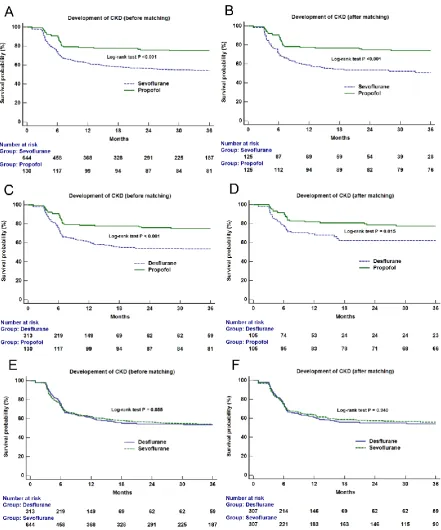
Secondly, to evaluate the effect of general anesthetic agents on long-term survival of the kidney, Kaplan-Meier survival curve analyses were performed for the development of new-onset CKD stage 3a or higher before and after matching. Patients were followed for up to 36 months and the log-rank test was used for inter-group comparison.
9
3. Results
Among 1087 patients included in our analysis, 130 patients (12.0%) received propofol and 957 patients (88.0%: Sevoflurane 59.2%, Desflurane 28.8%) received inhalational agent to maintain general anesthesia. After propensity score matching, 125 pairs of patients remained between the propofol and sevoflurane group, 105 pairs between the propofol and desflurane group, and 307 pairs between the sevoflurane and desflurane group (Figure 1). Patient characteristics and perioperative parameters are summarized in Table 1. Histograms and covariate balance plots of the distribution of standardized differences of covariates between groups before and after matching are shown in Supplemental Figures S1-S4 according to the different pair of matching.
There were significant differences in the incidence of postoperative AKI, new-onset CKD stage 3a or high and CKD upstaging between the propofol and sevoflurane or desflurane. (Tables 2, 3) However, there were no significant differences in any outcome between the sevoflurane and desflurane groups (Table 2). After propensity score matching, the propofol group still showed significantly less frequent postoperative AKI, new-onset CKD stage 3a or high and CKD upstaging than the sevoflurane group (Table 2). The propofol group also showed significantly less frequent postoperative AKI and CKD upstaging than the desflurane group (Table 3). Between sevoflurane and desflurane, there was no significant difference (Table 4). When the sevoflurane and desflurane groups were combined into the volatile group, the propofol group showed significantly less frequent postoperative AKI and CKD upstaging than the volatile group before and after matching (Supplemental Table S1).
10
11
4. Discussion
We investigated the association between general anesthetic agents and postoperative renal functional outcomes in patients undergoing nephrectomy. The incidences of postoperative AKI and CKD upstaging were significantly and consistently lower in the propofol group compared to the sevoflurane or desflurane group before and after propensity score matching. The 3-year postoperative incidence of new-onset CKD stage 3a or high was also significantly lower in the propofol group than sevoflurane group after matching. There was no significant difference between sevoflurane and desflurane groups. Propofol was associated with better short- and long-term renal function after nephrectomy compared to volatile agents. However, although we adjusted as many perioperative parameters which may affect postoperative renal function, further well-designed randomized trial with enough power is required to confirm our findings as our study was a single-center retrospective observational study.
Although the underlying mechanism for the significant association between the choice of anesthetic agent and postoperative AKI is unclear, several possible mechanisms can be elucidated on the basis of previous animal experiments. Propofol reduced postoperative AKI by attenuating oxidative stress in a rat model of liver transplantation [25]. Propofol conferred a protective effect against renal ischemia-reperfusion injury by modulating inflammatory cytokines [26,27]. Considering the mechanisms of renal dysfunction after partial nephrectomy involves the ischemic injury by vascular clamping [28], propofol could be beneficial to attenuate AKI after nephrectomy. By reducing the incidence of AKI, propofol could attenuate the risk of CKD subsequently, as AKI is a potent risk factor of postoperative CKD [3,29].
12
nephrotoxicity. Sevoflurane is metabolized into two products, inorganic fluoride ions and compound A with potential nephrotoxicity. However, despite the nephrotoxicity proven in an animal study, clinical studies have demonstrated the safety of sevoflurane for renal function, even for prolonged use in humans [18,30]. In a recent randomized trial conducted on patients with kidney transplantation, there was no significant difference in graft outcome between the sevoflurane and propofol [31]. Previous animal studies even reported the renal protective effect of sevoflurane [32,33]. However, there seems to be no previous study comparing propofol and sevoflurane during nephrectomy. The influence of anesthetic agent on renal function may be greater during nephrectomy with frequent and significant postoperative renal functional decline [13,34]. Our study results call for a further randomized trial comparing the effect of propofol and sevoflurane on renal function after nephrectomy.
There are conflicting results regarding the effect of general anesthetic agents on postoperative renal function in other surgical populations. There were no significant differences in renal function between sevoflurane, desflurane and propofol after elective surgery in a previous randomized trial [35]. However, this study involved only a small number of patients and did not limit the type of surgery. There was also no significant difference in the incidence of postoperative AKI after lung surgery between the propofol and sevoflurane in a recent retrospective study [36]. However, the incidence of AKI after lung surgery was as low as 3.5% and significantly larger number of patients are required for sufficient study power.
13
measuring plasma inflammatory markers. Propofol-based anesthesia reduced postoperative urinary kidney-specific proteins and serum pro-inflammatory cytokines compared with sevoflurane in patients undergoing open abdominal aortic aneurysm repair [38]. In addition, in a retrospective study conducted on 4,320 patients who underwent colorectal surgery, propofol decreased the incidence of postoperative AKI compared to sevoflurane [39]. Although not in surgical populations, propofol used in critically ill patients as a sedative agent was associated with lower AKI incidence and need for renal replacement therapy compared to midazolam [40]. Based on these findings, a recently updated report by the European Society of Incentive Care Medicine reported that propofol as a sedative agent may have an advantage in preventing the AKI in critically ill patients [41].
The strength of our study is that we investigated the incidence of new-onset CKD after nephrectomy for 36 months after nephrectomy. Demographic and genetic factors, comorbidity, pre-existing renal disease and surgical technique are associated with the development of CKD after nephrectomy [14]. However, there have been no reports of the association of anesthetic agents in the surgical population with long-term renal function. We demonstrated the possible benefit of propofol to mitigate the risk of CKD as well as AKI compared to volatile agents through rigorous adjustment of possible confounding factors. Matching was performed pairwise like network analysis, different matching for three pairs of general anesthetics. The consistent results between different pair of network comparison supported our conclusion.
14
analyses of secondary outcomes yielded consistent results. Secondly, we did not analyze radical and partial nephrectomy separately. Unlike radical nephrectomy, ischemic time due to renal arterial clamping and type of ischemia plays an important role in the development of direct ischemic injury of the remaining renal parenchyma [9]. Thus, the protective role of propofol on the AKI due to ischemia-reperfusion injury might vary between radical and partial nephrectomy. Thirdly, we used only serum creatinine concentration except urine output to diagnose the AKI. However, urine output criteria may be inaccurate due to mannitol infusion during partial nephrectomy [11].
5. Conclusions
In our propensity score-matched comparison of the patients undergoing radical and partial nephrectomy, the anesthetic agent of propofol was associated with a lower incidence of postoperative AKI or CKD upstaging compared to sevoflurane or desflurane. The three-year renal survival after nephrectomy was also significantly different between propofol and sevoflurane or desflurane. Therefore, in patients receiving nephrectomy, propofol may be the reasonable general anesthetic agent to mitigate postoperative renal functional deterioration compared to volatile agents. However, due to the limitation of retrospective design, randomized controlled trials are needed to confirm our findings and demonstrate the possible mechanism.
15
balance plot (right) of distribution of standardized differences of covariates between the patients who received propofol and sevoflurane during surgery before and after matching.
Supplemental Figure S2. Histograms (left) and covariate balance plot (right) of distribution of standardized differences of covariates between the patients who received propofol and desflurane during surgery before and after matching. Supplemental Figure S3. Histograms (left) and covariate balance plot (right) of distribution of standardized differences of covariates between the patients who received sevoflurane and desflurane during surgery before and after matching. Supplemental Figure S4. Histograms (left) and covariate balance plot (right) of distribution of standardized differences of covariates between the patients who received propofol and volatile agents during surgery before and after matching. Supplemental Figure S5. Kaplan-Meier survival curve analysis of new-onset chronic kidney disease according to the main anesthetic agents (TIVA vs. inhalation agents) before (A) and after (B) propensity score matching.
Author Contributions: H-J.L.: data curation, formal analysis, investigation, visualization, writing-original draft; J.B., Y.K., H.S.J., S.Y.: writing review and editing; J-T.K.: supervision, writing review and editing; C.W.J.: data curation, writing-review and editing; W.H.K.: conceptualization, data curation, formal analysis, investigation, methodology, visualization, writing-original draft.
Funding: This study was not supported by any external fund.
Acknowledgments: None.
16
References
1. Znaor A, Lortet-Tieulent J, Laversanne M, Jemal A, Bray F. International variations and trends in renal cell carcinoma incidence and mortality. Eur Urol. 2015; 67: 519-30. 2. Ljungberg B, Albiges L, Abu-Ghanem Y, Bensalah K, Dabestani S, Fernandez-Pello S, et al. European Association of Urology Guidelines on Renal Cell Carcinoma: The 2019 Update. Eur Urol. 2019; 75: 799-810.
3. Garofalo C, Liberti ME, Russo D, Russo L, Fuiano G, Cianfrone P, et al. Effect of post-nephrectomy acute kidney injury on renal outcome: a retrospective long-term study. World J Urol. 2018; 36: 59-63.
4. Schmid M, Krishna N, Ravi P, Meyer CP, Becker A, Dalela D, et al. Trends of acute kidney injury after radical or partial nephrectomy for renal cell carcinoma. Urol Oncol. 2016; 34: 293 e1- e10.
5. Grams ME, Rabb H. The distant organ effects of acute kidney injury. Kidney Int. 2012; 81: 942-8.
6. Weight CJ, Larson BT, Fergany AF, Gao T, Lane BR, Campbell SC, et al. Nephrectomy induced chronic renal insufficiency is associated with increased risk of cardiovascular death and death from any cause in patients with localized cT1b renal masses. The Journal of urology. 2010; 183: 1317-23.
7. Hobson C, Ozrazgat-Baslanti T, Kuxhausen A, Thottakkara P, Efron PA, Moore FA, et al. Cost and Mortality Associated With Postoperative Acute Kidney Injury. Ann Surg. 2015; 261: 1207-14.
17
factors associated with acute kidney injury after partial nephrectomy. Br J Anaesth. 2016; 116: 70-6.
10. Schmid M, Abd-El-Barr AE, Gandaglia G, Sood A, Olugbade K, Jr., Ruhotina N, et al. Predictors of 30-day acute kidney injury following radical and partial nephrectomy for renal cell carcinoma. Urol Oncol. 2014; 32: 1259-66.
11. Hur M, Park S-K, Yoo S, Choi S-N, Jeong CW, Kim WH, et al. The association between intraoperative urine output and postoperative acute kidney injury differs between partial and radical nephrectomy. Scientific reports. 2019; 9: 760.
12. Kim NY, Hong JH, Koh DH, Lee J, Nam HJ, Kim SY. Effect of Diabetes Mellitus on Acute Kidney Injury after Minimally Invasive Partial Nephrectomy: A Case-Matched Retrospective Analysis. J Clin Med. 2019; 8: E468
13. Mir MC, Ercole C, Takagi T, Zhang Z, Velet L, Remer EM, et al. Decline in renal function after partial nephrectomy: etiology and prevention. J Urol. 2015; 193: 1889-98.
14. Li L, Lau WL, Rhee CM, Harley K, Kovesdy CP, Sim JJ, et al. Risk of chronic kidney disease after cancer nephrectomy. Nat Rev Nephrol. 2014; 10: 135-45.
15. Kil HK, Kim JY, Choi YD, Lee HS, Kim TK, Kim JE. Effect of Combined Treatment of Ketorolac and Remote Ischemic Preconditioning on Renal Ischemia-Reperfusion Injury in Patients Undergoing Partial Nephrectomy: Pilot Study. J Clin Med. 2018; 7: E470.
18
17. Li Y, Zhong D, Lei L, Jia Y, Zhou H, Yang B. Propofol prevents renal ischemia-reperfusion injury via inhibiting the oxidative stress pathways. Cellular Physiology and Biochemistry. 2015; 37: 14-26.
18. Gentz BA, Malan TP. Renal toxicity with sevoflurane. Drugs. 2001; 61: 2155-62. 19. Kong HY, Zhu SM, Wang LQ, He Y, Xie HY, Zheng SS. Sevoflurane protects against
acute kidney injury in a small-size liver transplantation model. Am J Nephrol. 2010; 32: 347-55.
20. Chawla LS, Eggers PW, Star RA, Kimmel PL. Acute kidney injury and chronic kidney disease as interconnected syndromes. N Engl J Med. 2014; 371: 58-66.
21. Thomas ME, Blaine C, Dawnay A, Devonald MA, Ftouh S, Laing C, et al. The definition of acute kidney injury and its use in practice. Kidney Int. 2015; 87: 62-73. 22. Shin SR, Kim WH, Kim DJ, Shin IW, Sohn JT. Prediction and Prevention of Acute
Kidney Injury after Cardiac Surgery. Biomed Res Int. 2016; 2016: 2985148.
23. Levin A, Stevens PE, Bilous RW, Coresh J, De Francisco AL, De Jong PE, et al. Kidney Disease: Improving Global Outcomes (KDIGO) CKD Work Group. KDIGO 2012 clinical practice guideline for the evaluation and management of chronic kidney disease. Kidney International Supplements. 2013; 3: 1-150.
24. Levey AS, Coresh J, Greene T, Stevens LA, Zhang YL, Hendriksen S, et al. Using standardized serum creatinine values in the modification of diet in renal disease study equation for estimating glomerular filtration rate. Ann Intern Med. 2006; 145: 247-54. 25. Luo C, Yuan D, Li X, Yao W, Luo G, Chi X, et al. Propofol attenuated acute kidney
19
26. Hsing C-H, Chou W, Wang J-J, Chen H-W, Yeh C-H. Propofol increases bone morphogenetic protein-7 and decreases oxidative stress in sepsis-induced acute kidney injury. Nephrol Dial Transplant. 2010; 26: 1162-72.
27. Sánchez-Conde P, Rodriguez-Lopez JM, Nicolás JL, Lozano FS, García-Criado FJ, Cascajo C, et al. The comparative abilities of propofol and sevoflurane to modulate inflammation and oxidative stress in the kidney after aortic cross-clamping. Anesth Analg. 2008; 106: 371-8.
28. Zabell JR, Wu J, Suk-Ouichai C, Campbell SC. Renal ischemia and functional outcomes following partial nephrectomy. Urologic Clinics. 2017; 44: 243-55.
29. Cho A, Lee JE, Kwon GY, Huh W, Lee HM, Kim YG, et al. Post-operative acute kidney injury in patients with renal cell carcinoma is a potent risk factor for new-onset chronic kidney disease after radical nephrectomy. Nephrol Dial Transplant. 2011; 26: 3496-501. 30. Kharasch ED, Frink EJ, Jr., Artru A, Michalowski P, Rooke GA, Nogami W.
Long-duration low-flow sevoflurane and isoflurane effects on postoperative renal and hepatic function. Anesth Analg. 2001; 93: 1511-20, table of contents.
31. Nieuwenhuijs-Moeke GJ, Nieuwenhuijs VB, Seelen MAJ, Berger SP, van den Heuvel MC, Burgerhof JGM, et al. Propofol-based anaesthesia versus sevoflurane-based anaesthesia for living donor kidney transplantation: results of the VAPOR-1 randomized controlled trial. Br J Anaesth. 2017; 118: 720-32.
20
33. Lee HT, Kim M, Song JH, Chen SW, Gubitosa G, Emala CW. Sevoflurane-mediated TGF-β1 signaling in renal proximal tubule cells. American Journal of Physiology-Renal Physiology. 2008; 294: F371-F8.
34. Scosyrev E, Messing EM, Sylvester R, Campbell S, Van Poppel H. Renal function after nephron-sparing surgery versus radical nephrectomy: results from EORTC randomized trial 30904. Eur Urol. 2014; 65: 372-7.
35. Ebert TJ, Arain SR. Renal responses to low-flow desflurane, sevoflurane, and propofol in patients. Anesthesiology. 2000; 93: 1401-6.
36. Oh TK, Kim J, Han S, Kim K, Jheon S, Ji E. Effect of sevoflurane-based or propofol-based anaesthesia on the incidence of postoperative acute kidney injury: A retrospective propensity score-matched analysis. Eur J Anaesthesiol. 2019; 36: 649-55.
37. Yoo YC, Shim JK, Song Y, Yang SY, Kwak YL. Anesthetics influence the incidence of acute kidney injury following valvular heart surgery. Kidney Int. 2014; 86: 414-22. 38. Ammar A, Mahmoud K. Comparative effect of propofol versus sevoflurane on renal
ischemia/reperfusion injury after elective open abdominal aortic aneurysm repair. Saudi journal of anaesthesia. 2016; 10: 301.
39. Bang JY, Lee J, Oh J, Song JG, Hwang GS. The Influence of Propofol and Sevoflurane on Acute Kidney Injury After Colorectal Surgery: A Retrospective Cohort Study. Anesth Analg. 2016; 123: 363-70.
40. Leite TT, Macedo E, da Silva Martins I, de Oliveira Neves FM, Libório AB. Renal outcomes in critically ill patients receiving propofol or midazolam. Clin J Am Soc Nephrol. 2015; 10: 1937-45.
21
Prevention of acute kidney injury and protection of renal function in the intensive care unit: update 2017 : Expert opinion of the Working Group on Prevention, AKI section, European Society of Intensive Care Medicine. Intensive Care Med. 2017; 43: 730-49.
Figure legends
22
23