2731 IJSTR©2019
Competency Acquisition, Difficulty And
Performance Of First Year College Students In
Mathematics In The Modern World (MITMW)
Adriel G. Roman, Rogacion U. Villanueva
Abstract:— Mathematics in the Modern World (MITMW) is one of the general education subjects taught in the new college curriculum in the Philippines. In this study, the self-assessment of students on their acquisition of the competencies set in the MITMW are being described as well as the extent of difficulties and performance. Using descriptive correlational research design, this study hypothesized that the perceived extent of acquisition of the first year college students on the competencies intended for Mathematics in the Modern World and their extent of difficulties experienced provide significant relationship to their performance. Two hundred seventy-one (271) first year college students were surveyed using validated questionnaires. Results revealed that the first year college students have higher extent of acquisitions on the competencies set in the MITMW (knowledge, values, and skills). Students experienced slight difficulties on the different topics of MITMW with satisfactory performances in the subject. Finally, the study concluded that acquired competencies and difficulties are both significantly related to students’ performance in MITMW.
Index Terms:— Acquisition, Competency, Difficulty, Mathematics Education, Performance, Modern, World.
—————————— ——————————
1
INTRODUCTION
The Mathematics in the Modern World (MITMW) is a 3-unit subject which is part of the 36 general education units started in 2018 and implemented in all general education curriculum (GEC). MITMW involves the nature of explorative mathematics of patterns and as an application of inductive and deductive reasoning. Accordingly, MITMW is anticipated to become an instrument for dealing and understanding the complexity of present day living as to personal financial management, making social options, appreciation designs related to geometry, comprehending codes, and fairly allocating limited resources [1]. MITMW replaced the old general education mathematics subjects which had been used in the Philippines since 1996. Due to the effects of Senior High School as mandated by the RA 10533 (K-12 Law), all general education subjects were moved in the Senior High School and replaced by new set of general education subjects. The impact of this transition from the old curriculum to a more sophisticated curriculum is felt in the higher education especially teachers who have been teaching general mathematics subjects in the past years. The shifting from teaching traditional Algebra, Geometry, Trigonometry, Statistics to Problem Solving, Data Management, and Voting and Apportionment, provides new challenges to teachers. Several studies proved that teaching mathematics has a lot of challenges. According to Herheim and Kacerja [2], when doing mathematics in school, students often ask ―why do I have to learn this? or ―when will I use this?‖. Often, answer to this problem is that― by the time that the examination period comes up‖ or ―you are going to use that in your next mathematics school year‖ but according to Onion [3], answers do not address the core questions. When students ask questions similar to the abovementioned they are longing for the application of mathematics theories to the real world. In this kind of scenario, teachers are being challenged.
1.1 Objectives of the Study
This study was conducted with the aim of determining the extent of acquisition of expected competencies among students, the degree of difficulty/easiness they experienced after studying MITMW and its relationship to their performance. Likewise, this study solicited feedbacks from the students for the improvement of teaching MITMW. To attain this objective, the following questions were raised:
1. What is the perceived extent of acquisition of the first year college students on the competencies intended for Mathematics in the Modern World?
2. What is the extent of difficulty experienced by the first year college students in Mathematics in the Modern World?
3. What is the performance of first year college students in Mathematics in the Modern World?
4. Is there a significant relationship between the perceived extent of acquisition of the first year college students on the competencies intended for Mathematics in the Modern World and their performance?
5. Is there a significant relationship between the extent of difficulty experienced by the first year college students and their performance in Mathematics in the Modern World?
6. What are the suggestions of the first year college students to improve the teaching of Mathematics in the Modern World?
1.2 Hypothesis
It is hypothesized in this study that the perceived extent of acquisition of the first year college students on the competencies intended for Mathematics in the Modern World and their extent of difficulties experienced provide significant relationship to their performance.
2 M
ETHODOLOGYRespondents of the study were 271 first year college students (Agriculture, Agricultural Technology, Accountancy, Tourism, Criminology and Hotel and Management) during the first semester of the school year 2019 from One State University in the Philippines. With the informed consent of the respondents, their grades in the subject Mathematics in the Modern World
————————————————
• Adriel G. Roman is currently an Assistant Professor I at the Laguna State Polytechnic University, Siniloan, Laguna, Philippines.
E-mail: [email protected]
• Rogacion U. Villanueva is currently an Instructor III at the Laguna
State Polytechnic University. E-mail:
2732
(GEC 104) were obtained by the researchers. Since the Mathematics general education courses in the University where the study was conducted is following a departmentalized curriculum and assessment, the researchers through the consent of the subject coordinator, secured the copy of course syllabus. The competencies set in the syllabus were used as the basis of the first part of the research instrument consisting of 23 competencies divided into three categories: knowledge, values and skills. The second part of the instrument was taken from the content of the syllabus categorized as: Mathematics in our World, Mathematical Language and Symbols, Problem Solving and Reasoning, Data Management and Electives. In the second part of the instrument, the extent of difficulty as experienced by the respondents was asked using a 5-point Likert Scale (5-Not Difficult, 4-Slightly Difficult, 3-Moderately Difficult, 2-Very Difficult, 1-Extremely Difficult). To check the validity of the research instrument, five mathematics and research experts were consulted and verified the validity of the research instrument. In addition, reliability test using Cronbach’s Alpha revealed values 0.930 and 0.899 for first and second parts of the research instrument respectively. Administration of the questionnaires was done after the final date of submission of grading sheets. Classroom professors and instructors were not present during the administration of the questionnaire to the respondents and confidentiality of the responses was assured to them.
3 RESULTS AND DISCUSSIONS
3.1 Perceived Extent of Acquisition of the First Year College Students on the Competencies Intended for Mathematics in the Modern World
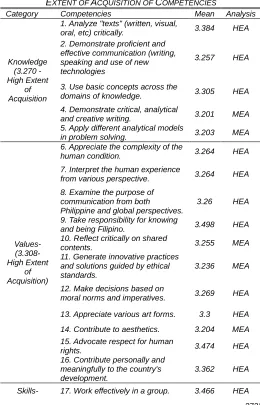
Table 1 shows the average perceptions of the first year college students on the extent of acquisition on the competencies intended for Mathematics in the Modern World. The results clearly show that first year college students have high extent of acquisition on knowledge (3.270), values (3.308) and skills as set in the curriculum mapping of the Mathematics in the Modern World. In particular, first year college students perceived that they have acquired with high extent the three competencies for knowledge category (Analyze "texts" (written, visual, oral, etc) critically; Demonstrate proficient and effective communication (writing, speaking and use of new technologies; Use basic concepts across the domains of knowledge.) while they perceived a moderate extent for the last 2 competencies. The results provide an implication that after the subject was taught, students could analyze texts, demonstrate proficient and effective communication and use basic concept in MITMW and apply these learnings in real world. First year college students perceived that they have acquired with high extent the competencies under the values category specifically the appreciation of complexity of human condition, Interpret the human experience from different perspectives. Taking responsibility for determining and being Filipino, making decisions anchored on moral norms and imperatives, appreciating various art forms, advocating respect for human rights, and contributing personally and meaningfully to the development of the country while moderate extent on reflecting critically on shared contents, Generate innovative practices and solutions guided by ethical standards, and contributing to aesthetics. As to competencies
under skills category, first year college students perceived that they could work effectively in a group, apply effectively computing tools to process information, use current technology in assisting and facilitating learning and research, negotiate responsibly the world of technology, manage one's knowledge skills and values for responsible and productive living, and organize one's self of lifelong learning while moderate extent in terms of creating solutions to problems in various fields. The findings provide that the knowledge, values and skills competencies are acquired with high extent by the first year college students. These acquired competencies manifest the achievement of the course discipline to improve not only knowledge to the students but also good values and useful skills. Researchers said that educational learning is classified into cognitive, interpersonal and psychomotor skills. Cognitive includes understanding the curriculum content, generating concepts and problem solving. Interpersonal is all about interacting with others while psychomotor involves performing behavioral activities [4]. A study conducted by Sönmez [5] found a high level of significant positive association between cognition skills, psychomotor skills, affective skills and intuitive learning outcomes which provided an implication that learning outcomes are not disjoint. Hence, when students learn a cognitive behavior, they also learn other related skills, values and intuitive behaviors.
TABLE1
EXTENT OF ACQUISITION OF COMPETENCIES
Category Competencies Mean Analysis
Knowledge (3.270 - High Extent
of Acquisition
1. Analyze "texts" (written, visual,
oral, etc) critically. 3.384 HEA
2. Demonstrate proficient and effective communication (writing, speaking and use of new technologies
3.257 HEA
3. Use basic concepts across the
domains of knowledge. 3.305 HEA
4. Demonstrate critical, analytical
and creative writing. 3.201 MEA
5. Apply different analytical models
in problem solving. 3.203 MEA
Values- (3.308- High Extent
of Acquisition)
6. Appreciate the complexity of the
human condition. 3.264 HEA
7. Interpret the human experience
from various perspective. 3.264 HEA
8. Examine the purpose of communication from both Philippine and global perspectives.
3.26 HEA
9. Take responsibility for knowing
and being Filipino. 3.498 HEA
10. Reflect critically on shared
contents. 3.255 MEA
11. Generate innovative practices and solutions guided by ethical standards.
3.236 MEA
12. Make decisions based on
moral norms and imperatives. 3.269 HEA
13. Appreciate various art forms. 3.3 HEA
14. Contribute to aesthetics. 3.204 MEA
15. Advocate respect for human
rights. 3.474 HEA
16. Contribute personally and meaningfully to the country's development.
3.362 HEA
2733 IJSTR©2019
(3.351-High Extent of Acquisition)
18. Apply computing tools to
process information effectively. 3.353 HEA
19. Use current technology to assist and facilitate learning and research.
3.359 HEA
20. Negotiate the world of
technology responsibly. 3.263 HEA
21. Create solutions to problems
in various fields. 3.226 MEA
22. Manage one's knowledge skills and values for responsible and productive living.
3.332 HEA
23. Organize one's self of lifelong
learning. 3.454 HEA
HEA-High Extent of Acquisition MEA-Moderate Extent of Acquisition
3.2 Extent of Difficulty Experienced by the First Year College Students in Mathematics in the Modern World
Based on studies, several reasons of having difficulties in Mathematics are lack of mathematics skills; insufficiency evidence on the part of the teachers to link new math concepts to prior competency or previous knowledge; fear in math (anxiety); negative thoughts and feelings about math; economic status; educational background; school management; and assessment tools [6],[7]. Based on the result of this study, first year college students experienced slight difficulties on the different subjects in MITMW. Using the 5-point Likert scale, topics such as Fibonacci Sequence, Elementary logic, organization of patterns and regularities in the world, characteristics of Mathematical language and applications of Math in the word are the top 5 among the topics while graphs ranked first in the elective subjects. Among the five core contents, Mathematics in our world (3.85) showed the highest mean. Mathematics in the modern world consists of specific topics focusing on the application of Mathematics in the vast changing world setting. Despite of having slight difficulties, students need not only to appreciate the beauty of Mathematics but also relate these concepts in the natural world. Rangel [8], connected mathematics to the real world using situational problems through mathematical modeling. Based on the conclusion, mathematical modeling fosters interest in learning mathematics through its connection to situations in context. In addition, students enable to actively and energetically involve in the learning process.
TABLE2
EXTENT OF DIFFICULTY
Topic Mean Analysis
Mathematics in Our World 3.89 Slightly Difficult
1. Fibonacci Sequence 4.04 Slightly Difficult
2. Mathematics helps organize patterns
and regularities in the world 3.95 Slightly Difficult
3. Mathematics helps predict the behavior of nature and phenomena in the world
3.84 Slightly Difficult
4. Mathematics helps control nature and
occurrences in the world for our own ends 3.76 Slightly Difficult 5. Mathematics has numerous
applications in the world making it indispensable
3.85 Slightly Difficult
Mathematical Language and Symbols 3.85 Slightly Difficult
1. Characteristics of Mathematical
language 3.88 Slightly Difficult
2. Expression vs. Sentences 3.74 Slightly Difficult
3. Four basic concepts:sets, functions, 3.81 Slightly Difficult
relations, binary operations
4. Elementary Logic 4.00 Slightly Difficult
5. Formality 3.82 Slightly Difficult
Problem Solving and Reasoning 3.72 Slightly Difficult
1. Inductive and Deductive Reasoning 3.82 Slightly Difficult
2. Intuition, proof and certainty 3.62 Slightly Difficult
3. Polya’s 4-steps in Problem Solving 3.63 Slightly Difficult
4. Problem Solving strategies 3.78 Slightly Difficult
5. Mathematical Problems Involving
Patterns 3.78 Slightly Difficult
6. Recreational Problems Using
Mathematics 3.68 Slightly Difficult
Data Management 3.73 Slightly Difficult
1. Data 3.87 Slightly Difficult
2. Measures of Central Tendency 3.72 Slightly Difficult
3. Measure of Dispersion 3.62 Slightly Difficult
4. Measures of Relative Position 3.69 Slightly Difficult
5. Probabilities and Normal Distributions 3.76 Slightly Difficult
6. Linear Regression and Correlation 3.69 Slightly Difficult
Electives 3.67 Slightly Difficult
1. Geometric Designs 3.67 Slightly Difficult
2. Codes 3.54 Slightly Difficult
3. Linear Programming 3.52 Slightly Difficult
4. Mathematics of Finance 3.72 Slightly Difficult
5. Apportionment and Voting 3.53 Slightly Difficult
6. Logic 3.81 Slightly Difficult
7. Mathematics Graphs 3.86 Slightly Difficult
8. Mathematical Systems 3.61 Slightly Difficult
3.3 Performance of First Year College Students in Mathematics in the Modern World
2734
also to prepare them in making well-grounded decisions that involve logical and mathematical reasoning. Confidence level, repeated kinder, mother work status and highest level of education to complete are salient elements to consider [9].
TABLE3
PERFORMANCE OF FIRST YEAR COLLEGE STUDENTS IN MATHEMATICS IN THE MODERN WORLD
Statistical Measures Value Interpretation
Mean 2.175 Satisfactory
Median 2.000 Satisfactory
Mode 2.000 Satisfactory
Skewness 0.403
Positively High
Standard Error of Skewness 0.160
Shapiro-Wilk 0.922 Skewed
Distribution
Shapiro-Wilk (P-value) <0.001
3.4 Relationship between the Perceived Extent of Acquisition of the First Year College Students on the Competencies Intended for Mathematics in the Modern World to their Performance
To determine the significant relationship between the perceived extent of acquisition on the competencies intended for MITMW (4-point Likert scale) and academic performance of the students (1.00-1.25: Excellent,…,5.00: Failed), Spearman rank order correlation is used. The competencies indicated in the Mathematics in the Modern World provided significant results to the performances of first year college students. In the knowledge category, competencies focusing on demonstrating proficiency and effective communication showed a negative correlation values. This negative relationship provides an avenue that as the extent of acquisition gets higher, the numerical value provided in the academic performance becomes lower. This implies that as the students’ acquired competency of demonstrating proficiency and effectiveness in communication increases, their performance in MITMW increases. The result conforms to what Henry, Baltes, and Nistor [10] concluded that English proficiency is a statistically significant predictor of mathematics scores. Mathematics scores increase simultaneously with English proficiency but inversely with grade level. Grade level moderates the influence of English proficiency on mathematics scores. Likewise, it supports the findings of Ramberly et al. [11] which showed that good mastering of English is essential in nurturing and comprehending mathematics for the assurance of excellent performance. Furthermore, poor proficiency in English resulted to students’ shortage in mathematics learning and obtained a lower grade in a mathematics discipline. Similar results are obtained from the following competencies: Use essential concepts across the knowledge domain, show analytical, critical and creative writing, and use different models analytically in problem solving while no significant relationship exists between analyze texts and students performance in MITMW. In terms of value competencies acquisition, results revealed that only contribute to aesthetics and advocate for human rights are not significant while other competencies under values categories are found significant. This results show that while knowledge is an important competency in learning mathematics, the attribution of high performance in mathematics in values should not be neglected. Values are important aspect in learning mathematics. According to Limbaco [12], there is a significant relationship between values taught by the teachers and values
learned by the students and attitude towards mathematics and performance in mathematics. Positive attitude towards mathematics would result to high performance. Having shown all significant p-values, the skills competencies are related to the performance of students in MITMW. Among seven competencies under skills category, it is found out that the use of modern technology to assist and facilitate learning and research has the highest significant value. The use of technology is already a part of teaching and learning. As concluded by the study of Rangel, et al. [8] with the use of technology and collaborative work, activities that involve problem situations in mathematics courses allow students to play an active role in their own learning. Through their own experience, they build concepts and develop abilities. Through peer interaction, the ideas, knowledge, arguments and conclusions presented by each member of the group so as to defend their positions, their conceptions and points of view based on prior experience, knowledge and the skills acquired throughout their education are all strengthened and enriched.
TABLE4
RELATIONSHIP BETWEEN THE EXTENT OF ACQUISITION AND PERFORMANCE IN MITMW
Competencies r Sig.
1. Analyze "texts" (written, visual, oral, etc) critically. -0.098 0.142 2. Demonstrate proficient and effective
communication (writing, speaking and use of new technologies
-.207** 0.002
3. Use basic concepts across the domains of
knowledge. -.206
**
0.002
4. Demonstrate critical, analytical and creative writing. -.205** 0.002 5. Apply different analytical models in problem solving. -.154* 0.02 6. Appreciate the complexity of the human condition. -.173** 0.009 7. Interpret the human experience from various
perspective. -.177
**
0.008
8. Examine the purpose of communication from both
Philippine and global perspectives. -.139
*
0.036
9. Take responsibility for knowing and being Filipino. -.195** 0.003
10. Reflect critically on shared contents. -.202** 0.002
11. Generate innovative practices and solutions
guided by ethical standards. -.267
**
<0.001
12. Make decisions based on moral norms and
imperatives. -.229
** <0.001
13. Appreciate various art forms. -.204** 0.002
14. Contribute to aesthetics. -0.107 0.105
15. Advocate respect for human rights. -0.122 0.066
16. Contribute personally and meaningfully to the
country's development. -.146
*
0.027
17. Work effectively in a group. -.241** <0.001
18. Apply computing tools to process information
effectively. -.272
** <0.001
19. Use current technology to assist and facilitate
learning and research. -.351
**
<0.001
20. Negotiate the world of technology responsibly. -.287** <0.001 21. Create solutions to problems in various fields. -.328** <0.001 22. Manage one's knowledge skills and values for
responsible and productive living. -.277
**
<0.001
23. Organize one's self of lifelong learning. -.208** <0.001
3.5 Relationship between the Extent of Difficulty Experienced by the First Year College Students in Mathematics in the Modern World and their Performance
2735 IJSTR©2019
language and symbols (rs = -0.316), problem solving and
reasoning (rs =-0.276), data management (rs = -0.250), and
Electives (rs = 0.265) revealed that students who do not
experience difficulties in MITMW have obtained high performance in the subject. In the same way, students who have experienced difficulties in learning MITMW have obtained low performance in the subject. This result implies that difficulties in mathematics lead students to low performance. Hence, this calls for an action to do something to minimize if not eliminate the difficulties experienced by the students in the subject. Likewise, the result shows that there is a weak to moderate relationships existed between the variables. Mathematical learning disabilities and learning difficulties associated with persistent low achievement in mathematics are common and not associated to intelligence [13].
TABLE5
RELATIONSHIP BETWEEN THE EXTENT OF DIFFICULTY AND PERFORMANCE IN MITMW
Extent of Difficulty r-value Sig.
Mathematics in Our World -0.414 <0.001
Mathematical Language and Symbols -0.316 <0.001
Problem Solving and Reasoning -0.276 <0.001
Data Management -0.250 <0.001
Electives -0.265 <0.001
3.6 Feedback of the First Year College Students to Improve the Teaching of MITMW
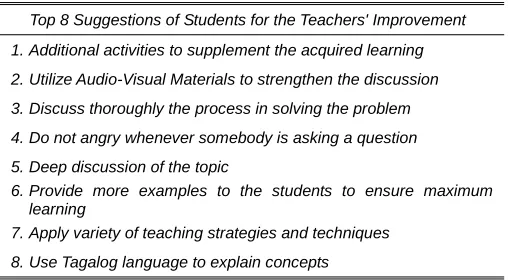
Table shows the suggestions of the students for the teachers’ improvement in teaching MITMW. First in rank is the additional activities to supplement the acquired learning. Students strongly believed that by providing additional activities to them, the learning is being supplemented and will be meaningful and life-long. Additionally, students suggest that utilization of audio-visual materials strengthen the discussion of the topics. Students likewise urged teachers to discuss thoroughly the process through analyzing the problems being solved and not just be focused on giving the final answer. Also, students suggest that teachers be approachable and should not be angry whenever somebody is asking a question. First year college students also said that there is a need to deepen discussion about the topics included in the MITMW. Recommended also are the provision of more examples to the students to ensure maximum learning, apply variety of teaching strategies and techniques, and the use of mother tongue language to explain concepts. The result of the recommendations given by the students are synthesized into mastery of the topic, methodology that includes strategies and techniques, assessment and evaluation, language and teachers’ behavior. According to Takiveikata (2018) while teachers recognize that numeracy is a crucial skill necessary for survival, they are challenged by a whole gamut of factors that hinder the opportunity of engaging creative classroom pedagogical practices. Although they are familiar with other teaching strategies that would enhance numeracy skills, it is argued that teachers are faced with a dilemma. In 2018, Dussault identified top 8 classroom challenges faced by the teachers which are: lack of teamwork, empathy, and support between students; teachers’ roles; time dealing with bodily functions; teachers’ additional accountabilities; insufficiency of time to plan; excessive paper works; meeting the expectations of school admins; and applying a congested curriculum to all types of students. Parallel to the findings of Dusault, it is
expected to every MITMW teacher to teach the content of the curriculum to all types of students and aside from being new to higher education curriculum, MITMW requires teachers to make a lot of readings and adjustments as well as instructional devices to meet the needs of the students.
TABLE6
FEEDBACK OF STUDENTS
Top 8 Suggestions of Students for the Teachers' Improvement
1.Additional activities to supplement the acquired learning
2.Utilize Audio-Visual Materials to strengthen the discussion
3.Discuss thoroughly the process in solving the problem
4.Do not angry whenever somebody is asking a question
5.Deep discussion of the topic
6.Provide more examples to the students to ensure maximum learning
7.Apply variety of teaching strategies and techniques
8.Use Tagalog language to explain concepts
4 CONCLUSION
Guided by the results of the study, it is reasonable to conclude that high extent of acquisition of competencies in MITMW is associated to better performance in the subject. The competencies in MITMW are not only focused on the cognitive aspect but also affective and psychomotor skills which are all seen to have significance in the achievement of the intended learning outcomes of the MITMW. In addition, the more difficult for the student to cope up with the subject matter, the higher the probability of getting low performance in MITMW. From the suggestions of the respondents, four themes emanate. Mastery of the subject content, methodology in facilitating the subject, assessment and evaluation process, language and teachers’ behavior are found significance on the part of the students’ perspective. Giving focus on these, teachers may consider other strategies and techniques in teaching MITMW. It is also recommended to utilize advanced technology in the facilitating the lessons. Research on language utilization in teaching MITMW and other mathematics disciplines is highly encouraged.
ACKNOWLEDGMENT
The authors wish to extend appreciation to the participants of the study.
REFERENCES
[1] Commission on Higher Education Memorandum Order Number 20 series of 2013. General Education Curriculum:Holistic Understandings, Intellectual and Civic Competencies.
[2] Herheim, R., & Kacerja, S.Building bridges between school mathematics and workplace mathematics. [3] Onion, A. J. (2004). What use is maths to me? A
report on the outcomes from student focus groups. Teaching Mathematics and its Applications, 23(4), 189–194.
[4] Sitzmann, T., Ely, K., Brown, K.G., & Bauer, K.N. (2010). Self-Assessment of Knowledge:A Cognitive Learning or Affective Measure?
2736
Affective, Psychomotor and Intuitive Domains in Education, Sönmez Model.
[6] Tambychik, T., & Meerah, T. S. M. (2010). Students’ difficulties in mathematics problem-solving: What do they say?. Procedia-Social and Behavioral Sciences, 8, 142-151.
[7] Acharya, B.R. (2017).Factors Affecting Difficulties in Learning Mathematics by Mathematics Learners. [8] Rangel, R.P., Magaña, M.D., Azpeitia, R.U., &
Nesterova, E.Y. (2016).Mathematical Modeling in Problem Situations of Daily Life.
[9] Gurat, M.G., & Gracia, R.S. (2016).Predictors of Students’ Competence in Applying Mathematics in Real World Problems.
[10]Henry, D. L., Baltes, B., & Nistor, N. (2014).Examining the relationship between math scores and English language proficiency. Journal of Educational Research and Practice, 4(1), 2.
[11]Rambely, Azmin & Ahmad, Rokiah & Majid, Noriza & Jaaman, Saiful Hafizah. (2013).The Relationship of English Proficiency and Mathematics Achievement. [12]Limbaco, K. S. A. (2015, March).Values taught, values
learned, attitude and performance in mathematics.In AIP Conference Proceedings (Vol. 1651, No. 1, pp. 94-98). AIP.
[13]Lai, Y., Zhu, X., Chen, Y., & Li, Y. (2015).Effects of mathematics anxiety and mathematical metacognition on word problem solving in children with and without mathematical learning difficulties. PloS one, 10(6), e0130570.
[14]Takiveikata, Sereima. (2018).Challenges of a Mathematics Teacher Abstract. 10.13140/RG.2.2.10500.42888.