
3620
Microbial Fuel Cell Functioning, Developments
And Applications-A Review
Abhishek J. Chhazed, Manisha V. Makwana, Neeraj K. Chavda
Abstract: Development of any country highly depends upon the generation of energy and efficiently using it in industries and agricultur al sector. Country such as India which is still developing has a major problem ahead of it in terms of generating en ergy which is sufficient. With the present crisis and environmental issues government has to look beyond carbon based sources and look towards sustainable energy sources. Microbia l fuel cell (MFC) is such technology which can be used to treat wastewater as well as be a power source at large scale. Here the crucial role is of researchers who can make this technology feasible as well as efficient enough to be undertaken. Researchers all over the worlds have researched on each and every major aspect of the MFC and still are optimizing it In order to use in its best possible way. This paper shows MFCs functioning, Developments and app lication which are currently in existence, like Wastewater treatment, Desalination, Hydrogen production and as Biosensors. The pap er allows reader to understand all the development in the field of MFC.
Index Terms: Minimum Anode, Biosensors, Cathode, Cation Exchange Membrane, Desalination, Proton Exchange Membrane, Microbial Fuel Cell, Wastewater treatment.
—————————— ——————————
1.
INTRODUCTION
One of the major challenges which mankind faces is the exponentially growing demand for energy. This energy demand results in the continuous use of fossil fuels. Still, the majority of total energy generated in the world is fulfilled by Fossil fuels. This results in not only depletion in their deposits at an alarming rate but they also generate CO2 which results in Global warming. India solely will produce 1905 Terawatt by 2022, which will make India as the Fifth largest consumer and producer of electricity [1]. Alternate renewable sources are in progress such as solar, wind and tidal. But waste management remains a big bottleneck in the commercial sector. This makes Microbial Fuel cell (MFC) a sustainable alternative source of renewable energy. MFC is a device that is an electrochemical technology that is being to recover electricity from wastewater [2][3][4]. It has great potential as an alternative to conventional power sources as it has applications in various fields like Wastewater Treatment [5][6][7][8], Implantable devices in medical fields [9] & Biosensors [10][11][12]. The original conceptualization of generating electricity from the decomposition of organic compounds was proposed by M.C. Potter in 1911. Due to low power generation, the idea was not appreciated [13]. The first major breakthrough came in 1931 when Barnet Cohen produced 35 volts with the number of microbial half fuel cells connected in series. This drew the attention of researchers towards MFC. The next fifty years comprised of understanding basic concepts of MFC and various experiments. The second and major breakthrough was the mediator less MFC. After this only optimization of various components is been done till today for better performance [14]. India alone produces about 36,400 million liters per day of wastewater. This wastewater has resulted in the development of MFC’s because of its multipurpose application of production of electricity with treating wastewater or production of hydrogen which can be further used as fuel. Indian scientific community has also contributed to the MFC field and will be doing furthermore work as MFC has great potential in India [15].
2
FUNCTIONING
OF
MFC
MFC structurally consists of two chambers, Anode chamber
where oxidation occurs and Cathode chamber where reduction occurs [16][17][18][19]. Anode chamber consists of Anode, Substrate (organic material) and the bacteria. The bacteria decompose the substrate in to form electrons (e-) and protons (H+)[20][21]. These electrons are transferred from bacteria to Anode (Electrode) by membrane-bound quinones and by cytochromes in electrogenic bacteria which does not require any mediator for electron transfer or by mediators such as Methylene blue or neutral red. These electrons are transferred from the anode chamber to the cathode chamber by external circuit providing the current while the protons are transferred through the salt bridge or Proton exchange membranes (PEM) [22]. Reduction takes place in the cathodic chamber mostly in the presence of oxygen. The transferred electron from the anode and the protons which are transferred from the PEM combine to form water in the cathode compartment. The bacteria form CO2 and H2O when it
decomposes substrate in the presence of oxygen. But the presence of oxygen is found inhibitory so Anode chambers are made Anaerobic. In anaerobic conditions, the bacteria decompose the organic matter into only CO2. As cathode
compartment can be aerobic, the cathode chamber can be eliminated which results in single-chamber MFC. The reactions while using acetate as a substrate are given below [15]. Figure 1 shows the schematic diagram of the MFC.
Anodic Reaction:
C2H4O2+ 2H2O = 2CO2 + 8e- + 8H+ (1)
Cathodic Reaction:
2O2 + 8e- + 8H+ = 4H2O (2)
Fig. 1 Schematic of MFC [26]
3. ESSENTIAL
PARTS
IN
MFC
Basic MFC contains single or dual chamber with anodic and cathodic chamber constructed by different materials, separated by different membranes and filled with different substrates and microorganism. This paper provides review of role of each part in MFC and the different materials used to construct electrode, membranes materials and microorganism used. Components of MFC are described below.
3.1 Anode
The anodic chamber is one of the important parts of the MFC because it is the place where decomposition of biomass occurs in the chamber with the help of bacteria. Anode electrode is the key element in transferring the electron and hence is an electron acceptor. There are various factors that influence the working and efficiency of the MFC like electrode material, bacteria, and proton transfer membranes. One of the major influential systems is the anodic electron transfer mechanism. Thus much work is being done to optimize the mechanism in to get best results. Electrical conductivity, Chemical stability, resistance to corrosion, high surface area, high mechanical strength and low cost for being feasible are the most important properties for materials as anode electrode [23][24]. Carbonaceous metal-based materials are used mostly in MFC because it comprises of all the above qualities required. Copper-based materials are not used due to the corrosion issues [25]. Carbonaceous based materials like carbon veil, carbon paper, carbon rod, carbonized cardboard, carbon cloth, and reticulated vitreous carbon materials are used [26]. Carbon cloth is the most often used anode material in MFC because of the high strength and high porosity for high surface area [27][28][29][30][31]. Nickel sheet, Copper sheet, stainless steel plate, silver sheet, titanium plate & gold sheet were used as anode materials [32]. Researchers have also utilized electrocatalytic materials like polyaniline (PANI) in to improve the current generation as the combination results in better electrical conductivity and environmental stability. Utilization of Pt one electrodes has been useful as it enhances electrocatalysis, however, the cost of Pt has been one of the major drawbacks for MFC. Alternates such as tungsten carbide have shown comparable results such as Pt [23]. Properties like high strength, large surface area, ductility, and stability have made carbon nanotubes (CNTs) one of the major materials which can be utilized as an electrode. Research conducted by Qiao et al [33] reported the use of CNTs and
PANI in combination to form anode electrode which enhanced the performance of MFC by the enhanced electron transfer system. Scott et al [34] conducted experiment by modifying graphite felt electrodes by C/PANI, carbon nanofibres and nitric acid carbon activation. The results suggested that modified electrodes performed better when compared to normal graphite felt electrodes. This occurred due to an increase in surface area which leads to more sites where microbial colonization could occur. CNTs have shown great results in terms of better performance compared to normal electrodes but the cost of CNTs and the expertise required to manufacture it has made it not feasible for its application in MFC till now. But we expect as the demand goes up and mass production of CNTs would bring down the cost and would be feasible enough in future to be utilized in MFCs.
3.2 Cathode
Cathode plays an important role in the performance of an MFC. Cathode should have high redox potential and properties to easily transfer protons. Initially, commercially available carbon electrodes were predominantly used, Graphite in particular due to properties like a wide electrochemical window, low residual current, recyclability, reusability and sufficient electrical conductivity [35]. Apart from graphite, cathode materials are similar to anode materials like Carbon veil, carbon cloth, carbon rod and carbon paper which are carbon-based and materials like nickel, titanium which are metal-based [36]. But as these materials were used a rod or single sheet which decreased productivity as it lacked a higher surface area which is a must for better growth of microbial activity. After various experiments by Marshall and his team concluded that using granular graphite as cathode would result in higher volumetric acetate production from CO2. This
3622 carbonaceous catalyst. Apart from this the third type of catalyst
which are PGM-free catalyst is one which is under a lot of research and has the attracted attention of researchers all around the world. These catalysts are based on transition metal along with carbon and nitrogen. These metals comprise of Mn, Fe, Co and Ni. Various test of Mn-based [46][47][48][49], Ni-based [50][51] and Fe based [52][53][54][55][56][57][58][59][60] cathode catalysts have been demonstrated.
3.3 Membrane Materials
Membrane plays a critical role in the performance of MFC as it the component through which the proton transfer takes place. Membranes are used to physically separate the anodic and the cathode chamber. Though it is found that membrane-less single-chamber MFC has higher power density but an increase in oxygen and substrate diffusion causes a decrease in columbic efficiency of the MFC [61]. To overcome this spacing between electrodes was considered and the experiments showed higher internal resistance and due to the high rate of substrate diffusion, the cathode electrode faced rapid deactivation [62]. Thus it was sufficient to use membrane as separators in MFC for efficient and sustainable performance. There are basically three main drawbacks which are caused due to usage of membranes, they are: a) Increase in internal resistance b) pH splitting (increase in pH levels in the cathodic chamber and decrease in anodic) c) Increases initial cost [16] [63]. Membrane materials are generally classified as cation exchange membrane (CEM), anion exchange membrane (AEM), bipolar membrane (BPM), ultrafiltration microfiltration, salt bridges, porous fibers and glass fibers.
CEM is the one which is widely used because they can easily transfer protons. CEM such as Nafion, Zirfon, Ultrex CMI 7000 are the most common ones. Out of them, all Nafion is the most widely used because of the negatively charged hydrophilic sulfonate group attached to hydrophobic fluorocarbon. The major drawback of CEM is the pH splitting, high initial cost, and formation of biofilm on CEM are inevitable which limits the use of CEM in MFC in long term operations. AEM is found to have a better proton transfer rate when compared to CEM due to the usage of phosphate or carbonate. Apart from better proton transfer rate, pH is more balanced in MFC with AEM due to phosphate anions [64]. The study showed that AEM performed better when compared to CEM during similar conditions [65]. Usage of phosphate buffer in MFC where AEM is used for better performance makes it costly and not feasible for treating wastewater. Bipolar membranes are the combination of two monopolar membranes, i.e AEM and CEM. The advantages of using bipolar membranes are that it allows the transfer of both protons and hydroxide ions which are formed by water splitting at the membrane interface [66]. Although it allows better transportation of protons and hydroxide ions, the fundamental issue of pH splitting is not solved. BPM’s are gaining attention by researchers who are working on Microbial Desalination Cells (MDC’s), as it allows ions to transfer easily into the electrode chambers which would be helpful for them as MDC have similar structure like MFC and have high salt content water for treatment [67]. Apart from this much research is going on in order to find membrane materials that are inexpensive and have desired characteristics [68]. Alternatives such as nylon fibers,
ceramics, glass fibers, and degradable shopping bags are been used [69][70][71][72][73][74]. Ceramics are being seen as one of the key material to be further used in MFC because of porosity, high strength, and chemical inertness. The first study which used ceramic as PEM was conducted in 2003 which utilized porcelain membrane between graphite electrodes. The research showed that protons were able to pass through the porous membrane and was the starting steps in the usage of ceramic material in MFC [75]. After that much research has been conducted using various materials like earthenware, terracotta and clayware [76].
3.4 Microbes Used
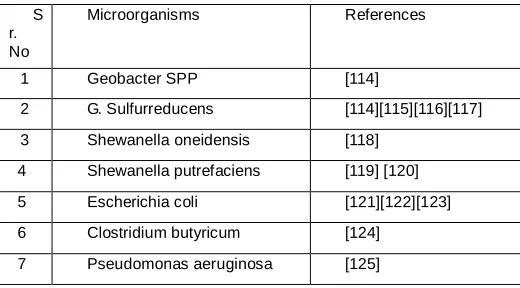
Microorganisms are the heart of MFC as they are the ones responsible for treatment and electricity generation. The first study was conducted by M.C Potter [13] in 1911 showed that microbes like yeast saccharomyces cerevisae and bacteria like E.Coli (Bacillus Coli) provided a voltage which was important in electricity generation. Till now much research has been conducted on MFC but still, there are many limitations which hinder the use of MFC in a commercial way are because of low power density and high initial cost. Thus for maximizing the power output of MFC, much understanding of microorganisms used is to be developed. The crucial breakthrough in the MFC community came when extracellular electron transfer was possible without a mediator. The basic function of bacteria is to colonize on the anode electrode and bio-catalyze the substrates in order to generate electricity [77] [78]. Table 1 shows different microorganisms that were used in MFC by various studies.
3.5 Substrate
Substrate is one of the most crucial members of the MFC, being an electron donor it plays a vital role in establishing electricity generation [79]. A variety of substrates has been used till now in MFC ranging from pure compounds to complex mixtures of organic matter present in wastewater. Most common substrates are acetate [80] & Glucose [81]. Apart from this various substrate used are cellulose particles [82], corn stover biomass [83], ethanol [84], Lactate [85], Landfill leachate [86], phenol [87], Starch [88], Sucrose [89]. Wastewater from different industries was used as a substrate which consisted of complex mixtures. Brewery wastewater [90], Paper recycling wastewater [91], Swine wastewater [92], chocolate industry wastewater [93] and many more were used.
TABLE 1
Different Microorganism used in MFC
S r. No
Microorganisms References
1 Geobacter SPP [114]
2 G. Sulfurreducens [114][115][116][117]
3 Shewanella oneidensis [118]
4 Shewanella putrefaciens [119] [120]
5 Escherichia coli [121][122][123]
6 Clostridium butyricum [124]
8 Gluconobacter oxydans [126]
9 Geothrix fermentas [127]
10 Chlorella vugaris [128]
11 Dunaliealla tertiolecta [129]
12 Scenedesmus obliquus [130]
13 Chlorella pyrenoidosa [131]
14 Corilous versicolor [132]
15 Agaricus meleagris [133]
16 Streptococcus lactis [134]
17 Erwinia dissolven [134]
18 Lactobacillus plantarum [134]
19 Paracoccus denitrificans [135]
20 Paracoccus pantotrophus [135]
21 Proteus vulgaris [136]
22 Proteus mirabilis [136]
4 DESIGN
OF
MFC
Keeping in mind the advantages offered by MFC by treating wastewater and generating electricity have attracted many researchers all over the world. But due to complex mechanism and high material cost has been one of the major factors inhibiting its application in real life and not only in the laboratory. Researchers are still trying to develop and optimize the design of MFC in to make MFC an acceptable technology. A typical MFC can be a single or dual chamber consisting of anode and cathode in chambers made of a different material having a membrane or being membrane-less for proton transfer. In this study single chamber, dual chamber, stacked MFC, and Up-flow MFC has been investigated.
4.1 Single Chamber MFC
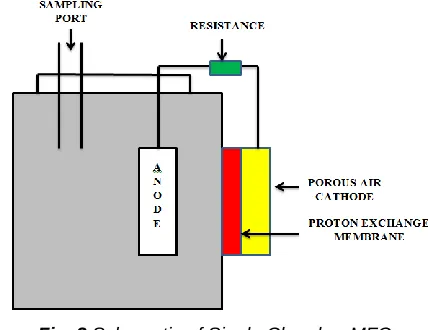
Single chamber MFC (SC-MFC) is easier in design and cost-effective compared to dual Chamber MFC (DC-MFC). Membrane-less SC-MFC was built by Carlo Santoro et al [94] which studied the effect of Pt-based and Pt-free cathode performance of the current generation having human urine as a source. Batch mode SC-MFC was developed having anode chamber capacity of 130 mL and air cathodes. Carbon brush was used as anode and carbon cloth as a cathode which was coated with microporous layer for better transfer of oxygen. They tested the setup for about 1000 hours and concluded that Pt-free cathode performed almost as Pt-based cathode which makes the system further cost-effective [94]. Figure 2 shows the schematic diagram of single-chamber MFC.
Fig. 2 Schematic of Single Chamber MFC
Mohanakrishna et al [95] studied the treatment of petroleum refinery wastewater in SC-MFC. The petroleum refinery waste was collected from the refinery in Doha, Qatar having 2150 mg L-1 of COD. Membrane-less SC-MFC made of plexiglass having a working volume of 350 mL were developed. A carbon fiber brush was used as anode and carbon cloth with platinum coating was used as the cathode. Electroactive biofilm generation on the anode was done by inoculation of domestic wastewater (COD: 780 mg L-1) and acetate (3g L-1). The external supply of 500 mV was supplied after 3 cycles of operation. The substrate removal efficiency of 58% was achieved at 500 mV. Similarly, efficiency of 37% and 32% were achieved at 300 mV and 100 mV [95]. Sawasdee et al [96] studied electricity generation and wastewater treatment of tannery waste in SC-MFC. Wastewater was collected from the primary sediment tank in Thailand. The pollution estimated was about 1100 mg L-1 of COD and pH was 8.17. Initially, the SC-MFC was injected with 1mL of inoculum with synthetic wastewater (COD: 500 mg L-1) as electron donor at pH 7. The
SC-MFC was kept with an open circuit till the power output, % of COD removal and Nitrogen removal were a steady state. After that system was brought to a closed circuit with 1000 and 10 ohm resistors and was fed with tannery wastewater. Pollution decrease up to 88% was observed under optimum conditions [96].
4.2 Dual Chamber MFC
3624
Fig. 3 Schematic of Dual Chamber MFC
Chi-Wen Lin et al [98] constructed DC-MFC with both chambers made from serum bottles having a working volume of 0.8 L, separated by Nafion as PEM membrane. External resistance of 1000 ohms was provided. Carbon cloth was used as both anode and cathode. Sludge samples were collected from wastewater treatment plants. Maximum voltage of 110.4 mV was in the absence of the mediators. Whereas the power output grew when the mediators were added but the time taken for degradation was increased to 1.56-2.15 times the former [98]. Sedky H.A Hassan et al [99] constructed DC-MFC for electricity generation from rice straw. The two chambers were constructed by two media bottles separated by Nafion as PEM. Carbon paper was used both as anode and cathode having the cross-section area of 10cm2. A mixed culture of Cellulose-degrading bacteria was used as inocula in the experiment. Nutrient mineral buffer was used as the medium whereas rice straw (1g/L) was used as a carbon source. Both the chambers were filled with 200 mL of nutrient mineral buffer. Anode chamber was flushed with N2 gas for 5 min and
then sealed. The power density of 145 mW m-2 was achieved with a rice straw concentration of 1 g L-1 [99].
4.3 Stacked MFC
MFC cannot generate sufficient power output to even run small scale equipment. This is the major reason due to which it has not been implemented yet in use. To eradicate this problem, MFC is stacked together in series or parallel connection for more power output based on the requirement which was studied by Aelterman et al [18]. They also concluded that parallel connection gave better output compared to series connection. S. Mateo et al [100] constructed a module of 112 MFC’s which were arranged in 7 stacks, each stack had 16 MFC units. The MFC was constructed from polymeric material of 4mm thickness. The MFC was the type of air-breathing cathode, in which cathode was made of carbon paper of 0.866 cm2 area, contained 10% Teflon and was modified by 0.5 mg Pt cm2. The anode was made out of carbon felt having the same cross-section area and both the electrodes were separated by Nafion as PEM [100]. A stack of 7 MFC units was prepared by Li Zhuang et al [101] out of the PVC pipe by separating with clapboards inside the tube. Air cathode made of carbon felt was used and was prepared of the same size as the Cation exchange membrane (CEM) and were placed enveloping around the tube. Graphite felt was used as an anode. Each MFC unit had a working
volume of 295 mL. Both parallel and series connection was tested out having an external resistance of 1000 ohms. 83.8% of COD removal was achieved by parallel stack connection whereas series stack connection COD removal rate stood at 77.1% [101].
5 APPLICATION
OF
MFC
5.1 Treatment of Wastewater and Electricity Production simultaneously
dual-chambered MFC having cathode catalyst as Iron phthalocyanine (FePc) with Multi-walled carbon nanotube (MWCNT), FePc with Ketjan Black. The chambers were made of borosilicate having a volume of 250 ml. Carbon cloth was used as anode whereas Graphite was used as cathode having the same cross-sectional area of 3cm*3cm. The two chambers were connected by Nafion as PEM. An external resistor of 66 ohms was connected externally. Anolyte were paper sludge and wastewater, whereas catholyte was phosphate buffer solution with potassium permanganate. The raw paper recycling waste was collected from the paper recycling industry in Tamil Nadu. The experiment showed that cathode catalyst FePc with MWCNT resulted in a maximum power density of 9.34 W m-2. They also concluded that FePc with MWCNT can be an appropriate and more feasible change compared to the Pt metal catalyst used before in MFCs [105].
5.2 Hydrogen Production
Hydrogen has been seen as the future in terms of fuel as it is the most abundant element in the universe comprising 75% of the matter. Though hydrogen is only about 0.07% in the atmosphere and 0.14% in an earth surface, it can be easily produced from other compounds available to us. Hydrogen is produced by many methods but, R. Nandi et al [106] studied various methods of production of hydrogen from microbial activity. They studied in detail about the production from anaerobes (Clostridia, Methylotrophs, Methanogenic Bacteria, Rumen Bacteria & Archaea), Facultative Anaerobes (Escherichia coli & Enterobacter), Aerobes (Alcaligenes & Bacillius), Photosynthetic Bacteria. They concluded that anaerobic bacteria produced optimum H2 with having a
stoichiometric ratio of 1:4 with glucose being substrate, while facultative Anaerobes produced at a ratio of 1:2. The former process being productive is complex than the latter, thus not being feasible at present. Photosynthetic process by cyanobacterium has the potential of being the most productive in terms of all but involves complex mechanism which is yet to be fully developed for making it feasible enough to generate h2
at big volumes. This study was done in 1998 after which much research has been done in the area of production of h2 from
MFC [106]. Yaseen Nalakath et al [107] studied the hydrogen production from dairy waste at a different iron concentrations as iron effects on the production of hydrogen. They constructed the setup with a 250 ml Erlenmeyer flask. The flask was tightly sealed by two rubber corks, one for the sample collection and other for Hydrogen gas. The gas was collected in an inverted jar and the produced amount was measured. The sample was collected from nearby dairy unit excluding grease or any other material which would hinder the growth of bacteria. The sample was heated for 2 hours at 110 degrees centigrade for removing methanogens and enhancing bacteria for hydrogen production. They mixed wastewater, sludge, and iron in different proportions. They concluded after three days of observation that hydrogen production at 2 g L-1 of iron is optimum at 90% sludge and 10% wastewater composition [107]. Jhansi L Varanasi et al [108] studied energy extraction from the cellulosic substrate by thermophilic dark fermentation method for optimum hydrogen production followed by Microbial fuel cell. Two dual-chambered MFC were made out of polyacrylic having a working volume of 110 ml. The chambers were separated by anion exchange membrane having a cross-section of 16 cm2. Carbon felt was anode and Graphite block as cathode with 50mM potassium ferricyanide
as catholyte. An external resistor of 1000 ohm was used to close the circuit. An enriched thermophilic mixed culture was produced in the laboratory for high h2 production. One of the
MFC’s anode was inoculated with electroactive consortia (10%) with fresh leachate collected from a thermal power plant. The mixture was enriched in acetate medium. The mixture in MFC 1 was initially operated for 30 days prior to the experiment. Both the MFCs were evaluated in terms of COD, Hydrogen production and power produced. The maximum hydrogen produced was found at 4-5 hours after initial fermentation which was around 22.5 ml h-1. Maximum power density of MFC 1 was found 85.8 mW m-2 and 76 mW m-2 for MFC 2. Reduction of 75% in COD was observed while overall energy recovery stood at 30.49% [108].
5.3 Desalination
3626 Fig. 4 Microbial Desalination Cell [26]
5.4 Biosensors
MFC has one more major application as biosensor as it can do on-line monitoring of BOD in organic content and control of biological wastewater treatment process as present methods lack that quality. Coulombic yield of MFC gives very much idea of BOD of the liquid stream of wastewater which can be utilized as biosensor [112]. Sumaraj et al [113] studied the performance of MFC as biosensors by studying the detection of organic matter of wastewater. They created two MFC comprising of two different Proton exchange membrane, MFC1 comprised of Nafion and MFC2 comprised of low-cost clayware and studied the effect of them on the performance of MFC as a biosensor. The evaluated that MFC1 has low response time and better performance to detect low COD concentration from 22 mg L-1 to 51 mg L-1. Whereas MFC2 can only sense concentration as high has 67 mg L-1 to 212 mg L-1. The response time was also varied in both the MFC’s. MFC 1 responded quickly with sensing time of 210 min and 120 min, While MFC2 sensed the concentration at 310 min and 120 min. They proposed that variation in results by both MFC is because of the PEM used. The variation is caused by proton conductivity (PC) and thickness of the membranes. Nafion has PC 40 times more than Clayware (CWPEM), while CWPEM is 17 times thicker than NPEM. They concluded that low cost clayware PEM can be used in MFC for monitoring the BOD keeping in mind the economics of the device. Nafion has better performance but the cost is about 400 cm-2 compared to 0.4 cm-2 of clayware [113].
6 CONCLUSION
AND
FUTURE
ASPECTS
The world facing problems like global warming and climate change, using of carbon-based fuels has to go down and we have to make way for the usage of more and more renewable sources for energy generation. Thus MFC has great potential in the future for not only energy generation but has many different applications. MFC not only generates electricity but the source for energy generation is waste, which makes it more special compared to the traditional energy sources. This paper shows that MFC has many applications apart from electricity generation and wastewater treatment like desalination and hydrogen production. The complexities of MFC and high-cost of electrodes and PEM make it tough and not feasible enough to utilize it on a commercial basis. The major area of research in MFC which would make it feasible is the cost aspect of the electrodes and the PEM. The usage of ceramic material has shown great hope being used as electrode and PEM. Another area is the use of biofilms on
electrodes which are used over electrodes has to be eradicated by using microbes like anodophilic for better output. The intensive ongoing research has turned the tide and has led to better power outputs and different applications like desalination and hydrogen production. Furthermore research is required in understanding the concepts better and optimize them to the fullest as MFC has many disciplines that work together. Seeing the potential of MFC, It can have a major impact on a country like India for providing green and clean energy.
7 REFERENCES
[1] P. M. Pathak and O. K. Mahadwad, ―Enhancement in Electricity Generation & Waste Water Treatment by Increasing Surface Area of Electrodes ( Four Blade , Six Blade & Eight Blade Electrodes ) in Dual Chamber Mediator Less Microbial Fuel Cell,‖ Int. J. Innov. Emerg. Res. Eng., vol. 2, no. 4, pp. 117–124, 2015. [2] B. E. Logan et al., ―Microbial fuel cells: Methodology
and technology,‖ Environ. Sci. Technol., vol. 40, no. 17, pp. 5181–5192, 2006.B. E. Logan and K. Rabaey, ―Conversion of wastes into bioelectricityand chemicals by using microbial electrochemical technologies,‖ Science (80-. )., vol. 337, no. 6095, pp. 686–690, 2012.
[3] K. Rabaey and W. Verstraete, ―Microbial fuel cells: Novel
biotechnology for energy generation,‖ Trends Biotechnol., vol. 23, no. 6, pp. 291–298, 2005.B. E. Logan, ―Simultaneous wastewater treatment and biological electricity generation,‖ Water Sci. Technol., vol. 52, no. 1–2, pp. 31–37, 2005.
[4] R. A. Rozendal, H. V. M. Hamelers, K. Rabaey, J. Keller, and C. J. N. Buisman, ―Towards practical implementation of bioelectrochemical wastewater treatment,‖ Trends Biotechnol., vol. 26, no. 8, pp. 450–459, 2008.
[5] J. Sun, Y. Hu, Z. Bi, and Y. Cao, ―Improved performance of air-cathode single-chamber microbial fuel cell for wastewater treatment using microfiltration membranes and multiple sludge inoculation,‖ J. Power Sources, vol. 187, no. 2, pp. 471–479, 2009. [6] Y. C. Song, K. S. Yoo, and S. K. Lee, ―Surface
floating, air cathode, microbial fuel cell with horizontal flow for continuous power production from wastewater,‖ J. Power Sources, vol. 195, no. 19, pp. 6478–6482, 2010.
[7] Y. Han, C. Yu, and H. Liu, ―A microbial fuel cell as power supply for implantable medical devices,‖ Biosens. Bioelectron., vol. 25, no. 9, pp. 2156–2160, 2010.
[8] I. S. Chang et al., ―Continuous determination of biochemical oxygen demand using microbial fuel cell type biosensor,‖ Biosens. Bioelectron., vol. 19, no. 6, pp. 607–613, 2004.
[9] S. Chang, H. Moon, J. K. Jang, and B. H. Kim, ―Improvement of a microbial fuel cell performance as a BOD sensor using respiratory inhibitors,‖ Biosens. Bioelectron., vol. 20, no. 9, pp. 1856–1859, 2005. [10] J. M. Tront, J. D. Fortner, M. Plötze, J. B. Hughes,
[11] M. C. Potter, ―Electrical Effects Accompanying the Decomposition of Organic Compounds,‖ Proc. R. Soc. B Biol. Sci., vol. 84, no. 571, pp. 260–276, 1911. [12] M. Rahimnejad, A. Adhami, S. Darvari, A. Zirepour,
and S. E. Oh,
―Microbial fuel cell as new technology for
bioelectricity generation:
A review,‖ Alexandria Eng. J., vol. 54, no. 3, pp. 745–756, 2015.
[13] R. Patel, P. Zaveri, and N. S. Munshi, ―Microbial fuel
cell, the Indian
scenario: developments and scopes,‖ Biofuels,
vol. 7269, no. January,
pp. 1–8, 2017.
[14] G. C. Gil et al., ―Operational parameters affecting the performannce
of a mediator-less microbial fuel cell,‖ Biosens.
Bioelectron., vol. 18, pp.
327–334, 2003.
[15] C. Song, ―Fuel processing for low-temperature and high-temperature
fuel cells: Challenges, and opportunities for
sustainable development
in the 21st century,‖ Catal. Today, vol. 77, no. 1– 2, pp. 17–49, 2002.
[16] P. Aelterman, K. Rabaey, and W. Verstraete,
―Continuous Electricity
Generation at High Voltages and Currents Using
Stacked Microbial
Fuel Cells,‖ vol. 40, no. 10, pp. 3388–3394, 2006.
[17] Z. He, S. D. Minteer, and L. T. Angenent, ―Electricity
generation from
artificial wastewater using an upflow microbial
fuel cell,‖ Environ. Sci.
Technol., vol. 39, no. 14, pp. 5262–5267, 2005. [18] S. T. Oh, J. R. Kim, G. C. Premier, T. H. Lee, C. Kim,
and W. T. Sloan,
―Sustainable wastewater treatment: How might
microbial fuel cells
contribute,‖ Biotechnol. Adv., vol. 28, no. 6, pp. 871–881, 2010.
[19] F. Zhao, F. Harnisch, U. Schröder, F. Scholz, P.
Bogdanoff, and I.
Herrmann, ―Application of pyrolysed iron(II)
phthalocyanine and
CoTMPP based oxygen reduction catalysts as
cathode materials in
microbial fuel cells,‖ Electrochem. commun., vol.
7, no. 12, pp. 1405–
1410, 2005.
[20] Z. Du, H. Li, and T. Gu, ―A state of the art review on
microbial fuel
cells: A promising technology for wastewater
treatment and
bioenergy,‖ Biotechnol. Adv., vol. 25, no. 5, pp. 464–482, 2007.
[21] A. Rinaldi, B. Mecheri, V. Garavaglia, S. Licoccia, P.
Di Nardo, and E.
Traversa, ―Engineering materials and biology to
boost performance
of microbial fuel cells: A critical review,‖ Energy
Environ. Sci., vol. 1,
no. 4, pp. 417–429, 2008.
[22] K. Guo, A. Prévoteau, S. A. Patil, and K. Rabaey, ―Engineering
electrodes for microbial electrocatalysis,‖ Curr.
Opin. Biotechnol., vol.
33, pp. 149–156, 2015.
[23] R. Goswami and V. K. Mishra, ―A review of design, operational
conditions and applications of microbial fuel
cells,‖ Biofuels, vol. 9,
no. 2, pp. 203–220, 2018.
[24] C. Santoro, C. Arbizzani, B. Erable, and I. Ieropoulos,
―Microbial fuel
cells: From fundamentals to applications. A
review,‖ J. Power Sources,
vol. 356, pp. 225–244, 2017.
[25] E. Guerrini, M. Grattieri, S. P. Trasatti, M. Bestetti, and
P. Cristiani,
―Performance explorations of single chamber
microbial fuel cells by
using various microelectrodes applied to
biocathodes,‖ Int. J.
Hydrogen Energy, vol. 39, no. 36, pp. 21837– 21846, 2014.
[26] C. Santoro, A. Agrios, U. Pasaogullari, and B. Li,
―Effects of gas
diffusion layer (GDL) and micro porous layer
(MPL) on cathode
performance in microbial fuel cells (MFCs),‖ Int.
J. Hydrogen Energy,
vol. 36, no. 20, pp. 13096–13104, 2011.
[27] C. Santoro, Y. Lei, B. Li, and P. Cristiani, ―Power
generation from
wastewater using single chamber microbial fuel
cells (MFCs) with
platinum-free cathodes and pre-colonized
anodes,‖ Biochem. Eng. J.,
vol. 62, pp. 8–16, 2012.
[28] C. Santoro, B. Li, P. Cristiani, and G. Squadrito,
―Power generation of
microbial fuel cells (MFCs) with low cathodic
platinum loading,‖ Int.
J. Hydrogen Energy, vol. 38, no. 1, pp. 692– 700, 2013.
[29] F. Zhao et al., ―Activated carbon cloth as anode for
sulfate removal in
a microbial fuel cell,‖ Environ. Sci. Technol., vol.
42, no. 13, pp. 4971–
4976, 2008.
[30] A. Baudler, I. Schmidt, M. Langner, A. Greiner, and U. Schröder,
―Does it have to be carbon? Metal anodes in
microbial fuel cells and
related bioelectrochemical systems,‖ Energy
Environ. Sci., vol. 8, no.
7, pp. 2048–2055, 2015.
[31] Y. Qiao, C. M. Li, S. J. Bao, and Q. L. Bao, ―Carbon nanotube/polyaniline composite as anode
material for microbial fuel
cells,‖ J. Power Sources, vol. 170, no. 1, pp. 79–84, 2007.
[32] ] K. Scott, G. A. Rimbu, K. P. Katuri, K. K. Prasad,
3628 ―Application of modified carbon anodes in
microbial fuel cells,‖
Process Saf. Environ. Prot., vol. 85, no. 5 B, pp. 481–488, 2007.
[33] N. Aryal, F. Ammam, S. A. Patil, and D. Pant, ―An
overview of
cathode materials for microbial electrosynthesis
of chemicals from
carbon dioxide,‖ pp. 5748–5760, 2017.
[34] J. Wei, P. Liang, and X. Huang, ―Recent progress in
electrodes for
microbial fuel cells,‖ Bioresour. Technol., vol.
102, no. 20, pp. 9335–
9344, 2011.
[35] C. W. Marshall, D. E. Ross, E. B. Fichot, R. S.
Norman, and H. D. May,
―Electrosynthesis of commodity chemicals by an autotrophic
microbial community,‖ Appl. Environ. Microbiol.,
vol. 78, no. 23, pp.
8412–8420, 2012.
[36] C. W. Marshall, D. E. Ross, E. B. Fichot, R. S.
Norman, and H. D. May,
―Long-term operation of microbial
electrosynthesis systems
improves acetate production by autotrophic
microbiomes,‖ Environ.
Sci. Technol., vol. 47, no. 11, pp. 6023–6029, 2013.
[37] S. Cheng, H. Liu, and B. E. Logan, ―Power densities
using different
cathode catalysts (Pt and CoTMPP) and
polymer binders (Nafion and
PTFE) in single chamber microbial fuel cells,‖
Environ. Sci. Technol.,
vol. 40, no. 1, pp. 364–369, 2006.
[38] L. Dai, Y. Xue, L. Qu, H.-J. Choi, and J.-B. Baek,
―Metal-Free Catalysts
for Oxygen Reduction Reaction,‖ Chem. Rev.,
vol. 115, no. 11, pp.
4823–4892, 2015.
[39] Z. Wang, C. Cao, Y. Zheng, S. Chen, and F. Zhao,
―Abiotic Oxygen
Reduction Reaction Catalysts Used in Microbial
Fuel Cells,‖
ChemElectroChem, vol. 1, no. 11, pp. 1813– 1821, 2014.
[40] H. Dong, H. Yu, and X. Wang, ―Catalysis kinetics and
porous analysis
of rolling activated carbon-PTFE air-cathode in
microbial fuel cells,‖
Environ. Sci. Technol., vol. 46, no. 23, pp. 13009–13015, 2012.
[41] H. Dong, H. Yu, X. Wang, Q. Zhou, and J. Feng, ―A novel structure of
[42] scalable air-cathode without Nafion and Pt by rolling activated
carbon and PTFE as catalyst layer in microbial
fuel cells,‖ Water Res.,
vol. 46, no. 17, pp. 5777–5787, 2012.
[43] M. Ghasemi, S. Shahgaldi, M. Ismail, B. H. Kim, Z.
Yaakob, and W. R.
Wan Daud, ―Activated carbon nanofibers as an
alternative cathode
catalyst to platinum in a two-chamber microbial
fuel cell,‖ Int. J.
Hydrogen Energy, vol. 36, no. 21, pp. 13746– 13752, 2011.
[44] F. Zhang, S. Cheng, D. Pant, G. Van Bogaert, and B.
E. Logan, ―Power
generation using an activated carbon and metal
mesh cathode in a
microbial fuel cell,‖ Electrochem. commun., vol.
11, no. 11, pp. 2177–
2179, 2009.
[45] R. Burkitt, T. R. Whiffen, and E. H. Yu, ―Iron
phthalocyanine and
MnOx composite catalysts for microbial fuel cell
applications,‖ Appl.
Catal. B Environ., vol. 181, pp. 279–288, 2016. [46] B. Jiang et al., ―Evaluation of Microbial Fuel Cells with
Graphite Plus
MnO 2 and MoS 2 Paints as Oxygen Reduction
Cathode Catalyst,‖ J.
Electrochem. Soc., vol. 164, no. 3, pp. H3083– H3090, 2017.
[47] X. Li, B. Hu, S. Suib, Y. Lei, and B. Li, ―Manganese
dioxide as a new
cathode catalyst in microbial fuel cells,‖ J. Power
Sources, vol. 195, no.
9, pp. 2586–2591, 2010.
[48] M. Lu, L. Guo, S. Kharkwal, H. Wu, H. Y. Ng, and S. F.
Y. Li,
―Manganese-polypyrrole-carbon nanotube, a
new oxygen reduction
catalyst for air-cathode microbial fuel cells,‖ J.
Power Sources, vol.
221, pp. 381–386, 2013.
[49] J. Huang, N. Zhu, T. Yang, T. Zhang, P. Wu, and Z.
Dang, ―Nickel
oxide and carbon nanotube composite
(NiO/CNT) as a novel cathode
non-precious metal catalyst in microbial fuel
cells,‖ Biosens.
Bioelectron., vol. 72, pp. 332–339, 2015. [50] A. Modi, S. Singh, and N. Verma, ―In situ
nitrogen-doping of nickel
nanoparticle-dispersed carbon nanofiber-based
electrodes: Its
positive effects on the performance of a
microbial fuel cell,‖
Electrochim. Acta, vol. 190, pp. 620–627, 2016. [51] ] S. Li, Y. Hu, Q. Xu, J. Sun, B. Hou, and Y. Zhang,
―Iron- and nitrogen-
functionalized graphene as a non-precious
metal catalyst for
enhanced oxygen reduction in an air-cathode
microbial fuel cell,‖ J.
Power Sources, vol. 213, pp. 265–269, 2012. [52] C. Santoro et al., ―Cathode materials for ceramic
based microbial fuel
cells (MFCs),‖ Int. J. Hydrogen Energy, vol. 40,
no. 42, pp. 14706–14715,
2015.
[53] F. Harnisch, S. Wirth, and U. Schröder, ―Effects of
metabolite crossover on the cathodic oxygen
reduction reaction in
microbial fuel cells: Platinum vs. iron(II)
phthalocyanine based
electrodes,‖ Electrochem. commun., vol. 11, no.
11, pp. 2253–2256,
2009.
[54] Y. Pan, X. Mo, K. Li, L. Pu, D. Liu, and T. Yang, ―Iron-nitrogen-
activated carbon as cathode catalyst to
improve the power
generation of single-chamber air-cathode
microbial fuel cells,‖
Bioresour. Technol., vol. 206, pp. 285–289, 2016.
[55] ] H. Tang et al., ―Iron-embedded nitrogen doped
carbon frameworks
as robust catalyst for oxygen reduction reaction
in microbial fuel
cells,‖ Appl. Catal. B Environ., vol. 202, pp. 550–556, 2017.
[56] ] P. Bosch-Jimenez et al., ―Non-precious metal
doped carbon nanofiber
air-cathode for Microbial Fuel Cells application:
Oxygen reduction
reaction characterization and long-term
validation,‖ Electrochim.
Acta, vol. 228, pp. 380–388, 2017.
[57] C. Cao, L. Wei, M. Su, G. Wang, and J. Shen,
―Low-cost adsorbent
derived and in situ nitrogen/iron co-doped
carbon as efficient
oxygen reduction catalyst in microbial fuel
cells,‖ Bioresour. Technol.,
vol. 214, pp. 348–354, 2016.
[58] E. Martin, B. Tartakovsky, and O. Savadogo, ―Cathode materials
evaluation in microbial fuel cells: A comparison
of carbon, Mn2O3,
Fe2O3and platinum materials,‖ Electrochim.
Acta, vol. 58, no. 1, pp.
58–66, 2011.
[59] L. Birry, P. Mehta, F. Jaouen, J. P. Dodelet, S. R.
Guiot, and B.
Tartakovsky, ―Application of iron-based cathode
catalysts in a
microbial fuel cell,‖ Electrochim. Acta, vol. 56,
no. 3, pp. 1505–1511,
2011.
[60] W. Li, G. Sheng, X. Liu, and H. Yu, ―Bioresource
Technology Recent
advances in the separators for microbial fuel
cells,‖ Bioresour.
Technol., vol. 102, no. 1, pp. 244–252, 2011. [61] B. Tartakovsky and S. R. Guiot, ―A Comparison of Air
and Hydrogen
Peroxide Oxygenated Microbial Fuel Cell
Reactors,‖ no. Figure 1, pp.
241–246, 2006.
[62] F. Harnisch and U. Schröder, ―Selectivity versus
mobility: Separation
of anode and cathode in microbial
bioelectrochemical systems,‖
ChemSusChem, vol. 2, no. 10, pp. 921–926, 2009.
[63] C. I. Torres, A. K. Marcus, and B. E. Rittmann, ―Proton transport
inside the biofilm limits electrical current
generation by anode-
respiring bacteria,‖ Biotechnol. Bioeng., vol.
100, no. 5, pp. 872–881,
2008.
[64] Y. Zuo, S. Cheng, and B. E. Logan, ―Ion exchange
membrane cathodes
for scalable microbial fuel cells,‖ Environ. Sci.
Technol., vol. 42, no. 18,
pp. 6967–6972, 2008.
[65] A. Ter Hejine, H. V. M. Hamelers, V. De Wilde, R. A.
Rozendal, and
C. J. N. Buisman, ―A Bipolar Membrane
Combined with Ferric Iron
Reduction as an Efficient Cathode System in
Microbial Fuel Cells,‖
vol. 40, no. 17, pp. 5200–5205, 2006.
[66] X. Cao et al., ―A New Method for Water Desalination
Using Microbial
Desalination Cells,‖ Environ. Sci. Technol., vol.
43, no. 18, pp. 7148–
7152, 2009.
[67] H. M. Singh, A. K. Pathak, K. Chopra, V. V. Tyagi, S.
Anand, and R.
Kothari, ―Microbial fuel cells: a sustainable
solution for bioelectricity
generation and wastewater treatment,‖ Biofuels, vol. 7269, pp. 1–21, 2018.
[68] J. X. Leong, W. R. W. Daud, M. Ghasemi, K. Ben
Liew, and M. Ismail,
―Ion exchange membranes as separators in
microbial fuel cells for
bioenergy conversion: A comprehensive
review,‖ Renew. Sustain.
Energy Rev., vol. 28, pp. 575–587, 2013. [69] Y. Fan, H. Hu, and H. Liu, ―Enhanced Coulombic
efficiency and
power density of air-cathode microbial fuel
cells with an improved
cell configuration,‖ J. Power Sources, vol. 171,
no. 2, pp. 348–354,
2007.
[70] P. S. Jana, M. Behera, and M. M. Ghangrekar, ―Performance
comparison of up-flow microbial fuel cells
fabricated using proton
exchange membrane and earthen cylinder,‖
Int. J. Hydrogen Energy,
vol. 35, no. 11, pp. 5681–5686, 2010.
[71] J. Winfield, L. D. Chambers, J. Rossiter, and I. Ieropoulos,
―Comparing the short and long term stability of biodegradable,
ceramic and cation exchange membranes in
microbial fuel cells,‖
Bioresour. Technol., vol. 148, pp. 480–486, 2013.
3630
Logan, ―Separator
characteristics for increasing performance of
microbial fuel cells,‖
Environ. Sci. Technol., vol. 43, no. 21, pp. 8456–8461, 2009.
[73] X. Zhang, S. Cheng, X. Huang, and B. E. Logan, ―The
use of nylon
and glass fiber filter separators with different
pore sizes in air-
cathode single-chamber microbial fuel cells,‖
Energy Environ. Sci.,
vol. 3, no. 5, pp. 659–664, 2010.
[74] D. H. Park and J. G. Zeikus, ―Improved fuel cell and electrode
designs for producing electricity from microbial degradation,‖
Biotechnol. Bioeng., vol. 81, no. 3, pp. 348– 355, 2003.
[75] J. Winfield, I. Gajda, J. Greenman, and I. Ieropoulos,
―A review into
the use of ceramics in microbial fuel cells,‖
Bioresour. Technol., vol.
215, pp. 296–303, 2016.
[76] J. Niessen, F. Harnisch, M. Rosenbaum, U. Schröder,
and F. Scholz,
―Heat treated soil as convenient and versatile
source of bacterial
communities for microbial electricity
generation,‖ Electrochem.
commun., vol. 8, no. 5, pp. 869–873, 2006. [77] E. Zhang, W. Xu, G. Diao, and C. Shuang, ―Electricity
generation
from acetate and glucose by sedimentary
bacterium attached to
electrode in microbial-anode fuel cells,‖ J. Power Sources, vol. 161, no. 2, pp. 820–825, 2006.
[78] Z. Liu, J. Liu, S. Zhang, and Z. Su, ―Study of
operational performance
and electrical response on mediator-less microbial fuel cells fed with carbon- and protein-rich substrates,‖ Biochem.
Eng. J., vol. 45, no. 3,
pp. 185–191, 2009.
[79] B. Logan, S. Cheng, V. Watson, and G. Estadt,
―Graphite fiber brush
anodes for increased power production in
air-cathode microbial fuel
cells,‖ Environ. Sci. Technol., vol. 41, no. 9, pp. 3341–3346, 2007.
[80] T. Catal, K. Li, H. Bermek, and H. Liu, ―Electricity
production from
twelve monosaccharides using microbial fuel
cells,‖ J. Power Sources,
vol. 175, no. 1, pp. 196–200, 2008.
[81] F. Rezaei, D. Xing, R. Wagner, J. M. Regan, T. L.
Richard, and B. E.
Logan, ―Simultaneous cellulose degradation
and electricity
production by Enterobacter cloacae in a
microbial fuel cell,‖ Appl.
Environ. Microbiol., vol. 75, no. 11, pp. 3673– 3678, 2009.
[82] L. B. E, ―Electricity Production from Steam Exploded
Corn Stover
Biomass,‖ Energy Fuels, vol. 20, no. 12, p. 1716, 2006.
[83] J. R. Kim, S. H. Jung, J. M. Regan, and B. E. Logan, ―Electricity
generation and microbial community analysis of
alcohol powered
microbial fuel cells,‖ Bioresour. Technol., vol.
98, no. 13, pp. 2568–2577,
2007.
[84] A. K. Manohar and F. Mansfeld, ―The internal
resistance of a
microbial fuel cell and its dependence on cell
design and operating
conditions,‖ Electrochim. Acta, vol. 54, no. 6, pp. 1664–1670, 2009.
[85] J. Greenman, A. Gálvez, L. Giusti, and I. Ieropoulos,
―Electricity from
landfill leachate using microbial fuel cells:
Comparison with a
biological aerated filter,‖ Enzyme Microb. Technol., vol. 44, no. 2, pp. 112–119, 2009.
[86] H. Luo, G. Liu, R. Zhang, and S. Jin, ―Phenol
degradation in
microbial fuel cells,‖ Chem. Eng. J., vol. 147,
no. 2–3, pp. 259–264,
2009.
[87] J. Niessen, U. Schröder, and F. Scholz, ―Exploiting complex
carbohydrates for microbial electricity generation - A bacterial fuel cell operating on starch,‖ Electrochem.
commun., vol. 6, no. 9, pp.
955–958, 2004.
[88] M. Behera and M. M. Ghangrekar, ―Performance of
microbial fuel
cell in response to change in sludge loading
rate at different anodic
feed pH,‖ Bioresour. Technol., vol. 100, no. 21, pp. 5114–5121, 2009.
[89] Y. Feng, X. Wang, B. E. Logan, and H. Lee, ―Brewery wastewater
treatment using air-cathode microbial fuel
cells,‖ Appl. Microbiol.
Biotechnol., vol. 78, no. 5, pp. 873–880, 2008. [90] L. Huang and B. E. Logan, ―Electricity generation and
treatment of
paper recycling wastewater using a microbial
fuel cell,‖ Appl.
Microbiol. Biotechnol., vol. 80, no. 2, pp. 349– 355, 2008.
[91] B. Min, J. R. Kim, S. E. Oh, J. M. Regan, and B. E.
Logan, ―Electricity
generation from swine wastewater using
microbial fuel cells,‖ Water
Res., vol. 39, no. 20, pp. 4961–4968, 2005. [92] S. A. Patil et al., ―Electricity generation using
chocolate industry
wastewater and its treatment in activated
sludge based microbial
community in the anode chamber,‖ Bioresour. Technol., vol. 100,
no. 21, pp. 5132–5139,
2009.
[93] C. Santoro et al., ―Current generation in
membraneless single
chamber microbial fuel cells (MFCs) treating
urine,‖ J. Power
Sources, vol. 238, pp. 190–196, 2013.
[94] [95] G. Mohanakrishna, I. M. Abu-Reesh, S.
Kondaveeti, R. I. Al-Raoush,
and Z. He, ―Enhanced treatment of petroleum
refinery wastewater
by short-term applied voltage in single
chamber microbial fuel cell,‖
Bioresour. Technol., vol. 253, pp. 16–21, 2018. [95] [96] V. Sawasdee and N. Pisutpaisal, ―ScienceDirect
Simultaneous
pollution treatment and electricity generation of
tannery wastewater
in air-cathode single chamber MFC,‖ Int. J.
Hydrogen Energy, pp. 4–9,
2016.
[96] [97] Z. Yu et al., ―Treatment of sewage and
synchronous electricity
generation characteristics by microbial fuel
cell,‖ J. Fuel Chem.
Technol., vol. 42, no. 4, pp. 481–486, 2014. [97] [98] C. W. Lin, C. H. Wu, Y. H. Chiu, and S. L. Tsai,
―Effects of different
mediators on electricity generation and
microbial structure of a
toluene powered microbial fuel cell,‖ Fuel, vol. 125, pp. 30–35, 2014.
[98] [99] S. H. A. Hassan et al., ―Electricity generation
from rice straw using a
microbial fuel cell,‖ Int. J. Hydrogen Energy,
vol. 39, no. 17, pp. 9490–
9496, 2014.
[99] [100] S. Mateo, A. Cantone, P. Cañizares, F. J.
Fernández-Morales, O.
Scialdone, and M. A. Rodrigo, ―Development
of a module of stacks
of air-breathing microbial fuel cells to light-up
a strip of LEDs,‖
Electrochim. Acta, vol. 274, pp. 152–159, 2018.
[100] [101] L. Zhuang, Y. Zheng, S. Zhou, Y. Yuan,
H. Yuan, and Y. Chen,
―Scalable microbial fuel cell (MFC) stack for
continuous real
wastewater treatment,‖ Bioresour. Technol., vol. 106, pp. 82–88, 2012.
[101] [102] R. Nair, K. Renganathan, S. Barathi,
and K. Venkatraman,
―Performance of Salt-bridge Microbial Fuel
Cell at Various
Agarose Concentrations using hostel
sewage waste as substrate,‖
Int. J. Adv. Res. Technol., vol. 2, no. 5, pp. 326–330, 2013.
[102] [103] J. S. Sudarsan, K. Prasana, S. Nithiyanantham, and K. Renganathan,
―Comparative study of electricity production
and treatment of
different wastewater using microbial fuel cell
(MFC),‖ Environ.
EarthSci.,vol. 73, no. 5, pp. 2409–2413, 2015. [103] [104] S. Sevda, X. Dominguez-benetton, K.
Vanbroekhoven, and H. De
Wever, ―High strength wastewater treatment
accompanied by
power generation using air cathode microbial
fuel cell,‖ Appl.
Energy, vol. 105, pp. 194–206, 2013.
[104] [105] M. Radha and S. Kanmani, ―Performance of cathode catalysts for bio-electricity from paper recycling , wastewater-fed , microbial fuel cells,‖ vol. 113, no. 3, 2017.
[105] [106] R. Nandi and S. Sengupta, ―Microbial
Production of Hydrogen : An
Overview,‖ vol. 24, no. 1, pp. 61–84, 1998. [106] [107] Y. Nalakath, C. M. Malikudy, and J.
Jose, ―Role of Iron
Concentration on Hydrogen Production from
Waste Water - A
Study in Dairy Waste,‖ vol. 6, no. 03, pp. 55– 60, 2017.
[107] [108] J. L. Varanasi, S. Roy, S. Pandit, and
D. Das, ―ScienceDirect
Improvement of energy recovery from
cellobiose by thermophillic
dark fermentative hydrogen production
followed by microbial fuel
cell,‖ Int. J. Hydrogen Energy, pp. 1–11, 2015. [108] [109] S. Sevda, H. Yuan, Z. He, and I. M.
Abu-Reesh, ―Microbial
desalination cells as a versatile technology:
Functions, optimization
and prospective,‖ Desalination, vol. 371, no. April, pp. 9–17, 2015.
[109] [110] S. Sevda and I. M. Abu-reesh,
―Improved petroleum refinery
wastewater treatment and seawater
desalination performance by
combining Osmotic Microbial Fuel Cell and
Up- flow Microbial
Desalination Cell,‖ vol. 3330, no. November, 2017.
[110] [111] V. R. V Ashwaniy and M. Perumalsamy,
―Reduction of organic
compounds in Petro-Chemical Industry
Effluent and Desalination
using Scenedesmus abundans algal Microbial
Desalination Cell,‖
Biochem. Pharmacol., 2017.
[111] [112] S. Das and N. Mangwani, ―Recent developments in microbial fuel cells : a review,‖ pp. 7–11, 2010.
[112] [113] M.M Ghangrekar, ―Development of microbial fuel cell as biosensor for detection of organic matter of wastewater,‖
vol. 6, no. 1, pp.
162–166, 2014.
3632
of anode bacterial
communities and performance in microbial
fuel cells with different
electron donors,‖ Appl. Microbiol. Biotechnol.,
vol. 77, no. 2, pp. 393–
402, 2007.
[114] [115] H.Hall and C. Bettin, ―Applicability and
Feasibility of
Incorporating Microbial Fuel Cell Technology
into Implantable
Biomedical Devices College of Engineering By :,‖ Power, 2006.
[115] [116] D. R. Bond and D. R. Lovley, ―Electricity Production by Geobacter sulfurreducens Attached to Electrodes
Electricity Production by
Geobacter sulfurreducens Attached to
Electrodes,‖ Appl. Environ.
Microbiol., vol. 69, no. 3, pp. 1548–1555, 2003.
[116] [117] G. Reguera, K. P. Nevin, J. S. Nicoll, S. F. Covalla, T. L. Woodard, and D. R. Lovley, ―Biofilm and nanowire
production leads to
increased current in Geobacter sulfurreducens fuel cells,‖ Appl. Environ. Microbiol., vol. 72, no. 11, pp. 7345– 7348, 2006.
[117] [118] B. R. Ringeisen et al., ―High Power
Density from a Miniature
Microbial Fuel Cell Using Shewanella
oneidensis DSP10,‖ U.S.
Navy Res., vol. 17, 2006.
[118] [119] H. J. Kim, M. S. Hyun, I. S. Chang, and B. H. Kim, ―A microbial fuel cell type lactate biosensor using a metal-
reducing bacterium,
Shewanella putrefaciens,‖ Journal of Microbiology and Biotechnology, vol. 9, no. 3. pp. 365–367, 1999.
[119] [120] H. J. Kim, H. S. Park, M. S. Hyun, I. S.
Chang, M. Kim, and B. H.
Kim, ―A mediator-less microbial fuel cell using
a metal reducing
bacterium, Shewanella putrefaciens,‖ Enzyme
Microb. Technol., vol.
30, no. 2, pp. 145–152, 2002.
[120] [121] M. Grzebyk and G. Poźniak, ―Microbial
fuel cells (MFCs) with
interpolymer cation exchange membranes,‖
Sep. Purif. Technol., vol.
41, no. 3, pp. 321–328, 2005.
[121] [122] U. Schröder, J. Nießen, and F. Scholz,
―A generation of microbial
fuel cells with current outputs boosted by
more than one order of
magnitude,‖ Angew. Chemie - Int. Ed., vol.
42, no. 25, pp. 2880–
2883, 2003.
[122] [123] Y. Choi, E. Jung, S. Kim, and S. Jung,
―Membrane fluidity sensoring
microbial fuel cell,‖ Bioelectrochemistry, vol.
59, no. 1–2, pp. 121–
127, 2003.
[123] [124] H. S. Park et al., ―A Novel Electrochemically Active and Fe ( III ) - reducing Bacterium Phylogenetically Related
to Clostridium
butyricum Isolated from a Microbial Fuel Cell,‖
Scanning, vol. 7,
no. 6, pp. 297–306, 2001.
[124] [125] K. Rabaey, N. Boon, M. Höfte, and W.
Verstraete, ―Microbial
phenazine production enhances electron
transfer in biofuel cells,‖
Environ. Sci. Technol., vol. 39, no. 9, pp. 3401–3408, 2005.
[125] [126] S. A. Lee, Y. Choi, S. Jung, and S. Kim, ―Effect of initial carbon sources on the electrochemical detection of
glucose by
Gluconobacter oxydans,‖ Bioelectrochemistry, vol. 57, no. 2, pp. 173–178, 2002.
[126] [127] D. R. Bond and D. R. Lovley, ―Evidence for Involvement of an Electron Shuttle in Electricity Generation by
Geothrix fermentans
Evidence for Involvement of an Electron
Shuttle in Electricity
Generation by Geothrix fermentans,‖ Appl.
Environ. Microbiol., vol.
71, no. 4, pp. 2186–2189, 2005.
[127] [128] Y. Zhang, J. S. Noori, and I. Angelidaki, ―Simultaneous organic carbon, nutrients removal and energy
production in a
photomicrobial fuel cell (PFC),‖ Energy Environ. Sci., vol. 4, no. 10, pp. 4340–4346, 2011.
[128] [129] A. M. Lakaniemi, O. H. Tuovinen, and
J. A. Puhakka, ―Production
of electricity and butanol from microalgal
biomass in microbial
fuel cells,‖ Bioenergy Res., vol. 5, no. 2, pp. 481–491, 2012.
[129] [130] R. Kakarla and B. Min, ―Evaluation of microbial fuel cell operation using algae as an oxygen supplier: carbon
paper cathode vs. carbon
brush cathode,‖ Bioprocess Biosyst. Eng., vol.
37, no. 12, pp. 2453–
2461, 2014.
[130] [131] Z. Fan et al., ―A green, cheap,
high-performance carbonaceous
catalyst derived from Chlorella pyrenoidosa
for oxygen reduction
reaction in microbial fuel cells,‖ Int. J. Hydrogen Energy, vol. 42, no. 45, pp. 27657–27665, 2017.
[131] [132] C. Wu et al., ―A white-rot fungus is used as a biocathode to improve electricity production of a microbial fuel cell,‖
Appl. Energy, vol. 98,
pp. 594–596, 2012.
Alfonta, ―Yeast surface display of dehydrogenases in microbial fuel-cells,‖
Bioelectrochemistry, vol. 112, pp. 53–60, 2016.
[133] [134] C. a Vega and I. Fernandez, ―Mediating Effect of Ferric Chelate Compounds in Microbial Fuel-Cells With Lactobacillus-
Plantarum, Streptococcus-Lactis, and
Erwinia Dissolvens,‖
Bioelectrochemistry Bioenerg., vol. 17, no. 2, pp. 217–222, 1987.
[134] [135] K. Rabaey et al., ―Microbial fuel cells for sulfide removal,‖ Environ. Sci. Technol., vol. 40, no. 17, pp. 5218–5224, 2006.
[135] [136] C. F. Thurston, H. P. Bennetto, G. M.
Delaney, J. R. Mason, S. D.
Roller, and J. L. Stirling, ―Glucose Metabolism in a Microbial Fuel Cell. Stoichiometry of Product Formation in a Thionine-mediated
Proteus vulgaris Fuel Cell and its Relation to
Coulombic Yields,‖
![Fig. 1 Schematic of MFC [26]](https://thumb-us.123doks.com/thumbv2/123dok_us/8620616.1410324/2.612.52.283.62.216/fig-schematic-of-mfc.webp)

![Fig. 4 Microbial Desalination Cell [26]](https://thumb-us.123doks.com/thumbv2/123dok_us/8620616.1410324/7.612.53.294.64.193/fig-microbial-desalination-cell.webp)
