DOI : 10.32628/CSEIT1952114
Comparative Study on Edge Detection Methods using Image Processing
1R. Akshaya, 2R. Saikumar
1Department of Computer Science, Shanmuga Industries arts and science college, Tiruvannamalai, Tamil Nadu, India 2Department of Computer Science, Bharathiar University, Coimbatore, Tamil Nadu, India
ABSTRACT
An edge detection is the process of identifying and locating the discontinuities in an image. Hence, the process of an edge detection is one of the step-in image analyses and it is the key for solving many complex problems. Edge detection is a basic tool which can be used for the image processing applications to obtain the information from frames to extraction the feature and performing the segmentation process of an object. The edge detection used for object recognition, segmentation of an image, data compression and so on. Edge detection is one of the familiar methods for transforming an original image into edge image which can gain the benefits from changing the grey tones in an image. In this research paper, three edge detection algorithms namely Prewitt edge detection, Robert edge detection algorithm and Sobel edge detection algorithm are used to extract edges from the two type of images which is used to detect the edge of an image. Performance factors are analysed namely accuracy and speed are used to find out which algorithm works better. From the experimental results, it is observed that the Sobel edge detection algorithm works better than other two edge detection algorithms. Keywords: Edge detection, Sobel edge detection, Robert edge detection, Prewitt edge detection, Image processing.
I. INTRODUCTION
Edge detection is nothing but a basic process of an image. Edges can be defined as boundary between two different regions of an image. It refers to the process of identifying and locating the sharp discontinuities in an image. Edge detection process is a process of reducing the amount of data and filters of the unwanted information in an image. Here, the computer vision involves the recognition and classification of an objects in an image. Edge detection is a vital tool for detecting the proper edges from an imported image into the software for the further process. In this paper, the main concept is to perform different edge detection operation using a single image with three different techniques named as Sobel, Robel and Prewitt edge detection.
An edge may be regarded as boundary between two dissimilar regions in an image. The edges for an image are the significant characteristics that put forward an indication for a higher frequency. Edge detection is a terminology in image processing and computer vision, mainly in field of feature detection and feature extraction that plays an important role in segmentation of an image for identification of objects. The process of detecting edges for an image may facilitate in image segmentation, data compression, and also help for image reconstruction.
the edges of each object in the image. Edge representation of an image significantly reduces the amount of data to be processed, yet it retains useful information about the shapes of objects in the scene. The effectiveness of many image processing and computer vision tasks depends on the perfection of detecting meaningful edges. Edge-detection has been a challenging task in low level image processing. Various approaches are available for edge detection, some are based on error minimization, maximizing an object function, neural network, fuzzy logic, wavelet approach, Bayesian approach, morphology, genetic algorithms.
II. SEGMENTATION BASED ON EDGE DETECTION
Edge-based segmentation techniques rely on discontinuities in image values between distinct regions, and the objective of the segmentation algorithm is to precisely distinguish the boundary separating these regions .Edge-based segmentation is the process of locating pixels in the image that match up to the boundaries of objects seen in an image .It is also assumed that since it is a boundary of a region then it is closed and that the number of interesting objects is equal to the number of boundaries in an image. There are an exceptionally large number of edge detection operators available, each of which are designed to be sensitive to certain edge types. Some variables that are involved in the selection of an edge detection operator include:
A.Edge orientation
The geometry of the operator determines a characteristic direction where it is most sensitive to edges. Operators can be optimized to seek horizontal, vertical, or diagonal edges.
B. Noise environment
Edge detection is complex in noisy images as both the noise and the edges contain high-frequency content. Operators used on noisy images are usually of larger range, so they can average adequate data to discount localized noisy pixels. This results in not as much of accurate localization of the detected edges.
C. Edge structure
All edges may not involve a step change in intensity. Effects like refraction or poor focus can end result in objects with boundaries defined by a gradual change in intensity. The operator needs to be preferred to be responsive to such a gradual change in those cases. In order to distinguish newer wavelet-based techniques actually exemplify the nature of the transition for each edge.
III. STEPS OF EDGE DETECTION
Filtering: Filter image to enhance performance of the edge detector concerning noise. It includes suppressing the noise as much as possible, without destroying the true edges.
Enhancement: Give emphasis to pixels having considerable change in local intensity.
Localization: Determine the accurate locations of an edge. Edge thinning and linking are generally a requisite for edge localization.
IV.METHODS OF EDGE DETECTION
An image can be imported into the software called MATLAB R2017b.An imported image can be processed for detecting the edges of the imported image for detecting the discontinuities in an image. The below mentioned image can be imported and the further edge detection technique have been implemented using three particular methods as Prewitt edge detection, Sobel edge detection, Robert edge detection methods.
1. The Roberts Detection:
The Roberts Cross operator performs a simple, rapid to compute, 2-D spatial gradient measurement on an image. Pixel values at each point in the output represent the estimated absolute magnitude of the spatial gradient of the input image at that point. The operator is made up of a 2×2 convolution kernel as shown in figure.
Robert Mask
These kernels are designed to act in response maximally to edges running at 45° to the pixel grid, one kernel for each of the two perpendicular orientations. The kernels can be applied independently to the input image, to produce separate measurements of the gradient component in each orientation (call these Ga and Gb). These can then be combined together to find the absolute
magnitude of the gradient at each point and the orientation of that gradient. The gradient magnitude is given by:
Although typically, an approximate magnitude is computed using:
It can be used to compute faster. The angle of orientation of the edge grows the spatial gradient (relative to the pixel grid orientation) and is given by:
2. The Sobel Detection:
The Sobel operator performs a 2-D spatial gradient measurement on an image and so emphasizes regions of high spatial frequency that correspond to edges. Typically, it is used to find the approximate absolute gradient magnitude at each point in an input grayscale image. The convolution masks of the Sobel detector are given below.
1 2 1 -1 0 1
0 0 0 -2 0 2
-1 -2 -1 -1 0 1
Sobel Mask
The Sobel edge detection technique is similar to that of the Roberts Cross algorithm. Despite the design of Sobel and Robert are common, the main difference is the kernels that each uses to obtain the image is different. The sobel kernels are more suitable to detect edges along the horizontal and vertical axis
whereas the Roberts’s able to detect edges run along
3. The Prewitt Detection:
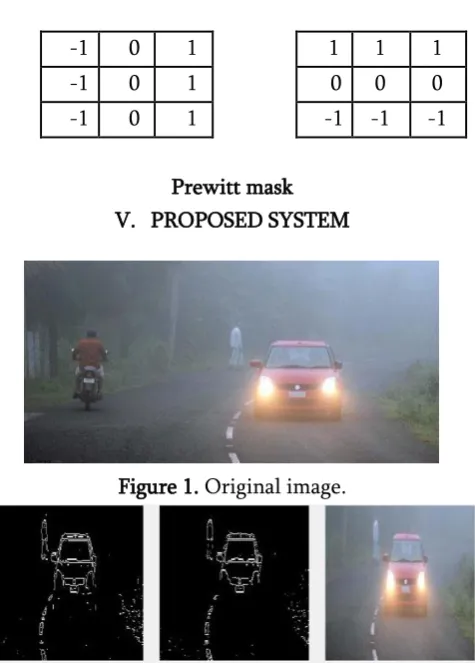
The prewitt edge detector is an appropriate way to estimate the magnitude and orientation of an edge. The prewitt operator is limited to 8 possible orientations, however most direct orientation estimates are not much more accurate. This gradient based edge detector is estimated in the 3x3 neighbourhood for 8 directions. All the eight convolution masks are calculated. The convolution mask with the largest module is then selected. The convolution masks of the Prewitt detector are given below:
-1 0 1 1 1 1
-1 0 1 0 0 0
-1 0 1 -1 -1 -1
Prewitt mask V. PROPOSED SYSTEM
Figure 1. Original image.
Figure 2. Original image to BW with edge detection.
From the fig 1. The original image can be imported to the software and converted into the gray image. The RGB image can be converted into the gray coloured image for detecting the edge of the image by the conversion.
Figure 3. Applying three Techniques
From the fig 2. The three techniques named Prewitt edge detection, Robert edge detection, Sobel edge detection can be applied to the image to detect the specified region for detecting the discontinuous of the image.
Figure 4. Edge detected for specified region
From the fig 4. The image can be extracted from the original image and the discontinuous of the image can be detected. And analysing the best result among the three techniques have used.
VI.CONCLUSION
From the above used technique, the sobel edge detection can produce the best result by executing the clear result.
VII. REFERENCE
[1].Canny, J. F (1983) Finding edges and lines in images, Master's thesis, MIT. AI Lab. TR-720. [2].Canny, J. F (1986) “A computational approach to
edge detection”, IEEE Transaction on Pattern
Analysis and Machine Intelligence, 8, 679-714. [3].Courtney. P & N. A. Thacker (2001)
“Performance Characterization in Computer
Vision: The Role of Statistics in Testing and
Design”, Chapter in: “Imaging and Vision Systems:
Theory, Assessment and Applications”, Jacques
Blanc-Talon and Dan Popescu (Eds.), NOVA Science Books.
[4].Hanzi Wang (2004) Robust Statistics for Computer Vision: Model Fitting, Image Segmentation and Visual Motion Analysis, Ph.D. thesis, Monash University, Australia.
[5].Jacinto C. Nascimento, Member, IEEE, and Jorge
S. Marques, “Performance Evaluation of Object Detection Algorithms for Video Surveillance”,
IEEE Transactions on Multimedia, Vol. 8, no. 4, August 2006.
[6].Kinjal A Joshi, Darshak G. Thakore, “A Survey
On Moving Object Detection And Tracking In
Video Surveillance System”, International Journal
of Soft Computing and Engineering (IJSCE) ISSN: 2231-2307, Volume-2, Issue-3, July 2012.
[7].Roshni V.S, Raju G, “Image Segmentation Using
Multiresolution Texture Gradient and Watershed
Algorithm”, International Journal of Computer
Applications (0975 – 8887) Volume 22– No.6, May 2011.
[8].Adnan Khashman, “Automatic Detection,
Extraction and Recognition of Moving Objects”,
International Journal of Systems Applications, Engineering and Development, Issue 1, Volume 2,2008.
Cite this article as :