DOI : https://doi.org/10.32628/CSEIT195528
A Study on Various Image Feature Extraction Techniques
1Merllin Ann George, 2Dr L. C. Manikandan
1M.Tech. Student, Department of CSE, Musaliar College of Engineering and Technology, Pathanamthitta,
Kerala, India
2Professor & HoD, Department of CSE, Musaliar College of Engineering and Technology, Pathanamthitta,
Kerala, India
ABSTRACT
Feature Extraction is the technique of extracting quantitative information from a image. Feature plays a very important role in the area of image processing. The purpose of feature extraction technique in image processing is to represent the image in its compact and unique form of single values or matrix vector. Feature extraction techniques are helpful in various image processing applications e.g. character recognition. As features define the behavior of an image, they show its place in terms of storage taken, efficiency in classification and obviously in time consumption also. The aim of this paper is to give the overview of image feature extraction techniques for young learners and researchers.
Keywords : Feature Extraction, Zoning, Characteristic Loci, Gray-level, Fourier Transforms, Walsh Hadamard Tansform, Rapid transform, Gabor Transform, Hough Transform
I. INTRODUCTION
Feature extraction describes the significant shape information enclosed in a pattern accordingly the task of classifying the pattern is made simple by a formal procedure. Feature extraction is a particular form of dimensionality diminution in image Processing. The extraction process transforms rich content of images into various content features. The main objective of feature extraction is to obtain the most important information from the original data and embody that information in a lower dimensionality space. When the input data to an algorithm is too large to be processed and it is assumed to be redundant (much data, but not much information) then the input data will be transformed into a reduced representation set of features (also named features vector). Transforming
the input data into the set of features is called feature extraction.
Feature extraction has been given as “extracting from the raw data information that is most suitable for classification purposes, while minimizing the within class pattern variability and enhancing the between class pattern variability”. Taking into consideration all these factors, it becomes essential to look at the various available techniques for feature extraction in a given domain, covering vast possibilities of cases.
II. Feature Extraction
In this process relevant features are extracted from images to form feature vectors. These feature vectors are then used by classifiers to recognize the input unit with target output unit. It becomes easier for the classifier to classify between different classes by looking at these features as it allows fairly easy to distinguish.
Feature extraction[17] is the process to retrieve the most important data from the raw data. The widely used feature extraction methods are Template matching, Deformable templates, Unitary Image transforms, Graph description, Projection Histograms, Contour profiles, Zoning, Geometric moment invariants, Zernike Moments, Spline curve approximation, Fourier descriptors, Gradient feature and Gabor features.
A good feature set contains discriminating information, which can distinguish one object from other objects. The selected set of features should be a small set whose values efficiently discriminate among patterns of different classes, but are similar for patterns within the same class.
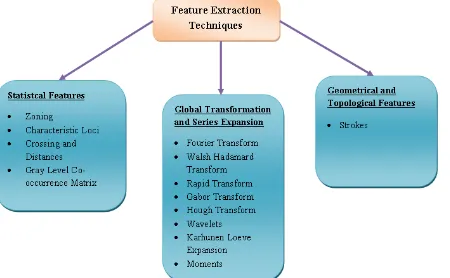
Feature extraction methods [1] are classified into three major groups as:
Figure 1 : classification of various feature extraction techniques
Statistical Features
These features are obtained from the point that are statistically distributed. They endow with high speed and low complexity. They take care of style variations to some extent. It can also be used for reducing the dimension of the feature set. The followings are the major statistical features [16]:
Zoning
The character contained in the frame is divided into several overlapping or non overlapping zones [6][7]. The densities of the points and some strokes in different regions are analyzed and form the features. Features in the contour direction measure the direction of the contours of the characters. Another example is bending point features Bending points are points at which a stroke in the image has a strong curvature. Figure 2 shows the zoning operation on character A
Figure 2 : Zoning
Characteristic Loci
For every white point in the background of the character, vertical and horizontal vectors are generated, the number of times that the line segments intersected by these vectors are used as features [18][20].
Crossing and Distances
Crossing counts the amount of transitions as of background to foreground pixels along vertical and horizontal lines through the image [9]. Distances calculate the distances of the first image pixel detected from the upper and lower boundaries of the image along the horizontal lines.
Gray Level Co-occurrence Matrix
The GLCM, which is a square matrix, can expose some properties about the spatial distribution of the gray-levels in the texture image [15]. It shows how often a pixel value known as the reference pixel with the intensity value i occur in a specific relationship to a pixel value known as the neighbour pixel with the intensity value j. So, each element (i,j) of the matrix is the number of occurrences of the pair of pixel with value i and a pixel with value j which are at a distance d relative to each other. The spatial relationship between two neighbouring pixels can be specified in many ways with different offsets and angles, the default one being between a pixel and its immediate neighbor to its right.
Mathematically, for a given image I of size K×K, the elements of a G×G gray-level co-occurrence matrix MCO for a displacement vector d(= dx, dy) is defined as
This approach describes the spatial relation between pixels of various gray-level values. Gray-level co-occurrence matrix (GLCM) is 2D histogram in which
(p,q)th elements is the frequency of event p occurs with q. It is a function of distance S = 1, angle at 0 (horizontal), 450 (with the positive diagonal), 900 (vertical) and 1350 (negative diagonal) and gray scales p and q, and calculates how often a pixel with intensity p, occurs in relation with another pixel q at a certain distance S and orientation.
Global Transformation and Series expansion Features These features are invariant to global deformations like translation and rotations. A continuous signal generally contains more information that needs to be represented for the purposes of classification. One way to represent a signal is by a linear combination of a series of simpler well defined functions. The coefficients of the linear combination provide a compact encoding known as series expansion. Common transform and series expansion features are as follows.
Fourier Transforms
transform is utilities in its ability to analyze a signal in the time domain for its frequency content. The signal can then be analyzed for its frequency content because the Fourier coefficients of the transformed function represent the contribution of each sine and cosine functions at each frequency. An inverse Fourier transform does just what you’d expect transform data from the frequency domain into the time domain.
The general procedure is to choose magnitude spectrum[21] of the measurement vector as the features in an n dimensional Euclidean space. One of the most attractive properties of the Fourier Transform is the ability to recognize the position shifted characters when it observes the magnitude spectrum and ignores the phase.
The Fourier transform decomposes a signal into orthogonal trigonometric basis function. The Fourier transform of a continuous signal can be defined as in equation (2) The Fourier transformed signal (y) gives the global frequency distribution of the time signals the original signal can be reconstructed using the inverse Fourier transform as shown in equation (3)[8].
Walsh Hadamard Tansform
This feature is more suitable in high speed processing since the arithmetic computation involves only addition and subtraction. The major drawback of Walsh Hadamard transform is that its performance depends heavily upon the position of the characters.
Rapid transform
It is same as the Hadamard Transform except for the absolute value operation which may be credited with the elimination of the position shifting problem.
Gabor Transform
The Gabor transform is a variation of the windowed Fourier Transform. In this case the window used is not a discrete size but is defined by a Gaussian function. In practical cases, the Gabor wavelet [2] is used as the discrete wavelet transform with either continuous or discrete input signal, while there is an intrinsic disadvantage of the Gabor wavelets which makes this discrete case beyond the discrete wavelet constraints: the 1-D and 2-D Gabor wavelets[10] do not have orthonormal bases. If a set of wavelets has orthonormal bases, the inverse transform could be easily reconstructed by a linear superposition, and we say this wavelet transform provides a complete representation. The non-orthonormal wavelets could provide a complete representation only when they form a frame. The concepts of the frame is beyond the scope of this report because it’s too theoretical, while in most of the applications, we don’t really care about these non-orthonormal properties if the Gabor wavelets are used for “feature extractions”. When extracting features for pattern recognition, retrieval, or computer vision purpose, the transformed coefficients are used for distance measure or compressed representation but not for reconstruction, so the orthogonal constraint could be omitted.
A core of Gabor filter-based feature extraction is the 2D Gabor filter function expressed as
Hough Transform
Hough transform has been implemented as a computational tool to detect and quantify shape primitives in images, particularly in the presence of noise. The Hough transform is a robust tool to extract features such as straight edges, circles or ellipses, but also primitives defined by polygons from images and then describe them parametrically. The Hough Transform[12][14] is generally used as one step in a processing chain. The strength of this transform to find, extract and quantify shapes relies on its ability to identify those shapes and features even if the outline is broken, incomplete or corrupted by noise in the thresholded image. The idea behind the Hough algorithm is to transform the shape of interest into its parameter space. For example, a line in a Cartesian coordinate system (x,y) can be described by:
Where the constant m represents (the slope of the line) and b corresponds to its interception with y. Each line is uniquely characterized by the pair of constants m and b. Therefore, any line can be represented by a point in a coordinate system m and b. Conversely, any point (x,y) is associated with a set of values for m and b that satisfy equation 5, which can be rewritten as:
Therefore, each point (x,y) is represented by a line in a (m,n) space. It can be seen from Eq. 6 that the line represented by Eq. 5 is unsuitable, since values in (m,n) space become undefined for vertical lines.
Wavelets
Wavelet transformation is a series expansion technique that allows us to represent the signal at different levels of resolution. This include the Discrete
Wavelet Transform
Wavelet transform performs multi–resolution of images that is simultaneous representation of images on different resolution levels. The wavelet
compression techniques uses wavelet filters for decomposition into sub images. First, filter is applied along the rows and then along the columns thus resulting in four sub-bands as low-low, lowhigh, high-low and high- high. Hence, M x N image is filtered and then down sampled into N x M/2 images. Then each column is filtered and down sampled into N/2 x M/2 images.
Wavelet decomposition provides four sub bands which are: Approximated sub band (LL) is normally further decomposed at different scales while three sub bands (LH, HL, HH) include characteristic of an image. DWT overcomes the drawback of Cosine transform by recognizing point discontinuities in image. Discrete Wavelet transform provides information about local frequency. LL is lower frequency component band. If LL band is further decomposed into next level then LL frequency component band will be distributed into further four parts and each part will have N/2 × N/2 coefficients and in second level N/2 × N/2 coefficients are further decomposed into four parts having N/4 × N/4 coefficients each and in the next level same procedure will be repeated. Figure 2 shows the decomposition of an image using DWT.
Figure 3: Decomposition of an image using DWT
Karhunen Loeve Expansion
Moments
Moment normalization strives to make the process of recognizing an object in an image size translation and rotation independent.
Geometrical and Topological features
These features may represent global and local properties of characters and have high tolerances to distortions and style variations. These topological features may encode some knowledge about the contour of the object or may require some knowledge as to what sort of components make up that object.
Strokes
These are the primitive elements which make up a character. The strokes can be as simple as lines l and arcs c which is the main strokes of Latin characters and can be as complex as curves and splines making up Arabic characters. In on line character recognition a stroke is also defined as a line segment from pen down to pen up.
III.CONCLUSION
Image feature extraction plays a vital role in image processing and medical imaging. In this paper image feature extraction techniques have been discussed in detail.
IV. REFERENCES
[1]. Isabelle Guyon and Andre Elisseeff, “An Introduction to Feature Extraction”, pp 1-25, Studfuzz 207, Springer, 2006
[2]. Neeraj Pratap1 and Dr. Shwetank Arya “A Review of Devnagari Character Recognition from Past to Future” International Journal of Computer Science and Telecommunications Volume 3, Issue 6, June 2012].
[3]. Gaurav kumar and Pradeep Kumar Phatia, “A Detailed Review of Feature Extraction in Image Processing Systems”, International Conference
on Advanced Computing & Communication Technologies, IEEE, 2014
[4]. S. S.Wang, P. C. Chen, and W. G. Lin, “Invariant pattern recognition by moment Fourier descriptor,” Pattern Recognit., vol. 27, pp. 1735– 1742, 1994.
[5]. X. Zhu, Y. Shi, and S. Wang, “A new algorithm of Connected character image based on Fourier transform,” in Proc. 5th Int. Conf. Document Anal. Recognition. Bangalore, India, 1999, pp. 788–791.
[6]. C.Y. Suen, M. Berthod and S. Mori, Automatic Recogniti”on of Handprinted-Characters _ the State of the Art in Proceedings of the IEEE, Vol: 68, No: 4, 1980.
[7]. Nariz Arica” An Offline Character Recognition System for Free Style Handwritting” 1998. [8]. S.S.Pandey, Manu Pratap Singh and Vikas
Pandey, “Image Transformation and
Compression using Fourier Transformation”, International Journal of Current Engineering and Technology, Vol. 5, No. 2, April 2015.
[9]. M. A. Mohamed, P. Gader, “Handwritten Word
Recognition Using Segmentation-Free Hidden Markov Modeling and Segmentation Based Dynamic Programming Techniques”, IEEE Trans. Pattern Analysis and Machine Intelligence, vol.18, no.5, pp.548-554, 1996. [10]. Neelu Arora and Mrs. G. Sarvani, “A Review
Paper on Gabor Filter Algorithm and its Application”, IJARECE, Vol 6, Sept 2017.
[11]. Biswajit Pathak and Debajyoti Barooah, “Texture Analysis Based on the Gray-Level Co-occurrence Matrix Considering Possible Orientations”, IJAREEIE, Vol. 2, September 2013.
[13]. Nafiz Arica, “An Offline Character Recognition System for free style Handwriting”, pp.1- 123, Sept. 2008.
[14]. Anshul Gupta, Manisha Srivastava, “Offline Handwritten Character Recognition”, pp. 1-27, April 2011.
[15]. R.M. Haralick, K. Shanmugam, I. Dinstein, “Textural Features for Image Classification”, IEEE Trans. on Systems, Man and Cybernetics (1973)610 – 621.
[16]. M. A. Mohamed, P. Gader, “Handwritten Word Recognition Using Segmentation-Free Hidden Markov Modeling and Segmentation Based Dynamic Programming Techniques”, IEEE Trans. Pattern Analysis and Machine Intelligence, vol.18, no.5, pp.548-554, 1996. [17]. Sandhya Arora, Meghnad Saha, Debotosh
Bhattacharjee, Mita Nasipuri, “Combining Multiple Feature Extraction Techniques for
Handwritten Devnagari Character
Recognition”, IEEE Region 10 Colloquium and the Third ICIIS, pp. 1-6, Dec. 2008
[18]. Nariz Arica” An Offline Character Recognition System for Free Style Handwritting” 1998. [19]. Cheng-Lin Liu, “Normalization-Cooperated
Gradient Feature Extraction for Handwritten Character Recognition”, IEEE Transaction on pattern analysis and machine intelligence, vol. 29, no. 8, Aug. 2007.
[20]. R. G. Casey, E. Lecolinet, “A Survey of Methods and Strategies in Character Segmentation”, IEEE Trans. Pattern Analysis and Machine Intelligence, vol.18, no.7, pp.690-706, 1996. [21]. C. Goswami & A. K. Chan , Fundamental of
Wavelets Theory, Algorithms & Application 2nd Edition, Wiley, 2011.
Author Details
Merllin Ann George is doing M Tech at Musaliar College of Engineering and Technology, Pathanamthitta, Kerala, INDIA. She has received B Tech degree in Computer Science and Engineering from Visvesvaraya Technological University, Belgaum, Karnataka, India. Her main research interest is in Image Feature Extraction.
Dr. L. C. Manikandan is working as Professor at Musaliar College of Engineering and Technology, Pathanamthitta, Kerala, INDIA. He has received Ph.D. degree in Computer and Information Technology from Manonmaniam Sundaranar University, M.Tech. Degree in Computer and Information Technology from Manonmaniam Sundaranar University, M.Sc., Degree in Computer Science from Bharathidasan
University and B.Sc. Degree in Computer Science from Manonmaniam Sundaranar University. His main research interest includes Video Surveillance, Image Compression & Video Coding in image processing.
Cite this article as :
Merllin Ann George, Dr L. C. Manikandan, "A Study on Various Image Feature Extraction Techniques", International Journal of Scientific Research in Computer Science, Engineering and Information Technology (IJSRCSEIT), ISSN : 2456-3307, Volume 5 Issue 5, pp. 151-157, September-October 2019.
Available at doi :
https://doi.org/10.32628/CSEIT195528