DOI : https://doi.org/10.32628/CSEIT1952307
Exploration of Factors Affecting Learners’ Motivation
in E-learning
Shubham Dubey1*, Biro Piroska2
1,2Faculty of Informatics, University of Debrecen, Debrecen, Hungary
ABSTRACT
The world is changing rapidly, so is academics. E-learning has altered the area of academics and education. ICT enabled learning has given ideal services to students by providing any type of content on demand which is proportional to the performance of students. The concentration of learner has been found instinctive; thus there is a need of engaging mind towards course progress with its entirety till the objectives of the course will be achieved. There are several e-learning platforms available as EdX, Udacity, Khan Academy, Alison those have a number of learners registered for various courses. Studies suggest that these platforms suffer from the
common problem of learners’ dropping out. Investigations also claim early leaving rate is increasing due to lack of quality of content, distraction factors, learners’ mind change, outdated and succinct information, and some
more detraction factors. These issues have been observed on the basis of early leaving rates in various MOOCs. Thus there is a mammoth scope for minimizing the impact of these reasons on the learners’ mind. It can be achieved by identifying these factors affecting learners’ motivation during the course. This study is aiming on
identifying these factors. The approach is to explore some certain keywords on previous literature (total 41) and then calculating their frequencies and co-factors associated with them. Both grouped factors contribution and individual factor contribution have been taken care. The study gives a direction for future work towards overcoming these actor and engaging learners in ICT enabled learning.
Keywords : E-learning, ICT enabled learning, Pedagogy, MOOCs, Dropping Out
I. INTRODUCTION
The number of E-learning platforms is increasing speedily. This creates a variety of courses and option for the same course to the user/ learners. Since
choices are there thus students’ performances are
increasing sharply and dropout rate too [1]. Dropping a course does not only depend on choices but some more parameters are there on which it depends.
These reasons may be learner’s mind change,
language barrier, wrong selection of course etc.[2]. Thus we need to engage their mind by improving the quality of core properties of E-learning models, in order to maintain the motivation of students [3].
Several models have been developed for online course promotions schemes. In order to increase the
learners’ engagement, hits and traffic on the course
content must be highlighted. Thus first we need to
find out the reasons affecting learners’ motivation
and then their treatment can be done.
In the paper section, II is giving the idea of kinds of literature spoofed for the study. Section IV is explaining the methodology followed in this study while section V holds result and analysis of the study. The research is concluded in the last section i.e. section VI with the future scope of this work.
II. LITERATURE REVIEW
In [6] Author Nurul Islam has emphasized the limitations of E-learning technology and grouped limitations into five categories: learning styles and cultural challenges, pedagogical e-learning challenges, technological Challenges, technical training challenges, and time management. Some suggestions are also given to overcome those limitations and contributing towards effective e-learning outcome these are: Efficient in Technology, E-learning system must be stable, Provide a high standard of support and guidance, Policies must be clear, to encourage students towards e-learning and The Training must be practical.
Papia Bawa has asserted some critical reasons for high attrition rates in online classes and also advances retention rates [7]. Author has proposed that usually, learners drop out early stage of the semester and some more reasons like personal preference, profession-related and program-related issues. Factors those are responsible for high attribution rates in online environments have been identified as- misconceptions, cognitive challenges, and general expectations. Learners, who are used to the structured form of face to –face courses when going through with ill-structured domains of online environment leads to demotivation and attrition [5]. A literature [8] threw the light on application of the inquiry-based science education approaches in
relation to Informatics and specialized classes. The challenges which students and Teachers have been confronting in the course of application of the inquiry-based science education precisely discussed in this paper. Skills developed through inquiry- Based science education- Identifying the problem, Investigating Search information, differentiating the alternatives, discussing with friends and teachers and finally add your view in respect to the problem.
In [9] the whole emphasis is on to assess motivation by analyzing other types of information like times
variables, learner’s actions and learner’s statement
about his level of motivation. In this regard, future research may extend this model to become a general model taking into consideration the variety of actions that could occur in WBEL environments.
Author Safiyeh investigated the strength of the relationship between e-learning and students’
motivation during learning to find out the use of e-learning in higher education that leads to affect
students’ motivation in the field of learning and effect of technology on students’ motivation [10].
When e-learning was applied on the students they were comparatively motivated so the students likely to be engaged and in this way we able to achieve learning objectives. By this study Education, thinkers are able to mull over and comprehend the effects of e-learning on students’ motivation.
Marina has discussed the problem while designing the courses usually teachers take everything ideal and they assume the motivation of learners is self-generated, i.e. learners are self-motivated [11].
Which doesn’t always work since there will be so
many states when learners need external motivation too. From the studies performed above, we found a gap to identify the crucial parameters those affect the
III. METHODOLOGY AND OBSERVATIONS
After performing a review of the literature; we have made clusters of the words. These words are identified as factors that affect motivation while following E-learning. The analysis has been performed on 41 pieces of literature. Among them, 39 are research papers published in various journals and there were 2 books. Here we did not only highlight the factors those can affect the learners' engagement but also those can demotivate them and enforce them for dropping the course.
The approach is based on counting the frequencies of words as the factors affecting the motivation of learners [5]. The reasons i.e. factors are subcategorized and specified in smaller reasons those directly affect the motivation of learners. Once we have found the frequency we can easily find the main factors those play the crucial role. Hence a model can be prepared for maintaining the motivations of learners in order to increase engagement in e-learning.
TABLE 1.
FACTORS AFFECTING LEARNERS’ MOTIVATION
AND THEIR FREQUENCY IN LITERATURES
S. No
Reasons Sub-Categories Frequenc y
Network issues 79
103 Advertisement 58
Reference’s
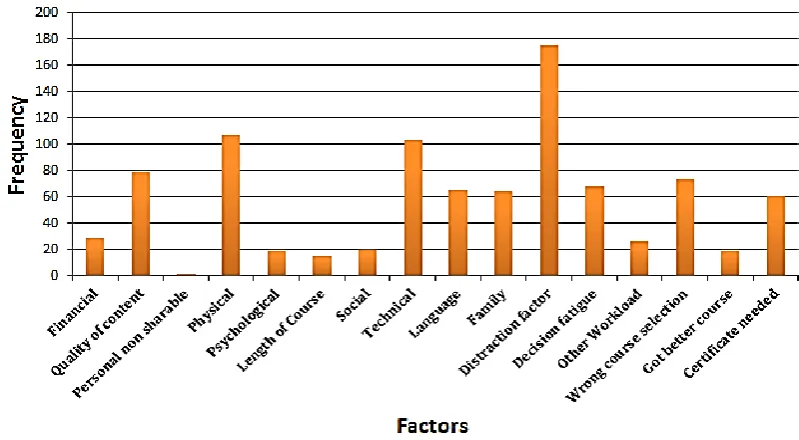
Here is the frequency chart in which it can be observed that distraction factors are the main reasons affecting learners motivation while when it meets with technical and physical factors it share approximate 385 frequencies among all frequency terms.
IV.RESULTS AND DISCUSSION
There are numerous factors behind learners early
leaving. In order to maintain the learners’ motivation
first, we need to be identified the factors behind this leaving. Table 1 shows the frequencies of the factors in studies.
Figure 1. Frequency chart of Factors affecting learners’ motivation
If we plot the pie chart for the same frequency chart mentioned in the figure 1, we will get the exact percentage of the factors that contribute the motivation level with massive contribution.
Figure 2. Ratio among factors as per their contribution
In figure 2, it can be inferred that the major factor for motivation is the distraction factor, physical actor and technical factors. These are sharing approx. 19%, 12% and 11% of the whole impact ratio. Factors associated with distraction are Reference divergence, popups, and advertisements. Reference divergence is just diverting the readers from the mainstream of content.
In figure 3 it is clear that tiredness is the factor which is taking the highest part for physical demotivation factor. There are three obstacles including other disabilities and following course with other works. It has been observed that tiredness is contributing with a 42% share and some physical disabilities are taking part with 22 %. Course following with other stuff too is itself a bigger factor of motivation lagging which is of 36% of total physical factors.
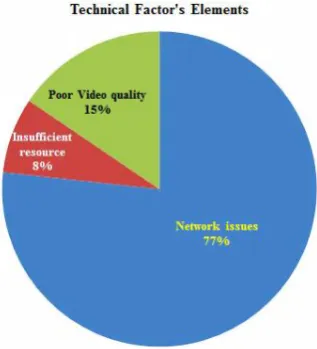
Here figure 5 shows the factors those are
participating elementary way in learners’ motivation in E-learning. Among all three Network issue shares 77 %, insufficiency of content shares 8% and poor video /audio quality shares 15% of the whole technical problem.
Figure 4. Ratio among co-factors of physical factor of lagging motivation
Figure 5. Ratio among co-factors of physical factor of lagging
This analytics are generated by doing analysis on a group of factors. There is a vital need to analyze the factors individually and figure 6 draws attention to it.
From figure 6 it is clear that on an individual basis network issues network issues is the term having highest frequency, while language barrier is the second one having 65 as frequency value.
V. CONCLUSION
The study was done over finding the factors affecting
learners’ motivation when E-learning is the main source. Here the crucial thing is that after reviewing the literature some keywords have been taken out for study. From the results and discussion, it is clear that the network issue is the most important factor that usually creates a hurdle for learners to finish a course. Excluding it language barrier is the second biggest individual problem; since all the learners are not aware of English or the language on which the courses are available.
It can be concluded that detraction factors, physical factors, and technical difficulties are the top 3 factors
that can affect learners’ motivation. Language
proficiency and network issues are major individual issues which must be taken care.
This study is giving a future direction towards how to
increase the users’ engagement in E-learning and how to promote science education on E-learning. This work is also giving a firm invitation for localization of MOOCs
VI.REFERENCES
[1]. R. Y. (2018). The Relationship Between Quality of Student Contribution in Learning Activities and their Overall Performances in an Online Course. European Journal of Open, Distance and E-Learning, EURODL.
[2]. Yuan, L. (May-2017). Explore the Business Model of MOOCs. HCI Business, Government and Organizations Interacting with Information Systems.
[3]. R. H. (2007). Student E-learning Intrinsic Motivation: A Qualitative Analysis (Vol. 19). Communications of the Association for Information Systems.
[4]. Prajapat Shaligram, Dubey Shubham. (2017, August). Generic Model For Online Course Promotion of HRDC In Social Network. Germany: Omni spectrum, Lambert academic journal, ISBN 978-3-330-33155-6.
[5]. Shraddha Soni, Shubham Dubey. (2018, April). Towards Systematic Literature Review of E-learning. International Journal of Scientific Research in Computer Science, Engineering and Information, 3(3),1389-1396.
[6]. Nurul Islam,Martin Beer, Frances Slack. (2015 , September). E-Learning Challenges Faced by Academics in Higher Education: A Literature Review. Journal of Education and Training Studies , 3(5), 102-113.
[7]. Bawa, P. (2016, March ). Retention in Online Courses: Exploring Issues and Solutions—A Literature Review. SAGE Open DOI: 10.1177/2158244015621777.
[8]. Nikolova, N., & Stefanova, E. (2012). Inquiry-Based Science Education in Secondary School Informatics - Challenges and Rewards. SEFM Satellite Events.
[9]. Nehad T. Ramaha, Wan Mohd. Fauzy Wan
Ismail. (2012, August). Assessment of Learner’s
Motivation In Web Based E-Learning. International Journal of Scientific & Engineering Research, 3(8).
[10].Harandi, S. R. (2015). Effects of e-learning on students' motivation. 3rd International Conference on Leadership, Technology and Innovation Management, 423-430.
Cite this article as :