FastSOA:
Achieving High-Performance
Service Oriented Architectures
Master’s Thesis
FastSOA: Achieving High-Performance
Service Oriented Architectures
Author: Michel Kruiskamp
University: University of Twente
Master: Computer Science
Supervisors University of Twente: Harold van Heerde & Maarten Fokkinga Track: Information Systems Engineering Organisation: Logica Arnhem
Division: Public Sector
Coordinators Logica: Raynni Jourdain & Martijn Vlietstra Mentor Logica: Jan Wolsink
Management Summary
Service Oriented Architecture (SOA) is an architectural style that aligns IT with business processes in an enterprise. Currently, Logica is involved in multiple SOA projects. As SOA projects grow, so does the need for more employees that have experience with large SOA environments. In SOA, there is taken care of scalability, accessibility, extensibility and maintainability. However, load and performance often are not taken care of. Inexperience with and unclear use of large grown SOA environments may rise the question what happens with the performance of such SOA environments. This was the reason for the following research:
“Determine whether a Service Oriented Architecture environment suffers from load and performance
issues by looking at it from multiple (4) perspectives.
Research how the environment can cope with these possible issues. The results can be used to build
high performance SOA environments.”
In order to answer the questions that this research goal rises, we looked from four perspectives at SOA, theoretical as well as practical. The theoretical perspectives comprised a literature study and an existing research on SOA performance, the practical part comprised a questionnaire and tests. These observations showed that there is a need for improvement of SOA performance. According to these observations, a lack of good performance is occasionally experienced during SOA projects. The results of our own findings show that the following recommendations can be made:
Using these recommendations for future SOA projects it is possible to achieve higher performance SOA environments than before. For even more insights in high performance SOA environments, this thesis also mentions suggestions for future research.
Use SOAP Document Literal Encoding for SOAP messages.
Use DOM for the parsing of small XML document. As the size of the XML documents grow, it is recommended to look
at other solutions, such as SAX or StAX. When dealing with large to huge XML documents, it is best to use XML Binding
techniques.
Use tool kits such as Visual Studio .NET for developing services. However, mind the choices tool kits automatically
make, such as XML parser and encoding style. Where possible, change the default choice according to this advice.
Try to use middleware, e.g. data grids, when reliability and speed is a critical aspect.
Evaluate more often on projects. The questionnaires showed that only a bit more than half of the SOA projects are
evaluated. Evaluations can lead discovery of best practices, that can in turn lead to better knowledge of SOA and
performance.
Make use of caching. Our proof of concept for caching in ASP.NET C# shows that it is to implement caching in
Preface
For the final part of my study Master Computer Science (MCS) at the University of Twente in Enschede, I have conducted a research leading to the document you are reading now: my final thesis. This research was conducted at Logica Arnhem and started at the first of February 2008. It was quite an endeavour to find a suitable research for the track Information Systems Engineering that I am following for my master title, but looking back at the past half year, I can conclude that I combined the best parts of this track in this research. Using the knowledge I have learned during my study, it was great to be able to put all of it in practice.
The result of this research and this thesis would not have been possible without various people, so I would like to thank all of them for giving me insights, access to information and valuable
feedback.
I would like to start by thanking my supervisors at the University of Twente. Harold van Heerde, my first supervisor, really gave helpful feedback during all parts of the research and advice for bringing structuring the thesis. My second supervisor, Maarten Fokkinga, helped me looking thoroughly at the results from the test, so nothing important could be missed.
Besides the supervision at the University of Twente, I was supported by various people at Logica. Raynni Jourdain and Martijn Vlietstra, project leader and project architect of Working Tomorrow Arnhem, guided me during the overall progress of the research, pointed me at critical aspects of this research and helped me finding my own way within Logica. Without their help, a lot of useful information and knowledge would have remained hidden for me. Next, I would like to thank my mentor Jan Wolsink for giving useful feedback , literature and insights into Service Oriented Architectures. Also, I would like to thank my fellow Working Tomorrow students at Logica Arnhem for having a great time. Finally, I would like to thank my girlfriend Karin and my family for supporting me during these six months.
Table of Contents
Management Summary ... I Preface... II List of Abbreviations ... V
1 Introduction ...1
1.1 Research Setting ...1
1.2 Problem Analysis ...2
1.3 Conceptual Design...3
1.4 Technical Design...5
1.5 Performance of Information Systems ...6
1.6 Enterprise Architecture ...7
1.7 SOA and EAI ...7
1.8 SOA Definitions ...8
2 SOA Levels and Technologies ...9
2.1 SOA Levels of Abstraction ...9
2.2 SOA Technologies ... 12
2.3 Advantages of SOA ... 17
2.4 Disadvantages of SOA... 18
2.5 Summarizing SOA ... 20
3 Possible causes for low SOA Performance ... 21
3.1 XML and SOA according to Frank Cohen ... 21
3.2 Cause 1: SOAP Encoding Styles ... 22
3.3 Cause 2: Java SOAP Bindings ... 23
3.4 Cause 3: XML Parsers ... 24
3.5 Summary ... 25
4 The Logica Approach to SOA ... 26
4.1 Introduction ... 26
4.2 Respondent Projects ... 26
4.5 XML Parsers ... 29
4.6 Middleware ... 31
4.7 Implementation Problems ... 32
4.8 Evaluation Moments ... 33
4.9 Best-Practices... 34
4.10 Questionnaire Conclusion ... 35
5 Tests ... 36
5.1 Introduction ... 36
5.2 SOAP encodings ... 37
5.3 XML Parsers ... 42
6 Speeding up SOA ... 48
6.1 Introduction ... 48
6.2 Option 1: In-Memory Data Grids and Caching ... 48
6.3 Option 2: The FastSOA Solution ... 50
6.4 Option 3: Mid-Tier Service Response Caching ... 51
6.5 Model of Middleware Solutions... 57
6.6 Summary ... 58
7 Conclusions and Advice... 59
7.1 Carried Out Actions ... 59
7.2 Main Conclusion ... 59
7.3 Advice to Logica ... 62
8 Discussion ... 63
9 Future Research ... 63
10 Bibliography ... 65
Appendix A. Questionnaire Structure ... 68
Appendix B. SOAP encodings Performance Test Results ... 69
Appendix C. XML Parser Performance Test Results ... 75
List of Abbreviations
ICT Information and Communication Technology
SOA Service Oriented Architecture
XML eXtensible Markup Language
EA Enterprise Architecture
EAI Enterprise Application Integrations
BPEL Business Process Execution Language
WSDL Web Service Description Language
UDDI Universal Description Discovery and Integration
SOAP Simple Object Access Protocol
ESB Enterprise Service Bus
SAX Simple API for XML
StAX Streaming API for XML
1
Introduction
This chapter presents the research setting at which the research takes place, gives an analysis of the
problem, explains what is meant with performance and introduces Service Oriented Architectures.
1.1
Research Setting
This research takes place at Logica Netherlands, Arnhem. Logica is providing IT and business solutions at international level, employing around 39,000 people across 36 countries. The current mission statement of the company is “To help leading organisations worldwide achieve their business objectives through the innovative delivery of information technology and business process solutions”. Their main activities are providing business consulting, systems integration and IT and business process outsourcing across diverse markets, including telecoms, financial services, energy and utilities, industry, distribution and transport and the public sector.
Logica focuses on differentiated, value-added activities critical to the business success of its clients for a competitive advantage. It provides companies with a competitive advantage through the adoption of the following core strengths (Logica, 2008):
Strategic consultancy Systems integration Products
Project management
Business process outsourcing
Applications and infrastructure management Payroll and human resources outsourcing
Logica
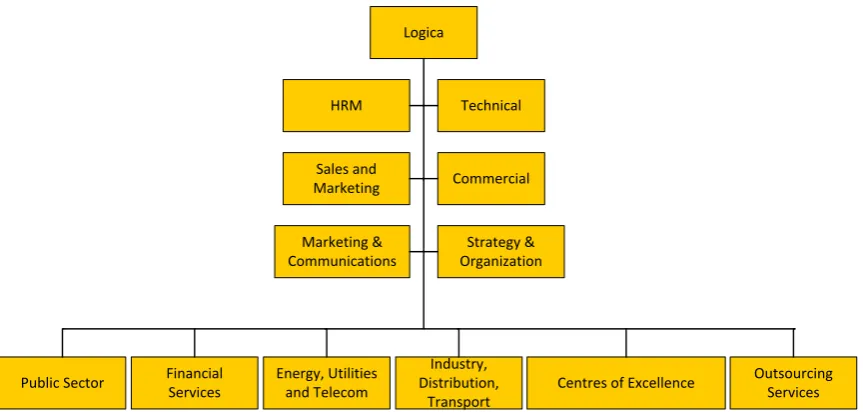
Figure 1-1: Organisation structure, Logica has six different divisions: the lower six blocks.
1.2
Problem Analysis
A quickly emerging development in the field of ICT is Service Oriented Architecture (SOA). The main goal of SOA is serving customers’ needs by increased flexibility of IT systems, while reducing costs. SOA gives companies a way to quickly react to the wishes and demands of their customers (SAP, 2006; Josuttis, 2007).
In rapidly changing markets, companies are sensitive to these arguments. SOA gives companies a possibility to rapidly switch of strategy. This gives them a large advantage over other companies.
However, there are also downsides to SOA. There are SOA components that take care of scalability, accessibility, extensibility and maintainability. However, these components do not take care of load and performance. This should not be a problem, if the SOA projects are only used internally: you can make calculations what the maximum load will be. On the other hand, if the SOA project is exposed to an amount of traffic that you cannot calculate in advance (e.g. external web users), it is hard to see what load can be expected, possibly leading to a decrease in performance. Therefore, it is important to try to anticipate to these issues in another way. Since an SOA
This research will look at SOA and it will examine from four perspectives whether there are any performance related problems in SOA environments:
A literature study, of which the results are shown in this thesis An existing research on SOA performance (Cohen, FastSOA, 2007) Questionnaire with employees at Logica
Tests
Furthermore, this research will look into solutions for such possible performance related issues.
1.3
Conceptual Design
1.3.1
Research Goal
The goal of this research is:
1.3.2
Research Model
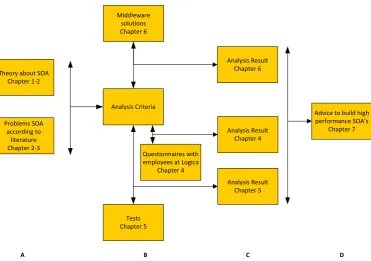
To achieve the research goal, it is useful to get an overview of the steps that have to be taken. This can be achieved by the research model. A research model is a schematic overview that shows how a research is structured (Verschuren & Doorewaard, 2000). Furthermore, a research model is important for determining the theoretical background for the research, such as main concepts and theoretical framework. Figure 1-2 shows the research model for this research, according to the guidelines given by Verschuren and Doorewaard.
To determine whether a Service Oriented Architecture environment suffers from load and
performance issues by looking at it from multiple (4) perspectives. Research how the environment
can cope with these possible issues. The results can be used to build high performance SOA
Analysis Result
Figure 1-2: The Research Model that is used during this research. It consists of four stages. Each topic is handled in chapters
of this thesis.
To clarify the research model, each step will be explained below.
In the first stage of the research model (A), different literature sources are used: theory about SOA (typical components, advantages, disadvantages, results of existing researches) and problems that can arise in SOA environments. These resources will give enough information to determine the analysis criteria for the rest of the research. Chapters 1 and 2 will show this literature study.
These analysis criteria are later on (B) used for taking a questionnaire with employees within Logica that are or have been involved in SOA projects to get an understanding of, if and how Logica sees the SOA problems and how it handles them. The results of this questionnaire can be found in Chapter 3.5.
As can be seen, stage B involves tests. These tests will be run to see if any possible performance issues can be solved, by carefully making decisions on implementing an SOA environment. Chapter 5 will show these tests and the results. The interviews and tests can also be used for getting practical knowledge about topics being researched and for validating own ideas. After stages A and B are completed, the results from these tests are analysed (C) in Chapter 5.2.1 and 5.3.1. Furthermore, a literature research and a practical research will be performed to see whether there are any
high performance SOA environments. This advice can be found in Chapter 7. By giving this advice, the research goal will be achieved.Chapter 8 gives a discussion on SOA and this research. Finally, Chapter 9 does suggestions for future research on SOA performance.
1.3.3
Research Questions
The previous sections gave a quick overview of the structure that the research project will have. This section will describe in more details which questions have to be answered to reach the research goal. In order to reach this goal, the most important question will be the following:
Since this is a very broad question, the main question can be split into several sub-questions, that can in turn be split into yet other sub-questions. Each question is answered in a chapter of this thesis.
1. What is Service Oriented Architecture?
a. What are the basics of an SOA environment? (Chapter 2.2) b. What are the capabilities of an SOA environment? (Chapter 2.1) c. How do organisations benefit from an SOA environment? (Chapter 2.3)
2. Does an SOA environment suffer from load and performance issues? (Chapters 3, 4 and 5) a. How are performance and load defined and how can it be measured?
b. When and where possibly do these issues arise? c. What are the possible consequences of these issues?
3. How can XML technology be used in SOA environments, leading to larger load tolerance and reaching higher performance? (Chapter 6)
a. What options can be given to increase the performance of an SOA environment and load tolerance?
b. How can performance increase be measured and how much performance increase can be achieved by using this XML technology in comparison with SOA projects that build upon typical current designs and components?
1.4
Technical Design
1.4.1
Knowledge Sources
In order to perform a research in a structured way, it is also important to look at the knowledge
different types of knowledge sources, namely people, media, reality, documents and literature (Verschuren & Doorewaard, 2000). This research project will use some of these resources, as mentioned in the following sections.
1.4.2
Literature
The research model shows us that literature will be used for this research. Using literature it is possible to get an understanding of what SOA is and whether it has to cope with load and
performance issues. Literature is the first perspective (see the research goal in Chapter 1.3.1). Chapters 1 and 2 show this literature study.
1.4.3
Existing Research
For this research, the results of an existing research by Frank Cohen(Cohen, FastSOA, 2007) will be used to look at the possible problems of SOA. This is the second perspective. Chapter 3 shows this existing research.
1.4.4
Questionnaire/People
As can be seen in the research model, a questionnaire will be used. This questionnaire will give a clear overview of the problems that Logica possibly has faced in the field of SOA. Different SOA project members have to fill in the questionnaire to get sufficient information. This questionnaire is the third perspective and it will be shown in Chapter 3.5.
1.4.5
Testing/Reality
Another way that will be used to perform research for this project, is actual testing. This will take place at stage B of the research (see Figure 1-2). These tests make up the fourth perspective. Chapter 5 shows these tests.
1.5
Performance of Information Systems
This research is about performance of SOA environments. Performance is also an important aspect of information systems in general. It can be seen as an indication of how the system performs and it refers to a system’s ability to achieve a response within a certain amount of time. A clear way to show performance of an information system is the throughput of the system. This can be
In the ideal situation, an information system is capable of handling requests regardless of the amount that comes in at the same time. However, typical information systems have a bottleneck: additional requests they receive, slow down the speed at which the system responds to the requests, decreasing the transactional speed. For this reason, it is important that organisations are able to predict how an application will behave under increasing load. One may think that this behaviour can be calculated by multiplying the resources one user uses by the number of users that actually are using the system at the same time. However, this prediction by multiplication is usually not applicable due to concurrency: a user action (e.g. a write request) can have effect on other user action whether negative (e.g. the write request can slow down other read requests) or positive (e.g. a read request can speed up other similar read requests).
1.6
Enterprise Architecture
An Enterprise Architecture(EA) is a conceptual method that organisations can use to understand their own structure and the way they work. It provides a map of the enterprise and can be used as a for future decisions about changes in business and technology. Enterprise Architecture is about understanding all of the different elements that make up the enterprise and how those elements interrelate. To visualise the relations between these elements, various frameworks have been developed. One of the most famous frameworks is the Zachman Framework, developed by John Zachman in 1987 (Zachman International, 2008).
A common term in IT community that can be heard often in combination with Enterprise Architecture is SOA. Major IT vendors are talking about SOA, promoting their view and products based on SOA. The following sections and chapters will explain what SOA is.
1.7
SOA and EAI
Many people consider SOA as the successor of Enterprise Application Integration (EAI). EAI is an integration technology that supports enterprise business processes with the existing application portfolio. The goal of all EAI products is interoperability: making it possible to send data and
commands between applications. The applications get more possibilities and become part of a bigger system. On the other side, the goal of SOA also is to let applications communicate with each other, but SOA does not use the current applications in order to reach its goal: it hides the existing
1.8
SOA Definitions
Before SOA was a common term in the IT community and broadly used, enterprises were mainly using siloed, closed end-to-end applications: each IT-part of a business process was accomplished by a specific application. However, as markets change, increasing the need for flexibility, reuse, and fast time-to-market delivery, another approach for alignment between business and IT was needed . This is where SOA comes into play. SOA is a new paradigm in the world of IT that allows this alignment between business and IT. It provides a way to integrate dissimilar applications within an enterprise, improving reuse of applications logic while eliminating duplication of production environments. All this is possible through the use of single or combined service delivering units. There are various kinds of communications and coordination, restricted by agreements and contracts between these units.
The OASIS (Organisation for the Advancement of Structured Information Standards) group, a non-profit consortium that aims for open standards for the global information society, has given a clear formal definition for SOA (OASIS, 2006):
The Open Group, a consortium neutral in both vendor and technology that aims for information integration within and among enterprises using open standards and global interoperability, also gives a definition for SOA (The Open Group, 2008):
Plenty other definitions can be found, but they tend to differ a lot, focus on different aspects and the question remains whether SOA can stick to the promises implicitly made in these definitions. To give a better view on what SOA is, we will explain the different aspects of SOA in the next
chapters.
“Service-Oriented Architecture is an architectural style that supports service orientation.
Service orientation is a way of thinking in terms of services and service-based
development and the outcomes of services. An architectural style is the combination of
distinctive features in which Enterprise Architecture is done or expressed.”
“Service Oriented Architecture is a paradigm for organizing and utilizing distributed
capabilities that may be under the control of different ownership domains. It provides a
uniform means to offer, discover, interact with and use capabilities to produce desired
2
SOA Levels and Technologies
The previous chapter gave some definitions of SOA. In these definitions various terms (such as
services) were used. This chapter will show us how SOA can be presented in different levels of
abstraction. It gives an example of each abstraction level and an example of all three abstraction
levels combined and It explains some of the terms that appeared in the SOA definitions from the
previous chapters. Furthermore, it will show what are the typical components of SOA.
2.1
SOA Levels of Abstraction
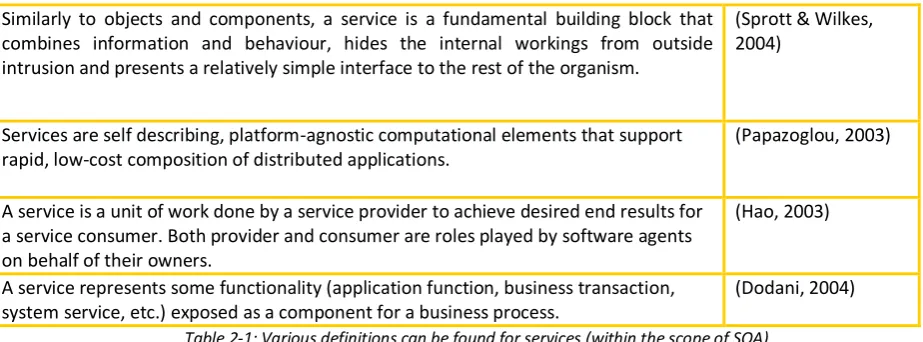
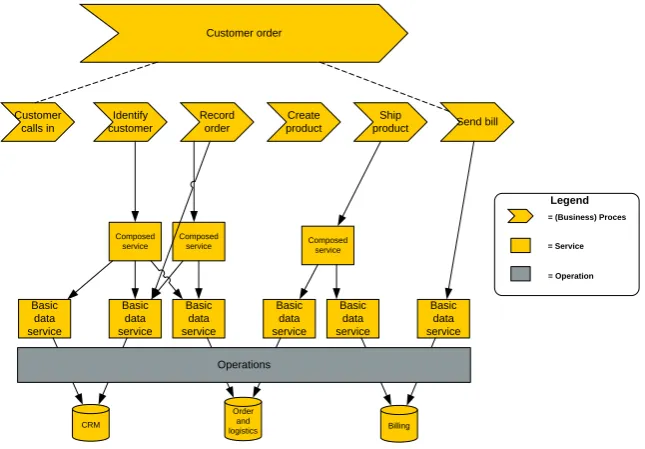
An SOA environment can be presented in three levels of abstraction: operations, services and business processes (Zimmerman, Krogdahl, & Gee, 2004). Operations are transactions that represent single logical units of work. An execution of such an operation will typically cause one or more persistent data records to be read, written or modified (e.g. ‘read number of items in stock’). Services represent logical groupings of operations (e.g. ‘ship product’). Various definitions can be found for services within the scope of SOA. Some of these can be found in Table 2-1.
Similarly to objects and components, a service is a fundamental building block that combines information and behaviour, hides the internal workings from outside intrusion and presents a relatively simple interface to the rest of the organism.
(Sprott & Wilkes, 2004)
Services are self describing, platform-agnostic computational elements that support rapid, low-cost composition of distributed applications.
(Papazoglou, 2003)
A service is a unit of work done by a service provider to achieve desired end results for a service consumer. Both provider and consumer are roles played by software agents on behalf of their owners.
(Hao, 2003)
A service represents some functionality (application function, business transaction, system service, etc.) exposed as a component for a business process.
(Dodani, 2004)
Table 2-1: Various definitions can be found for services (within the scope of SOA)
It is important to note that a service is often in alignment with a business service of the
Generally, the following rules apply for services (Evdemon, 2005):
A service has a clear boundary
Services are separated from each other and the outside world by well-defined boundaries. A boundary represents the border between a service’s public interface and its internal
implementation. Interaction between services takes place by passing messages over these boundaries: the only way to interact with a service from the outside is by sending a message and the only way a service can interact with the outside is by sending a message, as shown in Figure 2-1.
boundary and is only possible through its interface.
A service is autonomous
Services are units that are independently deployed, versioned, and managed. Even the further development of a service is independent of other services. While services are in this way designed to be autonomous, no service is isolated from the other services because interaction between autonomous services is possible.
Services only shares schema and contract
Service interaction should be based only upon a service’s policies, schema, and contract-based behaviours. It is not of any use that a service knows all ‘ins and outs’ of other services. A service's contract is generally defined using a language called Web Service Description Language (WSDL), which will be explained later on. Contracts for aggregations of services can be defined using a language called Business Process Execution Language (BPEL). BPEL uses WSDL for each service aggregated (see Chapter 2.2.1). Services communicating using XML schema-based messages are non-dependent of both programming languages and platforms, increasing the level of
contract defines the behaviour of the service itself. Service consumers will rely upon a service’s contract to invoke and interact with a service. This has as a consequence that a service’s contract must remain stable over time: contracts should be designed as explicitly as possible. Once such a contract has been published, it becomes very difficult to modify it, while minimising the
consequences for any service consumer that is currently working with the contract.
Collaboration between services is based on policies
It is not possible to communicate some requirements for service interaction in WSDL alone. Policy expressions can be used to separate structural compatibility (what is communicated) from semantic compatibility (how or to whom a message is communicated). Note that there is a structural difference in knowing what a service actually does with a message you sent (generally, a service consumer does not need to know this) and knowing the level of quality of the service and the operational requirements of the service (a service consumer needs to know this), such as under which conditions will the service accept the sent message. Such operational requirements for service providers can be in the form of machine-readable policy expressions.
The third and last level of abstraction are business processes: a long running set of actions or activities performed with specific business goals. Typically, such processes consist of multiple service invocations (e.g. ‘Customer Order’).
Figure 2-2 shows a visualisation of the levels of abstraction using a business process called
2.2
SOA Technologies
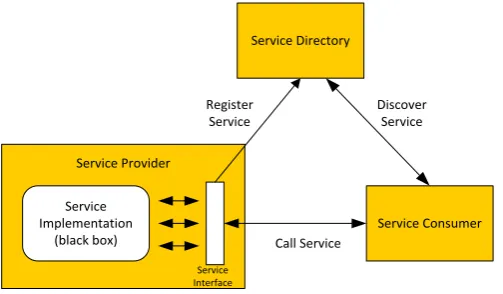
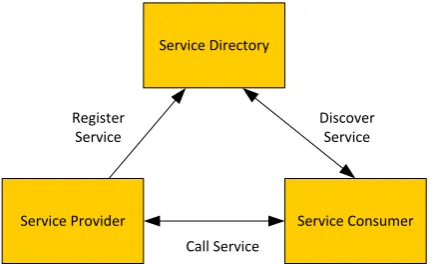
Since there is no standard for SOA environments, it is hard to explain how an SOA environment can be implemented. Two things that people often think are the same, are SOA and Web Services. What must not be forgotten, is that SOA is an architecture and Web Services are just one of the many (for example, other ways are REST and CORBA) ways to implement SOA. However, WSDL, SOAP and UDDI are the most popular type of technologies today to build services for an SOA environment and Web Services (Papazoglou, Mike P.; Heuvel, Jan-Willem van den, 2007). WSDL is used to describe services, UDDI to find and register the services and SOAP a transport mechanism to send messages between the service consumer and service provider. Figure 2-3 shows the relation between the service roles. The following sections will explain each component in more detail.
Service Consumer Service Provider
Service Directory
Discover Service
Call Service Register
Service
Figure 2-3: The relations between Service Consumer, Service Provider and Service Directory. Services register themselves at
the service directory, service consumers call service providers and services are discovered by service consumers through the
service directory (Josuttis, 2007).
2.2.1
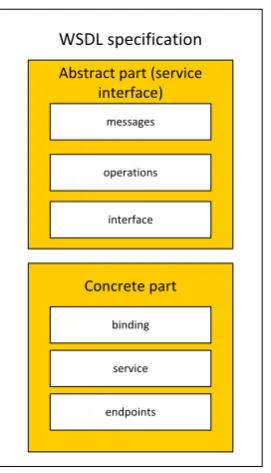
Description: WSDL
WSDL specification
Concrete part
service
endpoints Abstract part (service
interface)
messages
operations
interface
binding
Figure 2-4: The structure of a Web Service Description Language file. It consists of two parts (abstract and concrete),
enabling reuse of the interface.
2.2.2
Discovery: UDDI
One of the fundamental components of an SOA environment is a mechanism for services to be discovered by potential service consumers. Figure 2-3 shows this relationship between service consumers and the actual services. For the discovery of a service by a service consumer, a central directory to host service descriptions is required. The Universal Description Discovery and Integration (UDDI) specification has takes care of this. The primary goal of UDDI is the specification of a
framework for describing and discovering services, maintained by OASIS (Alonso & Casati, 2004). The core of an UDDI registry (implementation of the UDDI specification) is made of a business registry, a naming and directory service. UDDI defines data structures and APIs, which can be used to publish service descriptions and to query the registry to look for descriptions.
2.2.3
Messaging: SOAP
As mentioned above, the WSDL describes the messaging protocol(s) that must be used to access the service. In an SOA environment, this is most of the time the Simple Object Access Protocol (SOAP), a platform independent standard messaging protocol for Application-to-Application
interactions. SOAP defines how to organise information using XML in a structured way so that it can be exchanged between peers. SOAP specifies the following (Alonso & Casati, 2004):
Descriptions for using SOAP messages to implement Remote Procedure Call. These descriptions explain how clients can invoke a remote procedure using SOAP messages and how services can reply using SOAP messages.
Rules what any entity receiving the message should follow, such as the XML elements that an entity should or should not read and understand.
Description of how to carry a SOAP message as payload by other protocols, such as HTTP.
A SOAP message is a SOAP XML document instance. An advantage of the fact that messages are transported over HTTP, is that this transport easily passes through firewalls (it can be also a
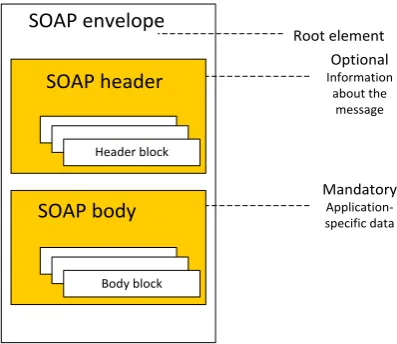
disadvantage in terms of security). As can be seen in Figure 2-5, a SOAP message is used as an envelope in which the information to be communicated is enclosed. An envelope consists of two parts: a SOAP header (optional) and a SOAP body (mandatory). Both the header and body can have multiple sub-parts: header blocks and body blocks. Every message has a sender, an ultimate receiver and an arbitrary number of intermediaries (nodes). Each of these processes the message and routes it to the (ultimate) receiver. The header contains additional information primarily meant for the nodes, such as transactional interactions, security, routing and debugging. Intermediaries should only process and manipulate this header, and not the SOAP body, since the body is the payload: the actual message being conveyed. Note that if there are no nodes, the header can be omitted.
SOAP body
Figure 2-5: The structure of a SOAP message. It consists of two parts (header and body), the first is optional, the second
mandatory (Alonso & Casati, 2004).
constructed in a different way: the body of a request message contains actual calls to a procedure (name of the procedure and input parameters), and the body of the response message contains the result and output parameters. See Figure 2-6 for a schematic overview of the different interaction styles.
SOAP protocol engine SOAP protocol engine
<SOAP: body> op (arg1, arg2, …) </SOAP: body>
<SOAP: body> return value </SOAP: body>
RPC Style
XML doc
XML doc
SOAP protocol engine SOAP protocol engine
</SOAP: body>
<SOAP: body> </SOAP: body> <SOAP: body>
Document Style
Figure 2-6: There are two SOAP interaction styles: document style and RPC style. The first sends complete XML documents,
while the second only sends procedure calls (Alonso & Casati, 2004).
Encoding rules also influence the structure of a SOAP message. They define how a particular entity or data structure is represented in XML. SOAP 1.2 gives a particular form of encoding called ‘SOAP Encoding’ (also called ‘Section 5 Encoding’), that defines how data structures, including basic types and complex types, can be serialised into XML. SOAP 1.2 does not enforce any specific encoding form, so applications are free to choose their own encoding (Alonso & Casati, 2004).
2.2.4
ESB
Point-To-Point Connection
Figure 2-7: A Point-To-Point Connection between systems is very inefficient: each systems connects to each other system.
Bus-style Connection
Service Bus
Figure 2-8: The Bus-Style Connection is efficient: a bus is used that routes the messages from one system to another system.
Traditionally, information system infrastructures used the Point-To-Point Connection method. With this connection method, every point in the information system is connected to every other point. This means that if a point, (e.g. an application ) is added to the system, the number of connections grows very fast, since each point has to connect to the new point (see Figure 2-7). Clearly, this raises serious performance and scalability issues and the need for a ‘backbone’ that can manage the complexity of how a service consumer connects and communicate with a service provider. The Enterprise Service Bus (ESB) gives a solution for these problems. Providing
interoperability and routing are the main roles of an ESB. Data transformation is an important aspect that is a direct result of the first role (providing interoperability). An SOA environment integrates different platforms and programming languages, so it is necessary the ESB is able to transform messages (data) to the right format.
There are two forms of routing, namely service routing and intelligent routing. Service routing means that the ESB is able to send a service call from a consumer to a provider, and then sending an answer back from the provider to the consumer. This way, the service consumer does not need to know the exact endpoint/location of the service provider. This is called location transparency.
Intelligent routing is a bit more complicated and is not a standard ESB capability (but a so-called value added service). From a business point of view, it is sometimes necessary to route messages in a different way. For example, different routing is needed if different messages have different priorities, or messages need to be dealt with according to their content. This type of routing is called ‘content based routing’.
2.2.5
Service Composition
orchestrated by a composition language, such as the Business Process Execution Language (BPEL). Business processes are often composed of individual services. An example of such composed services is a banking application: for each transfer of money between banks, the money has to be withdrawn from one account and be paid at another account. This can be accomplished by one service (called
transfer_money) that is made of two other services (withdraw_money and pay_money).
Business processes are modelled and run by business process languages. BPEL is one of these languages. It is becoming the standard for defining and running business processes (OASIS, 2007). BPEL is an XML-based language for specifying executable business processes, that are themselves (composed) services. This can be achieved by using basic description elements and advanced description elements. Basic description elements are message exchange elements such as invoke, receive, reply and flow of control elements such as sequence, switch, loop. Advanced description elements offer for example compensation and event handlers, rollback operations, etc.
2.3
Advantages of SOA
As mentioned before, SOA has become an important term in the world of IT. According to the vendors of SOA solutions, SOA offers an enterprise lots of advantages (Arsanjani, Zhang, & Ellis, 2007):
Reduced costs
Reusability of services enables a reduce of costs. Costs for software development and
maintenance can be kept low by reusing existing services for other applications and hence saving development and maintenance time.
Increased flexibility
Most of the business processes in an enterprise are supported by IT. The change of a business process always results in a change of the IT infrastructure. Consequently, enterprises try to keep business processes as long as possible without change. Building business processes using services as in SOA, the impact of a time-consuming business process change dramatically decreases. This way flexibility is increased.
Added business agility
SOA changes businesses to adaptive enterprises, where IT can respond to constantly changing business needs much more quickly and can do so with fewer resources. Business agility is increased because of the following reasons:
The use of loose service coupling has service independence as a result. This
independence frees a service from immediate links to other services. This way, reuse is easier to achieve.
o Service abstraction
Service abstraction enables reuse because it makes services appear as a black box: services are primarily viewed in terms of input and output. Processing details are hidden and service consumers only know how to access the service by a public service interface.
o Service composition
Reuse is primarily possible because of service composition. Because services are designed for reuse, it is possible to make new services by composing existing services.
o Service statelessness
The statelessness of services supports reuse because it enlarges the availability of a service and makes services more generic, reducing state management.
Increased consolidation
Often enterprises face the problem of how to handle with legacy systems that are vital for business processes. Using SOA, these legacy IT systems can be integrated across applications and organisations.
2.4
Disadvantages of SOA
The careful reader may have noticed the that the words “according to the vendors of SOA solutions” were used in the previous section and the question is whether SOA sticks to it promises that are made in several definitions. Reading the advantages of SOA in the previous section and the information about SOA published by the major IT vendors, it may seem that SOA is the holy grail in information system engineering. However, there is a downside to the SOA concept: a research performed by the UvA (University of Amsterdam), IBM and Sogeti shows SOA does not always stick to its promises(Berg, Hompes, & Truijens, 2007). This research involved taking interviews about SOA in practice at 12 large organisations, including KLM, Reed Elsevier and the Belastingdienst (Dutch IRS). All these organisations are currently involved or were involved in trying to make a small step towards an SOA architecture. These organisations make a good representation of the type of organisations that are using or planning to use SOA environments. Questions that were asked were about the increase in business flexibility, reusability, complexity, return on investment, consolidation of legacy systems and business/IT alignment. All the organisations had quite a high expectations about SOA: 10 of the 12 organisations expected large increases in flexibility and reusability
that complexity was increased by SOA (67%), while only four organisations (34%) experienced a decrease in complexity (see Chart 2-1).
Chart 2-1: As expected, more than half of the organisations experienced a decrease in complexity
Another point worth mentioning is that technological complexity greatly increased:
organisations were not familiar with SOA, so expertise was missing. Most of the organisations (seven out of 12, 58%) mentioned reuse was increased by SOA, so SOA keeps up with the promise of reuse (see Chart 2-2).
Chart 2-2: Seven organisations experienced an increase in reusability.
The research showed that 41% (five organisations out of 12) experienced an increase in flexibility, but 17% (two organisations) experienced a decrease in flexibility. The other five organisations did not notice an increase in flexibility or could not decide yet whether flexibility increased or decreased (see Chart 2-3).
Chart 2-3: Less than half of the organisations experienced an increase in flexibility
4; 33%
8; 67%
Complexity
Increase
Decrease
7; 58% 5; 42%
Reusability
Increase
Decrease
3; 25%
5; 41% 2; 17%
2; 17%
Flexibility
UnknownIncrease
Decrease
From the technological point of view, the main advantages that SOA offers, according to eight organisations, is standardisation. However, the main features of SOA big vendors promote, such as scalability and interoperability, are only mentioned by a few as technological advantage.
As this research shows, SOA is clearly not the holy grail for information system engineering according to these 12 organisations. SOA does not keep up with the high expectations of all the promises SOA vendors make. It is important to note that all 12 organisations were only involved in SOA on a small scale: it is hard to already see the results of the promises SOA vendors make.
2.5
Summarizing SOA
Service Oriented architecture (SOA) is an approach to structure enterprises and aligns business and IT. It provides a way to structure the business processes and the IT components of enterprises.
Vendors of SOA solutions promise to offer enterprises a lot of advantages and benefits, like shorter time-to-market and increased flexibility. However, studies show that these promises are not always fulfilled.
An SOA environment can be represented in three levels of abstraction: operations (e.g. ‘read number of items in stock’), services (e.g. ‘ship product’) and business processes (e.g. ‘Customer order’). Services are made of the basic components, operations. Business processes are made of services. The focus of SOA is, like the abbreviation says, placed on services. Typically, each service in the SOA environment is similar to real services the enterprise offers. For example, a room booking service that a hotel offers to its customers will be implemented by one SOA service. Interaction between services and service consumers is based on exchanging messages. There are three service roles. These are the service provider, the service consumer and the service directory.
The following components are typically used to build an SOA environment:
A description of the service, typically made in the Web Service Description Language (WSDL). A mechanism for services to be discovered, typically made using the Universal Description Discovery and Integration (UDDI) register.
A protocol for messages to be exchanged, typically the Simple Object Access Protocol (SOAP). A mechanism to regulate the exchanged messages, typically the WS-Policy framework. An infrastructure for delivering and routing the messages, typically an Enterprise Service Bus (ESB).
3
Possible causes for low SOA Performance
The previous chapters explained what SOA is, the advantages of SOA and how SOA works. This
chapter looks at the performance of SOA. It gives three possible bottlenecks or causes for low SOA
performance, according to an existing research.
3.1
XML and SOA according to Frank Cohen
This research focuses on this question by looking at it from four perspectives, as mentioned before in the Problem Analysis in Chapter 1.2:
A literature study
An existing research on SOA performance (Cohen, FastSOA, 2007) Questionnaire with employees at Logica
Tests
The literature study on SOA can be found in the previous chapters: what is SOA, how is it achieved and what are the experiences with SOA?
The remainder of this chapter looks at the existing research on SOA performance by Frank Cohen, the author of multiple articles on IBM DeveloperWorks (IBM, 2008). Next chapters will look at the research question from the two remaining perspectives, namely a questionnaire within Logica and tests.
The self describing aspect of XML encourages the use of XML in information systems: to use XML, you are not bound to certain structural tags or other constraints, but can define your own tags and data definitions. As a result, when you say SOA and messages, you say XML. Most SOA
environments use XML to exchange messages and access services. Business loves SOA for the advantages mentioned in Chapter 2.3 and developers love XML’s simplicity. Unfortunately, the combination of SOA with XML can lead to serious performance and scalability problems, reducing the transactions per second of an SOA environment when load and requests increase. For this reason, it is important to ask some questions when looking at performance of SOA environments and its services, such as the following:
How often will the services be accessed?
Where will the services be accessed from?
Frank Cohen looked into this subject of SOA and XML and wrote a book on his research that keeps these questions in mind, called FastSOA (Cohen, FastSOA, 2007). In this book he proposes a new approach to SOA and discusses the common traps than can be avoided by following a set of software development patterns when building an SOA environment. According to the FastSOA research, performance issues can emerge, as described in the following sections.
3.2
Cause 1: SOAP Encoding Styles
Chapter 2.2.3 introduced a type of encoding rules: SOAP Encoding (also called Section 5 Encoding). It defines how a particular entity or data structure is represented in XML. Messages that are encoded using SOAP Encoding, mainly use the RPC interaction style (see Chapter 2.2.3). The messages that are encoded this way and use this interaction style are called SOAP RPC Encoded messages.
Another kind of encoding is Literal encoding. An additional requirement to use this encoding is that the Body contents of the SOAP messages have to conform to an XML Schema. Messages that are encoded using Literal encoding mainly use the Document interaction style, and are called SOAP Document Literal Encoded messages.
Chart 3-1: There is a large difference between the two types of SOAP encoding according to Frank Cohen’s research. Where
RPC Encoding almost plummets to zero when the payload size of a message increases, Document Literal Encoding only
slightly decreases.
A question one can ask is why a developer does not always choose the best encoding style. There are multiple answers to this question. Often developers just choose the encoding style that is the easiest for them to implement. This saves the developer a lot of code-writing, time, and thus costs. Another reason is that vendors of SOA solutions, such as IBM and Microsoft, tend to favour one encoding style. For example, IBM WebSphere Application Developer uses SOAP RPC Encoding by default, while Microsoft .NET uses SOAP Document Literal Encoding by default (Cohen, FastSOA, 2007).
3.3
Cause 2: Java SOAP Bindings
Large enterprises often have spent a lot of money and time on their IT investments. As a result, as enterprises move on by extending their infrastructure with SOA, they want to keep and expand their existing IT investments. One of these investments most organisations have done, are
application servers: a machine or its software that works in conjunction with a web server to deliver application services. The best known and most used application servers are Java Enterprise Edition (JEE) application servers. Among the vendors that support these JEE application servers are BEA, IBM, Oracle, SAP and Apache Tomcat. The widespread use and investments of these application servers make developers often use tools of these JEE application servers to build SOA environments. Most of these servers provide a utility that asks for a WSDL service definition file as input and outputs a Java class SOAP binding, also known as a proxy (see Chapter 3.3 ).
0
RPC Encoding vs Document Literal
Encoding
Document Literal Encoding
WSDL service
Figure 3-1: Some tools require a WSDL service definition as input and generate a Java SOAP binding (proxy) that can be used
by service consumers to call a service (Cohen, FastSOA, 2007).
This binding or proxy is a reference to services and can be used to call these services as if the services can be found locally. The proxy extracts the XML content from the SOAP service call (deserialises the service call) that originates from the service consumer and instantiates a Java Request object that contains the SOAP message body contents. This Request object is handled by the Enterprise JavaBeans (EJB) to get a response to the actual service request (see Figure 3-2). EJB technology is the server-side component architecture for JEE (Sun Microsystems, 2008). It makes use of application modules and can be used by application servers.
Service Consumer SOAP binding
Figure 3-2: With a Java SOAP binding as generated in Figure 3-1, handling a SOAP request messages means lots of overhead
transforming it into request and response object (according to Frank Cohen)(Cohen, FastSOA, 2007).
According to Frank Cohen’s research, SOAP bindings generated by application server tools are inefficient and very slow. His research shows that throughput went down from 15-20 TPS (at 10 kB payload) to 1.5 TPS (at 100 kB payload). The fact that services can be reused for service composition (see Chapter 2.2.5) decreases the performance of the SOAP bindings even more. For each
consecutive service call, the request and response has to be deserialised and serialised. Java SOAP bindings can be said to increase user convenience, but at the same time decrease performance.
3.4
Cause 3: XML Parsers
Streaming API for XML (StAX) and Simple API for XML (SAX) types, read an XML document from beginning to end and each time it encounters a syntax construction, it returns an event to the application that is running it. This application has to handle the event. There is a fundamental difference between StAX and SAX parsers. The first are called pull parsers and the latter are called push parsers (Sun Microsystems, 2005). The reason for this is as follows: pull parsers are called this way because client applications call the methods in the parsing library only when it needs to interact (the client pulls XML data when it explicitly asks for it). Push parsers are called this way because these kind of parsers send XML data to the client as the parser encounter elements (it pushes the data to the client, whether or not the client is ready to use the data at that time).
Object model parsers, such as DOM, do not only read the data but also construct an in-memory (tree) representation of the document, which can be altered (Intel Software Network, 2007). The choice when to use what type of parser, heavily depends on the type and amount of data to parse (we return to this in Chapter 5.)
Table 3-1 (Sun Microsystems, 2005) shows these and other differences between the types of parsers. Another approach, that has the same goal as parsing (breaking an XML document up in logical pieces), is the transformation of XML to (e.g. Java) content objects. Using this technique, it is possible to access and process XML data without having to know XML or XML processing (Ort & Mehta, 2003).
StAX SAX DOM
API Type Pull, streaming Push, streaming In memory tree
Ease of use High Medium High
CPU and Memory Efficiency
Good Good Varies
Read XML Yes Yes Yes
Write XML Yes No Yes
Table 3-1: Comparison of XML parser types
3.5
Summary
4
The Logica Approach to SOA
In order to find out how Logica approaches SOA projects and which choices they make during these
projects, a questionnaire about the outcome of Frank Cohen's research is taken with employees at
Logica. This chapter explains the questions in the questionnaire, shows the and gives an analysis of
these results.
4.1
Introduction
In order to get to know whether Logica sees the issues mentioned in Chapter 3, a questionnaire was placed on the Internet (see Appendix A). The results of this questionnaire will be used to validate or reject the possible causes of low performance in SOA environments according to Frank Cohen, namely SOAP encodings, XML parsers and Java SOAP bindings (see Chapter 3).The people that filled in this questionnaire are all employees at Logica that are or were involved in one or more SOA projects or projects in which XML messaging played a large role. A lot of attention was paid to the selection of the respondents. All the respondents were IT/software architect or software engineer. The reason for this selection, is that these employees have the most experience with and knowledge about SOA.
Before placing the questionnaire on the Internet and sending out the invitations to the
respondents, the questions were validated by my supervisors and a Software Architect within Logica. By analyzing the answers to the questions in the interviews, I could get an overview of how Logica approaches such SOA projects. The structure of the questionnaire can be found in Appendix A.
In statistical researches, it is important to look at data reliability and validity. Reliability means that the answers that are given in the questionnaire will be the same when the questionnaire is repeated with the same respondents. Validity refers to the extent to which the data gives a true measurement: are the answers really true? (McNeill, 1990) However, the questionnaire part of this research is not a statistical research. The answers that are given in this research are used only to get an understanding about the view Logica and its employees have on the possible causes for the problems mentioned in this thesis. To get such a view, the proportion between the different answers will be enough. Therefore, it is not required that the given answers are 100% reliable and valid.
4.2
Respondent Projects
the coupling of various services offered by a Dutch railroad company, applications for selling insurances of various insurance companies and alarming systems for Dutch ministries.
4.3
SOAP Encoding Styles
There are two styles that can be used to encode a SOAP message: SOAP RPC Encoding and SOAP Document Literal Encoding (see Chapter 2.2.3). According to Frank Cohen, the SOAP encoding style that is used for an SOA environment can have a large impact on the performance (see Chapter 3.2). For this reason, a first question that was asked to the respondents was whether they have taken the different SOAP encodings into account (During this project, were SOAP encoding styles taken into account?) The answers that were given to these question were very different, so they had to be categorised. The following categories were made:
No, we did not look at the various encodings at all (for an unspecified reason) (NU).
No, the customer that ordered the project gave the preference for a specific encoding (NC). No, we used the encoding style that was ‘default’ for the tools we use (e.g. Microsoft BizTalk) (NT).
Yes, the encoding was chosen according to our own preferences and expertise or the W3C standard WS-I Basic Profile 1.0 (YO).
Do not know (DNK).
The distribution of the given answers can be found in Chart 4-1.
Chart 4-1: Answer distribution for question 1. The answers have been grouped into five categories.
As can be seen, the largest group of respondents answered to the question that they did not look to the different encoding styles at all (category NU): 16 out of 52, or 31%. Furthermore, the diagram shows that the three categories NU, NC and NT together comprise 50% (26 answers). This means that in 50% of the projects, SOAP encodings are not taken into account. For 21% (11 projects),
this is that these respondents are not engaged in these decisions, because of their function within Logica. The remainder of the respondents answered positive to the question: the W3C WS-I Basic Profile 1.0 was used to determine the SOAP encoding (Document-Literal) or the expertise of the developers was the deciding factor for this choice. Because of the diversity of these answers, further research on the performance difference between the SOAP encodings is needed. In Chapter 5.2, tests are performed on the two types of SOAP encodings that will look at the performance of both.
4.4
Out-of-the-box Tools
The second question in the questionnaire was whether any out-of-the-box tools, that can be used to ease the development of services, were used in the project (During the project, did you make use of any out-of-the-box tools to ease the development of the services? For example to build SOAP
bindings (proxies)?) . According to Frank Cohen’s research, (Java) SOAP Bindings that are often generated by such tools, can be the cause of performance issues (see Chapter 3.3). The answers that were given were categorised into the following categories:
Yes , because of the ease of development using such tools and the standard of using it. No, the project was too small of size.
Do not know.
The distribution of the given answers can be found in Chart 4-2.
Chart 4-2: Most respondents answered 'Yes' to the question whether tools were used to develop services.
The largest part of the respondents gave a positive answer to the question whether they have used or are using tools to ease the development of services. When looking more precise at these answers, the following reasons were given:
Better quality, when using tools, less coding errors are made 10; 19%
39; 75% 3; 6%
Tools used to develop services
Do not know
Yes
Standard part of toolset (e.g. Microsoft Visual Studio)
Where these answers may differ at first sight, it is highly possible that the intention behind the answers is the same, e.g. a toolset may be used in order to develop better quality products or increase the speed of the development. Therefore, all these answers are grouped in the same group in the diagram. When looking closer at the three no answers, it becomes clear that the reason for not using these tools is the size of the project. With smaller project, less tools are used. As mentioned above, the largest part of the respondents gave a positive answer to the question whether they have used or are using tools to ease the development of service. Looking at the reasons that are given for this choice, it becomes clear that these tools really improve a lot of aspects. For this reason, this research does not look further into performance of SOAP Bindings/proxies that are generated and the recommendation is to stick to using such tool kits, as it drastically improves speed and decreases the amount of errors.
4.5
XML Parsers
As mentioned before in Chapter 3.4, according to Frank Cohen, the different types of parser deliver different performance, depending on the situation. Therefore, the third question in the questionnaire was whether the different types of XML parsers was taken into account and what the motivation was behind the choice of parser (What considerations were made for choosing an XML parser?). Respondents gave answers that are grouped into the following categories:
No, not taken into account because the tool manages all the parsing (NT).
No, we used our own parser (NO).
No, the customer that ordered the project gave the preference for a specific parser(NC). Yes, and we choose a parser for specific reasons (Y).
Do not know (DNK).
Chart 4-3: Distribution of the given answers for the question whether XML parsers were taken into account. As can be seen,
most of the time they are not.
One answer really stands out among the others. 48% of the respondents answered that they did not look at the different type of XML parsers, but that they simply let the toolkit choose the parser and do the parsing. The reasons they gave for this were mainly the same as mentioned before in Chapter 4.4: better quality, speed of development and standard part of toolset.
When looking at the ‘other no’-answers, two reasons can be seen. For one project, a self-made solution was used to parse data. The remainder of the respondents gave as reason that the customer decided on the type of XML parser.
Only 19% of the respondents answered that they did look at the different type of XML parsers. The motivations for and use of a specific parser that were given are the following:
Speed of parsing, as mentioned in Chapter 3.4 and before in this chapter, different parsers perform different, depending on the situation.
Expertise, developers have different experience with and knowledge of the different types. For example, developers prefer one type over another type, since the first is easier to implement.
Another kind of ‘parsing’ is transforming XML to content objects. For example, the Microsoft toolkit supports this, so for some answers this fits into the NT category. By using this XML to content objects transforming, a user does not have to have any knowledge about XML processing. There is also a Java approach for directly transforming XML to objects, this is called the Java Architecture for XML Binding (JAXB) (Ort & Mehta, 2003). Figure 4-1 shows how it works.
25; 48%
1; 2% 2; 4%
10; 19% 14; 27%
Different XML parsers into account
NT
NO
NC
Y
Schema-Derived Classes & Interfaces Binding Compiler
XML Schema
Content Objects Unmarshal
JAXB API XML Document
Application
Figure 4-1: Mechanism of transforming XML to objects using JAXB
First, an XML schema (a document that defines the structure the XML document has to conform to) is used by the JAXB Binding Compiler to generate classes and interfaces that are derived from the XML schema. Next, the XML document is unmarshalled into Java content objects. These content objects are instantiations from the schema derived classes and interfaces. These objects can then be used in applications, as if the document is parsed using a SAX, StAX or DOM parser. The great advantage of all this, is that there is no need to create a parser (such as SAX, StAX or DOM) or write callback methods (Ort & Mehta, 2003).
As mentioned above, 48% of the respondents answered that they did not look at the different type of XML parsers, but that they simply let the toolkit choose the parser and do the parsing. Looking at these numbers, it is worthwhile to look further into the difference in performance between the types of XML parsers. In Chapter 5.3, tests are performed on the performance difference between the different types of XML parsers. In this section, recommendations will be given when to use what type of XML parser.
4.6
Middleware
The literature study in the early chapters of this thesis showed that there are various middleware products that can be used to develop an SOA environment (see Chapter 2.2). To see whether there were any middleware products used to increase the performance of such an SOA environment, the questionnaire contained a question whether some of these middleware solutions were used in the projects that respondents participated in (Did you make use of any middleware to improve performance during the project?) Only two types of answers were given:
The distribution of the given answers can be found in Chart 4-4.
Chart 4-4: Distribution of the given answers for the question whether performance specific middleware was used. As can be
seen, most of the time it is not the case.
It is clear that most of the respondents answered that they did not or do not use any
performance specific middleware. When looking at the complete answers including explanation for the answers, it becomes clear that lots of other middleware was and is used in most projects: almost every respondent answered that middleware such as application servers and Enterprise Service Buses were used. However, these kinds of middleware are used to ease the development,
deployment and maintainability of the SOA, and not to improve the performance in a way like data grids and caching do. None of the respondents answered ‘yes’ to the question. This gives an option to increase the performance of the SOA, e.g. by using solutions as mentioned in Chapter 6.
4.7
Implementation Problems
It is important to know whether any implementation specific problems were encountered during the projects the respondents were or are involved in. Using this knowledge, advice can be given on certain choices that are encountered during the implementation. Furthermore, the result of this question can be used to determine whether the statements that Frank Cohen made in his
research are true or not. The following question was included in the questionnaire: Did any problems arise during the project in terms of implementation technical issues (performance, reliability and
scalability)?
45; 87% 7; 13%
Use of performance specific middleware to
improve performance
No
Chart 4-5: Distribution of the answers to the question whether any problems were encountered during the projects. For just
only 31%, problems were not encountered.
The distribution of the given answers shows that nearly one third (31%) of the projects encountered implementation technical issues in terms of performance and scalability. Almost half of the respondents (48%) answered that no implementation technical issues were encountered. The remainder of the respondents could not say whether any problems were encountered.
When looking closer at the ‘yes’ answers, the following causes for these problems were given:
Large and too many XML messages Processor intensive services (calculations) Thoughtless system architecture
The first cause was mentioned most often and the third cause was mentioned least. When looking at the causes for low performance according to Frank Cohen, we can see a correspondence with the causes for the low performance as given by the respondents: both Frank Cohen and the respondents point at XML for being a cause of low SOA performance. Moreover, these observations point out that the XML part of SOA can be important for performance.
4.8
Evaluation Moments
At the end of a project, it is a good thing to evaluate. Using evaluations, new insights and new information can be gathered to improve the project (The National Science Foundation, 2002). For this reason, the respondents were asked whether there had been any evaluation moments after the project they were or are involved in using the following question: Have there been any evaluation moments after the project? Chart 4-6 gives an overview of the results of this question.
16; 31%
25; 48% 11; 21%
Problems during the project in terms of implementation
technical issues (performance, reliability and scalability)
Yes
No
Chart 4-6: Distribution of the answers to the question whether there have been any evaluation moments after the project.
For most of the projects, this was the case.
For most of the projects that the respondents were involved in, there have been evaluation moments (62%). Still, for more than one third of the projects, there have not been evaluation moments, so improvement is certainly possible. Using evaluation moments, one can get to know best-practices, than later on can be used in other similar projects. As a results, these similar projects can show higher performance.
4.9
Best-Practices
Another question that was asked to the respondents was whether any best-practices (methods and procedures found to be most effective) came forward out of the projects (Did any best-practices come forward out of this project?). Using these best-practices, it is possible to learn from the projects and take the findings along to other projects. Chart 4-7 gives an overview of all the answers.
Chart 4-7: Distribution of the answers whether best-practices came forward out of the project. For most of the projects, this
was the case.
For more than half of the projects, best-practices were found, such as:
Configuration of the hardware environment Testing should start early
32; 62% 20; 38%
Evaluation moments after the project
Yes
No
28; 54%
10; 19% 14; 27%
Did any best-practices come forward?
Yes
No
SOAP Document Literal Encoding should be used, because of interoperability
Keep it simple, use the business as SOA initiator, not IT
Another large group of respondents could not give answer to the question whether any best practices came forward: 27% or 14 out of 52 respondents. A possible reason for this, is that the respondents that gave this answer don’t have the appropriate knowledge about the project to give a positive or negative answer to this question.
4.10
Questionnaire Conclusion
When looking closer at all the questions and the corresponding answers, the following can be concluded:
The different SOAP encodings are most of the time not taken into account, if they are, most of
the time SOAP RPC Document Literal Encoding is chosen. According to the best practises, this
also is the best choice, because of interoperability.