An eRulemaking Corpus:
Identifying Substantive Issues in Public Comments
Claire Cardie, Cynthia Farina, Matt Rawding, and Adil Aijaz
Faculty of Computing and Information Science, Law School, Information Science, Dept. of Computer Science Cornell University, Ithaca, NY 14850, USA
[email protected], [email protected], [email protected], [email protected]
Abstract
We describe the creation of a corpus that supports a real-world hierarchical text categorization task in the domain of electronic rulemaking (eRulemaking). Features of the task and of the eRulemaking domain engender both a non-traditional text categorization corpus and a correspondingly difficult machine learning task. Interannotator agreement results are presented for a group of six annotators. We also briefly describe the results of experiments that apply standard and hierarchical text categorization techniques to the eRulemaking data sets. The corpus is the first in a series of related sentence-level text categorization corpora to be developed in the eRulemaking domain.
1.
Introduction
Each year regulatory agencies in the U.S. issue more than 4,000 new rules (Kerwin, 2005). By law, many of these must be created through a complex process known as notice
and comment (N&C) rulemaking: the agency (e.g., the
De-partment of Commerce or DeDe-partment of Transportation) drafts a proposed rule and then exposes the proposal, any underlying data, and its legal and policy rationale to pub-lic comment. The agency’s fundamental legal obligation, in turn, is to review all the comments received and, if it chooses to adopt the proposed rule, to issue a statement that responds to significant criticisms made in the com-ments and explains why it rejected alternative suggested approaches (Strauss et al., 2003).
Electronic rulemaking (eRulemaking) refers to the use of
information technology to support any step in the rulemak-ing process. For example, comments on proposed rules can now be submitted electronically through the use of government-wide web portals like ‘regulations.gov’. How-ever, an agency may receive anywhere from dozens, to hundreds of thousands, of comments for a particular rule, and the analysis of the comments to determine the issues each raises is still performed manually in an often slow and painful “issue annotation” process: agency analysts iden-tify each snippet of text in the comments that addresses an important issue and organize the snippets in in terms of these issues. Issue annotation of the comment precedes in-depth comment analysis and facilitates the writing of the response.
This paper presents a corpus developed to study the issue categorization task in eRulemaking. We describe the cre-ation and annotcre-ation of the corpus, focusing on those char-acteristics of the task and of the eRulemaking domain that engender both a non-traditional text categorization corpus and a correspondingly difficult machine learning task. We then present and discuss the results of an interannotator agreement study for a group of six annotators.
Finally, we summarize related work, in which we use the corpus to train a text categorization system for issue catego-rization of public comments: given the comments submit-ted for a proposed rule, the automasubmit-ted system determines
for each sentence in each comment, which of a set of pre-defined issues of substance it raises, if any (Cardie et al., 2008).
This corpus is the first in a series of sentence-level text cat-egorization corpora to be developed by the Cornell eRule-making Initiative (CeRI).
2.
Related Work
In recent years, researchers have begun to investigate a range of methods from natural language processing, infor-mation retrieval, and machine learning for a number of e-rulemaking sub-tasks. Yang & Callan (2005; 2006), for ex-ample, extend duplicate detection methods from informa-tion retrieval to handle “e-postcard campaigns” — e-mail campaigns organized by special interest groups that sup-ply constituents with electronic form letters for submission during the comment period. Kwon et al. (2006; 2007) in-vestigate the use of natural language processing methods to identify the main claims of a comment and then categorize them according to whether they support the proposed rule, oppose the proposed rule, or are proposing a new idea. Most relevant for the current paper is the work of Kwon et al. (2006; 2007) on topic categorization of public com-ments. Our work differs from theirs in that we categorize sentences in public comments according to a large set of rule-specific issues rather than a small set of general topics. We also investigate hierarchical categorization techniques in addition to standard flat text categorization methods. Fi-nally, we create a corpus to use as a gold standard for the evaluation of automatic text categorization techniques. The creation of the corpus is described in the following section.
3.
Corpus Creation
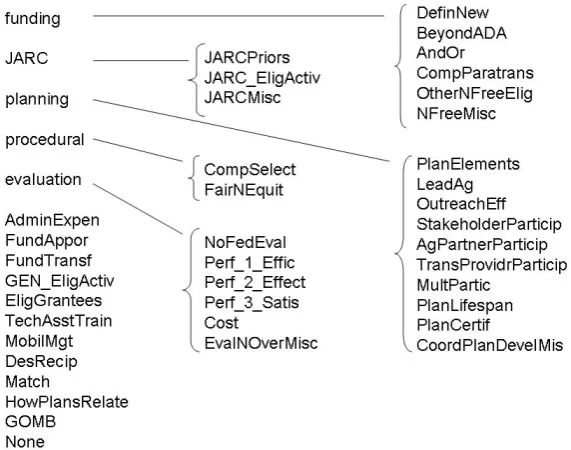
Figure 1: Issue Hierarchy. There are 17 top-level categories and 39 leaf categories.
local transportation services for the elderly, disabled per-sons, and low income persons commuting to work.1 FTA had been seeking public input at several stages of develop-ing this guidance.
We used comments from the final two comment periods: March 15–May 22, 20062 and September 6–November 6, 20063. Based on the judgment of the agency official pri-marily responsible that comments from both periods raised the same issues, we treat them as a single set. A total of 290 comments were submitted (211 + 79). Many of the com-ments were not submitted electronically. When scanned by the agency, several became image-based PDFs that could not be converted to machine-readable form. Also, some commentors filed comments with identical text; we retained only a single version of such duplicate comments. As a re-sult of these adjustments, we were left with 267 comments. These comprise the CeRI FTA Grant Circulars Corpus. Next, we constructed a list of 38 issues likely to be raised in the comments. This list was derived by consulting both the actual issue summaries prepared by the FTA analyst when she reviewed the comments, and the Federal Register notice seeking comments, which explained the proposal in detail and highlighted various aspects. The issues are organized into a shallow categorization hierarchy in which the 38 is-sues are leaf nodes. Seventeen form the first level; five of these expand into two or more sub-issues at level two. The issue hierarchy, expressed in the abbreviated form used
1
Docket No. FTA-2006-24037: Elderly Individuals and Indi-viduals With Disabilities, Job Access and Reverse Commute, and New Freedom Programs: Coordinated Public Planning Guidance for FY 2007 and Proposed Circulars.
2
FTA-2006-24037-002.
3
FTA-2007-24037-0222.
within the annotation tool4, is shown in Figure 1. NONEis a special category (shown as the 39th “issue”). It is auto-matically assigned to sentences deemed by the annotator to address none of the rule-specific issues.
The annotation team comprised six law students in their fi-nal year of study. They were deliberately selected because of their general academic performance and, particularly, their work with Farina in a course on the federal regulatory process. However, none of the annotation team, nor anyone else involved in the project, had expertise in the substantive areas or regulatory programs involved in the guidance. After an initial three-week training period in which all stu-dents annotated the same comments and then discussed their selections as a group, they began annotation. Spo-radic follow-up discussion occurred throughout the anno-tation period about the meaning and/or scope of specific issues, with clarifying information then being circulated to the entire group. The students annotated comments accord-ing to the 39 fine-grained issues.
The annotation tool allows for annotation at the word-, phrase-, sentence-, or paragraph- level. After an initial pe-riod of individual annotator discretion, it was determined that annotation would occur at the sentence level. As a result, all issue annotations are automatically projected to sentences. In addition, the fine-grained issue annotations can be converted to their corresponding top-level issue as needed for any of our analyses. Finally, any sentences the student annotator left unmarked are automatically assigned the labelNONE. Annotators were free to assign more than one issue to a single span of text. Multiple annotations, however, were rare (4% of sentences in the corpus). In all, there are 11,094 sentences in the corpus. On aver-age, there are 41.55 sentences per comment. The shortest
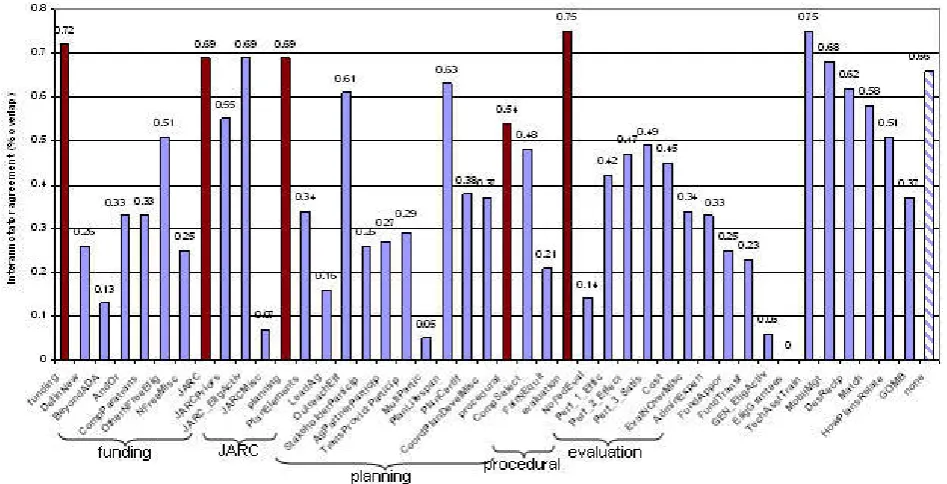
Cover-Figure 2: Issue-by-Issue Interannotator Agreement Results.
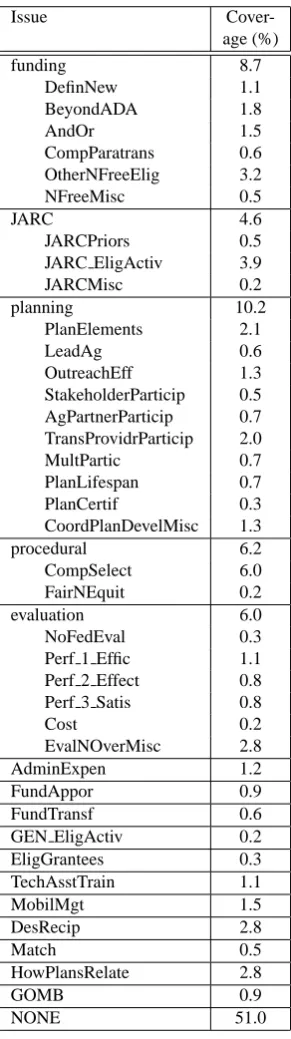
scores, we show the coverage of each issue set across all sentences of the corpus.
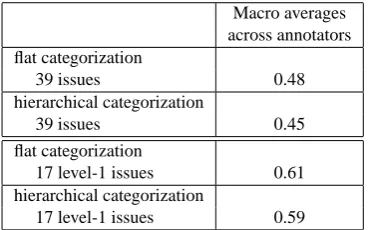
When calculated across the full set of 39 issues (38 issues plusNONE), interannotator agreement scores are quite low (see row 1 of the table), indicating either that more training is required or that there is inherent difficulty in interpret-ing the meaninterpret-ing and applicability of each issue. The latter possibility was raised in the Section 4.
Annotation according to just the 17 top-level issues (row 2) ameliorates the problem to some degree — agreement in-creases to 64.7% across all sentences in the corpus. Even higher levels of agreement (69.3%) can be obtained if anno-tation is limited to just the five hierarchical issues at the top-level (row 3) although this issue subset covers only 35.7% of the sentences in the corpus. Annotating these five issues as well as NONE’s, however, allows for agreement scores approaching 70% and sentence coverage of 86.7%.7 Figure 2 shows the interannotator agreement scores on an issue-by-issue basis. It is clear from the chart that there is wide variation in annotators’ abilities to identify various is-sues. Not surprisingly, however, the agreement scores for the five hierarchical categories are among the best that we encounter for this task (these are the dark bars in the Fig-ure): for four of five hierarchical issues, agreement scores are at 69% or above, and in all but one case, the scores for the hierarchical issue are substantially higher than those of each of its associated sub-issues. Many of the top-level non-hierarchical issues also score reasonably well (see the righthandside of the chart), indicating that automatic text categorization methods might be able to achieve reasonable levels of accuracy for an important subset of the issues.
7
Coverage is measured on the “aggregate gold standard” de-scribed in Section 4.
6.
Text Categorization Experiments
In spite of the rather low interannotator agreement scores and the difficulties raised in Section 4., we have made progress in applying text categorization techniques to the CeRI FTA Circular Corpus. We investigate flat and
hierar-chical text categorization methods, where flat refers to
di-rect categorization of sentences according to the 39 issues;
hierarchical categorization exploits the issue hierarchy in
an attempt to make the assignment of issues to sentences easier for the learning algorithms. For hierarchical classi-fication, we train multiple classifiers, one for each internal node in the issue hierarchy of Figure 1. In addition, we found that treating theNONEclass specially improves per-formance.
none-classifier: distinguishes sentences that address
NONE of the issues from those that address some issue.
level-1 classifier: distinguishes among the remaining 16 top-level issues (i.e., excludingNONE)
level-2 classifiers: one classifier is created for each of the five hierarchical classes from level-1 (FUND
-ING, JARC,PLANNING,PROCEDURAL, andEVALU
-ATION) to distinguish among its leaf classes.
Namhee Kwon, Eduard Hovy, and Stuart Shulman. 2006. Multidimensional text analysis for erulemaking. In
Pro-ceedings of the 7th Annual International Conference on Digital Government Research.
Stephen Purpura, Claire Cardie, and Jesse Simons. 2008. Active Learning for e-Rulemaking: Public Comment Categorization. In Proceedings of the Ninth Annual
International Conference on Digital Government Re-search. to appear.
Mehran Sahami and Timothy D. Heilman. 2006. A web-based kernel function for measuring the similarity of short text snippets. In WWW ’06: Proceedings of the
15th international conference on World Wide Web, pages
377–386, New York, NY, USA. ACM.
Danny Silver, Goekhan Bakir, Kristin Bennett, Rich Caru-ana, Massimiliano Pontil, Stuart Russell, and Prasad Tadepalli. 2005. Inductive Transfer : 10 Years Later. NIPS 2005 Workshop.
P. Strauss, T. Rakoff, and C. Farina. 2003. Administrative
Law. 10th edition.
H. Yang and J. Callan. 2005. Near-duplicate detection for erulemaking. In Proceedings of the Fifth National
Con-ference on Digital Government Research.
H. Yang and J. Callan. 2006. Near-duplicate detection by instance-level constrained clustering. In Proceedings of
the Twenty-Ninth Annual International ACM SIGIR Con-ference on Research and Development in Information Retrieval.
Sarah Zelikovitz and Haym Hirsh. 2000. Improving short text classification using unlabeled background knowl-edge. In Pat Langley, editor, Proceedings of
ICML-00, 17th International Conference on Machine Learn-ing, pages 1183–1190, Stanford, US. Morgan Kaufmann