Improving Statistical Machine Translation Efficiency by Triangulation
Yu Chen, Andreas Eisele, Martin Kay
Saarland University Saarbr¨ucken, Germany
{yuchen, eisele, kay}@coli.uni-sb.de
Abstract
In current phrase-based Statistical Machine Translation systems, more training data is generally better than less. However, a larger data set eventually introduces a larger model that enlarges the search space for the decoder, and consequently requires more time and more resources to translate. This paper describes an attempt to reduce the model size by filtering out the less probable entries based on testing correlation using additional training data in an intermediate third language. The central idea behind the approach istriangulation, the process of incorporating multilingual knowledge in a single system, which eventually utilizes parallel corpora available in more than two languages. We conducted experiments using Europarl corpus to evaluate our approach. The reduction of the model size can be up to
70%while the translation quality is being preserved.
1.
Introduction
Statistical machine translation (SMT) is now generally taken to be an enterprise in which machine learning tech-niques are applied to a bilingual corpus to produce a trans-lation system entirely automatically. Such a scheme has many potential advantages over earlier systems which re-lied on large bodies of carefully crafted rules. The most ob-vious is that it becomes thinkable to construct a system for a new pair of language in a matter of days, if not hours, rather than years, and at dramatically reduced cost in human la-bor. It can also be claimed, though perhaps more contro-versially, that a system based directly on authentic data will be more likely to take into account phenomena that a hu-man might overlook or consider unimportant. Whereas a system built in the more traditional way might sometimes be unable to produce any translation at all, however unsat-isfactory, for some inputs, this is fare less likely to happen in an automatically generated system.
On the other hand, the new approach also has potential drawbacks. In particular, the data on which it is based rarely contain more than one translation of each sentence, cho-sen escho-sentially at random from an often large set of equally good candidates. The information on which the system is based therefore contains a great deal of noise. This paper describes a preliminary attempt to reduce that noise and, at the same time to enhance the efficiency of the resulting system in certain cases. We propose to take advantage of a special, but increasingly common, circumstance, namely that in which translations of a single original are required in more than one other language. Considerable amounts of data of the kind required to explore this proposal al-ready exist in the form of parallel corpora are alal-ready avail-able in more than two languages, such as Europarl (Philipp Koehn, 2005), JRC-Aquis (Steinberger et al., 2006), UN parallel text corpus (Graff, 1994), etc. The opportunity that such resources presents is that of incorporating mul-tilingual knowledge in in a single statistical MT systems. Related proposals have sometimes been referred to as tri-angulation(Kay, 1997).
2.
Phrase-based SMT
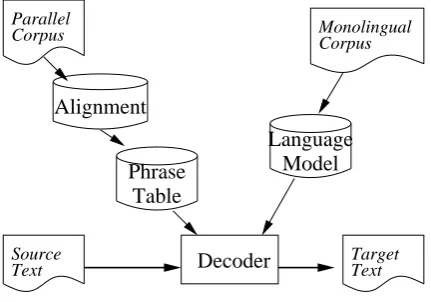
The dominant paradigm in SMT is referred to as phrase-basedmachine translation. The term refers to a sequence of words characterized by its statistical rather then any gram-matical properties. At the center of the process is aphrase table, a list of phrases identified in a source sentence to-gether with potential translations. Phrases in the source sentence may overlap and also may have several transla-tions, so that a subset of the entries in the table must, in general, be selected to make a translation of the sentence. The members of the selected subset must then be arranged in a specific order to give a translation. These operations are determined by statistical properties of the target lan-guage enshrined in the so-calledlanguage model. Several current SMT systems work in this way and, most notably for our purposes, the freely available, open-source Moses Toolkit (Philipp Koehn et al., 2007) on which our work is based.
Decoder
Monolingual Corpus
Model
Language
Phrase
Table
Alignment
ParallelCorpus
Source
Text TextTarget
Figure 1: Phrase-based SMT system
950,000 sentences for each language in the first subset and around 1,100,000 sentences in the second subset. Our ap-proaches are evaluated on 2,000 sentences of test data from the shared task of the third Workshop on Statistical Ma-chine Translation, 20082.
The experiments are performed on translations from Spanish to English. We choose French and Ger-man as bridge languages used separately. Phrase-based models are then built for the following transla-tion directransla-tions: English, French, Spanish-German, French-English, German-English, English-French and English-German. The Spanish-English phrase tables are filtered through either bridge language using other phrase tables. For each direction, two models are trained from both Europarl subsets. The Spanish-English mod-els are considered as baselines. Neither of our approaches modify feature values in a phrase table. Only a part of en-tries are removed from the table. The probability distribu-tions of the features remain the same as before filtering. We only train the feature weights for these two baseline transla-tion models using minimum error rate training (Och, 2003) to maximize the BLEU scores on a set of 500 sentences from a development data provided by the mentioned shared task. The other systems simply adapt the weights obtained for respective baseline, namely the baseline trained on the same subset of Europarl. Moreover, all experiments use the same English 5-gram language model trained from Eu-roparl corpus.
We apply both approaches to every combination of two original phrase tables and two bridge languages, that is, 4 setups in total. Reordering tables, which keep the distor-tion models, are also filtered following the same scheme when phrase tables are being filtered. As for method 2, the threshold is set to zero, namely only phrase pairs with neg-ative scores are excluded.
6.
Results
The results of these experiments are showed in Table 1 through 5. In the tables, the translation models are denoted by names consisting of two parts: the number in the first part indicates the corresponding approach and the language in the second part is used as the bridge.
Model Phrase pairs PT (Byte) RT (Byte) Baseline 19,199,807 2.5G 1.9G
1:French 8,599,708 1.1G 741M
2:French 14,877,456 1.9G 1.3G
1:German 6,113,769 725M 492M
2:German 13,600,633 1.8G 1.2G
Table 1: Size of the models on Europarl-40
Table 1-2 present the sizes of various models used in the experiments. In these two tables, PT stands for the phrase tables and RT refers to the reordering tables. Both physical sizes of the files and number of entries in them are listed. Table 3 shows the excluded portion for each model. The size of a phrase table can be reduced to less than30%of the
2For details, see
http://www.statmt.org/wmt08/shared-task.html
Model Phrase pairs PT (Byte) RT (Byte) Baseline 54,382,715 7.1G 5.4G 1:French 24,057,849 3.0G 2.3G 2:French 41,821,489 5.5G 4.2G 1:German 15,938,151 1.9G 1.5G
2:German 37,841,524 5G 3.8G
Table 2: Size of the models on Europarl-50
Europarl-40 Europarl-50
1:French 55.21% 55.77%
2:French 23.52% 24.10%
1:German 69.16% 70.70%
2:German 29.16% 30.42%
Table 3: Removed portions through filtering
original. Obviously, Method 1 filters out more phrase pairs than Method 2 because exact phrase matches in Method 1 occur much less frequent than word overlaps between trans-lation vocabularies in Method 2 given the same transtrans-lation models. Both methods remove slightly more entries when the phrase table to filter is larger. The reduction appears to be more significant using German as the third language. French is so close to Spanish, the source language, that the data in French cannot provide as much information as Ger-man data.
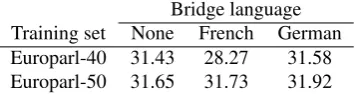
Bridge language Training set None French German Europarl-40 31.43 28.27 31.58 Europarl-50 31.65 31.73 31.92
Table 4:BLEUscores using models filtered with Method 1
Bridge language Training set None French German Europarl-40 31.43 28.20 31.38 Europarl-50 31.65 31.69 31.75
Table 5:BLEUscores using models filtered with Method 2
The approaches are evaluated by means of BLEU score (Pa-pineni et al., 2001). The results are listed in Table 4 and Table 5. It becomes clear that filtering would not reduce BLEU in most cases. In general, using German data results in more improvement. However, the performance of mod-els filtered through French and German actually converges while the original phrase table becomes larger. The dis-tinction between two approaches also decreases with larger models. The scores increase in larger models based on larger corpora. This is plausible since a larger models usu-ally contains more noise to be excluded. In addition, larger corpus in the third language can also introduce more con-straints for filtering. Taking the model sizes into account, we can infer that smaller models do not necessarily produce worse results. The best BLEU score was not produced by the largest phrase table we have produced in the experi-ments.
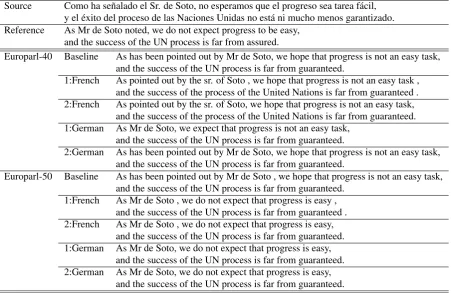
Source Como ha se˜nalado el Sr. de Soto, no esperamos que el progreso sea tarea f´acil, y el ´exito del proceso de las Naciones Unidas no est´a ni mucho menos garantizado. Reference As Mr de Soto noted, we do not expect progress to be easy,
and the success of the UN process is far from assured.
Europarl-40 Baseline As has been pointed out by Mr de Soto, we hope that progress is not an easy task, and the success of the UN process is far from guaranteed.
1:French As pointed out by the sr. of Soto , we hope that progress is not an easy task , and the success of the process of the United Nations is far from guaranteed . 2:French As pointed out by the sr. of Soto, we hope that progress is not an easy task,
and the success of the process of the United Nations is far from guaranteed. 1:German As Mr de Soto, we expect that progress is not an easy task,
and the success of the UN process is far from guaranteed.
2:German As has been pointed out by Mr de Soto, we hope that progress is not an easy task, and the success of the UN process is far from guaranteed.
Europarl-50 Baseline As has been pointed out by Mr de Soto , we hope that progress is not an easy task, and the success of the UN process is far from guaranteed.
1:French As Mr de Soto , we do not expect that progress is easy , and the success of the UN process is far from guaranteed . 2:French As Mr de Soto , we do not expect that progress is easy,
and the success of the UN process is far from guaranteed. 1:German As Mr de Soto, we do not expect that progress is easy,
and the success of the UN process is far from guaranteed. 2:German As Mr de Soto, we do not expect that progress is easy,
and the success of the UN process is far from guaranteed.
Table 6: Example translations
and thereby reduce the time and space costs required for translation tasks. Meanwhile, translation quality is im-proved after the models being filtered. Table 6 illustrates an example on how the translations can be better after filtering. The translations from both baselines have selected the word “hope” for “esperamos”, which leads to a wrong meaning. This error disappeared in the results of 5 filtered models out of 8. Since we made no changes to probability distributions in the models, the only explanation for this is that the filter-ing procedure has removed the noisy entry/entries causfilter-ing the problem.
7.
Discussion
In this paper, we have presented two novel approaches to phrase tables filtering for more efficient translations. Multi-parallel data can be useful for reduce the computation costs without harming the translation quality of phrase-based SMT. Our triangulation methods verify a translation model via an intermediate language. The performance of the fil-tered models greatly relates to the choice of the bridge lan-guage.
There are several potential directions to continue this work. Selection of the intermediate language needs to be stud-ied more systematically. According to the experimental re-sults, there is a vague idea about what languages can be more helpful as the additional language for filtering, how-ever more experiments, including using more than one in-termediate languages for filtering, are important before we can draw any general conclusions.
Another potential work is refinement of the correlation measure introduced in Method 2. Current design of the scoring scheme is still ad hoc. We can only assign certain
labels to the phrase pairs under consideration instead of nu-merical values that indeed reflect the degrees of correlation. The approaches in this paper are working with phrases on the model level. If the methods can be scaled up to hy-potheses level, at which we work with complete sentences rather than small units, we can easily imagine resources in the third language can help to eliminate implausible trans-lation candidates.
8.
Acknowledgement
This work is supported by the EuroMatrix project funded by the European Commission (6th Framework
Pro-gramme). We also want to thank anonymous reviewers for their helpful comments.
9.
References
Trevor Cohn and Mirella Lapata. 2007. Machine Transla-tion by TriangulaTransla-tion: Making Effective Use of Multi-Parallel Corpora. Inthe 45th Annual Meeting of the As-sociation for Computational Linguistics, Prague, Czech, June.
David Graff. 1994. UN Parallel Text (Complete). Linguis-tic Data Consortium, Philadelphia.
J. Howard Johnson, Joel Martin, George Foster, and Roland Kuhn. 2007. Improving Translation Quality by Dis-carding Most of the Phrasetable. In the Conference on Empirical Methods in Natural Language Processing (EMNLP), Prague, Czech Republic, June.
Philipp Koehn, Franz Josef Och, and Daniel Marcu. 2003. Statistical phrase-based translation. InNAACL ’03: Pro-ceedings of the 2003 Conference of the North American Chapter of the Association for Computational Linguis-tics on Human Language Technology, pages 48–54, Mor-ristown, NJ, USA. Association for Computational Lin-guistics.
Shankar Kumar, Franz Josef Och, and Wolfgang Macherey. 2007. Improving word alignment with bridge languages. In the 2007 joint conference on empirical methods in natural language processing and computational natu-ral language learning (EMNLP-CoNLL), pages 42–50, Prague, Czech, June.
Franz Josef Och and Hermann Ney. 2001. Statistical multi-source translation. In MT Summit VIII, Santiago de Compostela, Spain, September.
Franz Josef Och and Hermann Ney. 2003. A system-atic comparison of various statistical alignment models. Computational Linguistics, 29(1):19–51.
Franz Josef Och. 2003. Minimum error rate training in statistical machine translation. In ACL ’03: Proceed-ings of the 41st Annual Meeting on Association for Com-putational Linguistics, pages 160–167, Morristown, NJ, USA. Association for Computational Linguistics. Kishore Papineni, Salim Roukos, Todd Ward, and Wei-Jing
Zhu. 2001. Bleu: a method for automatic evaluation of machine translation. InACL ’02: Proceedings of the 40th Annual Meeting on Association for Computational Linguistics, pages 311–318, Morristown, NJ, USA. As-sociation for Computational Linguistics.
Philipp Koehn, Hieu Hoang, Alexandra Birch, Chris Callison-Burch, Marcello Federico, Nicola Bertoldi, Brooke Cowan, Wade Shen, Christine Moran, Richard Zens, Chris Dyer, Ondrej Bojar, Alexandra Constantin, and Evan Herbst. 2007. Moses: Open Source Toolkit for Statistical Machine Translation. InAnnual Meeting of the Association for Computational Linguistics (ACL), Prague, Czech Republic, June.
Philipp Koehn. 2005. Europarl: A Parallel Corpus for Sta-tistical Machine Translation. InMT Summit 2005. Michel Simard. 1999. Text-translation alignment: Three
languages are better than two. In Proceedings of EMNLP/VLC-99, College Park, MD, June.