Semi-automatic Building Method for a Multidimensional Affect Dictionary for
a New Language
Guillaume Pitel, Gregory Grefenstette
CEA-LIST
18, rte du Panorama, BP6 Fontenay-Aux-Roses F-92265 France {guillaume.pitel, gregory.grefenstette}@cea.fr
Abstract
Detecting the tone or emotive content of a text message is increasingly important in many natural language processing applications. Examples of such applications are rating new books or movies or products, judging the mood of a customer e-mail and routing it accordingly, measuring reputation that a person or a product has in the blogosphere. While for the English language there exists a number of affect, emotive, opinion, or affect computer-usable lexicons for automatically processing text, other languages rarely possess these primary resources. Here we present a semi-automatic technique for quickly building a multidimensional affect lexicon for a new language. Most of the work consists of defining 44 paired affect directions (e.g. love-hate, courage-fear, . . . ) and choosing a small number of seed words for each dimension. From this initial investment, we show how a first pass affect lexicon can be created for new language, using a SVM classifier trained on a feature space produced from Latent Semantic Analysis over a large corpus in the new language. We evaluate the accuracy of placing newly found emotive words in one or more of the defined semantic dimensions. We illustrate this technique by creating an affect lexicon for French, but the techniques can be applied to any language found on the Web and for which a large quantity of text exists.
Introduction
There is an emotional dimension to many words. Some words evoke pleasant feelings and sensations and others ex-press anger, frustration, dislike. More and more, research in computer processing of text recognizes the interest in be-ing able to recognize this emotional level. For example, see (Abbasi and Chen, 2007). Most automated text pro-cessing systems identify this level by referring to a lexi-con of affect-bearing words, such as the General Inquirer. Few other languages possess such linguistic resources. For this reason we have developed a method for bootstrapping a large-scale lexical resource for a new language. Our method involves defining semantic axes, choosing a num-ber of seed words for each axis, and creating a numnum-ber of emotion-evoking text segments to gather from the Web ad-ditional candidate words for inclusion in the affect lexicon. We then show how these candidate words are automatically classified into the semantic axes using the seed words with a classification method based on LSA and SVM. We eval-uate the method by comparing the classification accuracy against a hand-built gold standard. Our techniques allows the rapid creation of a new affect lexicon for any language appearing on the Web.
1.
Related Work
Given an existing affect lexicon, a number of techniques have been proposed for extending it, especially in terms of binary positive and negative polarity. Hatzivassiloglou and McKeown (1997) showed how the pattern X and Y could be used to automatically classify adjectives as having positive or negative orientation. Co-occurring words were consid-ered to have the same polarity, and the bigger class of words was considered as having negative polarity. They achieved 92% accuracy over a set of 236 adjectives. Wiebe (2000) used a seed set of “subjective” adjectives and a thesaurus
generation method (Hindle, 1990) to find more subjec-tive adjecsubjec-tives. Turney and Littman (2003) developed the SO-PMI approach, using sets of known positively charged paradigm words (good, nice, excellent, positive, fortunate, correct, superior) and negative paradigm words (bad, nasty, poor, negative, unfortunate, wrong, inferior) to the classify the valence of new words, achieving 98.2% accuracy with the 334 most frequent adjectives from the (Hatzivassiloglou and McKeown, 1997) test set. Grefenstette et al. (2006) de-scribed a similar method for classifying new words into an existing, richer set of affect classes. We extend this line of work here to unresourced languages. The problem of multiclass classification has been recently evaluated on 6 classes (Anger, Disgust, Fear, Joy, Sadness, Surprise) for multiword news headlines classification (Strapparava and Mihalcea, 2007), with middling results.
2.
Manually Built Resources
2.1. Defining Semantic Dimensions of Affect
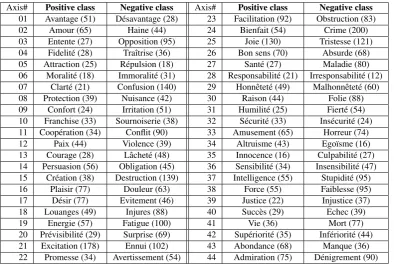
Osgood et al. (1975) defined three value axes: Positive-Negative, Strong-Weak, Active-Passive, but hundreds of more specific axes of human values1 can be defined. For our new language, we started from the 43 paired axes de-tailed in (Grefenstette et al., 2006), translating them by hand into French as shown in table 2.1. (adding an addi-tional dimensionAdmiration-Denigration). This initial in-vestment took three hours for one person.
2.2. Creating seed words for each dimension
For each chosen dimension, we then selected two to four seed words which we thought best captured our intuitive
1The Humanity Quest Web site lists more than 500 dif-ferent human values, similar to our affect classes. See
http://web.archive.org/web/20031118174947/
Axis# Positive class Negative class Axis# Positive class Negative class
01 Avantage (51) D´esavantage (28) 23 Facilitation (92) Obstruction (83)
02 Amour (65) Haine (44) 24 Bienfait (54) Crime (200)
03 Entente (27) Opposition (95) 25 Joie (130) Tristesse (121)
04 Fidelit´e (28) Traˆıtrise (36) 26 Bon sens (70) Absurde (68)
05 Attraction (25) R´epulsion (18) 27 Sant´e (27) Maladie (80)
06 Moralit´e (18) Immoralit´e (31) 28 Responsabilit´e (21) Irresponsabilit´e (12)
07 Clart´e (21) Confusion (140) 29 Honnˆetet´e (49) Malhonnˆetet´e (60)
08 Protection (39) Nuisance (42) 30 Raison (44) Folie (88)
09 Confort (24) Irritation (51) 31 Humilit´e (25) Fiert´e (54)
10 Franchise (33) Sournoiserie (38) 32 S´ecurit´e (33) Ins´ecurit´e (24)
11 Coop´eration (34) Conflit (90) 33 Amusement (65) Horreur (74)
12 Paix (44) Violence (39) 34 Altruisme (43) Ego¨ısme (16)
13 Courage (28) Lˆachet´e (48) 35 Innocence (16) Culpabilit´e (27)
14 Persuasion (56) Obligation (45) 36 Sensibilit´e (34) Insensibilit´e (47)
15 Cr´eation (38) Destruction (139) 37 Intelligence (55) Stupidit´e (95)
16 Plaisir (77) Douleur (63) 38 Force (55) Faiblesse (95)
17 D´esir (77) Evitement (46) 39 Justice (22) Injustice (37)
18 Louanges (49) Injures (88) 40 Succ`es (29) Echec (39)
19 Energie (57) Fatigue (100) 41 Vie (36) Mort (77)
20 Pr´evisibilit´e (29) Surprise (69) 42 Sup´eriorit´e (35) Inf´eriorit´e (44)
21 Excitation (178) Ennui (102) 43 Abondance (68) Manque (36)
22 Promesse (34) Avertissement (54) 44 Admiration (75) D´enigrement (90)
Table 1: The 44 affect axes chosen for our classification experiment. Each axis has a positive and a negative pole. In parentheses is the number of words manually affected to each axis pole.
notion of the dimension (often including the dimension label). For example for the dimension Avantage (advan-tage) we chose the noun, the adjective and the verb
forms of the concept: avantage, avantageux, avantager. For D´esavantage (disadvantage), we chose the different forms of two close synonyms: d´esavantage, d´esavantager, d´esavantag´ee, d´efavoriser, andd´efavoris´ee. Over the 88 dimensions, this second effort generated a list (L1) of 229 seed words. In a third step, we manually extended the list in order to reach an average 10 words per class, generating a list (L2) containing 881 words for the 88 classes. This pro-cess took about a full day for one of the authors, a native speaker of French.
2.3. Creating a gold standard for evaluation.
For subsequent evaluation purposes, we also produced a gold standard (L3) by first expanding the initial seed list (L1) using a synonyms dictionary 2 (Ploux and Victorri, 1998), and then manually deleting words that the human annotator felt intuitively did not belong to the class being built. During its construction, a few words not proposed by the synonym dictionary were occasionally added to the gold standard (L3) by the annotator. The only criterion for inclusion of a gold standard word in a dimension was: does this word significantly evoke the corresponding sentimental dimension for the native language annotator. The gold stan-dard now contains 4980 word-to-class relations (3513 dis-tinct words, a word can belong to more than one class), and was built in about 2 weeks. The construction of the gold standard3 is not part of the technique for creating an
af-2Available online at http://elsap1.unicaen.fr/dicosyn.html 3This gold standard might more appropriately be called a silver standard, since it was not built with exhaustiveness as a goal.
fect lexicon, but was created only to evaluate the technique. Additional work to add centrality and intensity information to the word-to-class relations in underway.
3.
Classifying affect words along their
dimensions
This first round of words was found by filtering syn-onyms of L2 words, leaving a collection of emotive words. The next step consists of automatically assign-ing these words to their appropriate semantic dimensions among the 44 we have defined. For instance,d´esagr´ement (annoyance,unpleasantness), might be assigned to the axes of Avantage/D´esavantage,Protection/Nuisance, Con-fort/Irritation, Plaisir/DouleurandSant´e/Maladie. To make this assignment, we use the L1 and L2 seeds for each paired positive-negative dimension, and providing us with 44 sets of about five (for L1) or twenty (for L2) words each dimension.
3.1. Classifying with SL-dLSA+SVM
C. E. Osgood, W.H. May, and M.S. Miron. 1975. Cross-Cultural Universals in Affective Meaning. University of Illinois Press.
Bo Pang, Lillian Lee, and Shivakumar Vaithyanathan. 2002. Thumbs up? Sentiment classification using ma-chine learning techniques. In Proceedings of the 2002 Conference on Empirical Methods in Natural Language Processing (EMNLP), pages 79–86.
S. Ploux and B. Victorri. 1998. Construction d’espaces s´emantiques `a l’aide de dictionnaires informatis´es des synonymes. Traitement Automatique des Langues, 39(1).
H. Schmidt. 1994. Probabilistic part-of-speech tagging using decision trees. In Proceedings of International Conference on New Methods in Language Processing., Manchester.
Carlo Strapparava and Rada Mihalcea. 2007. Semeval-2007 task 14: Affective text. In Proceedings of the Fourth International Workshop on Semantic Evaluations (SemEval-2007), pages 70–74, Prague, Czech Republic, June. Association for Computational Linguistics. P.D. Turney and M.L. Littman. 2002. Unsupervised
learn-ing of semantic orientation from a hundred-billion-word corpus. Technical Report ERB-1094, National Research Council Canada.
P.D. Turney and M.L. Littman. 2003. Measuring praise and criticism: Inference of semantic orientation from as-sociation. ACM Transactions on Information Systems, 21(4):315–346.