CSEIT1723227 | Received : 27 May 2017 | Accepted : 11 June 2017 | May-June-2017 [(2)3: 759-763]
International Journal of Scientific Research in Computer Science, Engineering and Information Technology © 2017 IJSRCSEIT | Volume 2 | Issue 3 | ISSN : 2456-3307
759
A System for Detecting Congestion using Optical Flow Approach
Sunil Kumar Aithal S, Krishna Prasad N Rao, Puneeth R P
Computer Science and Engineering, NMAMIT, Nitte, Karkala, Karnataka, India
ABSTRACT
Nowadays, millions of people travel internationally for mass gatherings that range from major sports events to fairs, festivals, concerts, railways, or political rallies. Such mass gatherings pose special risks for crowds, because large numbers of people in small areas can facilitate the spread of infectious diseases or increase the risk of injury which certainly leads to crowd stampedes. Crowd depends on several factors, such as age, mood, and consumption of drugs or drinks, will influence whether violence is harmful. Congested crowds are more likely to be violent. These issues should be addressed well for avoiding unusual situations in such places. Human movement activity is gaining increasing attention from current computer vision researchers. It is one of the chosen proactive research area for modern technical decades. The admiration is due to a large evolution of applications in surveillance, crowds and their dynamics. Because the process is of great scientific interest, it offers new computational challenges and because of a rapid increase in video surveillance technology deployed in public and private spaces. In this paper, we present a system for the detection and early warning of hazardous situations during huge gathering. It is based on optical flow computations and detects patterns of crowd movement that are characteristic for lethal congestions. For optical flow, Horn- Schunck’s method is embodied to compute the optical flow fields to the gathered video. Segmentation of video frames is done and optical flow is computed for individual segments. A threshold is set in such a way that the detection of congested region in video is identified easily through comparison with individual segments computed optical flow. Finally, we display the congested region for further preventive measures.
Keywords : Movement Detection, Huge Gatherings, Optical Flow Approach, Segmentation, Video Processing.
I.
INTRODUCTION
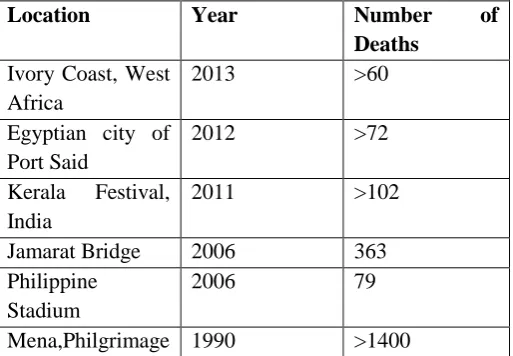
Huge gatherings are most common and very famous in social activities around the globe. Nowadays, typical examples include sports events, gatherings at railways, airports, tourist spots, fairs, or concerts. They attract unstoppable huge number of visitors and major precautionary measures are always important. Even then, above of all safety measures and the use of recent computer vision area such as video surveillance; deadly human stampedes and crowd catastrophe occurs more often (refer Table 1).
Many research works have shown that at such crowd gatherings, the crowd density soon becomes too extreme; on average densities of 10 people per square meter has reported in most works [1]. Huge densities of pedestrian typically results from various patterns of collective behavior such as stop-and-go waves or
Location Year Number of
Table 1. Statistics of recent crowd disasters
The motivation behind this work is to develop software for tracking and recognizing crowd, the major application in computer vision, security, crowd dynamics, and surveillance. The developed software must be capable of tracking one or more objects moving in the video sequences and this system might find application in real-time surveillance or object tracking in video.
In this paper, initially we present a system for the movement detection in video sequences. It is based on optical flow estimations and detects patterns of crowd movement that are characteristic for dangerous congestions. Sequences of ordered frames allow the calculation of movement as either discrete image displacements or instantaneous image velocities. For optical flow, we use Horn- Schunck’s method to compute the optical flow vectors for the sample videos. Later segmentation of video frames is done and optical flow fields are computed for individual video segments. A threshold optical flow values is set in such a way that the detection of congested region in video can be find easily through comparison with individual segment’s computed optical flow vectors. Finally, we display the congested segment in video for further preventive actions.
II.
LITERATURE REVIEW
Currently, crowd dynamics area in computer vision finds vast application in detecting and to provide early warnings in highly crowded region and also in emergency security purposes [3]. Pedestrian flow studies are also an active research topic from past two decades. Huge pedestrian groups and their
self-behaving characteristics can be studied using simulations. For tracking individual behavior in crowds various physical models exist that describes pedestrian flow as a model. Those are modeled based on the analogy to fluid dynamics. Further various popular models came into existence such as socio-force model [4, 5] and cellular automaton [6, 7], which models pedestrian flow on a microscopic level.
From several decades, numerous different vision analysis and detecting techniques have been developed particularly to track and recognize unusual human behavior in crowds [8, 9]. Currently designing of efficient vision-based systems also takes into account various models of simulation tool that tracks pedestrian flow. Cellular automata model referred by Ali and Shah [10] is so admiring that made him to produce a framework for human detection [6]. Computation of flow vectors in that model is automatic which composed knowledge on individual behavior, positions of obstructing objects and entry or exit door’s area. Ali and Shah presented a framework on segmenting the pedestrian flow which helps to track variations in crowd scenes [11]. To identify unusual occasions Mehran et al. refers social force model and calculates force interactions [12]. Further, various studies and experiments are carried out in crowd dynamics to understand hazardous mass behavior and enhance existing physical methods. Various factors like pedestrian flow, velocity, pressure, mass density are estimated either traditionally [13] or by means of enhanced digital image processing techniques [14, 16]. Usually, vision-based analysis are normally carried out using videos taken from top and front-view cameras in order to avoid obstructions and to do automated vision analysis.
movement of any objects, regions, edges in a video sequences which are caused by the instantaneous movement between both viewer and the vision is called an optical flow. They can also be referred as an optic flow. American psychologist James J. Gibson in the year 1940 reported the theory of optical flow to explain the concept of visual stimulus experienced by various animals moving around globe. The significance of optical flow is also reported by James Gibson to explain affordance perception concept, which recognizes various activities occurring in an environment. Currently, the optical flow concept finds extensive application in the robotics area where various related approaches from image or video processing and navigation control, like movement detection of an object, segmentation of frames, surface or edge identification are incorporated. Motion estimation, video processing or compressions are also an active optical flow research topic. Optical flow estimation knowledge is considered valuable for balanced operation of micro air vehicles.
2.1Ddetection of overcrowded region
In an overcrowded region, oscillatory movements are recognized due to the fact that humans moving in such region take very small steps resulting in rapid decrease in motion. Because its people tendency to change directions more frequently while moving which makes tracking their speed and directions difficult. Liu et al. work have proved that people moving in crowd with varying velocities from 0.26 m/s up to 1.72 m/s will not always move in line rather with oscillating movements [14]. For study of crowd dynamics numerous authors reported the existence of linearity between the speed and the amplitude also between the velocity and the frequency. We estimate dense optical flow vectors using the Horn-Schunck’s approach which is a differential technique. The perceptible movement of brightness pattern is called as optical flow. Video sequences consist of ordered frames or images that allow the computation of flow as either instantaneous frame velocities or discrete displacements of images. Different methods exist for the estimation of optical flow vectors that tracks movement between two subsequent or different image sequences that are captured at times T and T+∆T at each volumetric pixel location. Optical flow technique used is called differential because they consider only partial differentiation of spatio-temporal coordinates also
approximations of image sequences depends on Taylor series. Apparently, such global smoothness necessity is induced by the partial derivation residues of optical flow fields. The embodied Horn-Schunck’s technique calculates an estimation of the velocity field vectors say m and n, which minimizes the following brightness constraint of image equation:
In the above equation, ∂m⁄∂x and ∂m⁄∂y are the spatial derivatives of the optical flow velocity component m and β is a global smoothing constraint term. Ix and Iy are the spatial partial derivatives. The Horn-Schunck technique by minimizing the above equation deduces the velocity field vectors m and n, for each volumetric pixel in the image or frame, which is shown in the fields are initialized to value zero.
The stated approach is said to be iterative in nature and solves velocity field m and n as follows:
2. Compute Iy using transpose of 0.25* [1 -1; 1 -1] as convolution kernel, for every pixels in the first and second image.
3. Compute It between images 1 and 2 using the kernel [-0.25 -0.25; -0.25 -0.25] and [0.25 0.25; 0.25 0.25] respectively.
4. Assume the previous velocity to be 0, and compute the average velocity for each pixel using [1/12 1/6 1/12; 1/6 0 1/6; 1/12 1/6 1/12] as a convolution kernel.
5. Iteratively solve for m and n.
In image or video analysis, a convolution mask, or kernel is a matrix used for smoothing, sharpening, edge-identification, etc. This is achieved by means of convolution between a frame or an image and a kernel.
2.3 Segmentation of Video Frames
The above module iteratively solves for optical flow vectors for an entire image or frame. Further for a gathered crowd video segmentation technique is employed for easy processing of video sequences or frames. The whole captured video is sub divided into different segments and for each segment the optical flow estimation approach is applied. In overcrowded regions, the people either move very slowly or stops moving itself. If the observation is considered for top-view video the calculation of crowd velocity can be made by assuming only the magnitude of optical flow fields. So for each segments by only depending on the magnitude values actual optical flow vectors can be deduced. Also, a threshold optical flow fields for comparison with each segments already computed optical flow fields is assumed. Thus, if the optical velocity values in any segments are less than the set threshold values then there is no movement in that region and congestion exist. Further, if the optical vectors values in any segments are more than the set threshold flow values then people in that portion moves very freely no congestion exist. Finally, the regions where the congestion is uncontrollable and there is necessity of further preventive measures are reported. This technique of estimating optical flow vectors is also applicable to real time crowd video footage which yields same result.
III. RESULTS
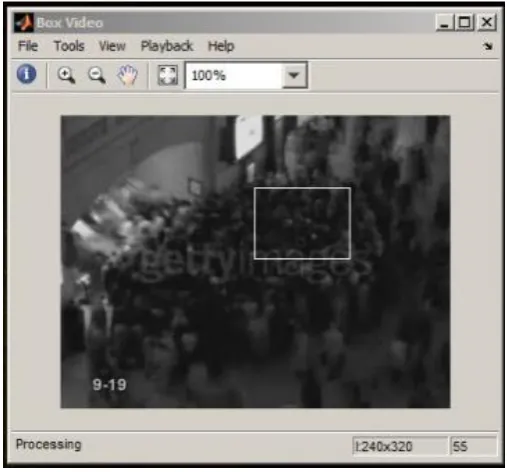
The following snapshots are the output of our initial work on automatic detection of crowd congestion. Figure 3 shows the motion of object between frame 1 and frame 2 of Figure 1 and 2 respectively.
Figure 1. Crowd Detection
IV. CONCLUSION
The proposed system automatically detects an overcrowded location using optical flow estimation and segmentation phenomenon applied over an entire captured video sequences. It also detects and informs such congested regions in real-time video sequences. The video footage assumed is crowd at railways or overcrowding at mosque. Such information can be used to take necessary steps in controlling hazardous incidents taking place at such places.
V.
REFERENCES
[1]. Crowd Dynamics. K. Still. PhD thesis, Univ. of Warwick, 2000.
[2]. D. Helbing and A. Johansson. Pedestrian, crowd and evacuation
[3]. dynamics. In R. A. Meyers, editor, Encyclopedia of Complexity
[4]. and Systems Science. Springer, 2009.
Machine Visions and Applications, 19(5–6):345– 357, 2008.
[6]. D. Helbing and M. P. Social force model for pedestrian dynamics. Physical Review E, 51(5):4282–4286, 1995.
[7]. D. Helbing, I. Farkas, and T. Vicsek. Simulating dynamical features of escape panic. Nature, 407(6803):487–490, 2000.
[8]. C. Burstedde, K. Klauck, A. Schadschneider, and J. Zittartz. Simulation of pedestrian dynamics using a 2-dimensional cellular automaton. Physica A, 295(3–4):507–525, 2001.
[9]. A. Kirchner and A. Schadschneider. Simulation of evacuation processes using a bionics-inspired cellular automaton model for pedestrian dynamics. Physica A, 312(1-2):260–276, 2002. [10]. T. Zhao and R. Nevatia. Tracking multiple
humans in crowded evnironment. In CVPR, 2004.
[11]. G. Brostow and R. Cipolla. Unsupervised bayesian detection of independent motion in crowds. In CVPR, 2006.
[12]. S. Ali and M. Shah. Floor fields for tracking in high density crowd scenes. In ECCV, 2008. [13]. S. Ali and M. Shah. A lagrangian particle
dynamics approach for crowd flow segmentation and stability analysis. In CVPR, 2007.
[14]. R. Mehran, A. Oyama, and M. Shah. Abnormal crowd behavior detection using social force model. In CVPR, 2009.
[15]. A. Seyfried, B. Steffen, W. Klingsch, and M. Boltes. The fundamental diagram of pedestrian movement revisited. Transportation Science, 39(1):1–24, 2005.
[16]. X. Liu, W. Song, and J. Zhang. Extraction and quantitative analysis of microscopic evacuation characteristics based on digital image processing. Physica A, 388(13):2717–2726, 2009.
[17]. A. Johansson, D. Helbing, H. Z. Al-Abideen, and S. Al-Bosta. From crowd dynamics to crowd safety: A video-based analysis. Advances in Complex Systems, 11(04):497–527, 2008. [18]. Optical Flow and Motion Analysis Ying Wu
Electrical Engineering & Computer Science Northwestern University Evanston, IL 60208. [19]. Object Tracking and Velocity Determination
using TMS320C6416T DSK. Institute of Networked and Embedded Systems Pervasive Computing.