CSEIT172470 | Received : 18 July 2017 | Accepted : 29 July 2017 | July-August-2017 [(2)4: 202-212]
International Journal of Scientific Research in Computer Science, Engineering and Information Technology © 2017 IJSRCSEIT | Volume 2 | Issue 4 | ISSN : 2456-3307
202
Towards Achieving Knowledge Security with the Cloud
Computing Implementation Framework
Singampalli. Sankeerthi
*1, Chavali Rekha
21Assistant Professor, Department of MCA , St. Mary’s Group of Institutions, Guntur, Andhra Pradesh, India 2PG Student, Department of MCA , St. Mary’s Group of Institutions, Guntur, Andhra Pradesh, India
ABSTRACT
Offering continuous information security for petabytes of information is essential for Cloud Computing. A current study on cloud security expresses that the security of clients' information has the most astounding need and in addition to accomplish with an approach that is efficient, adoptable and very much organized. In this way, this paper has built up a structure known as Cloud Computing Adoption Framework (CCAF), which has been modified for securing cloud information. This paper clarifies the diagram, basis and segments in the CCAF to ensure information security. CCAF is outlined by the framework configuration in light of the necessities and the execution showed by the CCAF multi-layered security. Since our Data Center has 10 petabytes of information, there is a gigantic undertaking to give ongoing insurance and isolate. We utilize Business Process Modeling Notation (BPMN) to reenact how information is being used. The utilization of BPMN recreation enables us to assess the picked security exhibitions before genuine usage. Results demonstrate that an opportunity to take control of security break can take near 50 and 125 hours. This implies extra security is required to guarantee all information is very much ensured in the significant 125 hours. This paper has additionally exhibited that CCAF multi-layered security can ensure information progressively and it has three layers of security: 1) firewall and get to control 2) personality administration and interruption avoidance and 3) merged encryption. To approve CCAF, this paper has embraced two arrangements of moral hacking tests required with infiltration testing with 10,000 Trojans and infections. The CCAF multi-layered security can square 9,919 infections and Trojans, which can be decimated in seconds and the staying ones, can be isolated or separated. The analyses appear despite the fact that the rate of blocking can diminish for nonstop infusion of infections and Trojans, 97.43% of them can be isolated. Our CCAF multi-layered security has a normal of 20% preferable execution over the single-layered approach, which could just square 7,438 infections and Trojans. CCAF can be more viable when joined with BPMN recreation to assess security handle and infiltrating testing comes about.
Keywords: Cloud Computing Adoption Framework (CCAF), security framework, Business Process Modelling Notation(BPMN), Data security in the Data Centre, multi-layered security protection
I.
INTRODUCTION
CLOUD Computing and its adoption has been a subject of debate within the past few years. It has been associate agenda for structure adoption due to edges in cost-savings, improvement in work efficiencies, business nimbleness and quality of services [1-2]. With the speedy rise in Cloud Computing, software package
peers. Whereas additional folks and organizations use the Cloud ser-vices, security and privacy become vital to ensure that all the info they use and share area unit well protected. Some researchers assert that security ought to be implemented before the employment of any Cloud services in situ [6-8]. This makes a difficult adoption situation for organ-inactions since security ought to be enforced and implemented in parallel with any services. Though organizations that adopt Cloud Computing acknowledge edges offered by Cloud services, challenges like security and privacy stay a scrutiny for structure adoption. Whereas overseeing the importance of security, the software package engineering and development method should de-sign, implement and look at safety features.
The knowledge centres have encountered challenges of speedy increase within the data [9-11]. As an example, in an exceedingly knowledge centre that the lead author accustomed work with, daily increase of a hundred terabytes of information was common. If the organization has encountered a speedy rise of information growth and is unable to reply quickly and with efficiency, issues like knowledge traffic, knowledge security and repair level agreement problems will happen [6, 11]. During this paper, we tend to specialize in the info security whereas experiencing an oversized increase of information, whether they are from the external sources like attack of viruses or Trojans; or they from the interior sources if users or shoppers accumulate many terabytes of information per day. This can be a probe challenge for knowledge security that is important for the higher management of {the knowledge the info the information} centre to handle a speedy increase within the data.
Apart from the info centre security management for Rapid growth in knowledge, the software package engineering method should be strong enough to face up to attacks and unauthorized access. The whole method is more console-dated with the event of a framework to limit the technical style and implementations, governance and policies related to smart practices. This motivates US to develop a framework, Cloud Computing Adoption Framework (CCAF), to assist organizations such-
Cess fully adopts and delivers any Cloud services and pro-jests. During this paper, we tend to demonstrate our security style,
Implementation and resolution for CCAF. We tend to use penetration testing and connected experiments to validate its robustness and live exactitude, recall and F-measure to justify benefits over different approaches. The breakdown of this paper is as follows. Section 1.1, 1.2 and 1.3 present
Literature associated with Cloud application security. Section 2
Presents security summary beneath CCAF. Section 3 de-scribes CCAF security in details, as well as the code, multi-layered approach and part for every layer. Sec-tin four explains a way to defend knowledge security and predicts likely consequences by exploitation Business method ModelingNotation (BPMN) simulations. Section 5 uses penetrationtesting against the CCAF multi-layered security andcompares with different similar approaches. Section half dozen presents Conclusion.
A. Cloud applications security literature and overview
We audit a couple of chose literary works that are important for Cloud application security depicted as takes after. Existing writing [7-9, 11-12] characterize cloud application benefit se- crudity as dangers, vulnerabilities and insurance of cloud operational administrations and programming as an administration Applica- tins Liu et al [7] has proposed a specialist arranged model- in structure for investigating security necessities.
Nevertheless, it is seen up until now another demonstrating language than security necessities catching system.
Mather et al [8] gives a nitty gritty definition and description on different cloud security and protection issues.
programming acquisition security (which incorporates the security details in all procedures to purchase, lease, or trade programming to use in a venture), frameworks, and programming advancement security (which incorporate the security particulars in all procedures to create data frameworks). In any case, there is no evident system to be embraced to group security prerequisites and after that to encourage towards implementation. A structure with a comprehensive approach of offering a coordinated arrangement and multi-layered security is required
B. Data security for the private mists facilitated in the Data Center
As talked about in the presentation, the quick information development postures challenges for information security for the private mists facilitated in the server farm. Literary works for various security arrangements are as per the following. Zhang et al [11] give audit of the Cloud Computing and clarify the exploration challenges related with security. In any case, they just professional vide a diagram of essential security challenges however do not give a full nitty gritty arrangement on Cloud security. Liu et al [7] clarify their product security examination with their basis and a case. Be that as it may, there is an absence of de- tails about the product plan and execution expert cess included, and observational outcomes to assess its per- formance and viability of their proposed arrangement, which resembles the blend of UML and work processes.
Yu et al [13] and Wang et al [14] propose their fine- grained security show for Cloud stockpiling. Both are similar, aside from that proposition from Yu et al [14] is more in subtle elements and they clarify speculations and clients related with their evidence of-idea. Nevertheless, the two recommendations [13, 14] do not have any trials, re-enactment and empire- cal information to demonstrate the adequacy and vigour of their fine-grained security demonstrate. Therefore, the two recommendations do not address top to bottom information security issues, when the quick development of information is a test for the Data Centre.
There are basic perceptions in the security star postured techniques: Each paper [7-8, 10, 12, and 14] just proposes
A solitary arrangement. In case of extortion, digital criminal exercises and unapproved hack, the security arrangement is deficient to ensure the information security and the information centre if just a solitary arrangement is received. Subsequently, a superior elective is required. We proposed the multi-layered security to coordinate security methods to show the quintessence and adequacy of the system with advertisement vantages of doing as such. In the first place, the quality of every procedure is upgraded. Second, since every system can't generally completely forestall hacking or give a full arrangement without Paradox, the multi-layered security can enhance the degree of security since it is more troublesome for infections and trojans to soften diverse sorts of security up one go. The point is to boost security assurance and diminish the dangers.
To show the information security of the private mists Facilitated in the server farm, we propose the utilization of moral hacking to show whether our CCAF multi-layered security can withstand many infections and Trojans assaults, if the quick information increment is from the outer pernicious hacking. We will give point by point prepare and brings about Section 5.
II.
Security review under distributed
computing selection structure (CCAF)
The present difficulties confronting cloud group on cloud security is huge. In this way, we require a reasonable casing work, which gives an incorporated way to deal with contemplate cloud benefit exhibitions before the execution, the one that backings clear usage of cloud security properties at the usage level, and the one that can be embraced by both cloud clients and cloud professional voiders. The utilization of the system is a reasonable approach delineated by Zhang et al. [15], who propose a client based security structure for communitarian registering frameworks. They clarify their method of reasoning, foundation, centre technologies, utilization situations, analyses, comes about and their in-perpetrations. Their approach is vigorously cantered around the
Security system. The utilization of the structure is a suit- capable approach gave cautious and clear explains-
Tins. We have proposed our own structure, Cloud
Registering Adoption Framework (CCAF), to address the security challenge.
The CCAF is an extensive model for embracing and applying cloud security standards efficiently. The result of every movement is appeared inside the enclosure.
These best practice systems will keep develop as the system has been in different applications. It is a con- Copula system like ITIL variant 3 to control organize For the prescribed procedures. Also, such a casing Work can incorporate with Cloud Computing administrations to Give added qualities to embracing associations [16]. It Is additionally a design system concentrated on the conveyance of a security benefit, through building up a multi- layered security for server farms? Zhang et al. (2008) ex- plain their justification, foundation, centre advances, usage situations, tests, comes about and their interpret tins. Their approach is vigorously cantered around the utilization of XML to exchange and translate information through their security instrument. Structure is a proper strategy professional vided with cautious and clear clarifications. This segment presents the foundation work and diagram for our ace postured Cloud Computing Adoption Framework (CCAF).
2.1 Overview
We sum up the ranges for security diagram. The following are classifications of CCAF security expects to cover:
Application programming security which manages how we can assemble frameworks that can consequently ensure themselves.
Network (LAN, MAN, GAN), remote system se- curity and stage security incorporate Operating Frameworks, Virtualization and frameworks programming.
Convergence arrange security where uniting, multi-organize media foundations, social net- works and advances, which is one of the emerging zones of research.
Service-arranged security where issues identified with framework administrations, for example, disavowal of administration assaults, circulated
disavowal of administrations, and web administrations.
Cloud security manages administrations security, information security and protection with the goal that administrations conveyed and resources are secured.
Open-source programming security incorporates issues such as trust, affirmation and capability models.
Programming segments and engineering, security which manages building segments and archi- tectures with security can be utilized as modules.
Web administrations security is basic to guarantee secure administrations are conveyed with respectability.
Frameworks and Software security building bargains with building security in CCAF
appropriate from re- quirements. This is alsoconsidered creating programming applications with CCAF.
Suggestions from McGraw [17] give a com- prehensive structure for frameworks building techniques also, ideas. In any case, it doesn't offer an entire solu- tion for Cloud Computing. This persuades us to have a exhaustive outline, usage and administration for
Cloud security under the CCAF proposal. CCAF is a system for associations that we have already exhibited how CCAF can be offered in social insurance [18], back [19] and different sorts of organizations. It is our objective to give rules and suggestion to security and protection. PC security has been ordered into various general ideas and procedures, for example, ID, which recognizes articles, capacities, and air conditioning- tions, validation, approval, security, honesty and solidness. We have so far entrenched essential security highlights with recognizable proof, confirmation, approval,advanced security encryption and unscrambling procedures.
Key elements with their clarifications are as per the following.
recognizable proof key and this can be checked against when a client login into the framework. Authentication and approval are two particular types of get to controls to get to any data in the framework. Protection is the way to keeping up the accomplishment of cloud registering and its effect on sharing data for social systems administration and cooperation on a particular venture. This can be kept up by enabling clients to pick when and what they wish to partake notwithstanding permitting encryp- tion and decoding offices when they have to secure particular data/information/media content. Uprightness is the essential component of individual as a procedure of keeping up consistency of activities, correspondences, values, strategies, measures, standards, desires, and results. Moral esteems are critical for cloud benefit suppliers to secure honesty of cloud client's information with genuineness, honesty and precision at unsurpassed. In cloud processing terms, we can accomplish honesty by keep up- ing consistent excess checks and advanced affirmation in expansion to other fundamental security elements of keeping up distinguishing proof, confirmation, and approval. Solidness is otherwise called, persistency of client activities furthermore, benefits being used ought to incorporate sessions and various sessions.
2.2 CCAF Security Design
This segment depicts the framework configuration required by CCAF. Catching and distinguishing necessities for security unequivocally is one of difficulties in Cloud security for SaaS, which affects the usefulness of the sys- tem. Along these lines, we should be capable indicate security re- quirements unequivocally all through the security-particular life- cycle stages as a major aspect of accomplishing CCAF (security re- quirements, outline for security, security testing and setreatability testing). Tondel et al. [20] has given an extensive overview on security prerequisites techniques which help to recognize security prerequisites efficiently and structure them. For instance, Mead [21] for the SEI's (programming Engineering Institute) has distinguished a strategy. Rreferred to as square (at ease first-class requirements engi-neering) which has been extended syssquare (structures engineering square) toward systems protection engi-neering approach. our extended technique includes ten steps as follow:
• Agree on definition to outline a hard and fast of acronyms, definitions, and domain-unique information wishes to be agreed with the aid of stakeholders. this can assist identi-fy and validate security-particular requirements certainly by stakeholders.
• Become aware of protection desires to truely outline what's expected of the machine with admire to safety of business drivers, regulations and tactics. • Increase artefacts to develop situations, for
examination-ples, misuse instances and templates for specs and forms.
• Perform danger assessments to behavior danger analysis for all safety desires recognized, behavior chance analysis.
• Select an elicitation technique to encompass system-atic identification and evaluation of security require-ments from stakeholders within the sorts of interviews, enterprise technique modeling and simulations, prototypes, discussion and cognizance corporations. as part of this phase, one should perceive level of security, value-advantages analysis, organizational culture, shape and fashion. • Elicit protection necessities to consist of sports
such as producing security necessities docu-ment primarily based safety specific principle shape as a part of our intention of growing ccaf in advance, threat assessment results, and strategies identifies for analysis together with business procedure modeling and simu-lations, risk modeling, and misuse cases, and so on.
• Sategorize safety necessities to consist of activ-ities that (1) classify and categorize protection re-quirements based totally on employer-specific require-ments specification templates and (2) use our rec-ommended safety principles as this could help systems engineers to use ccaf and (3) track se-curity-unique requirements to validate & verify in any respect levels of the systems engineering existence-cycle.
expand facts protection as part of organisation huge systems improvement.
• Prioritize security requirements to include activi-ties of selecting and prioritizing safety require-ments primarily based on enterprise goals in addition to value-benefit evaluation.
• Investigate protection requirements to behavior re-quirements validation procedure the usage of necessities inspection and evaluation meetings.
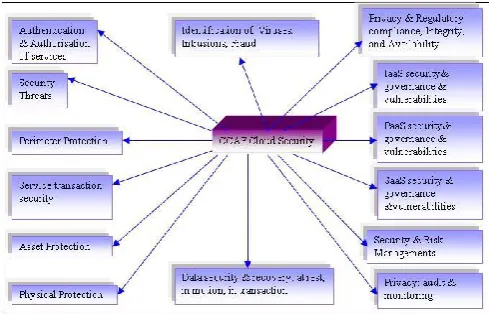
To obtain an incorporated safety for the iterated re-quirements, you can still pick out keywords as gadgets and com-ponents. system and software additives should con-tain a ccaf multi-layered protection and every layer has its personal protection cognizance. information might be offered in section three and five most of the safety attributes and ideas identified in advance are simply relevant to developing cloud offerings with a structures engineering focus. but, there are a few cloud-unique security related issues which include securi-ty in virtualization and server environments. cloud secu-rity attributes can be found in many-fold as proven in discern 1. even though there are numerous attributes available, they can be further categorized as follows:
Confidentiality, privateness and believe – these are widely known basic attributes of digital security inclusive of authen-tication and authorization of records as well defend-ing privacy and accept as true with.
Cloud services protection – this consists of security on all its offerings which includes saas, paas, and iaas. that is the important thing area of attention wanted for reaching cloud security.
Statistics security – this category is once more paramount to sus-taining cloud technology. this consists of defensive and recovering making plans for cloud records and service facilities. it is also important to comfy statistics in transactions.
Bodily protection of cloud belongings – this class be-longs to protective cloud facilities and its belongings. The above cloud safety attributes/traits are critical and useful to understand non-functional factors of services improvement and service provision. these at-tributes also are useful for building ccaf and preserve-ing safety
Figure 1 : CCAF Cloud Security Attributes serving for the community
2.3 Ccaf Facts Security
Data protection cope with most of the cloud computing secu-rity demanding situations either you remember architectural and tech-nological issues nor manner and regulatory safety challenges; they all comes right down to records in many forms which include records (offers with identification control-ment), statistics in transition and transaction, records in modifi-cation, privateness of consumer facts, and statistics at relaxation on servers and storages. but, the alternatives of some of rec-ommendations [7-9; 20-24] have diagnosed approximately eight key data protection problems that are:
• Statistics tampering offers with problems of unauthorized amendment to a transaction. as an example, in case you add 100 times to a simple transaction of £/$one thousand.00 this equals to £/$100k. oracle [22] provides that 80% of protection breaches are caused by insider at-tacks than some other kinds of safety attacks.
• Eavesdropping and facts robbery deal with stealing crucial personal information (non-public and economic in-formation consisting of credit score card) all through statistics trans-mission. network and packet sniffers may be used to steal such statistics.
• Falsifying person identities deals with identification robbery by gaining access to statistics and can also threaten dig-ital signatures with non-repudiation attacks
• Password-associated threats deals with stealing and cracking passwords.
• Lack of responsibility deals with gadget adminis-trators for tracking and protective information get right of entry to and user account control.
• Complicated user control necessities cope with consumer account control techniques.
• Multi-tier systems address supplying get right of entry to to other services and application layers. • Scaling the safety administration of more than one
sys-tems poses more complexity of coping with cloud se-curity as it offers with presenting multiple accesses to multiple applications.
III. CCAF data security in details
This section describes differing kinds of system develop-ment and method development for CCAF. The content includes the code syntax to proceed with the CCAF secu-rity, the design and also the proposal of the multi-layered security.
3.1 CCAF Security Schema by XACML
This section describes the software system theme needed by CCAF. protractible Access management language (XACML) is that the language that may outline the rule, permis-sion, operate and interactions within the use of SaaS and Cloud security. A projected XACML section sort, Rescue, is represented here as AN example. “Rescue” is employed to dam virus, trojans and attacks like denials of services and unauthorized access. within the event of hacking, all the files ar secured and retrieved from secure ports like twenty two for secure FTP and 443 for secure HTTPS. rather than dis-playing scientific discipline addresses within the ancient methodology, the scientific discipline addresses altogether virtual machines ar assigned at runtime.
3.2 CCAF multi-layered security
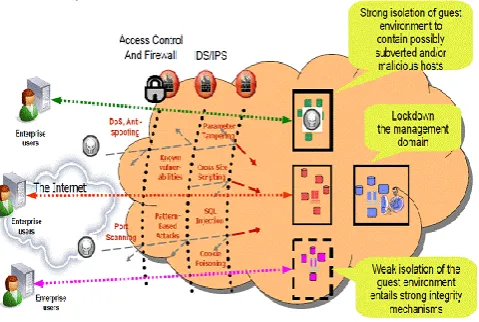
CAF security software system implementation is incontestible by its multi-layers of security mechanism to maximise protection. It conjointly ensures reduction within the infections by trojans, virus, worms and unauthorized access and denial of service attacks. every layer has its own protection and is answerable of 1 or multiple duties within the protection, pre-ventive activity and quarantine action given in Figure a pair of.
Figure 2 : The CCAF multi-layered security in a nut shell
All the options in CCAF multi-layered embody access management, intrusion detection system (IDS) and intrusion hindrance system (IPS), this fine-grained security
The layer description is as follows.
• the primary layer of defense is Access management and
• firewall to permit restricted members to access. • The second layer consists of the IDS and IPS.
Theaim is to find attack, intrusion and penetration, • and conjointly give up-to-date technologies to pre- • vent attacks like DoS, anti-spoofing, port scan- • ning, illustrious vulnerabilities, pattern-based
attacks,parameter change of state, cross website scripting, SQL in-
• jection and cookie poisoning. The identity man- • agement is enforced to make sure that right level
of ac-cess is simply granted to the proper person.
3.3 Layer 1: Firewall
This section describes the intrusion protection utilized Inca to make sure that each one knowledge is safeguarded all the days. The Intrusion hindrance System (IPS) is employed with the core syntax includes:
Crypto key pub key-chain rammed-key realm-cisco.pub signature key-string while writing these three lines, AN encrypted key-strings generated to shield the information from potential malicious Hack. The key-string might appear as if this:
B199ABCB D34ED0F9 085FADC1 359C189E F30AF10A C0EFB624
7E0764BF 3E53053E
Once the key generation is finished, the IPS configuration can be saved. Kind of like “Rescue” XML tag in Section three.1, the next step is to form a rule for IPS, followed by con-figuring IPS signature storage location. The ultimate step in- Clues IPS event notification. Their various steps are
Presented as follows.
ip scientific disciplines name <rule name> <
nonobligatory ACL>router#configure
terminalrouter(config)# scientific discipline ips name iosipsip scientific disciplines config location flash:<directory name>router(config)#ip ips config location flash:ipsip scientific disciplines send word sdee 3.4 Layer 2: Identity Management
The personality administration is isolated into three parts: us-
ers, CCAF server and the security supervisor as takes after.
Clients
Clients can encode each key from his piece and his own key. They can part documents into squares, encode them with the key, trailed by marking the subsequent encoded squares and making the capacity ask. For each record, this key will be utilized to decode and revamp the first document amid the recovery stage. The client additionally utilizes single sign- on to get to each piece with a conservative mark conspire.
CCAF Server
Three parts are offered by the server. To begin with, it can authen- ticate clients amid the capacity/recovery stage. Second, it can get to control. Third, it can scramble/decode information amongst clients and their cloud. The information can be further encoded to counteract word reference assaults before being for- warded to the metadata chief (MM). Squares are de- crypted and the server checks the mark of each square with the client's open key amid the recovery stage.
Security Manager (SM)
Security Manager (SM) stores metadata which incorporate square marks, encoded keys and prepare character administration check. While SM checks and confirms the right personality, the CCAF security continues to focalized encryption, which fills in as the third layer of security. SM has a connection list and a little database, where the connection list is as takes after.
Each hub in the connected rundown speaks to an information square. The identifier of every hub is acquired by hashing the en- crypted information square got from the server. –A interface between two hubs, forinstance, hubs An and B, relates to the record identifier and the encryption of the key to decode the information square B. SM can check whether a client is approved to recover a record that he/she has asked. This offers an extra get to control. Moreover, SM can speak with the cloud specialist organization (SP) to store and recover information pieces.
3.5 Layer 3: Convergent Encryption
After the personality administration stage, all information needs to un- dergo the security test offered by Convergent encryption
ciphertexts since the encryption key is the same. This permits the distributed storage supplier to perform effective capacity, (for example, deduplication, which implies a similar record is just put away and filed at one place without duplica- tion) on such ciphertexts without having any information the ciphertexts with other encryption calculation utilizing the same keying material for all contribution to forestall assaults against. The advantage is that the deduplication necessity can be perfect with CoE.
3.6 The center code to send security
This segment discloses the center code to continue with multi-layered security to check the status of the CCAF security and presents the condition of 0 and 1. The status 0 implies all exercises and all records are reasonable and can't be completely controlled. The similarity resembles human bodies: while there are likewise awful/carcinogenic cells, the rate is tiny to the point that they are controlled. In any case, until to a specific status trigger the body invulnerability, terrible/dangerous cells can't be con-trolled. To counterbalance his, our human body triggers the caution for body resistance. Like our security outline, status=1 implies that a caution is activated and the cure activity starts. The framework director can likewise physically trigger it if the server farm is under the danger before the framework location turns positive.
On the off chance that "security" is equivalent to 1, which implies the CCAF secu- rity prepare is commenced as appeared in Table 2. On the off chance that "security" is equivalent 0, it implies the CCAF perceives there is a low hazard and danger. The expression "status(job)" implies that the
CCAF security is putting forth ongoing insurance and activities for isolate. All these CCAF orders empower thworking of multi-layered security. Clarifications of different parts of the security procedure are as per the following.
• "trigger(status(job))" is to empower the activating of the possibility activity. It is the initial step to trigger a rundown of activities for looking after framework what's more, information security. • "check(status(job)" is to check the status of secu-
rity is 0 or 1. The status 0 is the controlled status
and status of 1 is the activated status due to secu-rity break or dangers.
• "firewall(status(job))" is to empower firewall on. • "identity(status(job))" is to empower personality
man-agement to be dynamic.
• The most effective method to utilize CCAF for associations
CCAF can be utilized on each VM and every server to check all the approaching information to see whether they are perfect, isolate and free of suspected malevolent records. Suspect-ed records will be alarmed and moved to the isolate sec-tion prepared for additionally checks. Since tests have been led more than 125 hours with 99.19% PTe, 99.98% STe, 100% accuracy, 99.19% review and 99.5% F-measure, there is a decent unwavering quality. The utilization of CCAF mutli-layered security can guarantee the abnormal state of assurance and safe-watch of information security for the associations.
Relevance to Big Data
Our paper exhibits information security utilizing CCAF multi-layered security to represent our verifications of-ideas. There are five attributes with Big Data: volume, speed, assortment, veracity and esteem. Our work meets volume, since broad investigations and recreations had been performed for 10 petabytes of information. Our work likewise meets speed, since 10,000 infections and trojans had been infuse ed into our multi-layered security to test how our star postured arrangement can deal with a lot of tainted records. The finding was that up to 125 hours were required to pick up control and full information recuperation. Exploratory re-sults in Section 5 additionally bolster veracity, since over 99% of infections and trojans can be blocked and expelled under the moral entrance test.
IV. Conclusion and Future Work
security for 10 PB of information in the Data Center based at the Universi-ty of London Computing Center (ULCC). We clarified the specialized points of interest in each layer of security and propose an incorporated answer for check every one of the information when information is seriously utilized. We utilized the Business Process Modeling Notation (BPMN) to reenact the instances of how the information can be utilized, either very still, being used, or in movement. All simu-lations could be finished inside 2 seconds.
Our BPMN reproduction comes about demonstrated that it could take up to 50 hours to secure all the 2PB information and up to 125 hours to raise a caution to take control of the circumstance in the ULCC Data Center. This implies a coordinated approach was required to guarantee information security, on the off chance that that the server farm is under the assault or potential risk from the quick ascent of information development in the server farm, which can be because of the outer interruption or the inward fast utilization. We at that point utilized FGSM for the penetra-
tion testing. 10,000 infections and trojans were infused into Data Center with two tests performed. The primary test demonstrated that firewall, character administration and encryption could square 5,423, 3,742 and 842 infections and trojans separately. The rest of the 81 could be either isolated or confined. The second investigation demonstrated that constant infusion of 10,000 infections and trojans could make the blocking rate diminished from the 99.19% to 76.00% of every 125 hours. Notwithstanding of this outcome, the CCAF multi-layered security could isolate and disengage 97.53% of infections and trojans. Our work can show that the utilization of CCAF multi-layered security can shield the server farm from the fast information development because of the security break, and the utilization of BPMN can ascertain how much time required for save activity if the information security is bargained. Thusly, we can work out the better strategies and plans for information recuperation and security.
In this paper, we exhibited that CCAF multi-layered security could give the extra assurance to each of the 10 PB of information in 125 hours when the Data Center was under the security danger and assault. Information security in the Cloud is a vital issue for Cloud reception. We showed that our approach could give constant insurance of the considerable number of information,
obstruct the dominant part of dangers and isolate the petabyte frameworks in the Data Center. We intend to enhance our technique and code in the reenactment and pick the correct sort of calculations to enhance the general execution in execution time of information security and blocking infections/trojans progressively. We will devel-operation more administrations and confirmations of-idea in CCAF to im-demonstrate the execution of BPMN reproduction and penetra-tion testing. Existing examinations on cloud security [11, 14, 20-24; 28-29, 33] have been centered around either distinguish man-agement, general issues concerning cloud security, get to control or design layers. Our approach gives an incorporated answer for cloud security in light of a reasonable structure, business prepare displaying to think about the im-settlement on the execution of a client got to benefit which is frequently learned on the fly which is expensive and a CCAF three layered model.
V.
REFERENCES
[1] S., Marston, Z., Li, S., Bandyopadhyay, J., Zhang, A., Ghalsasi, "Cloud computing – The business perspective". Decision Sup-port Systems, Elsevier, 51(1): pp 176-189, 2011.
[2] M. A., Vouk, "Cloud Computing – Issues, Research and Imple-mentations". Journal of Com-puting and Information Technolo-gy - CIT 16, page 235–246, Volume 4, 2008.
[3] A. K., Jha, C. M., DesRoches, E. G., Campbell, K., Donelan, S. R., Rao, T. G., Ferris, & D., Blumenthal. “Use of electronic health records in US hospitals. New England Journal of Medicine”, 360(16), 1628-1638, 2009.
[4] H. T., Peng, W. W., Hsu, C. H., Chen, F., Lai, J. M. Ho, "Finan-cialCloud: Open Cloud Framework of Derivative Pricing. In So-cial Computing (SocialCom), 2013 International Conference on (pp. 782-789). IEEE, 2013, September.
[5] M., Mircea, A. I., Andreescu, "Using cloud computing in higher education: A strategy to improve agility in the current financial crisis". Communications of the IBIMA, 2011, 1-15. [7] L., Liu, E., Yu, & J., Mylopoulos, “Security and
Interna-tional (pp. 151-161), IEEE, 2003, September.
[8] T., Mather, S., Kumaraswamy, S. Latif, (2009), “Cloud security and privacy: an enterprise perspective on risks and compli-ance”. ISBN: 978-0-596-80276-9, O'Reilly Media, Inc.
[9] M., Pop, S. L., Salzberg, "Bioinformatics challenges of new se-quencing technology". Trends in Genetics, 24(3), 142-149, 2008.
[10] A., Greenberg, A., J., Hamilton, D. A., Maltz, P., Patel, "The cost of a cloud: research problems in data center networks". ACM SIGCOMM computer communication review, 39(1), 68-73, 2008.
[11] Q., Zhang, L., Cheng, R., Boutaba, "Cloud computing: state-of-the-art and research challenges". Journal of internet services and applications, 1(1), 7-18, 2010.
[12] J. J. Cebula, L. R. Young, “A Taxonomy of Operational Cyber Security”, Technical Note: CMU/SEI-2010-TN-028, Software Engineering Institute, USA, December 2010.
[13] S., Yu, C., Wang, K., Ren, W., Lou, "Achieving secure, scalable, and fine-grained data access control in cloud computing". In INFOCOM, 2010 Proceedings IEEE, 1-9, March 2010.
[14] G., Wang, Q., Liu, J., Wu, "Hierarchical attribute-based encryp-tion for fine-grained access control in cloud storage services". In Proceedings of the 17th ACM conference on Computer and communications security (pp. 735-737), ACM, 2010, October.
[15] X., Zhang, M., Nakae, M. J., Covington, R., Sandhu, "Toward a usage-based security framework for collaborative computing systems", ACM Transactions on Information and System Secu-rity (TISSEC), 11(1), 3, 2008.
[16] G. McGraw, “ Software security: building security in, Addison Wesley, USA, 2006
[17] P., Brooks, J., Chittenden, "Metrics for Service Management: Designing for ITIL". Van Haren Publishing, ISBN: 978 90 8753 6480, 2012. [18] V., Chang, R. J. Walters, G. Wills, "Cloud
Storage and Bioinfor-matics in a private cloud deployment: Lessons for Data Inten-sive research". Springer: CLOSER 2012, CCIS 367, pp. 245–264, 2013.
[19] V., Chang, "Business Intelligence as Service in the Cloud". Future Generation Computer Systems, DOI:
http://dx.doi.org/10.1016/j.future.2013.12.028, 2014.
[20] I. A., Tondel, et al., "Security requirements for rest of us: a sur-vey". IEEE Software, Special Issue on Security and Agile re-quirement engineering methods, Jan/Feb, 2008.
[21] N.R., Mead, et. al., "Security Quality
Requirements Engineering (SQUARE)
Methodology". Technical Report, CMU/SEI-2005-TR-009, 2005.
[22] Oracle, "Data Security Challenges". Oracle9i security overview release number 2(9.2),
accessed on 4th November,
http://docs.oracle.com/cd/B10501_01/network.92 0/a96582/o verview.htm , 2012.