CSEIT1723337 | Received : 26 June 2017 | Accepted : 04 July 2017 | July-August-2017 [(2)4: 18-22 ]
International Journal of Scientific Research in Computer Science, Engineering and Information Technology © 2017 IJSRCSEIT | Volume 2 | Issue 4 | ISSN : 2456-3307
18
A Survey on Cloud Computing and Mobile Cloud Computing
Kusum Lata, Sugandha Sharma
Computer Science and Engineering Department, Chandigarh University Institute of Engineering and Technology, Gharuan, Mohali, Punjab, India
ABSTRACT
Cloud Computing is provides on demands services to local clients or users with the help of internet. Cloud Computing offers applications, infrastructures and online data storage facilities by which we can manipulate, configure and access the software and hardware resources easily and quickly. Mobile Cloud Computing is also a kind of Cloud Computing in which computing is included the device like mobile. This paper represents the types of cloud computing, its service models, advantages, issues of Cloud Computing. In this paper we also discuss the techniques of Mobile Cloud Computing like Offloading, technologies and some issues related to the Cloud Computing that are security and data privacy issues.
Keywords : Cloud Computing, Mobile Cloud Computing, Infrastructures, Applications, Software
I.
INTRODUCTION
Cloud: It refers to internet or something, which represents at remote location. It provides various kinds of services in public and private network like LAN (Local Area Network), WAN (Wide Area Network) etc. Its examples are e-mail, web conferencing etc.
Cloud Computing: Cloud computing is a kind of on-demand computing where we can share no. of resources and information to the computer. Cloud Computing offers user to use different kinds of infrastructures, platforms and software that provides at very cheap cost. Cloud Computing allow us to create and customize different online applications and games. It also helps us in manipulating, accessing and configuring different kinds of hardware and software resources. It also provides us online data storage infrastructures and applications. Cloud computing is internet based computing which is reliable and user friendly in nature. A Cloud Computing is used in these days and it is an emerging term of computing utilities. Cloud Computing have various kinds of important characteristics and software. Cloud Computing is referred from network computing where applications are run on a server, which is connected. Cloud Computing allow us to create and customize different
online applications and games. It also helps us in manipulating, accessing and configuring different kinds of hardware and software resources. It also provides us online data storage infrastructures and applications. Cloud computing is internet based computing which is reliable and user friendly in nature.
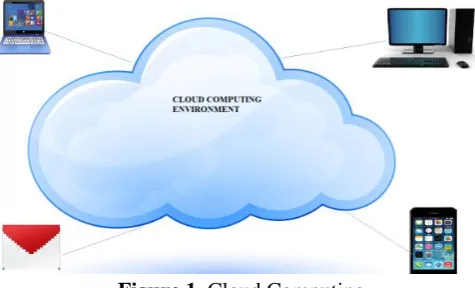
Figure 1. Cloud Computing
II.
TYPES OF CLOUD COMPUTING
Cloud Computing comes in the form of Public, Private, Hybrid, Community, Distributed, Inter and Multi cloud etc.
A. Public Cloud
Cloud, single administrator provides services to the multiple users. The only disadvantage of Public cloud is it is less secure in nature
B. Private Cloud
The system and services is accessible only within an organization. The advantages of Private Cloud is high privacy, improve reliability, more security, cost and energy efficient in nature.
C. Hybrid Cloud
It generally includes the critical and non-critical activities of public and private cloud both. In hybrid cloud, some network issues are faced. Hybrid cloud is also composition of public, private and community cloud.
D. Community Cloud
The system and services are accessible by a group of organizations in community cloud.
E. Distributed Cloud
In distributed cloud different set of machines are located at different location but all are connected to a single network.
F. Inter Cloud
It shows the inter-connectivity between cloud and cloud globally. It focuses on the direct inter-operability between public cloud service providers and consumers.
G. Multi Cloud
In multi cloud, no. of computing services lies in a single heterogeneous architecture to increase flexibility through choice and reduce reliance of single vendor.
III. SERVICE MODELS
A. IaaS
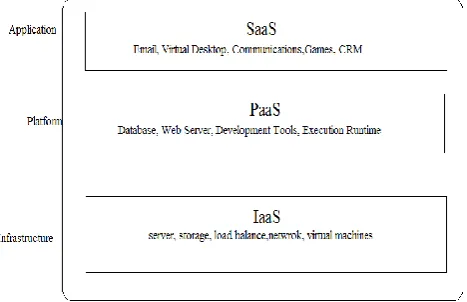
This is the most basic and common service model. It provides physical and virtual machines and computer. In this model, cloud user maintains operating system and applications. The IaaS model is generally used to
included services which are linked to computer resources, communication channel and data storage.
Example: E-mail, Virtual desktop, games etc.
B. PaaS:
It provides typically toolkit and standard for development. It generally provides computing platforms, operating system, databases and web server etc. It combines the environment for developing and provisioning cloud applications.
C. SaaS:
It is developed over internet. It is a type of delivery model where different software and data are hosted in cloud environment by a third party, which may be called as Cloud Service Provider. In SaaS the user access different applications and databases. It operates and install application and software in cloud and user access these easily.
Figure 2. Cloud Computing Service Models
IV. ISSUES IN CLOUD COMPUTING
A. Privacy Issues
In G-mail and Google, various kinds of privacy problems are faced in cloud computing.
B. Security Issues
C. Sustainability
Some primary environmental problems are also associated with cloud like energy use.
D. Portability:
The ability to move application and its data between public and private cloud environment.
V.
CLOUD COMPUTING ARCHITECTURE
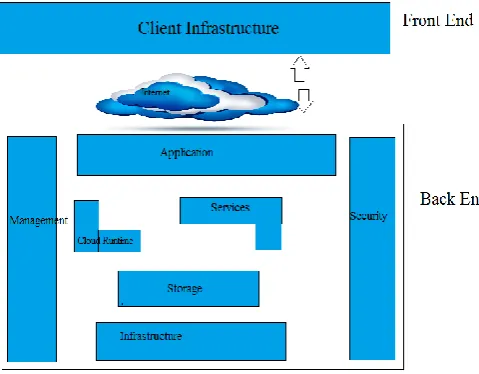
Cloud computing architecture is comprises of different components that are loosely coupled. These components are divided in to two parts in cloud computing architecture that are connected through a network, usually internet. These two ends of cloud computing architecture are explained as below:
A. Front End
This end refers to the client part of cloud computing. It consist mainly applications and interfaces that are required to access cloud computing platforms like Web Browser.
B. Back End
This end refers to the cloud itself. It mainly consist all resources that are needed to provide cloud-computing services. It contains data, information, storage, virtual machines, services, security mechanism, server and deployment models.
Figure 3: Cloud Computing Architecture
VI.
MOBILE CLOUD COMPUTING
Mobile Cloud Computing is the combination of mobile computing and cloud computing that includes hardware, software and communication for performing different operations like accessing information, storing data and running different applications on mobile devices. The focus of Mobile Cloud Computing is to provide accurate, real time and valuable information to the user or client. Due to large applications in internet, Mobile Cloud Computing has become a research topic of industrial and scientific research. The MCC application is becoming more popular day by day. The different MCC applications have been developed and served to mobile user like Gmail, Google Maps and navigation system for mobile voice search and android based applications. The main motive behind MCC is to deliver services, processing and software and increase storage, automating system, reduce cost and de-coupling different service delivery from underlying technology and give the flexibility and mobility for different purposes. It is simply the combination of cloud computing and web which is beneficial for mobile user to access services and application on internet.
Figure 4: Mobile Cloud Computing
VII.
MCC ARCHITECTURE
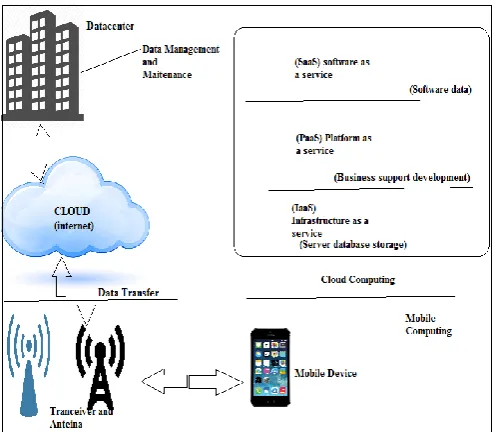
Figure 5: Architecture of Mobile Cloud Computing
The mobile devices like mobile phone, smart phones with mobile network with the help of access point /satellite and base station. The information is transferred from mobile device and information is operated on CPU, database and server on mobile network provider side. After that subscriber is requested to cloud with the help of internet and cloud process the request, navigate to corresponding cloud services to provide mobile subscribers. This architecture provides advantages of cloud computing. It is a rich mobile cloud computing technology that unified resources of cloud and different network technologies with functionality like mobility to serve mobile device from anywhere, anything with the help of Ethernet and internet with heterogeneous environment and environment, which have pay -as – you use principle.
VIII.
MOBILE CLOUD COMPUTING
ADVANTAGES
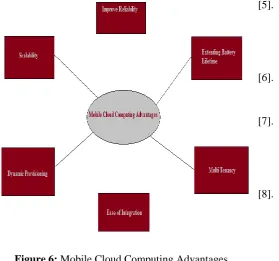
There are different reason like communication, mobility and portability that provides the solutions for mobile cloud computing. The advantages of cloud and mobile computing are combined by mobile cloud computing which provides optimal services to users. These advantages are explained as below:
A. Improving Reliability
computers. Therefore, the chance of application and data lost on mobile phones is decreased and reliability is increased ultimately.
B. Scalability
Internet services providers can be easily expand and increase the application and services with or without small constraint on the resource usage.
C. Dynamic Provisioning
It is a flexible method for mobile user and service provider to run their applications without any advanced reservations of different resources. We can easily store data on cloud dynamically without storing in mobile devices.
D. Ease of Integration
Different kinds of services from different services provider can be integrated very easily with the help of cloud and internet to fulfill the user requirements.
E. Multi-tenancy
Internet Service Provider like data centre owner and network operator can easily share the resources and cost that provide variety of applications and for numbers of users.
F. Extending Battery Lifetime
Figure 6: Mobile Cloud Computing Advantages
IX. CONCLUSION
Cloud computing is verity cheap way for users to access different resources and applications at same place. With the help of cloud, it is easier to access various application and software from longer distance. Cloud computing is safe to secure all resources and data of a user. Cloud computing provides us on– demand services by which user can easily access various applications at different locations and at low price.
X.
REFERENCES
[1]. Harshitha. K. Raj "A Survey on Cloud Computing" in International Journal of Advanced Research in Computer Science and Software Engineering, issues July 2014.
[2]. Palvinder Singh, Er. Anurag Jain "Survey Paper on Cloud Computing" in International Journal of innovations in Engineering and Technology, issues April 2014.
[3]. Pragya Gupta, Sudha Gupta "Mobile Cloud Computing: The Future of Cloud" in International Journal of Advanced Research in Electrical, Electronic Instrumentation Engineering, issues September 2012.
[4]. Han Qi Abdullah Gani "Research on Mobile Cloud Computing: Review, Trend and Perspectives" in IEEE, issues April 2013.
[5]. Ms. Snehal P. Warhekar, Prof. V.T. Gaikwad "Mobile Cloud Computing: Approaches and Issues" in International Journal of Emerging Trends and Technology in Computer Science, issues April 2014.
[6]. Han Qi Abdullah Gani "Research on Mobile Cloud Computing: Review, Trend and Perspectives" in IEEE, issues April 2013.
[7]. Ms. Snehal P. Warhekar, Prof. V.T. Gaikwad "Mobile Cloud Computing: Approaches and Issues" in International Journal of Emerging Trends and Technology in Computer Science, issues April 2014.
[8]. Karamjeet Kaur, Sugandha Sharma, Mayank Arora "Mobile Cloud Computing Techniques: A Review" in International Journal of Advanced Research in Computer Engineering and Technology, issues April 2014.
[9]. Palvinder Singh, Er. Anurag Jain "Survey Paper on Cloud Computing" in International Journal of Innovations in Engineering and Technology, issues April 2014.