
MASTER THESIS
BEHAVIOR SPECIFICATION
FOR ONTOLOGICALLY
GROUNDED CONCEPTUAL
MODELS
Ruud Wiegers
COMPUTER SCIENCE
SERVICES, CYBERSECURITY AND SAFETY
SUPERVISORS
dr. Luís Ferreira Pires
dr. João Paulo Almeida
dr.ir. Rom Langerak
Abstract
Conceptual modeling of a domain of interest is an important step in the design of information systems. To facilitate such an approach, suitable modeling languages have been developed, among which is OntoUML, a philosophically well-founded conceptual modeling language based on UML. However, OntoUML can be used to describe the structure of a domain, but it has not been designed to support the description of behavior.
This thesis discusses the development a language, named OBSL, for modeling behaviors of ele-ments of a domain, complementary to a structural specification. OBSL is designed to be expres-sive enough to cover most common behaviors, but the focus is placed on ease of use. It de-scribes behavior in terms of transitions between states, an abstraction that avoids the use of temporal logic. A graphical notation for OBSL is developed, according to a theory for diagram design aimed at cognitive effectiveness, resulting in diagrams that are intuitively appealing for modelers, and therefore relatively easy to understand.
The semantics of OBSL is expressed in Alloy, a logic-based modeling language that has also been used to express the semantics of OntoUML. An OBSL specification combined with its OntoUML model can be translated to an Alloy specification, which can then be used to simulate examples of the specified behaviors.
Acknowledgements
This thesis could not have been completed without the support of many people. I would like to thank the following people in particular:
Luís Ferreira Pires and João Paulo Andrade Almeida, my supervisors, who through many insight-ful Skype conversations have provided the feedback and guidance I required. Rom Langerak, my secondary supervisor, who has always shown enthusiasm and interest, even though this thesis lies outside his personal area of research. John, Tiago, and anyone else at NEMO who answered my questions about OntoUML and related material. Ivan Kurtev, who supervised my research topics, for sparking my interest in Model Driven Engineering, which started me on the road that led to this thesis. My parents Frans and Mirjam, and my sister Ineke, for their patience and quiet support. And finally, Irana, whose loving support has helped me through every phase of the lengthy process of completing my studies.
Thank you.
6.5 Discussion ... 54
7 Implementation ... 55
7.1 Eclipse Modeling Framework ... 55
7.2 OntoUML Infrastructure ... 55
7.3 OBSL Tool Infrastructure ... 56
7.4 OBSL ... 57
7.5 Editor ... 57
7.6 Transformation to Alloy... 58
7.7 Discussion ... 59
8 Case Study ... 60
8.1 Domain model ... 60
8.2 Behavior specification in OBSL ... 61
8.3 Representation in Alloy ... 64
8.4 Simulation ... 64
8.5 Discussion ... 66
9 Conclusions ... 68
9.1 Contribution ... 68
9.2 Future Work ... 68
8
multiple worlds representing past, future, and possible worlds. The resulting simulations are suffi-cient to show alethic properties of domain elements.
The use of complete temporal structures as examples invites a modeler to read it not only as a repre-sentation of the alethic properties of the structural conceptual model, but as a reprerepre-sentation of the dynamic aspects of the domain represented by the conceptual model. The lack of expressivity of OntoUML regarding these dynamic aspects means it is not possible to describe the behavior of the domain entities in the conceptual model in sufficient detail. For example, consider a domain which includes people, which may be either children or adults. OntoUML is capable of modeling these con-cepts, but it cannot express the domain-specific constraint that persons cannot be children after being adults. Therefore, example models may show a person as an adult in one moment, and as a child the next. Such an example model appears to represent behavior, and specifically behavior that does not match the domain being modeled.
1.2
Goals
This thesis aims to remedy the limitations of OntoUML concerning the representation of behaviors by developing a language for modeling the dynamic aspects of elements of a domain. The resulting be-havioral models will be complementary to conceptual models created with OntoUML. The formaliza-tion of these behavioral models will be compatible with the OntoUML models they are based on, and will be usable by the model simulator when generating examples. In this way, the purpose of the model simulator is extended: an example model will not only represent the structural and alethic properties of entities in a domain, but will also include their dynamic aspects.
9 In summary, the research goals of this thesis are:
1. To identify how dynamic aspects of a domain can be represented in a conceptual model, in a way that is complementary to a (static) conceptual model.
a. To describe the distinction between static and dynamic aspects in conceptual model-ing.
b. To describe the limits of OntoUML with respect to describing dynamic aspects. c. To define a modeling language capable of modeling these aspects in complementary
to static conceptual models defined in OntoUML.
2. To examine methods by which the cognitive effectiveness of a conceptual modeling language can be enhanced.
a. To examine the effectiveness of a language which has limited expressivity (i.e., can we define a language that do not require the user to understand formal logic?) b. To examine the advantages of a suitable visual notation.
c. To describe ways in which integration with OntoUML’s infrastructure, particularly the model simulator, can be used to enhance the modeling process.
3. To create a prototype as a proof-of-concept for the language and the elements of its design. a. Develop a visual editor.
b. Develop integration with OntoUML domain models and their simulation with the model simulator.
1.3
Approach
In order to achieve the goals as presented, we take the following approach:
1. To identify how dynamic aspects of conceptual models can be represented, we first examine the existing work on conceptual modeling, focusing on OntoUML, and its model simulator in particular.
2. The results of this analysis are used to design a modeling language for the behavior of con-ceptual models. Integration with OntoUML is achieved by basing the formal semantics of our modeling language on the semantics defined for OntoUML.
3. To create an appropriate visual representation for this language, we utilize a theory for visual notations developed in [8].
10
1.4
Structure
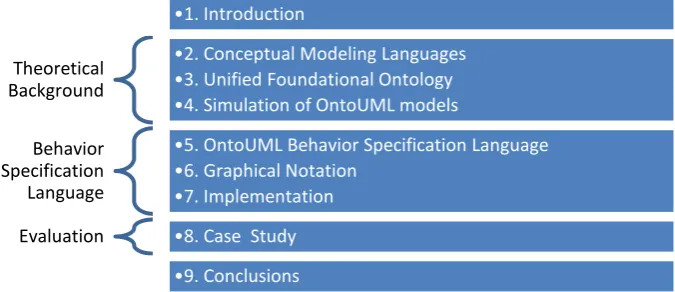
This thesis is further structured as follows: Chapter 1.2 presents the theoretical foundations of con-ceptual modeling. Chapter 3 presents the structure of UFO, the foundation of OntoUML. Chapter 4 discusses the model simulator and the issues with respect to dynamic aspects of conceptual models in OntoUML. Chapter 5 presents the language we developed to allow the specification of behaviors of OntoUML models. Chapter 6 discusses the graphical notation for this behavior specification lan-guage. Chapter 5.5 describes a tool to create, manage and simulate behavior specifications. Chapter 7 evaluates the approach by means of a case study.
Figure 1 summarizes the structure of this thesis.
Figure 1: Thesis structure •1. Introduction
Theoretical Background
•2. Conceptual Modeling Languages •3. Unified Foundational Ontology •4. Simulation of OntoUML models Behavior
Specification Language
•5. OntoUML Behavior Specification Language •6. Graphical Notation
•7. Implementation Evaluation •8. Case Study
12
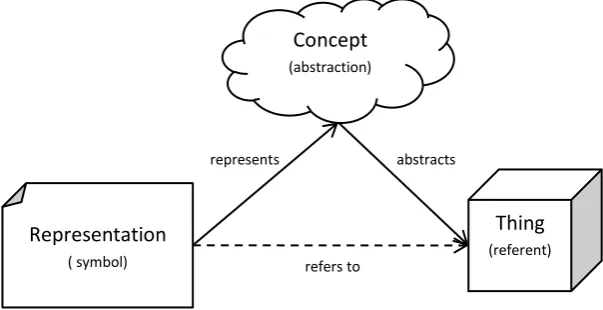
To illustrate this definition, consider the statement “There is a person called John, who owns a red car”. This is a conceptual model of a situation (according to our definition), since it is a representation
of concepts, in the form of a sentence in the English language. This sentence represents the concepts
of John, people, cars, the color red, and their relations. These concepts are mental structures, which exist in the minds of people, such as the reader and writer of the statement that represents this con-ceptualization. The conceptualization is an abstraction of reality itself, focusing on those aspects that are deemed relevant by the creator of the conceptualization. In this case, the name of the person that owns the car is included in the conceptualization, but not his age, physical location, etc.
What separates conceptual models from sentences in natural language is that conceptual models are meant to be formal descriptions, i.e., conceptual models are intended to have well-defined seman-tics. In Computer Science, this generally means that their semantics are defined in a mathematical or logical structure such as first-order logic. This definition is called the formalization or axiomatization
of the conceptual modeling language. While the intent of the formalization is to provide semantics, the use of a formalization also allows automation to be applied to the conceptual model (see Section 2.4.1).
13
2.2
Conceptualizations and Ontologies
In Computer science, conceptual models of domains are traditionally called ontologies [4], which are related to the philosophical field of Ontology, the study of what exists. In Philosophy, the term ‘on-tology’ is generally used to refer to a classification or description of domain-independent aspects of entities (e.g., the nature of identity, types, properties, part-whole relations, and so on). In Computer Science, ‘ontology’ often refers to a classification or description of what exists in the particular do-main that is being modeled. To distinguish these, we call the former foundational ontologies, and the latter domain ontologies.
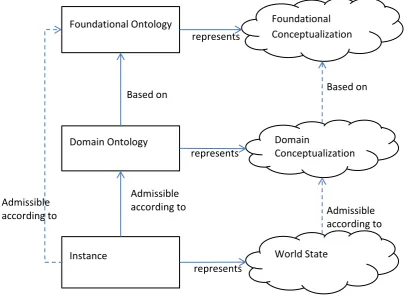
The relation between ontologies and individual entities in a domain can be expressed as follows: both foundational and domain ontologies define a set of world states that are valid according to the ontology. A world state refers to a configuration of individual entities in the domain (see Figure 3).
Figure 3: Sets of admissible world states according to different ontologies [11]
In [3,4], the authors argue that in order to achieve its goals of being a suitable and clear representa-tion of a domain, a domain ontology should be based on a foundarepresenta-tional ontology. For example, con-sider a domain ontology that describes cars, people, roads, cities, drivers, passengers, and their rela-tions. A world state in which John is driving a red Volkswagen Beetle from Enschede to Amsterdam is admissible according to this ontology. This domain ontology should be based on
independent concepts, such as kinds and roles. A foundational ontology captures the
16
putational complexity of automated reasoning tasks, and the performance and tractability of these tasks.
OntoUML favors language expressivity over performance. Other conceptual modeling languages, such as Z [12] and the Web Ontology Language [13], aim at enabling automated reasoning, and have been designed with a simple formalization as an explicit criterion.
2.4.2 Implementation domain concerns
Some modeling languages are created with explicit implementation concerns. ER diagrams [14], for example, are intended to be used as a conceptual modeling language, but with the express purpose of modeling information systems and translating the model to a database design. This concern im-plies that ER diagrams favor the performance of an implementation over the accuracy of the repre-sentation.
2.4.3 User base
Some modeling languages have originally been developed for a different purpose, and have been co-opted for use as a conceptual modeling language. Generally, the constructs of the modeling language are related to the domain for which the language was originally intended, rather than the purpose of expressing real-world structures and phenomena. The most notable example is UML [5], which was originally developed to be a software design language.
17
3
Unified Foundational Ontology
This chapter presents the Unified Foundational Ontology (UFO) [4]. UFO is a foundational ontology, which is a conceptualization of the domain-independent aspects of reality. It is based on theories from Philosophy, Cognitive Science, Linguistics and Knowledge Representation, and it is designed for the purpose of conceptual modeling. It has been used to evaluate and redesign existing conceptual modeling languages, as well as to provide real-world semantics for their modeling constructs [15]. In [2], UFO has been used to redesign UML to make it more suitable for conceptual modeling, a process that resulted in OntoUML.
A basic understanding of UFO and the terminology that is used is required for understanding concep-tual models created with OntoUML. We outline the global structure of UFO as presented in [4]. Here we aim for a general understanding and therefore we omit some details. We illustrate the concepts with examples where necessary.
Section 3.1 explains the core concepts of UFO. Section 3.2 deals with the classification of substances, Section 3.3 with properties, and Section 3.4 with relations. Section 3.5 discusses UFO’s
implementation in OntoUML.
3.1
UFO core
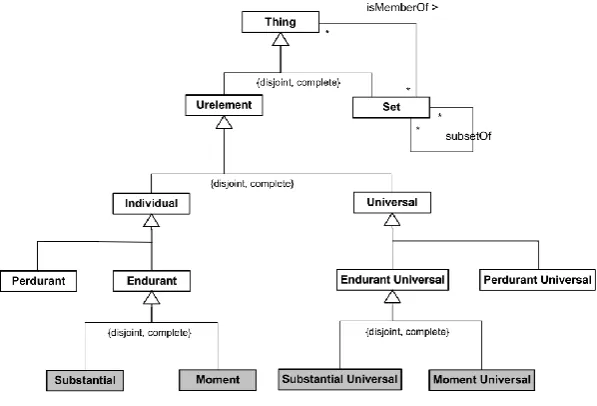
The Unified Foundational Ontology is a classification of the elements that make up reality into differ-ent categories. In this section, we briefly describe the principal categories of UFO, from most general to more specific. A further subdivision of the fundamental categories is found in the subsequent sec-tions.
Figure 5: Fundamental categories in UFO
19
3.2.1 Identity
The identity of a universal is defined with respect to an identity condition, a relationship defined between two individuals. If it holds, the two individuals are the same. Universals either carry an identity condition (inherit it from a generalization) or supply it. Each entity has only one identity condition.
‘Person’ is a universal that supplies an identity condition. ‘Man’ and ‘woman’, as types of person,
carry the identity, but do not supply their own.
3.2.2 Rigidity
Rigidity is a metaproperty, as described in [6]. In OntoUML, rigidity is a property of universals. A universal is rigid if it is essential to all its instances. A universal is nonrigid if it is essential to some but not all instances. A universal is antirigid if it is not essential to any instance. A universal is essential to an individual if and only if whenever the individual exists, it is an instance of that universal.
‘Person’is an example of a rigid universal. Persons are always persons, and an entity cannot cease to be a person without ceasing to exist altogether. ‘Student’is an antirigid universal. Every student instance is not essentially a student, i.e., all students can start or stop being a ‘student’ at some point, while still continuing to exist. ‘Things you can sit on’ is an example of a nonrigid universal. It is essential to individual ‘chairs’: if you can’t sit in a chair, it is no longer a chair. Crates or suitcases can also be used for sitting on, but this is not an essential property of these things.
3.2.3 Substantial universals
Figure 3 shows the classification of substantial universals as defined by UFO, according to the princi-ples of identity and rigidity. Instances of these categories adhere to additional rules specifying how they may relate to other universals.
Figure 6: Substances in UFO. The categories used in OntoUML are marked in grey.
sub-20
stance sortals that are whole and singular, such as person, car, and planet. Quantities are nominali-zations of amounts of matter like water, sand, sugar, martini and wine. Their identity does notchange when adding or removing some amount. Collectives are representations of collections in general, such as a forest, a deck of cards, a pile of bricks and a pack of wolves. Subkinds are types of Sortal that specialize other rigid sortals, e.g., man and woman, truck, van and sports car.
Phases and Roles, which are the two types of antirigid sortals defined in UFO, represent temporary aspects of the sortals they specialize. Phases represent possible stages in the history of a substance sortal. For example, ‘alive’ and ‘deceased’ are possible stages of a Person. Phases form a partition of the substance sortal they specialize, based on intrinsic properties of that sortal. Roles represent tem-porary aspects of rigid sortals based on properties that relate the sortal to external entities. For ex-ample, Student is a role played by a person that relates them to another entity, such as a University.
Mixins are the bearers of properties that apply to dispersive types, i.e., types that are not related by a grouping principle of identity. Categories are rigid types that represent essential properties that are common to all their instances. An example is ‘Legal Entity’, which may apply to both persons and organizations. Role Mixins represent abstractions of common properties of roles. Mixins represent properties that are essential to some of its instances and accidental to others. For example, ‘thing you can sit on’ is essential to chairs and accidental to crates.
3.3
Moments
Moments are endurants that inhere in other endurants. They are the endurants that are ‘about’ oth-er endurants, which in some way describe the endurant they inhere in.
Using several key distinctions, UFO classifies moments into categories (Figure 7). Moments that in-here in one endurant are intrinsic moments. Intrinsic moments are further divided into qualities and
modes. Relators are a type of moment that inheres in more than one endurant.
21 The simplest type of intrinsic moment is quality. A quality is an attribute of an endurant that is meas-urable in some way. More precisely, a quality is an individual intrinsic moment inhering in an individ-ual endurant that describes that endurant by relating it to a quale on a quality structure. For exam-ple, ‘the weight of John’ is a quality inhering in ‘John’ that relates John to the quale ‘75kg’on the quality dimension ‘weight in kg’.
There are two kinds of quality structures: the quality dimension and the quality domain. A quality dimension is a set of values that represent a measurement of a single quality (e.g., the positive real numbers for a temperature scale, kg for weight, a 1-10 value for bitterness). Two quality dimensions are called integral when one cannot assign a value to a quality on one dimension without assigning it to the other (e.g., hue, saturation, and brightness, when considering color). Otherwise, two dimen-sions are separable. A group of integral quality dimensions that are separable from all other dimen-sions form a quality domain. For example, HSB is a quality domain for Color. A particular value on a quality structure is called a quale.
In the realm of individuals, we speak of an individual endurant bearing a quality that is represented by a quale. In the realm of universals, we speak of an endurant universalcharacterized by a quality universal that is associated with a quality structure. An example of these relations is shown in Figure 8.
Figure 8: Example of a quality
There can be multiple quality structures used to represent a quality. The quality of Color, for exam-ple, can be represented using a wide variety of quality domains, such as the RGB, CYMK, or CIE 1931 color spaces, or even a set of colors such as ‘red’, ‘orange’, ‘yellow’, etc.
Modes are another type of intrinsic moment. Modes cannot be described by a single quality struc-ture, but can be conceptualized by multiple separable quality structures. Examples include beliefs, desires, intentions, perceptions, symptoms and skills. Modes can bear other intrinsic moments, so they may be described by a group of separate qualities.
23 tion relations (e.g., a kind may not specialize another kind, a phase must specialize a sortal), and the-se are included in OntoUML.
Figure 9: A fragment of the representation of UFO substances in OntoUML, as specializations of the UML Class [4]
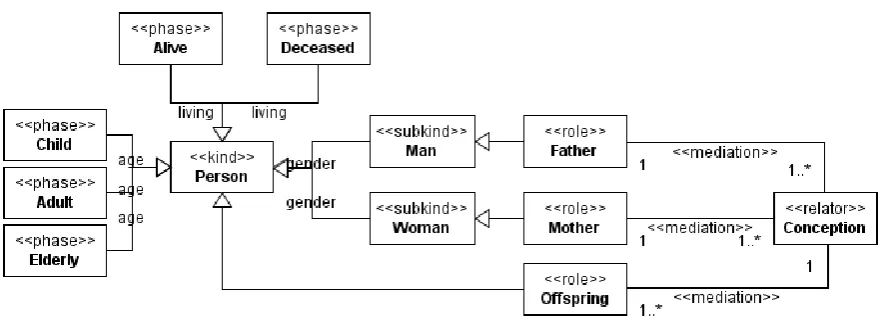
Figure 10 shows an example domain model described with OntoUML: a family tree. The model con-tains one kind, person. A person can be either a man or a woman, modeled as subkinds. The age of a person is partitioned into three phases. Finally, persons can be either alive or deceased. Persons are related to other persons through conception relators. With respect to these relators, they can play the role of father, mother, or offspring. Elements of this domain ontology are used as examples throughout the remainder of this work.
28
We discern three categories of dynamic aspects: temporal entities, perdurants, and behavior of en-durants. The following sections discuss each of these categories,their treatment in OntoUML and its representation in Alloy.
4.4.1 Temporal entities
Fundamental to the notion of dynamic aspect is the structure of time in which these aspects occur. In order to be able to describe dynamic aspects, a conceptualization of time is required.
There are many possible conceptualizations of time. Time can be expressed in numerical terms, using timestamps. Time can also be expressed using intervals and the relations between them, describing situations that overlap, occur consecutively, or are disjoint. Examples are the category of Chronoids in the ontology GOL [18], and Allen’s interval algebra [19].
The notion of time used by OntoUML/Alloy is described in Section 4.3. Additional constraints exist, which enforce that “all entities must be continuous in time”. A person cannot exist today, then dis-appear tomorrow, then exist again next week. OntoUML/Alloy’s definition of histories constrains the set of admissible histories: a history with two Present Worlds is inadmissible, as are cycles, or a fu-ture world preceding a past world.
The structure of histories forms the basis of the definition of other dynamic aspects. In
On-toUML/Alloy, these constraints exist at the level of the modeling language, and a modeler of domain ontologies cannot directly interact with this temporal structure.
4.4.2 Perdurants
Perdurants are discussed in Chapter 3: they are entities that happen in time. They cannot be fully described by a snapshot of a single moment. Examples of perdurants are events, processes, and ac-tions.
Foundational Ontologies like UFO-B and GFO classify entities of this kind. OntoUML contains no ex-plicit account of perdurants, so it is not possible to directly represent these in a domain ontology with OntoUML. However, OntoUML’s relators can be interpreted as an indirect representation of perdurants. For example, a relator that connects a student to a university can be interpreted as a representation of the process of that student’s studies at that university. Alternatively, the creation of a relator can be interpreted as being caused by an event: an “ownership” relation between a per-son and a car may be caused by a sale event.
30
models in time creates expectations about the capabilities of OntoUML to express time-related as-pects of a domain, something OntoUML was not designed to do.
32
of phases as changes between the different phases of a partition, as opposed to a pair of linked crea-tion/deletion behaviors.
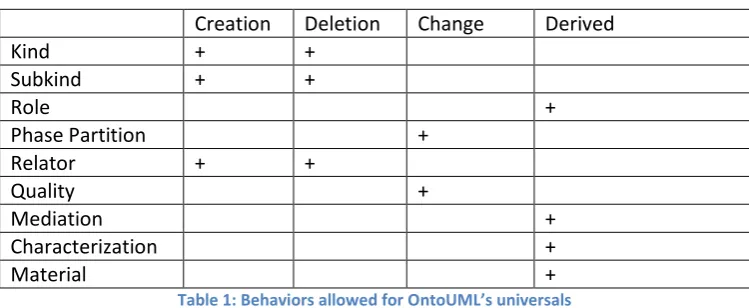
According to UFO, phases are derived purely from intrinsic qualities of the sortal that bears them (i.e., the child/adult/elderly phases can be derived from an age quality). If that were the case, behav-ior of phases should be specified in terms of this derivation, instead of behavbehav-ioral rules. However, in practice, it is not always the case that we wish to express the derivation of a phase. For example, the precise derivation of the alive/deceased phases (in medical terms) is irrelevant for most models deal-ing with persons, even though the notion of the phases themselves is relevant. For this reason, we choose not to model the derivation of phases from intrinsic qualities.
The behavior of roles is derived from the relator that mediates them. For example, a ‘father’ role exists when a ‘person’ participates in at least one ‘conception’ relator as a father. The role of ‘father’ follows from the existence of the relator.
As qualities are existentially dependent on their bearer, creation and deletion need not be modeled. We do model their admissible transitions (in terms of values).
Characterization and Mediation relations are formed and removed with their respective qualities and relators. Their behavior does not need to be modeled separately.
Table 1 summarizes the relation between universals and allowed types of behavior.
Creation Deletion Change Derived
Kind + +
Subkind + +
Role +
Phase Partition +
Relator + +
Quality +
Mediation +
Characterization +
Material +
Table 1: Behaviors allowed for OntoUML’s universals
35
5.3.1 Transition Rules
Using the concept of situations, OBSL defines the behavior of a domain entity using transition rules. A transition rule contains two situations: a before and after situation. A transition obtains in a pair of consecutive worlds if the before-situation obtains in the first world, and the after-situation obtains in the second world. In order to relate both situations, the rule defines the individuals that parameter-ize them. There are different types of rules for each domain entity.
For example, consider the behavior “Persons can change from children to adults.” This behavior is implemented as a transition rule containing the before-situation, in which a person is a child, and an after-situation, in which that person is an adult.
In Section 5.1, the types of behavior exhibited by each category of entity are summarized. A type of transition rule is defined for each of these behaviors.
For example, the example transition rule above is a phase change rule for the age phase partition. It necessarily includes an individual X, an instance of one phase in the before-situation and an instance of another phase in the after-situation, in which both phases are members of the age phase parti-tion.
5.3.2 Rulesets
The behavior of domain entities of an OntoUML model is described by rulesets, composed of a group of rules that is applicable to that domain entity. An OBSL specification contains one ruleset for each Kind, Subkind, Phase partition, Relator, and Quality that is present in an OntoUML model.
A ruleset governs the behavior of their respective entities, by specifying that for each instance of that entity, one of the transition rules obtains in each pair of consecutive worlds, or no behavior occurs. In other words, in each world, an individual may exhibit one of the applicable behaviors as defined by its ruleset, or it may transition into the next world without changing.
For example, consider the age phase partition, comprised of the phases child, adult and elderly. The ruleset that specifies the behavior contains two rules, one phase change rule that specifies the transi-tion from child to adult, and from adult to elderly. This means that whenever a person is in the child
38
5.4.3 Transition rules
A transition is represented by a predicate, parameterized by a pair of worlds w, w’ and an individual e, which represents the domain entity governed by the transition:
TransitionRulex(w, w’ ∈ W, e∈ E)
Equation 6: Predicate for transition rules
The transition rule defines the entities shared between both situations, existentially quantified. The rule is satisfied if there exist entities such that the before-situation (appropriate parameters) obtains in w, the after-situation obtains in w’.
5.4.4 Situations
Situations are also defined as predicates, parameterized by a world W and individual entities.
Situationx(w∈ W, p1∈ E,…, pn∈E)
Equation 7: Predicate for situations
In addition to the parameterized individuals, a situation may contain additional individuals, which only occur locally. These are existentially quantified.
∃ a1∈E,…, am∈E :
Equation 8: Quantification for local variables
The individuals bound in a situation are disjunct:
disjunct(p1,…, pn,a1,…, am)
Equation 9: Disjunct variables
A situation predicate is defined as a conjunction of the contents of the situation:
Classification of an individual: InstanceOfUniversal(w, ei)
A relation: AssociationObtains(w, ei, ej)
A subsituation: Situationy(w, … )with the appropriate individuals passed as parameters.
Some elements of a situation description may be defined in a negative form:
An individual stated to be absent: ¬Obtains(w,ei)
An individual not classified by a universal : ¬InstanceOfUniversal(w, ei)
40
5.4.5 Example
Consider a domain ontology containing the kind person and the phases child, adult and elderly. For these entities, we wish to define the behavior: “a person starts as a child”. This is formalized as:
RulesetForPerson: ∀w,w’ ∈W, w’ succeeds w, ∀e∈E : Exists(w, e) xor Exists(w’,e) →
PersonCreationRule (w, w’, e) ∨ PersonDeletionRule (w, w’, e)
PersonCreationRule (w, w∈ W’, e∈ E) : SNotPerson(w, e) ∧ SChild(w’,e) PersonDeletionRule (w, w’∈ W, e∈ E) : SPerson(w, e) ∧ SNotPerson(w’,e) SPerson(w, e) : InstanceOfPerson( w,e )
SNotPerson(w, e) : not(InstanceOfPerson( w,e ))
SChild(w, e) : InstanceOfPerson( w,e ) ∧ InstanceOfChild( w,e )
The behaviors “children can become adults” and “adults can become elderly” are behaviors that ap-ply to the age phase partition. They are formalized as:
RulesetForAge: ∀w,w’ ∈W, w’ succeeds w, ∀e∈E :
InstanceOfPerson(w, e) and InstanceOfPerson (w’,e) and not (
(InstanceOfChild(w, e) and InstanceOfChild (w’,e)) or(InstanceOfAdult(w, e) and InstanceOfAdult(w’,e)) or(InstanceOfElderly(w, e) and InstanceOfElderly(w’,e)) ) →
AgeChangeRule1 (w, w’, e) ∨ AgeChangeRule2 (w, w’, e)
AgeChangeRule1 (w, w∈ W’, e∈ E) : SChild(w, e) ∧ SAdult(w’,e) AgeChangeRule2 (w, w∈ W’, e∈ E) : SAdult(w, e) ∧ SElderly(w’,e)
43 closer to that of the original OntoUML model. There are some exceptions however (phases, quali-ties), and the modeler should be aware of this.
Because OBSL defines behavior as occurring between a pair of consecutive worlds, a behavior speci-fication does not constrain the state of the initial world of a history. This may cause the initial world to contain a situation that is not reachable through applying the behavior specification on an empty first world. It is difficult to alter OBSL’s or OntoUML’s semantics such that this is prevented. A possi-ble solution could be to constrain histories such that the initial world must be empty. However, the consequence is that generated histories will increase in size. The ‘initial state’ required to simulate a particular behavior can currently be achieved in a single world. If the first world of a history is re-quired to be empty, it may take several consecutive worlds to arrive at the same initial state. This increase in complexity of the simulation may negatively impact performance.
5.5.5 Ontological concerns
OBSL’s transition rules are not intended to have any ontological status themselves. They merely con-strain the behavior of the entities they describe. For example, consider the kind person with phases
alive and deceased. An OBSL phase change rule from alive to dead should not be interpreted as the specification of a death event. Rather, because alive and dead are phases, they are derived from in-trinsic qualities of person. If these qualities are to be specified directly, this should be done in On-toUML. The function of OBSL is to say, in absence of an explicit definition of these qualities, they are constrained by OBSL such that the resultant behavior from those qualities is compatible with the behavior described by the OBSL.
It is possible to define behavior in OBSL that is incompatible with the dynamic aspects of categories as defined by OntoUML. For example, a specification without phase change rules for a phase parti-tion results in the phases of that partiparti-tion being effectively rigid, which contradicts OntoUML’s defini-tion of phases. Fortunately, using explicit visualizadefini-tion of anti-rigidity for OntoUML, it is possible to detect these incompatibilities.
44
6
Graphical notation
One of the key characteristics of our approach is clarity of the behavior specification, both while signing it as while reading it. A suitable visual notation is a great aid in this process. This chapter de-scribes the visual notation developed for OBSL.
Section 6.1 presents a theory for the creation of effective visual notations, which was used as a guide for developing OBSL. Section 6.2 presents the basic components of OBSL’s visual notation, which are the symbols used to represent situations. Section 6.3 presents the structures aggregating these sym-bols into situations, behavioral rules and the complete behavior specification. Section 6.4 presents the visual notation for different types of negation. Section 6.5 provides a discussion of the properties of the resulting visual notation.
6.1
Background
In [8] the author defines a theory for the design of effective visual notations. This work is extensively sourced, and is based on research in a wide variety of fields, including communication, semiotics, graphic design, visual perception, and cognitive psychology. For a detailed discussion of this theory, we refer to the paper. The conclusions and recommendations proposed by this theory are helpfully codified in a set of nine design principles. The following sections summarize these principles.
6.1.1 Semiotic Clarity
An effective visual notation requires a 1-to-1 correspondence between elements of the visualization and the semantic constructs they represent. This principle is based on the same theoretical frame-work as OntoUML’s (see section 2.3.1), but applied to visual notations instead of ontologies. The concepts are equivalent: mismatches between visualization and underlying semantics are classified as symbol excess, overload, redundancy or deficit, and the resulting issues are similar to those for ontologies.
The exception is formed by symbol deficit, since in visual notations it is often desirable to limit the complexity of diagrams. Not all language constructs should be represented in a visualization, espe-cially when dealing with languages that have a lot of constructs.
6.1.2 Perceptual Discriminability
45 Figure 14: Visual variables [8]
A few factors further influence discriminability. First, the shape of symbols is the prime variable used to distinguish symbols. Second, by separating symbols along multiple variables (called redundant coding), they become more easily distinguishable. Third, by giving each symbol a unique value for at least one visual variable, they can be more readily identified. Finally, text is not a visual variable, and text is not a suitable method to use distinguish different symbol types. However, text canbe used to distinguish individual symbols of the same type.
6.1.3 Semantic Transparency
By using symbols whose appearance indicates their meaning, they are more easily interpreted cor-rectly. This can be applied to icons as well as relationships. Again, shape is the primary variable used to identify symbols.
Icons can use resemblance (a bull’s-eye for ‘Target’), common properties (Venn diagrams to show overlap), or metaphor (a thrash can for ‘Delete’).
Relationships can be represented using arrows, but also containment, overlapping symbols, or spatial location. The restrictions imposed by the choice of representation should correspond to those of the semantics (e.g., containment cannot be used to represent multiple inheritance).
A symbol that is a suitable mnemonic for what it represents (its meaning) is called semantically im-mediate. A symbol that offers no indication of its meaning, and thus requires memorization, is called
semantically opaque. Finally, a symbol that has a different meaning than its appearance suggests is called semanticallyperverse.
6.1.4 Complexity Management
It is difficult to interpret an entire specification displayed in a single diagram. By including mecha-nisms to deal with the complexity of diagrams, they become more readily understandable.
Two key mechanisms are modularization and the use of hierarchies. Modularization covers the de-composition of a visual notation into separate, smaller diagrams. The use of hierarchies covers the organization of these diagrams into a structure. By summarizing diagrams in a higher-level visual notation, complexity is managed and a system can be understood in a top-down manner.
47
6.2
Domain Elements
As a starting point for the examination of OBSL’s visual notation, we examine its basic components, namely the representation of the contents of a situation.
6.2.1 Atomic Symbols
A situation description contains two categories of elements: Individuals corresponding to the Univer-sals defined in an OntoUML domain ontology, and relationships that link these elements.
The Individuals we consider are instances of kinds, subkinds, phases, roles, qualities, modes, and relators. They can be related by generalization, characterization, mediation, and material association.
The individual types can be classified according to their category, distinguishing between substances and moments, considering rigidity, and considering the difference between inherent and mutual moments. By aligning the visual distance of elements with this hierarchy, the visualization conforms to the intuition of the modeler.
Category Inherence Rigidity Mutuality Complexity
Kind Substance Rigid Intrinsic
Subkind
Phase Antirigid Intrinsic
Role Mutual
Relator Moment Rigid Mutual
Mode Antirigid Intrinsic Simple
Quality Complex
Table 2: OntoUML categories and their properties
Figure 15: OBSL symbols for individuals
We aim at achieving semantic immediacy in that aspects of certain shapes are suggestive of their properties:
Solid square shapes for Kinds;
Phases are represented by a crescent shape, which is intended to relate to lunar phases;
Color is used to distinguish substances from moments;
Relator Mode Quality
49 lating the respective universals. As an additional constraint, we strive to keep the arrows that repre-sent this relationship short, keeping the relata closely together in the diagram.
6.2.3 Qualities and characterization
The characterization relation between modes or qualities and their bearers, is represented by a solid arrow (Figure 17).
Figure 17: Representing qualities and modes
6.2.4 Mediation between relators and roles
A role represents an individual-as-a-participant in a certain type of material association. For example, the father role represents an individual that is a father of some child. Where the role represents the individual in the general sense, the relator represents the participating individuals with respect to that particular relator, since a relator represents the qua individuals of the participants.
Relators are the bridging element between different individuals in a situation. To represent the dis-tance of the connection, we use a lighter line thickness, and a dotted line instead of the solid line used for identity and characterization.
Figure 18: Mediation relations in OBSL
6.3
Situations, Rules, and Rule sets
Situations are a partial description of the state of a world. They consist of individuals and relations that together form a pattern, which should or should not be met by world states). In OBSL, Situations are represented by rounded rectangles. A situation is described by means of its domain elements, which are represented inside the symbol (rounded rectangle) that denotes the situation.
A transition rule consists of two such situations, a before- and after-situation, linked through a transi-tion. The situations have a textual label. Because the direction of time is generally conceived of as
Car
Damaged Damage age
age
Car
Rental RentalCar
Person
50
moving from left to right, the two situations that comprise a transition rule are ordered in this way, with the before-situation to the left, and the after-situation to the right.
The two situations of a transition rule are linked through elements that occur in both situations. Each transition rule has one defining individual, the individual that represents the type whose behavior is being defined. This entity is represented in both worlds, and linked through a broad dashed arrow. right. This link represents the flow of time from the before-situation to the after-situation.
Other elements that occur in both situations are linked through lighter, less broad dashed lines. To represent these elements as parameters of the situations they occur in, this parameterization is rep-resented explicitly by a colored square.
The transition rule itself is displayed as a simple rectangle, with a background color that denotes the type of transition rule (green for creation, red for deletion, and blue for change).
A rule set is denoted by a grey rectangle, with the label denoting the Universal whose behavior is being described, and its category.
Figure 19 shows an example of a representation of a rule set.
51
6.4
Representing absence or negation
There are multiple situations in which the notion of negation needs to be represented in OBSL. These are modeled as discussed below.
6.4.1 Absence of specialization
A substance individual may be classified by a universal, but not by a particular universal that is a spe-cialization of that universal. The absence of the specializing individual is represented by using the red color to denote the specialization relation, the outline and the label of the specializing classifier. Ad-ditionally, the label is prefixed with ‘not’ (see Figure 20).
Figure 20: Absence of an aspect (phase, role, or subkind)
6.4.2 Future or past absence
An individual may be present in one of the two worlds, but not in the other. This is defined by repre-senting the individual in one situation, and linking it to a symbol for absence that is shown in the preceding or following situation (see Figure 21).
Figure 21: An individual that is present in one world, but not the other
6.4.3 Complex conditions
Sometimes we need to represent more complex conditions for behaviors that involve negation. To represent those conditions, OBSL uses sub-situations. The section of the condition that is negated is presented as a negated sub-situation, and the parent situation obtains if the sub-situation does not.
We represent the sub-situation as a red-bordered rectangle, labeled ‘not’. Again, we use a dashed line with an explicit parameter marker on the situation border to represent a relation across situation borders.
Figure 22 provides an example of such a complex condition. It shows the visual representation of the situation where “there is a car that is under maintenance, and there is a garage, but it does not hold that this car is under maintenance in that particular garage.”
52
Figure 22: Example of negation through use of a sub-situation
This representation of negation is rather verbose, as classifiers in the sub-situation are linked to those in the parent situation through parameters, requiring the duplication of entities (in the exam-ple, CarUnderMaintenance and Garage). However, this verbosity is intentional. By forcing the model-er to explicitly and vmodel-erbosely describe which classifimodel-ers obtain and which classifimodel-ers are part of the situation that must not obtain, the meaning of the specification is expect to be clearer.
By moving elements of the specification into the sub-situation, it is possible to make fewer claims about the nature of the individuals. For example, if we move all roles into the sub-situation, the situ-ation obtains if “There is a car and there is a building, but it is not the case that the car is under maintenance in that building”
6.4.4 Negation of relations
Finally, we consider the representation of negation of relations, namely generalization, characteriza-tion, mediacharacteriza-tion, and material relations. Our analysis shows that including these options would not be beneficial for the reasons that we discuss in the sequel.
Classifiers that are represented separately in a single situation are considered to be disjoint (i.e., they do not classify the same individual), unless explicitly related through (a transitive closure of) generali-zation relations. Therefore, a classifier is not a generaligenerali-zation of another classifier unless this general-ization is explicitly shown. There is no need to explicitly represent a negated generalization.
In the case of characterization, it is not possible to describe an intrinsic moment unless its bearer and the characterization relation are also represented. Since intrinsic moments inhere in a single bearer by definition, it follows that they do not inhere in any other individual than their bearer, and repre-senting the negation of the characterization relation is therefore not meaningful.
59
7.7
Discussion
OBSL is supported by a set of tools, namely a graphical editor, capabilities to process existing On-toUML models, and the capabilities to translate an OBSL specification to Alloy.
The transformation to an Alloy-based formalization integrates with the available formalization of OntoUML models [7], which provides the option to simulate domain models with the defined behav-ior. This helps modelers create a behavior specification that conforms to their intentions.
Our OBSL tools implementation is a prototype. The focus is on the core functionality and the clarity of the language and its visualization. Several issues remain unaddressed:
OBSL’s specifications are based on OntoUML models, and maintain a link to the original toUML specification. OBSL specifications are not resilient to changes to the underlying On-toUML models.
Robustness of the implementation has not been a focus of this prototype. The validation of model correctness through appropriate OCL constraints is an area for further work.
60
8
Case Study
This chapter illustrates the use of OBSL to define a behavior specification for a domain model. Sec-tion 8.1 describes the domain model. SecSec-tion 8.2 demonstrate the specificaSec-tion of behavior for this domain model, by proposing intended behavior, showing the specification in OBSL. Section 8.3 shows the representation of the behavior specification in Alloy. Section 8.4 shows a simulation of the be-havior specification. Section 8.5 discusses the issues encountered when defining this bebe-havior speci-fication.
8.1
Domain model
The domain model used in the case study models the renting of cars to people (see Figure 27). It contains four kinds:
Persons, who can rent cars;
Buildings, used for storage or maintenance of cars;
Companies, who may own cars and buildings;
Cars, which be damaged or undamaged (a complex quality represented as a mode), and may be used as a rental car by a company.
61
8.2
Behavior specification in OBSL
The following behavior is modeled for this domain ontology:
Cars only accrue damage when they are rented;
Cars can be repaired at a garage. They can only be sent to a garage when they are damaged, and can only leave when they have been repaired;
Only undamaged cars may be rented.
Persons are not created unless they are customers, and not deleted unless they are no long-er customlong-ers.
In order to focus the simulation on these particular behaviors, we have chosen not to define the cre-ation and deletion of cars, companies, buildings, etc. This means that when one of these entities exists in the history, they exist in every world of that history.
We describe the behavior specification for each universal in turn.
8.2.1 Persons
As an example of a simple set of behavior specification rules, we use the creation and deletion rules of the kind person. We specify the following behaviors:
When persons are created, they must play the role of customer.
Only persons that are no longer customers can be deleted.
The graphical notation for specifying these behaviors in OBSL is shown in Figure 28.
Figure 28: Behavior for persons
8.2.2 Non-changing individuals
Cars, buildings, and rental companies are defined as unchanging. The relators that relate a rental company to its cars and buildings are also defined this way. In OBSL, this means that no transition
62
Figure 29: Rule sets for Kinds and some relators
8.2.3 Phase Partition
The damage phase partition of car has the following behavior associated with it: a car may change from damaged to undamaged, or vice versa. This behavior is specified in OBSL as shown in Figure 30.
Figure 30: Behavior for a phase partition
8.2.4 Mode
The constraints on how damage can be accrued and removed are specified in the transition rules for the creation and deletion of the mode damage. The intended behavior is that damage can only occur when a car is being rented, and that damage can only be removed when a car is being maintained. This is specified in OBSL as shown in Figure 31.
63
8.2.5 Relators
The relators maintenance, Parking, and RentalContract together specify the more interesting behav-ior of the domain model.
The behavior for the RentalContract relator is specified as:
Only undamaged cars may be rented to customers;
The rental of a car may be terminated at any time.
These behaviors are expressed in OBSL as shown in Figure 32.
Figure 32: Behavior for the rental of a car
The behavior for the Maintenance relator is specified as:
Only damaged cars may be sent for maintenance;
Cars may only leave maintenance when undamaged.
These behaviors are expressed in OBSL as shown in Figure 33.
Figure 33: Behavior for the maintenance of cars
The behavior for the Parking relator is specified as:
Cars may be parked at any time;
65 We append this specification to the Alloy specification generated from the domain model. Using the Alloy Analyzer, we generate an example history from this specification. The result is shown in Figures 34-36.
Figure 35: Alloy simulation: Past world
Figure 36: Alloy Simulation: Current World
69 OBSL aims to describe behavior in simple terms, trading expressivity for ease of use. However, there are cases in which a modeler would need a more expressive language to describe behavior, e.g., when defining formal relations. Such a language for OntoUML, which is based on OCL enriched with temporal operators from CTL, is currently under development. It may be possible to integrate this language with OBSL, creating a hybrid approach in which OBSL is used to define the ‘groundwork’ of simple behaviors, and the more expressive language is used where necessary to define those behav-iors that cannot be expressed in OBSL.
70
References
[1] John Mylopoulos, "Conceptual Modeling and Telos," 1992.
[2] Olivé, Conceptual Modeling of Information Systems.: Springer-Verlag, 2007. [3] R Weber, Conceptual Modeling of Information Systems., 1997.
[4] Giancarlo Guizzardi, Ontological Foundations for Structural Conceptual Models., 2005. [5] Object Management Group. (2003) UML 2.0 Superstructure Specification. [Online].
http://www.omg.org/spec/UML/2.4.1/Superstructure/PDF/
[6] N. Guarino and C. Welty, "A Formal Ontology of Properties," in Proceedings of the ECAI-2000 workshop on Applications of Ontologies and Problem-Solving Methods., 2000.
[7] A.B. Benevides, G Guizzardi, B.B. Braga, and J.A. Almeida, "Validating Modal Aspects of OntoUML Conceptual Models Using Automatically Generated Visual World Structures," Journal of
Universal Computer Science, vol. 16, no. 20, pp. 2904-2933, 2010.
[8] D Moody, "The “Physics” of Notations: Toward a Scientific Basis for Constructing Visual
Notations in Software Engineering," IEEE Transactions on Sofware Engineering, vol. 35, no. 6, pp. 756-779, 2009.
[9] Eclipse Foundation. Eclipse. [Online]. http://www.eclipse.com
[10] Giancarlo Guizzardi, "On Ontology, ontologies, Conceptualizations, Modeling Languages, and (Meta)Models," in Databases and Information Systems IV, 2007, pp. 18-39.
[11] V. de Carvalho, JPA Almeida, and G. Guizzardi, "Using Reference Domain Ontologies to Define the Real-World Semantics of Domain-Specific Languages," in Advanced Information Systems Engineering, vol. 8484, Thessaloniki, 2014, pp. 488-502.
[12] J. M. ‘ Spivey, Understanding Z.: Cambridge University Press, 1988.
[13] I. Horrocks, P. Patel-Schneider, and F. van Harmelen, "From SHIQ and RDF to OWL: the making of a web ontology language," Journal of Web Semantics, vol. 1, no. 1, pp. 7-26, February 2003. [Online]. http://www.w3.org/TR/owl-ref/
[14] P. Chen, "The entity-relationship model: Towards a unified view of data," ACM Transactions on Database Systems, vol. 1, no. 1, 1976.
71 [16] Armstrong, Universals: An Opinionated Introduction., 1989.
[17] D Jackson, "Alloy: a Lightweight Object Modelling Notation," TOSEM (Transactions on Software Engineering and Methodology), vol. 2, no. 11, pp. 256-290, 2002.
[18] B. Henderson-Sellers, "Bridging metamodels and ontologies in software engineering," Journal of Systems and Software, vol. 2, no. 84, pp. 301-313, 2011.
[19] J Allen, "Maintaining knowledge about temporal intervals," Communications of the ACM, vol. 26, no. 11, pp. 832-843, November 1983.
[20] Object Management Group. Object Constraint Language. [Online]. www.omg.org/spec/OCL/2.2
[21] (2014, October) Eclipse QVTo. [Online]. http://www.eclipse.org/mmt/?project=qvto
[22] (2014, October) Sirius. [Online]. http://www.eclipse.org/sirius/
[23] (2014, October) Acceleo. [Online]. https://www.eclipse.org/acceleo/
[24] (2014, October) OntoUML Infrastructure. [Online]. https://code.google.com/p/rcarraretto/
[25] E.J. Lowe, The Four-Category Ontology: A Metaphysical Foundation for Natural Science. Oxford: Oxford University Press, 2006.
[26] Giancarlo Guizzardi, Gerd Wagner, Ricardo de Almeida Falbo, Renata S.S. Guizzardi, and João Paulo A. Almeida, "Towards Ontological Foundations for the Conceptual Modeling of Events," , 2013.
[27] S. Bechhofer et al. (2004, February) OWL Web Ontology Language Reference. [Online].
http://www.w3.org/TR/owl-ref/
[28] A.L. Opdahl and B. Henderson-Sellers, "Ontological Evaluation of the UM LUsing the Bunge– Wand–Weber Model," Software and Systems Modeling, vol. I, no. 1, pp. 43-67, 2002. [29] T. P. Sales, P. P. F. Bardcelos, and G Guizzardi, "Identification of Semantic Anti-Patterns in
Ontology-Driven Conceptual Modeling via Visual Simulation," in 4th International Workshop on Ontology-Driven Information Systems, 2012.


![Figure 12: The temporal ordering of worlds [7] (left), with an example instance (right)](https://thumb-us.123doks.com/thumbv2/123dok_us/1053945.1131741/28.595.80.469.292.408/figure-temporal-ordering-worlds-left-example-instance-right.webp)
![Figure 14: Visual variables [8]](https://thumb-us.123doks.com/thumbv2/123dok_us/1053945.1131741/46.595.167.429.72.193/figure-visual-variables.webp)
