Evaluating resource acquisition tools for Information Extraction
Thierry Poibeau*, Dominique Dutoit** and Sophie Bizouard***
* THALES RESEARCH AND TECHNOLOGY and LIPN Domaine de Corbeville, 91 404 Orsay, France
** MEMODATA and CRISCO
17, rue Dumont d’Urville, 14 000 Caen, France [email protected]
*** CRIM/INALCO
2, rue de Lille, 75007 Paris, France [email protected]
Abstract
This paper evaluates two different approaches for the elaboration of semantic classes. The framework is an Information Extraction, which needs large amount of domain-dependent resources. An endogenous approach (corpus-based learning) is contrasted with a heterogeneous one (the use of a large semantic network). The two techniques are evaluated.
Cet article vise à évaluer deux approches différentes pour la constitution de classes sémantiques. Nous nous plaçons dans la perspective d’une application d’extraction d’information, pour laquelle la notion de classe sémantique est primordiale. Une approche endogène (acquisition à partir d’un corpus) est contrastée avec une approche exogène (à travers un réseau sémantique riche). L’article présente une évaluation fine de ces deux techniques et leur complémentarité possible.
Keywords – Mots Clés
Semantic classes, Evaluation, Information Extraction, Resources, Semantic network
Classes sémantiques, Évaluation, Extraction d’information, Ressources, Réseau sémantique
1
Introduction: general resources vs.
specific resources
This paper presents an evaluation methodology applied to the elaboration of semantic classes. Our framework is Information Extraction: in this domain, one needs to develop extraction patterns (on the syntactic level) enriched with semantic classes (on the semantic level). In this introduction we consider the two main approaches that are commonly used to define semantic classes: the access to large general resources and the semi-automatic elaboration form a corpus analysis.
The utility of general resources has been disputed in the last few years. The main objections are enumerated in D. Dutoit’s thesis (Dutoit, 2000):
− General linguistic resources (especially large semantic networks) are rarely usable in context since they encode abstract data but not the main linguistic features specific of the domain to be addressed.
− Even if relevant information has been encoded, this information is lost among a
large set of irrelevant information. Finding and using the good information is then a difficult task.
− The information that has to be encoded is so large that the task is potentially infinite and, so, is doomed to failure (Victorri, 1998).
3.1 The
A
SIUMacquisition system
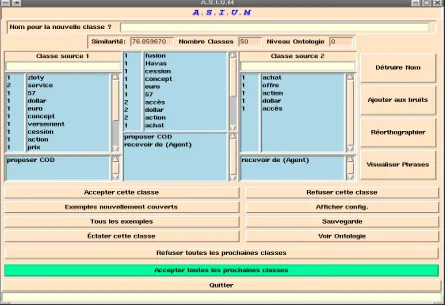
The ASIUM system provides knowledge acquired from unstructured texts that have previously been syntactically analyzed. The approach is based on a distributional analysis. ASIUM aims at providing to the analyst a set of classes relevant for the task he is doing and it also provides means to structures these classes into a domain ontology. This ontology gives a clear image of the relationships among classes.
Figure 1. The ASIUM system
The method is original in that it provides an interactive validation phase. The analysis rests on a distributional analysis that allows to generate classes of words appearing in similar contexts (the base classes). The similarity measure implemented in ASIUM gives a score for the coverage of a class compared to another one. The system then proposes to group together classes that have a similarity measure above a certain threshold (this threshold is empirically fixed by the expert). The base classes are progressively aggregated following a cooperative bottom-up method.
This classification process is not limited to lists of words appearing in similar contexts but it also extends these lists by induction. Indeed, from two classes C1 and C2 found in two different contexts CTXT1 and CTXT2, one can authorize non-attested sequences like CTXT1 C2 or CTXT2 C1. For example, imagine that acquisition and fusion belong to the same base class. Then, if procéder à une acquisition is a sequence present in the corpus, the system will infer that procéder à une fusion is also a valid sequence, even if it is not present in the corpus. The result is then a generalization of the knowledge base that can be directly inferred from the corpus.
ASIUM requires that a domain expert intervene to validate the results. This validation is done by examining each class, one by one, until the threshold is reached. Classes under the threshold are supposed to be non relevant and are automatically rejected by the system.
3.2 From unsupervised to supervised
methods
The validation phase is very important in the acquisition process designed in ASIUM. Given that the amount of data was reduced, the threshold that we retained to merge the base classes was low. The consequence is that the propositions from the system concerned classes having very few elements in common.
To solve this problem, we made two different experiments. In the first one, ASIUM is used as it. The propositions of the system are the result of an unsupervised process: they are solely based on the number of common elements between the different base classes. This strategy leads to an expensive validation task: the analyst needs to validate a large number of irrelevant items.
A second experiment then used a new function of ASIUM allowing to focalize the validation process on the sole classes containing words that are relevant for the domain. These words are defined by the analyst in a file that is then considered as a filter. For example, to find the semantic class
purchase_operations (Opération
d’achat), the filter contained the following set of words: achat, fusion, scission and for the class Company (Entreprise), the words: entreprise, société, filiale.
This strategy led us to the definition of a supervised strategy for ASIUM. Performances are then largely better, provided that the filter (i.e. the set of words initially defined by the analyst) is relevant. In function of the semantic class that the analyst wants to model, the filter has to change. There is here a subjectivity factor in our evaluation: elaborating a filter is, by definition, a subjective task that influences the quality of the results.
ten years a very compete network, the INTEGRAL DICTIONARY (le DICTIONNAIRE INTÉGRAL in French), together with a set of functionality and a programming interface (API). See (Dutoit, 2000).
4.1 The semantic network:
T
HEI
NTEGRALD
ICTIONARYand
associated tools
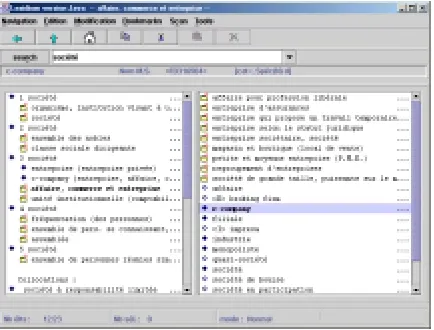
THE INTEGRAL DICTIONARY is the name of the semantic network developed by the French company Memodata. This network is inspired from the Text-Sense Theory from Igor 0HOþ¶XN7KHWKHRUHWLFDOEDVLVRIWKHGLFWLRQDU\ is the set of different senses associated with a word (a string of characters). The network is made of 186.000 word senses. From this point of view, the coverage of the network is comparable with that of Wordnet (Fellbaum, 1998). However, THE INTEGRAL DICTIONARY is very different when one observes its overall structure. The links between words are not only is-a links, they are not based on psychological assumptions. Instead, the analysis is based on a decomposition of words in a set of basic features called sèmes (in the framework of a componential analysis) that are structured through typed links.
Figure 2. The INTEGRAL DICTIONARY
The network is structured thanks to an important set of links between elements of different syntactic category, like in EUROWORDNET (Vossen, 1998). This aspect is especially important for the task we are interested in, given that we must find that the French words achat (a noun) as well as acheter (a verb) reflect the notion of acquisition. The coverage of the INTEGRAL DICTIONARY is
larger than the French EUROWORDNET. By the way, a part of the information contained inside
the French EUROWORDNET has been
automatically derived from MEMODATA’s resources (the rest of the French EUROWORDNET network has been produced by the University of Avignon, that was responsible of the French part of the project).
4.2 Criteria for the elaboration of
semantic classes
To elaborate semantic classes from a semantic network like the one from MEMODATA, the end-user must choose a keyword from the domain he is interested in and then query the linguistic base. A semantic class then progressively emerges when following the different links between elements in the semantic net.
In our experiment, we took into account all the words that were linked to the original keyword with one of the following typed links: generic, specific or synonym. The lexical class we obtain is then refined, so that we finally obtain an homogeneous and relevant semantic class (the analyst must essentially delete terms that are not relevant for the task or the domain. For example, in French, if the entry point (the initial keyword) is achat (purchase), the system will propose the following list of terms: abonnement, accaparement, acheter, acquérir, acquisition, appropriation, commande, prise de contrôle, prise de participation, préemption, téléachat… In this context of company purchasing other companies, the words abonnement and téléachat are irrelevant. They have to be manually discarded.
When we compare this approach with what we have previously done with ASIUM, we see that the end-user has no information about the representativeness of a word: the number of occurrences in the training corpus cannot be accessed. For the analyst, going back to the corpus to check the context is a too heavy and boring task. We will see in the next section that this can cause problem when dealing with the representativeness of the results.
(ACL’99), Université du Maryland, 1999, pp. 389–396.
VICTORRI B. – « La construction dynamique du sens ». In Actes du 11ème Congrès de Reconnaissance des Formes et Intelligence Artificielle (RFIA’1998), Clermont Ferrand, 1998, pp. 15–29.