CSEIT411804 | Published - 25 April 2018 | March-April-2018 [ (4 ) 1 : 22-27 ]
National Conference on Recent Advances in Computer Science and IT (NCRACIT)
International Journal of Scientific Research in Computer Science, Engineering and Information Technology
© 2018IJSRCSEIT | Volume 4 | Issue 1 | ISSN: 2456-3307
22
Cheater Detection Scheme for Dynamic Secret Key Generation
Sunil Dalal
1, Sangeeta Bhan
2, Susobhan Das
313Department of Information Technology BGSB University, Rajouri, J&K, India 2Computer Science and Engineering, Delhi Technological University, Delhi, India
[email protected], [email protected]2, [email protected]3
ABSTRACT
Any secret sharing scheme is considered to be strong if the complexity of cryptanalysis is very high. In cryptography the brutal attack is the type of attack in which all the possible keys of the algorithm are tried for obtaining the secret. Various types of cryptanalytic methods for a given scheme are compared with complexity of the brute force attack. If the complexity of various cryptanalytic attacks is of the same order as that of brute force attack, then the system is said to be computationally strong. In our method of dynamic multi-secret sharing the security analysis mainly depends upon the application of hash function to calculate C matrix and modular arithmetic over primitive element. In this paper, two methods are proposed which remove the need of secret share distribution by the dealer using secure channel and to find out the cheater in the group.
Keywords: Secret Key, Cheater Detection, Cryptanalysis.
I.
INTRODUCTION
In any kind of network [8] whether wired or wireless, communication reliability and security are two important issues, especially when networks are used in national security and safety critical applications. The secure and reliable way to send information on network [5] is to encrypt the information with the help of encryption algorithm and a secret key. So in this case we have to mainly protect the cryptographic [1] key in order to protect the encrypted data from disclosure as encryption algorithm is publically known due to limited in number and follow a definite pattern to encrypt data, so cryptanalysist can easily know about encryption algorithm [9]. The secure scheme keeps the key safe by putting it in single location but such a scheme is unreliable in case of a single misfortune occurs. To keep multiple copies of a key is also unsecure from
theft point of view. Here we need more robust secure way to protect the key and this can be done by sharing of the secret key/ Password using various schemes [7].
secret plan can be utilized. Many times this scheme is also not enough for giving the reliability such as we need to keep up a secret on-line. We can store the secret on server.
Therefore Lin-Yeh developed a dynamic multi secret sharing scheme that can be used, when we have to change the secret without need to change secret shares. Therefore this scheme is more capable to stop intruders. The cheaters are those who are shareholder in scheme or the dealer itself who is distributing wrong secret shares to users. In such cases, There should be a method for detect the cheater from good shareholders and also a method so that dealer not able to know about secret shares. Lin-Yeh scheme does not provide such kind of solution. We can apply here a verification process to detect the cheater and also the problem regarding dealer. Dynamic multi- secret sharing schemes includes secret shares selection by users themselves using modular arithmetic and verification can be done by calculating W matrix and publish it publically. Now the verification and cheater detection process take place.
II.
RELATED WORK
The Shamir’s Scheme [2] of Secret Sharing method consist of two stages, namely (a) Shares Generation Phase, (b) Secret Reconstruction Phase Steps followed in each of these stage as presented in are as follows:
A. Shares Generation Phase
1) Select the limit plot (k, n) for conveyance of secret and in view of estimation of k, compose a polynomial p(x) of degree k-1
2) It can be randomly chosen (k-1) degree i.e. polynomial according to mathematical equation, like q(x) = (a0 + a1x + ... +ak-1 xk-1) mod P a0 i.e. a0 is a value to be used for secret key. Select a constant value for a1, a2…ak-1.
3) Find more valuable result for modular arithmetic to be applied on GF(P) ,hence P is greater than (S, n). Here S = secret value that will be shared. 4) Select n diverse estimations of x to get the
distinctive estimations of y. The sets framed by gathering (y, x), are diverse offers for members. Appropriate these offers among the members.
B. Secret Reconstruction Phase
1) Gather k or more number of members share. 2) Utilizing Lagrange's introduction strategy, reproduce the secret. Secret from the interjection strategy is ascertained from this equation.
Here, put the value of x= 0 then formula is reduce t
q(0) provide the value of secret data. So, we can see that how one can distribute and
reconstruct the secret using Shamir’s secret sharing scheme.
III.
PROPOSED METHOD
In proposed method of Dynamic multi-secret sharing scheme employs hash function [10] and modular arithmetic concept on primitive element. In first proposed method modular arithmetic operation are applied on primitive elements. Master secret shares xj are choosing by user. Then user calculate yj using equation (yj = gxj mod p, where g is a primitive
element) and send this value to the dealer. The dealer can checks that no two users choose same secret shares by comparing their respective yj values he got from users. There is no secure channel is required by the dealer to distribute secret shares and users choose their master secret shares by themselves.
The proposed scheme called as “Cheater Detection scheme for Dynamic Secret Key Generation” consists of three stages namely (A) System initialization and construction stage (B) The Pseudo Secret Share Generation Stage (C) The Group Secret Reconstruction Stage The steps followed in each stage are as follow:
A. System Initialization and Construction Stage In the framework initialization phase the dealer D is select the accompanying parameters.
1) P: A vast prime number can have any value depend on number of client and group secrets value, p -> (group secrets, n).
2) g: The primary component upon GF (p).
3) h(.): The safe one-way hash function that acknowledges contributions of the any dimension i.e. creates a settled length input.
4) IDj : With respect to the client the value assigned to Identifiers is Uj (user) for j = 1 to n. here n is the number of clients which are having the secret share value.
B. The Pseudo Secret Share Generation Stage
Suppose there is a Dealer with name D that can share group i.e. k secrets (
), for i= 1 to k i.e n comparing to the privileged insights takes after f1(x) = S1 where f1 (0) = S1 themselves whose equation. that equation is polynomial to be computed and d1 to d(i-1) i.e.
4) Each user compute C_ij(pseudo secret share) by using hash function and master secret share .
C. The Group Secret Reconstruction Stage
the accompanying strides with the gathering secret merge.
1) To compute the pseudo secret share of every user Uj, for j = 1 to m, (condition is m ≤ n) as follows:
= ( ( ) ⊕ ) mod p and at that point it will post to the gathering secret merge over a protected channel.
The gathering secret combiner checks legitimacy of every member's pseudo secret share Cmj by the accompanying conditions:
= h ( ( ) ⊕ ) mod p.
If any user is cheating at the time of reconstruction of secret by giving wrong secret share then we can check by analyzing hash function on its share scheme and match it with respective value in W_ij matrix and find that secret share given is right or wrong. This cheater detection technique is not available in Lin Yeh method.
2) After accepting all Cmj, for j = 1 to m, effectively gathering secret combiner remakes the mth assemble secret Sm takes after: [4]
∑ ∏ MOD P.
As framework Rij is publically known in this way the gathering secret combiner get Rmj relating to the particular Cmj and IDj of the individual clients from Rij lattice (i.e. in the event that third secret is to be recreate and first, second and third clients are takes an interest in secret remaking then R3j have values R31, R32 and R33 taken from Rij lattice known publically).
Thusly one can disperse insider facts and remaking of privileged insights should be possible by utilizing above depict plans. The plan can be effectively
executed. In the event that another secret is to be included by merchant then he does not need to convey the ace secret shares among clients.
IV. RESULTS AND ANALYSIS
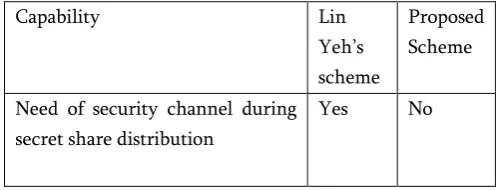
In Lin Yeh’s scheme the dealer has to select master secret shares xj where j=1 to n Where n is number of users) and master secrets Si i.e. i = 1 to k. where k is number of master secrets). Dealer distribute with the respective user’s j master secret shares xj over secure channel shown in Figure 1. Second, there is no method to verify the secret shares given by user at the time of secret reconstruction. Therefore, any user can give a wrong share to group secret combiner.
Dealer having master secret two schemes using various parameters discussed. How our scheme takes equal time as taken by Lin-Yeh’s scheme [4] but it provides more security with decrease in complexity level. Here, we introduce a method due to which even dealer cannot think of becoming a cheater. Various parameters are being discussed below in the Table 1.
Capability Lin as well as group secret combiner.
Yes Yes
Participant choose his secret share
No Yes
Group secrets corresponding threshold value
Yes Yes
The group secret combiner is able to check whether participant’s pseudo secret share is true or not
No Yes
V.
CONCLUSION
curve techniques can be used at time of secret distribution process. The elliptic curve cryptography is a way to deal with open key cryptography in view of the arithmetical structure of elliptic curve over limited fields and has strong algebraic properties.
VI.REFERENCES
[1] Atul Kahate, Cryptography and network security, second edition, India: Tata McGraw-Hill.
[2] Shamir Adi, “How to share a secret”, Communication of ACM, vol. 22(11), pp. 612- 613, November 1979.
[3] Blakely G., “Safeguarding cryptographic keying”, In Proc. Of AFIPS, National computer conference, 1979. [4] Lin Han-Yu and Yeh Yi-Shiung, “Dynamic Multi-Secret Sharing Scheme”, Int. J. Contemp. Math. Sciences, Vol. 3, no.1, pp. 37-42, 2008.
[5] William Stallings, Cryptography and Network Security, third edition, India: Pearson Education. [6] Bogdnav Dan, “How to securely perform computation
on secret share data” ,Master’s thesis, University of Tartu, 2007.
[7] Menezes, P. Oorschot, S. Vanstone, Handbook of applied cryptography, CRC Press.
[8] Hallberg, Networking a beginning guide, TMH. [9] Diffie W., Hellman M., “New directions in
cryptography”, IEEE Transactions, on Information Theory, IT-22 (6), pp. 644-654, 1976.