International Journal of Scientific Research in Computer Science, Engineering and Information Technology © 2018 IJSRCSEIT | Volume 4 | Issue 3| ISSN : 2456-3307
Computer Wireless Networking and Communication
R. Deeparani1, S. Surya1
1Research Scholar, Department of Computer Science, Shanmuga Industries Arts and Science College,
Thiruvannamalai, Tamil Nadu, India
ABSTRACT
Wireless communications and networking technologies have drastically changed the way we live. An explosion of innovation over the past two decades has resulted in wireless networking capabilities that have fundamentally changed the way we create, share, and use information. Combined with advances in computing and networking technology, the wireless Internet ushered into reality the information age predicted long ago. This information era has undeniable effects on global socioeconomic and cultural conditions. These effects have had a profound impact on the operations of governments and military forces. Timely and reliable access to information is key to the success of virtually all government and military functions. A review of how wireless networks can be used in education and training is then given and it is demonstrated that the education field has benefited from the growth of wireless technology and the cost effectiveness of this technology.
Keywords:Bluetooth, Wi-Fi, WiMAX, and Cellular Networks
I.
INTRODUCTIONThe invention of the computer and the subsequent creation of communication networks can be hailed at the most significant accomplishment of the 21st century. This invention has transformed the way in which communication and information processing takes place. The network functionality of computer systems has been exploited by the government, businesses, and individual with immense benefits being reaped by all. The two major types of networks in existence are the fixed connection (which makes use of cables) and wireless networks (which use waves to transmit data). The backbone of the vast communication network is made up of fixed connections which mostly utilize fiber optics as well as Ethernet. Even so, wireless networks have gained increased popularity in the course of the past decade. Malone (2004) reveals that as of the year 2000, wireless networks were limited in existence due to the prohibitive cost of wireless devices such as
integrated routers and access points and laptops. The hardware cost has significantly decreased making wireless networks affordable to many individuals and organization. In addition to this, technological advances have increased the capacity and efficiency of wireless networks, which have made them favourably, compare with wired networks. This paper will set out to discuss wireless
networking with particular focus on the types of wireless technologies commonly employed and the security measures used to protect wireless technology.
II.
COMPUTER NETWORKS: AN OVERVIEWas data is moved from device to device. Local Area Networks (LANS) extend from a few hundred meters to a few kilometers and they were designed to cover buildings which are close together or large facilities. Wireless LANs are implemented in facilities such as campuses and busy business locations. Metropolitan Area Networks (MANs) connect different buildings and facilities within a city. These networks mostly make use of wired connections with fiber optic transmissions providing the fastest speeds. The biggest networks are Wide Area Networks (WANs) which connect cities and countries together and they typically make use of fiber-optic cables, which operate at speeds of up to 40Gbps.
III.
WHAT IS WIRELESS NETWORKING?Wireless networking refers to the "utilization of cross-vendor industry standards, such as IEEE 802.11, where nodes communicate without needing to be wired" (Mamoukaris& Economides 2003, p.1). The infrastructure of wireless networks makes use of standard protocols that are oriented according to the demands of the network. This makes the capacity as well as the quality of services of wireless networks vary based on the devices. Wireless networks are typically expected to deal with devices that are made from various manufactures. The networks are therefore supposed to be able to support different hardware technologies, architectures, and transport protocols and also control the flow of traffic within the network.
All wireless networks make use of waves in the electromagnetic spectrum range. For example, Wireless local-area networks (Wireless LANs) make use of high frequency electromagnetic waves to transmit data. Modulation and demodulation of the radio waves used to transmit data occurs at the transmitter and receiver respectively. They operate in the industry, scientific, and medical (ISM) radio bands and unlicensed-national information
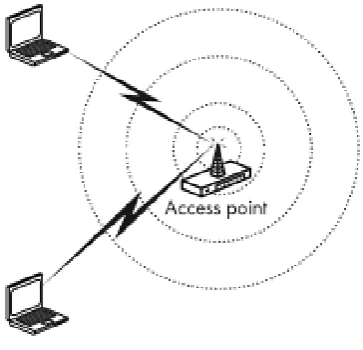
infrastructure (U-NII) bands (Zheng 2009). The networks are often connected to routers in order for them to access the internet. Reynolds (2003) declares that Wi-Fi has the potential to let anyone with a computing device to connect to the internet at impressive speeds without the need Wireless networks also use the Open System Interconnect (OSI) reference model in the transmission of data. The manner in which this reference model applies to wireless networks is similar to wired networks with some differences in the data link layer where wireless networks coordinate access by data to a common air medium and also deal with errors which occur due to the inherent nature of the wireless medium. At the Physical layer, the data is transmitted in the form of radio waves.
IV.
WHY WE NEED TO BUILD A WIRELESS NETWORKINGFigure 2.Access Point
V.
WIRELESS TECHNOLOGIESThere are a myriad of wireless technologies and they differ in the amount of bandwidth they provide as well as the distance over which the nodes in the network can communicate. Zheng (2009) observes that wireless technologies also differ in the part of the electromagnetic spectrum that they use and the amount of power consumed. To provide physical connectivity, wireless network devices must operate in the same part of the radio spectrum and two wireless cards therefore need to be configured to use the same protocol on the same channel in order for communication to occur. There are four prominent wireless technologies which are; Bluetooth,Wi-Fi, WiMAX and 3G cellular wireless.
Table 1: Popular Wireless Technologies
A.Bluetooth
Bluetooth (IEEE 802.15.1) is the technology that is employed to undertake short-range communicationbetween notebook computers, PDAs, mobile phones and other personal computing devices. The technology is more convenient than connecting
operates in a license free band at 2.45GHz, the communication range is about 10m, and due to this short range, the technology is sometimes categorized as a personal area network (PAN) (Zheng 2009). A major consideration with Bluetooth technology is power usage and typically, the technology provides speeds of up to 2.1Mbps with low power consumption.
B.Wi-Fi
Wi-Fi stands for wireless fidelity technology and the term is commonly used to describe a wireless local area network based on the IEEE 802.11 series of standards. The IEEE 802.11 standards resolve compatibility issues between manufacturers of wireless networking equipment by specifying an "over the air" interface consisting of "radio frequency technology to transmit and receive data between a wireless client and a base station as well as among wireless clients communicating directly with each other" Wi-Fi describes a family of radio protocols which include 802.11a, 802.11b, and 802.11g. 802.11b is the most popular wireless networking protocol in use and it uses a modulation called Direct Sequence Spread Spectrum in a portion of the ISM band from 2.412 to 2.484GHz (Zheng 2009).
C. Wi-MAX
WiMAX physical layer protocol is designed to propagate signals at a frequency of 10-66 GHz and the technology is able to provide both line of sight coverage and optimal non line of sight coverage as well.
Figure 3. LOS Signal Transmission
The components of a WiMAX include; a Base Station, Subscriber Station, Mobile Subscriber and a Relay Station. The Base station connects and manages access by the devices in the network. This component is made up of multiple antennas pointed in different directions and transceivers which are necessary for the wireless data network communication. A subscriber station is a fixed wireless node which communicates with the base station and forms a link between networks. A mobile subscriber is a wireless node that receives or transmits data through the Base Station while the relay station is a Subscriber Station whose purpose is to retransmit traffic to the relay stations or subscriber stations. A significant merit of WiMAX is that it supports high mobility by user devices. A user can access the network so long as they do not exceed the threshold speed which is normally valued at 120km/H. This property of the technology allows for portability since the user can traverse a significant area which is covered by multiple base stations without having to interrupt their current session.
D.Cellular Networks
While mobile phones have gained overwhelming prominence in the past decades, mobile phone
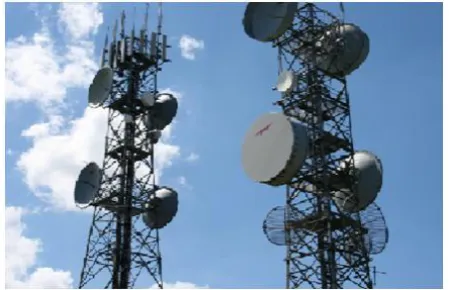
networks were introduced as far back as the early 1980s and this technology was able to provide access to the wired phone network to mobile user. The area of coverage by the cellular wireless network can range from a few hundred meters to a few kilometers in radius. In each cell, there is a base station which is connected to the wired network and which allows the mobile devices in the range to communicate with each other.
Figure 4. Cellular Transmission Towers.
VI.
ADVANTAGES OF WIRELESS TECHNOLOGY The main advantage of a wireless network over a wired one is that users can move around freely within the area of the network with their laptops, handheld devices etc and get an internet connection.Users are also able to share files and other resources with other devices that are connected to the network without having to be cabled to a port.
Not having to lay lots of cables and put them through walls etc. can be a considerable advantage in terms of time and expense. It also makes it easier to add extra devices to the network, as no new cabling is needed.
Wireless networks can sometimes handle a larger amount of users because they are not limited by a specific number of connection ports.
Instant transfer of information to social media is made much easier. For instance, taking a photograph and uploading it to Facebook can generally be done much quicker with wireless technology.
VII.
DISADVANTAGES OF WIRELESS TECHNOLOGYIt can require extra costs and equipment to set up, although increasingly routers have built-in wireless capability, as do devices such as laptops, handheld devices, modern DVD players, and TVs.
Setting up a wireless network can sometimes be difficult for people who are not experienced with computers. (Although there are issues with setting up a wired network too, off course!)
File-sharing transfer speeds are normally slower with wireless networks than they are with cabled. The speeds can also vary considerably according to your location in relation to the network.
The general speed of a wireless connection is also usually much slower than a wired one. The connection also gets worse the farther you are from the router, which can be a problem in a large building or space.
Everyday household items and structures such as walls, ceilings, and furniture can obstruct wireless connections.
Wireless networks are generally less secure. There can also be problems with neighbors stealing bandwidth, if the network has not been set up to be password protected. Information is also less secure too and can be easier to hack into.
VIII.
USING WIRELESS TECHNOLOGYINEDUCATION AND TRAINING
Wireless networks have had a profound impact in the area of schools where the exchange of data was previously unattainable due to the complications associated with wired networked.
The education field has benefited from the growth of wireless technology and the cost effectiveness of this technology. Before wireless networks were feasible, the education area suffered from the inherent setbacks of wired networks such as a lack of mobility, the complexity of deployment and difficulty in computing devices without incurring additional costs to the schools.
Educational institutes which make use of centralized databases for educational material and information can benefit from wireless networks since the students are able to access the available resources at different areas in the school.
Wireless networks can be quickly deployed for temporary use and then moved when the training is over.
For small training sessions, which have a small number of people, ad-hoc networks can be very useful since they do not require any additional infrastructure to set up. The various individuals in the networks can therefore share resources after configuring their devices to communicate in an ad-hoc manner.
This computer networks do not require the use of access point but rather allow the wireless devices, which are within range of each other to discover each other and proceed to communicate in a peer to- peer manner. Mamoukaris and Economides (2003) argue that implementation so of an ad-hoc wireless networks can help overcome some of the drawbackscaused by the changing educational environment. The networks provide the flexibility and dynamic interaction that is required to foster the success of group communication.
IX.
CONCLUSIONIn conclusion, wireless communications globally is something that people can expect as technology advances. Wireless communications has many benefits and can make the world a lot more efficient. From the discussions provided in this paper, it is clear that wireless network solutions are increasing in popularity as they become more affordable and are adopted by more people. This paper has elaborated how wireless networks provide freedom from place restriction, scalability and flexibility. The most popular technologies are; Bluetooth, Wi-Fi, WiMAX and Cellular networks. The paper has confirmed that the mobility of wireless networks is their most desirable characteristic. It has been noted that in spite of their merits, there are a few significant issues with wireless networks, which are primarily: quality assurance and security issues. Wireless links are
noisier and less reliable than wired links due to the interference that occurs as the signals are transmitted. Engaging in site surveys before setting up a wireless network can help to mitigate this issue. Using strong encryption standards and can resolve the security issues inherent with wireless networks.
ACKNOWLEGEMENT
We wish to express our deep sense of indebtednessand sincerest gratitude effort to all the experts andMr. V.SAKTHIVEL for his valuable guidance and appreciation. We also wish to thank our parents for their encouragement at every step of progress.
X.
REFERENCES[1] Chenoweth, T Robert, M & Sharon, T 2010, “Wireless Insecurity: Examining User Security Behavior on Public Networks”, Communications of the ACM, 53(2): 134-138. [2] Ganesh, R &Pahlavan, K 2000, Wireless
Network Deployments, Springer, Boston. [3] Jordan, R &Abdallah, C 2002, “Wireless
communications and networking: an overview”, IEEE Antenna's and Propagation Magazine, 44 (1): 185-193.
[4] Kumar, A &Manjunath, K 2008, Wireless Networking, Morgan Kaufmann, Boston. [5] Kumar, A 2010, “Evolution of Mobile
Wireless Communication Networks: 1G to 4G”, International Journal of Electronics & Communication Technology, 1(1): 68-72. [6] Malone S, 2004, Case Study: A Path towards a
Secure, Multi-role Wireless LAN in a Higher Education Environment, SANS Institute, Massachusetts.
[8] Reynolds, J 2003, Going Wi-Fi: A Practical Guide to Planning and Building an 802.11 Network, CMP, New York.
[9] Schmidt, A &Lian, S 2009, Security and Privacy in Mobile Information and Communication Systems, Springer, Boston. [10] Singh, L 2009, Network Security and
Management, PHI Learning Pvt. Ltd., New Delhi.
[11] Wi-Fi Alliance, 2004, WPA Deployment Guidelines for Public Access Wi-Fi Networks. Wi-Fi alliance, Massachusetts. [12] Zheng, P 2009, Wireless Networking