Computational Linguistics and Chinese Language Processing
Vol. 15, No. 1, March 2010, pp. 61-76 61
© The Association for Computational Linguistics and Chinese Language Processing
Cross-Validation and Minimum Generation Error based
Decision Tree Pruning for
HMM-based Speech Synthesis
Heng Lu
∗, Zhen-Hua Ling
∗, Li-Rong Dai
∗, and Ren-Hua Wang
∗Abstract
This paper presents a decision tree pruning method for the model clustering of HMM-based parametric speech synthesis by cross-validation (CV) under the minimum generation error (MGE) criterion. Decision-tree-based model clustering is an important component in the training process of an HMM based speech synthesis system. Conventionally, the maximum likelihood (ML) criterion is employed to choose the optimal contextual question from the question set for each tree node split and the minimum description length (MDL) principle is introduced as the stopping criterion to prevent building overly large tree models. Nevertheless, the MDL criterion is derived based on an asymptotic assumption and is problematic in theory when the size of the training data set is not large enough. Besides, inconsistency exists between the MDL criterion and the aim of speech synthesis. Therefore, a minimum cross generation error (MCGE) based decision tree pruning method for HMM-based speech synthesis is proposed in this paper. The initial decision tree is trained by MDL clustering with a factor estimated using the MCGE criterion by cross-validation. Then the decision tree size is tuned by backing-off or splitting each leaf node iteratively to minimize a cross generation error, which is defined to present the sum of generation errors calculated for all training sentences using cross-validation. Objective and subjective evaluation results show that the proposed method outperforms the conventional MDL-based model clustering method significantly.
Keywords: Speech Synthesis, Hidden Markov Model, Decision Tree Pruning, Cross-validation, Minimum Generation Error.
∗
University of Science and Technology of China, No. 96, Jinzhai Road, Hefei, Anhui, China Tel: (+86) 13721053256; fax: (+86) 551 5331801.
62 Heng Lu et al.
1.
Introduction
Currently, there are two main speech synthesis methods. One is unit-selection speech synthesis (Hunt & Black, 1996) (Ling & Wang, 2007) and the other is the hidden Markov model (HMM) based parametric speech synthesis (Black, Zen, & Tokuda, 2007). The unit-selection approach concatenates the natural speech segments selected from a recorded database to produce synthetic speech. It can generate highly natural speech often, but its performance may degrade severely when the contexts for synthesis are not included in the database. In HMM-based parametric speech synthesis, speech waveforms are parameterized and modeled by HMMs in model training (Yoshimura, Tokuda, Masuko, Kobayashi, & Kitamura, 1999). During synthesis, speech parameters are generated from the trained models (Tokuda, Yoshimura, Masuko, Kobayashi, & Kitamura, 2000) and sent to a parametric synthesizer to reconstruct speech waveforms. Although the quality of synthetic speech still needs improvement, HMM-based parametric synthesis has several important advantages, including high flexibility of the statistical models, a comparatively small database necessary for system construction and robust performance of the synthetic speech -- it never makes the serious errors that unit-selection speech synthesis may make sometimes.
In HMM-based parametric speech synthesis, binary decision tree based context-dependent model clustering is a necessary step in dealing with data-sparsity problems and predicting model parameters for the contextual features of synthetic speech that do not occur in the training set. In the conventional model clustering process, the maximum likelihood (ML) criterion is utilized to choose the optimal question from the question set for each tree node split and the minimum description length (MDL) criterion (Shinoda & Watanabe, 2000) is used as the stopping criterion to control the size of trained decision trees, which affects the performance of synthetic speech significantly, e.g., a large decision tree may alleviate the over-smoothing effects in generated speech parameters but may also lead to over-fitting problems. Nevertheless, the MDL criterion is derived based on an asymptotic assumption and the assumption that fails when there is not enough training data (Rissanen, 1980). Therefore, it may not work successfully in HMM-based speech synthesis, where the amount of training data is much smaller than that in speech recognition.
Cross-Validation and Minimum Generation Error based 63 Decision Tree Pruning for HMM-based Speech Synthesis
2004) to reduce the computational complexity, which means the decision tree backing-off is conducted simultaneously for all states instead of processing each state separately. The other is the inconsistency between the ML criterion and the aim of speech synthesis, which is to generate speech (acoustic parameters) as close to natural speech as possible. The minimum generation error (MGE) criterion has been proposed to solve the second issue. It optimized the model parameters by minimizing the distortion between the generated speech parameters and the natural ones for the sentences in the training set. The MGE criterion has been applied not only to the clustered model training (Wu & Wang, 2006b) but also to the decision tree based model clustering of context-dependent models (Wu, Guo & Wang, 2006) and positive results have been achieved in improving the naturalness of synthetic speech. In (Wu, Guo & Wang, 2006), MGE was adopted to replace the ML criterion to select the optimal question at each tree node split. Since increasing the size of the decision tree always leads to the reduction of the generation error on the training set, MGE cannot be used directly as a stopping criterion in decision tree building. Thus, the size of the decision tree trained in (Wu, Guo & Wang, 2006) was tuned manually to compare the results with the MDL clustering that had almost equivalent numbers of leaf nodes.
On the other hand, cross-validation (CV) is a well-known technique to deal with the over-training and under-training problems without requiring extra development data. It estimates the accuracy of performance of a predictive model by partitioning the data set into complementary subsets and uses different subsets for training and validation (Bishop. 2006). In (Hashimoto, Zen, Nankaku, Masuko & Tokuda, 2009), a CV based method of setting hyper-parameters for HMM-based speech synthesis under the Bayesian criterion was proposed and positive results were reported.
In this paper, we integrate the minimum “cross” generation error criterion to optimize the size of the model clustering decision tree automatically for HMM-based speech synthesis. Different from (Wu, Guo & Wang, 2006), the ML criterion is still adopted to select the optimal question at each tree node split. A “cross” generation error is defined to calculate the sum of generation errors for all training sentences by cross-validation using the models clustered with a given decision tree. The size of the decision tree is optimized to minimize the cross generation error in two steps. First, an initial decision tree is obtained through model clustering with the MDL factor tuned with MCGE criterion. Then, the decision tree is finely modified by backing-off or splitting each leaf node iteratively to minimize the cross generation error. Objective and subjective evaluation results show that this proposed method outperforms the conventional MDL based HMM model clustering method significantly.
64 Heng Lu et al.
in Section 4. Finally, conclusions are given in Section 5.
2.
HMM-based Parametric Speech Synthesis
2.1
The Framework of HMM-based Speech Synthesis
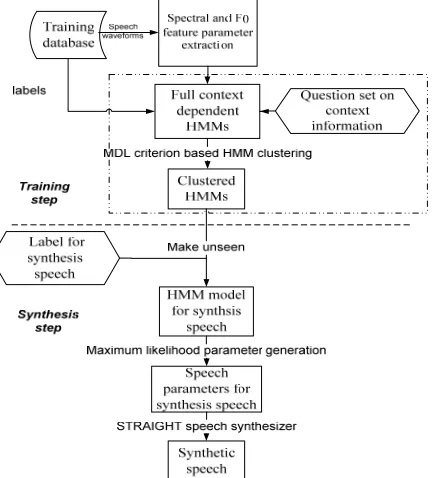
As shown in Figure 1, a typical HMM-based parametric speech synthesis system consists of two parts: the model training part and the speech synthesis part. In the model training part, spectrum, F0 and state duration are modeled simultaneously in a unified HMM framework. For each HMM state, the spectral features are modeled by a continuous probability distribution and F0 features are modeled using a multi-space probability distribution (MSD) (Tokuda, Masuko, Miyazaki & Kobayashi, 1999). In the synthesis step, speech parameters are generated from the trained models using maximum likelihood parameter generation (MLPG) algorithm (Tokuda, Yoshimura, Masuko, Kobayashi & Kitamura, 2000) and a parametric synthesizer is employed to reconstruct speech waveforms from the generated parameters.
Figure 1. Flowchart of a conventional HMM-based parametric speech synthesis system.
2.2
MDL-based Model Clustering
Cross-Validation and Minimum Generation Error based 67 Decision Tree Pruning for HMM-based Speech Synthesis
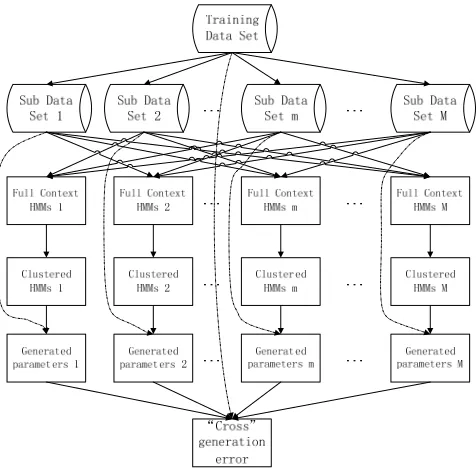
Figure 2. The calculation process of cross generation error.
3.2
Decision Tree Initialization
The pruning of the decision tree by CV and MGE is carried out in two steps. First we tune the MDL factor in Eq. (6) and the threshold in the node size stop condition discussed in Section 2.2 to generate an initial decision tree with a minimum cross generation error. Then the effect of each single tree leaf node on the cross generation error is inspected separately for further decision tree leaf backing-off or splitting. The decision tree initialization process is introduced in this section.
As shown in Equation (6), a small α would decrease the threshold in the stop condition of the MDL criterion and lead to a large decision tree. On the other hand, reducing the threshold β in the stop condition of the node size would also increase the size of the decision tree. A set of threshold parameter pairs { , }α β is designed in accordance with our speech synthesis system construction experience. For each pair of { , }α β , a decision tree is trained via the method discussed in Section 2.2 and the cross generation error is calculated. We tune α first and keep β equal to its default value. When reducing α can no longer increase the size of the decision tree, we keep α constant and reduce β further. By such tuning, we are able to find a pair of { , }α β that leads to the smallest cross generation error. When the optimum pair of { , }α β is obtained, they are applied to conduct the model clustering using all of the training data and to generate the initial decision tree TR0 for
Cross-Validation and Minimum Generation Error based 69 Decision Tree Pruning for HMM-based Speech Synthesis
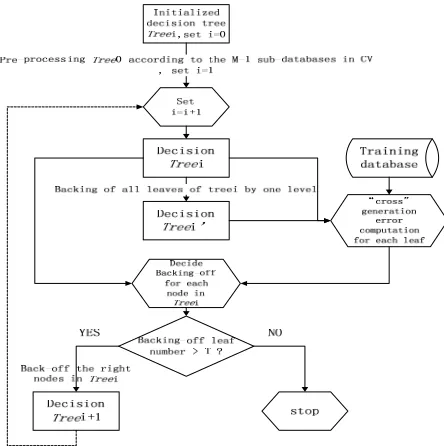
Figure 3. Flowchart for one decision tree back-off process.
4.
Experiments
4.1
Experimental Conditions
In the experiment, we used a female phonetic balanced Mandarin database containing 1,000 sentences as the training database. The sample rate for the speech waves in the training database was 16kHz. 40 dimensional LSPs were extracted as the spectral features with 5ms frame shift. Five state context-dependent HMMs were used in the model training. Our experiments only focused on the decision-tree-based model clustering for spectral features. The context-dependent F0 and duration models were clustered in the conventional way.
A question set describing the contextual features for Mandarin Chinese was designed to conduct the decision tree splitting. The context features include:
¾ Left phone : phone before the current phone
¾ Current phone : the focused phone
¾ Right phone : phone after the current phone
¾ Left tone : tone of the syllable before the current syllable
¾ Current tone : the tone of the current syllable
¾ Right tone : tone of the syllable after the current syllable
70 Heng Lu et al.
¾ Relative positions of the current syllable, word, phrase, sentence, and sentence group
¾ Absolute positions from head and tail of the current syllable, word, phrase, sentence, and sentence group
4.2
Experiments on Decision Tree Initialization
4.2.1 Objective Evaluation
The training database was divided into ten subsets in our experiments. Following the method described in Section 3.2, a group of threshold parameter pairs { , }α β were designed as shown in Table 1. As the MDL factor α is the main factor that affects the size of the decision tree, we did not modify β until reducing α to where it could no longer enlarge the size of the decision tree. The System ID, the corresponding threshold parameter pairs { , }α β , size of the decision tree, and the cross generation error calculated by LSP distortion introduced in Section 3.1 are shown Table 1.
Table 1. Scale of the decision tree and the objective LSF “cross” generation error for each system.
System ID Sys-A Sys-B Sys-C Sys-D Sys-E Sys-F Sys-G Sys-H Sys-I
{ , }α β {0.01,1} {0.01,5} {0.01,10} {0.01,15} {0.1,15} {0.5,15} {1,15} {2,15} {10,15}
Number of all
leaf nodes 52882 36706 21211 14683 14654 8909 3946 1886 470 LSF distortion 0.02576 0.02498 0.02442 0.02421 0.02421 0.02428 0.02470 0.02553 0.02869
From Table 1, we can see that parameter set {0.01,15} (Sys-D) and {0.1,15} (Sys-E) lead to the smallest cross generation error. The baseline system is Sys-G with { , }α β in default settings.
4.2.2 Subjective Evaluation
Cross-Validation and Minimum Generation Error based 71 Decision Tree Pruning for HMM-based Speech Synthesis
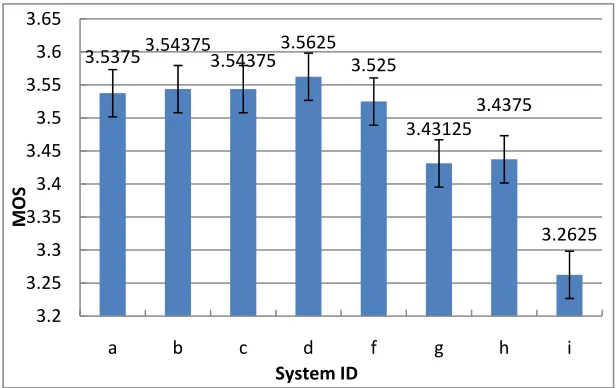
Figure 4 and Table 1, we also find that the LSF distortion of Sys-A and Sys-B is larger than Sys-G, but with a higher MOS score. This is reasonable because with a much smaller decision tree like in system Sys-G, the acoustic model would be too “average”, making the synthesis speech “blurring”. Nevertheless, large decision trees like Sys-A and Sys-B cause an over-training problem, where voice quality is not impacted much, but synthesized speech may not be stable.
Figure 4. MOS of different systems for decision tree initialization.
4.3
Experiments on Decision Tree Pruning
4.3.1 Objective Evaluation
Using the threshold parameter pair {0.01,15} of Sys-D, the initial decision tree TR0 was built
by conducting MDL-based HMM clustering using this parameter set on the whole training database. Then further tree node backing-off and splitting introduced in Section 3.2 were conducted iteratively on the basis of TR0. Here in the calculation of cross generation error,
the same decision treeTR0, other than the optimal { , }α β , is utilized to conduct the model
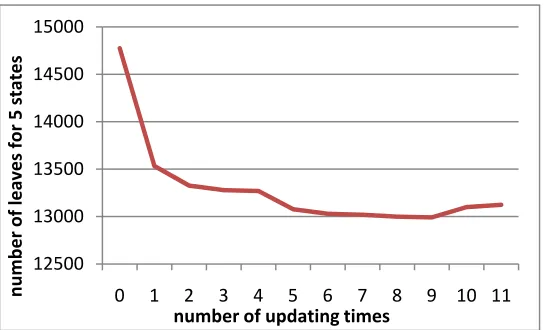
estimation of λk(TR). The Euclidean LSP distance measure was used to compute the distortion between the generation and natural parameters. Figure 5 and Figure 6 describe the change in the cross generation error and the total number of the decision tree nodes in the iterative backing-off or splitting process. We can see that the cross generation error in Fig. 5 decreases consistently. Figure 6 shows that the backing-off was conducted for 9 iterations until no tree leaf could be backed-off and that node splitting was conducted for 2 iterations.
3.53753.543753.543753.5625 3.525
3.43125 3.4375
3.2625
3.2 3.25 3.3 3.35 3.4 3.45 3.5 3.55 3.6 3.65
a b c d f g h i
MOS
Cross-Validation and Minimum Generation Error based 73 Decision Tree Pruning for HMM-based Speech Synthesis
the backing-off and splitting process, however, the same decision tree except for the MDL parameters is employed for HMM clustering in the CV. A different decision tree for different divisions in CV leads to a smaller “cross” generation error.
4.3.2 Subjective Evaluation
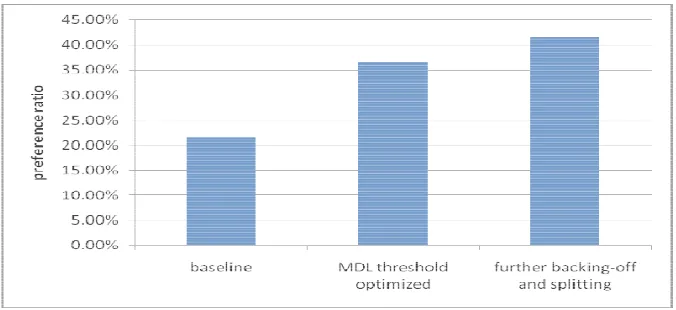
A subjective listening test was conducted for the three systems: the baseline system (Sys-G), the system with tuned { , }α β (Sys-D), and the system with further backing-off and splitting based on Sys-D. Sixteen sentences were synthesized by each of the systems and five native speakers were asked to choose the best sentence from the randomly ordered three sentences by three systems. The results are listed in Fig. 7, where the preference ratios for the three systems are 21.6%, 36.7% and 41.7% respectively.
Figure 7. Preference ratio for the (1) baseline system, (2) MDL parameter optimized speech synthesis system and (3) further backing-off and splitting system.
From Figure 7, one can conclude that the MDL threshold parameter optimized speech synthesis system and further backing-off and splitting system both out-perform the baseline system. The proposed method for initialization of the decision tree and the further pruning method are both effective.
4.4
Discussion
74 Heng Lu et al.
larger than the tree leaves. It could be smaller! Also pruning from the middle of the decision tree avoids a huge computational cost.
Theoretically, in order to get the decision tree that leads to the minimum cross generation error, one should use the minimum cross generation error criterion to choose the best question from the question set, and use the best question to conduct the splitting of every decision tree node. This means speech parameters for the synthesized speech should be generated and the cross generation error for the whole decision tree should be calculated for all the questions in the question set for each tree leaf. This will lead to an unacceptable computational cost. Another method of decision tree optimization is from the bottom to top. Using the ML criterion to conduct the decision tree generation with no stopping criterion, a huge decision tree is generated. In such a huge decision tree, there is almost only one sample for each tree leaf. Then the backing-off for each tree leaf to reduce the “cross” generation error is conducted. The problem, however, is that, backing-off the tree from the bottom does not always lead to the decision tree with the smallest “cross” generation error. It is quite possible that the backing-off process lead to some sub-optimal results. This is the case especially when there are only three tree leaves in the two level sub-tree. Nevertheless, informal experiments conducted by us revealed that, by conducting the decision tree leaf backing-off from the bottom of a huge decision tree as mentioned above, the out-of-training-set generation error of the optimized decision tree is even larger than the generation error by the decision tree initialized by only optimizing the MDL threshold parameters introduced in Section 3.2.
5.
Conclusion
In this paper, we have proposed a minimum cross generation error criterion based decision tree pruning method for HMM-based parametric speech synthesis. Rather than generating the decision tree from the top or backing-off from the bottom, we optimize the decision tree from the middle. We first initialize the decision tree by tuning the MDL threshold parameter using the minimum “cross” generation error criterion over the whole decision tree. Then, by further backing-off or splitting tree leaves according to the cross generation error for every single leaf of the decision tree initialized in the first step, the optimal decision tree is obtained. In the decision tree pruning process, the cross generation error is calculated for every tree leaf using CV over the whole training database, and no extra development data set is needed.
Cross-Validation and Minimum Generation Error based 75 Decision Tree Pruning for HMM-based Speech Synthesis
pruning process.
Acknowledgement
This work was partially supported by Hi-Tech Research and Development Program of China (Grant No.: 2006AA01Z137,2006AA010104) and National Natural Science Foundation of China (Grand No.: 60475015). The authors also thank the research division of iFlytek Co. Ltd., Hefei, China, for their help in corpus annotation.
References
Bishop, C. M. (2006). Pattern Recognition and Machine Learning. Springer, New York, U.S.A.
Black, A. W., Zen, H., & Tokuda, K. (2007). Statistical parametric speech synthesis. in Proc. of ICASSP, 4, 1229-1232.
Hashimoto, K., Zen, H., Nankaku, Y., Masuko, T., &Tokuda, K. (2009). A Bayesian approach to HMM-based speech synthesis. in Proc. of ICASSP, 4029-4032.
Hunt, A. J., & Black, A. W. (1996). Unit selection in a concatenative speech synthesis system using a large speech database. in Proc. of ICASSP, 373-376.
Kataoka, S., Mizutani, N., Tokuda, K., & Kitamura, T. (2004). Decision-tree backing-off in HMM-based speech synthesis. In Proc. of Interspeech, 1205-1208.
Kawahara, H., Masuda-Katsuse, I., & Cheveigne, A. (1999). Restructuring speech representations using a pitch-adaptive time-frequency smoothing and an instantaneous-frequency-based f0 extraction: possible role of a repetitive structure in sounds. Speech Commun, 27 (3), 187-207.
Ling, Z. H., & Wang, R. (2007), HMM-based hierarchical unit selection combining Kullback-Leibler divergence with likelihood criterion. in Proc. of ICASSP, 1245-1248. Rissanen, J. (1980). Stochastic complexity in stochastic inquiry.World Scientific Publishing
Company.
Shinoda, K. & Watanabe, T. (2000). MDL-based context dependent subword modeling for speech recognition, J. Acoust. Soc. Japan(E), 21(2), 79-86.
Tokuda, K., Yoshimura, T., Masuko, T., Kobayashi, T. & Kitamura, T. (2000). Speech parameter generation algorithms for hmm-based speech synthesis. in Proc. of ICASSP, 3, 1315-1318.
Tokuda, K., Masuko, T., Miyazaki, N., & Kobayashi, T. (1999). Hidden Markov models based on multi-space probability distribution for pitch pattern modeling. in Proc. of ICASSP, 229-232.
76 Heng Lu et al.
Wu, Y.-J., Guo, W., & Wang, R. (2006). Minimum generation error criterion for tree-based clustering of context dependent HMMs. in Proc. of Interspeech. 2046-2049.