Computational Linguistics and Chinese Language Processing
Vol. 19, No. 3, September 2014, pp. 39-54 39 The Association for Computational Linguistics and Chinese Language Processing
Modeling Human Inference Process for
Textual Entailment Recognition
Hen-Hsen Huang
*, Kai-Chun Chang
*and Hsin-Hsi Chen
*Abstract
To prepare an evaluation dataset for textual entailment (TE) recognition, human annotators label rich linguistic phenomena on text and hypothesis expressions. These phenomena illustrate implicit human inference process to determine the relations of given text-hypothesis pairs. This paper aims at understanding what human think in TE recognition process and modeling their thinking process to deal with this problem. At first, we analyze a labelled RTE-5 test set which has been annotated with 39 linguistic phenomena of 5 aspects by Mark Sammons et al., and find that the negative entailment phenomena are very effective features for TE recognition. Then, a rule-based method and a machine learning method are proposed to extract this kind of phenomena from text-hypothesis pairs automatically. Though the systems with the machine-extracted knowledge cannot be comparable to the systems with human-labelled knowledge, they provide a new direction to think TE problems. We further annotate the negative entailment phenomena on Chinese text-hypothesis pairs in NTCIR-9 RITE-1 task, and conclude the same findings as that on the English RTE-5 datasets.
Keywords: Textual Entailment Recognition, Chinese Processing, Semantic.
1.
Introduction
Textual Entailment (TE) is a directional relationship between pairs of text expressions, text (T) and hypothesis (H). Given a text pair T and H, if human would consider that the meaning of H is right by using the information of T, then we can infer H from T and say that T entails H (Dagan, Glickman, & Magnini, 2006). (S1) shows an example where T entails H.
*
40 Hen-Hsen Huang et al.
(S1) T: Norway‟s most famous painting, „The Scream‟ by Edvard Munch, was
recovered Saturday, almost three months after it was stolen from an Oslo museum.
H: Edvard Munch painted „The Scream‟.
Because such an inference is important in many applications (Androutsopoulos & Malakasiotis, 2010), the researches on textual entailment have attracted much attention in recent years. Recognizing Textual Entailment (RTE) (Bentivogli et al., 2011), a series of evaluations on the developments of English TE recognition technologies, have been held seven times up to 2011. In the meanwhile, TE recognition technologies in other languages are also underway. The 9th NTCIR Workshop Meeting first introduced a TE task in Chinese and in Japanese called Recognizing Inference in Text (RITE-1) into the IR series evaluation (Shima et al., 2011).
The overall accuracy is used as the only evaluation metric in most TE recognition tasks (Androutsopoulos & Malakasiotis, 2010). However, it is hard to examine the characteristics of a system when only considering its performance by accuracy. Sammons et al., (2010) proposed an evaluation metric to examine the characteristics of a TE recognition system. They annotated text-hypothesis pairs selected from the RTE-5 test set with a series of linguistic phenomena required in the human inference process. When annotators assume that some linguistic phenomena appear in their inference process to determine whether T entails H, they would label the T-H pair with these phenomena. The RTE systems are evaluated by the new indicators, such as how many T-H pairs annotated with a particular phenomenon can be correctly recognized. The indicators can tell developers which systems are better to deal with T-H pairs with the appearance of which phenomenon. On the other hand, that would give developers a direction to enhance RTE systems.
For example, (S2) is an instance that matches the linguistic phenomena Exclusive Relation, and this phenomenon suggests T does not entail H. More than one argument of H, i.e., Venus Williams, Marion Bartoli, 2007, and Wimbledon Championships, appear in T, but the relation defeated in H contracts the relation triumphed in T.
Modeling Human Inference Process for Textual Entailment Recognition 41
H: Venus Williams was defeated by Marion Bartoli at the 2007 Wimbledon Championships.
Such linguistic phenomena are thought as crucial in the human inference process by annotators. In the RITE-2 in the 10th NTCIR Workshop Meeting, some linguistic phenomena for TE in Japanese are reported in the unit task subtask (Watanabe et al., 2013). In a similar manner, types of some linguistic phenomena in Chinese are consulted in the RITE-VAL task in the 11th NTCIR Workshop Meeting1. In this paper, we use this valuable resource from a different aspect. Instead of using the labelled linguistic phenomena in the evaluation of TE recognition, we aim at knowing the ultimate performance of TE recognition systems which embody human knowledge in the inference process. The experiments show five negative entailment phenomena may be strong features for TE recognition, and this finding confirms the previous study of Vanderwende et al (2006). Moreover, we propose a method to acquire the linguistic phenomena automatically and use them in TE recognition. Our method is evaluated on both the English RTE-5 dataset and the Chinese NTCIR-9 RITE-1 dataset. Experimental results show that our method achieves decent performances near the average performances of RTE-5 and NTCIR-9 RITE-1. Compared to the other methods incorporating a lot of features, only a tiny number of binary features are required by our methods.
This paper is organized as follows. In Section 2 we introduce the linguistic phenomena used by annotators in the inference process, do a series of analyses on the human annotated dataset released by Mark Sammons et al., and point out five significant negative e ntailment phenomena. Section 3 specifies the five negative entailment phenomena in detail, proposes a rule-based method and a machine learning method to extract them from T -H pairs automatically, and discuss their effects on TE recognition. In Section 4, we extend the methodology to the BC (binary class subtask) dataset distributed by NTCIR-9 RITE-1 task (Shima et al., 2011), annotate the dataset similar to the schema of Sammons et al. (2010), discuss if the negative entailment phenomena also appear in Chinese T-H pairs, and show their effects on TE in Chinese. Section 5 concludes the remarks.
2.
Analyses of Human Inference Process in Textual Entailment
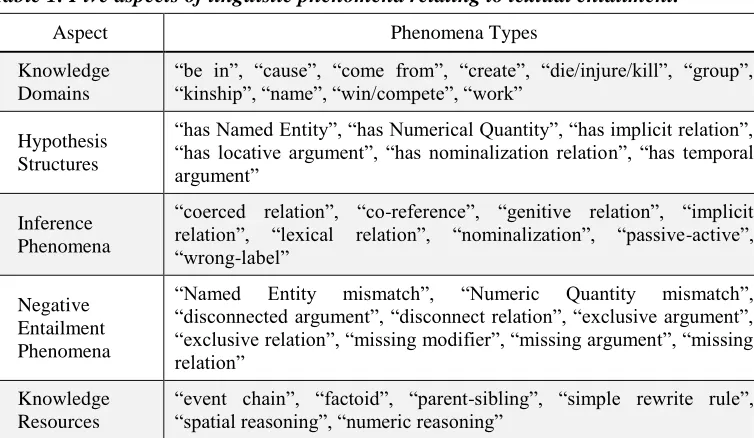
We regard the human annotated phenomena as features in recognizing the binary entailment relation between the given T-H pairs, i.e., ENTAILMENT and NO ENTAILMENT. Total 210 T-H pairs were chosen from the RTE-5 test set by Sammons et al. (2010), and total 39 linguistic phenomena divided into the following 5 aspects as follows, including knowledge domains, hypothesis structures, inference phenomena, negative entailment phenomena, and
1
Modeling Human Inference Process for Textual Entailment Recognition 43
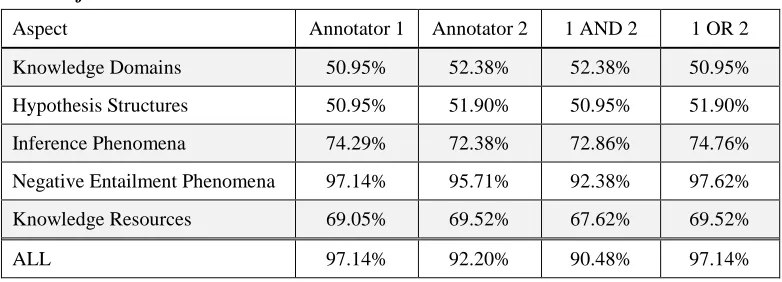
For the dataset of Sammons et al. (2010), two annotators are involved in labeling the above 39 linguistic phenomena on the T-H pairs. They may agree or disagree in the annotation. In the experiments, we consider the effects of their agreement. Table 2 shows the results. Five aspects are first regarded as individual features, and then merged together. The two schemes , Annotator 1 and Annotator 2, mean the phenomena labelled by annotator 1 and annotator 2 are used as features, respectively. The scheme “1 AND 2”, a strict criterion, denotes a phenomenon exists in a T-H pair only if both annotators agree with its appearance. In contrast, the scheme “1 OR 2”, a looser criterion, denotes a phenomenon exists in a T-H pair if at least one annotator marks its appearance.
We can see that the aspect of negative entailment phenomena is the most significant features of the five aspects. With only 9 phenomena in this aspect, the SVM classifier achieves accuracy above 90% no matter which labeling schemes are adopted. Comparatively, the best accuracy in RTE-5 task is 73.5% (Iftene & Moruz, 2009). In negative entailment phenomena aspect, the “1 OR 2” scheme achieves the best accuracy whereas the performances of Annotator 1 and “1 OR 2” are the same in the setting with all the five aspects as features. In the following experiments, we adopt this labeling scheme.
Table 2. The accuracy of recognizing binary TE relation with the five aspects as
features.
Aspect Annotator 1 Annotator 2 1 AND 2 1 OR 2
Knowledge Domains 50.95% 52.38% 52.38% 50.95%
Hypothesis Structures 50.95% 51.90% 50.95% 51.90%
Inference Phenomena 74.29% 72.38% 72.86% 74.76%
Negative Entailment Phenomena 97.14% 95.71% 92.38% 97.62%
Knowledge Resources 69.05% 69.52% 67.62% 69.52%
ALL 97.14% 92.20% 90.48% 97.14%
2.2
Negative Entailment Phenomena
There is a large gap between negative entailment phenomena aspect and the second effective aspect (i.e., inference phenomena). Moreover, using the negative entailment phenomena aspect as features only is even better than using all the 39 linguistic phenomena as features. We further analyze which negative entailment phenomena are more significant.
44 Hen-Hsen Huang et al.
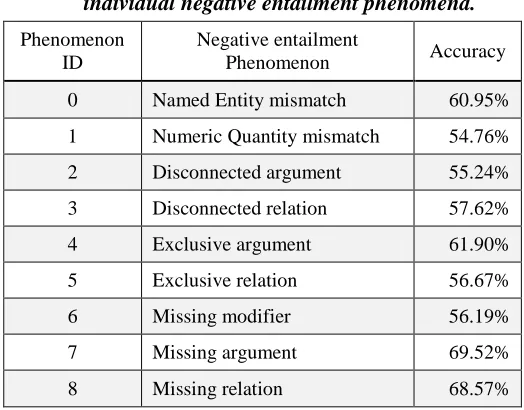
phenomenon in the binary classification. Comparing with the best accuracy 97.62% shown in Table 2, the highest accuracy in Table 3 is 69.52%, when missing argument is adopted. Each phenomenon may be suitable for some T-H pairs, and consequently all negative entailment phenomena together achieve the best performance.
Table 3. Accuracy of recognizing TE relation with
individual negative entailment phenomena.
Phenomenon ID
Negative entailment
Phenomenon Accuracy
0 Named Entity mismatch 60.95%
1 Numeric Quantity mismatch 54.76%
2 Disconnected argument 55.24%
3 Disconnected relation 57.62%
4 Exclusive argument 61.90%
5 Exclusive relation 56.67%
6 Missing modifier 56.19%
7 Missing argument 69.52%
8 Missing relation 68.57%
We consider all possible combinations of these 9 negative entailment phenomena, i.e.,
𝐶19+…+ 𝐶99 =511 feature settings, and use each feature setting to do the task of two -way
entailment relation recognition by SVM classifiers. The notation 𝐶𝑛𝑚 denotes a set of
m!/((m-n)!n!) feature settings, each with n features. For the sake of paper space, we only list the best 4 results in each combination set 𝐶𝑛𝑚 shown in Table 4. Each feature setting is
denoted by a set of phenomenon IDs enclosed parentheses. The notations between combination sets 𝐶19~𝐶49 and 𝐶59 ~𝐶89 are a slight difference because of the table space. For clarification, we list the phenomena not involved in the combination sets 𝐶59 ~𝐶89. For
example, the notation “-(0,1,2,6)” equals to the notation “(3,4,5,7,8)“, which means the feature setting is composed of disconnected relation (ID: 3), exclusive argument (ID: 4), exclusive relation (ID: 5), missing argument (ID: 7) and missing relation (ID: 8).
The model using all nine phenomena achieves the best accuracy of 97.62%. Examining the combination sets, we find phenomena IDs 3, 4, 5, 7 and 8 appear quite often in the top 4 feature settings of each combination set. In fact, this setting achieves an accuracy of 95.24%, which is the best performance in 𝐶59 combination set. On the one hand, adding more
Modeling Human Inference Process for Textual Entailment Recognition 45
setting (-(0,6)), i.e., only 7 phenomena, is the same as that of using all 9 phenomena shown in Table 2.
Table 4. Accuracy of combination of negative entailment phenomena.
𝐶89 𝐶79 𝐶69 𝐶59
-(6) 97.62% -(0,6) 97.62% -(0,1,6) 96.67% -(0, 1,2,6) 95.24%
-(0) 97.62% -(0,1) 97.14% -(0,2,6) 96.19% -(0,1,3,6) 94.29%
-(1) 97.14% -(1,6) 96.67% -(0,1,2) 96.19% -(1,2,3,6) 93.33%
-(2) 96.67% -(2,6) 96.67% -(1,2,6) 95.71% -(0,2,3,6) 93.33%
𝐶49 𝐶39 𝐶29 𝐶19
(4,5,7,8) 92.38% (4,7,8) 88.57% (4,7) 79.52% (7) 69.52%
(3,4,7,8) 91.43% (3,4,7) 85.24% (7,8) 79.05% (8) 68.57%
(2,4,7,8) 90.48% (0,7,8) 84.76% (4,8) 78.57% (4) 61.90%
(3,4,5,7) 90.00% (4,5,7) 84.29% (0,8) 76.67% (0) 60.95%
We follow Sammons et al.‟s definitions (2010) and describe the five significant negative entailment phenomena (3, 4, 5, 7, 8) as follows.
(a) Disconnected Relation: The arguments and the relations in H are all matched by counterparts in T. None of the arguments in T is connected to the matching relation.
(b) Exclusive Argument: There is a relation common to both H and T, but one argument is matched in a way that makes H contradict T.
(c) Exclusive Relation: There are two or more arguments in H that are also related in T, but by a relation that means H contradicting T.
(d) Missing Argument: Entailment fails because an argument in H is not present in T, either explicitly or implicitly.
(e) Missing Relation: Entailment fails because a relation in H is not present in T, either explicitly or implicitly.
Modeling Human Inference Process for Textual Entailment Recognition 47
In the following, two methods are proposed to extract the phenomena from T -H pairs automatically in Section 3.2 and Section 3.3. The pre-processing of the pairs is described in Section 3.1.
3.1
Preprocessing
Before extraction, the English T-H pairs are pre-processed according to following considerations.
(a) Numerical Character Transformation: All the numerical values are normalized to a single format. The fractional numbers and percentages are converted to real numbers.
(b) Stemming: The stemming is performed to each word in the T-H pair with NLTK (Bird, 2002).
(c) Part-of-Speech Tagging: Stanford Parser is performed to tagging each word in the T-H pair (Levy & Manning, 2003).
(d) Dependency Parsing: Stanford Parser also generates the dependency pairs from T and H (de Marneffe et al., 2006). The results of dependency parsing contain crucial information for capturing negative entailment phenomena.
3.2
A Rule-Based Method
Noun phrases are the fundamental elements for comparing the existences of entailment. Given a T-H pair, we first extract 4 sets of noun phrases based on their POS tags: {noun in H}, {named entity (nnp) in H}, {compound noun (cnn) in T}, and {compound noun (cnn) in H}. Then, we extract 2 sets of relations: {relation in H} and {relation in T}, where each relation in the sets is in a form of Predicate(Argument1, Argument2). Some typical examples of relations are verb(subject, object) for verb phrases, neg(A, B) for negations, num(Noun, number) for numeric modifier, and tmod(C, temporal argument) for temporal modifier. A predicate has only 2 arguments in this representation. Thus, a di-transitive verb is in terms of two relations.
48 Hen-Hsen Huang et al.
(a) Disconnected Relation: If (1) for each a {noun in H}{nnp in H}{cnn in H}, we
can find a T too, and (2) for each r1=h(a1,a2) {relation in H}, we can find a relation r2=h(a3,a4) {relation in T} with the same header h, but with different arguments, i.e., a3≠a1 and a4≠a2, then we say the T-H pair has the “Disconnected Relation” phenomenon.
(b) Exclusive Argument: If there exist a relation r1=h(a1,a2){relation in H}, and a relation r2=h(a3,a4){relation in T} where both relations have the same header h, but either the pair (a1,a3) or the pair (a2,a4) is an antonym by looking up WordNet, then we say the T-H pair has the “Exclusive Argument” phenomenon.
(c) Exclusive Relation: If there exist a relation r1=h1(a1,a2){relation in T}, and a relation r2=h2(a1,a2){relation in H} where both relations have the same arguments, but h1 and h2 have the opposite meanings by consulting WordNet, then we say that the T-H pair has the “Exclusive Relation” phenomenon.
(d) Missing Argument: For each argument a1 {noun in H}{nnp in H}{cnn in H}, if there does not exist an argument a2T such that a1=a2, then we say that the T-H pair has “Missing Argument” phenomenon.
(e) Missing Relation: For each relation r1=h1(a1,a2){relation in H}, if there does not exist a relation r2=h2(a3,a4){relation in T} such that h1=h2, then we say that the T-H pair has “Missing Relation” phenomenon.
3.3
A Machine Learning Method
We aim at finding meta-features to describe the characteristic of negative entailment phenomena, and use them for classification. We analyse the dependencies in a T -H pair with Stanford dependency parser (de Marneffe et al., 2006) and derive two dependency sets DT and DH for T and H, respectively, where a dependency gr(g,d) is in terms of a binary grammatical relation gr between a governor g and a dependent d. We further define the following three multisets to capture the relationships between T and H:
(a) {H only}={gr|gr(g,d)DH-(DT DH)}
(b) {Partially identical in governor}={gr|gr(g,d1)DT, gr(g,d2)DH, d1≠d2}
(c) {Partially identical in dependent}={gr|gr(g1,d)DT, gr(g2,d)DH, g1≠g2}
Modeling Human Inference Process for Textual Entailment Recognition 49
dependency parser. The weights of each grammatical relation gr in V(a), V(b), and V(c) are the number of gr appearing in the multisets {H only}, {Identical in governor only} and {Identical in dependent only}, respectively. The SVM classifier with the RBF kernel is adopted to develop classifiers with the parameters (cost and gamma) tuned by grid search and evaluated with 10-fold cross validation.
3.4
Experiments and Discussion
The following two datasets are used in English TE recognition experiments.
(a) 210 pairs from part of RTE-5 test set: The 210 T-H pairs are annotated with the linguistic phenomena by human annotators in the work of Mark Sammons et al (2010). They are selected from the 600 pairs in RTE-5 test set, including 51% ENTAILMENT and 49% NO ENTAILMENT.
(b) 600 pairs of RTE-5 test set: The original RTE-5 test set, including 50% ENTAILMENT and 50% NO ENTAILMENT.
Table 6 shows the performances of the negative entailment phenomena detection by rule-based and machine-learning methods. The performances of rule-based model are especially poor. The major challenge is to identify the arguments in T-H pairs. (S3) shows an instance. The correct arguments of H in (S3) are “Fifth Amendment right” and “driving license”, but the arguments captured by our method are “Fifth Amendment” and “license”. The issue can be improved with a better dependency parser.
(S3) T: “There is a rational basis to distinguish between people driving cars and semi
trucks,” Jambois said. “All I would say is I think he has an uphill battle.” The lawsuit says the truckers' Fifth and Fourteenth amendment rights are being violated because there is no way for them to apply for an occupational license. Mutschler said the state is taking away the truckers' right to drive a truck for a living. He said he will argue that while driving is a privilege, once a person has a
license for work, it becomes a right.
50 Hen-Hsen Huang et al.
Table 6. Performance of negative entailment phenomena detection. Reported in
Precision (P), Recall (R), and F-Score (F).
Aspect Rule-based Learning-based
P(%) R(%) F(%) P(%) R(%) F(%)
Disconnected Relation 9.52 28.57 14.28 15.91 100.00 27.45
Exclusive Argument 12.94 47.83 20.37 15.49 95.65 26.66
Exclusive Relation 5.71 33.33 9.75 10.43 100.00 18.89
Missing Argument 32.11 37.81 34.72 38.46 97.56 55.17
Missing Relation 23.08 61.54 33.57 32.23 100.00 48.75
Average 16.67 41.82 22.54 22.50 98.64 35.38
Although the rule-based method is poorly-performed, and the machined learning method is not so good at precision and F-Score, the resulting models for TE recognition achieve decent performances. These interesting results are depicted in Table 7. The “Human-annotated” column shows the performance achieved by using the phenomena annotated by human. Using “Human-annotated” phenomena can be seen as the upper-bound of the experiments. In data set (a), the performance of using all the 5 phenomena as features by the machine learning method (M2) is better than that of using the rule-based method (M1). However, the results are reverse in data set (b). This may be because data set (b) contains some cases that cannot be recognized by the model trained from the T-H pairs annotated by human. On the other hand, the rule-based method is implemented directly from the definitions, which is more robust.
Though the performance of using the phenomena extracted automatically by machine is not comparable to that of using the human annotated ones, the accuracy achieved by using only 5 features (59.17%) is just a little lower than the average accuracy of all r uns in RTE-5 formal runs (60.36%) (Bentivogli et al., 2009). It shows that the significant phenomena are really effective in dealing entailment recognition even though the phenomena detector is extremely simple. If we can improve the performance of the automatic phenomena detection algorithm, it may make a great progress on the textual entailment.
52 Hen-Hsen Huang et al.
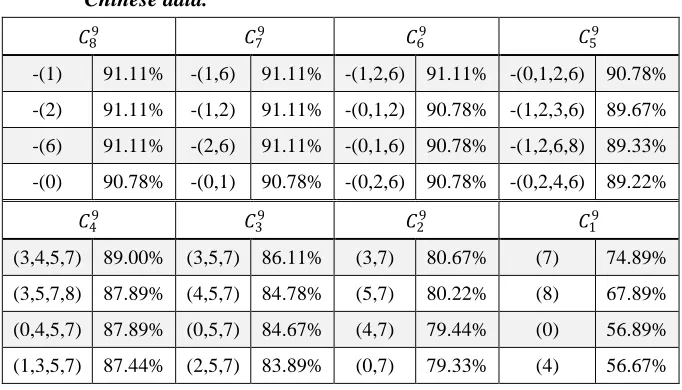
(3,4,5,7,8), are the same as those on English data. Besides, we can use only six phenomena to achieve the same performance as using all nine phenomena as features. Furthermore, we also classify the entailment relation by the phenomena extracted automatically by the rule-based method. The process is similar to those of English text described in Section 3.1 and Section 3.2, while Additional effort of processing is required for Chinese text. We segmented Chinese words with Stanford word segmenter (Chang et al., 2008) and performed Chinese dependency parsing using Stanford parser and the CNP parser (Chen et al., 2009). We extract two sets of negative entailment phenomena according to the parsing results of Stanford parser and CNP parser separately. Both sets are used as independent features to achieve a better performance.
Table 9. Accuracy of combination of negative entailment phenomena on
Chinese data.
𝐶89 𝐶79 𝐶69 𝐶59
-(1) 91.11% -(1,6) 91.11% -(1,2,6) 91.11% -(0,1,2,6) 90.78%
-(2) 91.11% -(1,2) 91.11% -(0,1,2) 90.78% -(1,2,3,6) 89.67%
-(6) 91.11% -(2,6) 91.11% -(0,1,6) 90.78% -(1,2,6,8) 89.33%
-(0) 90.78% -(0,1) 90.78% -(0,2,6) 90.78% -(0,2,4,6) 89.22%
𝐶49 𝐶39 𝐶29 𝐶19
(3,4,5,7) 89.00% (3,5,7) 86.11% (3,7) 80.67% (7) 74.89%
(3,5,7,8) 87.89% (4,5,7) 84.78% (5,7) 80.22% (8) 67.89%
(0,4,5,7) 87.89% (0,5,7) 84.67% (4,7) 79.44% (0) 56.89%
(1,3,5,7) 87.44% (2,5,7) 83.89% (0,7) 79.33% (4) 56.67%
The rule-based method obtains a similar result of TE recognition in Chinese. The accuracy achieved by using the five automatically extracted phenomena as features is 57.11%, and the average accuracy of all runs in NTCIR-9 RITE task is 59.36% (Shima et al., 2011). Compared to other methods using a lot of features, only 12 binary features are used in our method.
5.
Conclusion
Modeling Human Inference Process for Textual Entailment Recognition 53
direction to deal with the TE problem. The fundamental issues such as determining the boundary of the arguments and the relations, finding the implicit arguments and relations, verifying the antonyms of argument and relations, and determining their alignments need to be further examined to extract correct negative entailment phenomena. Besides, mul ti-class TE recognition will be explored in the future.
Reference
Androutsopoulos, I. & Malakasiotis, P. (2010). A Survey of Paraphrasing and Textual Entailment Methods. Journal of Artificial Intelligence Research, 38, 135-187.
Bentivogli, L., Clark, P., Dagan, I., Dang, H. T., & Giampiccolo, D. (2011). The seventh PASCAL recognizing textual entailment challenge. In Proceedings of the 2011 Text Analysis Conference (TAC 2011), Gaithersburg, Maryland, USA.
Bentivogli, L., Dagan, I., Dang, H. T., Giampiccolo, D., & Magnini, B. (2009). The fifth PASCAL recognizing textual entailment challenge. In Proceedings of the 2009 Text Analysis Conference (TAC 2009), Gaithersburg, Maryland, USA.
Bird, S. (2006). NLTK: the natural language toolkit. In Proceedings of the 21st International Conference on Computational Linguistics and 44th Annual Meeting of the Association for Computational Linguistics (COLING-ACL 2006), 69-72.
Chang, P.-C., Galley, M., & Manning, C. (2008). Optimizing Chinese Word Segmentation for Machine Translation Performance. In Proceedings of the Third Workshop on Statistical Machine Translation (StatMT '08), 224-232.
Chang, C.-C. & Lin, C.-J. (2011). LIBSVM: a Library for Support Vector Machines. ACM Transactions on Intelligent Systems and Technology, 2:27:1-27:27. Software available at http://www.csie.ntu.edu.tw/~cjlin/libsvm.
Chen, W., Kazama, J., Uchimoto, K., & Torisawa, K. (2009). Improving Dependency Parsing with Subtrees from Auto-Parsed Data. In Proceedings of the 2009 Conference on Empirical Methods in Natural Language Processing (EMNLP2009), 570-579, Singapore.
Dagan, I., Glickman, O., & Magnini, B. (2006). The PASCAL Recognising Textual Entailment Challenge. Lecture Notes in Computer Science, 3944:177-190.
de Marneffe, M.-C., MacCartney, B., & Manning, C. D. (2006). Generating typed dependency parses from phrase structure parses. In Proceedings of the Fifth International Conference on Language Resources and Evaluation (LREC 2006), 449-454.
Iftene, A. & Moruz, M. A. (2009). UAIC Participation at RTE5. In Proceedings of the 2009 Text Analysis Conference (TAC 2009), Gaithersburg, Maryland, USA.
54 Hen-Hsen Huang et al.
Sammons, M., Vydiswaran, V.G.V., & Roth, D. (2010). Ask not what textual entailment can do for you... In Proceedings of the 48th Annual Meeting of the Association for Computational Linguistics (ACL 2010), Uppsala, Sweden, 1199-1208.
Shima, H., Kanayama, H., Lee, C.-W., Lin, C.-J., Mitamura, T., Miyao, Y. et al. (2011). Overview of NTCIR-9 RITE: Recognizing inference in text. In Proceedings of the NTCIR-9 Workshop Meeting, Tokyo, Japan.
Vanderwende, L., Menezes, A., & Snow, R. (2006). Microsoft Research at RTE-2: Syntactic Contributions in the Entailment Task: an implementation. In Proceedings of the Second PASCAL Challenges Workshop.
Wang, R. & Zhang, Y. (2009). Recognizing Textual Relatedness with Predicate-Argument Structures. In Proceedings of the 2009 Conference on Empirical Methods in Natural Language Processing, Singapore, 784–792.