Computational Linguistics and Chinese Language Processing
Vol. 12, No. 3, September 2007, pp. 273-290 273
© The Association for Computational Linguistics and Chinese Language Processing
[Received May 10, 2007; Revised August 9, 2007; Accepted August 12, 2007]
Integrating Complementary Features from Vocal Source
and Vocal Tract for Speaker Identification
Nengheng Zheng
∗, Tan Lee
∗, Ning Wang
∗and P. C. Ching
∗Abstract
This paper describes a speaker identification system that uses complementary acoustic features derived from the vocal source excitation and the vocal tract system. Conventional speaker recognition systems typically adopt the cepstral coefficients, e.g., Mel-frequency cepstral coefficients (MFCC) and linear predictive cepstral coefficients (LPCC), as the representative features. The cepstral features aim at characterizing the formant structure of the vocal tract system. This study proposes a new feature set, named the wavelet octave coefficients of residues (WOCOR), to characterize the vocal source excitation signal. WOCOR is derived by wavelet transformation of the linear predictive (LP) residual signal and is capable of capturing the spectro-temporal properties of vocal source excitation. WOCOR and MFCC contain complementary information for speaker recognition since they characterize two physiologically distinct components of speech production. The complementary contributions of MFCC and WOCOR in speaker identification are investigated. A confidence measure based score-level fusion technique is proposed to take full advantage of these two complementary features for speaker identification. Experiments show that an identification system using both MFCC and WOCOR significantly outperforms one using MFCC only. In comparison with the identification error rate of 6.8% obtained with MFCC-based system, an error rate of 4.1% is obtained with the proposed confidence measure based integrating system.
Keywords: Speaker Identification, Vocal Source Feature, Vocal Tract Feature, Information Fusion, Confidence Measure
1.
Introduction
Speaker recognition is the process of determining a person's identity based on the intrinsic characteristics of his/her voice. In the source-filter model of human speech production, the
∗
274 Nengheng Zheng et al.
speech signal is modeled as the convolutional output of a vocal source excitation signal and the impulse response of a vocal tract filter system [Rabiner and Schafer 1978]. The most representative vocal tract related acoustic features are the cepstral coefficients, e.g., Mel-frequency cepstral coefficients (MFCC) [Davis and Mermelstein 1980] and linear predictive cepstral coefficients (LPCC) [Furui 1981], which aim at modeling the spectral envelope, or the formant structure of the vocal tract. With the primary goal being identifying different speech sounds, these features are believed to provide pertinent cues for phonetic classification and have been successfully applied to automatic speech recognition [Rabiner and Juang 1993]. At the same time, these features are also implemented in most existing speaker recognition systems [Campbell 1997; Reynolds 2002]. This indicates that MFCC and LPCC features do contain important speaker-specific information, in addition to the intended phonetic information. Ideally, if a large amount of phonetically balanced speech data is available for speaker modeling, the phonetic variability tends to be smoothed out so that speaker-specific aspects can be captured.
The vocal source related features, e.g., pitch and harmonics, on the other hand, characterize the vocal folds’ vibration style in speech production and are closely related to the speaker-specific laryngeal system. The spoken contents have less effect on the variation of the vocal source excitation than on that of the vocal tract system [Miller 1963; Childers 1991]. This makes the vocal source derived acoustic features useful for speaker recognition, especially for text-independent cases. However, the usefulness of vocal source information for speaker recognition, although having been investigated in some literature, has not been thoroughly studied, let alone the efficient information retrieving techniques. In this paper, a novel vocal source feature is presented and implemented to supplement the vocal tract features in speaker recognition.
276 Nengheng Zheng et al.
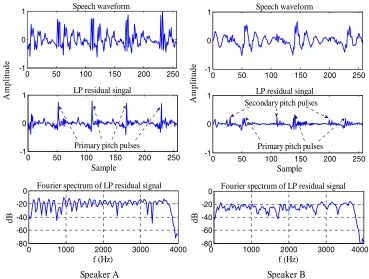
Figure 1 shows the speech waveforms of the vowel /a/ uttered by two different male speakers and the corresponding LP residual signals. There are noticeable differences between the two segments of residual signals. In addition to the difference between their pitch periods, the residual signal of speaker A shows much stronger periodicity than that of speaker B. For speaker B, the magnitudes of the secondary pulses are relatively high. In frequency domain, the Fourier spectra of the two residual signal segments look similar in that they have nearly flat envelopes. Although the harmonic peaks carry speaker-related periodicity information, the useful temporal information, i.e., the amplitudes and the time locations of pitch pulses, are not represented in the Fourier spectra. To characterize the time-frequency characteristics of the pitch pulses, wavelet transform is more appropriate than the short-time Fourier transform.
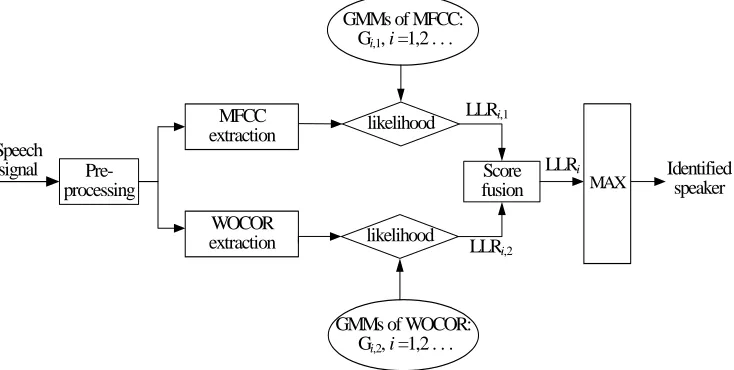
This paper describes a novel feature extraction technique based on time-frequency analysis of the LP residual signal. The new feature parameters, called wavelet octave coefficients of residues (WOCOR), are generated by applying pitch-synchronous wavelet transform to the residual signal [Zheng et al. 2004]. The WOCOR features contain useful information for speaker characterization and recognition. More importantly, WOCOR and MFCC carry different speaker-specific information since they characterize two physiologically distinct components in speech production. As a result, combining these two complementary features will result in higher recognition performance than using only one set of features.
The performance of the information fusion system, however, is highly dependant on the effectiveness of the fusion technique implemented. In multi-modal biometric authentication systems, the reliability of authentication decisions from different classifiers may vary significantly in different tests. Therefore, it is very important to apply an efficient fusion technique to maximize the benefit through the information fusion. A number of information fusion techniques have been proposed for biometrics systems [Garcia-Romero et al. 2004; Ross et al. 2001; Toh and Tau 2005]. Generally, the information fusion can be done at: (i) feature level, (ii) score level, or (iii) decision level. This paper proposes a score level fusion technique for combining MFCC and WOCOR for speaker identification. Score level fusion is preferred because the matching scores are easily obtained and contain sufficient information for distinguishing different speakers. A confidence measure, which measures the confidence of MFCC in identification decision in comparison to that of WOCOR, is adopted as the fusion weight in each individual identification trial. The confidence measure provides an optimized fusion score by giving more weight to the feature of higher confidence in correct identification. The effectiveness of the proposed information fusion system is demonstrated by a set or speaker identification experiments.
Integrating Complementary Features from Vocal Source and 277 Vocal Tract for Speaker Identification
3 demonstrates the usefulness of WOCOR in speaker identification and the complementary contributions of WOCOR and MFCC in speaker identification. Section 4 presents the confidence measure based score-level fusion technique for integrating MFCC and WOCOR for speaker identification. Some analysis of the identification results is presented in Section 5, which further elaborates the complementarity of MFCC and WOCOR in speaker recognition and the superiority of the proposed confidence measure based fusion technique over the fixed-weight fusion. Conclusions are given in Section 6.
2.
Vocal Source and Vocal Tract Features
2.1
Vocal Source Features: WOCOR
As illustrated in Figure 1, Fourier spectrum is not good at characterizing the time-frequency properties of the pitch pulses in the residual signal. Wavelet transform has been well known to be an effective method for transient signal representation. Therefore, the proposed WOCOR feature extraction is based on wavelet transform, rather than Fourier transform, of the residual signal. The process of extracting the WOCOR features is formulated in the following steps: 1) Voicing decision and pitch extraction. Voicing status decision and pitch extraction are done with Talkin's Robust Algorithm for Pitch Tracking [Talkin 1995]. Only voiced speech is retained for subsequent processing. In the source-filter model, the excitation signal for unvoiced speech can be approximated as random noise [Rabiner and Schafer 1978]. We believe that such noise-like signals carry relatively little speaker-specific information.
2) LP inverse filtering. The voiced speech is divided into non-overlapping frames of 30 ms long. The LP residual signal e n( ) is obtained from each frame by inverse filtering the speech signal s n( ), i.e.,
12
1
( ) ( ) k ( )
k
e n s n a s n k
=
= − ∑ − (1)
where the LP filter coefficients ak are computed using the autocorrelation method [Rabiner
and Schafer 1978]. To reduce intra-speaker variation, the amplitude of the residual signal within each voiced segment is normalized to the range [-1, 1].
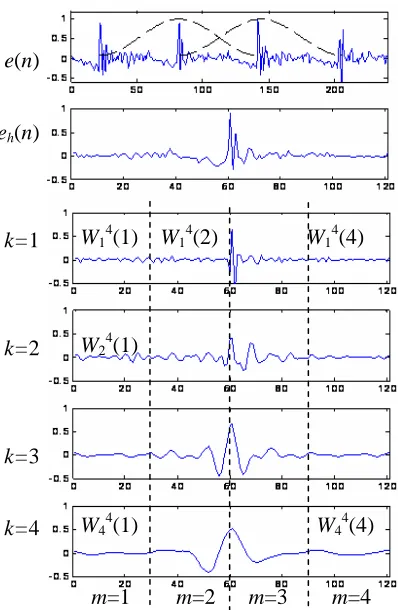
3) Pitch-synchronous windowing. Based on the pitch periods estimated in Step 1, pitch pulses in the residual signal are located by detecting the maximum amplitude within each pitch period. For each pitch pulse, pitch-synchronous wavelet analysis is applied with a Hamming window of two pitch periods long. Let ti−1, ti and ti+1denote the locations of three
successive pitch pulses. The analysis window for the pitch pulse at ti spans from ti−1 to 1
+ i
Integrating Complementary Features from Vocal Source and 279 Vocal Tract for Speaker Identification
dimension is also desirable for effective statistical modeling. In Section 3.3, the effect of M on recognition performance will be investigated experimentally.
To summarize, given a speech utterance, a sequence of WOCOR feature vectors is obtained by pitch-synchronous wavelet transform of the LP residual signal. The WOCOR features are expected to capture spectro-temporal characteristics of the residual signal, which is useful for speaker characterization and recognition.
2.2
Vocal Tract Features: MFCC
The MFCC features have been widely used for speech and speaker recognition. In this study, we use the standard procedures of extracting MFCC on a short-time frame basis as described below [Davis and Mermelstein 1980]:
1) Short-time Fourier transform is applied every 10 ms with 30-ms Hamming window.
2) The magnitude spectrum is warped with a Mel-scale filter bank that consists of 26 filters, e(n)
eh(n)
k=1
k=2
k=3
k=4 W1
4
(1) W1 4
(2) W1 4
(4)
W2 4
(1)
W4 4
(1) W4
4 (4)
m=1 m=2 m=3 m=4
Integrating Complementary Features from Vocal Source and 281 Vocal Tract for Speaker Identification
,1 ,2
LLRi =
f
(LLR , LLRi i ), 1, 2,i= ",N (6)where LLRi,1 and LLRi,2 are likelihood scores obtained from MFCC and WOCOR, respectively,
f
is the combination function and N is the number of speakers. Although in real application, the test utterances could come from the unregistered impostors. In this study, we only deal with the closed-set speaker identification. That is, all the test utterances must come from one of the 50 male speakers. The one whose models give the highest matching score is marked as the identified speaker.3.2
Speech Databases: CU2C
CU2C is a continuous speech database of Cantonese developed at the Chinese University of Hong Kong [Zheng et al. 2005]. Cantonese is one of the most popular Chinese dialects and is spoken by tens of millions of people in southern China. CU2C was designed to facilitate general speaker recognition research. It contains parallel utterances collected over fixed-line telephone channel and desktop computer microphones. The spoken contents include Hong Kong personal identity numbers, randomly generated digit strings, and phonetically balanced sentences. In this study, the speaker identification experiments are conducted on the sentence subset of the male speakers. There are 50 male speakers, each having 18 sessions of speech data with 10 utterances in each session. The first 4 sessions are used for training the speaker models. Sessions 5 to 8 are used as development data for training the weighting parameters for the score level fusion of MFCC and WOCOR. The last 10 sessions are used as the evaluation data, and there are totally 5000 identification trials (50 speakers, 100 trials per speaker). All the utterances are text-independent telephone speech with matched training and testing conditions (the same handset and fixed line telephone network). The speech data were sampled at 8 KHz and encoded by 8-bit µ-law encoding. The speech data of each speaker are collected over 4 to 9 months with the minimum inter-session interval of 1 week. Therefore, the challenge of the long-term intra-speaker variation for speaker recognition can be addressed by the database.
3.3
Determining the Parameter M for WOCOR
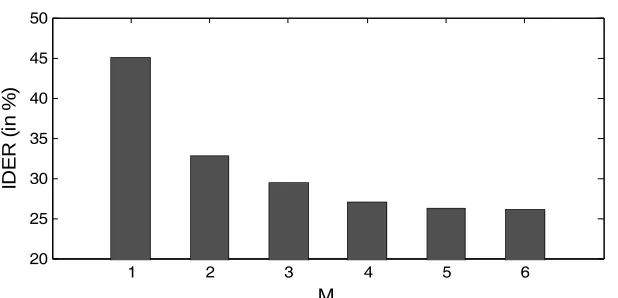
As discussed earlier, the value of M controls the size of the WOCOR feature vector and how much temporal detail can be captured. First, we compare the performance of WOCOR with different values of M. Figure 4 shows the identification error rate (IDER) of WOCOR in which M varies from 1 to 6. The identification error rate is defined as:
Number of incorrect identification trials
IDER 100%
Number of identification trials
282 Nengheng Zheng et al.
It is clear that WOCOR in general provide a certain degree of speaker discrimination power. For M =1, i.e., no temporal detail is captured and the feature vector has only 4 components, an IDER of 45.1% is achieved. With M increasing from 1 to 4, the IDER is significantly reduced to only 27.0%. ForM >4, the improvement becomes less noticeable. Therefore, in the following experiments, we will use WOCOR with M =4, which consists of 16 feature components.
3.4
Wavelet vs. Fourier Transform of LP Residual Signal
To demonstrate the superiority of wavelet transform over Fourier transform for feature extraction from the LP residual signal, we compare the speaker identification performances of WOCOR and the Fourier spectrum-based vocal source features. To do so, we apply the MFCC feature extraction process on the LP residual signal to generate another set of vocal source features, noted as MFCCres. Speaker identification experiments with WOCOR and MFCCres
result in IDERs of 27.0% and 52.0%, respectively. That is, WOCOR significantly outperforms MFCCres. This is reasonable because MFCC focuses on extracting the spectral
envelope-related features, and, as given in Fig. 1, spectral envelopes of LP residual signals are almost the same for different speakers. On the other hand, WOCOR tries to capture the spectro-temporal information in the residual signals, which is quite different between speakers.
3.5
Speaker Identification Results
We evaluate the speaker identification performances of MFCC and WOCOR individually. In addition, we evaluate the system with both MFCC and WOCOR, using the same evaluation data described in Section 3.2 for all three performance evaluations. In this case, information Figure 4. The speaker identification results of WOCOR for different values of M
1 2 3 4 5 6
20 25 30 35 40 45 50
M
ID
E
R
(
in
%
Integrating Complementary Features from Vocal Source and 283 Vocal Tract for Speaker Identification
fusion is performed as a score-level linear fusion, i.e.,
,1 ,2
LLRi =wtLLRi + −(1 wt)LLRi (8) The fusion weight wt is experimentally determined using the development data set. That is,
t
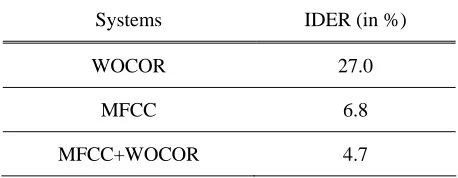
w is varied from 0 to 1, and the value giving the smallest IDER is selected for the evaluation trials. Figure 5 shows IDER vs. wtcurve with the development data. As illustrated, the best performance is achieved at aroundwt =0.80. Actually, the identification performance is not very sensitive to wt at aroundwt =0.80. The performances of MFCC- and WOCOR-based systems and the information fusion system with wt =0.80 are evaluated over the evaluation data and the results are as given in Table 1. As shown, the MFCC-based speaker identification system significantly outperforms the WOCOR system. It is noted that, despite the performance difference, the two approaches make complementary decisions in many cases, which will be further elaborated in Section 5, and the combining system has superior performance over that using MFCC only. The IDER is reduced from 6.8% to 4.7%, a relative improvement of about 30%.
Table 1. Speaker identification performances
Systems IDER (in %)
WOCOR 27.0
MFCC 6.8
MFCC+WOCOR 4.7
0.1 0.2 0.3 0.4 0.5 0.6 0.7 0.8 0.9 1 0
0.1 0.2 0.3 0.4
wt
ID
E
R
284 Nengheng Zheng et al.
4.
Information Fusion with Confidence Measure
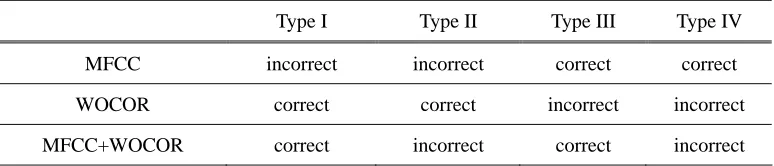
While information fusion with a pre-defined fusion weight as given in (8) can improve identification performance, it does not necessarily provide the best result. Fixed weight is unable to cover explicitly the different performance levels of MFCC and WOCOR for individual identification trials. As a result, for some cases, although one of the features gives the correct decision, the fused score may not necessarily result in correct decision. For example, consider four types of identification trials as given in Table 2, in which MFCC and WOCOR give different contributions to speaker identification, and the info-fusion as (8) results in different decisions as well. In Type I and II trials, MFCC gives incorrect decisions while WOCOR gives correct decisions. The combined system makes correct decisions in Type I trials while making incorrect decisions in Type II trials. In Type III and IV trials, MFCC gives correct decisions while WOCOR gives incorrect decisions, and the combined system makes correct decisions in Type III trials while producing incorrect decisions in Type IV trials. To avoid the undesired outputs in Type II and IV trials, an ideal solution should be capable of distinguishing these four types of trials and give null weight to MFCC in Type I and II trials and null weight to WOCOR in Type III and IV trials. Although such an ideal solution is not available in real-world applications, we propose to apply a confidence measure based fusion method, which adopts varying weight in individual trials and avoids most of the identification errors introduced by information fusion.
Table 2. Different contributions of MFCC and WOCOR in four types of identification trials
Type I Type II Type III Type IV
MFCC incorrect incorrect correct correct
WOCOR correct correct incorrect incorrect
MFCC+WOCOR correct incorrect correct incorrect
4.1
Speaker Discrimination Power
Analysis of the matching scores shows that, generally, in a correct identification, the difference of the scores between the identified speaker and the closest competitor is relatively larger than that in an incorrect identification. The score difference can therefore be adopted for measuring the speaker discrimination power, i.e.,
max{LLR } sec max{LLR }
max{LLR }
i i
i i
i i
ond D
−
Integrating Complementary Features from Vocal Source and 285 Vocal Tract for Speaker Identification
where LLRi is the likelihood score of the i-th speaker. The normalization of the difference over max{LLR }i
i aims to equalize the dynamic ranges of D for different features.
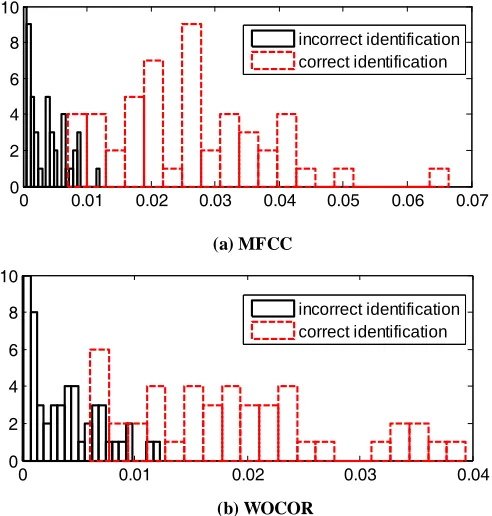
Figure 6 shows the histograms of D for MFCC and WOCOR. It is clear that, for both features, a correct identification is generally associated with a larger D than an incorrect identification. Therefore, a larger D implies that the corresponding feature has higher confidence for speaker identification. Obviously, it is desirable to take into account D for score fusion in each identification trial instead of using the fixed weight.
4.2
Confidence Measure Based Score Fusion
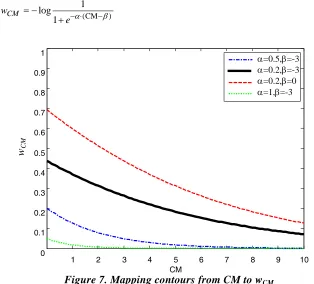
Although the optimal method of combining the scores from MFCC and WOCOR with the knowledge of the discrimination power is not known, the relative discrimination power of MFCC and WOCOR can be considered as a confidence measure, with which a better fusion weight can be derived to improve the identification performance. In each identification trial, the confidence measure is defined the discrimination ratio of the two features, i.e.,
1 2
CM= D D (10) Figure 6. Histogram of speaker discrimination power D of MFCC and WOCOR
0 0.01 0.02 0.03 0.04 0.05 0.06 0.07 0
2 4 6 8 10
0 0.01 0.02 0.03 0.04
0 2 4 6 8 10
incorrect identification correct identification incorrect identification correct identification
(a) MFCC
Integrating Complementary Features from Vocal Source and 287 Vocal Tract for Speaker Identification
As shown in Table 3, the CM-based score level fusion leads to a further performance improvement over the fixed-weight fusion. In summary, the IDERs attained with WOCOR and MFCC, in conjunction with the two methods of score fusion are 27.0%, 6.8%, 4.7%, and 4.1%, respectively.
Table 3. Speaker identification performances
Systems IDER (in %)
WOCOR 27.0 MFCC 6.8
Fixed-weight fusion 4.7
Fusion with CM 4.1
5.
Analysis of the Identification Results
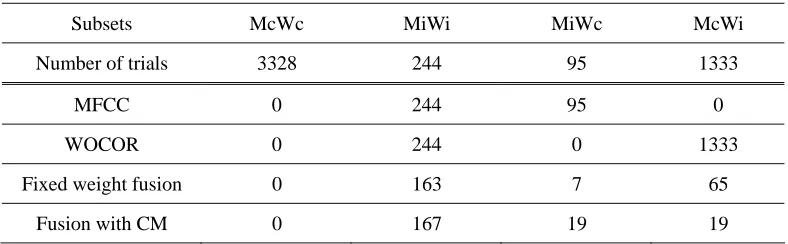
Table 4 elaborates how the integration of the two complementary features affects the identification performances. The identification trials are divided into 4 subsets according to the performances of MFCC and WOCOR: (i) correct identification with both MFCC and WOCOR (McWc), (ii) incorrect identification with both MFCC and WOCOR (MiWi), (iii) incorrect identification with MFCC while correct identification with WOCOR (MiWc), and (iv) correct identification with MFCC while incorrect identification with WOCOR (McWi). Among the 5000 identification trials, there are 3328, 244, 95 and 1333 trials for these 4 subsets, respectively. The number of identification errors with MFCC, WOCOR and the integrated systems within each subset are given in the table.
Table 4. Number of errors of 4 identification subsets by different systems
Subsets McWc MiWi MiWc McWi
Number of trials 3328 244 95 1333
MFCC 0 244 95 0
WOCOR 0 244 0 1333
Fixed weight fusion 0 163 7 65
Fusion with CM 0 167 19 19
288 Nengheng Zheng et al.
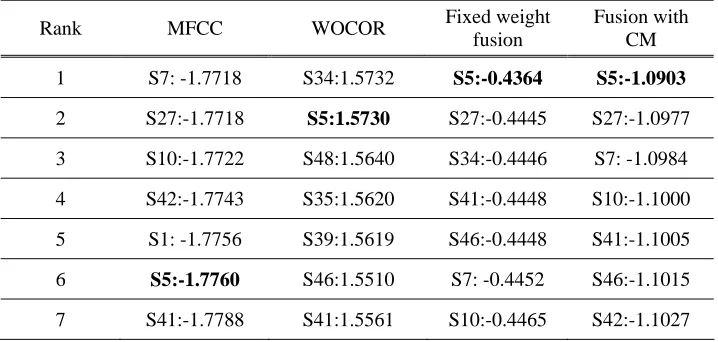
Table 5 gives an example demonstrating how the score fusion can give correct result even though both MFCC and WOCOR give error results. In this example, the true speaker is S5. It is shown that although S5 only ranks at the 6th and the 2nd with MFCC and WOCOR, respectively, in both integrating systems, it ranks at the first and therefore is correct identified. The results of the two one-error identification subsets McWi and MiWc in Table 4 demonstrate the superiority of the CM-based score fusion over the fixed-weight fusion. For the fixed-weight fusion system, although the number of errors in the MiWc subset is significantly reduced from 95 to 7, there are 65 errors introduced to the McWi subset, which have been correctly identified with MFCC only. For the CM-based system, the number of this kind of newly introduced errors is significantly reduced to 19, with only a slight increase in errors in MiWi and MiWc subsets. As a whole, the number of total identification errors is reduced from 339 with MFCC only to 235 with fixed-weight fusion, and further reduced to 205 with CM-based fusion.
Table 5. Ranking the speaker scores in an identification trial.
Rank MFCC WOCOR Fixed weight
fusion
Fusion with CM
1 S7: -1.7718 S34:1.5732 S5:-0.4364 S5:-1.0903
2 S27:-1.7718 S5:1.5730 S27:-0.4445 S27:-1.0977
3 S10:-1.7722 S48:1.5640 S34:-0.4446 S7: -1.0984
4 S42:-1.7743 S35:1.5620 S41:-0.4448 S10:-1.1000
5 S1: -1.7756 S39:1.5619 S46:-0.4448 S41:-1.1005
6 S5:-1.7760 S46:1.5510 S7: -0.4452 S46:-1.1015
7 S41:-1.7788 S41:1.5561 S10:-0.4465 S42:-1.1027
6.
Conclusions
Integrating Complementary Features from Vocal Source and 289 Vocal Tract for Speaker Identification
Acknowledgements
This research was supported partially by an Earmarked Research Grant (Ref. CUHK 4236/04E) and a Central Allocation Grant (Ref. CUHK1/02C) from the Hong Kong Research Grants Council.
References
Atal, B. S., “Automatic speaker recognition based on pitch contours,” Journal of the Acoustical Society of America, 52(6), 1972, pp. 1687-1697.
Brookes, D. M. and D. S. F. Chan, “Speaker characteristics from a glottal airflow model using robust inverse filtering,” Proceedings of Institute of Acoustics, 16(5), 1994, pp. 501-508. Campbell, J. P., “Speaker recognition: a tutorial,” Proceedings of the IEEE, 85(9), 1997, pp.
1437-1462.
Chen, S.-H. and H.-C. Wang, “Improvement of speaker recognition by combining residual and prosodic features with acoustic features,” In Proceedings of 29th IEEE International Conference on Acoustics, Speech, and Signal Processing, 2004, pp. 93-96.
Childers, D. G. and C. K. Lee, “Vocal quality factors: Analysis, synthesis, and perception,” Journal of the Acoustical Society of America, 90(5), 1991, pp. 2394-2410.
Daubechies, I., Ten Lectures on Wavelets. Society for Industrial and Applied Mathematics, Philadelphia, 1992.
Davis, S. B. and P. Mermelstein, “Comparison of parametric representations for monosyllabic word recognition in continuously spoken sentences,” IEEE Transactions on Acoustics, Speech, and Signal Processing, 28(4), 1980, pp. 357-366.
Furui, S., “Cepstral analysis technique for automatic speaker verification,” IEEE Transactions on Acoustics, Speech, and Signal Processing, 29(2), 1981, pp. 254 - 272.
Garcia-Romero, D., J. Fierrez-Aguilar, J. Gonzalez-Rodriguez and J. Ortega-Garcia, “On the use of quality measures for text-independent speaker recognition,” In ESCA Workshop on Speaker and Language Recognition, Odyssey, 2004, pp. 105-110.
He, J., L. Liu and G. Palm, “On the use of features from prediction residual signals in speaker identification,” In Proceedings of Eurospeech, 1995, pp. 313-316.
Imperl, B., Z. Kacic and B. Horvat, “A study of harmonic features for speaker recognition,” Speech Communication, 22(4), 1997, pp. 385-402.
Miller, J. E. and M. V. Mathews, “Investigation of the glottal waveshape by automatic inverse filtering,” Journal of the Acoustical Society of America, 35, 1963 pp.1876.
290 Nengheng Zheng et al.
Plumpe, M. D., T. F. Quatieri and D. A. Reynolds, “Modeling of the glottal flow derivative waveform with application to speaker identification,” IEEE Transactions on Speech and Audio Processing, 7(5), 1999, pp. 569-585.
Rabiner, L. R. and R. W. Schafer, Digital Processing of Speech Signals. Prentice Hall, 1978. Rabiner, L. R. and B.-H. Juang, Fundamentals of Speech Recognition. Prentice Hall, 1993. Reynolds, D. A., “An overview of automatic speaker recognition technology,” In Proceedings
of 27th IEEE International Conference on Acoustics, Speech, and Signal Processing, 2002, pp. 4072-4075.
Reynolds, D. A., T. F. Quatieri and R. B. Dunn, “Speaker verification using adapted Gaussian mixture models,” Digital Signal Processing, 10(1-3), 2000, pp. 19-41.
Ross, A., A. Jain and J.-Z. Qian, “Information fusion in biometrics,” In Proceedings of 3rd International Conference on Audio- and Video-Based Person Authentication, 2001, pp. 354-359.
Sonmez, K., E. Shriberg, L. Heck and M. Weintraub, “Modeling dynamic prosodic variation for speaker verification,” In Proceedings of International Conference on Spoken Language Processing, 1998, pp. 3189-3192.
Talkin, D., “A robust algorithm for pitch tracking (RAPT),” Speech Coding and Synthesis, ed. By W. B. Kleijn and K. K. Paliwal, Elsevier, 1995.
Thevenaz, P. and H. Hugli, “Usefulness of the LPC residue in text-independent speaker verification,” Speech Communication, 17(1-2), 1995, pp. 145-157.
Toh, K.-A. and W.-Y. Yau, “Fingerprint and speaker verification decisions fusion using a functional link network,” IEEE Transactions on System, Man and Cybernetics B, 35(3), 2005, pp. 357-370.
Yegnanarayana, B., K. S. Reddy and S. P. Kishore, “Source and system features for speaker recognition using AANN models,” In Proceedings of 26th IEEE International Conference on Acoustics, Speech, and Signal Processing, 2001, pp. 409-413.
Zheng, N., P. C. Ching and T. Lee, “Time frequency analysis of vocal source signal for speaker recognition,” In Proceedings of International Conference on Spoken Language Processing, 2004, pp. 2333-2336.