Learning to Parse Bilingual Sentences Using Bilingual Corpus and
Monolingual CFG
Chung-Chi Huang1 and Jason S. Chang2
1Dept. of Information Systems and Application/Taiwan International Graduate Program, National Tsing Hua University, HsinChu, Taiwan, [email protected]
1Taiwan International Graduate Program, Academia Sinica, Nankang, Taiwan
2 Dept. of Computer Science, National Tsing Hua University, HsinChu, Taiwan, [email protected]
Abstract
We present a new method for learning to parse a bilingual sentence using Inversion Transduction Grammar trained
on a parallel corpus and a monolingual treebank. The method produces a parse tree for a bilingual sentence,
showing the shared syntactic structures of individual sentence and the differences of word order within a syntactic
structure. The method involves estimating lexical translation probability based on a word-aligning strategy and
inferring probabilities for CFG rules. At runtime, a bottom-up CYK-styled parser is employed to construct the
most probable bilingual parse tree for any given sentence pair. We also describe an implementation of the
proposed method. The experimental results indicate the proposed model produces word alignments better than
those produced by Giza++, a state-of-the-art word alignment system, in terms of alignment error rate and
F-measure. The bilingual parse trees produced for the parallel corpus can be exploited to extract bilingual phrases
and train a decoder for statistical machine translation.
1.
Introduction
1.1.
Background
The amount of information available in English on the Internet has grown exponentially for the past few years. Although a myriad of data are at our disposal, non-native speakers often find it difficult to wade through all of it since they may not be familiar with the terms or idioms being used in the texts.
To ease the situation, a number of online machine translation (MT) systems such as SYSTRAN and Google Translate provide translation of source text on demand. Moreover, online dictionaries have mushroomed to provide access at any time and everywhere for second language learners.
1.2.
Motivation
MT systems and bilingual dictionary are designed to provide the services for non-English speakers or to ease learning difficulties for second language learners. Both require a lexicon which can be derived from aligning words in a parallel corpus.
concepts of unfamiliar foreign words in a sentence pair.
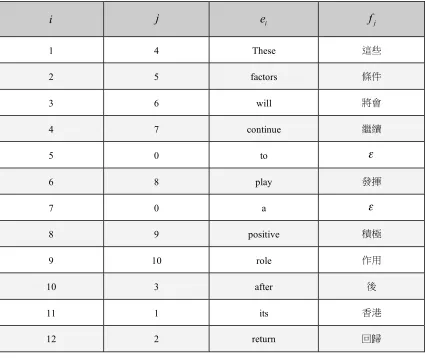
For instance, consider the English sentence “These factors will continue to play a positive role after its return” with its segmented Chinese translation “ ” shown in Figure 1, where the solid dark lines are word alignment results of them and ,
e f stand for two sentences in two languages E F, respectively. If we don’t know the usage of
“play” in the sense of “perform,” in this example sentence pair with the help of word alignment, we would quickly understand such meaning and learn useful expressions like “play … role” meaning “
… ” in Chinese.
Figure 1. An example sentence pair.
Table 1.The word alignment of the example sentence pair.
i
j
e
if
j1 4 These
2 5 factors
3 6 will
4 7 continue
5 0 to
!
6 8 play
7 0 a
!
8 9 positive
9 10 role
10 3 after
11 1 its
12 2 return
These factors will continue to play a positive role after its return
:
e
Table 1 shows the word alignment result of above example sentenece pair. In Table 1 we use 0, and ! to denote the corresponding translation does not exist for a particular word, that is, this word in
one language is translated into no words in another and we use e fi, j to stand for the words at the
position of i j, in sentence e f, respectively.
1.3.
Bilingual Parsing
If we look more closely to the example sentence in Figure 1, we would notice that the beginning half “These factors will continue to play a positive role” is translated into the back of the Chinese sentence whileas the ending half “after its return” is translated into the beginning. This phenomenon is very common while translating one language into another. A simple observation is that if one language is SVO-structured and another SOV-structured, the “VO” part of the first language would constantly be reversely translated into “OV” of the second because of the reverse ordering of syntactic structures in “V” and “O” in these languages. We call it inverted word order during translation. More often than inverted cases, we have straight word order such as when “positive role” is translated into “
”. It would occur more frequently if two languages have identical word orientation for a syntactic
structure, such as adjectives modifying nouns in English and Chinese noun phrases.
In this paper, we propose a new method of learning to recognize straight and inverted phrases in bilingual parsing by using a parallel corpus and a monolingual treebank. The parallel text will be exploited to provide lexical translation information and project the syntactic information available in the source-language treebank onto the target language. This way we can leverage the monolingual treebank and avoid the difficult problem of inducing a bilingual grammar from scratch. We identify production rules derived from the treebank based on the part of speech information of the source text. This information is simultaneously projected to the target language by exploiting the cross-language lexical information produced by a word-aligning method. The relation of straight or inverted word orders between the syntax of the two languages at all phrase levels can be captured and modeled during the process. At runtime, these production rules are used to parse bilingual sentences, simultaneously determining the syntactic structures and word order relationships of languages involved.
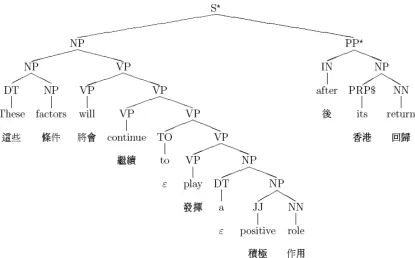
Thus, the proposed model commits to common linguistic labels for words and phrases found in an English treebank, such as NN (noun), VB (verb), JJ (adjective), NP (noun phrase), VP (verb phrase), ADJP (adjective phrase), PP (prepositional phrase). Furthermore, we assume straight and inverted linguistic phenomena, when projected to the target language, should render a reasonable structural explanation of the target language. We extend ITG productions (Wu 1997) to carry out this process of projection. Take word-aligned sentences in Figure 1 for example. It is possible to match the part of speech information of the source language sentence against the right hand sides of the production rules induced from a tree bank and identify the instances of applying specific rules such as NP!JJ NN;
"positive"
JJ ! and NN !"role." Moreover, by exploiting the word alignment information, it is
such as NP!JJ NN; JJ!” ,” and NN!” .” By combining and tallying such information, we are likely to derive ITG productions such as NP!
[
JJ NN]
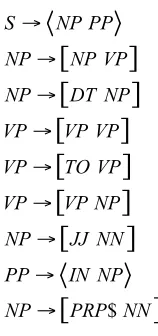
; JJ!“positive/ ” and NN!“role/ .” Here, the square bracket pair, “[“ and “]” signifies that a straight synchronous nominal share between English and Mandarin Chinese. Similarly, we would also find out the inverted prepositional phrases like PP! IN NP ; IN!“after/ ” and NP!“its return/ ” where
“<“ and “>” indicate cross-language inverted structure. See Figure 3 for more details. Additionally, the occurrence counts of these straight or inverted structures can be tallied and used in estimating the probabilistic parameters of the ITG model.
Intuitively, with rules like those shown in Figure 2 learned from a parallel corpus and a monolingual treebank, we should be able to extend a CYK-style parser to derive bilingual parse tree as
shown in Figure 3, where the symbol indicates word order of the subtrees in the target language is inverted. According to the theory of ITG, the probability of a bilingual parse tree consists of the lexical translation probability and the probability for the straight or inverted production rules involved.
Figure 2. Example grammar rules for the sentence pair.
The rest of the paper is organized as follows. We review the related work in the next section. In Section 3, we describe the steps for learning synchronous grammar rules in the form of ITG and the association probabilistic estimation. An implementation of the bottom-up CYK-styled bilingual parser based on ITG is also described in Section 3. Reports on experiments and discussions are covered in Section 4 and 5, respectively.
S! NP PP
[
]
NP! NP VP
[
]
NP! DT NP
[
]
VP! VP VP
[
]
VP! TO VP
[
]
VP! VP NP
[
]
NP! JJ NN
PP! IN NP
[
$]
Figure 3. A bilingual parse tree for example sentence pair.
2.
Related Works
A statistical translation model (STM) is a mathematical model in which process of human translation from one language into another is modeled statistically. Model parameters are estimated using a corpus of translation pairs with or without human supervision. STMs have been used in various researches and applications including statistical machine translation, word alignment of a sentence-aligned corpus and the automatic construction of a dictionary, just to name a few. For this point of view, a better STM cross language for processing is essential and fundamental for those applications.
Brown et al. (1988) first described a STM, or the alignment of sentence and word pairs in different languages. This and subsequent IBM models are based on noisy channel which converts or translates a sequence of words in one language into another. IBM model 1 can be trained using EM algorithm: starting with a uniform distribution among all translation candidate pairs and ending with convergent probabilities. While IBM model 1 does not utilize position information, the subsequent IBM models take positions into account when modeling for the translation process. (take an English-Chinese sentence pair for example, the first English word more likely translates into the first word in the Chinese sentence)
Neither IBM models nor HMMs explicitly utilize any linguistic information. However, other researchers have experimented with incorporation of part of speech (POS) information or context-specific features into STM. Exploiting POS tags of the two languages, Toutanova et al. (2002) introduced tag translation probabilities and tag sequences for jump probabilities to improve HMM-based word alignment models in modeling local word order differences. Cherry and Lin (2003) made use of dependency trees of a language to model features and constraints that are based on linguistic intuitions. In contrast, our model which uses POS information and tree structures from a treebank of a language to derive relation of syntax of two languages based on initial word alignments takes into consideration positions and linguistic characteristics such as word order and syntactic structures.
Wang (1998) enhanced the IBM models by introducing phrases, and Och et al. (1999) made use of templates to capture phrasal sequences in a sentence. While flat structures of languages beyond words are being used in above researches, often researchers attempted using nested structures. Those studies can be divided into two approaches according to whether they are linguistically syntax-based or not. Either ways, both approaches try to model structural differences between two languages.
Wu (1997) described an Inversion Transduction Grammar to model translation. However, only a lesser version, bracketing transduction grammar (BTG) with three structural labels A,B,C and a start symbol S, was experimented to perform bilingual parsing. Nevertheless, BTG accommodates a wide range of ordering variation between languages and imposes a realistic position distortion penalty. In other words, a system with structural-like, or hierarchical-like rules that specify the constituents and the order of the counterparts in both language is good at resolving the word alignment relations within a sentence pair. However, in their experiments, constituent categories are almost not differentiated, and thus their influences on ordering preferences of the counterparts are not taken into consideration. Consequently, very little syntax information is incorporated into the process of bilingual parsing. In contrast to Wu’s experiment, we use regular context-free grammar rules in our experiments.
More recently, Yamada and Knight (2001) suggested the syntax differences in languages are really a better way to model translation. In their work, the English sentence goes through a parser to generate a full parse tree. Subtrees of each node are reordered, function words are inserted and finally the tree is linearized to produce the target sentence. The parse tree of an English sentence is generated independently from the target sentence. Although the monolingual parse might be correct, it may be difficult to project the structures onto the target language. Instead, our model has grammar rules that specify bilingual syntactic information including constituent labels and word ordering, which enables us to extend a CYK parser to parse bilingual sentences simultaneously.
large (2.2M rules). The rules do not represent some general ideas of languages such as word classes like verb, noun, or adjective, but rather have to do with specific words. In any case, the word classes like verb, noun, and adjective and the phrase categories like verb phrase (VP), noun phrase (NP) and adjective phrase (ADJP) would provide a more general way to reflect the parallel and differences of languages. Chiang also posed the hypothesis that syntactic phrases are better for machine translation (MT) and predicted the future trend of MT is to move towards a more syntactically-motivated grammar. With that in mind, we exploit part-of-speech information and linguistic phrase categories to model the syntactic relation between two languages, which is designed to have a higher degree of generality, unlike Chiang’s lexicalized labelless production rules.
In contrast to previous work in STM, the proposed method not only automatically identifies the hidden structural information of two languages but models variations of ordering counterparts within them. Moreover, a much-smaller set of flexible context-free grammar rules obtained from a very large-scale parallel corpus. Syntactic information indicated by those rules is exploited to parse bilingual sentences.
3.
The Model
A promising method for learning to parse a bilingual sentence using Inversion Transduction Grammars is based on training on a monolingual treebank and a parallel corpus. We project part of speech information and syntactic structures from a treebank of source language onto target language based on initial word alignment results of a parallel corpus to obtain and estimate the probabilities for ITG rules. During the projection process, word order relationships (straight and inverted) of shared syntactic constructs between two languages are identified and modeled. At runtime, the derived ITG rules drive a CYK-style parser to construct bilingual parse trees and hopefully lead to better word alignment results at the leaf nodes.
3.1.
Problem Statement
The model is aimed at statistically derived ITG rules with probability and making use of those rules for bilingual parsing and word alignments. We focus on the process of bilingual parsing which exploits the syntactic information such as shared syntactic structures and word order relationships in two languages using a parallel corpus and a monolingual treebank.
Problem Statement: Given a sentence-aligned corpus C=
{
(
r e f, ,)
1!r!n}
where r is the record number of the aligned sentence pair(
e f,)
and n is the total number of sentence pairs inparallel corpus C, and a grammar G=
{
lhs!rhs lhs !rhs is a grammar rule on sideE}
derivedfrom a source-language treebank, we extend G into ITG rewrite rules for bilingual parsing.
parsing algorithm based on ITG in Section 3.3.
3.2.
Proposed Training Process
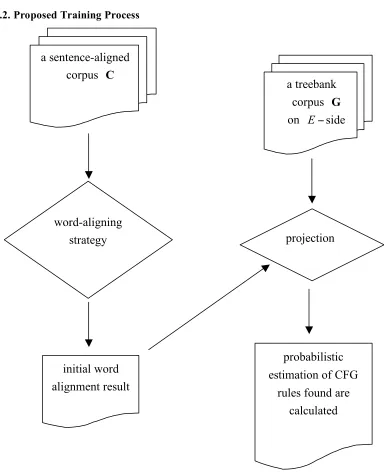
Figure 4: Flowchart of the proposed training process. The training process can be illustrated using the flowchart in Figure 4.
Given a sentence-aligned corpus C=
{
(
r e f, ,)
1!r!n e, and are an aligned sentence pairf}
where r is the record number of the sentence pair and n is the total number of sentence pairs in C, a source-language grammar G, we map part of speech information and syntactic structures of sourcelanguage onto target language words using word alignment result. During the mapping process, we exploit occurrence of syntactic structures and the differences of word order of the right-hand-side constituents to estimate probabilities. The proposed training process is elaborated as follows.
projection
a treebank
corpus
G
on
E
!
side
a sentence-aligned
corpus
C
word-aligning
strategy
initial word
alignment result
probabilistic
estimation of CFG
Table 2. Outline of the training process.
(1) Tag source-language sentences and segment target-language sentences
(Section 3.2.1)
(2) Apply a word-aligning strategy to obtain word alignment result
(Section 3.2.2)
(3) Apply the algorithm of projecting linguistic information of source language onto target
language and estimating related probabilities of grammar rules found
(Section 3.2.3)
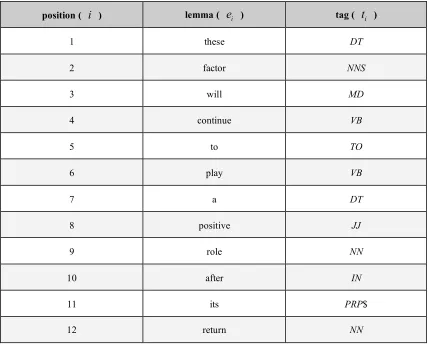
Table 3. Lemmas and tags for English sentence of sentence pair 193.
position (
i
) lemma (e
i ) tag (t
i )1 these DT
2 factor NNS
3 will MD
4 continue VB
5 to TO
6 play VB
7 a DT
8 positive JJ
9 role NN
10 after IN
11 its PRP$
12 return NN
3.2.1 Tagging and Segmenting
In the first stage of the training process, for every sentence-aligned pair
(
e f,)
in corpus C, we tagsentence e using a POS tagger and generate
(
1, ,2 ,)
me= e e L e with tag sequence
(
1, ,2 ,)
m
where ei stands for the ith word in e with m words and i
t stands for the POS tag of the word
i
e . Further, we segment sentence f to obtain
(
1 , 2 , ,)
nf f L f , where fj stands for the jth word
in f with n words.
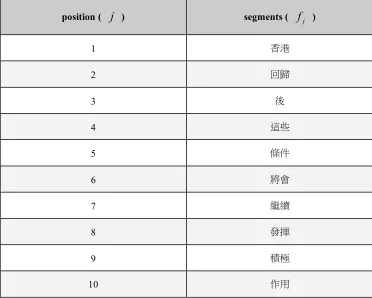
Take sentence pair whose record number is 193 in Figure 1 for instance. Table 3 shows the lemmatized and tagged result of the English sentence, while Table 4 shows the segmentation result of the Chinese sentence.
Table 4. Segments for Chinese sentence of sentence pair 193.
position (
j
) segments (f
j )1
2
3
4
5
6
7
8
9
10
The POS information of sentence e will then be projected onto the target language based on
word alignments described in next subsection.
3.2.2 Initial Word Alignments
In the second training stage, we obtain a word-aligning set A for corpus C by applying any
existing word-level alignment method.
For notation convenience, we use 8-tuple
(
r i i j j L rhs rel, , , , , ,1 2 1 2 ,)
to represent that substringpair
(
)
1 2, 1 2
i i j j
e Le f Lf in sentence pair r has L!rhs as the derivation leading to the bilingual
are some examples using the 8-tuple representation. The tuple
(
193,1, 2, 4, 5,NP DT NN, ,S)
denotesa straight bilingual noun phrase (these factors, ) in sentence 193. Similarly, the tuple
(
193,10,12,1, 3,PP IN NP, , I)
denotes an inverted prepositional phrase (after its return,). The tuple (193,8,8,9,9,JJ,positive/ ,S) denotes a terminal bilingual adjective (positive, ) which can be obtained from word alignment result.
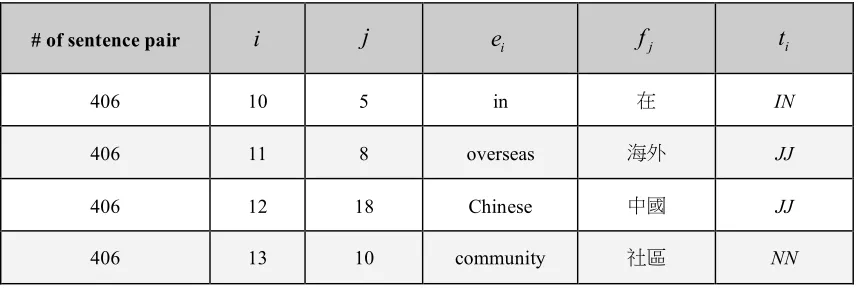
Table 5. Some alignments after applying a word-aligning strategy.
# of sentence pair
i
j
e
if
jt
i406 10 5 in IN
406 11 8 overseas JJ
406 12 18 Chinese JJ
406 13 10 community NN
Further take word alignments of the sentence pair specified in Table 5 for example. A would at least contain entries like (406,10,10,5,5,IN,in/ ,S), (406,11,11,8,8,JJ,overseas/ ,S),
(406,12,12,18,18,JJ,Chinese/ ,S) and (406,13,13,10,10,NN,community/ ,S).
3.2.3 Algorithm for Probability Estimation
In the final stage of the training process, we map the part of speech information and tree structures available in treebank of language E onto language F based on word alignment result.
We exploit following algorithm to identify syntactic structures of E and model the syntactic relation between E and F. The resulting ITG grammar will then be used in a bottom-up CYK parser
for parsing bilingual sentences.
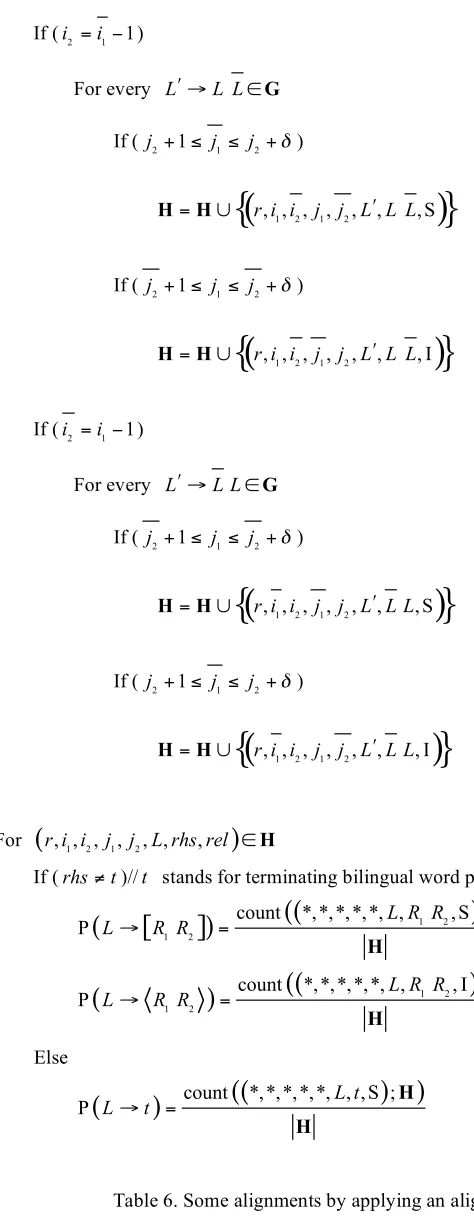
The algorithm begins with a set H initialized as word-aligning result A. Then recursively select two elements from H. If these two tuples have contiguous word sequence on source-language side and exhibit straight or inverted relation between source and target language during the mapping process, a new tuple representing these two is added into H. In the end, we exploit the occurrence in
H to estimate following probabilities: P
(
L![
R R1 2]
)
, P(
L! R R1 2)
and P(
L!t)
. In this algorithm, we follow the notation described in section 3.2.1 and use W to stand for the number of entries in set W, count(
p;Q)
for the frequency of p in set Q and ! for thetolerance of straight/inverted phenomenon within source and target languages.
Algorithm for Probabilistic Estimation
= H A
If (i2 =i1!1)
For every L! "L L#G
If ( j2+1" j1" j2+!)
H=H"
{
(
r i i j j L L L, , , , , , , S1 2 1 2 !)
}
If ( j2+1" j1" j2+!)
H=H"
{
(
r i i j j L L L, , , , , , , I1 2 1 2 !)
}
If (i2 =i1!1)
For every L! "L L#G
If ( j2+1" j1" j2+!)
H=H"
{
(
r i i j j L L L, , , , , , , S1 2 1 2 !)
}
If ( j2+1" j1" j2+!)
H=H"
{
(
r i i j j L L L, , , , , , , I1 2 1 2 !)
}
For
(
r i i j j L rhs rel, , , , , ,1 2 1 2 ,)
!HIf (rhs!t)//t stands for terminating bilingual word pair
(
[
]
)
(
(
1 2)
)
1 2
count *,*,*,*,*, , , S ; P L! R R = L R R H
H
(
)
(
(
1 2)
)
1 2
count *,*,*,*,*, , , I ;
P L! R R = L R R H
H
Else
P
(
L!t)
= count *,*,*,*,*, , , S ;(
(
L t)
H)
H
Table 6. Some alignments by applying an aligning strategy on corpus C.
# of sentence pair
i
j
e
if
jt
i1 2 2 ceremony NN
1 3 3 mark VBZ
1 4 4 handover NNS
9 24 6 before IN
9 25 5 midnight NN
62 12 5 provisional JJ
62 13 6 legislative JJ
62 14 7 council NN
249 2 2 will MD
249 3 3 strive VB
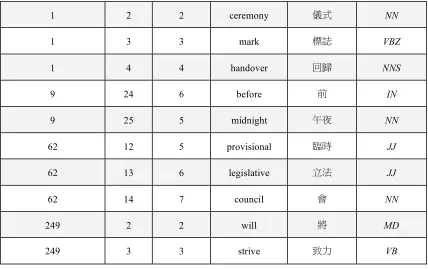
Consider the word alignment results in Table 6 as an example, the algorithm described above will identity syntactic structures and model syntax relations of languages. The overall projecting process is as follows.
Initially, for sentence pair 1, we have the following in A. (1,1,1,1,1,JJ,solemn/ ,S)
(1,2,2,2,2,NN,ceremony/ ,S) (1,3,3,3,3,VBZ,mark/ ,S) (1,4,4,4,4,NNS,handover/ ,S)
Table 7. Examples for the algorithm.
# of sentence pair rule entry
9 PP!IN NN
(
9, 24, 25, 5, 6,PP IN NN, , I)
62 NP! ADJP NN
(
62,12,14, 5, 7,NP ADJP NN, , S)
249 VP!MD VB
(
249, 2, 3, 2, 3,VP MD VB, , S)
After the first round, we have (1,1,2,1,2,NP,JJ NN,S), (1,3,4,3,4,VP,VBZ NNS,S). After the second round, we have (1,1,4,1,4,S,NP VP,S) where syntactic label S means simple declarative clause in
linguistic sense.
constructed. Figure 3 illustrates the tree structures derived for the example bilingual sentences.
4.
Experiments
Our model is aimed at capturing shared syntactic structures and preferences in word order between two languages. The context-free grammar rules obtained in training process identity syntactic structures and model relations of syntax of languages involved. These rules can be exploited to produce better word-level alignments and most probable bilingual parse trees since syntactic information is taken into consideration.
In this section, we first present the details of training our model in Section 4.1. Then, we describe the evaluation metrics for the performance of the trained model in Section 4.2. The evaluation results are reported in Section 4.3.
4.1.
Training Setting
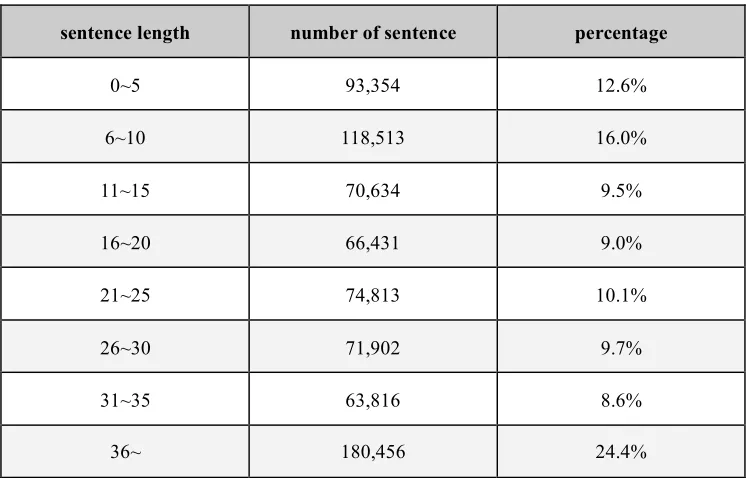
We used the news portion of Hong Kong Parallel Text (Hong Kong news) distributed by Linguistic Data Consortium (LDC) as our sentence-aligned corpus C. The corpus consists of 739,919 English
and Chinese sentence pairs. English sentence is considered to be the source while Chinese sentence is the target. The average sentence length is 24.4 words for English and 21.5 words for Chinese. Table 8 and Table 9 show the statistics of number of sentences in this corpus according to sentence length. For monolingual treebank corpus G, we made use of PTB section 23 production rules distributed by
Andrew B. Clegg (http://textmining.cryst.bbk.ac.uk/acl05/). There are 2,184 distinct grammar rules. The statistics of G is shown in Table 10 while Table 11 illustrates some examples of grammar rules in G.
Table 8. Statistics on English side.
sentence length number of sentence percentage
0~5 93,354 12.6%
6~10 118,513 16.0%
11~15 70,634 9.5%
16~20 66,431 9.0%
21~25 74,813 10.1%
26~30 71,902 9.7%
31~35 63,816 8.6%
Table 9. Statistics on Chinese side.
sentence length number of sentence percentage
0~5 146,957 19.9%
6~10 81,716 11.0%
11~15 72,870 9.8%
16~20 90,286 12.2%
21~25 84,802 11.4%
26~30 74,739 10.1%
31~35 57,347 7.7%
36~ 131,202 17.7%
Table 10. Statistics of monolingual treebank.
# of constituents on
right hand side
# of distinct grammars percentage
1 106 4.85%
2 418 19.13%
3 752 34.43%
4 553 25.32%
5~ 355 16.25%
Table 11. Example grammars in G.
grammar rules
VP!VB NP!DT ADJP NNS
ADJP!RB JJ PP!RB IN NP
VP!TO VP VP!MD ADVP VP
PP!IN NP ADVP!ADVP CC ADVP
orientation for prepositional phrases.
4.2.
Evaluation Metrics
We evaluated the trained ITG rules based on the performance of word alignment. We took the leaf nodes as word-level alignments and evaluate the proposed model in terms of agreement with human-annotated word alignments.
We used the metrics of alignment error rate (AER) proposed by Och and Ney (2000), in which the quality of a word alignment result A=
{
( )
i j,}
, where i j, are positions of the sentence pair,
e f respectively and i j, !0, is evaluated using
precision= A!P
A , recall !
= A S
S and
(
, ;)
1AER = " ! + !
+
A S A P
S P A
A S ,
where S (sure) is the set which contains alignments that are not ambiguous and P (possible) is the set consisting of the alignments that might or might not exist
(
S!P)
. For that the human-annotatedalignments may contain many-to-one and one-to-many relations. Furthermore, whether a word-level alignment is in P or S is determined by human experts who perform the annotation work.
4.3.
Evaluation Result
For testing, we randomly selected 62 sentence pairs from the corpus of Hong Kong News. For the sake of time, we only selected sentence pairs in which the length of English and Chinese sentences does not exceed 15. From Table 8 and Table 9, we know the upper bound of 15 would cover approximately 40% of sentence pairs in HKN. We manual annotated the word alignment information in these bilingual sentences. The ratio of P and S of the test data is 1.2.
4.3.1 Baseline
We chose a freely-distributed word-aligning system, Giza++, as the baseline for evaluation. The adopted setting to run Giza++ is IBM model 4, the direction is from English to Chinese same as our model treating English as source language and the alignment units of Chinese are words not characters.
4.3.2 Word-level Evaluation
Figure 5. Alignments produced by our system (left) and Giza++ (right).
Table 13. Alignment results of the test data. Our system vs. Giza++.
Recall Precision AER F-measure
The proposed method 0.55 0.80 0.34 0.65
Giza++ 0.37 0.87 0.48 0.52
Table 13 shows that although the precision is 87% for Giza++, the low recall leads to high alignment error rate and poor F-measure. However, our system with lower precision increased recall by 48.6%, which achieved a 29.2% alignment error reduction. From this experiment, we showed the proposed model with ITG rules allows for a wide range of ordering variations with a realistic position distortion penalty, which attributes to significantly better word alignment results.
Since the proposed model takes lexical and syntactic aspects of languages into consideration, the proposed method can be used to improve an existing word-aligning system that utilizes few linguistic information of languages. For that we evaluated the proposed method on top of the alignment results of Giza++, a freely-available state-of-the-art word alignment system. In other words, the C and G corpora are the same as the previous experiment but we adopted Giza++ as the word-aligning method in the training process.
Figure 6. Alignments produced by Giza++ with ITG (left) and Giza++ (right).
Table 14. Alignment results of the test data. Giza++ with ITG vs. Giza++.
Recall Precision AER F measure
Giza++ with ITG 0.58 0.87 0.30 0.70
Giza++ 0.37 0.87 0.48 0.52
The use of ITG results in significant improvement for recall and F-measure of Giza++ by 56.8% and 34.6% leading to substantial alignment error reduction (37.5%) while precision suffers only slightly (0.1%).
4.3.3 Phrase-level Evaluation
We further evaluated base phrases of the generated bilingual parse trees. We take into consideration the correctness of syntactic label and phrase alignment of a base phrase. Table 15 is how we rated a base phrase produced by our method concerning syntactic label and phrase alignment.
Table 15. Points of phrase-level evaluation.
syntactic label phrase alignment point
O O 1.0
O X 0.5
X O 0.5
X X 0.0
alignment is right, it will also be rated as partially correct (0.5 point). In the worse case, the label and alignment are not quite correct, 0 point is given to that base phrase.
The average score of the base phrases generated by Giza++ with ITG was 0.82, showing that our method produced satisfactory result in constituent label of base phrases and alignments in phrase level.
5.
Conclusion and Future Work
Improvements of the proposed method and future researches have presented themselves along the way. Currently, we only focus on CFG with two right-hand-side constituents. Nonetheless, in linguistic sense, it is undesirable to divide the structure of
(
NP CC NP)
into(
NP CC)
and(
NP)
or(
NP)
and(
CC NP)
in that it is an indivisible syntactic-meaningful construct. Therefore, one of ourfuture goals is to incorporate grammar rules with more constituents on the right hand side, such as NP!NP CC NP, and their related probabilistic estimations into our model. Moreover, to make the structures of the bilingual parse trees more complete and rational, we would include a meaningful label for target-language words translated into no words in the source and grammar rules with the label in the future. It is also interesting to see how produced bilingual parse trees would influence the performance of the actual decoding process of machine translation and facilitate bilingual phrase extraction.
In conclusion, we have presented a robust method for learning ITG rules which specify the syntactic structures and relations of syntax of two languages involved. The proposed method exploits both lexical and syntax information to derive a structural model of the translation process. At runtime, a bottom-up CYK-styled implementation parses bilingual sentences simultaneously by exploiting trained ITG rules. Experiments show that our model consisting of grammar rules with linguistics-motivated labels and preferences of ordering counterparts in languages produces much more satisfying word alignment results compared with a state-of-the-art word-aligning system.
6.
References
1. Andrew B. Clegg and Adrian Shepherd. 2005. “Evaluating and integrating Treebank parsers on a biomedical corpus.” In Association for Computational Linguistics Workshop on software 2005. 2. Colin Cherry and Dekang Lin. 2003. A probability model to improve word alignment. In
Proceedings of the 41st Annual Meeting on Association for Computational Linguistics, volume 1, pages 88-95.
3. David Chiang. 2005. “A hierarchical phrase-based model for statistical machine translation.” In Proceedings of the 43rd Annual Meeting of the ACL, pages 263-270.
4. Yuan Ding and Martha Palmer. 2005. “Machine translation using probabilistic synchronous dependency insertion grammars.” In Proceedings of 43rd Annual Meetings of the ACL, pages
541-548.
5. Wu Hua, Haifeng Wang, and Zhanyi Liu. 2005. “Alignment model adaptation for domain-specific word alignment.” In Proceedings of the 43rd Annual Meeting of the ACL, pages
6. I. Dan Melamed. 2003. “Multitext grammars and synchronous parsers.” In Proceedings of the 2003 Meeting of the North American chapter of the Association for Computational Linguistics. 7. Franz Josef Och and Hermann Ney. 2000. “Improved statistical alignment models.” In
Proceedings of the 38th Annual Conference of the Association for Computational Linguistics
(ACL-00), pages 440-447.
8. F Franz Josef Och, C. Tillmann, and H. Ney. 1999. “Improve alignment models for statistical machine translation.” In 1999 EMNLP.
9. Kristina Toutanova, H. Tolga Ilhan and Christopher D. Manning. 2002. “Extentions to HMM-based statistical word alignment models.” In Proceedings of the Conference on Empirical Methods in Natural Processing Language.
10. Stephan Vogel, Hermann Ney, and Christoph Tillmann. 1996. “HMM-based word alignment in statistical translation.” In Proceedings of the 16th conference on Computational linguistics, volume 2, pages 836-841
11. Wei Wang, Ming Zhou, Jin-Xia Huang, and Chang-Ning Huang. 2002. “Structure alignment using bilingual chunking.” In Proceedings of the 19th international conference on Computational
linguistics, volume 1, pages 1-7.
12. Wei Wang and Ming Zhou. “Improving word alignment models using structured monolingual corpora.” In Proceedings of the 2004 Conference on Empirical Methods in Natural Language Processing, pages 198-205.
13. Ye-Yi Wang. 1998. “Grammar inference and statistical machine translation.” Ph.D. thesis. 14. Dekai Wu. 1997. “Stochastic inversion transduction grammars and bilingual parsing of parallel
corpora.” Computational Linguistics, 23(3):377-403.
15. Kenji Yamada and Kevin Knight. 2001. “A syntax-based statistical translation model.” In Proceedings of the 39th Annual Conference of the Association for Computational Linguistics
(ACL-01).
16. Hao Zhang and Daniel Gildea. 2004. “Syntax-based alignment: supervised or unsupervised?” In Proceedings of the 20th International Conference on Computational Linguistics.