Computational Linguistics and Chinese Language Processing
Vol. 9, No. 1 , February 2004, pp. 83-96 83 © The Association for Computational Linguistics and Chinese Language Processing
Reliable and Cost-Effective Pos-Tagging
Yu-Fang Tsai*, and Keh-Jiann Chen*
Abstract
In order to achieve fast, high quality Part-of-speech (pos) tagging, algorithms should achieve high accuracy and require less manually proofreading. This study aimed to achieve these goals by defining a new criterion of tagging reliability, the estimated final accuracy of the tagging under a fixed amount of proofreading, to be used to judge how cost-effective a tagging algorithm is. In this paper, we also propose a new tagging algorithm, called the context-rule model, to achieve cost-effective tagging. The context rule model utilizes broad context information to improve tagging accuracy. In experiments, we compared the tagging accuracy and reliability of the context-rule model, Markov bi-gram model and word-dependent Markov bi-gram model. The result showed that the context-rule model outperformed both Markov models. Comparing the models based on tagging accuracy, the context-rule model reduced the number of errors 20% more than the other two Markov models did. For the best cost-effective tagging algorithm to achieve 99% tagging accuracy, it was estimated that, on average, 20% of the samples of ambiguous words needed to be rechecked. We also compared tradeoff between the amount of proofreading needed and final accuracy for the different algorithms. It turns out that an algorithm with the highest accuracy may not always be the most reliable algorithm.
Keywords: part-of-speech tagging, corpus, reliability, ambiguous resolution
1. Introduction
Part-of-speech (pos) tagging for a large corpus is a labor intensive and time-consuming task. Most tagging algorithms try to achieve high accuracy, but 100% accuracy is an impossible goal. Even after tremendous amounts of time and labor are spent on the post-process of proofreading, many errors still exist in publicly available tagged corpora. Therefore, in order to achieve fast, high quality pos tagging, tagging algorithms should not only achieve high accuracy but also require less manually proofreading. In this paper, we propose a context-rule
* Institute of Information Science, Academia Sinica
84 Yu-Fang Tsai, and Keh-Jiann Chen
model to achieve both goals.
The first goal is to improve tagging accuracy. According to our observation, the pos tagging of a word depends on its context but not simply on its context category. Therefore, the proposed context-rule model utilizes a broad scope of context information to perform pos tagging of a word. Rich context information helps to improve the model coverage rate and tagging accuracy. The context-rule model will be described in more detail later in this paper. Our second goal is to reduce the manual editing effort. A new concept of reliable tagging is proposed. The idea is as follows. An evaluation score is assigned to each tagging decision as an indicator of tagging confidence. If a high confidence value is achieved, it indicates that the tagging decision is very likely correct. On the other hand, a low confidence value means that the tagging decision requires manual checking. If a tagging algorithm can achieve a high degree of reliability in evaluation, this means that most of the high confidence tagging results need not manually rechecked. As a result, the time and manual efforts required in the tagging process can be drastically reduced. The reliability of a tagging algorithm is defined as follows:
Reliability = The estimated final accuracy achieved by the tagging model under the constraint that only a fixed number of target words with the lowest confidence values are manually proofread.
The notion of tagging reliability is slightly different from the notion of tagging accuracy since high accurate algorithm may require more manual proofreading than a reliable algorithm that achieves lower accuracy.
The rest of this paper is organized as follows. In section 2, the relation between reliability and accuracy is discussed. In section 3, three different tagging algorithms, the Markov pos bi-gram model, word-dependent Markov bi-gram model, and context-rule model, are discussed. In section 4, the three algorithms are compared based on tagging accuracy. In addition, confidence measures of tagging results are defined, and the most cost-effective algorithm is determined. Conclusions are drawn on section 5.
2. Reliability vs. Accuracy
90 Yu-Fang Tsai, and Keh-Jiann Chen
pattern types in the training data and
λ
denotes the default occurrence count for an unseen event. That is to say, we took a valueλ
for an unseen event as its occurrence count. If the value ofλ
was 0, this means that there was no smoothing process for the unseen event. The most widely used value forλ
is 0.5, which was also applied in our experiments.4.1 Tagging Accuracy
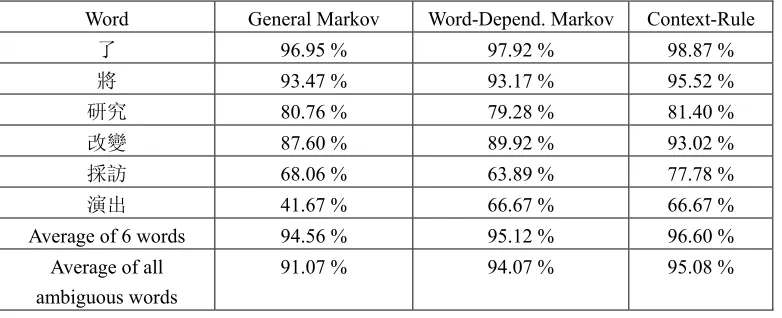
In the experiments, we compared the tagging accuracy of the three tagging algorithms as described in section 3. The experiment results are shown in Table 3. It is obvious that the word-dependent Markov bi-gram model outperformed the general Markov bi-gram model. It reduced almost 30% the number of errors compared to the general Markov bi-gram model. As expected, the context-rule model performed the best for each selected word and the overall tagging accuracy. The tagging accuracy results for selected words show inconsistency. This is exemplified by the lower accuracy for the word ‘研究 research’. It is believed that the flexible usage of ‘研究 research’ degraded the performances of the tagging algorithms. The lack of training data also hurt the performance of the tagging algorithms. The words with fewer training data, such as ‘採訪 interview’ and ‘演出 perform’, were also associated with poor tagging accuracy. Therefore, words with low frequencies should be handled using some general tagging algorithms to improve the overall performance of a tagging system. Furthermore, in future, word-dependent reliability criteria need to be studied.
4.2 Tagging Reliability
In the experiments on reliability, the confidence measure of the ratio of the probability gap
between the top choice candidate and the second choice candidate
) ( ) (
) (
2 1
1
c P c P
c P
+ was
Reliable and Cost-Effective Pos-Tagging 91
0.9100 0.9200 0.9300 0.9400 0.9500 0.9600 0.9700 0.9800 0.9900 1.0000 1.0100
0.0000 0.0500 0.1000 0.1500 0.2000 0.2500 0.3000 0.3500 0.4000 0.4500 0.5000 0.5500 Amount of Manual Proofreading
Final A
ccuracy
Context-Rule Word-Dependent Markov General Markov
Figure 1. Tradeoff between the amount of manual proofreading and the final
accuracy.
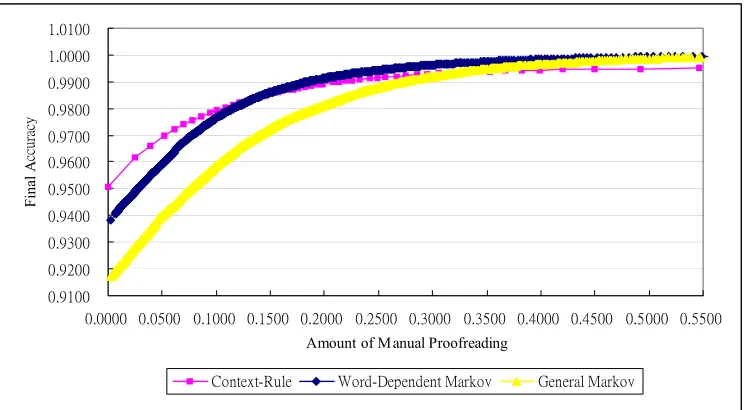
Figure 1 shows the results for the tradeoff between the amount of proofreading and the estimated final accuracy for the three algorithms. The x-coordinate indicates the portion of the partial corpus that needed to be manually proofread under a pre-defined threshold. The y-coordinate indicates the final accuracy after the corresponding portion of the corpus was proofread. Without any manual proofreading, the accuracy of the context-rule algorithm was about 1.4% higher than that of the word-dependent Markov bi-gram model. As the percentage of manual proofreading increased, the accuracy of each algorithm also increased. It is obvious that the accuracy of the context-rule model increased more slowly than did that of the two Markov models, as the amount of manual proofreading increased.
Reliable and Cost-Effective Pos-Tagging 93
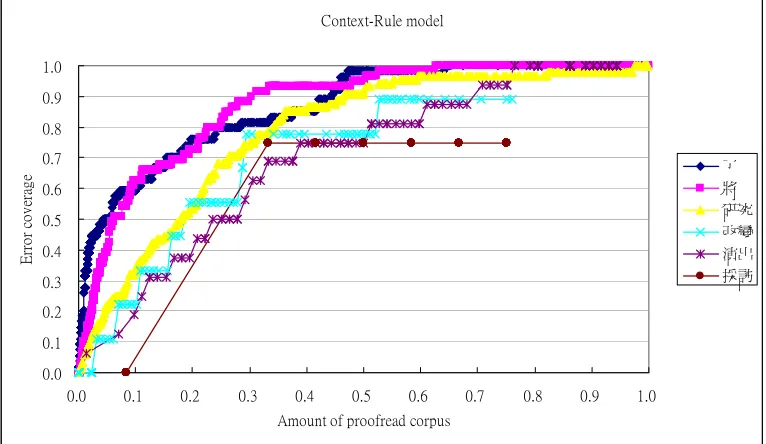
Figure 2 and Figure 3 show the error coverage of the six ambiguous target words after different portions of corpus are proofread respectively. It shows that not only tagging accuracy but also reliability were degraded due to the lack of sufficient training data. Tagging algorithms achieve better error coverage for target words with more training data.
4.3 The Tradeoff between the Amount of Manual Proofreading and the
Final accuracy
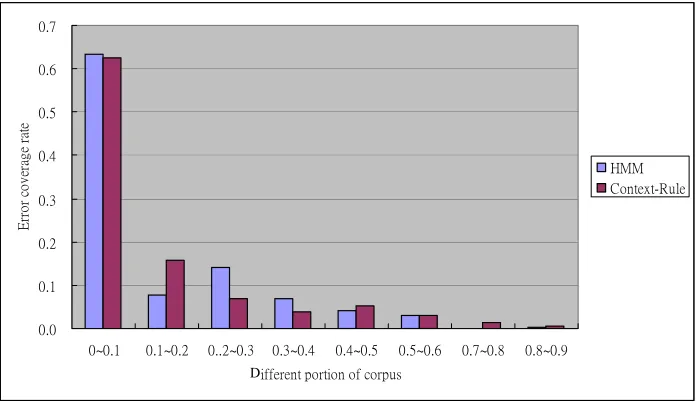
There is a tradeoff between amount of manual proofreading and the final accuracy. If the goal of tagging is to achieve 99% accuracy, then an estimated threshold value of the confidence score needed to achieve the target accuracy rate will be given, and a tagged word with a confidence score less than this designated threshold value will be checked. On the other hand, if the requirement is to finish the tagging process in a a limited amount of time and with limited amount of manual labor, then in order to achieve the desired final accuracy, we will first need to estimate the portion of the corpus which will have to be proofread, and then determine the threshold value of the confidence score. Figure 4 shows the error coverage of each different portions of corpus with the lowest confidence score. By proofreading the initial 10% low confidence tagging data we achieve the most improvement in accuracy. As the amount of proofread corpus increased, the level of accuracy decreased rapidly. The experimental results of tagging reliability can help us decide which is the most cost-effective tagging algorithm and how to proofread tagging results under constraints on the available human resources and time.
0.0 0.1 0.2 0.3 0.4 0.5 0.6 0.7
0~0.1 0.1~0.2 0..2~0.3 0.3~0.4 0.4~0.5 0.5~0.6 0.7~0.8 0.8~0.9
Different portion of corpus
E
rro
r
co
v
era
g
e
ra
te
HMM Context-Rule
94 Yu-Fang Tsai, and Keh-Jiann Chen
5. Conclusion
In this paper, we have proposed a context-rule model for pos tagging. We have also proposed a new way of finding the most cost-effective tagging algorithm. Cost-effectiveness is defined based on a criterion of reliability. The reliability of the system is measured in terms of the confidence score for ambiguity resolution of each tagging. The basic observation of confidence tagging is as follows: the larger the gap between the candidate pos with the highest probability and other (the second, for example) candidate pos with lower probability, the more confidence can be placed in the tagging result. It is believed that the ability to resolve pos ambiguity plays a more important part than the confidence measurement in the tagging system, since a larger gap between the first candidate pos and the second candidate pos can result in a high confidence score. Therefore, another reasonable measurement of the confidence score will work as well as the one used in our experiments if the tagging algorithms have good ability to resolve pos ambiguity.
For the best cost-effective tagging algorithm, on average, 20% of the samples of ambiguous words need to be rechecked to achieve 99% accuracy. In other words, the manual labor of proofreading is reduced by more than 80%. Our study on tagging reliability, in fact, provides a way to determine the optimal tagging strategy under different constraints. The constraints might be to achieve the best tagging accuracy under time and labor constraints or to achieve a certain accuracy with the least effort possible expended on proofreading. For instance, if the goal of tagging is to achieve 99% accuracy, then a threshold value of the confidence score needed to achieve the target accuracy will be estimated, and a tagged word with a confidence score less than this designated threshold value will be checked. On the other hand, if the constraint is to finish the tagging process under time and manual labor constraints, then in order to achieve the desired final accuracy, we will first estimate the portion of the corpus that will have to be proofread, and then determine the threshold value of the confidence score.
In future, we will extend the coverage of confidence checking for all words, including words with single pos, to detect flexible word usages. The confidence measure for words with single pos can be obtained by comparing the tagging probability of the pos of the words with the probabilities of the other categories. Furthermore, since tagging accuracy and reliability are degrading due to the intrinsic complexity of word usage and the less amount of training data, we will study word-dependent reliability to overcome the degrading problems. There are many possible confidence measures. For instance is a reasonable alternative. We will study different alternatives in the future to obtain a more reliable confidence measure.
)) ( / ) (
Reliable and Cost-Effective Pos-Tagging 95
Acknowledgement:
The work was partially supported under NSC grant 92-2213-E-001-016.
References
C. H. Chang & C. D. Chen, 1993, “HMM-based Part-of-Speech Tagging for Chinese Corpora,” in Proceedings of the Workshop on Very Large Corpora, Columbus, Ohio, pp. 40-47.
C. J. Chen, M. H. Bai, & K. J. Chen, 1997, “Category Guessing for Chinese Unknown Words,” in Proceedings of NLPRS97, Phuket, Thailand, pp. 35-40.
Christopher D. Manning & Hinrich Schutze, Foundations of Statistical Natural Language Processing, The MIT Press, 1999, pp. 43-45, pp. 202-204.
E. Brill, “A Simple Rule-Based Part-of-Speech Taggers,” in Proceedings of ANLP-92, 3rd Conference on Applied Natural Language Processing 1992, pp. 152–155.
K. J. Chen, C. R. Huang, L. P. Chang, & H. L. Hsu, 1996, “Sinica Corpus: Design Methodology for Balanced Corpora,” in Proceedings of PACLIC II, Seoul, Korea, pp. 167-176.
K. T. Lua, 1996, “Part of Speech Tagging of Chinese Sentences Using Genetic Algorithm,” in Proceedings of ICCC96, National University of Singapore, pp. 45-49.
P. Kveton & K. Oliva, 2002, “(Semi-) Automatic Detection of Errors in Pos-Tagged Corpora,” in Proceedings of Coling 2002, Taipei, Taiwan, pp. 509-515.
S. H. Liu, K. J. Chen, L. P. Chang, & Y. H. Chin, 1995, “Automatic Part-of-Speech Tagging for Chinese Corpora,” on Computer Proceeding of Oriental Languages, Hawaii, Vol. 9, pp.31-48.